




Abstract
There are a plethora of medical journals, also for the diabetes indication. Only a limited number of these journals are listed in databases like PubMed. A number of other diabetes journals approach potential authors and ask for submission of manuscripts. They promise rapid publication; however, one wonders what kind of impact these journals have and how serious they are at handling the review process and so on. One wonders what the economical basis (= business model) for these journals is, the publication fee might be considerable. Apparently, some journals pretend to publish manuscripts; however, this does not happen in reality, despite the fact that the authors have paid the publication fee. In the same line of thinking, the quality of the publications in these journals is at least questionable.
Introduction
I receive more or less frequent requests by email asking me to submit manuscripts for publication to this or that diabetes journal as soon as possible, promising that they will be published immediately. Most of these are clearly mass emails, but some are remarkably personal and specific, with references to previous publications. In addition, there are various other emails with similar content for other journals with completely different content focuses. Considering the effort involved, the impression is that many of these journals are desperately looking for manuscripts and have problems finding enough articles. In many cases, they almost beg for the one missing article so that an issue can be filled. The publishers behind the emails/the respective journals, although this term is probably no longer really appropriate in many cases, would not (be able to) go to such lengths if it were not economically attractive to publish journals.
Overall, the number of medical journals has exploded in the last 20 years. According to current estimates, there are 28 000 journals that publish more than 1.8 million articles per year. This also appears to be true for the field of diabetes, although no concrete figures for the total number of diabetes journals are available on the internet. This raises the question of how many trade journals on diabetes actually exist. My intention is not to generalize any journals as predatory ones, this would require a detailed evaluation of their individual characteristics; however, the aim is to raise awareness for this topic.
How Many Diabetes Journals Are There?
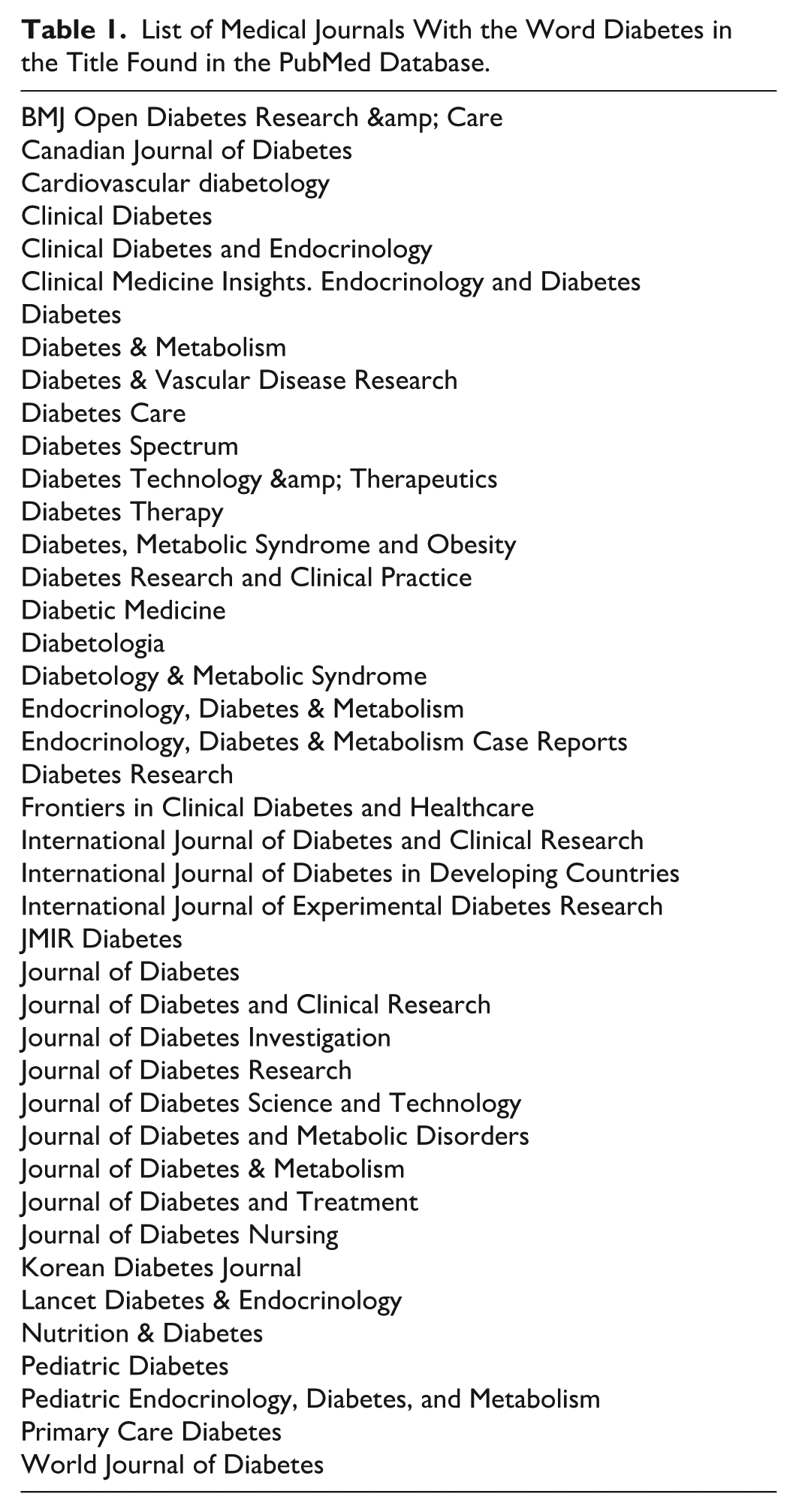
If you enter the word diabetes as a search term in the journal list on PubMed, an established and recognized source for medical articles, or search specifically for diabetes journals, you will get 42 hits (Table 1). This type of search is unlikely to be exhaustive. In particular, diabetes journals published in languages other than English are overlooked. 1 As there are many such journals, it is probably not really possible to answer the question posed. If we limit ourselves to English-language journals, there are probably 100 to 200 such specialist journals. The total number of diabetes journals in the various national languages will be significantly higher, probably by at least by at least one power of ten.
List of Medical Journals With the Word Diabetes in the Title Found in the PubMed Database.
What Characterizes a Journal?
There are a number of aspects and considerations to bear in mind in connection with this question:
There is probably no clear-cut answer to the question of what characterizes a medical journal. The listing of a journal in a database for medical journals (eg, in PubMed) can be regarded as a point of reference in this regard. If you look at the journals that wrote to me, this is the case for many, but not all. Table 2 lists information about such journals that they provide on their homepages.
Information on Diabetes Journals That Have Recently Sent Emails Requesting Manuscript Submissions (in Alphabetical Order).
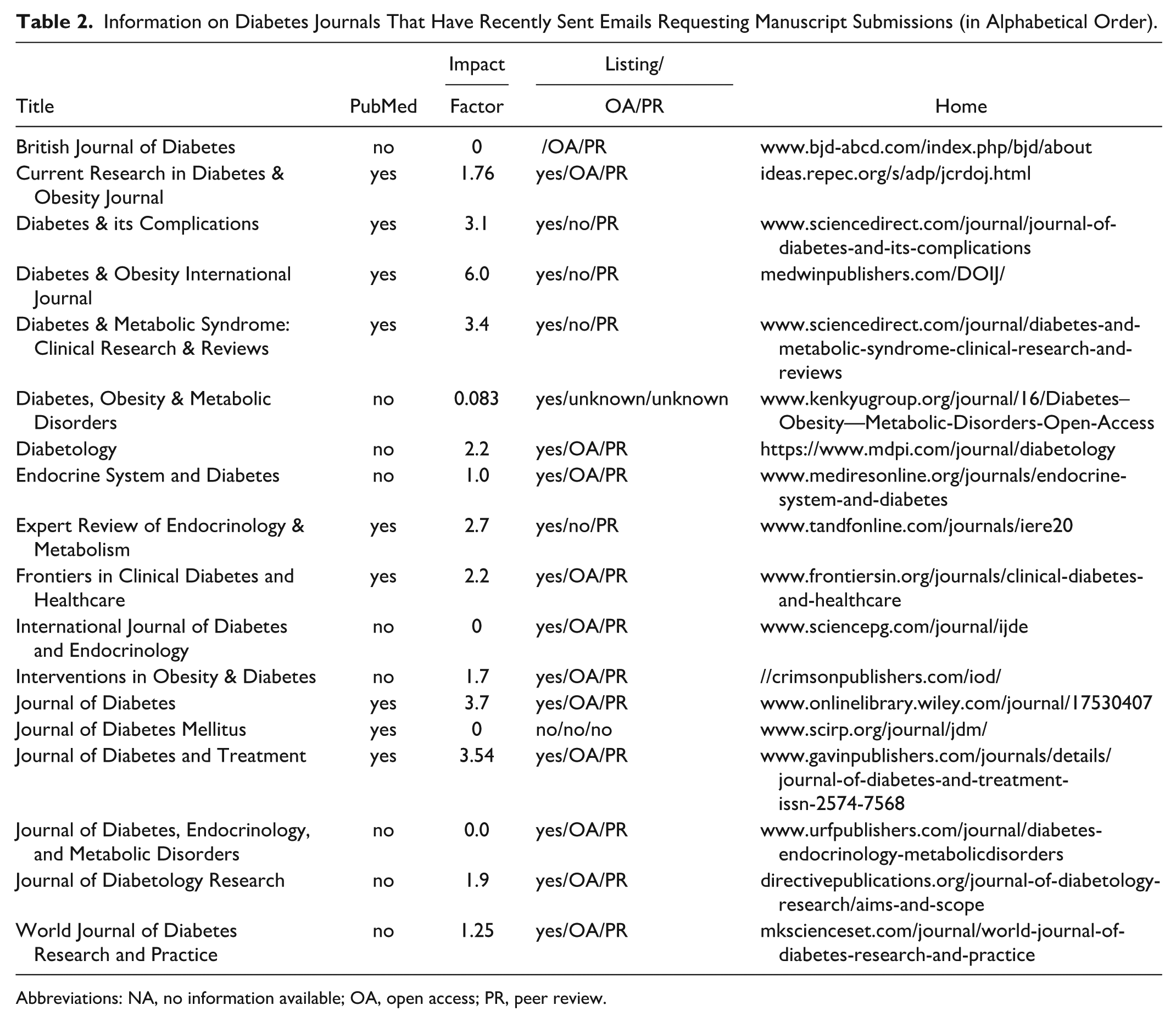
Abbreviations: NA, no information available; OA, open access; PR, peer review.
As an author, you want your publication to have as wide a distribution and resonance as possible. The question is, therefore, what kind of impact does a publication in such journals have? Is such a publication seen and read by colleagues in the field? The impact factor (and comparable publication factors) provides an indication of this, that is, whether the journal in question has a readership or not. Considering how complex and opaque the process of obtaining an impact factor is, it is remarkable how many of the journals listed in Table 2 have an impact factor. The range is quite considerable, from none, to very low, to as high as 6.0.
Are these various diabetes journals really still printed? Nowadays, medical journals are usually available online (often as open access), either via the publishers' websites or via databases such as Google Scholar. These journals are probably only printed in a few cases; they are published in electronic form (as PDFs), partly to avoid high printing costs. Specific information on this is very difficult to find on the websites.
In view of the above-mentioned aspect of why there are so many journals for one indication area (there may also be various journals for other indication areas), one question is of considerable importance: How are these journals financed? This is probably done through various sources, such as advertisements from relevant manufacturers, subscriptions, membership fees, and license fees. However, libraries are extremely reluctant to pay the high annual fees for specialist journals (= subscription costs). However, manufacturers of pharmaceutical or medical products will only place advertisements in specialist journals if they believe that this will enable them to reach their target audience. An obvious source of income is a publication fee (several hundred dollars per printed page), which the author pays to see their manuscript in print.
For various reasons, the field of diabetes is likely to be quite attractive to publishers of specialist journals. On one hand, the growing global significance of diabetes (because of an increase in the number of people with the disease) is leading to more research in this area, including research into the treatment of people with diabetes. There is, therefore, a greater need for the publication of relevant specialist articles from both basic scientific research and clinical research. Because of the increasing specialization of research in the field of diabetes, most specialist journals focus on specific aspects of the disease, such as epidemiology, clinical studies, or specific complications or forms of therapy, such as diabetes technology.
This commentary was triggered by the considerable number of requests for manuscript submissions. At the same time, I constantly receive emails inviting me to participate in diabetes conferences. Here, too, there must be a business model that makes it worthwhile to organize such conferences. Considering the effort involved in attending a conference, one wonders whether colleagues really do attend these conferences in more or less attractive venues. Are they just fake? Attending such conferences offers also the option to accrue continued medical education (CME) credits with little efforts.
Predator Journals
As in many other areas of the digital world, there are apparently now publishers of scientific publications that are clearly fraudulent. Authors are deceived, that is, they pay (considerable) publication fees without receiving legitimate peer review, editorial processing, or actual publication. This fraudulent practice severely undermines the integrity of scientific communication and can harm researchers and the institutions they belong to. Characteristics of such predatory journals include the following:
They only accept submitted manuscripts in exchange for a fee.
Lack of peer review.
Aggressive marketing tactics, that is, they actively solicit contributions, often through spam emails.
Unclear or misleading information about their editorial processes, copyright policies, and archiving practices.
Claiming to be indexed in reputable databases or boasting high impact factors.
A list of such journals (Beall’s list; https://beallslist.net/) is no longer maintained, but provides clues for identifying potential predatory publishers. By checking the indexing in reputable databases (such as PubMed, Scopus, or Web of Science), the claims made by these publishers can be verified.
Quality of Journals/Publications
The question now is: how good are these various journals? Anyone who has ever been directly involved in the entire publication process at a journal knows the considerable effort involved in each individual manuscript. 2 The various more technical aspects must be separated from the content. From the sometimes quite complex process of submitting a manuscript by the author to the journal's website (via, for example, Manuscript Central) to the final publication of the manuscript in PDF or print form, several months can pass. The following description of the publication process is intended to illustrate the effort involved in each individual publication.
In terms of content quality, the first step is for each submitted manuscript to be assessed by the editor—or editorial board—of the respective journal. This person should be an expert in the relevant field and evaluate the quality of the article in general terms. In renowned journals, 60% to 80% of manuscripts do not make it past this stage, that is, the editor considers the content of the manuscript unsuitable for the journal or of insufficient quality. In good journals, several manuscripts are submitted every day. If you look at the homepages of the journals listed in Table 2, you will see that the editors and members of the editorial boards are often not well-known diabetologists. They are often from institutions that are not well known either.
If the manuscript is considered suitable, then the next step is to conduct an adequate peer review process. Finding reviewers who are willing to undertake this time-consuming work is an increasing and time-consuming problem. The likelihood of motivating suitable colleagues, based on their knowledge, to invest the work and time (usually several hours) in a critical and detailed assessment of a manuscript, without remuneration, decreases if a review request comes from a journal they are not familiar with. The editor must review the quality of the reviewers' comments when they arrive after some time (easily several weeks) and decide whether to reject the manuscript or ask the authors to revise it (or maybe accept it without revisions in rare cases?). If they submit a revised manuscript after some time, the editor must critically assess whether the authors have adequately implemented the reviewers' comments.
From an organizational and publication-related perspective, the journal's editorial office is responsible for handling all communication with authors and reviewers, then, as well as designing the print pages, printing them, handling the proofs with corrections made by the authors, and so on. In the final step, the publisher must carry out the actual publication process, including the corresponding external communication via suitable channels, otherwise the publications will not receive any attention.
It is clear that the promise made by the trade journals mentioned above to publish a submitted manuscript within a few days (!) cannot be kept under the conventional publication process described here. In other words, the quality of publications in such journals must be viewed with extreme caution.
Manuscripts generated using artificial intelligence (AI) pose a significant problem for the conventional publication process. On one hand, it is remarkable how, after entering just a few terms and ideas, a manuscript can be generated in a very short time that reads surprisingly well and makes sense. This enables a single author to generate various manuscripts in a single day. On the other hand, these are only reviews of already published manuscripts and do not contain any creative new ideas. It is not an easy task for publishers to ensure that AI has not been used in the creation of submitted manuscripts. The requirement for authors to confirm upon submission that the manuscript in question was not generated by AI must be considered insufficiently precise. Although there are software programs that claim to be able to detect AI-generated manuscripts, they do not offer 100% protection (eg, Turnitin, GPTZero, and Copyleaks).
Summary
This critical and personal commentary on the situation in diabetes trade journals is not intended to be mud-slinging, but rather to point out what appears to be a rather heterogeneous situation, especially with regard to quality. The developments mentioned here could seriously undermine confidence in the scientific validity of publications. On the contrary, it should be noted that new journals should be given a chance to establish themselves. To do this, they need to contact potential authors to draw attention to themselves and receive submissions. Otherwise, there will only be a fixed circle of journals in the future.
Anyone who wants to submit a manuscript to a journal, especially younger colleagues, may find this information useful in deciding what conclusions to draw. A public discussion (and awareness-raising) of some of the issues raised could help to identify possible solutions.
Footnotes
Abbreviations
n/a, not available; OA, open access; PR, peer review.
Declaration of Conflicting Interests
The author declared the following potential conflicts of interest with respect to the research, authorship, and/or publication of this article: LH is a partner in Profil Institut Stoffwechselforschung GmbH, Neuss; Science Consulting in Diabetes GmbH, Düsseldorf; and diateam GmbH, Bad Mergentheim. He is a consultant for a number of companies developing new diagnostic and therapeutic options for diabetes treatment.
Funding
The author received no financial support for the research, authorship, and/or publication of this article.
