



Abstract

The integration of machine learning and artificial intelligence (AI) techniques into clinical prediction models for diabetes management has shown promising outcomes.1,2 However, ensuring the robustness, transparency, fairness, and reproducibility of these models remains a critical challenge. In response to this need, the TRIPOD+AI statement (April 2024), 3 an extension of the Transparent Reporting of a multivariable prediction model for Individual Prognosis Or Diagnosis (TRIPOD) statement (2015), has been introduced.
In recent years, several frameworks have emerged to enhance the reporting quality of such studies within a medical context (see Table 1), including the Clinical Artificial Intelligence Research, 4 the minimum information about clinical artificial intelligence modeling (MI-CLAIM), 5 and the Minimum Information for Medical AI Reporting (MINIMAR) 6 checklist.
Overview of Reporting Frameworks for Machine Learning and AI Utilization in the Medical Domain.
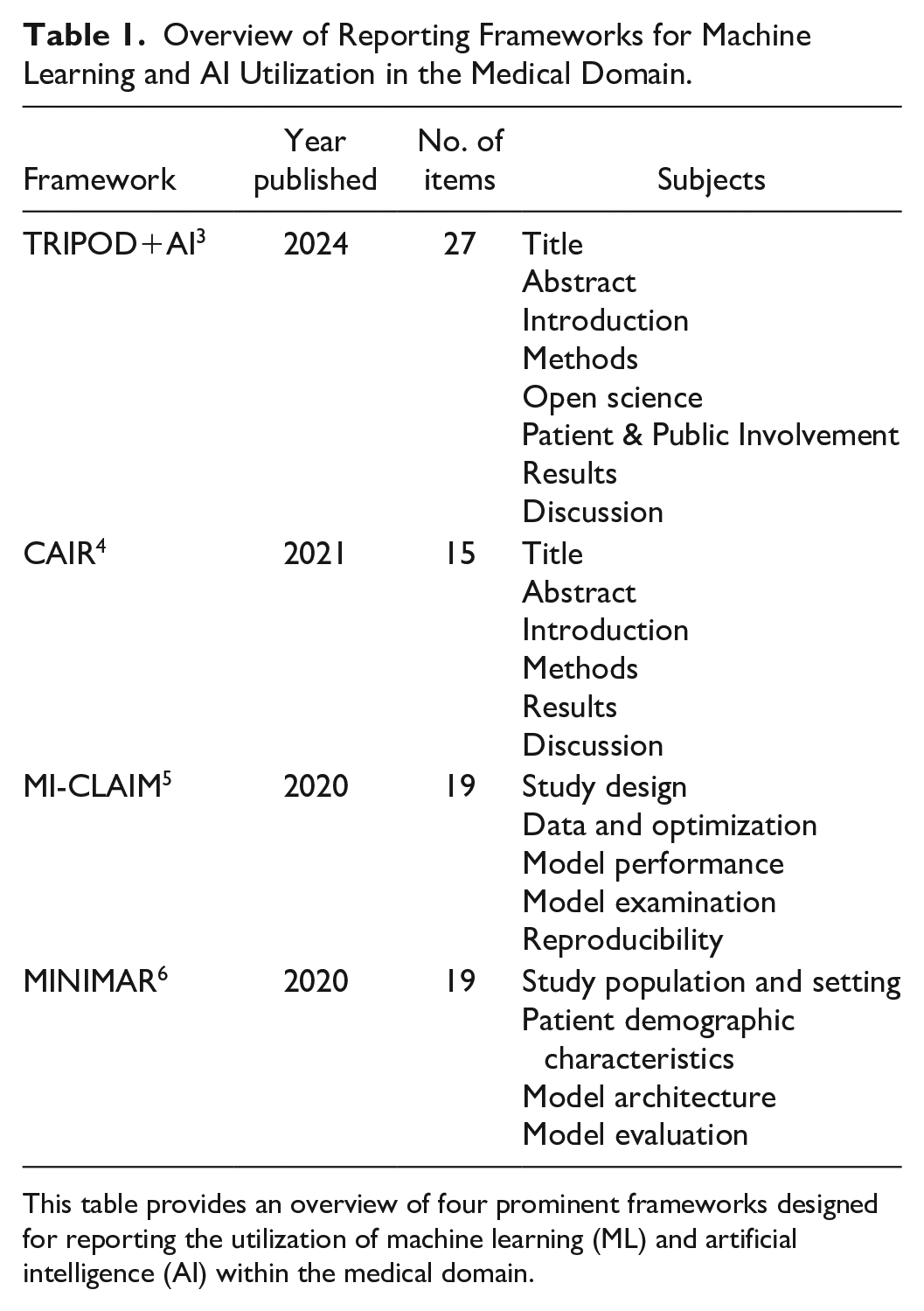
This table provides an overview of four prominent frameworks designed for reporting the utilization of machine learning (ML) and artificial intelligence (AI) within the medical domain.
The updated TRIPOD+AI guideline incorporates recent advancements in clinical prediction modeling, particularly in the domain of machine learning. This revision also reflects evolving research practice standards, such as an increased focus on fairness, reproducibility, and research integrity, as well as the principles of open science, including public and patient involvement in research. In addition, efforts have been made to enhance consistency in terminology between the machine learning and traditional clinical research communities. While the TRIPOD+AI framework offers the most comprehensive set of guidelines for reporting, encompassing 27 items in the checklist, its extensive nature may pose a barrier to adoption. Particularly for studies exploring the potential of machine learning and AI in novel areas of diabetes research without immediate implementation in clinical practice, this exhaustive checklist may be deemed cumbersome and some of the items may be irrelevant. In such cases, the MI-CLAIM 5 and MINIMAR 6 frameworks could serve as more suitable standards for reporting guidelines.
Despite the commendable efforts to provide these reporting frameworks for the utilization of AI in the medical domain, many published papers still fail to adhere to these guidelines. Consequently, there is a need for increased awareness among reviewers and journals regarding the benefits of utilizing these frameworks to drive further adoption.
The publication of the TRIPOD+AI statement 3 and checklist (https://www.equator-network.org/reporting-guidelines/tripod-statement) represents a significant milestone in promoting transparency and reproducibility in the development and reporting of clinical prediction models, particularly those leveraging machine learning techniques. In the context of diabetes research, adherence to the TRIPOD+AI guidelines is essential for advancing the field toward more accurate, interpretable, and clinically actionable predictive models. By adopting standardized reporting practices, researchers can facilitate the translation of predictive analytics into meaningful improvements in diabetes management and patient outcomes.
Footnotes
Abbreviations
MI-CLAIM, minimum information about clinical artificial intelligence modeling; MINIMAR, Minimum Information for Medical AI Reporting; TRIPOD, Transparent Reporting of a multivariable prediction model for Individual Prognosis Or Diagnosis.
Declaration of Conflicting Interests
The author(s) declared no potential conflicts of interest with respect to the research, authorship, and/or publication of this article.
Funding
The author(s) received no financial support for the research, authorship, and/or publication of this article.
