



Abstract
The widespread use of smartphones in the United States has led to a surge in mHealth apps designed to support people with various health issues. Yet the effectiveness and long-term impacts of these apps still need to be determined. This article presents a case study of the development of MyT1DHero, an mHealth app for people with type 1 diabetes, to identify best practices for app development. We propose four essential best practices based on the insights gained from this case study: incorporating theoretical frameworks, prioritizing user feedback, engaging key stakeholders, and establishing a robust data-collection foundation. These findings have practical implications for researchers and developers seeking to create effective mHealth interventions. Furthermore, we suggest future research directions to advance the development and implementation of innovative health technologies.
Keywords
Cellphone ownership is widely prevalent in the United States, with 97% of Americans owning one and 85% of them owning a smartphone. 1 Cellphone ownership rates are consistent across urban, suburban, and rural populations, with rates of 98%, 97%, and 94%, respectively. Mobile phones are commonly used for health purposes, known as mobile health or mHealth.2-7 These apps address various health concerns, such as nutrition, addiction, maternal and infant health, respiratory conditions, physical activity, and diabetes.8-14 While mHealth apps are predicted to rise, their effectiveness and long-term impact vary, often due to technical issues, user barriers, or poorly developed interventions. Many existing apps lack efficacy or fail to sustain user engagement. Research suggests that the clinical effectiveness of mHealth apps is questionable, and users often do not interact with them as intended.15-17 These challenges highlight the need for improved considerations during the design and development phase, and the establishment of best practices for developing effective mHealth apps.
This commentary aims to provide a series of best practices for developing mHealth apps, using the MyT1DHero app intervention as an example. This intervention’s goal was to enhance communication between adolescents with type 1 diabetes (T1D) and their parents, and its development process and outcomes have been previously reported.18-20 While the use of mHealth varies on multiple dimensions, such as the health issue of focus, the audience, and the technology type, this article offers valuable insights and practical implications drawn from a combination of robust theoretical foundations and a decade of real-world experiences. By merging theoretical knowledge with hands-on expertise, this commentary serves as a comprehensive and informative resource for researchers and developers in mHealth.
Furthermore, the lessons learned from the app intervention development process, along with the ever-growing body of research in the field,21-27 can be effectively applied to creating new mHealth tools, ultimately improving the health and well-being of individuals. In addition, this commentary identifies areas for future research in innovative health technologies, paving the way for continuous advancement of mHealth interventions.
A Real-World Case Study in Effective mHealth App Development
The app intervention was designed to enhance communication between adolescents with T1D and their parents. As a real-world case study, it served as a unique and valuable example for applying best practices in developing mHealth apps. The focus on communication enhancement in managing a chronic health condition highlights the relevance and importance of the insights gained from this intervention.
Throughout the development of the app intervention, a series of best practices were applied, drawing from both theoretical foundations and real-world experiences.28-30 By incorporating these guidelines, such as using theory to guide intervention design, engaging in an iterative design process, prioritizing user engagement, accommodating existing user behaviors and needs, and ensuring effective backend data management, the team successfully created an impactful mHealth app (Figure 1). This case study serves as a validation of the insights and practical implications provided in this commentary. By showcasing how the best practices were effectively applied and resulted in a communication-enhancing mHealth intervention for adolescents with T1D, the relevance, and significance, of the guidance offered here are further solidified.
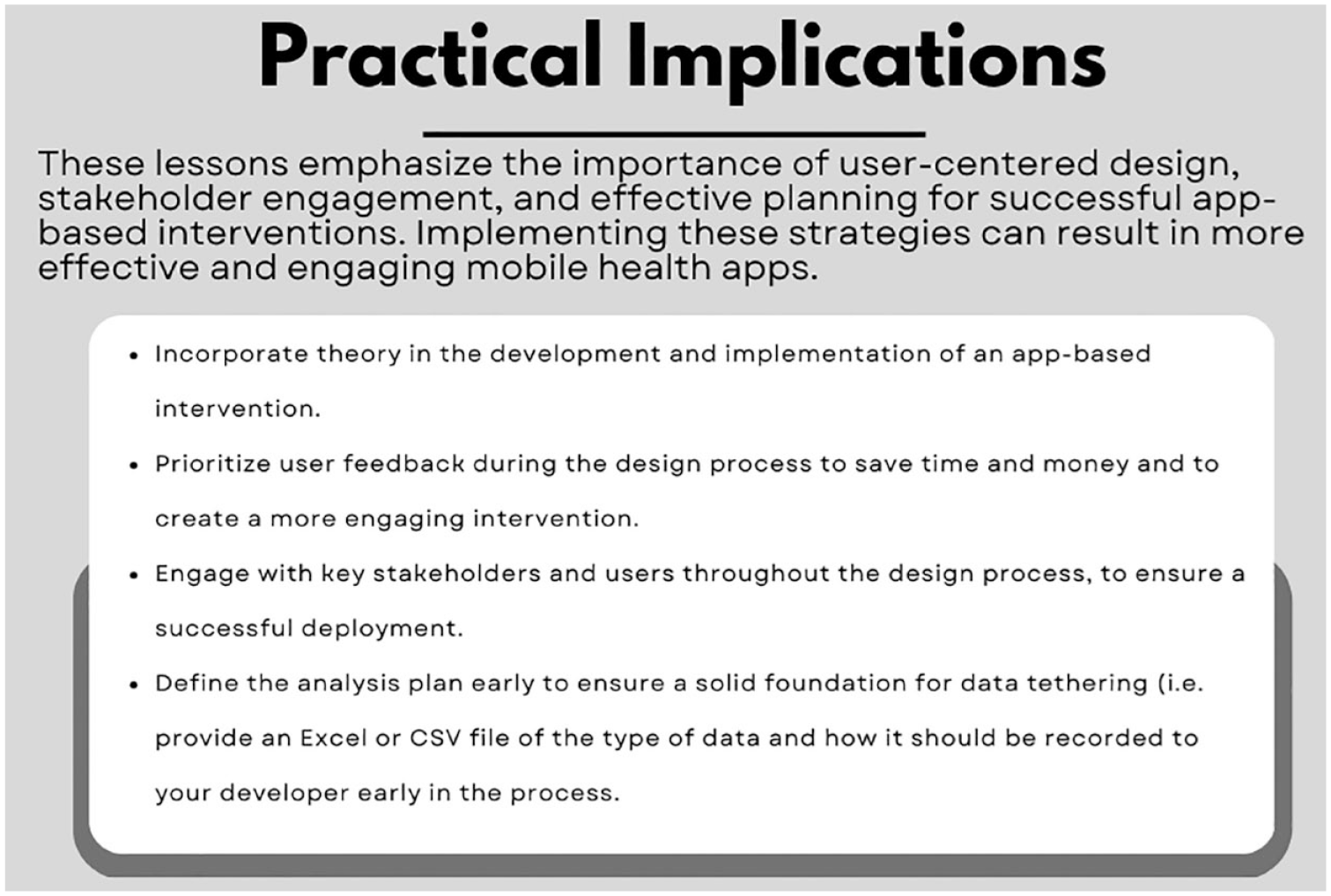
Practical implications for developing an mHealth intervention app.
Use of Theory
While those outside the social sciences may scoff at using a theory to guide the development and implementation of an mHealth app, repeated research articles have demonstrated its importance in changing behavior.10,31,32 Interventions that have used a theory have recorded success in the intervention’s effectiveness and have shown to have cost-benefit advantages. 31 Theories not only help us in developing the intervention but also help us to understand what constructs are critical to the intended behavior we are seeking. Theory also helps us know what to measure to determine our overall impact. 33 When guided by a theory, developers can target known variables (eg, motivation) and identify key constructs (eg, autonomy, competency, and relatedness) to foster change. Without theory, much time and money can be wasted in haphazardly trying ideas hoping to see change. This example project is no different. By connecting theoretical foundations to real-world experiences at each stage of the mHealth app development process, we effectively demonstrated how integrating theory can yield practical implications for creating impactful and user-centered interventions. These insights contribute to a robust framework for future researchers and developers interested in developing effective mHealth apps.
Iterative Design
As with the rest of the work that has been published regarding the intervention development,28-30 it is critical to use an iterative design. This becomes more crucial when you deliver the intervention using technology. Our iterative design process was rooted in social cognitive theory and self-determination theory, enabling us to create a dynamic and adaptive mHealth intervention, thus recognizing the importance of continuous feedback and collaboration with key stakeholders, including parents, children, and medical experts, by engaging them through focus groups, interviews, prototyping sessions, and usability trials.
Throughout the development phase, we encountered challenges stemming from the rapidly changing technology landscape and variations in participants’ mobile devices. For example, we underestimated the impact of the pace of technological change. The rapidly changing technology landscape also presented unforeseen challenges.
In the transitional period between the proposal and implementation phases of the study, there was a notable shift among participants aged 10-15 years. They progressed from a lack of ownership of cell phones to becoming owners of these devices. At the outset, we had stipulated an Android operating system due to budget constraints for procuring phones for the participants. However, during the application rollout phase, a significant hurdle emerged. Nearly half of the participants were found to possess Apple phones, necessitating a separate and unforeseen development process. This adjustment not only posed logistical challenges but also exceeded our originally allocated budget.
However, during app rollout, we discovered that about half of our participants had Apple phones, requiring a separate development process that exceeded our budget. To address this, we provided Android phones to participants without phones or with Apple phones, but this was a limitation. By being flexible and incorporating user engagement and testing, we addressed unforeseen issues and understood their preferences early on. This responsiveness allowed us to refine the app continuously and enhance its overall effectiveness.
User Engagement
User-centered design was essential to our mHealth intervention development, closely aligned with self-determination theory. By valuing the autonomy and needs of our target audience, we gathered crucial insights that informed our decision-making process. Initially, we proposed a tree or flower design as a motivational aspect, reflecting growth through healthy behavior management, rooted in the theory’s emphasis on autonomy and competence.
However, through iterative user engagement, inspired by social cognitive theory’s emphasis on observational learning and feedback mechanisms, we realized the significance of incorporating themes preferred by our users, such as pet care and superhero avatars. This user-driven customization made the app more engaging and empowering, further reinforcing autonomous motivation.34-36 We connected with the participants frequently through the use of emailed newsletters, social media groups, and satisfaction and usability questionnaires throughout the project. By maintaining continuous communication and assessments, we were able to stay connected with participants and refine the intervention based on their feedback, adhering to the principles of self-determination theory that stress relatedness and collaboration.
Accommodating Users’ Behaviors and Needs
Understanding the end users’ experiences and requirements played a central role in our app’s development as many technologies neglect the end user, resulting in errors and reduced user satisfaction. While our interdisciplinary research team included T1D specialists, none had T1D themselves. Therefore, it was essential for adolescents and parents to provide insight into living with and managing the condition. We discovered that integrating our intervention with adolescents’ continuous glucose monitors (CGMs) would enhance usability. However, integrating with CGM companies’ proprietary code proved challenging. To overcome this, we implemented a manual entry option, ensuring inclusivity and ease of use for participants without CGMs and prioritizing family communication within the app.
Engaging with users offers the advantage of gathering feedback that can inspire research in other areas. For instance, the insights gained from user preferences also led us to explore alternative communication options, bridging theory and practice to improve the intervention’s impact continually. In response to feedback from parents, we developed a comprehensive diabetes website that significantly improved diabetes knowledge and parental satisfaction. 37 Parents also preferred using Facebook groups, leading us to explore alternative communication options. Our study revealed that diabetes-specific information, regardless of the medium (text or Facebook), effectively improved diabetes management skills. 38 In addition, older adolescents found support on Instagram, prompting us to investigate T1D and social support on this social media platform. 39
Back-End Data
Without clearly defining your back-end data, it can be difficult or nearly impossible to measure the outcomes you seek to examine. In our experience, app developers are not researchers, so we had to communicate clearly about the objectives and aims of the intervention. During the pilot tests, we repeatedly verified the data being captured and the format of the data. Remembering our research questions and objectives when discussing the intervention with the app’s developers was always important. It makes sense to want to collect as much data as you can, but you need to be certain that what you are getting will be able to answer your key questions. Also, be wary of project or scope creep. It is essential not to sacrifice the main objectives of your intervention for something else. For example, our app was developed to improve the communication between parents/guardians and their child with T1D; it was not meant to communicate to the health care team. Those use cases need to be made clear at the project’s outset.
One strategy is to provide a file with the data type, and how you want it coded, to your developer early on. This can be a helpful way to communicate your needs, but it requires solid research methods at the outset. Having an established analysis plan to answer research questions is also key.
Insights Gained From Hindsight
As with everything, hindsight is 20-20, and there are things that we would do differently now if we were to start the process over again. The first is that everything takes more time and money than what you had originally planned. We would recommend adding at least 6 months to your plan and 10% to your budget. While we did plan for usability tests, the participants encountered different bugs in the app when using it daily. We would have set about a different testing and process. Finally, we encourage future researchers to integrate existing technology as much as possible into their intervention (Figure 2).
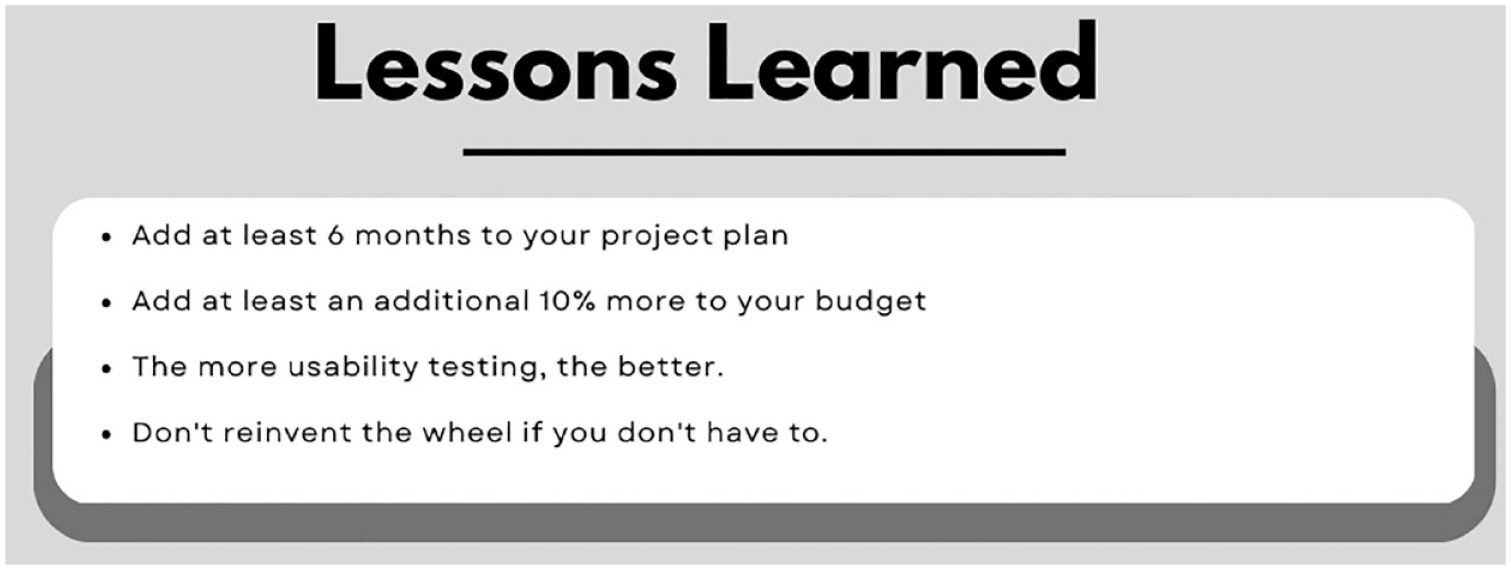
Lessons learned.
Future Research
While reflecting on the lessons learned from the current state of mobile health is important, it is equally crucial to anticipate what lies ahead. As we look to the future, several areas hold immense promise, including the integration of artificial intelligence (AI), wearables, and mobile apps to address critical health care needs in underserved rural areas. These areas are ripe for innovation and they have the potential to improve lives.
Artificial Intelligence in mHealth
The use of chatbots for various health conditions is already well-documented. As the training data used to program the interactions becomes more available and the technology more accessible, more and more health applications will undoubtedly use this technology. While AI has many benefits in health, including wide access, cost-effectiveness, and tailoring, many potential challenges exist. This includes privacy, ethical, and regulatory issues.
Wearables
Wearable technologies, such as smartwatches, fitness trackers, CGM, and other disease-targeted devices, are becoming increasingly popular. However, along with the data they provide, information regarding how to act on that data needs to be integrated with devices. For example, one study found that participants felt validated knowing their sleep patterns—but they were never provided action steps in an engaging way that helped them make. 40
mHealth in Rural Areas
While most Americans own a cell phone or a smartphone, the nation’s rural areas should be considered. The rural population makes up approximately 14% of the nation’s population. 41 The individuals living in those areas have fewer health resources available, including the number of health care providers and hospital beds. Further exasperating the issue is that this population tends to have more instances of chronic health issues.42,43 Therefore, using mobile phones to provide health information and interventions is appealing. However, there are still many challenges to mHealth in these areas. Some of these include poor and expensive Internet accessibility and the lack of local health care providers. If considering the use of mHealth in these areas, it is essential to work with the local population and determine the best type of technology (text message–based vs app-based) for the specific context.
Effectiveness of mHealth Apps
Evidence-based research plays an indispensable role in achieving meaningful advancements in the field of mHealth and ensuring the creation of impactful digital solutions. Rigorous empirical studies are essential for substantiating the efficacy, safety, and long-term impact of mHealth apps. As the field of mHealth continues to grow, integrating evidence-based research practices becomes paramount to elevate the quality and effectiveness of digital solutions. By embracing evidence-based research methods, mHealth app developers can establish the credibility and impact of their interventions. Empirical evidence provides the foundation for demonstrating efficacy, engaging stakeholders, and securing support from funding agencies and regulatory bodies. Prioritizing empirical validation through usability studies, pilot feasibility studies, and randomized clinical trials (RCTs), and leveraging existing research, researchers and developers can collectively contribute to a future where evidence-driven mHealth interventions positively affect the lives of individuals, families, and communities.
Conclusion
In advancing mHealth research, learning from past projects is crucial to propel the field forward, particularly in health communication interventions. The COVID-19 pandemic accelerated mobile health usage and, while its pace may taper post-pandemic, the apps’ significance in supporting health will persist. This commentary offers a solid framework, highlighting key lessons learned and merging theoretical foundations with real-world experience, benefiting researchers and developers. This commentary demonstrates the power of user-centered design and iterative development, creating interventions that resonate and improve health outcomes. We hope this work inspires and guides future mHealth endeavors, empowering individuals to take charge of their health and fostering a healthier, more connected society.
Footnotes
Abbreviations
AI, artificial intelligence; CGM, continuous glucose monitor; RCT, randomized clinical trial; T1D, type 1 diabetes.
Declaration of Conflicting Interests
The author(s) declared no potential conflicts of interest with respect to the research, authorship, and/or publication of this article.
Funding
The author(s) disclosed receipt of the following financial support for the research, authorship, and/or publication of this article: This work was supported by the American Diabetes Association (No. 1-16-ICTS-045).
