




Abstract
Global increase in mobile phone usage provides an opportunity in transforming health care delivery for improving the management of noncommunicable diseases (NCDs). 1 Before planning mHealth interventions, it is useful to know the capacity and willingness of the target population. 2 Therefore we aimed to assess mobile phone availability and knowledge regarding operation of mobile phones and assess willingness to receive health-related information.
We conducted a facility based cross-sectional study among patients attending NCD clinic in the month of November 2014 in a rural primary health center, Puducherry, India. After obtaining informed consent, a pretested semistructured questionnaire was administered to all consecutive patients attending NCD clinic. Access to mobile phone, knowledge on mobile usage and willingness to receive health information were expressed as percentages. We calculated adjusted relative risks (prevalence ratios) to assess socio-demographic and clinical characteristics associated with willingness to receive health information.
Of total 285 participants, 171 (60%) were females and mean (SD) age was 56 (12.5) years. Majority (52.6%) of participants had no formal education, and 189 (66.3%) participants were unemployed. In all, 35 (12.3%) patients had diabetes alone, 147 (51.6%) patients had hyper-tension alone, and 64 (22.5%) had both diabetes and hypertension.
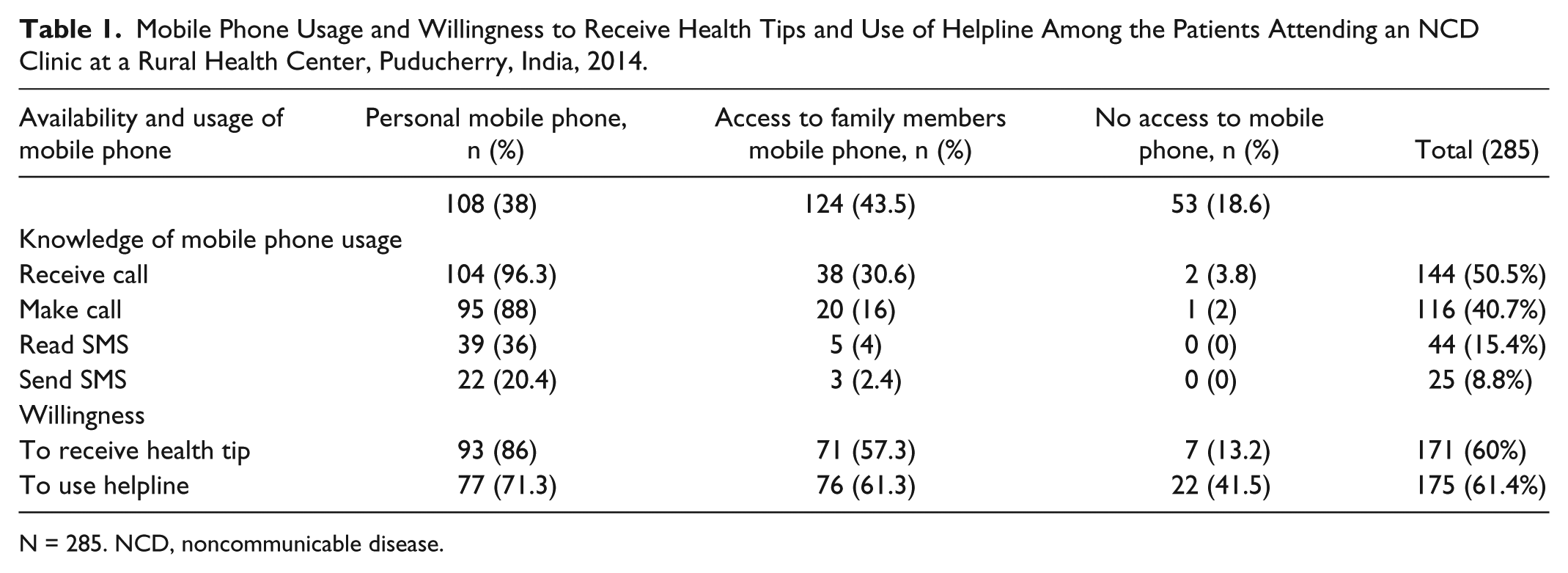
Access to mobile phone and knowledge about its use are described in Table. Personal mobile phone was with 108 (38%) patients and 124 (43.5%) had mobile phone with their family members. Willingness to receive health information was reported by 171 (60%) patients (Table 1), 52.6% preferring voice calls. In bivariate regression analysis, lower age group, male gender, having formal education, employment, and access to mobile phone were associated with willingness. In multivariate analysis, having a personal mobile phone (RR = 5.9 [2.9-12.0]) and mobile with family member (RR = 4.1 [2.0-8.3]) were independently associated with willingness (data not shown).
Mobile Phone Usage and Willingness to Receive Health Tips and Use of Helpline Among the Patients Attending an NCD Clinic at a Rural Health Center, Puducherry, India, 2014.
N = 285. NCD, noncommunicable disease.
Among 171 study participants who were willing to receive health-related information, 90 (52.6%) preferred voice calls, 72 (42%) preferred SMS, and 9 (5%) preferred either of them. Of them, 160 (93.6%) preferred to receive health tip in local language. Diet (38.6%), medication usage (21.6%), and lifestyle modification (25.2%) were the 3 most common bits of information that participants were willing to receive.
This is the first study from India assessing knowledge and willingness related to mHealth interventions among patients with noncommunicable diseases. The study has a few implications. This comprehensive assessment on receiver level capacity and preparedness will help in effective planning of mHealth interventions for chronic disease patients. Voice calls being the preferred mode for receiving health information, mHealth interventions using voice calls tailored to the specific needs of elderly and the less educated in rural setting can be tried under primary care settings. These interventions have shown favorable results in improvement of blood glucose control in diabetics, an increased rate of HbA1c testing in previously nonadherent patients, and improved outpatient attendance.3-6
The study was conducted among patients from a particular geographical area and hence the results cannot be generalized. In conclusion, 4 out of 5 patients had access to a mobile phone, and willingness to receive health information was also high.
Footnotes
Abbreviation
NCD, noncommunicable disease.
Declaration of Conflicting Interests
The author(s) declared no potential conflicts of interest with respect to the research, authorship, and/or publication of this article.
Funding
The author(s) received no financial support for the research, authorship, and/or publication of this article.