




Abstract

Technology applied to health has provided benefits including increasing efficiency of care, reducing costs, obtaining greater control over treatment options, and offering patients to know their state of health. 1 Electronic medical records have contributed to improve the quality of care, patient outcomes, reducing medical errors, and promoting development of clinical research. 2
In our setting there is no regional electronic system that allows patient’s empowerment, limits clinical inertia, emits alerts about the goals or unattended essential evaluations, and provides analysis of data obtained.
The Integral Diabetes Monitoring System (SMID) is a technological tool linked to a database, including 291 indicators for a comprehensive care center and 142 indicators for individual praxis with a comprehensive approach. It is available in an open electronic portal where the user record in real-time data generated. It is an open, robust, and interoperable electronic diabetes-oriented system created according to the International Consortium for Health Outcomes Measurements standards.3,4 It includes metabolic (glycemic targets and hypoglycemia), psychosocial outcomes (mental health, distress, and depression), barriers for adherence, foot care, and chronic and acute complications. Patients can obtain education, advice, and feedback, allowing them to participate in diabetes care without the need of a face-to-face visit.
There are three types of access: patients/relatives, health and administrative professionals. Data entry and presentation is according to the role. The conceptual map of the system is shown in Figure 1.
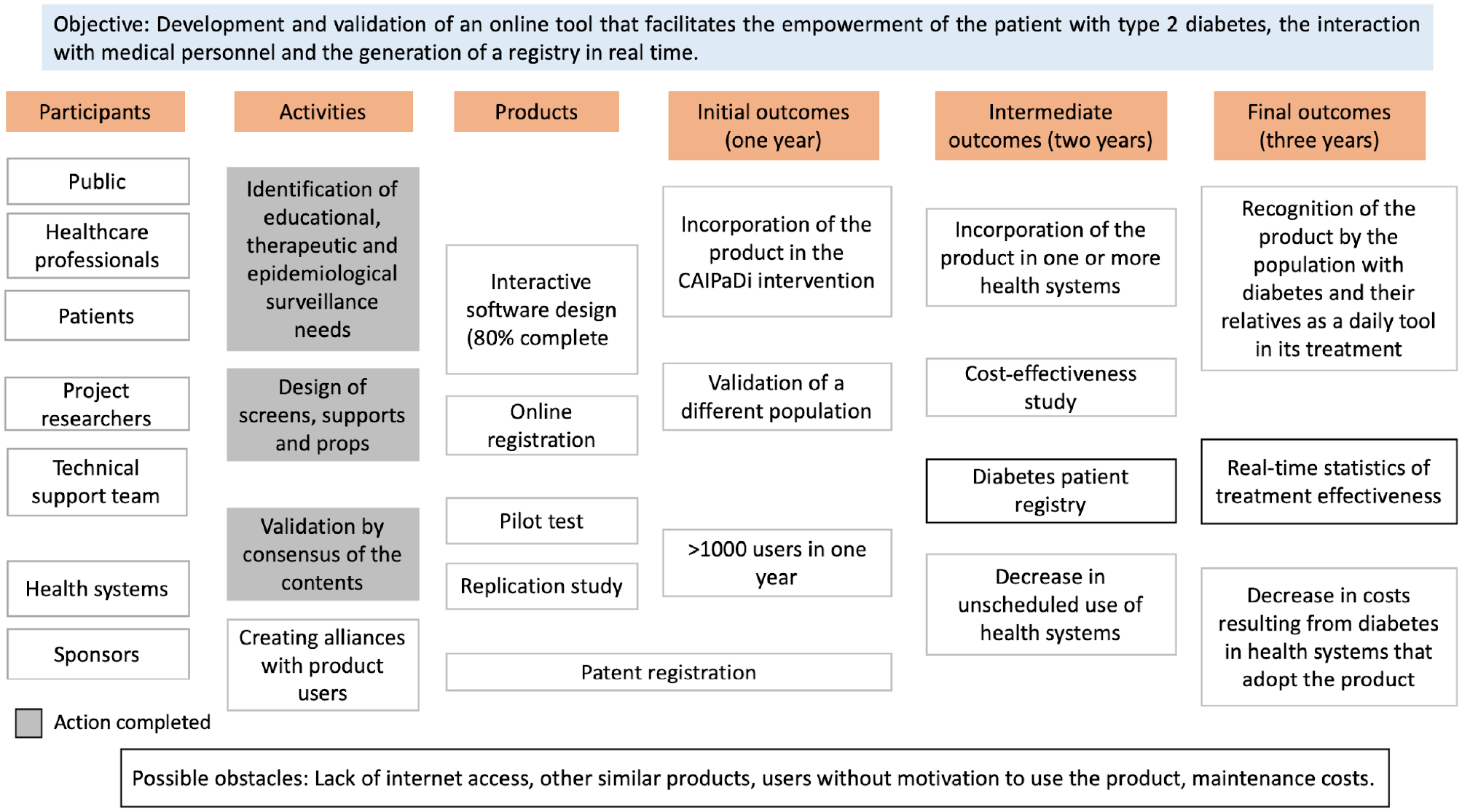
Conceptual model of the project.
The SMID has been implemented successfully. The average time required for registering the information is 4 minutes and requires less than 40 clicks. This is done through the dichotomization of variables, assignment of pre-established categories, and limitation of spaces to include text. For numeric values, normal ranges are established to avoid registering unreal parameters. Alerts (exclamation sign) for incorrect values indicate mistakes (extreme weight or biologically impossible values). Reminders indicate the need for subsequent evaluations (eg, renal, dental, or ophthalmological). Calculators allow estimating parameters (non–high-density-lipoprotein cholesterol, body mass index, questionnaire scores) and images can be uploaded.
If metabolic control goals are not achieved and there are no changes in the treatment, the system issues an alert to motivate change or treatment adjustment and educational material is offered. In subsequent evaluations, graphs can be displayed showing evolution in the parameters.
The interphase for patients/relatives and health professionals allows obtaining averages, standard deviations, and alerts of high and low glucose values. The number of hypoglycemia events can also be recorded and displayed.
The SMID generates statistics in real time, comparisons over time, and reports by strata (eg, by age, sex, period of time, specific clinic, and so on). It allows the recovery, processing, analysis, and publication of information.
The SMID can be adapted to pre-existing technological platforms, facilitating adoption and implementation in regional and national clinics to generate statistics to evaluate and establish strategies for improvement. This is a step to have big data addressing national problems and implementing health policies on diabetes.
The SMID is a technological tool that provides benefits to patients, health professionals, and the health system.
Footnotes
Acknowledgements
The SMID system was developed for the Instituto Nacional de Ciencias Médicas y Nutrición Salvador Zubirán by INTTELMEX and TELMEX based on the CASTOR and SIMAP systems.
Declaration of Conflicting Interests
The author(s) declared no potential conflicts of interest with respect to the research, authorship, and/or publication of this article.
Funding
The author(s) disclosed receipt of the following financial support for the research, authorship, and/or publication of this article: The SMID software received grant from Consejo Nacional de Ciencia y Tecnología (Proyectos de Desarrollo Científico para Atender Problemas Nacionales 2013 project 214718) on behalf of the Global Alliance for Chronic Diseases and a grant from NovoNordisk.
