




Abstract

Heart failure (HF) is an increasingly recognized complication of diabetes. Observational trials and national registries have shown HF prevalence between 9% and 22% among persons with type 2 diabetes (PWT2D). 1 In June 2022, the American Diabetes Association (ADA) released new guidance for annual HF screening in persons with diabetes (PWD) using serum biomarkers. 2 Additional evidence evaluating HF prevalence in persons with type 1 diabetes (PWT1D) or PWT2D would be useful to corroborate the rationale for new HF guidelines.
Real-world evidence (RWE), through analysis of large datasets derived from electronic health records (EHRs), can augment evidence from observational trials, randomized controlled trials, and national registries.3,4 In lieu of randomization, RWE utilizes large datasets and observational research techniques to control observable confounders and draw conclusions from millions of past patient encounters, providing robust results with statistical rigor. 5 We present HF prevalence in adults with type 1 diabetes (T1D), type 2 diabetes (T2D), and the general US population. Results were generated from a research acceleration query for a retrospective observational analysis of a nationally sourced EHR dataset comprised of academic medical centers, hospitals, large practice groups, and individual doctor offices across 48 states and Washington, DC. Data collection and analysis was performed by Atropos Health, a RWE company for clinical evidence and research.
In the dataset, we identified 25 598 285 patients with sufficiently rich medical records comprising of diagnostic, treatment, lab, and vital records that could be evaluated for both the presence of diabetes and HF (Tables 1A and 1B). Compared to a 2.09% HF prevalence in the adult general population, PWT1D were more than four times as likely to have a HF diagnosis at 8.87% (risk ratio [RR]: 6.77; P < .001). Heart failure among persons with T2D was 7.98%, representing a more than three-fold greater HF prevalence than the general population (RR: 6.09; P < .001). Heart failure prevalence increased with age across all patient types irrespective of diabetes diagnosis, with marked increase in the 50 to 59 age group for persons with either T1D or T2D.
RWE Prevalence of HF by Age and Gender Among Adults With T1D and T2D Compared With the General Population.
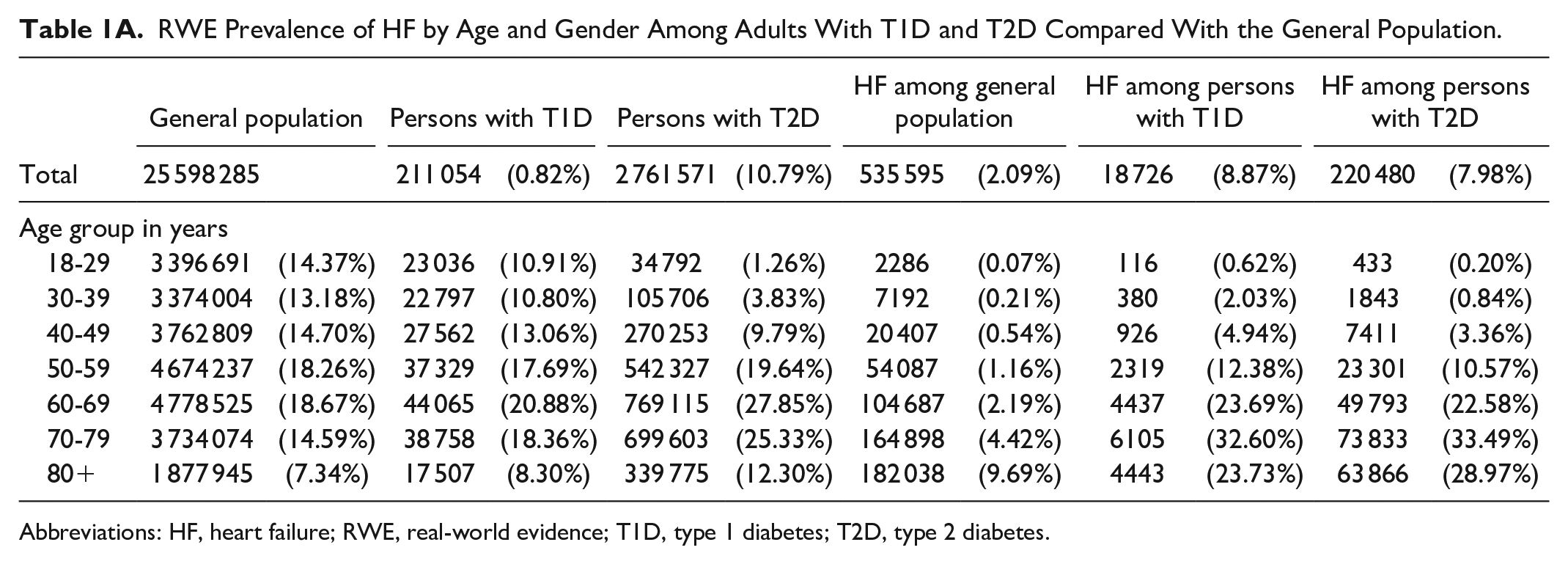
Abbreviations: HF, heart failure; RWE, real-world evidence; T1D, type 1 diabetes; T2D, type 2 diabetes.
Relative Risk of HF Comparing Persons With Diabetes to the General Population.

Abbreviations: HF, heart failure; T1D, type 1 diabetes; T2D, type 2 diabetes.
This RWE retrospective study supports the conclusion by the ADA and others that PWT1D and PWT2D have excess risk of HF compared with the general population. Our results demonstrate HF prevalence in PWD at the lower end of prevalence ranges quoted elsewhere. 1 This may reflect coding inaccuracies in diabetes or HF documentation in the EHR dataset. However, this limitation would be expected to be proportional in each of the cohorts so although the exact percentage differs, trends in direction should be consistent between a RWE approach and observational or prospective studies.
This analysis was performed with three query cycles involving question submission, analysis, and debrief over one month, representing a fraction of the time and costs incurred with observational trials and registries. These data serve as a snapshot of 10% of the US adult population and represent the largest analysis of HF and DM to date.
It is useful to utilize observational evidence on a broad population when informing health guidelines. 5 RWE evidence can provide timely, cost-effective, and statistically rigorous assessments of guideline adoption and health benefit from early diagnosis and intervention.
Footnotes
Abbreviations
ADA, American Diabetes Association; HF, heart failure; RR, risk ratio; RWE, real-world evidence; T1D, type 1 diabetes; T2D, type 2 diabetes.
Declaration of Conflicting Interests
The author(s) declared the following potential conflicts of interest with respect to the research, authorship, and/or publication of this article: Valerie Garrett and Saurabh Gombar work for Atropos Health.
Funding
The author(s) disclosed receipt of the following financial support for the research, authorship, and/or publication of this article: This work was funded by Atropos Health.
