



Abstract

Continuous glucose monitor (CGM) use in people with diabetes improves glycemic control, 1 reduces hypoglycemia, 2 and is associated with fewer diabetic ketoacidosis (DKA) admissions. 2 However, less than 40% of individuals with diabetes use CGM, 2 and there are disparities in CGM use among minority populations. 2 Barriers to CGM use are many and exist at the personal, 3 provider, 4 and systems 3 levels, yet few interventions have demonstrated success in overcoming these barriers. We sought to determine whether providing free CGM samples to pediatric patients at the point-of-care in the real-world clinic setting increases personal CGM uptake.
This was a retrospective manual chart review of youth who were CGM naïve or prior CGM users (not currently using CGM) who were provided a free sample CGM in the diabetes clinic from October 2020 to January 2022. CGMs were distributed to patients at their provider’s discretion. One provider obtained approval from the Johns Hopkins legal team to dispense sample CGMs in the clinic setting. The study was approved by the Johns Hopkins Institutional Review Board with a waiver of consent. Data on the use of CGM at subsequent follow-up visits were collected and described as personal uptake (ie, new personal CGM use) or sustained use (ie, continued CGM use at subsequent visits).
Continuous variables described by median and interquartile range and categorical variables described by frequency and percentage. Chi-square or Fisher’s exact tests were used to test associations between CGM use at follow-up and descriptive characteristics. Statistical analysis was generated using SAS software version 9.4.
As shown in Table 1, CGM samples were provided to 90 patients (64.4% with T1D, median age 14.6 years, 56% female, 73% on public insurance, 67% non-Hispanic Black), of whom 56 (62.2%) were CGM naïve, and 34 (37.8%) were prior CGM users. Of these, 87 had at least one follow-up (median time to first follow-up: 3.2 months), where 45% (39/87) of patients were using personal CGM. Of these 39 patients, 31 had a second follow-up, where 28/31 (90%) had sustained CGM use. There were nine patients who were not using CGM at first follow-up but were using CGM at their second follow-up.
Descriptive Characteristics of Patients Given Sample CGM (n = 90).
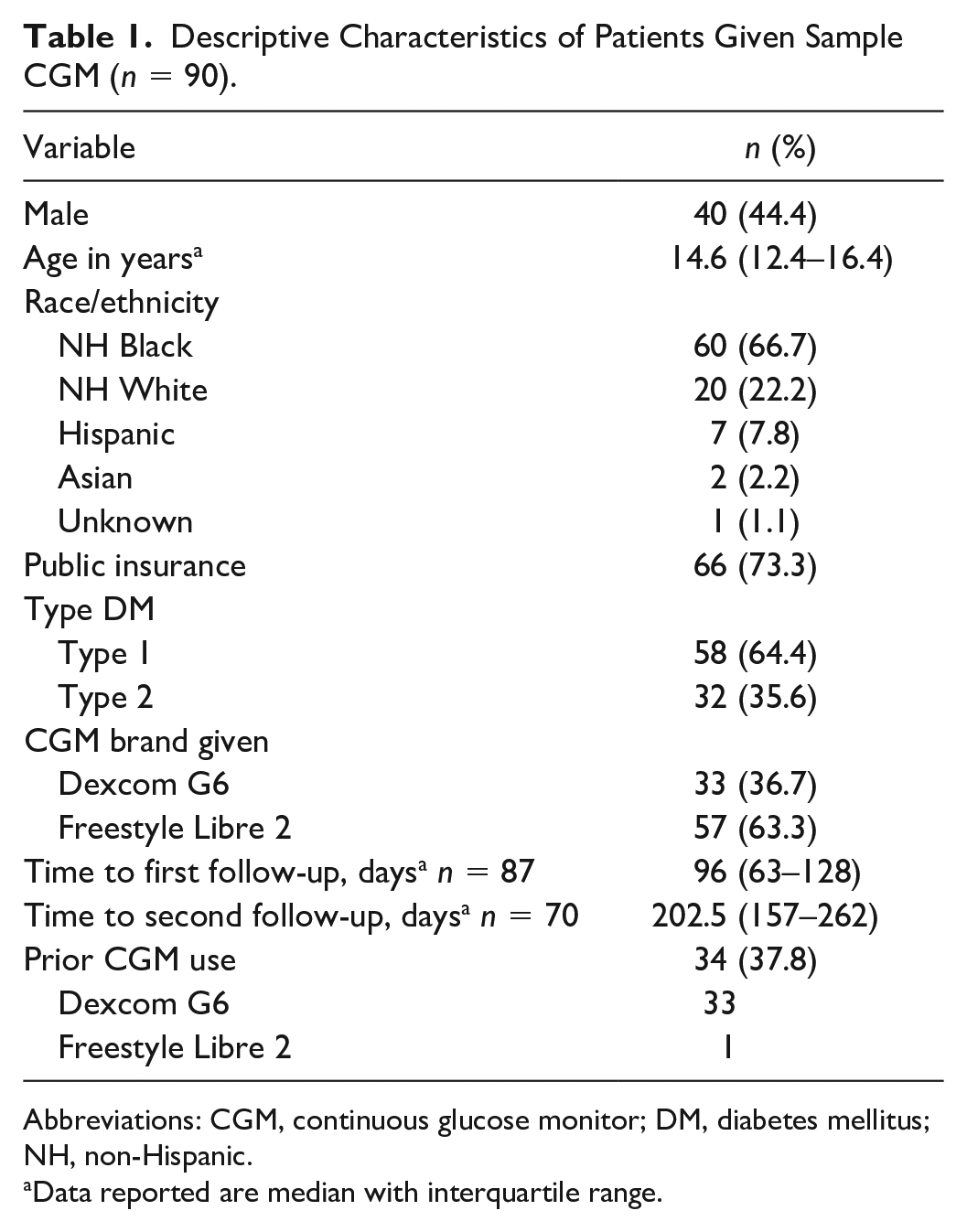
Abbreviations: CGM, continuous glucose monitor; DM, diabetes mellitus; NH, non-Hispanic.
Data reported are median with interquartile range.
There was no association between personal uptake of CGM and age, sex, race or ethnicity, insurance type, diabetes mellitus (DM) type, CGM brand, or prior CGM use.
Providing free CGM samples to youth at the point-of-care increases personal uptake for new CGM users and prior CGM users restarting use. Our findings are similar to a quality improvement initiative providing sample CGMs in an adult diabetes clinic, 5 and in a clinical trial in pediatrics. 6 Many diabetes practices across the country utilize sample CGM programs to provide CGMs at the point-of-care. This may be a feasible strategy to improve personal CGM uptake and sustained use in a real-world setting, especially in underserved and minority populations.
The strength of this report is that it includes a diverse patient population in the real-world clinical setting. Limitations include those inherent to retrospective studies, and there may have been other unmeasured factors impacting CGM uptake.
Footnotes
Abbreviations
CGM, continuous glucose monitor; DKA, diabetic ketoacidosis; DM, diabetes mellitus; NH, non-Hispanic.
Author Contributions
EAB and RMW conceptualized the study. AZ and EAB completed the data collection. AZ, EAB, and RMW wrote the manuscript. All authors critically reviewed the final draft. RMW is the guarantor of this work and, as such, had full access to all the data in the study and takes responsibility for the integrity of the data and the accuracy of the data analysis, and had final responsibility for the decision to submit the manuscript.
Declaration of Conflicting Interests
The author(s) declared the following potential conflicts of interest with respect to the research, authorship, and/or publication of this article: RMW reports receiving research grants from Dexcom, Inc and Boehringer Ingelheim outside the submitted work.
Funding
The author(s) received no financial support for the research, authorship, and/or publication of this article.
