



Abstract
Background:
Sharps waste, especially medical sharps waste, can put those who come into contact with it at risk for injury and exposure to blood-borne pathogens. Options for self-injectors to dispose of their sharps while traveling vary greatly – from sharps containers in limited locations in some public restrooms to large kiosks centrally located to no containers at all. Currently, there is a lack of published data on sharps disposal bins in commercial airports. We surveyed commercial airports in California to assess the current state of sharps waste disposal. Many people with diabetes routinely use sharps every day for injecting medications or for self-monitoring glucose concentrations and these people, along with others who self-inject medications, must have a safe mechanism for sharps disposal when travelling by air.
Methods:
A five-question survey was sent to 30 commercial airports in California. Responses were collected and then analyzed based on the following three metrics: (1) the percentage of airports that responded and indicated that they had any sharps disposal bins, (2) the percentage of airports that responded and indicated that they had sharps disposal bins in over half their restrooms, and (3) the average percentage of bathrooms that have available sharps disposal bins in airports that responded to our survey.
Results:
Out of 30 commercial airports in California, we received survey responses from 13 airport representatives and direct email responses from 5 airport representatives. Out of 18 total responses, 11 airports (61.1%) reported that they had some form of available sharps disposal options. Out of the 13 survey responses, 6 airports (46.2%) reported that they had sharps disposal in over 50% of their restrooms.
Conclusion:
There is a lack of consistency in sharps waste disposal options among commercial airports in California. While many commercial airports in California offer sharps waste disposal options, not all commercial airports have sharps waste disposal options in all their public restrooms. There is room for improved availability of sharps disposal bins in California’s commercial airports.
Introduction
In this issue of Journal of Diabetes Science and Technology, Zhang et al. 1 published a commentary on the necessity of guidelines for sharps waste disposal in commercial airports. In this commentary, Zhang et al. state that there is no standardized guideline for sharps waste disposal in commercial airports, which can put travelers, cleaning staff, and solid waste workers at risk for needlestick injuries and exposure to blood-borne pathogens. For travelers who must use injected medications that generate medical waste, such as travelers with diabetes, a lack of convenient sharps disposal promotes unsafe sharps waste disposal practices and increases the risk of injury to waste handlers and other travelers. Needlestick injuries in the airport sanitation workforce are not well documented. The most relevant discussion of this topic was published in 2010 by Dorevitch et al., 2 who stated that most needlestick injuries occurred when sanitation workers cleaned restrooms and most needlestick injuries were caused by insulin needles.
Currently, no regulations exist for sharps waste disposal options in commercial airports. According to the California Department of Public Health (CDPH)’s website, the CDPH has the authority to approve locations for sharps-consolidation. 3 However, there is no indication of a requirement for locations to provide sharps disposal options. Similarly, there is no regulatory information available on the California Department of Transportation website for airports in California. 4 To get a better understanding of the current landscape of sharps waste disposal in commercial airports, we surveyed all 30 commercial airports represented by the California Airport Council (CAC). The goal of this survey was to obtain data on how many commercial airports have available sharps waste disposal options, and among the airports with sharps disposal, what are the sharps waste disposal options.
Methods
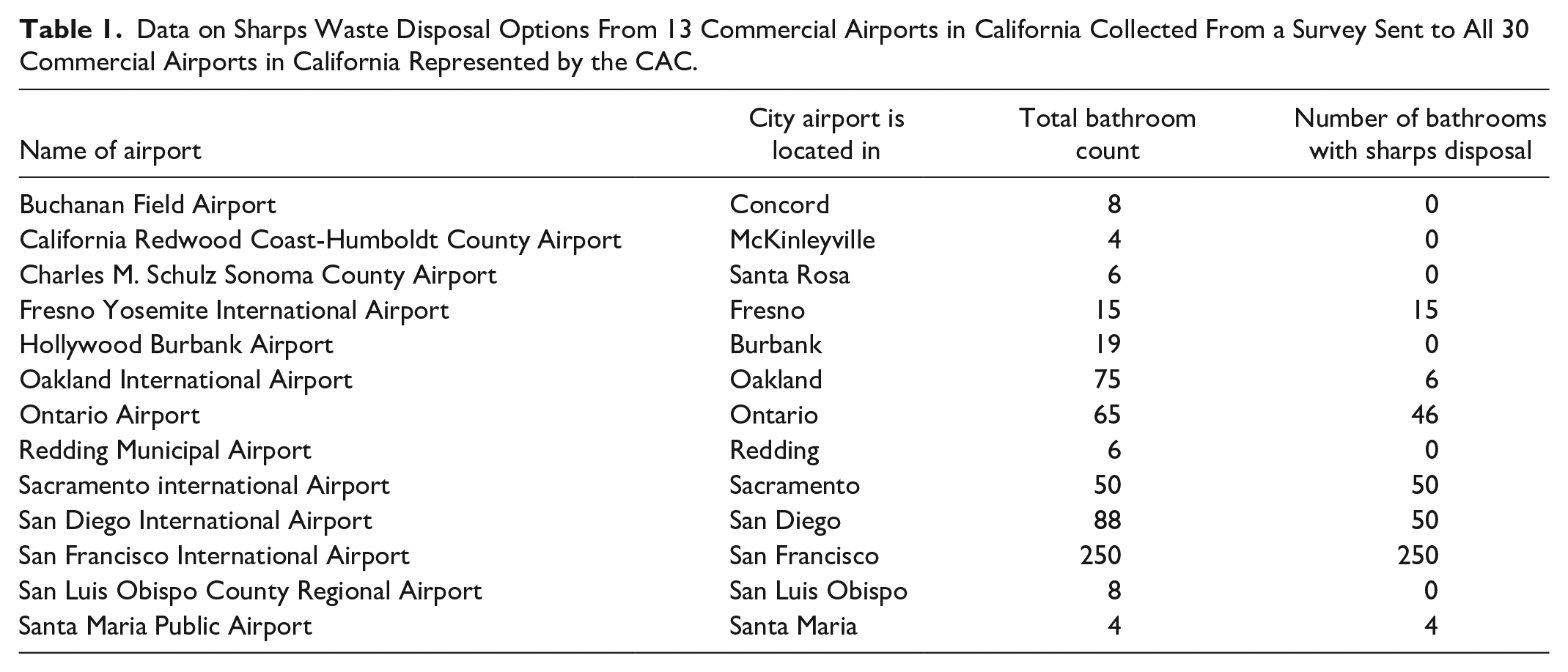
We designed a survey with the following five questions and requests: (1) How many bathrooms, lounges, or other potential locations for sharps disposal bins does your airport have? (2) How many sharps disposal bins does your airport have? (3) If you have airport map images or documents of where sharps disposal bins are located, then please upload them here. (4) If you do not have a map image, then please write out the locations of your sharps disposal bins. Please write N/A if you have already uploaded a map and do not wish to provide further information. (5) Please describe the design(s) of the sharps disposal bin(s) your airport uses. The data from questions 1 (the total bathroom count) and 2 (the number of bathrooms with sharps disposal) are presented in Table 1.
Data on Sharps Waste Disposal Options From 13 Commercial Airports in California Collected From a Survey Sent to All 30 Commercial Airports in California Represented by the CAC.
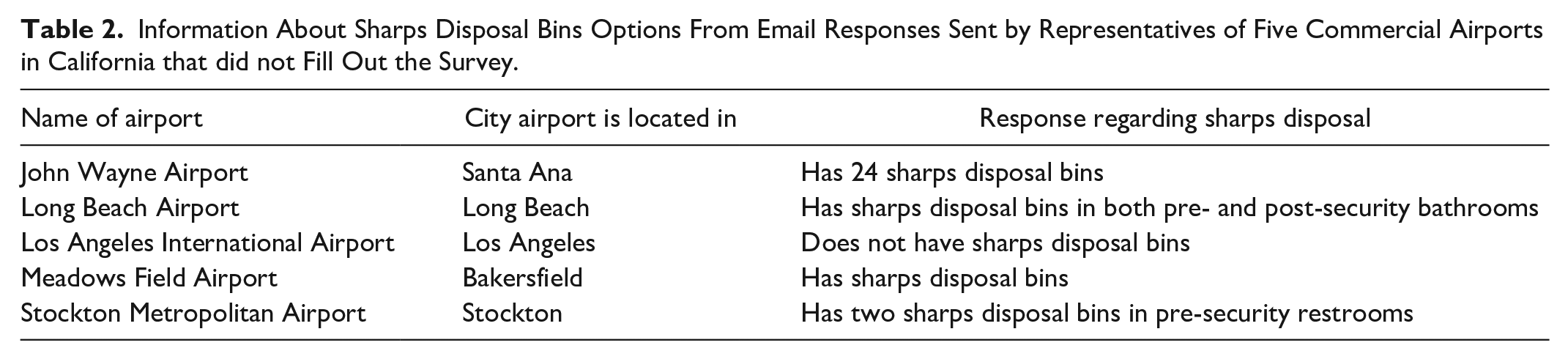
The survey was then distributed by a representative of the CAC to representatives of all 30 commercial airports represented by the CAC. Responses were automatically collected through Google Forms. Five airports individually sent responses by email without completing the survey. The responses received by email contained general responses about whether or not the represented commercial airports have sharps disposal, but did not contain complete survey responses (ie, no numbers regarding how many restrooms in their commercial airport have sharps disposal bins). Table 2 presents self-reported responses regarding sharps disposal bins from representatives of commercial airports in California that did not fill out the survey.
Information About Sharps Disposal Bins Options From Email Responses Sent by Representatives of Five Commercial Airports in California that did not Fill Out the Survey.
The responses to questions 1 and 2 were analyzed and graphed based on the following three metrics: (1) the percentage of airports that responded and indicated that they had sharps disposal bins, (2) the percentage of airports that responded and indicated that they had sharps disposal bins in over half their restrooms, and (3) the average percentage of bathrooms that have available sharps disposal bins in airports that responded to our survey.
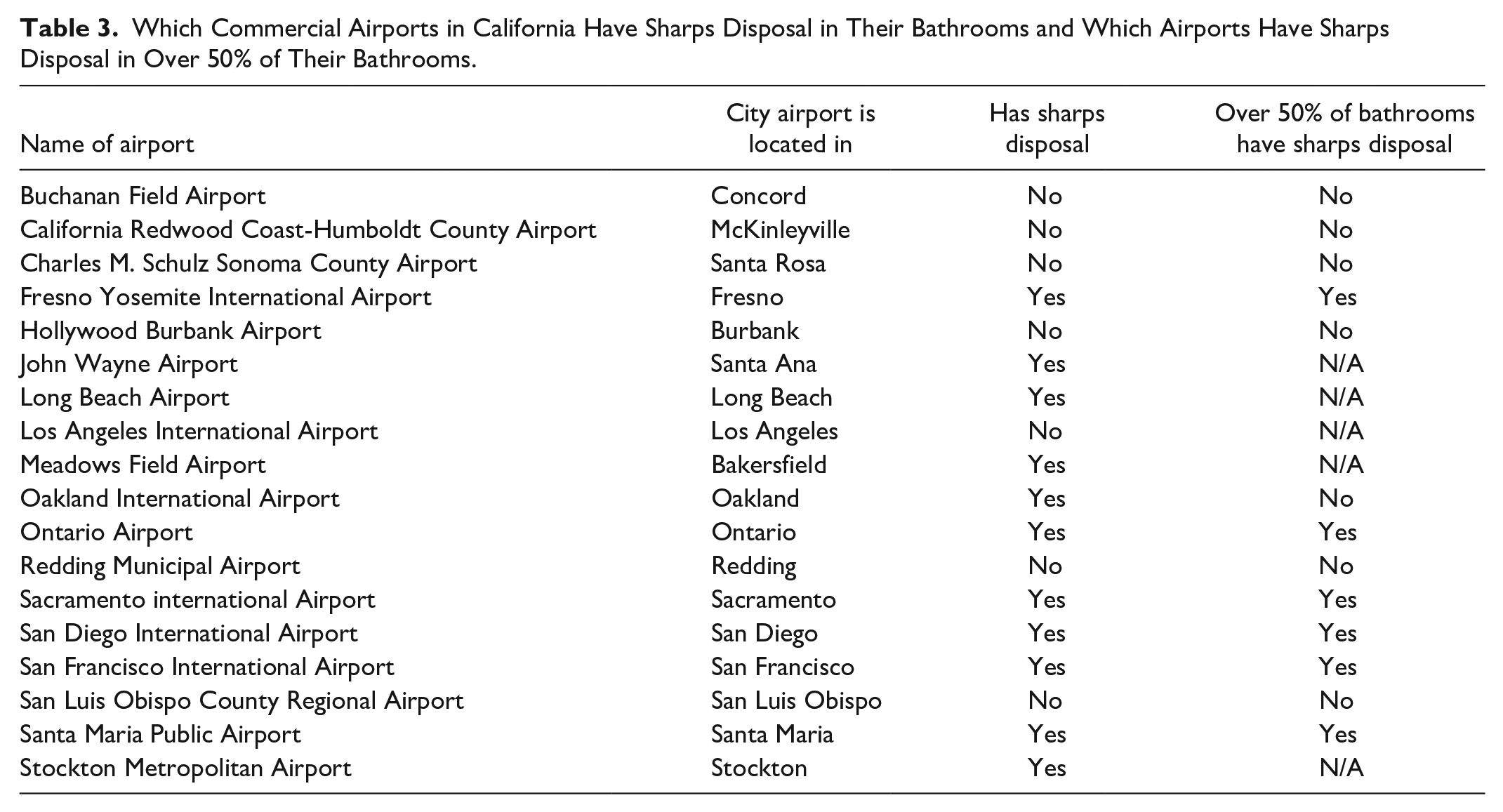
The data from Tables 1 and 2 was used to generate Table 3. Each airport was characterized based on whether they have sharps disposal bins, whether they have sharps disposal bins in over 50% of their bathrooms, and what percentage of their bathrooms have sharps disposal bins. For the airports that did not provide numerical values for their number of bathrooms or number of sharps disposal bins, the value “N/A” was entered for whether they had sharps disposal in over 50% of their bathrooms and the percentage of bathrooms that have sharps disposal.
Which Commercial Airports in California Have Sharps Disposal in Their Bathrooms and Which Airports Have Sharps Disposal in Over 50% of Their Bathrooms.
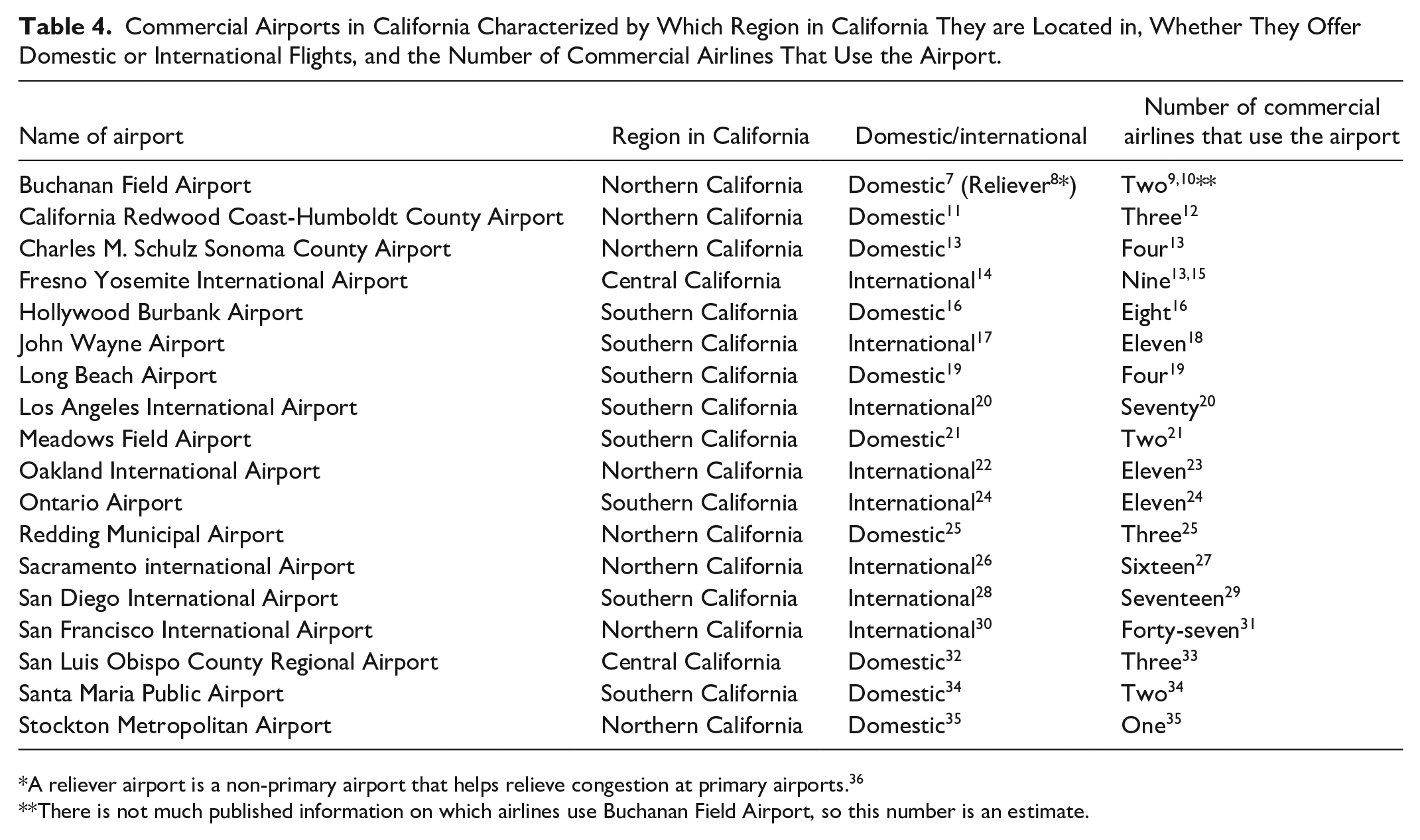
To compare the different airports that we received responses from, we characterized each airport using the following three features: (1) which region in California it is located in, (2) whether it offers domestic or international flights, and (3) the number of commercial airlines that use the airport. We defined California to consist of three regions: (1) Northern California, (2) Central California, and (3) Southern California. These regions are defined based on Study California’s Maps & Regions of California. 5 The information for whether the airports offer domestic or international flights and the number of commercial airlines that use the airport was obtained through each airport’s website and is presented in Table 4. The one exception is Buchanan Field Airport because this airport’s website did not have much information on the types of flights that the airport offers. In this case, we looked up on Google “Buchanan Field Airport flights” and used a flight tracker to determine whether the airport offers domestic or international flights. There is limited information on which airlines use Buchanan Field Airport, 6 but we estimated that there are two commercial airlines that use this airport based on information available on flight trackers and travel websites.
Commercial Airports in California Characterized by Which Region in California They are Located in, Whether They Offer Domestic or International Flights, and the Number of Commercial Airlines That Use the Airport.
A reliever airport is a non-primary airport that helps relieve congestion at primary airports. 36
There is not much published information on which airlines use Buchanan Field Airport, so this number is an estimate.
Results
We received responses regarding public sharps disposal availability from 18 commercial airports out of a total of 30 commercial airports in California. 13 of the responses were collected automatically through our Google Forms survey. Data from 13 commercial airports in California collected from a survey sent to all 30 commercial airports in California represented by the CAC is presented in Table 1. Five airport representatives did not submit data through the survey, but rather through email. These non-survey responses did not include complete numerical data, so they were excluded from some of our analysis. The five email responses that were not received through the survey are presented in Table 2. In response to questions 4 and 5 on the survey, we received photos of sharps disposal bins from four airports and maps of where sharps disposal bins are located from 2 airports.
Using the information received from both survey and non-survey responses, we generated Table 3, which presents information on which airports have sharps disposal in their bathrooms (using data from both survey and non-survey responses) and which airports have sharps disposal in over 50% of their bathrooms (using data from only survey responses).
We found that out of the 18 responses (both survey and non-survey) from airports, 11 airports (61.1%) indicated that they had sharps disposal bins available. This information is presented in Figure 1.
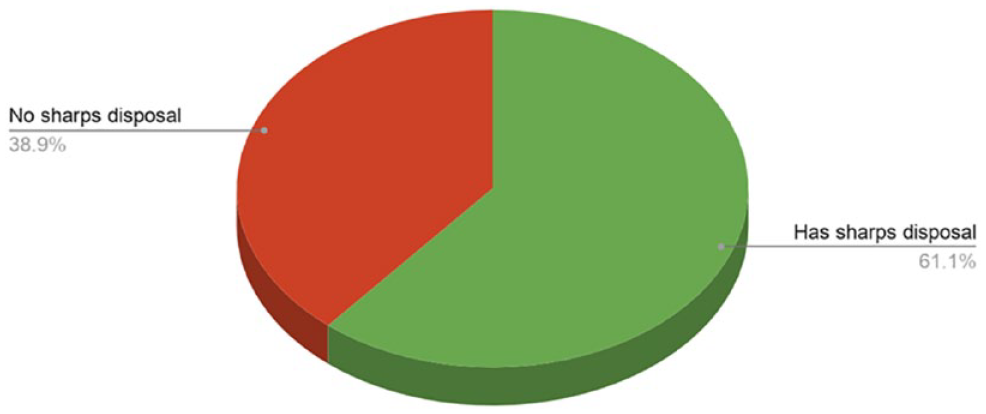
A pie chart showing the percentages of commercial airports in California that responded to our request for information that had and did not have sharps disposal. 61.1% had sharps disposal (in green) and 38.9% did not have sharps disposal (in orange).
We also looked at how many airports had sharps disposal bins in over 50% of their bathrooms. Because the five non-survey responses did not include complete numerical data for their number of total bathrooms and number of bathrooms that include sharps disposal, we omitted these non-survey responses from the calculations. We found that out of 13 airports that provided survey responses, 6 airports (46.2%) had sharps disposal bins in over 50% of their bathrooms. This information is presented in Figure 2.
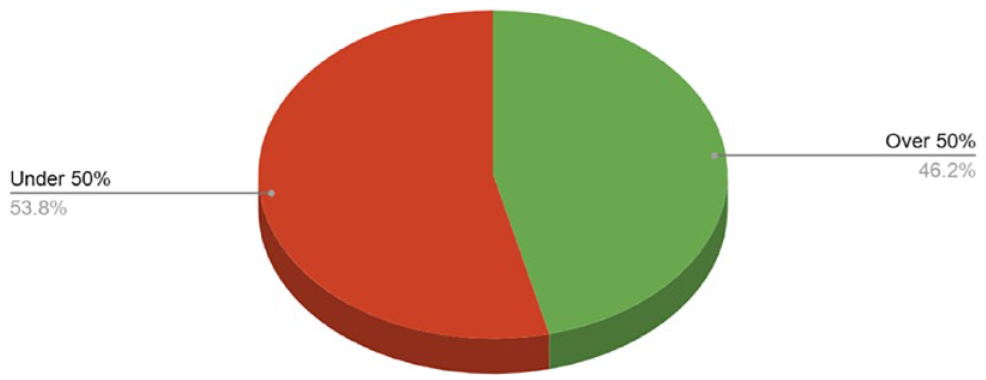
A pie chart showing the percentages of commercial airports in California that filled out our survey that had sharps disposal bins in over 50% of their bathrooms and commercial airports in California that filled out our survey that had sharps disposal bins in under 50% of their bathrooms. 48.2% had sharps disposal bins in over 50% of bathrooms (in green) and 53.8% had sharps disposal in under 50% of bathrooms (in orange).
Table 4 characterizes the airports that we surveyed. Out of the 18 total responses we received, 7 airports (39%) were based in Northern California, 2 (11%) were based in Central California, and 9 (50%) were based in Southern California. Out of the 7 airports in Northern California, 4 airports (57%) claimed to have sharps disposal options. Out of the 2 airports based in Central California, 1 airport (50%) claimed to have sharps disposal options. Out of the 9 airports based in Southern California, 6 airports (67%) claimed to have sharps disposal options. 10 of the commercial airports only offered domestic flights (within the United States) and 8 offered international flights. Out of the 10 commercial airports that only offer domestic flights, 4 airports (40%) claimed to have sharps disposal options. Out of the 8 airports that offered international flights, 6 airports (75%) claimed to have sharps disposal options. 11 commercial airports serviced ten airlines or less, and 7 airports serviced more than ten airlines. Out of the 11 commercial airports that serviced ten airlines or less, 5 airlines (45%) claimed to have sharps disposal options. Out of the 7 airports that serviced more than ten airlines, 5 airports (71%) claimed to have sharps disposal.
Discussion
As far as we are aware, this is the first article that attempts to characterize the availability of sharps disposal options in commercial airports in California. This study has limitations, but we hope that our research inspires other researchers to design and conduct studies of their own to characterize sharps disposal options in commercial airports. One limitation of our study is that we only surveyed commercial airports in one state in the United States of America, California. Our sample size was small (ie, one state), and only represents one specific geographical location. While the majority of the commercial airports that submitted responses indicated that they had sharps disposal options available for travelers, the survey responses were voluntarily supplied and the data could be skewed towards a favorable response (in this case, having sharps disposal options available for travelers). Furthermore, the accuracy of the reported data was not validated by any of the authors.
With the assumption that the collected data is accurate, there is a large amount of variation in sharps waste disposal options for travelers in commercial airports in California. The photos of sharps disposal bins that we received from four airports showed that the commercial airports use different models of sharps disposal bins. Based on the pictures that were provided, the bins were all wall mounted, similarly colored, and clearly labeled, but the openings for each bin varied in size and shape. In general, more commercial airports based in Southern California seemed to offer sharps disposal options. Airports that offer international flights and service more than ten airlines also typically claimed to offer sharps disposal options to their travelers. However, as stated before, our sample size for each of these demographics is small and may not be reflective of the entire population.
The data collected from commercial airports in California highlights the lack of standardization of sharps waste disposal bins in public spaces. A lack of accessible sharps waste disposal options can lead to improper sharps waste disposal practices, that is, disposing of hazardous sharps in normal trash bins, or overflowing sharps containers, leading to a risk of injury and infection. These risks are particularly relevant to travelers with diabetes testing themselves with fingerstick lancets for self-monitoring of blood glucose or using needles to inject insulin or glucagon-like peptide 1 medications. However, safe sharps disposal practices are also relevant for some injectable medications users, such as those with allergies, arthritis, cancer, diabetes, hepatitis, HIV/AIDS, infertility, migraines, multiple sclerosis, osteoporosis, blood clotting disorders, and psoriasis. 37
Several studies have been conducted to gather data on how people with diabetes handle sharps waste in non-healthcare settings. These studies found that unsafe practices for sharps disposal, such as disposing of sharps waste in normal household garbage bins38,39 or even on the street when in public, 40 are common. In fact, studies by Basazn et al., 40 Khan et al., 38 and Montoya et al. 39 found that the majority of people with diabetes they surveyed practiced poor sharps disposal habits. Montoya et al. 39 also found that the majority of people with diabetes they surveyed claimed that they were not properly educated on sharps disposal safety, which likely contributed to poor sharps disposal practices.41,42 With the prevalence of unsafe sharps disposal practices in non-healthcare settings, improving sharps disposal policies for public spaces to reduce risk of injury or exposure is a pressing matter. From our data, we can see that, at least in California, commercial airports are not all providing sharps waste disposal options to travelers. As far as we are aware, there is also no publication of whether sharps disposal options are offered at a particular commercial airport or where sharps disposal bins are located if they are available. Accompanied with the lack of standardized sharps disposal options in commercial airports in California, these factors all increase the burden associated with practicing safe disposal for people who need to dispose of sharps waste. People who must dispose of sharps do not know what sharps disposal options to expect and cannot prepare appropriately.
A first step toward improving safety for airport solid waste handlers and travelers would be to build a consensus among various stakeholders on the need for airports to install sharps containers that are well designed and well placed and which can reduce injuries most likely to solid waste workers. The guideline proposed by Zhang et al. 1 could be the next step because it would establish requirements for sharps waste disposal bins in all public transit environments.
Future studies are necessary to characterize the problems with sharps waste disposal options in order to design actionable solutions that thoroughly address the current shortcomings for sharps waste disposal options in commercial airports. More information is needed on the chain of custody of commercially-postured sharps containers, for example, who is in charge of monitoring and replacing the bins. While sharps waste is closely managed in healthcare facilities, 43 the same cannot be said for public spaces such as commercial airports. Furthermore, there is no published data in the literature on how many patients with diabetes transit these airports, therefore it is unclear what the need for sharps containers looks like, for example, how many bins are needed and how large the bins need to be. Expanded studies with larger sample sizes in different geographical locations outside of California are also needed to further identify the need for sharps waste disposal options, because these needs likely vary from location to location. It would also be beneficial to expand these studies to ground-level transportation hubs, such as train stations and bus terminals.
Conclusion
The availability of sharps waste disposal options varies in each commercial airport in California. There is no standardized requirement for sharps waste disposal bin installation in public restrooms in commercial airports. This inconsistency can increase the risk of needlestick injuries and transference of blood-borne pathogens for everyone who must interact with sharps waste disposal. Further studies are needed to fully understand the resources and options provided for travelers who need to dispose of sharps waste. Publicized guidelines that explain ideal sharps waste disposal bin design and placement in commercial airports would help better protect travelers, cleaning staff, and solid waste workers.
Footnotes
Acknowledgements
We thank Annamarie Sucher-Jones for her expert editorial assistance. We would like to thank the California Airport Council for their assistance in our research.
Abbreviations
CAC, California Airport Council.
Declaration of Conflicting Interests
The author(s) declared the following potential conflicts of interest with respect to the research, authorship, and/or publication of this article: Jennifer Y. Zhang, Trisha Shang, and Dorian Liepmann have nothing to disclose. Edward Krisiunas is the President of WNWN International Inc., a medical waste management company in Burlington, Connecticut. He is currently a consultant for Stericycle, Daniels, HealthBeacon, and Tesalys. David C. Klonoff is a consultant for Dexcom, Eoflow, Fractyl, Lifecare, Novo, Roche, and Thirdwayv.
Funding
The author(s) received no financial support for the research, authorship, and/or publication of this article.

