




Abstract
Travelers frequently eat at an airport before their flight. Travelers with diabetes also frequently need to lance their fingertips to check a blood glucose concentration and/or inject themselves with insulin. These actions generate medical sharps waste. Bloody sharps can be a source of needlestick injuries for other travelers or waste handlers if the waste is not safely disposed of. There are currently no guidelines or standards for medical sharps waste disposal in commercial airports or similar public places. We advocate for the establishment of guidelines for medical sharps waste disposal in commercial airports. These guidelines should include four elements: (1) design of sharps disposal bins, (2) placement of sharp disposal bins, (3) publication of locations with sharps disposal bins, and (4) safety protocols for both sharps disposal and handling sharps waste. In this article, we present the background and reasons behind our recommendation for establishing guidelines for medical waste disposal in commercial airports.
Introduction
In view of the current unregulated distribution of sharps disposal bins, which may be difficult to locate or even be unsafe, the risk of needlestick injuries for both users who must dispose of sharps and cleaning/sanitation staff needs to be reduced. Medical waste, consisting of used needles for self-injected medications, can be generated before a flight by people with diabetes and also in a few cases by other diseases, such as migraines or inflammatory diseases. While guidelines for managing diabetes during air travel have been published by the American Diabetes Association, 1 Transportation Security Administration, 2 and the National Institute of Diabetes and Digestive and Kidney Diseases, 3 none of these guidelines discuss safe sharps disposal and only provide suggestions on transporting supplies for managing diabetes. There is no data in the medical literature about recommended standards for medical sharps disposal at commercial airports. This article covers the current status of medical waste disposal regulation in commercial airports, the purpose of a sharps disposal guideline, benefits of better sharps disposal bins in commercial airports, and the scope of a sharps disposal guideline.
Current Status of Medical Waste Disposal Regulation
As of 2018, over seven million Americans with diabetes have needed to self-inject with insulin to maintain physiologically normal blood glucose levels.4,5 Injections of insulin and self-monitoring of blood glucose prior to an injection require, respectively, handling needles 6 (See Figure 1) and lancets 7 (see Figure 2 8 ), which are exposed to the user’s body and are considered biohazardous.
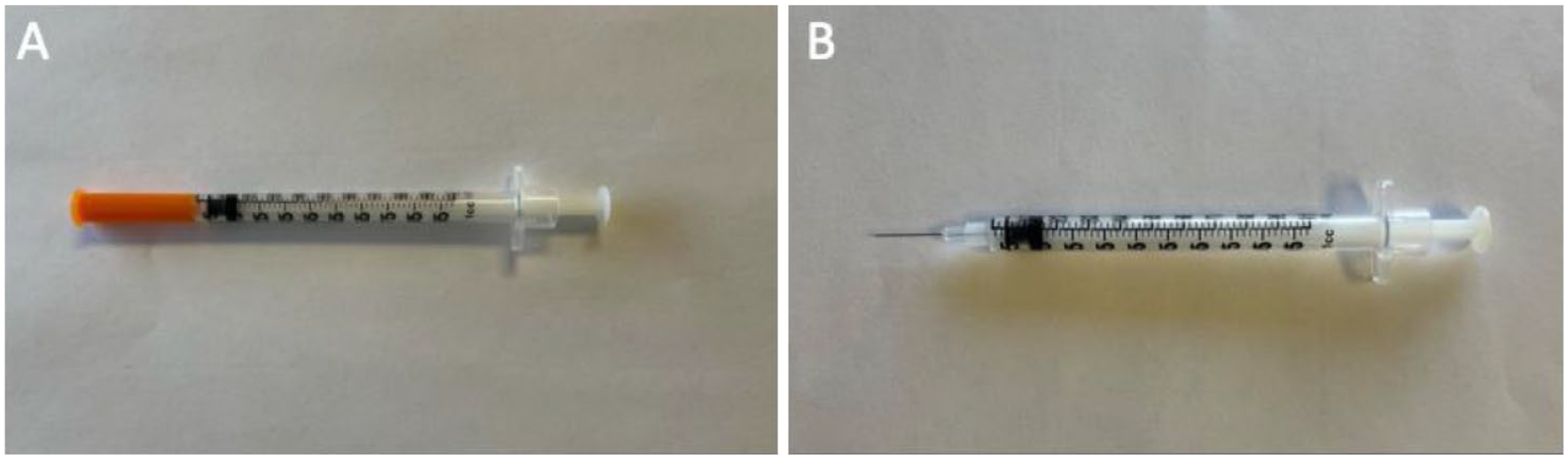
Images of syringes and needles used to deliver insulin. (A) An insulin syringe with a protective cap over the needle. (B) An insulin syringe with the needle exposed. (Both images provided by Irina Nayberg).
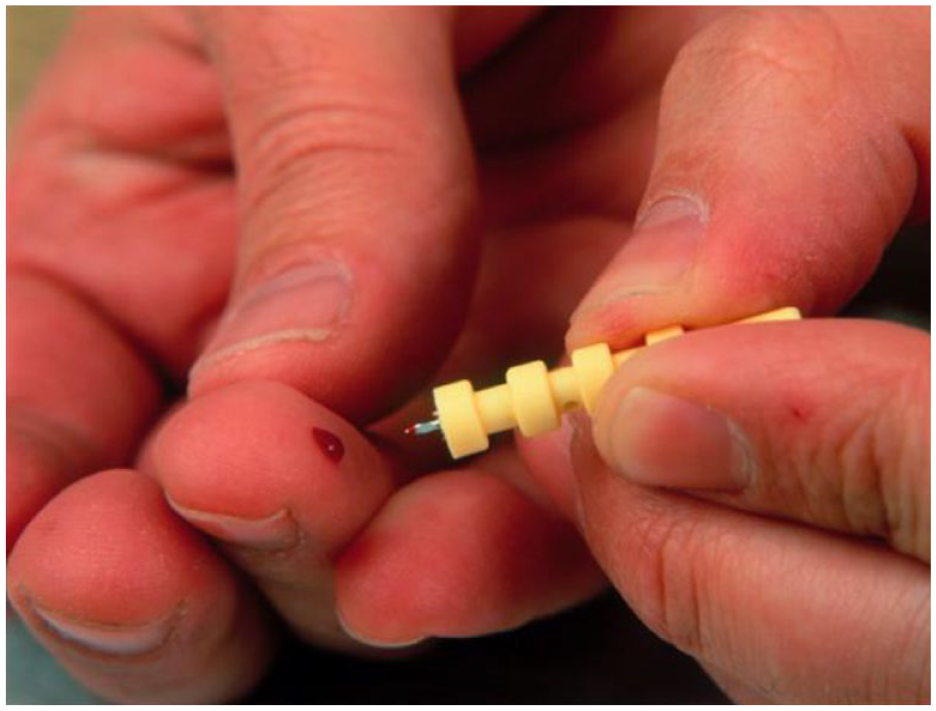
A lancet used to obtain a blood sample from the fingertip. Image used with permission from SATURN STILLS/SCIENCE PHOTO LIBRARY.
In clinical settings, it is easier to safely dispose contaminated materials, where there are designated locations to do this determined by established standards. Since the early 1980s, sharps waste collection containers in healthcare settings have been regulated by the United States Food and Drug Administration (FDA), Occupational Safety and Health Administration, Environmental Protection Agency, and state agencies. In non-healthcare settings, however, no standards mandate the availability of well-designed bins. Studies show that the majority of people with diabetes do not currently follow good practice regarding sharps disposal, that is, disposing of sharps waste in designated and sealed disposal bins.9,10 For example, Montoya et al. 9 surveyed inpatients and outpatients with diabetes that were receiving insulin therapy. Out of 150 survey results, Montoya et al. found that over 30% of the surveyed patients were disposing of sharps waste unsafely and over 60% of the surveyed patients claimed that they were never properly educated on sharps disposal. Another study conducted by Hassan et al. 10 surveyed 429 people with diabetes who were over 12 years of age and had used insulin for over a year. Hassan et al. found that over 60% of patients who responded claimed to dispose of sharps waste in regular public waste disposal bins, and over 80% of patients who responded had poor practices regarding sharps waste disposal. A contributing factor to poor practices is likely the lack of accessible, well designed, and clearly marked sharps disposal bins in non-healthcare settings. Although some studies on patient sharps disposal practices in non-healthcare settings have been published, there is no published data to our knowledge on how people who use sharps manage their waste during air travel. We recommend future studies, such as multisite clinic-based surveys, on how people with diabetes are managing their sharps waste during air travel to emphasize the importance of the availability of safe public sharps disposal options.
Sharps disposal bins in public locations have become more easily found in the past 20 years albeit inconsistently. Some rest stops along major toll roads have installed sharps containers in bathrooms. 11 Casinos have installed sharps containers to accommodate visitors who require self-injection.12-15 Commercial airports fit in this model as well, because they accommodate large gatherings of individuals and serve food, and therefore people with diabetes would require insulin injections.
The Purposes of a Guideline for Sharps Disposal
Four purposes of a guideline for commercial airports covering sharps disposal bins design would be to:
protect travelers who need to dispose of sharps safely;
protect cleaning/waste handling staff from sharps injuries and the potential transference of a blood-borne disease;
promote responsible waste disposal to protect the environment;
reduce liability for airports.
Through a guideline document, commercial airports would be provided with a set of safe options to protect their passengers, staff, and visitors. A guideline document would not be legally binding and, as such, would not penalize those who do not follow the criteria outlined. 16 The main goal of this document would be to educate commercial airports on the liability risk associated with sharps injuries and provide them with necessary information and advice so that they will be well-equipped to better address this public health concern. Such a guideline could serve as a precedent for a more binding set of standards in the future regarding sharps disposal and sharps-related injury prevention, depending on the needs of the stakeholders affected by commercial airport sharps disposal policies. However, standards development can take years and would require the involvement of an official standards developing organization. By turning to a non-binding guideline instead, it would be possible to quickly begin to educate airport officials and inspire changes to occur.
Benefits of Better Sharps Disposal Bins in Commercial Airports
There is a need for better sharps disposal bins in commercial airports specified by a consensus guideline for the following three reasons:
commercial airports need bins;
current bins are often poorly designed;
no guidance exists to encourage better bins.
Many people who travel by airplane will eat meals in the airport prior to boarding or while waiting for delayed flights. Eating before a flight is particularly necessary for people with diabetes because the selection of food on planes is limited and may be less healthy than what is available within the airport. It follows that many insulin requiring people with diabetes will need to self-inject insulin before eating at some point while they are departing from a commercial airport. Proper disposal of these materials is necessary to avoid exposing others to potential blood-borne pathogens. The FDA specifies that travelers who use needles and syringes should never dispose of loose needles and other sharps in trash cans or recycling bins, and they should also never flush them down the toilet. 17
To the best of our knowledge, there are no enforced standards or guidance regarding sharps disposal in public non-medical settings. 18 Some commercial airports have made efforts to appropriately manage sharps waste disposal through training employees and purchasing sharps disposal bins, 19 but there is a lack of standardization among commercial airports regarding bin design/security and placement. Furthermore, when we recently checked for data regarding the availability of sharps disposal bins in commercial airports in California by directly surveying commercial airport representatives and speaking with a representative from the California Airport Council, we could find no consistently available data.
Commercial airports use sharps disposal bins of all shapes and sizes. Some of the bin designs are impractical and unsafe. Pictures of sharps disposal bins in commercial airports around the world demonstrate the variability and in many cases, the poor design of such bins (see Figure 3). Three examples of poorly designed sharps bins are bins that:
are not secured to a surface so they could be easily picked up by any passers-by;
do not indicate how full they are until the sharps stick protrude out of the opening;
contain openings of limited size where a disposed sharp might bounce back and stick the disposing person.
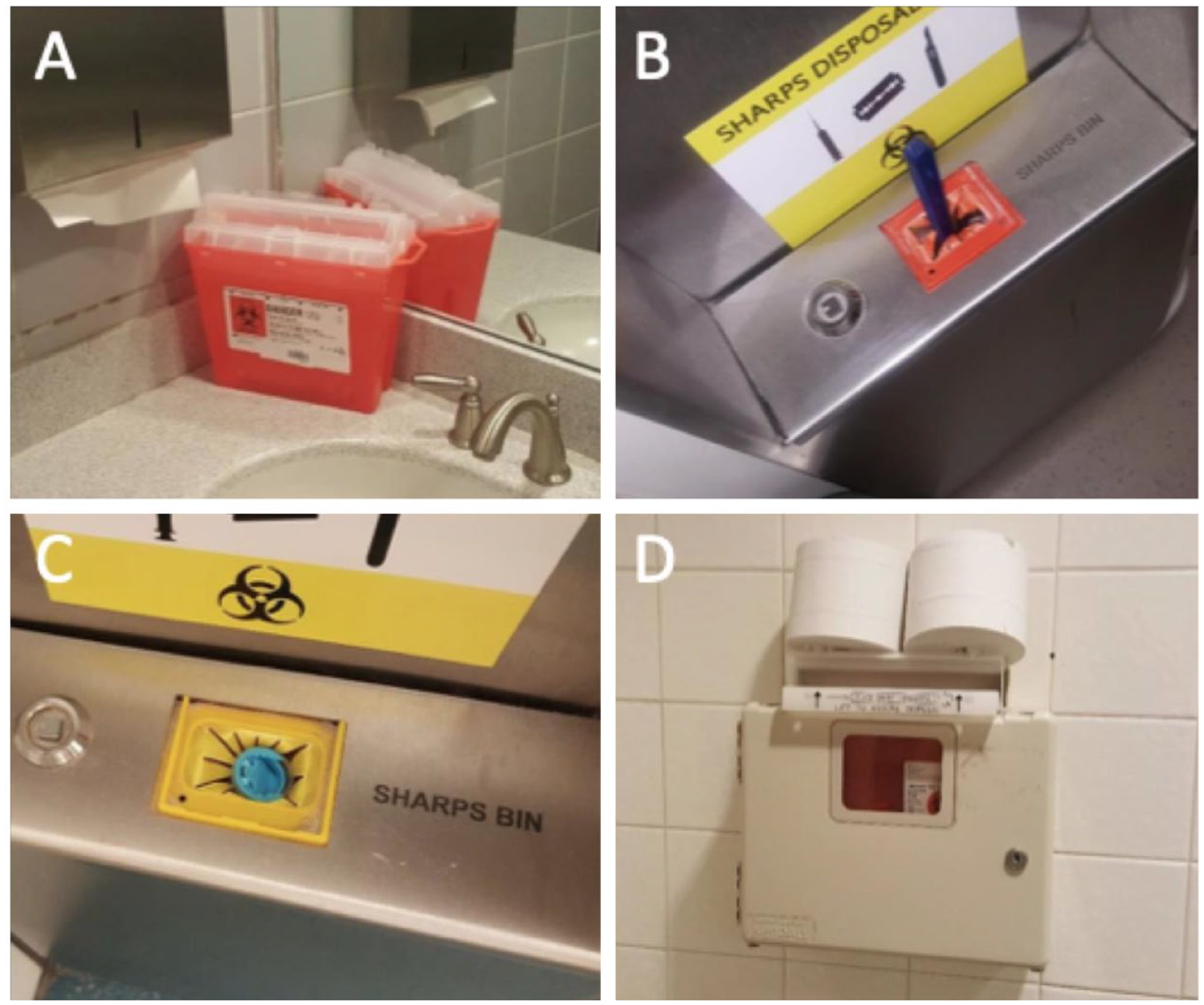
Images of sharps disposal bins in airports around the world. (A) A free-standing sharps disposal bin. (B) A piece of sharps waste that did not fit into the provided sharps disposal bin. (C) A sharps disposal bin with the opening blocked by a piece of sharps waste. (D) A wall-mounted sharps disposal bin with rolls of toilet paper above the opening. (All images provided by Edward Krisiunas).
These different and poorly designed bins each pose unique risks to the public. These risks include physical injury from improperly stored sharps as well as exposure to a blood-borne virus, such as hepatitis B, hepatitis C, or human immunodeficiency virus.20,21
The Scope of a Guideline for Sharps Disposal Bins in Commercial Airports
A guideline for sharps disposal bins would cover the following topics:
Safe design and structure
Secure placement
Publication of available locations
Methods for safe sharps collection by sanitation workers
The first two topics of the guideline would physically protect travelers who need to dispose of sharps waste. The design and placement of sharps disposal bins are important safety features, because they establish a physical barrier between the traveler and the sharps waste. Sharps disposal bins should be puncture-resistant and securely mounted at a height that can be easily reached by all travelers, including persons in wheelchairs. The third topic of the guideline would inform the traveler of safe bin locations which promotes opportunities for safe sharps disposal. The fourth topic of the guideline would aim to protect sanitation workers because they must transport the sharps waste after the waste disposal bins are full. Providing recommendations for safe sharps collection by sanitation workers would also promote responsible waste disposal to improve environmental health and reduce the liability of needlestick injuries for airports. This guideline could potentially specify: (1) a list of multiple safe methods, (2) a single standardized method or protocol, or (3) a recommendation that each airport establish its own standardized protocol. The proposed guideline document does not address every aspect of establishing safe sharps disposal, such as who would be responsible for the chain of custody for handling of the sharps waste, how will passengers and air crew be educated about disposal, or how will locations of sharps containers be identified (eg, similar to the way an automatic external defibrillator location is identified). The issue of bin standards pertains not only to commercial airports but to other civilian centers of mass transportation.
In healthcare settings, standards and guidance are available for sharps containers. They can be found, for example, in patient examination rooms. Standards and regulations have been developed by numerous organization and government agencies, including the National Institute for Occupational Safety and Health (NIOSH), 22 the British Standards Institution (BSI), 23 Canadian Sharps Association (CSA), 24 and the International Organization for Standardization (ISO). 25 These standards address design, puncture resistance, labeling/marking, and placement. Some examples of guidelines and the properties of sharps disposal they address are listed in Table 1.26-28
Examples of Standards, Guidelines, and Regulations for Sharps Disposal Bins, According to the Organization’s Name, its Region, and the Contents of the Regulatory Document. Organizations are Listed in Alphabetical Order.
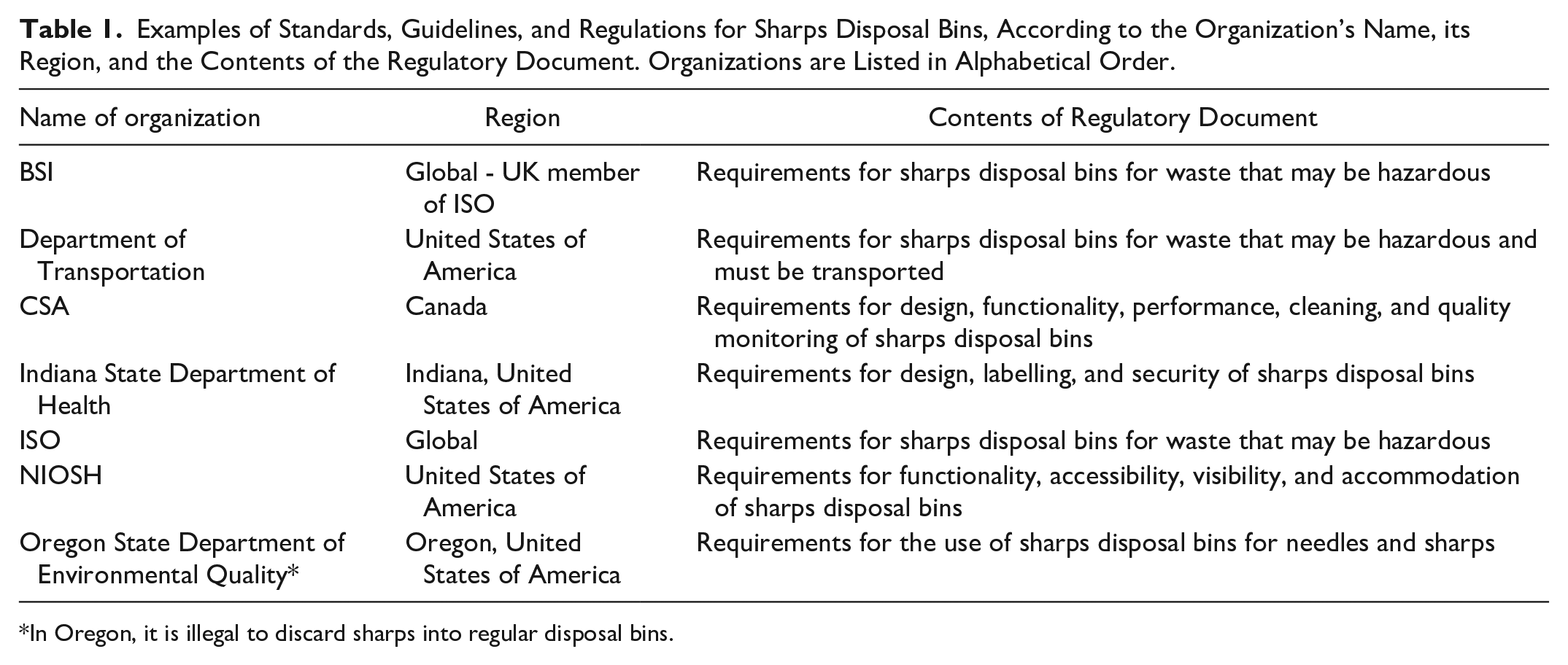
In Oregon, it is illegal to discard sharps into regular disposal bins.
Sharps disposal in public settings, when compared to healthcare settings, is subject to less regulation. 18 Selection and placement of sharps containers is currently often based upon a subjective criterion, such as sales information, rather than taking into consideration security, height placement, and visibility of the inner contents to guide exchanging/replacing the container. As the goals of sustainability and preservation of environmental health are increasingly being adopted, some private companies have been developing products to promote sustainable and safe medical waste disposal in non-healthcare settings.29,30 However, guidelines for medical waste disposal in non-healthcare settings from the federal government are not standardized. In the United States, guidelines can vary greatly from state to state, or even county to county. 31 Developing guidance specific to public spaces like airports would need input from stakeholders who would have an interest in bin standards. These stakeholders include those who are involved in the collection of these containers, people with diabetes who fly frequently, airport management staff, health and safety/infection prevention staff, diabetes educators relative to disposal of items used by people with diabetes, vendors of the sharps bins/ biomedical-engineering design professionals, and regulatory authorities with medical waste management oversight.
Conclusions
Guidelines for proper sharps disposal precautions and protocols for airports would help protect travelers and waste handling workers from sharps puncture injuries and exposure to blood as well as reduce liability risk for airports. Such guidelines will also decrease the risk of viral transmission from medical sharps used for diabetes. Implementing guidelines for sharps disposals in airports is sound public policy.
Footnotes
Acknowledgements
We would like to acknowledge the California Airport Council for their guidance and assistance. We would like to thank Annamarie Sucher-Jones for her expert editorial assistance.
Abbreviations
BSI, British Standards Institution; CSA, Canadian Sharps Association; FDA, United States Food and Drug Association; ISO, International Organization for Standardization; NIOSH, National Institute for Occupational Safety and Health
Declaration of Conflicting Interests
The author(s) declared the following potential conflicts of interest with respect to the research, authorship, and/or publication of this article: Jennifer Y. Zhang, Trisha Shang, and Dorian Liepmann have nothing to disclose. Edward Krisiunas is the President of WNWN International Inc., a medical waste management company in Burlington, Connecticut. He is currently a consultant for Stericycle, Daniels, HealthBeacon, and Tesalys. Lutz Heinemann is a partner of Profil Institut für Stoffwechselforschung in Neuss, Germany. He is a member of a number of advisory boards for Roche Diagnostics, Rubin Medical, Sanofi, Zealand Pharma, Novo Nordisk, and Dexcom, and has served on advisory panels for Medtronic, Abbott,and Novo Nordisk. David C. Klonoff is a consultant for Dexcom, Eoflow, Fractyl, Lifecare, Novo, Roche, and Thirdwayv.
Funding
The author(s) received no financial support for the research, authorship, and/or publication of this article.
