



Abstract
Thirteen continuous glucose monitoring (CGM) systems exist in the market for patients with type 1 and 2 diabetes. As of June 2017, over 40 000 reports were filed with the FDA indicating inaccuracies with blood glucose levels using CGM systems. 1 CGM devices measure interstitial glucose values and need to be validated against laboratory reference glucose analyzers for accuracy. However, whether differences in blood glucose exist between different areas of the body needs further exploration.
We used the Freestyle Libre Pro, a subcutaneous CGM system to assess differences between the left and right arms in 2 male nondiabetic adult volunteers. 2 Both participants wore a CGM sensor on the left and right arms per the manufacturer instructions with glucose levels measured every 15 minutes in each arm. Of note, both participants were right-handed. All data from the first day (minimum 12 hours of data) were dropped as they are known to be inaccurate. Data were time matched with the maximum difference being 5 minutes between the two readings. Both participants wore the sensors for 10 days generating a total of 1920 glucose readings per arm. Subjects followed a free-living diet for the duration of the study. A paired Student’s t-test was performed for all continuous data and a Fisher’s exact test performed for all discrete data.
A total of 1920 time matched left-arm and right-arm pairs were analyzed. The right arm was greater than the left arm 96.0% of the time (Figure 1). The average glucose readings for the right and left arms were 96 ± 16 mg/dL (range 68-186) and 88 ± 15 mg/dL (range 57-174), respectively (P ≤ .001). The minimum and maximum changes in the right arm relative to the left arm were −11 and 41 mg/dL respectively. In the right arm, 2.19% of the values were outside the 70-140 mg/dL range compared to 4.58% in the left arm (P ≤ .001). In 14.1% of cases, the right arm was greater than the left arm by 15% or more. There is no correlation between the magnitude of intra-arm differences and glucose levels (R2 < .09).
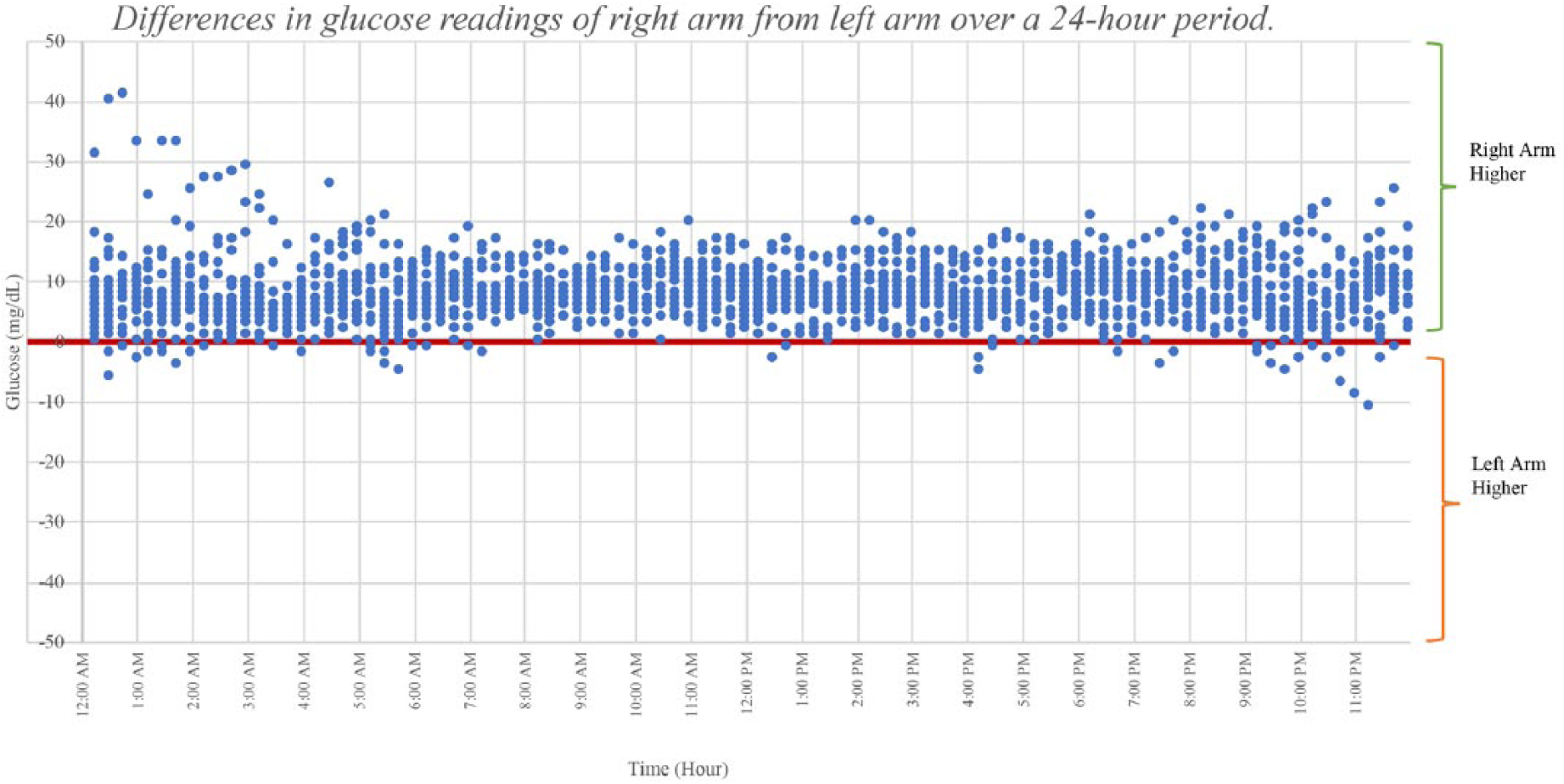
Differences in glucose readings of right arm from left arm over a 24-hour period.
The right arm was higher 96% of the time and was half as likely to detect glucose levels outside the 70-140 mg/dL range compared to the left arm. Generally, 1 unit of insulin decreases blood glucose by 50 mg/dL and since the average difference between the two arms was approximately 8 mg/dL (range −11 to 41 mg/dL), only a small number of patients on self-monitoring blood glucose (SMBG) systems may be impacted. However, this degree of change could significantly impact clinical trial design and interpretation. In 2 recent landmark trials comparing CGM with SMBG in patients with type 1 diabetes, the published protocols did not specify on which arm the sensor was placed.3,4 Interestingly, when the sensor was worn by a left-handed person for 8 days (768 data pairs), the right arm was higher only 21.5% of the time.
These findings need to be validated in larger studies with a diverse patient population to eliminate the presence of any sensor related bias. In addition, a study enrolling patients that are left-arm-dominant versus right-arm-dominant to delineate the mechanism behind any real differences due to sensor site selection would be valuable. Since interstitial fluid behaves as a different compartment relative to blood, it is possible that muscle/fat mass differences between the two arms explains the glucose level discordance between the arms. 5 It may not be unreasonable to study the placement of two sensors on each arm to assess inter- and intra-arm differences. Bleeding from the skin can also interfere with the sensor suggesting the need for assessing the degree of bleeding during sensor placement and removal. 6
Ours is the first report suggesting the need for future studies assessing if patients and clinical trials need to be consistent in choosing on which arm to place the CGM sensor.
Footnotes
Abbreviations
CGM, continuous glucose monitoring; FDA, Food and Drug Administration; SMBG, self-monitoring blood glucose.
Declaration of Conflicting Interests
The author(s) declared no potential conflicts of interest with respect to the research, authorship, and/or publication of this article.
Funding
The author(s) received no financial support for the research, authorship, and/or publication of this article.