




Abstract
Despite increased use of insulin pumps, many youth with T1D exhibit significant glycemic variability (GV). Emerging data suggest that GV relates to complications of diabetes.1,2 Prior studies demonstrated that entering self-monitoring blood glucose (SMBG) and carbohydrate data into the pump and delivering insulin boluses relate to improved mean blood glucose (BG) and glycated hemoglobin (HbA1c).3,4 We hypothesized that as patients increased these behaviors, GV would decrease.
Average daily risk range (ADRR) measures GV and is calculated from SMBG data using days with ⩾3 SMBG; a minimum of 14 days is required. It is computed by mathematically transforming BGs into a symmetrical scale giving equal weight to hyperglycemic and hypoglycemic values and computing the mean of daily high and low values. Higher values suggest risk of hyperglycemia and hypoglycemia. 5 Multiplicative standard deviation (MSD) similarly corrects for skewed data distributions. Logarithmic transformation of BGs yields a symmetrical distributional form; SD is then calculated on log-transformed values, and the result is exponentiated, which yields the nonscalar MSD parameter. 6 For example, for a set of BGs with an MSD of 1.5 and an average of 150 mg/dL, the values 225 mg/dL and 100 mg/dL are 1 MSD above and below the mean, respectively, reflecting the asymmetry of the BG data. We evaluated pump data on a random sample of 100 patients with T1D aged 3.5-20.5 years (median 15.0 years). Associations between adherence behaviors and GV were evaluated using Spearman correlations with P < .05 as significant.
Patients entered SMBG ⩾4 times on 52% of study days, carbohydrates ⩾3 times on 71% of study days, and delivered boluses ⩾3 times on 80% of study days. HbA1c was inversely correlated with number of days entering SMBG ⩾4 (rho = −.342, P < .001), carbohydrates ⩾3 (rho = −.382, P < .001), boluses ⩾3 (rho = −.316, P = .001), and completing all three behaviors (rho = −.374, P < .001). HbA1c was positively correlated with number of days with no bolus (rho = .234, P = .019), no SMBG (rho = .369, P = .0002), and number of times the patient gave less insulin than recommended by the bolus advisor (rho = .382, P < .0001). HbA1c was positively correlated with MSD (rho = .272, P = .006) and ADRR (rho = .409, P < .001).
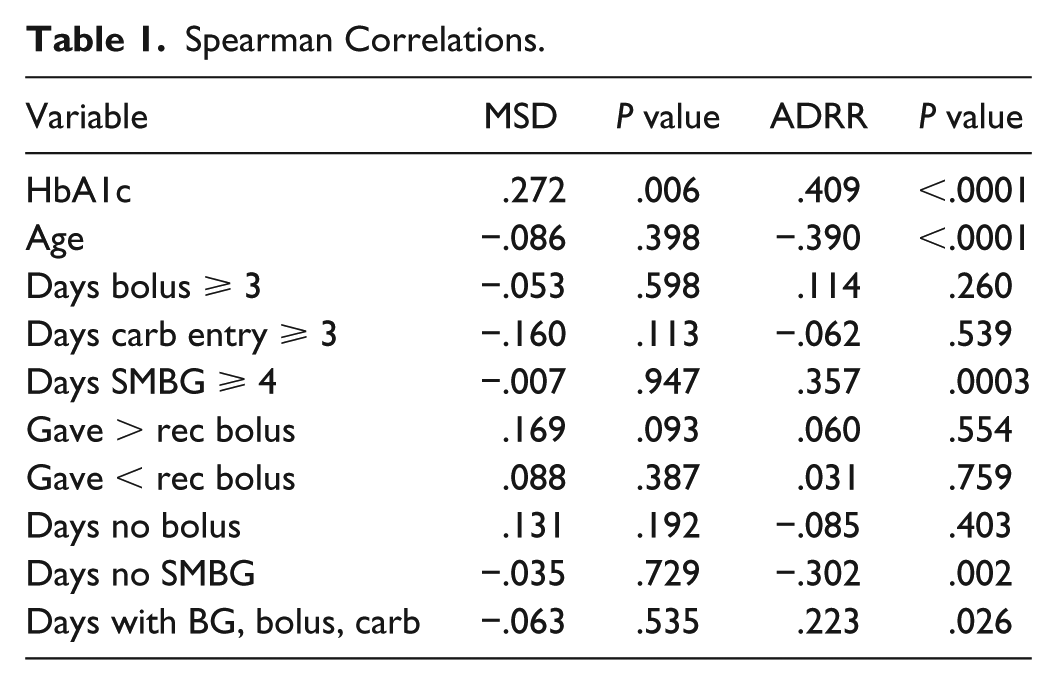
Increased adherence behaviors were not significantly correlated with decreased GV (Table 1). Entering SMBG ⩾4, carbohydrates ⩾3, or bolus delivery ⩾3 times per day were not correlated with MSD. Entering carbohydrate or bolus ⩾3 times per day did not relate to ADRR. ADRR was positively correlated with number of days with SMBG entries ⩾4, days with no SMBG, and days all three behaviors occurred. The direction of these correlations was unexpected. We hypothesized that more frequent behaviors would relate to lower ADRR. This paradox might be explained by the method of ADRR calculation relying on maximum and minimum BGs. As BG checks increase, there are more opportunities to capture extreme out-of-target BGs, yielding a higher ADRR. Similarly, increased engagement with SMBG and carbohydrate entry may yield more boluses, which could lead to more GV.
Spearman Correlations.
We did not find an association between pump adherence behaviors and GV. Additional behaviors should be considered as targets for interventions to decrease GV, and other measures of GV deserve further study.
Footnotes
Abbreviations
ADRR, average daily risk range; BG, blood glucose, GV, glycemic variability; HbA1c, glycated hemoglobin; MSD, multiplicative standard deviation; SD, standard deviation; SMBG, self-monitoring blood glucose; T1D, type 1 diabetes.
Declaration of Conflicting Interests
The author(s) declared no potential conflicts of interest with respect to the research, authorship, and/or publication of this article.
Funding
The author(s) received no financial support for the research, authorship, and/or publication of this article.
