




Abstract
An improved test cassette for the integrated Accu-Chek® Mobile system (Roche Diabetes Care GmbH, Mannheim, Germany) has been developed. System accuracy of this improved system was evaluated based on ISO 15197:2013, clause 6.3, for three reagent system lots. According to this standard, at least 95% of the system’s measurement results shall be within ±15 mg/dL and ±15% of the results of the comparison method at glucose concentrations <100 mg/dL and ≥100 mg/dL (accuracy criterion A), respectively, and at least 99% of results shall be within consensus error grid zones A and B (accuracy criterion B). In addition, accuracy was evaluated in the hands of users based on ISO 15197:2013, clause 8, with one reagent system lot.
Keywords
Systems for self-monitoring of blood glucose (SMBG) must provide accurate measurement results. A number of user errors can occur during SMBG that may in part compromise analytical performance, including the use of expired test strips, inadequate storage conditions, or having glucose-contaminated fingertips.1-3 An approach to reduce potential user errors is the development of more integrated systems to reduce SMBG handling steps, for example, by incorporating the tests into the meter by using cassettes, discs or drums. The Accu-Chek® Mobile system (Roche Diabetes Care GmbH, Mannheim, Germany) integrates a test cassette with 50 tests on a tape into the meter eliminating the single insertion of test strips for every measurement (Figure 1). Measurement results can be affected, for example, by pressing the fingertips on the test area when applying blood or by contamination of the test area with glucose residue on fingertips when patients did not wash their hands. Recently, an improved test cassette with guidance tabs has been developed to ensure that only the blood drop has contact with the test field (Figure 2), so that both pressure and contact with possibly contaminated skin area are minimized.
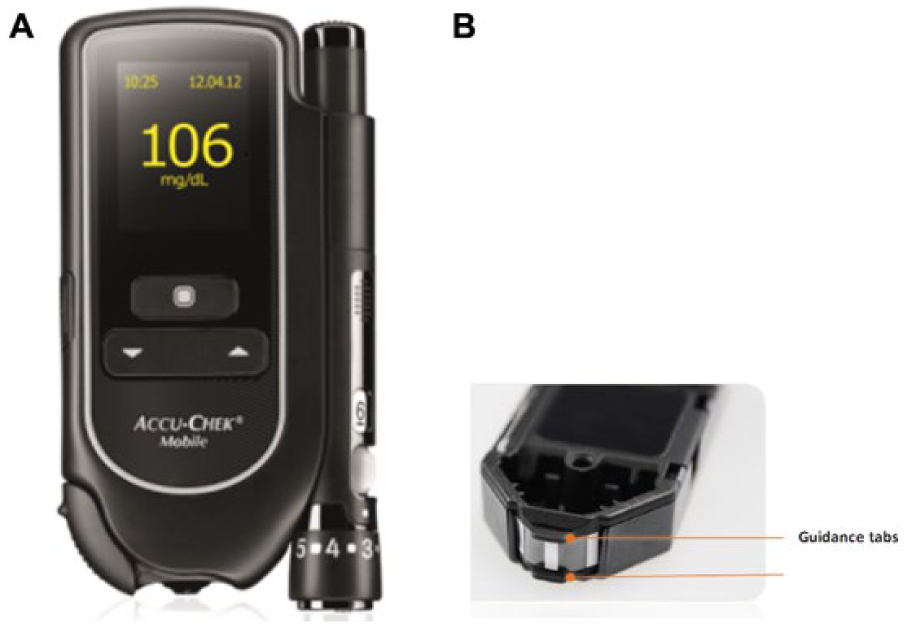
Illustrations of the system (A) and the improved test cassette (B) with the guidance tabs.
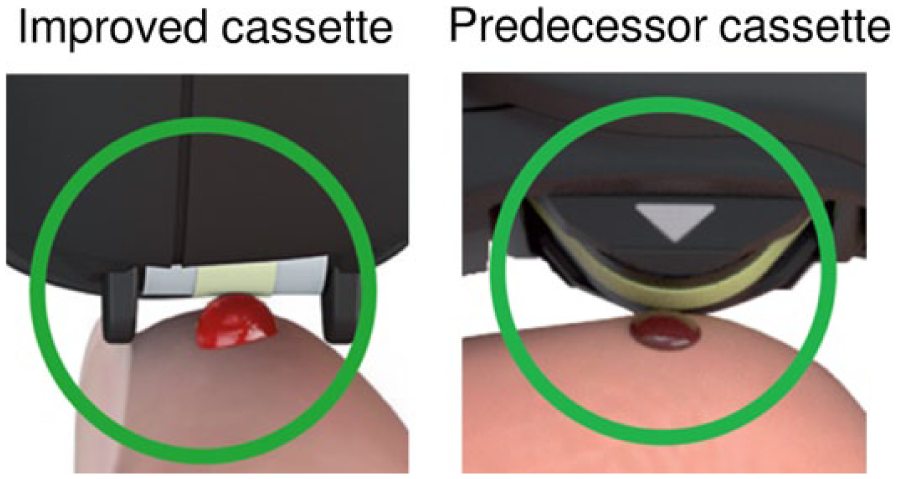
Schematic illustrations of the tip of the improved cassette and the predecessor cassette. The improved cassette incorporates guidance tabs to ensure that only the blood drop has contact to the test field.
In this study, system accuracy was evaluated for the improved system based on ISO (International Organization for Standardization) 15197:2013, 4 clause 6.3, by using three different reagent system lots. In addition, accuracy was evaluated for one reagent system lot in the hands of users based on ISO 15197:2013, clause 8, with focus on blood application.
Materials and Methods
The study was conducted between April and June 2017 at the Institut für Diabetes-Technologie Forschungs- und Entwick-lungsgesellschaft mbH an der Universität Ulm, Germany in compliance with the German Medical Devices Act. The study was approved by the responsible Ethics Committee and was exempted from approval by the German Federal Institute for Drugs and Medical Devices. All participants signed informed consent forms prior to the study procedures.
Subjects
For system accuracy evaluation, 113 subjects ≥18 years with diabetes mellitus type 1 or type 2 or without diabetes were included. For user performance evaluation, 107 subjects ≥18 years with diabetes mellitus type 1 or type 2 were included.
Test System
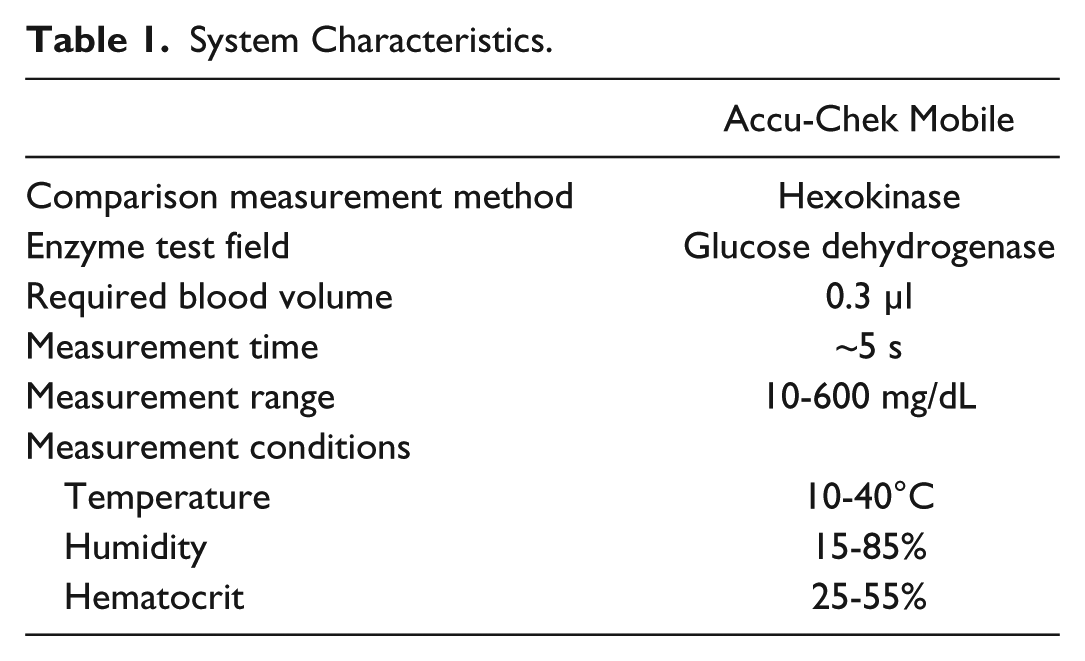
The new version of the system provides an improved test cassette which can be used with the currently available meters (Figure 1, Table 1). In contrast to the predecessor, the new test cassette incorporates guidance tabs on the test tip to ensure an adequate distance between the fingertip and the test area so that only the blood drop has contact with the test field. The new cassette is approximately 0.5 mm shorter than the predecessor (Figure 2). Control measurements were performed daily prior to the test procedure according to the manufacturer’s labelling and for each test cassette to ensure proper function.
System Characteristics.
Comparison Measurement Method
Comparison measurements were performed on deproteinized capillary whole blood with a hexokinase method (Cobas® 6000 c501; Roche Diagnostics GmbH, Mannheim, Germany) in triplicate at the laboratory at Roche Diabetes Care GmbH in Mannheim. Mean blood glucose (BG) values were provided in mg/dL.
Testing Procedures
Testing procedures were performed in a laboratory setting based on procedures described in detail in ISO 15197:2013. ISO 15197:2013 was harmonized in the European Union as EN ISO 15197:2015 5 with no changes regarding its requirements for performance studies. For hygienic reasons, each subject was provided with a separate test cassette and lancing device. Test meters were cleaned and disinfected after each subject.
System Accuracy
System accuracy was evaluated for 3 reagent system lots in the hands of trained study personnel based on procedures described in detail in ISO 15197:2013, clause 6.3.
Samples
The system was tested on at least 100 capillary samples from different subjects. According to ISO 15197:2013, clause 6.3.5, samples were distributed into different BG concentration categories according to the mean BG result of the comparison method.
For BG concentrations <50 mg/dL and >400 mg/dL, adjusted samples could be used. Adjustment was performed by either incubation to allow for glycolysis or by glucose supplementation (stock solution: 40% glucose in 0.9% NaCl).
Measurement Procedure—System Accuracy
Subjects were asked to wash and dry their hands before the measurement procedure. Study personnel collected capillary blood samples from the fingertip by skin puncture.
For each lot, duplicate measurements were consecutively performed on an individual sample by using two test systems. Aliquots for measurements with the comparison method were collected before (first laboratory measurement result) and after (second laboratory measurement result) the measurement procedure and were centrifuged, and supernatants were frozen at <–20°C.
User Performance
Accuracy in the hands of users was evaluated for 1 reagent system lot based on procedures described in detail in ISO 15197:2013, clause 8. Familiarization and measurement procedure were supervised by study personnel. This user performance evaluation focused on blood application by using the new test cassette, whereas subjects could be assisted regarding other aspects of meter and lancing device handling.
Familiarization
Each subject received training meter, training test cassette and an excerpt of the instructions for use routinely provided with the system describing the measurement procedure. Subjects had the opportunity to review the instructions for use and performed up to three training measurements.
Measurement Procedure—User Performance
After the familiarization, each subject collected its own capillary blood sample from the fingertip and performed a measurement by using the test meter. Out of 107 subjects, 104 washed their hands before the measurement. After the measurement, subjects were asked whether they thought that they had performed the measurement correctly. Subjects could repeat the measurement up to three times if they reported a mistake or if no valid result was obtained. The first quantitative measurement result for which a subject did not report a mistake in the measurement procedure was included in the accuracy analysis. After the measurement procedure, two aliquots for measurements with the comparison method (first and second laboratory measurement result) were collected and processed as described above.
Data Exclusions
To verify sample stability, the difference between the first and second laboratory measurement result was checked to be ≤4 mg/dL at BG concentrations ≤100 mg/dL and ≤4% at BG concentrations >100 mg/dL to verify sample stability. Data were excluded if they exceeded these criteria.
Data Analysis
System Accuracy
In total, 200 data (duplicate measurement on 100 capillary samples from different subjects) were analyzed and accuracy was assessed by comparing the SMBG system’s measurement results with the respective mean result of the comparison method (obtained from aliquots collected before and after the measurement with the system). For each lot, number and percentage of results within ±15 mg/dL of the mean comparison measurement result at BG concentrations <100 mg/dL and within ±15% at BG concentrations ≥100 mg/dL were calculated. The number of acceptable results at BG concentrations <100 mg/dL was added to the number of acceptable results at BG concentrations ≥100 mg/dL (accuracy criterion A). For consensus error grid (CEG) analysis, number and percentage of results within zone A and B of each lot was calculated and acceptability was determined by combining the results of the 3 lots (accuracy criterion B).
User Performance
In total, 107 data from different subjects were analyzed and accuracy was assessed by comparison of the test system’s measurement results with the respective mean result of the comparison measurements (obtained from the first aliquot collected after the SMBG measurements). According to ISO 15197:2013, clause 8, accuracy was calculated as described above (results within ±15 mg/dL and ±15%) and system accuracy criterion A (as described above) was applied.
Additional Analysis
An additional analysis was performed to calculate the smallest error range in which ≥95% of measurements were found. For study personnel 600 results were analyzed (all 3 reagent system lots combined) and for lay users 107 results (1 reagent system lot).
Results
The system fulfilled with each of the three investigated reagent system lots system accuracy criteria with 100% of results within the defined limits (±15 mg/dL and ±15%) and 100% of results within CEG zone A (Table 2, Figure 3).
ISO 15197:2013, Clause 6.3, System Accuracy Results and Relative Bias According to Bland and Altman. 6
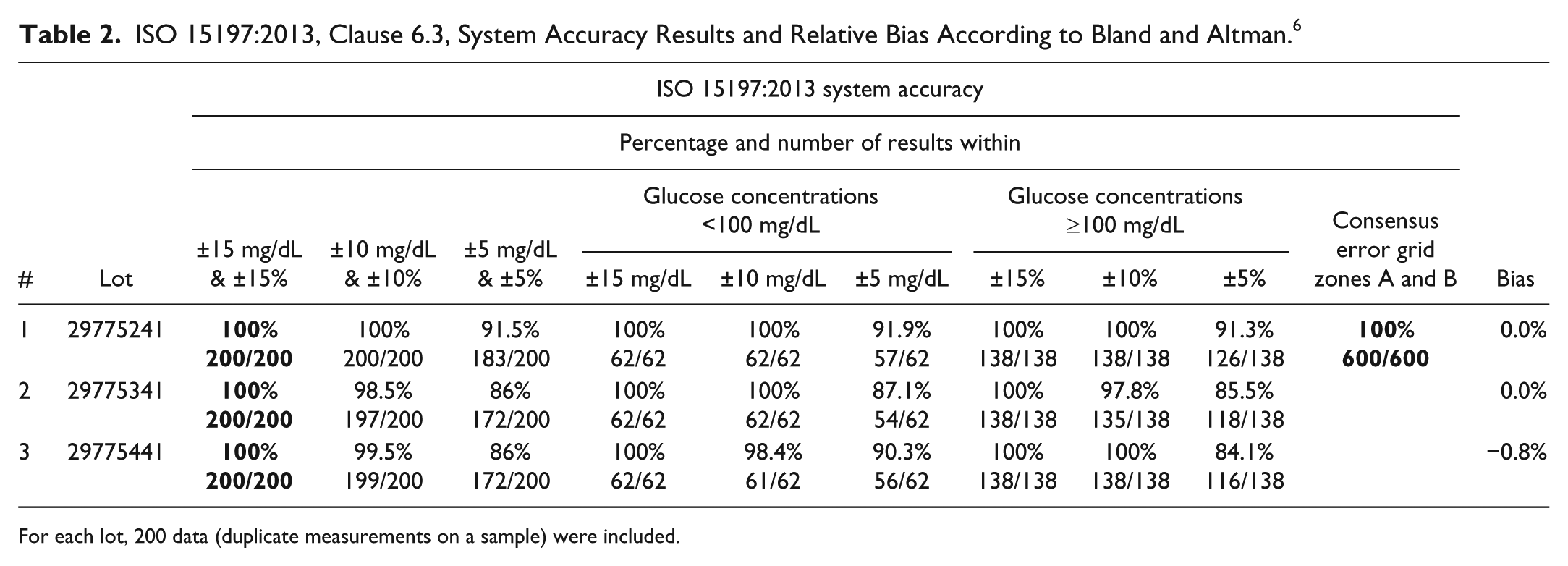
For each lot, 200 data (duplicate measurements on a sample) were included.
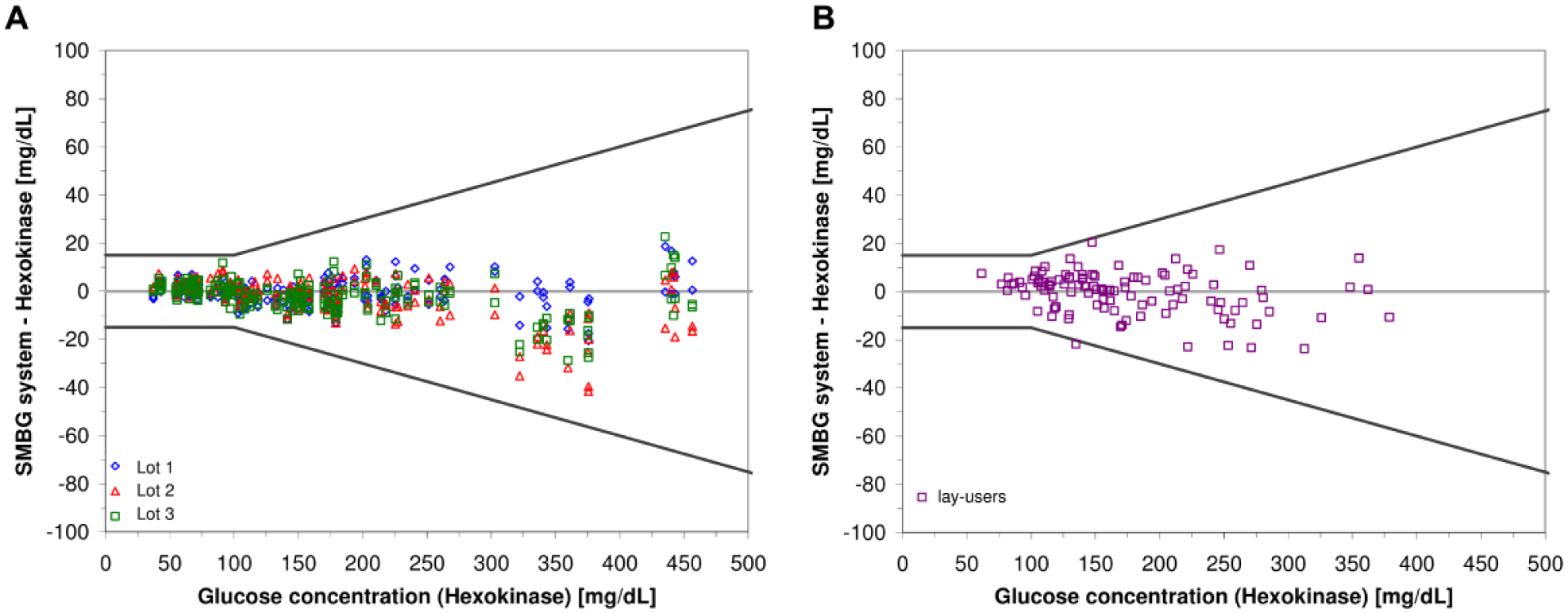
Difference plots. (A) System accuracy evaluation with three different reagent system lots: Absolute differences between the system’s measurement results and the mean comparison measurement results (200 data per lot, duplicate measurements on a sample with each lot) are displayed. (B) User performance evaluation with one reagent system lot: Absolute differences between the system’s measurement results and the mean comparison measurement results (107 data) are displayed. Lines indicate criteria of ISO 15197:2013: ±15 mg/dL / ±15% for glucose concentrations <100 mg/dL / ≥100 mg/dL.
The system also fulfilled with the investigated reagent system accuracy criteria in the hands of intended users, and showed 99.1% of results within the defined limits (Table 3, Figure 3).
Accuracy Results in the Hands of Users Based on ISO 15197:2013, Clause 8 and Relative Bias According to Bland and Altman.
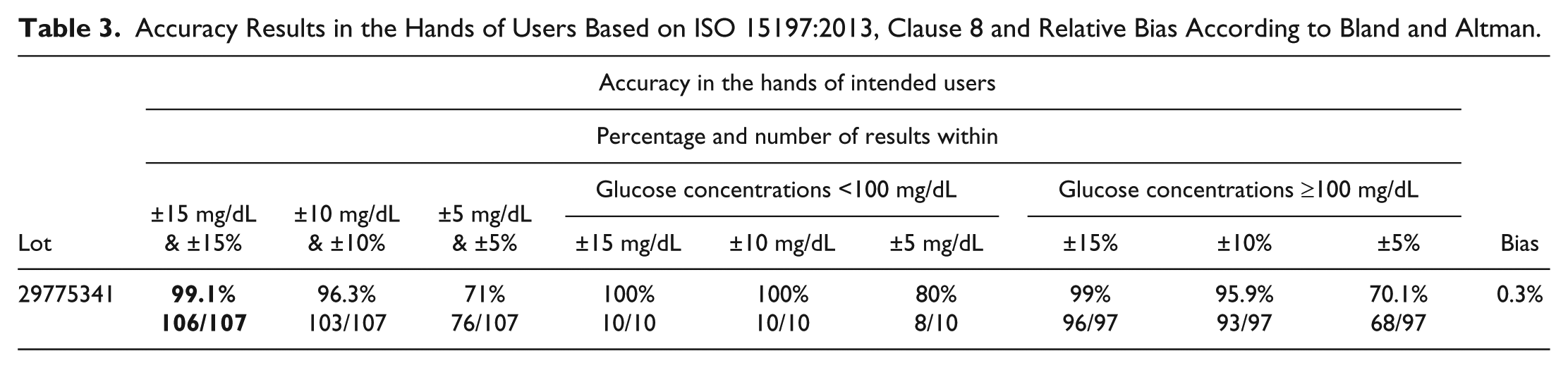
The smallest error range in which ≥95% of measurements were found was ±6.8 mg/dL and ±6.8% for study personnel measurements (all 3 reagent system lots combined) and ±9 mg/dL and ±9% for lay user measurements (1 reagent system lot).
Discussion
In this study, system accuracy of the improved system was evaluated for three different reagent system lots based on testing procedures and accuracy criteria of ISO 15197:2013, clause 6.3. The system showed a high level of accuracy (100% within the defined limits) in the hands of trained study personnel under standardized laboratory conditions in which influencing factors are reduced to a minimum. In a previous study, system accuracy of a predecessor model was evaluated showing 99.5% of results within the defined limits. 7 The evaluation of SMBG systems under optimally controlled conditions does not necessarily reflect the measurement accuracy obtained in the hands of patients under daily life conditions.8-11 Therefore, ISO 15197:2013 also requires a user performance evaluation to assess if intended users are able to obtain accurate glucose measurement results with a given SMBG system (clause 8). In this study, the system showed with the investigated reagent system lot 99.1% of results within the defined limits. It should be noted that this user performance evaluation focused on blood application by using the new test cassette, whereas subjects could be assisted regarding other aspects of meter and lancing device handling. The new test cassette has been developed with the aim to facilitate the blood application on the test field and to prevent mechanical pressure on the test area as well as contamination of the test area with sugar residues on the fingertip. In daily practice, many patients do not wash their hands before SMBG.12,13 Sugar residues, such as from fruits, can contaminate the reagent system, for example, test strips, and result in falsely high glucose readings.3,13 The improved cassette ensures with guidance tabs on the cassette tip that only the blood drop has contact with the test area, so that both pressure and contact with possibly contaminated skin area are minimized.
Conclusion
In this study, the improved system complied with accuracy criteria of ISO 15197:2013 when measurements were performed by study personnel and intended users.
Footnotes
Abbreviations
BG, blood glucose; CEG, consensus error grid; SMBG, self-monitoring of blood glucose.
Declaration of Conflicting Interests
The author(s) declared the following potential conflicts of interest with respect to the research, authorship, and/or publication of this article: GF is general manager of the IDT (Institut für Diabetes-Technologie Forschungs- und Entwicklungsgesellschaft mbH an der Universität Ulm, Ulm, Germany), which carries out clinical studies on the evaluation of BG meters and medical devices for diabetes therapy on its own initiative and on behalf of various companies. GF/IDT have received speakers’ honoraria or consulting fees from Abbott, Ascensia, Bayer, Berlin-Chemie, Becton-Dickinson, Dexcom, LifeScan, Menarini Diagnostics, Novo Nordisk, Roche, Sanofi, Sensile, and Ypsomed. AB, NJ, CL, GF, and CH have disclosed that they are employees of IDT.
Funding
The author(s) disclosed receipt of the following financial support for the research, authorship, and/or publication of this article: This study was funded by a grant from Roche Diabetes Care GmbH, Mannheim, Germany.