



Abstract

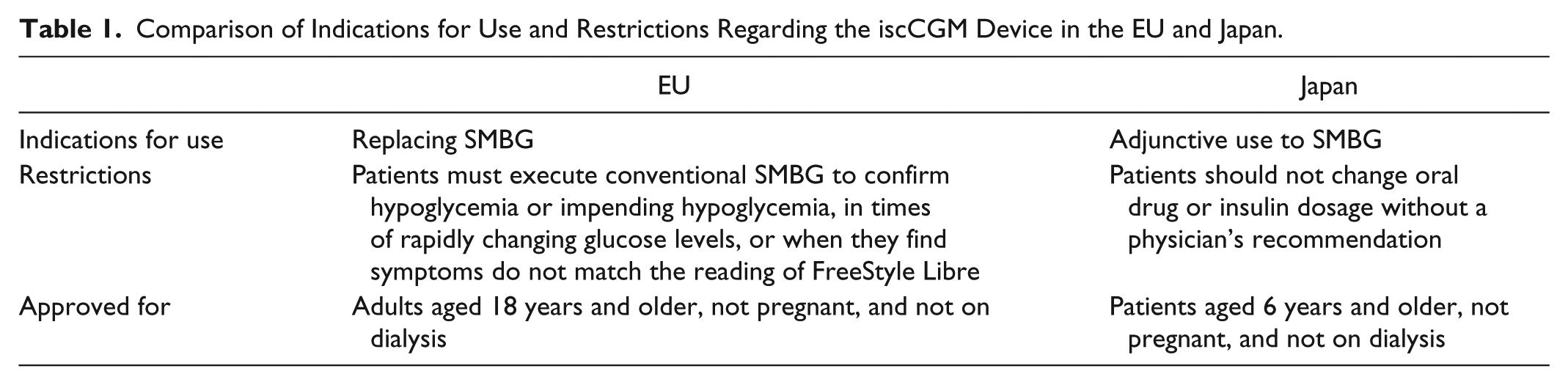
FreeStyle Libre (Abbott Diabetes Care, Alameda, CA, USA) is a variant of personal continuous glucose monitoring (CGM) device, which transmits interstitial glucose data from a sensor to a receiver intermittently, and therefore lacks alarm function for hypoglycemia and hyperglycemia. This intermittent-scanning CGM (iscCGM) device was originally developed with the aim of replacing conventional devices for self-monitoring of blood glucose (SMBG), and the manufacturer gave it the commercial nomenclature “flash glucose monitoring” device. 1 This device has been approved with a CE mark for nonadjunctive use to SMBG with some restrictions in EU countries since 2014, and in September 2017 it was also approved in the United States. 2 In Japan, the Ministry of Health, Labour and Welfare (MHLW) approved this device only for adjunctive use to SMBG (Table 1). 3 It is contraindicated to use for pregnant women, patients on dialysis, and patients younger than 6 years old in Japan (note: this iscCGM device is indicated for use in adults aged 18 years and older in the EU).2,3
Comparison of Indications for Use and Restrictions Regarding the iscCGM Device in the EU and Japan.
It has been commercially available in Japan since January 2017 and health insurance coverage started in September 2017. The prices announced by MHLW for health insurance coverage were identical to the prices for SMBG strips; the prices for health insurance coverage are JPY4000, 5800, 8600, 11 400, 13 200, or 15 000 according to the accompanying number of SMBG strips of not less than 20, 40, 60, 80, 100, or 120 times per month, respectively. The local branch of the manufacturer in Japan announced the sale of the packages of iscCGM sensors and SMBG strips at a single price of JPY13 800 for all lineups, with 2 iscCGM sensors and 20, 40, 60, 80, 100, or 120 SMBG strips, excluding the iscCGM receiver and the lancets. 4 This pricing means that if a patient uses 2 sensors per month, the medical institution will lose money in cases the patient performs SMBG at not less than 20, 40, 60, 80, or 100 times per month. Furthermore, the options of not less than 80, 100, or 120 SMBG strips per month are approved mainly for patients with type 1 diabetes mellitus (T1DM). Patients using the correction bolus frequently, like insulin pump users with T1DM, will need further additional SMBG strips for confirmation purposes, and this will lead to financial difficulty for the medical institution, as they must provide extra SMBG strips at their own cost to comply with the Japan regulations.
There is concern that patients may use this iscCGM device nonadjunctively to SMBG due to its convenience, but health care providers in Japan are not allowed to educate on nonadjunctive use to SMBG under current regulations. This may lead to the loss of an opportunity to educate patients when they must execute conventional SMBG (Table 1). To solve this issue effectively, the nonadjunctive use of this iscCGM device needs to be approved also in Japan, and the manufacturer’s effort to convince the Japanese authority with sufficient scientific evidence of its effectiveness and safety, especially for children and adolescents younger than 18 years old, are extremely important.
Footnotes
Abbreviations
CGM, continuous glucose monitoring; iscCGM, intermittent-scanning CGM; MHLW, Ministry of Health, Labour and Welfare; SMBG, self-monitoring of blood glucose; T1DM, type 1 diabetes mellitus.
Declaration of Conflicting Interests
The author(s) declared the following potential conflicts of interest with respect to the research, authorship, and/or publication of this article: TM discloses the following relationships: lecture fee from Arkray, Novo Nordisk, Eli Lilly, Sanofi, MSD; grants paid to institution as study physician by Novo Nordisk, Sanofi, Kissei, Ono, Astellas, Kowa. NS discloses the following relationships: lecture fee from Novo Nordisk, Eli Lilly, Sanofi. KK discloses the following relationships: lecture fee from Medtronic, Arkray, Sanwa Kagaku Kenkyusho, Novo Nordisk, Eli Lilly, Sanofi, Kowa, Mitsubishi Tanabe, Mochida, Ono. AT discloses the following relationships: lecture fee from Medtronic, Covidien, Novo Nordisk, Eli Lilly, Sanofi, MSD, Takeda, Kowa, Mitsubishi Tanabe, Kissei, Sumitomo Dainippon, Astellas, Novartis, Bristol-Myers Squibb, Taisho Toyama, Daiichi Sankyo, Kyowa Hakko Kirin, Ono. MT discloses the following relationships: lecture fee from Medtronic, Novo Nordisk, Eli Lilly, Sanofi, Takeda, Kowa, Mitsubishi Tanabe, Kissei, Kyowa Hakko Kirin, Ono, Sumitomo Dainippon, Daiichi Sankyo, AstraZeneca, Boehringer Ingelheim.
Funding
The author(s) received no financial support for the research, authorship, and/or publication of this article.
