




Abstract

Keywords
Use of intermittent scanning continuous glucose monitoring (isCGM; Abbott, Witney, UK) results in improvements in quality of life and glycemic control. 1 Barriers to access to this technology include a lack of reimbursement, lower socio-economic status, and inappropriate (subjective) selection criteria. 2 In the Netherlands, isCGM is reimbursed since 2019 for adults who use multiple daily injections (MDIs) or continuous subcutaneous insulin infusion (CSII), regardless of diabetes type. 3 Data concerning use of isCGM are of importance to identify barriers for access to this technology. We investigated isCGM use according to age categories in the Netherlands to assess uptake of isCGM in elderly.
Data were obtained from the Drug Information Project (Genees- en hulpmiddelen Informatie Project) database. 4 This public database contains information about health care reimbursements and covers >95% of the population. The database is coded according to the ATC code, the Anatomical Therapeutic Chemical coding system maintained by the World Health Organization. Use of fast-acting insulins is coded as “A10AB” and includes humane insulin and analogues. Use of isCGM is coded as “F3505.” Insulin data were used as proxy of MDI and CSII treatment, identifying potential isCGM users as compared with actual isCGM users. Data were obtained from 2019 through 2021 and were stratified per age category: ≤24, 25 to 44, 45 to 64, and ≥75 years. Due to constraints of the datasets, no further subdivisions could be made.
Distribution of isCGM use per age category is presented in Table 1. Overall, use of isCGM increased from 7.4% in 2019, to 27.6% in 2020 and 31.5% in 2021. Use of isCGM was considerably lower in older age categories, declining from age category 45 to 64 and older, with only 1.1% of those aged ≥75 using isCGM in 2019, increasing up to 19.0% in 2021.
Overview of the Potential Users and Actual isCGM Users, Given as Absolute Numbers and Percentage, in Total and Per Age Category or, From 2019, 2021, and 2021.
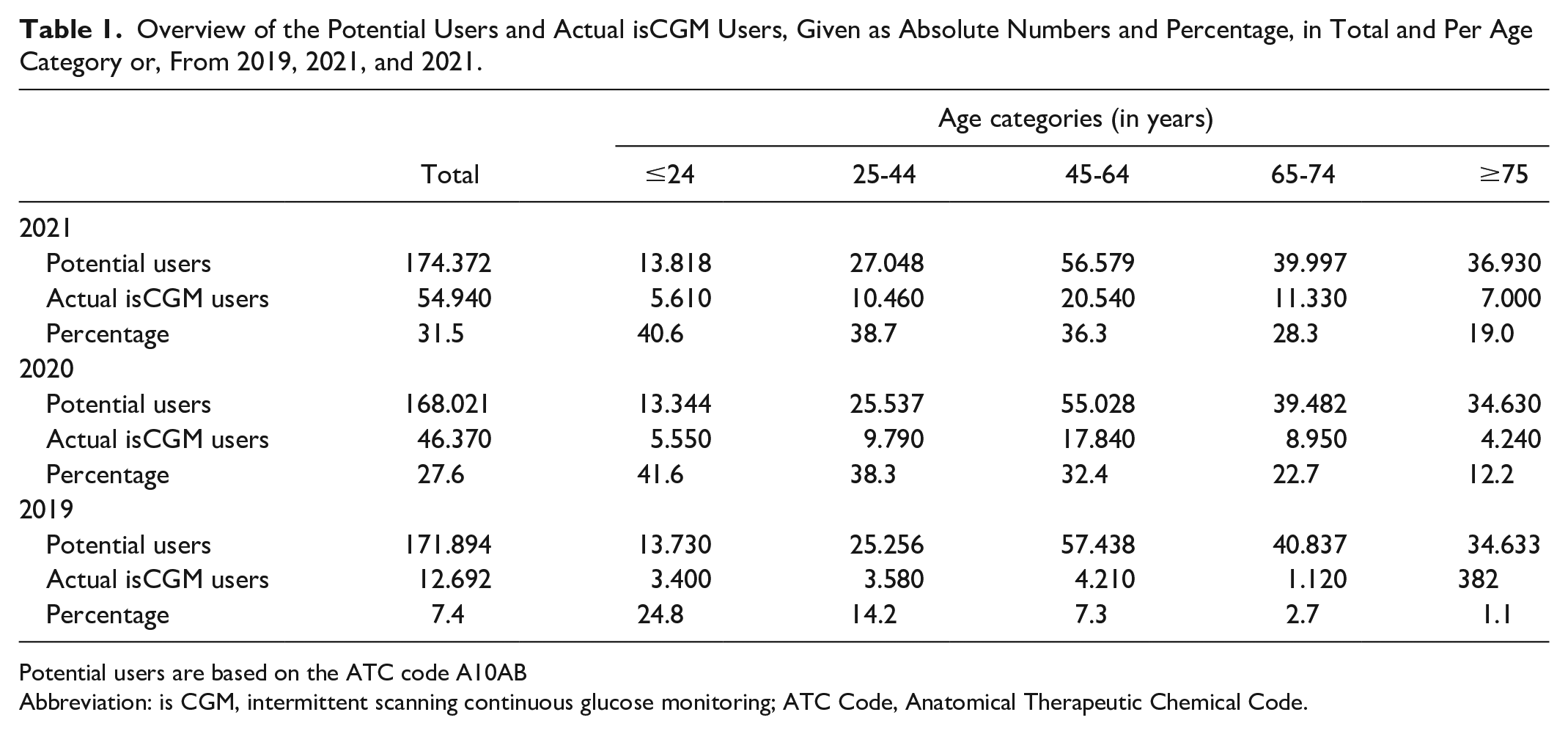
Potential users are based on the ATC code A10AB
Abbreviation: is CGM, intermittent scanning continuous glucose monitoring; ATC Code, Anatomical Therapeutic Chemical Code.
These data demonstrate that, despite reimbursement, there is less uptake of isCGM among Dutch elderly. Although there was an increase in isCGM use among the elderly population throughout the study period after reimbursement became available in 2019, it is still behind rates of isCGM use in other age categories (note that continuous glucose monitoring [CGM] usage is not included in these statistics, reimbursement of CGM is even more restricted in those of older age).
This study is limited in its accuracy by the categorization of the data provided, as only the type of medication is provided, not the indication. As such, it is possible that non-MID or CSII users were erroneously included. This would falsely decrease calculated percentages. However, it is unlikely that this effect would entirely negate the differences we report, as this only pertains to a small subset of the population.
The elderly population has often been considered less than ideal for usage of new technologies due to a variety of factors. 5 As evidence suggests that glucose sensor technology is effective in elderly, 6 these considerations may be inappropriate. As such it stands to reason that this population may benefit from isCGM, especially considering their high(er) risk of hypoglycemia-related and hyperglycemia-related adverse outcomes. We emphasize the need to identify and address barriers for uptake of isCGM in the elderly with diabetes, and thus reversing this apparent “treatment-risk paradox.”
Footnotes
Abbreviations
CGM, continuous glucose monitoring; CSII, subcutaneous insulin infusion; isCGM, intermittent scanning continuous glucose monitoring; MDI, multiple daily injection; ATC, Anatomical Therapeutic Chemical.
Author Contributions
Declaration of Conflicting Interests
The author(s) declared no potential conflicts of interest with respect to the research, authorship, and/or publication of this article.
Funding
The author(s) received no financial support for the research, authorship, and/or publication of this article.
Ethics Statement
Due to the use of publicly available, anonymized data, no review by the Ethics committee was required.
