



Abstract

Meta-analyses show that treatment with continuous subcutaneous insulin infusion (CSII) lowers HbA1c by 3 mmol/mol (0.3%) compared to multiple daily injections (MDI) in adult populations. However, the longest observation period in the included randomized controlled trials (RCTs) was only 1 year. 1 Here, we investigated the long-term effect of shifting from MDI to CSII on HbA1c and weight in adults with type 1 diabetes (T1D).
Since 2002, 856 patients initiated CSII at our center. Mean (± SD) age and T1D duration at CSII initiation were 39 ± 14 years and 21 ± 13 years. There were no clinically significant differences between males and females. 622 patients with complete data 2 years before CSII were included in the analysis. HbA1c decreased by 1.6 mmol/mol (0.1%) during the period prior to initiation (P < .0001) as patients received prepump carbohydrate counting training. The reduction in HbA1c from initiation to six years after was a further 7.8 mmol/mol (0.7%) (n = 183, P < .0001) (Figure 1). No significant changes in body weight (one-way ANOVA of BMI) were seen in the 8-year observation period (Figure 1). Total daily insulin dose decreased by 14.1 + 12.8 IE from 52.6 ± 24.0 IE to 38.6 ± 16.9 IE (0.50 ± 0.17 IE/kg) one year after initiation. By multiple regression analysis, we found that the six-year reduction in HbA1c was positively associated with HbA1c at initiation (regression coefficient beta [β] = 0.56, P < .0001), diabetes duration (β = 0.21, P = .0008), and BMI (β = 0.21, P = .02), independent of gender, age, and insulin dose level at initiation.
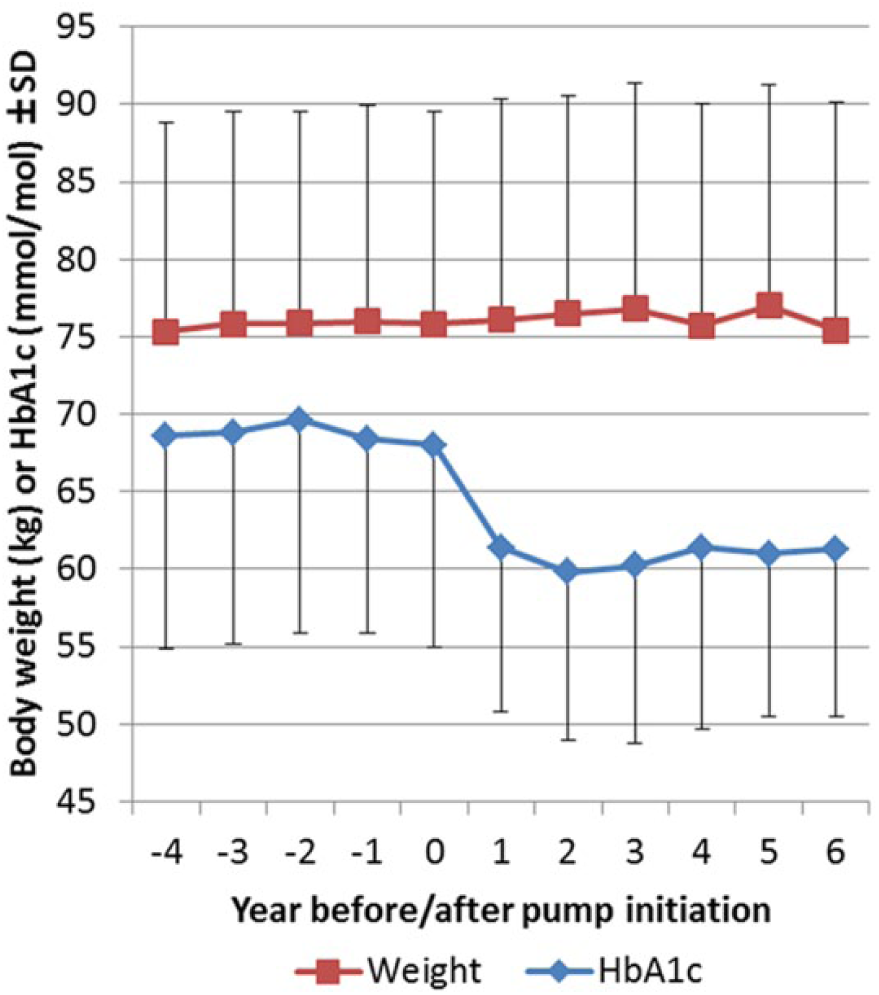
Body weight (kg, in red) and HbA1c (mmol/mol, in blue) ± SD 4 years before and up to 6 years after initiation of CSII.
A k-means cluster analysis identified five clinically distinct subgroups at initiation: a young lean and dysregulated group (18%), a young normal weight well-regulated group (32%), a young obese dysregulated group (8%), an older normal weight well-regulated group (28%), and an older obese dysregulated group. All clusters benefited from pump treatment; the decrease in HbA1c dependent on baseline HbA1c.
Our data show a significant HbA1c reduction after CSII initiation, which is comparable to, or better than, results from RCTs. A stable reduction in HbA1c without concomitant body weight increase has been seen in only one other retrospective study. 2 Previous studies have suggested diminishing CSII HbA1c effectiveness over time.2,3 Here, we found a stable reduction of HbA1c up until six years after CSII initiation.
Interestingly, although T1D may be a fairly homogenous disease from a pathophysiological point of view and CSII has distinct national and international indications, we were able to identify clinically distinct patient subgroups based on a limited set of data at CSII initiation. This concept may be important for personalizing treatment and deserves further study.
There are some limitations to our investigation. We are not able to exclude sensor-augmented pump (SAP) users (approximately 25% at our center) from the present data. If problems arise during the use of CSII, patients may shift to SAP. Consequently, the stable HbA1c seen during the 6 years could be influenced by SAP use. Another limitation is that it contains data from one center only. Strengths of the current study include a high level of data completion due to our electronic record and the long follow-up period.
Footnotes
Abbreviations
CSII, continuous subcutaneous insulin infusion; MDI, multiple daily injections; RCT, randomized controlled trial; SAP, sensor-augmented pump; T1D, type 1 diabetes.
Declaration of Conflicting Interests
The author(s) declared the following potential conflicts of interest with respect to the research, authorship, and/or publication of this article: HUA owns stock in Novo Nordisk and is a member of an advisory board for Abbott. MR is a full-time employee of Novo Nordisk A/S, but this does not represent a conflict of interest in this context.
Funding
The author(s) received no financial support for the research, authorship, and/or publication of this article.