




Abstract
Insulin remains indispensable to the treatment of diabetes, but its availability in injectable form only has hampered its timely and broader use. The development of an oral insulin remains an ultimate goal to both enhance ease of use, and to provide therapeutic advantages rooted in its direct delivery to the portal vein and liver. By mimicking the physiological path taken by pancreatic insulin, oral insulin is expected to have a distinct effect on the hepatic aspect of carbohydrate metabolism, hepatic insulin resistance, and, at the same time, avoid hyperinsulinemia and minimize the risk of hypoglycemia. With oral insulin approaching late stages of development, the goal of this review is to examine oral insulin in a physiological context and report on recent progress in its development.
Despite the wide selection of available antidiabetic pharmaceuticals and new classes of agents, since its discovery, insulin has remained the mainstay drug for treating type 1 diabetes mellitus (T1DM) and advanced type 2 diabetes mellitus (T2DM), and as such, has served to save a countless number of lives and prevent serious complications.1,2,3-5 Although insulin remains the single therapy with unlimited potential to safely achieve glucose control in most patients with T2DM, 6 for many patients and providers, it remains a last resort venue, with enormous negative connotations, this owing to the discomfort and adverse effects associated with the most commonly administered injectable forms. An exciting alternative to parenteral administration of insulin delivery via the pulmonary route has been clinically available since June 2014. 7
While still theoretical, yet compelling nonetheless, an oral route of insulin delivery may bear physiologic implications, which could significantly reduce the risk of hypoglycemia, while eliciting salient metabolic effects without weight gain. Moreover, oral insulin, devoid of the apprehension and distress associated with insulin injections, may bring this drug from last resort therapy to the forefront. At the present time, evidence suggesting the possible advantages of oral insulin can mostly be inferred from data generated from studies with intraperitoneal8-12 and intraportal insulins,13-16 which follow a similar route of absorption through the portal vein, and more recently, hepato-preferential insulins.17-19 Yet, insulin’s molecular mass of 5808 Da, and its physicochemical properties, hinder its intestinal absorption, posing a challenge for its oral delivery. Advances in the understanding of intestinal drug absorption and in drug delivery science may overcome the challenges of insulin absorption through the gastrointestinal tract in the not too distant future. While the topic of oral insulin has been extensively reviewed including in this journal,20,21 the purpose of this review is to present and emphasize the potential physiological advantages of an oral insulin preparation and to provide a current state of affairs in regard to oral insulin.
Potential Clinical Benefits of Oral Insulin
Oral Insulin and Its Relevance to Diabetic Hyperglycemia
Insulin secreted from pancreatic β-cells promotes glucose disposal through stimulation of glucose uptake and subsequent intracellular oxidative and nonoxidative metabolism in insulin-sensitive tissues and organs. Ingestion of a meal containing carbohydrates, elicits a prompt rise in insulin and a decrease in glucagon concentrations, both potentiated by intestinal L cell-secreted glucagon-like peptide 1 (GLP-1). In parallel, intestinal K cell-secreted gastric inhibitory polpeptide (GIP) stimulates glucagon release. From the portal vein, insulin passes through the liver, where up to 80% is extracted on first-pass, giving rise to a significantly (2.5- to 3-fold) higher insulin concentration in the portal vein as compared to the systemic circulation (Figure 1).22,23 This portal–peripheral gradient is maintained both in the fasting state (basal) and postprandial state, 24 leaving the liver constantly exposed to significantly higher insulin concentrations as compared with other organs/tissues. The fraction of insulin extracted by the liver is dynamic, varying in accordance with metabolic demands to maintain optimal peripheral insulinization, while also securing sufficient insulinization of the liver. 25 This dynamic process is further reinforced by insulin’s short half-life of 4-6 min in the circulation, which simplifies fine-tuning of insulin release into the systemic circulation, avoiding peaks and troughs in insulin concentrations and in glycemic excursions.
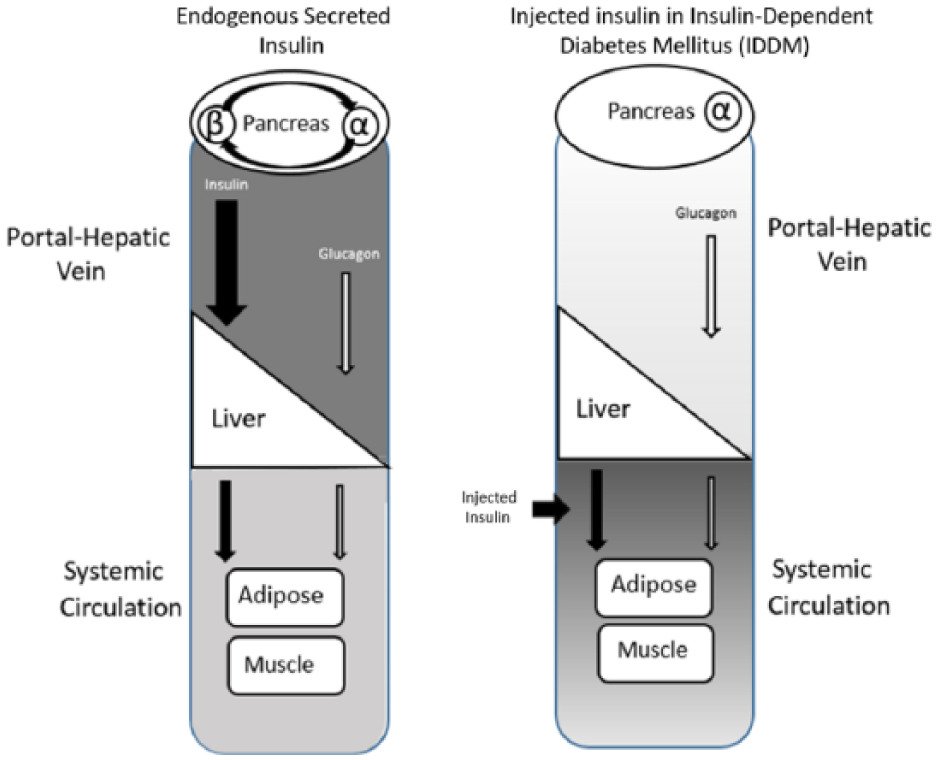
The pathways and targets of secreted versus subcutaneously injected insulin. The differences in routes taken by and targets of secreted versus subcutaneously delivered insulin may play a role in iatrogenic hypoglycemia, weight gain and glycemic variability.
The liver maintains plasma glucose concentrations within a narrow range, by sequestering ingested glucose after a meal (postprandial) and releasing glucose in response to low glucose levels (e.g., fasting state). Fasting hyperglycemia is the sequela of increased or unconstrained hepatic glucose release resulting from insufficient insulin secretion in T1DM or in the context of relative hepatic insulin resistance in T2DM,26-29 whereas postprandial hyperglycemia is mainly due to disproportionately high endogenous glucose production resulting from its reduced suppression and/or decreased glucose clearance in tissues. 30 Thus, sufficient hepatic insulinization is indispensably needed to suppress hepatic glucose production and to reduce both fasting and postprandial hyperglycemia.
Hepatic glucose production is discerningly sensitive to changes in insulin levels and thus can be controlled by a minute increase in hepatic insulinization.31-33
An oral insulin product is predicted to have therapeutic advantages in the management of hepatic glucose production, via its potential to mimic the natural route of endogenous insulin secreted by the pancreas. After reaching the portal vein, the oral insulin is directly delivered to the liver and then to the peripheral circulation, thereby reestablishing the physiologic portal–peripheral insulin gradient and providing for adequate hepatic insulinization. In contrast, parenteral or inhaled insulin is absorbed directly into the peripheral circulation without initial hepatic extraction, and fails to restore the portal-peripheral insulin gradient and physiologic hepatic insulinization. In addition, these routes expose peripheral targets to greater insulin concentrations relative to the liver, predisposing patients to a high risk of hypoglycemia, and the deleterious effects of hyperinsulinemia.
Mitigating Risk of Hypoglycemia
Hypoglycemia is one of the most common and feared iatrogenic side effects faced by individuals with diabetes, especially in those receiving intensive therapy, and is a known barrier to the glycemic management of diabetes. 34 The serious morbidity associated with hypoglycemia, and its fatal potential, apply to both T1DM and T2DM patients, as the pathophysiology of glucose counterregulation is the same in both. Furthermore, recurring episodes of hypoglycemia can impair defenses against subsequent incidents, by causing hypoglycemia-associated autonomic failure and hypoglycemia unawareness, thereby perpetuating a vicious cycle of recurrent hypoglycemia. 35 In addition, the concern over hypoglycemia often precludes maintenance of ideal glycemic control and in many individuals, triggers overeating and weight gain, and thus thwarts full realization of the therapeutic value of exogenous insulin.
Glucagon acts as a counterregulatory hormone to insulin by rapidly promoting hepatic glucose output via conversion of liver glycogen into circulating glucose. In healthy individuals, falling glucose levels triggers glucagon secretion, a response that is often blunted or absent in T1DM and in advanced T2DM and, as a result, increases the risk of hypoglycemia. 36
Under normal conditions, insulin and glucagon operate in concert to maintain the glucose level within a narrow physiological range. 37 The insulin/glucagon ratio the hepatocyte is exposed to will dictate if it will be induced to store or supply nutrients such as glucose and lipids. 38 The ratio is determined by the rate of secretion of these hormones from the α-cells and β-cells, which reside contiguously within the islets of Langerhans (islets) (Figure 1) and share the same interstitial space. By a paracrine action, insulin secreted from β-cells reciprocally regulates α-cell glucagon secretion, creating a secretory alliance, and generating the insulin/glucagon ratio optimal for maintained glycemic balance. 39 When exogenous insulin is necessary, injected forms distribute evenly throughout the body, in contrast to secreted insulin, which displays acute peaks (almost ~400 times higher) in the islets compared with the systemic concentration. 40 Therefore, suppression of glucagon secretion by injected insulin is impractical and exposes patients to the risk of hypoglycemia. 40 However, improving the ratio is attainable by increasing the insulin concentration in the portal vein.41,42 There is strong evidence that such a strategy can significantly reduce the occurrence of hypoglycemic events.13,43,44 Alternatively, the insulin/glucagon ratio can be increased by lowering glucagon levels, an approach that is drawing much attention and has spurred drug development research.40,45
Glycemic Stability
Much attention has recently been paid to the impact of glycemic variability, independent of hyperglycemia, on risk for diabetic complications.46,47 Studies in animal models and in humans suggest that oscillating glucose levels are more detrimental than stable high glucose concentrations, and have been correlated with production of free radicals, accompanied by an insufficient increase in intracellular antioxidant defenses.48,49
While glycemic variability appears to result from the complex interplay between behavioral, psychological, and treatment-related factors, its pathophysiology remains unclear. It is posited that the pathophysiology of glycemic variability hinges on α-cell and/or β-cell dysfunction, resulting in an imbalance of the portal insulin-to-glucagon ratio.50,51 More specifically, both insulin deficiency and impaired glucagon signaling, both of which affect hepatic glucose production and modify hepatic glucose uptake and storage, translate to glycemic swings.52,53 The net result is that more glucose (endogenous + ingested) enters the circulation at a faster rate than the body can assimilate, yielding prolonged elevation of plasma glucose levels.54,55 In parallel, glucose nadirs can result from malabsorption, interactions with concomitant drugs, defective insulin degradation, and delayed gastric emptying as a result of autonomic neuropathy. In addition, low glucose levels are often attributed to defective glucagon signaling, which adversely affects glycogenolysis and gluconeogenesis. Consequently, hepatic glycogen stores are lacking, limiting the ability of patients with diabetes to appropriately respond to low glucose levels.56-58 Studies involving direct portal administration of insulin have demonstrated a significant attenuation of glycemic swings and stabilization of glycemia.59-62 In the first recorded pilot study assessing the effect of oral insulin as an add-on therapy, on glycemic stability in eight uncontrolled T1DM patients on subcutaneous insulin therapy, a significant reduction in the amplitude of glycemic excursions and glucose area under the curve was observed. Nevertheless, due to the small sample size and short follow-up period, the clinical relevance of these findings remains speculative (Clinicaltrials.gov NCT00867594). 63
Mitigating Weight Gain
The association between insulin therapy and weight gain is well known64,65 and its magnitude is influenced by the intensity and duration of the insulin regimen, level of the initial glycemic control, the glycemic control achieved with treatment, and the combination of oral agents concomitantly used. 66 Many patients opt to delay treatment initiation or fail to exhibit long-term compliance due to this adverse effect of insulin. 67 Furthermore, weight gain is, by itself, associated with increased risk of cardiovascular disease, worsening insulin resistance and dyslipidemia, and can also fuel a vicious cycle of beta-cell dysfunction, further aggravating insulin resistance, increasing insulin requirement and leading to further weight gain. 68 Several mechanisms have been proposed to explain the insulin-weight gain correlation associated with the nonphysiologic route of insulin administration as the result of systemic hyperinsulinemia leading to a disproportional anabolic effect on muscle and adipose tissue.64,65 Adequate hepatic insulinization without systemic hyperinsulinization, achieved by means of sulfonylureas, 69 peritoneally delivered insulin, 70 or with hepatoselective insulin, 71 has shown that the route of insulin delivery has a strong bearing on weight control.
Potential Benefits of Portal Insulin Administration Beyond Glycemic Control
Insulin delivery directly to the liver has demonstrated salient effects on a wide range of processes, extending beyond glycemic control. Such effects have been observed with intraperitoneal insulin infusions,10,11,72 direct intraportal insulin administration, 13 and hepatoselective insulins, as well as with long-acting parenteral insulin with a circulating depot, such as insulin detemir, which appears to possess an increased liver specificity.18,71,73 Insulin increases the sensitivity of the liver to growth hormone (GH) by upregulating GH receptor expression, thereby augmenting insulin-like growth factor-1 (IGF-1) production. 74 In addition, it downregulates IGF binding protein-1 (IGFBP-1) production in the liver, thereby increasing circulating IGF-1 bioactivity. 75 Thus, portal insulinopenia, as seen in diabetes, is implicated by perturbations in GH bioactivity, worsening glucose intolerance and disrupted lipid metabolism. 76 Studies have shown that delivering insulin by continuous intraperitoneal insulin infusion (CIPII) or intraportally, as opposed to subcutaneously (SC), in patients with T1DM, had a beneficial effect on the GH–IGF1–IGFBP axis.15,77-79
Another example pertains to sex hormone–binding globulin (SHBG), which is produced in the liver and regulates the concentrations of freely circulating sex hormones. High SHBG levels lower the proportion of bioavailable sex hormones, such as estradiol and testosterone, and influences the relative balance of estradiol to testosterone through bidirectional feedback. 80 In male children and young adults with T1DM, SHBG and total testosterone levels appear to be significantly higher than in controls. 81 Moreover, adult men with controlled T1DM have a higher risk for hypogonadism, as reflected by lower free testosterone and higher SHBG levels. 82 In T2DM, a reduction in total testosterone, including both bioavailable and free testosterone, is observed.83,84 Portal insulin has been shown to downregulate SHBG, irrespective of glycemic control.85-87
The Challenges of Polypeptide Absorption Following Oral Delivery
The major challenges in the oral delivery of peptide and protein (p/p) drugs is their susceptibility to acid hydrolysis in the stomach, proteolytic degradation in the intestine, limited permeability across membranes and their tendency to complex and adsorb to the gut. 88 The process of proteolysis is a physiologic and efficient mechanism that enables the digestion of proteins in food and also plays a role in the inactivation of some organisms. Efforts to enhance p/p drug absorption have concentrated on methods which protect the drug during transit in the gastric environment and/or inhibition of proteolysis in the gut. Other technologies involve micronization, absorption enhancement and carrier-mediated transport enhancement, all of which allow for the sizable molecules to cross the epithelium either via the paracellular or transcellular route.89,90 The current status of insulin development, in general, and of oral insulin, in particular, has recently been reviewed.21,91,92 Two oral insulin development programs have gained visibility of recent. 91 Oramed Pharmaceuticals Inc. (Jerusalem, Israel) has developed its proprietary Protein Oral Delivery (POD™) technology, which employs a three-pronged approach composed of encapsulation, protease inhibitors and a chelating agent. The pH-sensitive capsule shields the insulin from hydrolysis in the stomach and ascertains that the protein and other additives within the formulation are contemporaneously released in the small intestines, where the pH is close to neutral. The protease inhibitors serve to protect the insulin from degradation by the ubiquitous proteases in the brush border zone of the small intestines. The chelating agent scavenges calcium, an important cofactor for many proteases, and thereby inhibits intestinal enzyme activities, while also increasing paracellular permeability. In subjects with T1DM, Oramed’s oral insulin has been shown to reduce postprandial glucose concentrations 63 and when administered preprandially, to reduce both fasting blood glucose levels and the requirement for fast-acting insulin doses. 93 In subjects with T2DM, Oramed’s oral insulin led to a reduction in fasting blood glucose levels 94 and a decrease of inflammatory marker (c-reactive protein; CRP) levels in response to a six-week, once-daily, bedtime oral insulin regimen. 63 In a recently completed phase IIb trial with oral insulin capsules in adults with T2DM, a significant lowering of mean nighttime glucose levels as compared to their average levels during the run-in period, was observed as well as a reduction in mean 24-hour glucose, fasting glucose and daytime glucose (unpublished data).
Novo Nordisk A/S (Denmark) has conducted five phase I clinical trials (NCT02470039, NCT02304627, NCT01931137, NCT01796366, and NCT01334034) with oral insulins (NN1953, NN1954, and NN1956) to treat T1DM and T2DM 95 and has completed a phase 2 study with an oral insulin (unpublished). The drug delivery technology used is Merrion Pharmaceuticals’ proprietary formulations, collectively referred to as gastrointestinal permeation enhancement technology (GIPET™). The technology is based on microemulsions of oil and surfactant or a mixture of fatty-acid derivatives in an enteric-coated gel capsule. This absorption enhancer system has shown to safely increase the oral bioavailability of several types of low-permeability compounds in man. 96
The Future
The realization of a safe and effective oral insulin dosage form will undoubtedly be a major advance in the field of diabetology. Yet, there remain aspects requiring further studies and evaluations. 97 Due to its potency and narrow therapeutic window, to be effective and safe, insulin doses must be reasonably titratable, with a consistent and reproducible absorption index, both within and among subjects. Even now, current parenteral insulin therapies continue to suffer from serious deficiencies owing to inconsistency of therapeutic action from dose to dose and from patient to patient, and thus only infrequently normalizes blood glucose in chronic use.98,99 To a large extent, its pharmacodynamic effect reflects the significant variability in its absorption, that can range from 20% to over 55% with injectable insulin.100,101 Absorption variability, inherent to oral ingested medications, is likely to be amplified when bioavailability is low. Current oral peptides and proteins delivery technologies are typified by relatively low bioavailability, estimated at 5-8% for Oramed’s oral insulin. 102 Furthermore, considerations and surveillance of the effects of the large amounts of unabsorbed drug lingering in the intestines, particularly regarding insulin, a growth factor with mitogenic potential 103 and a recognized modulator of gastrointestinal physiology will be required. 104 Moreover, given that the effect of oral insulin will be mainly on the liver, such a preparation is unlikely to have a potent effect on glucose disposal in the periphery and on controlling free fatty acid lipolysis in adipose tissue. While it is improbable that it will replace injectable insulin in insulin-dependent individuals, an oral insulin dosage form may serve as a stand-alone drug for patients in the early stages of T2DM with impaired fasting blood glucose, largely the outcome of excess hepatic glucose production. In addition, it may be advantageous as an adjuvant to antihyperglycemic drugs (e.g., insulin sensitizers), prescribed to contend with insulin insufficiency, or when hepatic insulin resistance is driven by a pathogenic mechanism. Oral insulin may also be effective in reducing glucose instability, such as often seen in unstable T1DM, by modifying the insulin-to-glucagon ratio in the portal vein to favor hepatic glucose sequestration and restoration of glycogen stores. In such a case, oral insulin will not only dampen glucose excursions, but may also replenish glycogen stores in the liver, which is important in hypoglycemia, to allow for rapid glycogenolysis and glucose infusion into the circulation.
Given the magnitude of diabetes and the heterogeneity of its pathophysiology, it is likely that no single drug or delivery method will meet the needs of all patients. It is therefore essential that oral insulin will be optimally positioned to address the specific pathophysiologic aspects of glucose intolerance, where its use may have the greatest impact to improve outcome.
Conclusion
Insulin remains the one therapy with unlimited potential to safely achieve glucose control in most patients with diabetes. Acceptance and compliance of insulin therapy in patients with T2DM is wanting. The oral dosage form is generally the preferable and safest route for drug delivery. An oral insulin, often referred to as the holy grail, being patient friendlier and with theoretical physiologic advantages, may foster adherence and compliance, to result in superior outcomes. However, its relatively low bioavailability and consequently high absorption variability, remain a challenge to be overcome. While the first century of insulin therapy focused on supply, purification, and improved pharmacokinetics, the future will likely focus on development of more user-friendly and physiologic formulations that will minimize the risk of hypoglycemia, weight gain and other insulin therapy-associated complications. Early-stage development programs of oral insulin are under way and appear promising; challenges remain, but seem surmountable.
Footnotes
Acknowledgements
The authors would like to acknowledge and thank Yehudit Posen, PhD for her invaluable editorial assistance.
Abbreviations
CIPII, continuous intraperitoneal insulin infusion; CRP, c-reactive protein; GH, growth hormone; GIP, gastric inhibitory polpeptide; GIPET, gastrointestinal permeation enhancement technology; GLP-1, glucagon-like peptide 1; IGFBP-1, IGF binding protein-1; IGF-1, insulin-like growth factor-1; POD, Protein Oral Delivery; p/p, peptide and protein; SC, subcutaneous; SHBG, sex hormone–binding globulin; T1DM, type 1 diabetes mellitus; T2DM, type 2 diabetes mellitus.
Declaration of Conflicting Interests
The author(s) declared the following potential conflicts of interest with respect to the research, authorship, and/or publication of this article: MK is an employee of Oramed Pharmaceuticals Inc. and holds shares in the company. EA is not affiliated with Oramed and holds no shares in the company.
Funding
The author(s) received no financial support for the research, authorship, and/or publication of this article.