




Abstract

The performance requirements for blood glucose monitoring systems (BGMSs) set out in the International Organization for Standardization (ISO) standard 15197:2003 1 was revised with tighter standards in 2013 (ISO: 15197:2013), 2 following concerns about the accuracy of many BGMSs. 3 Klonoff and Prahalad 4 in a recent review article claim that only 32% of tested cleared BGMS met ISO 15197:2013 analytical accuracy standards in their study. Herein we report the accuracy of a BGMS with a glucose dehydrogenase nicotinamide adenine di-nucleotide (GDH-NAD) enzyme system and a mediator couple operating at the low potential of 220mV, Microdot+ (Cambridge Sensors Ltd, Godmanchester, UK), against the ISO 15197:2013 accuracy standards. The study was approved by the relevant UK ethics committee, and was carried out at a large community clinic in Cambridge, UK. In the United Kingdom the majority of diabetes treatment is now delivered in such primary care clinics.
A total of 101 patients with diabetes were recruited to the trial between November 2015 to February 2016 and informed written consent was obtained from all participants. Capillary whole blood from the patient finger was tested on 3 lots of test strips in duplicate on 6 meters. A separate sample of capillary blood was collected from the finger and tested on a Yellow Springs Instrument 2300 laboratory analyzer (Yellow Springs, OH, USA) to obtain a plasma calibrated result. This analyzer is calibrated with glucose standards traceable to National Institute of Standards and Technology (NIST). Because of the difficulty in obtaining samples with very low or very high glucose concentrations, modified samples were used according to the ISO 15197:2013 standard at very high or low glucose concentrations.
In total, 118 samples were tested in duplicate for each of the 3 lots of test strips. 101 samples were fresh capillary samples and 17 samples were altered in the laboratory to achieve the very low (<80 mg/dl) and very high (>400 mg/dl) glucose concentrations as indicated for the glucose concentration distribution required by the ISO 15197:2013 standard.
The new ISO criteria for accuracy standards for BGMS is as follows: Criterion A - 95% of the measured glucose values shall fall within either ± 15 mg/dl of the average of the reference measurements at glucose concentrations < 100 mg/dl or within ± 15% at glucose concentrations ≥ 100 mg/dl for each lot of measured values. Criterion B: 99% of individual glucose measured values shall fall within zones A and B of the consensus error grid for 3 lots of test strips.
Table 1 presents the system accuracy results for each lot of test strips and the results for all 3 lots combined as recommended by ISO 15197:2013.
System Accuracy Results for Each Lot of Test Strips and 3 Lots Combined.
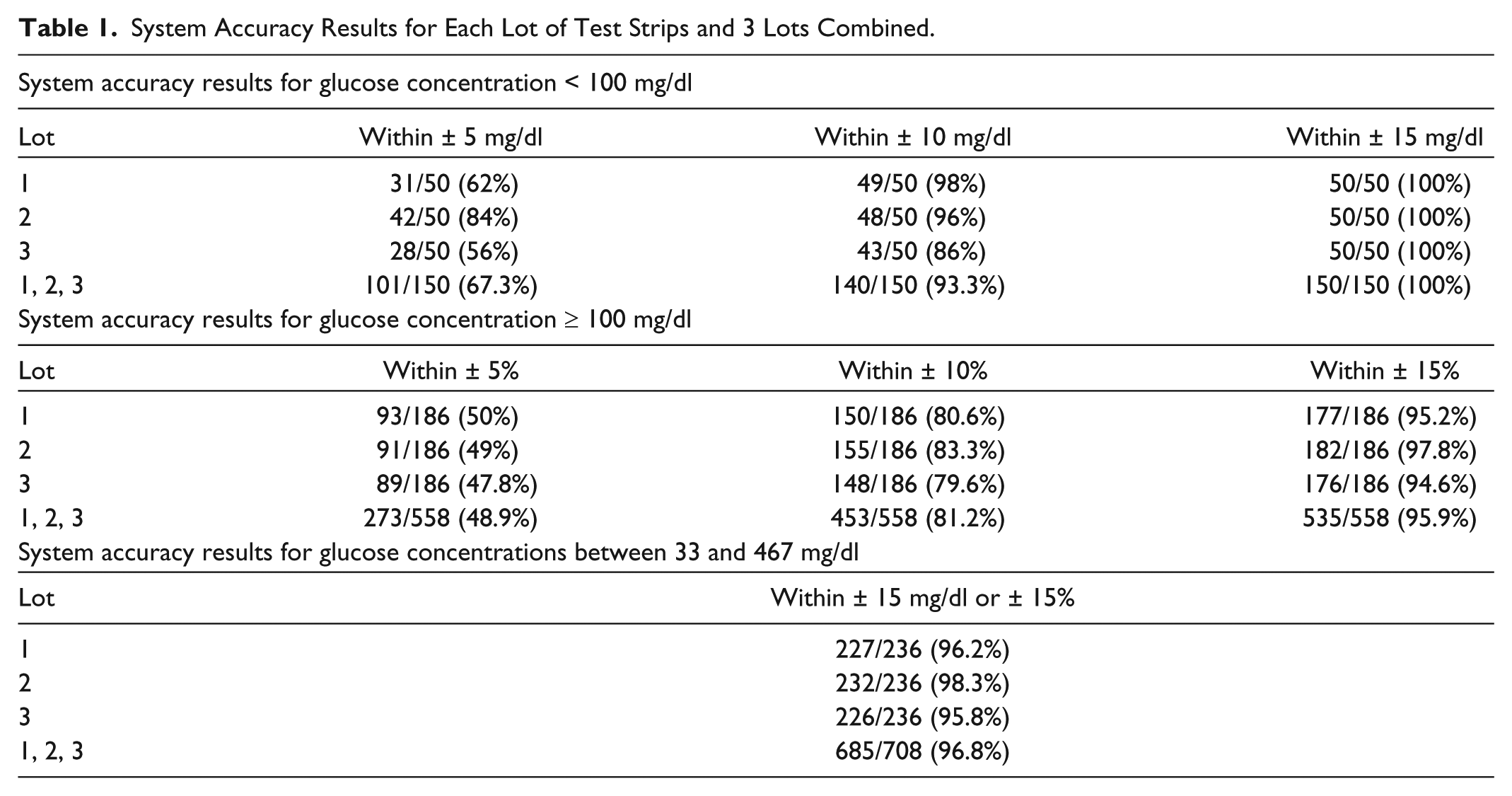
Criterion A was achieved by all 3 lots of test strips tested in this study, ranging from 95.8% to 98.3% compared to the ISO 15197: 2013 requirement of 95% for system accuracy. The system gives better accuracy (100% within acceptance criteria) at glucose concentration below 100 mg/dl than at glucose concentration above 100 mg/dl (95.4% within acceptance criteria). This is probably due to the higher error margin allowed for glucose concentration below 100 mg/dl.
Criterion B of the ISO standard was also met in this study, all 708 values, that is, 100% of the results were in zones A and B of the consensus error grid. This grid resulted from a survey of 100 endocrinologists attending the American Diabetes Association Annual meeting in 1994 and results in zones A and B lead to little or no effect on clinical outcome.
Footnotes
Abbreviations
BGMS, blood glucose monitoring system; GDH, glucose dehydrogenase; ISO, International Organization for Standardization; NAD, nicotinamide adenine di-nucleotide; NHS, National Health Service; NIST, National Institute of Standards and Technology.
Declaration of Conflicting Interests
The author(s) declared the following potential conflicts of interest with respect to the research, authorship, and/or publication of this article: Dr Yon Hin and Dr Iturriagagoita Bueno are employees of Cambridge Sensors Ltd. Professor C R Lowe is a Board member of Cambridge Sensors Ltd.
Funding
The author(s) disclosed receipt of the following financial support for the research, authorship, and/or publication of this article: This work was funded by a grant from Cambridge Sensors Ltd.