



Abstract
Manual calculation of bolus insulin dosages can be challenging for individuals treated with multiple daily insulin injections (MDI) therapy. Automated bolus calculator capability has recently been made available via enhanced blood glucose meters and smartphone apps. Use of this technology has been shown to improve glycemic control and reduce glycemic variability without changing hypoglycemia; however, the clinical utility of app-based bolus calculators has not been demonstrated. Moreover, recent evidence challenges the safety and efficacy of these smartphone apps. Although the ability to automatically calculate bolus insulin dosages addresses a critical need of MDI-treated individuals, this technology raises concerns about efficacy of treatment and the protection of patient safety. This article discusses key issues and considerations associated with automated bolus calculator use.
We know that use of intensive insulin management with basal-bolus insulin therapy is effective in helping individuals with diabetes achieve and maintain optimal glycemic control.1-4 However, a key challenge for many individuals treated with multiple daily insulin injection (MDI) therapy is accurately calculating their bolus insulin dosages. Unlike individuals treated with insulin pumps that offer automated bolus calculation capability, MDI-treated individuals must remember and factor in several inputs, including insulin-to-carbohydrate (I:CHO) ratios, insulin sensitivity factors (ISF), target blood glucose range, and current blood glucose values, to manually calculate their bolus insulin dosages. 5
Manual insulin dosage calculations can be both complex and time-consuming, and individuals often rely on empirical estimates of their insulin needs, which can limit their ability to achieve optimal glycemic control. 6 Even when individuals attempt to calculate their requirements, many have difficulty determining accurate insulin dosages.7,8 This is especially problematic in individuals with deficits in literacy and numeracy, which are common among individuals with diabetes. 9 With others, the obstacle is lack of expertise in carbohydrate counting.5,10-12 For those who want to fine-tune their insulin dosing by incorporating the dietary fat and protein into their calculations, the process becomes even more complex.13,14
Automated Bolus Calculator Capability
Automated bolus calculator capability has recently been made available to individuals treated with MDI via blood glucose meters with integrated bolus calculator technology and smartphone apps. To use this feature, individuals enter their current blood glucose level and number of carbohydrates they will ingest (if requesting a meal bolus), similar to those who wear an insulin pump. The bolus calculator then automatically determines a recommended bolus dosage based on predefined insulin parameters, such as target glucose, I:CHO, duration of insulin action, and ISF.
Several studies have shown that use of blood glucose meters with integrated bolus calculator technology improved glycemic control and reduced glycemic variability without changing hypoglycemia,5,15-18 decreased glycemic variability, 5 prompted earlier and more aggressive therapy changes, 17 improved carbohydrate counting proficiency, 5 and reduced fear of hypoglycemia. 18
Cautions and Considerations
Smartphone Apps
The growing number of bolus calculator smartphone apps provides greater opportunities for individuals with diabetes to benefit from automated bolus calculator technology in their daily management. However, unlike insulin pumps and blood glucose meters with integrated bolus calculator capabilities, the safety and clinical efficacy of these smartphone-based bolus calculators are not known. We, and others, have concerns about their accuracy and technical performance. In a recent study by Huckvale and colleagues, 19 investigators evaluated the accuracy and clinical suitability of all English-language apps for calculation of rapid/short-acting insulin currently available on iOS and Android platforms at the time. Among the 46 apps studied, only 14 (30%) provided documentation for the calculation formula, 42 (91%) lacked numeric input validation and 27 (59%) allowed calculation when 1 or more inputs were missing (eg, correction bolus were calculated even though ISF parameter is not provided). In short, most of the bolus advice apps evaluated either provide no protection against erroneous recommendations due to input issues or may actively contribute to incorrect or inappropriate dose recommendations due to software errors/malfunctions. Individuals who use these apps may face additional significant risk of both severe hypoglycemia and the long-term complications resulting from suboptimal glucose control. However, to our knowledge, there have been no documented cases of errors resulting in acute harm as of yet.
Training and Follow-Up
Insulin is considered to be one of the most dangerous medications available. Because most insulin dosage calculations are handled solely by patients, it is critical that all patients treated with insulin receive adequate training about their insulin therapy. This is especially important for patients treated with intensive insulin regimens. Training in basal-bolus therapy is generally considered an integral part of insulin pump training and is usually performed by clinicians who are experienced in insulin pump therapy. Unfortunately, the majority of MDI-treated patients are under the supervision of clinicians with far less expertise in insulin therapy. Often there are no qualified individuals within these practices to provide the necessary training provide. Nor is there any standardization for the training that is provided.
Recommendations
Demonstrate Safety and Efficacy
Large trials of all devices with automated bolus calculator capabilities are needed to assess their safety and clinical efficacy. Extensive human factor testing is also required to ensure accuracy and usability. These studies should include assessment of the system interface ease of use, user accuracy, selection of appropriate settings, usability of the user instruction materials, and any other factors that are designed to prevent user errors. In addition, in vitro testing with identical samples of hypothetical patients and parameters could be utilized to assess the ability of bolus calculator apps to provide safe insulin dose recommendations. This would rapidly uncover any erroneous or dangerous dose recommendations caused by calculation errors or defective software.
Establish Effective Regulatory Oversight
Another necessary component is regulatory review and assessment. Fortunately, this is currently being addressed. In November 2014, the US Food and Drug Administration (FDA) hosted a public workshop to discuss the issue of medical apps, specifically those that provide insulin bolus advice. Recognizing the rapid growth in the number of bolus calculator apps and the potential benefits and risks to public health, the FDA issued guidance for industry and FDA staff regarding mobile medical applications. 20 In their report, the FDA indicated regulatory oversight will be applied to mobile applications that meet its statutory definition of a medical device, specifically apps that use patient-specific parameters and calculate dosage or create a dosage plan. The FDA believes that this subset of mobile medical apps poses the same or similar potential risks to the public health as currently regulated devices if they fail to function as intended. The FDA strongly recommends that manufacturers of all mobile apps that may meet the definition of a device follow the Quality System regulation (which includes good manufacturing practices) in the design and development of their mobile medical apps and initiate prompt corrections to their mobile medical apps, when appropriate, to prevent patient and user harm. The guidance document contains nonbinding recommendations and is now waiting for public comment.
Ensure That Patients Receive Adequate Training and Follow-Up
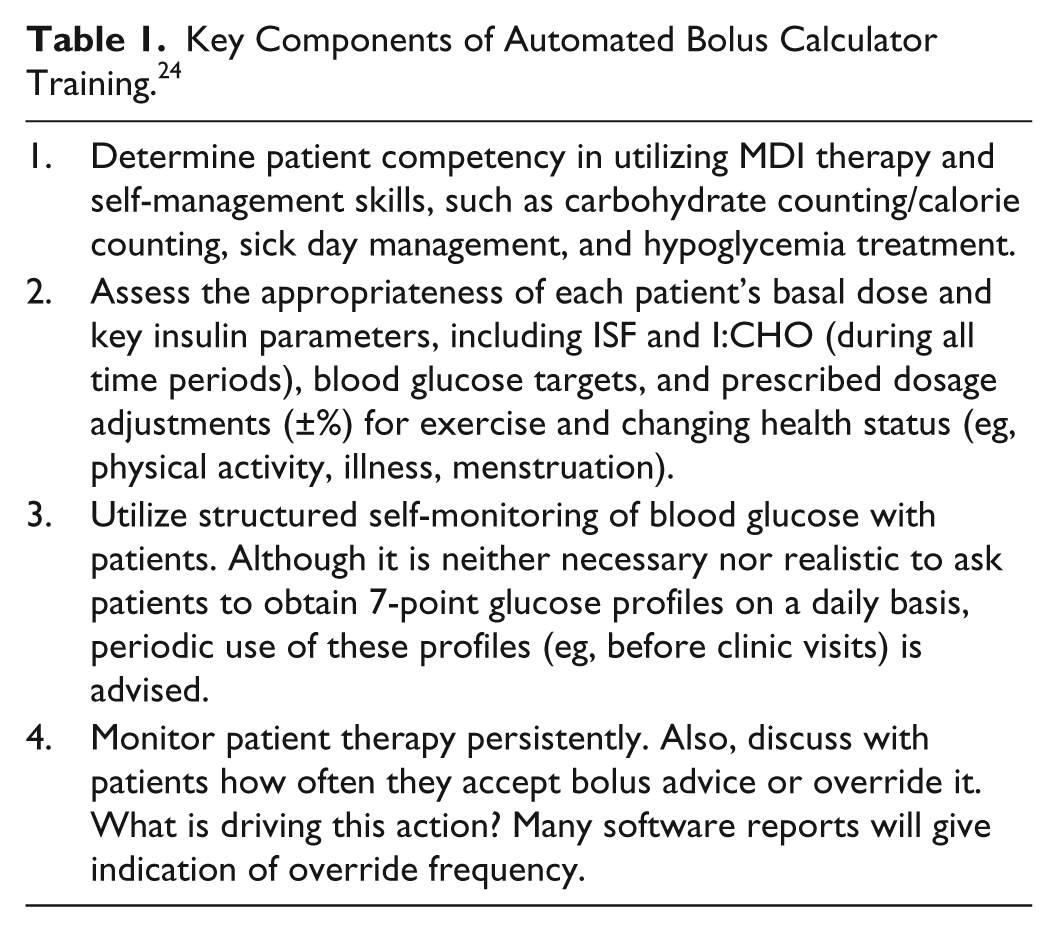
As demonstrated by Cavan and colleagues, 17 use of automated bolus calculator technology can assist clinicians in these efforts; however, accurately establishing and persistently monitoring and adjusting insulin parameters, as needed, are critical to accurate bolus calculation. Unfortunately, patients are often using inappropriate parameters in their daily regimens.21-23 Moreover, as with any new tool or technology, it is important that patients fully understand how to use their bolus calculator devices safely and effectively. Parkin and colleagues 24 recently published a list of key considerations for training and use of automated bolus calculator technology (Table 1). It should be noted, however, that the majority of these recommendations apply to all MDI-treated individuals regardless of automated bolus calculator use.
Key Components of Automated Bolus Calculator Training. 24
Summary
Use of automated bolus calculator technology offers significant benefits to individuals with diabetes who are treated with MDI therapy. Today, many credible medical device manufacturers are in various development stages of incorporating this technology into their products. Because these companies have extensive experience in developing medical devices that meet stringent performance requirements, we are confident that these products will be safe and effective when they become available. However, the safety and efficacy of many of the current smartphone apps are questionable and put users at risk for acute, potentially life-threatening consequences.
Given the growing number of bolus calculator apps, it is important that national and international regulatory agencies move quickly to address the potential dangers of these apps by defining the appropriate pathways for thorough evaluation and clearance. Regulatory involvement should include collection and analysis of surveillance data and rigorous enforcement of the proposed FDA regulations. Although we applaud the efforts of the FDA to address this issue in a timely manner, we also recognize that the development and implementation of regulatory policies will take time.
Therefore, it is critical that health care professionals become vigilant in discussing with their patients the potential dangers of bolus calculator technology that has not been evaluated and proven to be accurate and reliable. Otherwise, their patients will be exposed to avoidable risk of severe and potentially dangerous swings in blood glucose. Moreover, clinicians who prescribe intensive insulin regimens for patients should have expertise in insulin management and be willing to accept the responsibility for ensuring that each patient receives adequate training and follow-up. Part of this will require an infrastructure for training that should be available for clinicians who are already prescribing intensive insulin therapy regimens.
Footnotes
Abbreviations
FDA, US Food and Drug Administration; I:CHO, insulin-to-carbohydrate; ISF, insulin sensitivity factors; MDI, multiple daily insulin injection.
Declaration of Conflicting Interests
The author(s) declared the following potential conflicts of interest with respect to the research, authorship, and/or publication of this article: IBH serves as an advisory board member for Abbott Diabetes Care, Roche, and Becton Dickinson. He receives research grant support from Novo Nordisk and Sanofi-USA. CGP has received consulting fees from Animas, CeQur, Dexcom, and Roche Diabetes Care.
Funding
The author(s) received no financial support for the research, authorship, and/or publication of this article.