




Abstract
Keywords
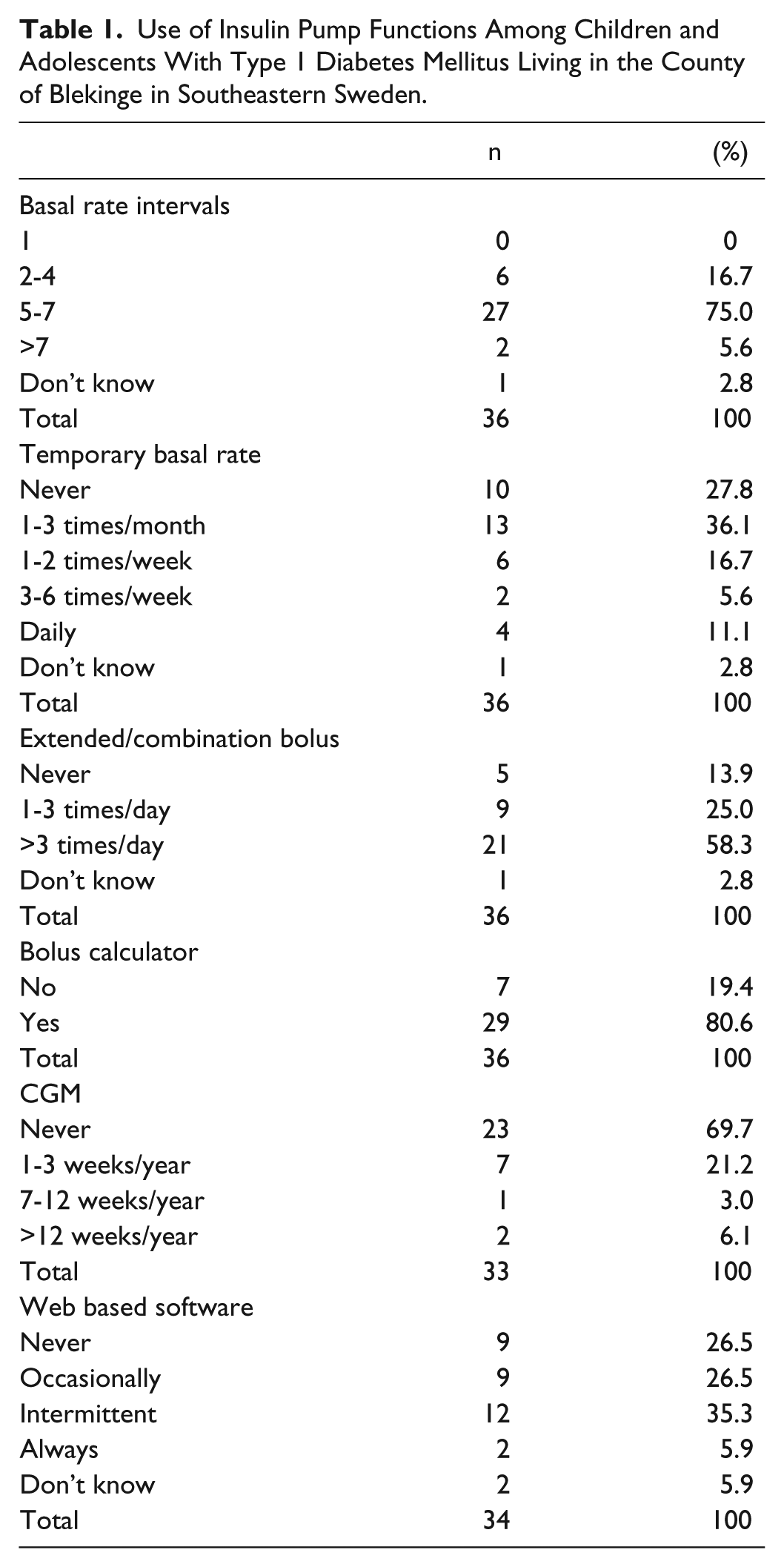
Meta-analyzes in US and Europe report improved hemoglobin A1c (HbA1c) with use of continuous subcutaneous insulin infusion (CSII) compared to multiple daily insulin injections (MDI) in patients with type 1 diabetes mellitus (T1DM).1,2 Simultaneously, reported data in the Swedish Childhood Diabetes Registry (Swediabkids) show that children and adolescents in Sweden with T1DM treated with CSII on average do not achieve as good HbA1c as the whole group of diabetic children. 3 Our study aimed to identify what functions of the insulin pump being used, to increase patient awareness of the use of insulin pump functions and to investigate if usage of insulin pump functions has an impact on HbA1c. At time of inclusion (November 1, 2013) there were 105 patients, 0-18 years of age, with T1DM at Blekinge Hospital, which is responsible for the care of all residents (154.157 the year of inclusion) in the county of Blekinge in southeastern Sweden. Of the patients, 46% (49/105) were treated with CSII and were asked to fill out a paper questionnaire about their usage of insulin pump functions. HbA1c, weight, and daily insulin need data were collected from the medical record at time of questionnaire submission. Thirty-six patients (36/49, 73%) responded to the questionnaire, 44% (16/36) boys and 56% (20/36) girls, 30 patients (30/36, 83%) used the Medtronic Paradigm Veo pump (Medtronic Minimed Inc.,Northridge, CA) and 6 patients (6/36, 17%) used the Animas Vibe pump (Animas Corp.,West Chester, PA). Most patients had the basal rate set into 5-7 intervals. In all, 28% (10/36) said they had never used temporary basal rate, and 36% (13/36) used it as infrequently as 1-3 times per month. Also, 83% (30/36) used extended or combination bolus, while 14% (5/36) always gave the total bolus dose at once at mealtime. Twenty-nine patients (29/36, 81%) stated they were using the bolus calculator (BC). Out of the 29, 5 could not account for the BC’s settings and 2 patients entered settings that did not correspond to the settings they should have had based on daily insulin need. All in all, a total of 22 patients were using the BC satisfactory. Most patients (23/33, 70%) were not using continuous blood glucose monitoring (CGM) and 35% (12/34) periodically used web based software. In all, 26% (9/34) never used software, and 26% (9/34) had used software in occasionally (Table 1). We found through Fisher’s exact test no significant difference in HbA1c level between the group who used extended/combination bolus (P = 1.00) or those assessed using the BC satisfactorily (P = .49) and the patients who did not. We think our results reflect the clinical practice outside controlled studies with motivating study personnel. As more patients migrate from MDI to CSII it becomes important with further research investigating why the patients in Sweden with insulin pump therapy as a group has higher HbA1c level than those using insulin pens. It is also important to identify why the patients chose to use or not to use the functions of the insulin pump, and how they use the functions in order to better approach the needs of the patients in developing new products.
Use of Insulin Pump Functions Among Children and Adolescents With Type 1 Diabetes Mellitus Living in the County of Blekinge in Southeastern Sweden.
Footnotes
Abbreviations
BC, bolus calculator; CGM, continuous blood glucose monitoring; CSII, continuous subcutaneous insulin infusion; HbA1c, hemoglobin A1c; MDI, multiple daily insulin injections; Swediabkids, Swedish Childhood Diabetes Registry; T1DM, type 1 diabetes mellitus.
Declaration of Conflicting Interests
The author(s) declared no potential conflicts of interest with respect to the research, authorship, and/or publication of this article.
Funding
The author(s) received no financial support for the research, authorship, and/or publication of this article.