



Abstract
The comment section accompanying news stories on social media offers an important interactive context for news, but may also afford the possibility to spread anti-establishment, trust-eroding comments. Exposure to such comments may affect social media users’ trust in news media. However, evidence of over-time effects is scarce. This study draws upon cultivation theory and uses a three-wave panel survey in the Netherlands (N = 906). Findings indicate that increased comment reading at T2 exacerbates and deepens news media mistrust at T3, suggesting that exposure to the comment section accompanying news stories posted on social media indeed has negative ramifications for news media trust. News media seem to be closing off their own comment section and delegating commenting to social media in part to create a buffer between themselves and trust-eroding comments. Our findings suggest this buffer is not as solid as news media might hope.
Across the globe, distrust in established information sources is mounting (e.g., Bennett & Livingston, 2018; Waisbord, 2018) as the traditional news media's role as gatekeeper of information is waning (Bimber, 2003; Jungherr et al., 2019; Vos & Heinderyckx, 2015). Society's public sphere has developed into an “unruly public arena” (Jungherr & Schroeder, 2021). This is arguably fueled by the affordances of social media, which offer a discursive opportunity for problematic information and distrust (e.g., Bennett & Livingston, 2018; Bennett & Pfetsch, 2018; Waisbord, 2018). The affordances of social media turned news media into less effective gatekeepers, because anyone with an internet connection can contribute to the public arena (Jungherr & Schroeder, 2021). As a result, the previously (somewhat) orderly public arena has become “noisy and unruly” (p. 9). There are few rules online, and many voices to be heard, which can be empowering for marginalized groups. However, beyond the potential for the inclusion of diverse voices and the empowerment of marginalized or suppressed groups, through social media, citizens can use ungated comment sections to interact with news, and herewith be exposed to unruly and noisy comments that may contain delegitimizing content aimed at established information sources such as the news media (Gorrell et al., 2019; Santana, 2019; Schmidt et al., 2020).
This study takes a cultivation theory perspective (Gerbner, 1973) and focuses on the extent to which exposure to social media comments that accompany news stories might over time cultivate distrust in the news media. The affordances of social media allow disenchanted citizens to directly express their concerns about the news media in comment sections (Kalogeropoulos et al., 2017), potentially influencing the opinions, attitudes, and perceptions of other news users who read the comments (Gearhart et al., 2023). Comment sections accompanying news stories on social media may offer a favorable discursive opportunity structure for the recurring expression of media trust-undermining views—as they are not restricted by the gatekeeping mechanisms of established media, are often algorithmically curated, and afford anonymity to (in)authentic commenters. Moreover, research suggests that those who comment on news stories on social media are often already distrusting of news media and place themselves on the fringes of the political spectrum (Kalogeropoulos et al., 2017).
While experimental research suggests that comment reading can affect citizens’ perceptions and attitudes (Gearhart et al., 2020; Waddell, 2018; Witteman et al., 2016), we know markedly little about the extent to which over-time exposure to comments accompanying news articles on social media cultivates people's distrust in the news media. We argue that increased comment reading, the consumption of social media comments accompanying a news story, not only cultivates distrust by exposing people to relatively homogeneous delegitimizing news media narratives. Driven by confirmation bias, increased distrust is also expected to reciprocally lead to more comment reading which would further strengthen cultivation effects.
Against this backdrop, we draw upon cultivation theory (Gerbner, 1973) and rely on a three-wave panel study (N = 906) to assess the over-time dynamic relationship between selective exposure to comments accompanying news stories on social media and news media trust. By answering the question whether over-time exposure to social media comments reciprocally cultivates distrust in news media, this paper aims to make an important contribution to our understanding of the cultivating impact of exposure to a specific part of the unruly public arena: the comment section accompanying news stories on social media.
Comment Reading as a Driver of Cultivation Effects
Cultivation theory (Gerbner, 1973) holds that the more time people spend watching television, the more likely they begin perceiving society along the lines of the portrayals they see on television. But because the world portrayed on television is not completely in sync with the real world, through cultivation, people start misperceiving the world. For instance, because television portrays the world as more hostile, mean, or dangerous, television viewers will start perceiving the real world as more hostile, mean, or dangerous as well (Shrum, 2017).
Cultivation theory conceptualizes television as an especially powerful storyteller. Heavy television viewers would over time be exposed to similar representations of reality, regardless of the different channels they would watch. As such, it would be unlikely to consider social media as a driver of cultivation effects since social media are known for their personalization of content, which would suggest that people would not be exposed over time to similar representations of reality (Van der Meer et al., 2020). However, Hermann et al. (2023) argue that social media do expose people to the same viral content and that social media afford the “weaving together of disparate personally created narratives in ways that do ultimately become consistent” (p. 2495). Indeed, a meta-analysis by Hermann et al. (2023) reveals consistent cultivation effects for social media users suggesting that cultivation effects are not confined to television.
The Comment Section as a Distrust-Cultivating Unruly Public Sphere
This study focuses specifically on the comment section that accompanies news stories that are shared on social media. Different than the studies included in the meta-analysis by Hermann et al. (2023), we argue that the comments accompanying news stories on social media allow for much more homogeneous narratives than the general social media content. As a result, people who read such comments fairly quickly get exposed to homogeneous narratives and thus do not need to be as heavy users compared to television. Especially the affordances of algorithmic amplification (i.e., previous exposure patterns and preferences lower diversity and choice automatically) and low amounts of content moderation online may amplify exposure to attitude-consistent viewpoints. This makes the threshold for cultivation effects low. Below we will argue that this is, first, because comments on social media are often conflict-oriented, anti-establishment, and rife with disinformation that has a shared delegitimization aim, and, second, because the comment sections on social media are often algorithmically curated, which benefits “engaging” comments.
Arguably, the comment section accompanying news stories on social media resembles the unruly and noisy public arena as described by Jungherr and Schroeder (2021). In this comment section, citizens have been afforded with a way to interact with information that is visible to all: by commenting on news placed on social media. While there are some guardrails provided by law (e.g., hate speech is illegal in the European Union), users are generally free to respond not only to any other user but also to formerly fewer approachable institutions such as news media. In the comment section, people can endorse or refute content and institutions or link to alternative sources and content.
Research shows that comments on social media are often conflict-oriented (Zannettou et al., 2020) and contain negative and hostile anti-establishment narratives (Gorrell et al., 2019; Schmidt et al., 2020). In addition, it is assumed that mis- and disinformation flourishes in the comment section (Anspach & Carlson, 2020), although it remains to be seen to what extent the average user encounters mis- and disinformation in their media diet (Acerbi et al., 2022). Disinformation often aims to delegitimize institutions of press and politics (Bennett & Livingston, 2018) and has indeed been shown to target the press (Humprecht et al., 2020).
The comment section on social media affords opportunities for delegitimizing anti-establishment narratives to spread, by allowing anyone to post almost anything, often with sub-optimal take-down procedures (Goldman, 2021; Leerssen, 2023), but also because many comment sections on social media are algorithmically curated. This means that controversial comments are more likely to be ranked above thoughtful comments because the former leads to more engagement on the platform (Massanari, 2017). In addition to this, as inauthentic actors such as bots and trolls can artificially increase engagement with certain posts (e.g., by automatically liking, sharing, and commenting; Shao et al., 2018), inauthentic behavior can “trick” the algorithm into up-ranking specific, potentially low-quality, information above information of higher quality (see, e.g., Kinetz, 2020; Lee & Chun, 2016). Moreover, the comment section affords commenter’s anonymity, which is associated with more uncivil and low-quality comments in response to news stories (Rowe, 2015; Santana, 2014, 2019, p. 480; see online disinhibition effect: Sproull & Kiesler, 1986; Suler, 2004).
Taken together, we argue that the comment section on social media resembles an unruly and noisy public sphere and that the affordances of social media (i.e., algorithmic curation, which is vulnerable to inauthentic manipulation, and anonymity) offer a discursive opportunity for problematic information.
Social Media Comments on News Stories Expose People to Trust-Eroding Narratives
While the cultivation literature might stress that mainstreaming, exposing people to similar portrayals of reality, is challenging on social media because of its atomized structure, we argue in this section that comments that accompany news stories on social media are likely to offer users a similar perspective: one that attempts to undermine trust in news media. First, these active authentic commenters are particular and hold low-trust perceptions. Second, these low-trust commenters are especially active around content from news media. Third, engaging (and artificially amplified) trust-undermining comments are ranked higher than regular comments, which increase visibility. Fourth, experimental research has shown that exposure to comments indeed increases perceptions of media bias, a media trust-undermining accusation.
Research suggests that commenters are not a cross-section of society. In fact, political partisans (left and right) and those who have low levels of trust in news are more likely to comment on news articles on social media (Kalogeropoulos et al., 2017). We argue that these strong partisans might make hostile media bias accusations. Research on media trust finds that people who place themselves either on the left or right of the political spectrum are more distrusting toward the news (e.g., Livio & Cohen, 2018; Schranz et al., 2018). The hostile media bias phenomenon (Vallone et al., 1985) holds that people perceive news media coverage as unfairly biased against their side (even when this is not the case). Since strong partisans are more likely to comment on news on social media, we expect that these comments are in part hostile media accusations. Indeed, perceived media bias is one of the most prominent reasons why people distrust the news media (Lewis, 2020; Newman & Fletcher, 2017). Research also finds that low-trusting citizens are more likely to comment on news stories on social media (Kalogeropoulos et al., 2017). As such, the comment section affords these users to make trust-undermining accusations to news media.
As discussed in the section above, the comment sections on social media are algorithmically curated, which affords opportunities for ill-intending networks to inauthentically spread and boost trust-undermining comments (see Kinetz, 2020; Lukito, 2019; Lukito et al., 2020), thereby increasing the prevalence and visibility of such comments. Indeed, Humprecht et al. (2020) found that social media comments in the USA and Germany were more often hostile than neutral or affirmative and often targeted at the media/journalism.
Experimental research has demonstrated that exposure to such comments has trust-eroding effects. Gearhart et al. (2020) found evidence for a hostile media bias effect. Reading comments accompanying news teasers posted on Facebook increased perceptions of media bias. Similarly, Gearhart et al. (2023) found evidence for social media comment reading-induced perceptions of hostile media bias.
Taken together, we argue that trust-eroding comments are “mainstreamed” in the social media comment sections that accompany news stories. People who read more comments repeatedly get exposed to a similar portrayal of reality: one where news media are unfairly biased and overall untrustworthy. Being exposed repeatedly to these narratives, over time, will cultivate real-world perceptions of untrustworthy news media. This leads to the first hypothesis.
The Reciprocal Relationship Between Exposure to Comments and Eroding Media Trust
Confirmation biases cause people to seek attitude-congruent information or to avoid attitude-incongruent information so as to avoid psychological discomfort (Festinger, 1957; Knobloch-Westerwick et al., 2020; Van der Meer et al., 2020). Driven by confirmation bias, it is to be expected that people seek to further expose themselves to congruent information that reassures their media distrust perspective (Knobloch-Westerwick et al., 2020; Van der Meer et al., 2020). Together with social media comments that are unruly and noisy, reading comments, over time, might further erode trust in mainstream media over time. Considering the interrelationships between comment reading and media trust, we identify a reciprocal model of exposure to the unruly public arena of social media comments and present the following hypothesis (see Figure 1 for a depiction of the overarching model).
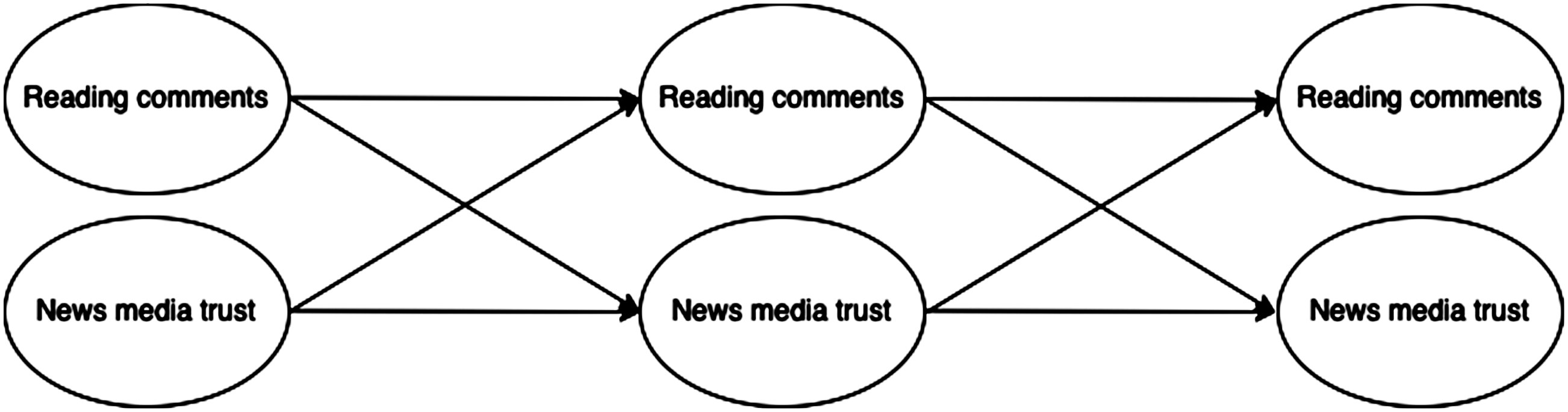
Reciprocal relationship between comment reading and news media trust.
Method
This study used a three-wave panel survey, administered in the Netherlands, between July 19, 2019, and April 20, 2020, by Ipsos GFK. The sample of participants who completed all three waves (N = 906) was representative of the Dutch 18+ population on age (M = 50.87; SD = 15.90), gender (46% women), education (26% low education, 50% intermediate education, and 24% high education). The survey data were part of an overarching project using the same set of panel respondents for three waves of data collection, and the variables relevant to this study were measured at the very start of each survey. Ethical approval was provided by the university's ethics board (details withheld for peer review). Participants provided informed consent before their participation.
Data for Wave 1 were collected between July 19 and August 9, 2019. There were 2,106 participants and the average participant took 35 min to complete the survey. Wave 2 was collected between December 4 and December 16. There were 1,288 participants (retention rate: 61%). The average Wave 2 participant took 20 min to complete the survey. Wave 3 was collected between April 9 and April 20, 2020. There were 906 participants who completed all three waves (retention rate relative to Wave 2, 70%; retention rate relative to Wave 1, 43%). The average Wave 3 participant took 25 min to complete the survey, but answered the questions relevant to this study at the start of each survey.
Measures
Reading comments. This variable was measured using the following item: to what extent do you read comments on news stories on social media? (T1: M = 2.88; SD = 1.71; min = 1; max = 7). Participants could answer 1 (never) to 7 (always). In the surveys, the question about comment reading was the second question respondents answered. After this question, respondents answered many other questions that were unrelated to social media comments. This should minimize the likelihood of a priming effect that could have influenced respondents when information.
Trust in news media. This variable was measured using a scale that consisted of the following items, each measured on a 7-point scale, where 7 is the highest: how much trust do you have in (1) websites of national newspapers; (2) the public broadcaster; (3) commercial broadcasters; (4) newspapers, and (5) news on the radio? (T1: M = 4.93; SD = 1.02; min = 1; max = 7; eigenvalue = 3.18; Cronbach's alpha = .90).
Education served as a control variable and was only measured at T1 (26% low education, 50% intermediate education, and 24% high education). When we look at the Dutch population, 30% has a low education level, 37% has an intermediate education level, and 33% has a high education level (Statistics Netherlands, 2021).
Age was reduced to age groups: 19–34 (N = 184; 20%), 35–54 (N = 362; 40%), 55+ (N = 361; 40%; min = 19; max = 88). When zooming in on the Dutch population, and specifically the Dutch population between 19 and 88 years old, age group 19–34 is 26% of the population, age group 35–54 is 32%, and 55–88 is 42% (Statistics Netherlands, 2022).
Media use was measured by asking respondents how many days per week they watch the NOS Journaal or RTL Nieuws and current affairs programs; read a newspaper such as De Telegraaf or Algemeen Dagblad; read a newspaper such as de Volkskrant, NRC Handelsblad, Trouw, and Het Financieele Dagblad; and listen to the news or current affairs programs on the radio (T1: M = 3.39; SD = 1.52; min = 0; max = 7). We excluded various (online) platforms with a less established readership (<100.000) such as de Correspondent. We did so as readers of these smaller platforms would be largely underrepresented in the sample. Yet, we should stress that we mainly focused on larger platforms of news in the Dutch setting.
Analytical strategy. This study focuses on the over-time reciprocal relationship between reading comments, trust in MSM, and trust in political institutions. The model uses stability coefficients and thus controls for the previous values of the same variable (at T-1). By taking these previous values into account, this study looks at within-respondent changes over time and is able to isolate the effect of the other variables of interest over time from the autoregressive effects.
Results
The Reciprocal Relationship Between Reading Comments and News Media Trust
Before the cross-lagged model is discussed, we describe the data in Tables 1 and 2, on the basis of two OLS regression analyses. The former table describes to what extent age, gender, and education predict the reading of comments placed alongside news articles on social media at T1. The latter table describes to what extent age, gender, and education predict media trust at T1. Table 1 shows that age, gender, education, and media use significantly predict comment reading. Specifically younger people, men, the lower educated, and people who consume less traditional media are more likely to read more comments. Table 2 shows that higher educated and people who use more traditional media are more likely to have more trust in mainstream media.
Association Between Socio-demographics and Reading of Comments Under News Articles on Social Media.
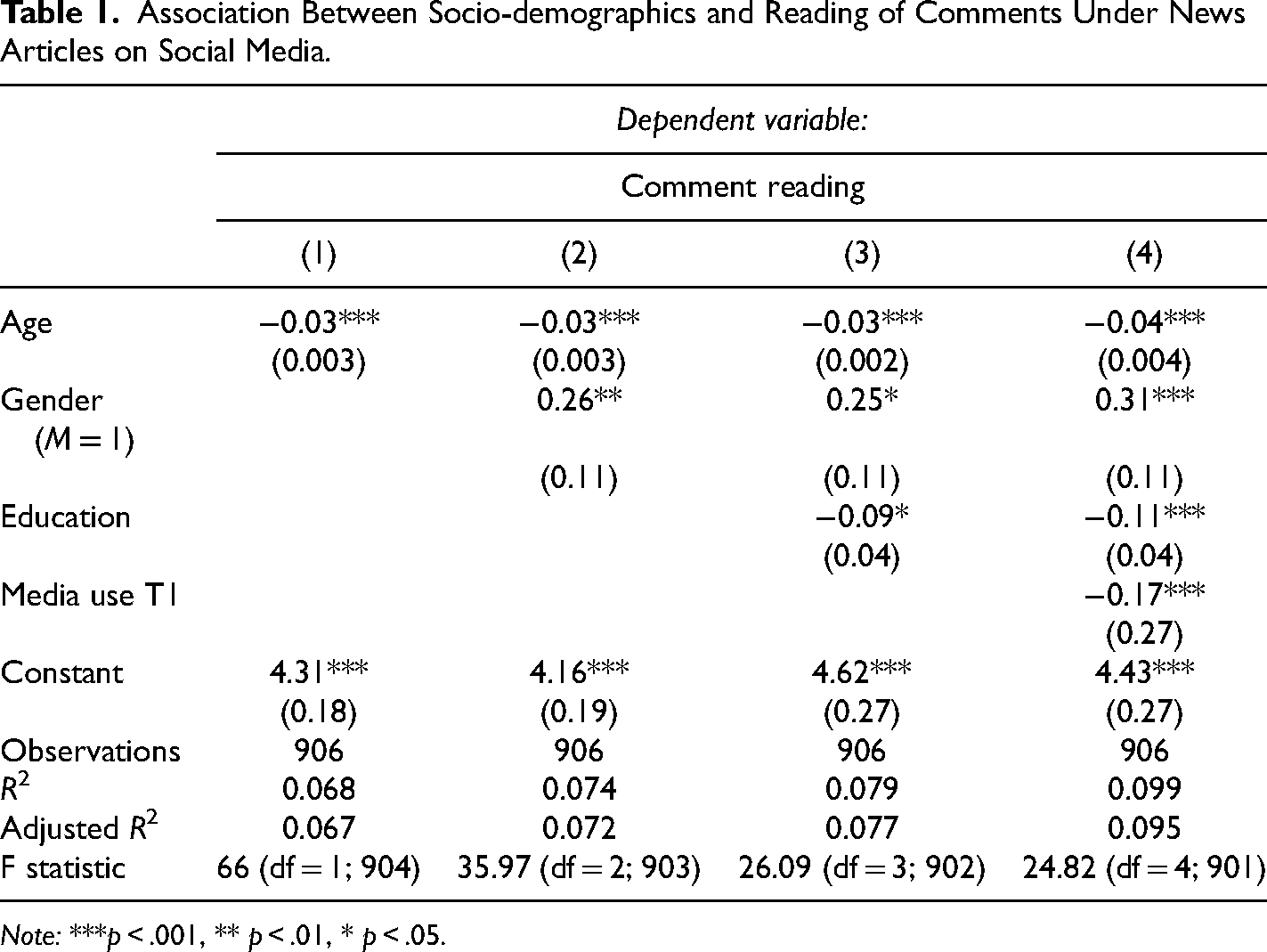
Note: ***p < .001, ** p < .01, * p < .05.
Association Between Socio-demographics and Trust in Mainstream Media.
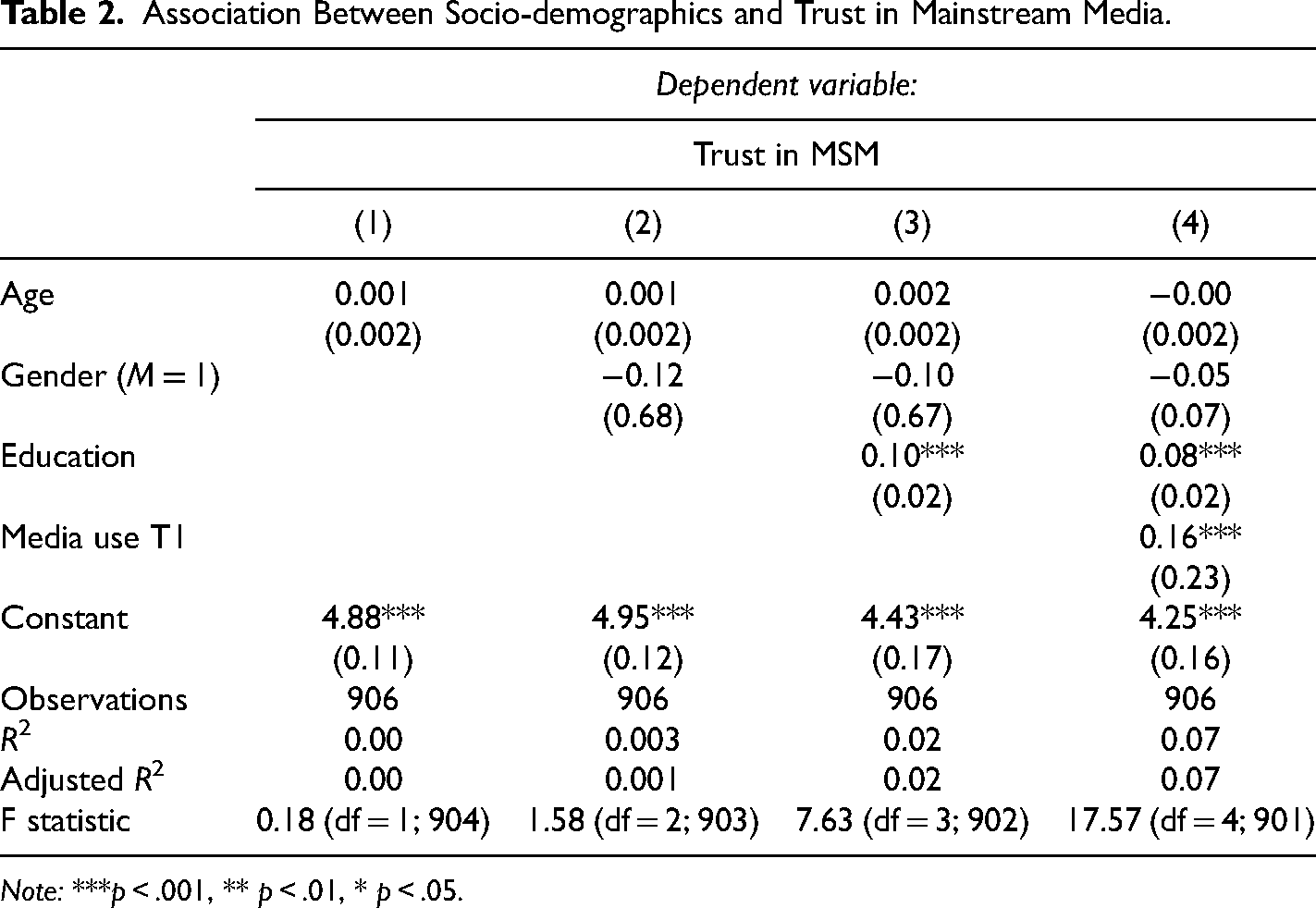
Note: ***p < .001, ** p < .01, * p < .05.
Estimating the cross-lagged model to test the reciprocal relation between reading comments and news media trust over time, it becomes clear that the model has an excellent fit with the data (χ² (9 df) = 16.67; p = .05; root mean square error approximation (RMSEA) = .03; 90% confidence interval = [.00 to .05]; CFI = .997; TLI .991; N = 906). Figure 2 shows the model's significant paths. Comment reading at T1 does not significantly predict news media trust at T2 (B = −.02; SE = .02; z = −.86; p = .39). Similarly, media trust in T1 does not significantly predict comment reading at T2 (B = −.004; SE = .02; z = −.16; p = .88). However, the analysis shows that an increase in comment reading at T2 does significantly predict a decrease in media trust at T3 (B = −.10; SE = .02; z = −3.97; p < .001; 95% CI −.14, −.05). However, this effect is not reciprocal. There is no significant relationship between media trust at T2 and comment reading at T3 (B = −.03; SE = .03; z = −1.01; p = .31). This means that comment reading indeed leads to a decrease in news media trust, which supports H1. However, lower levels of news media trust do not in turn lead to increased comment reading, which does not support H2.
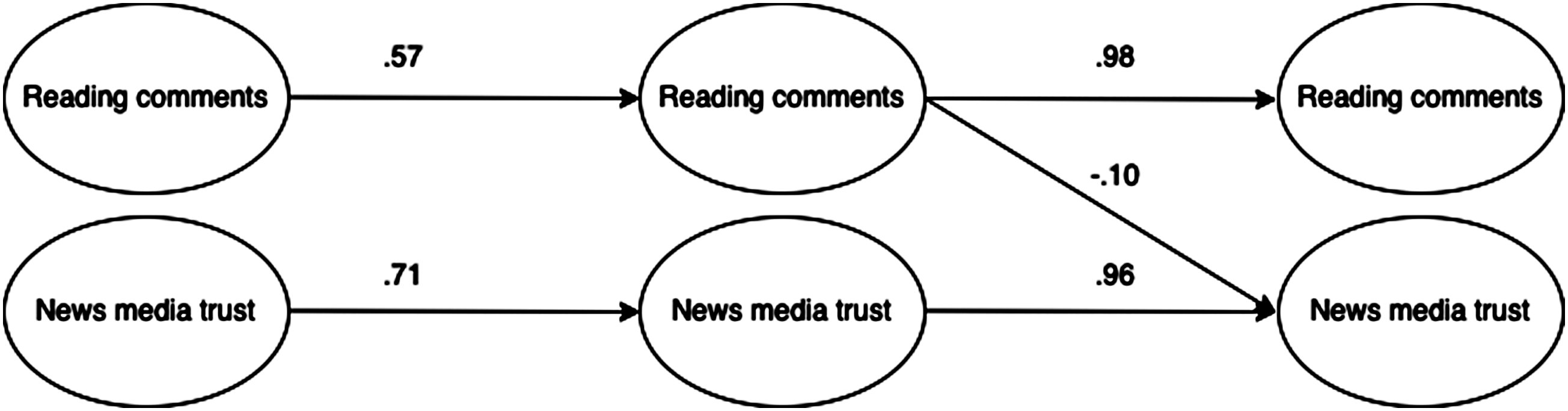
Significant paths in the model.
In terms of control variables, education at T1 did not significantly predict people's comment reading at T2 (B = −.03; SE = .02; z = −1.45; p = .15), but education did significantly predict people media trust scores at T2 (B = .04; SE = .02; z = 2.08; p = .04; 95% CI .003, .08). This means that higher educated people had higher trust levels at T2 than lower educated people. Age at T1 did predict comment reading at T2 (B = −.13; SE = .03; z = −5.37; p < .001; 95% CI −.18, −.09), but not media trust at T2 (B = .002; SE = .02; z = .09; p = .93). This shows that older people were less likely to read comments than younger people were. Finally, media use at T1 did not significantly predict comment reading at T2 (B = .03; SE = .02; z = 1.39; p = .16), but did significantly predict media trust at T2 (B = −.06; SE = .02; z = 2.79; p = .01). This means that the more media people use at T1, the higher their trust levels are at T2.
Discussion
In this study, we set out to map the potential cultivation effects of reading comments that accompany news stories posted on social media. We expected a reciprocal relationship between comment reading and news media trust, but we found no evidence for a reciprocal effect. The results do demonstrate that people who increased comment reading at T2, relative to T1, scored lower on news media trust at T3. This suggest that reading the comments under news stories posted on social media can cultivate distrust and exacerbate and deepen mistrust in the news media.
The findings support the idea that the comment section accompanying news stories posted on social media resembles an unruly and noisy public arena and that the affordances of social media (i.e., algorithmic curation, which is vulnerable to inauthentic manipulation, and anonymity) offer a discursive opportunity for problematic information and news media distrust. Moreover, the findings are in line with our argument that different people who read comments accompanying news stories on social media get exposed to the same type of news trust undermining comments (i.e., mainstreaming).
In the time period between T2 (December 4–16, 2019) and T3 (April 9–20, 2020), the Covid-19 pandemic left the world, including the Netherlands, in a state of uncertainty. As such, it is fair to ask whether we observed a cultivation effect of comment reading on news media trust, or whether we saw a pandemic-driven dip in news media trust. First, news media trust in the Netherlands did not drop during the first year of Covid-19. News media trust at first remained stable, and a year later, news media trust even increased (53% trust in 2019, 52% trust in 2020, and 59% trust in 2021; Newman, 2019; Newman et al., 2020; Newman et al., 2022). Second, when inspecting the news media trust levels in the sample, we see that the news media trust level at T3 was on average slightly higher (M = 4.86; SD = 1.02) than at T2 (M = 4.78; SD = 1.02). Hence, it is unlikely that the findings of the current study are “due to Covid-19.” If anything, Covid-19 seemed to have slightly increased news media trust perceptions.
This study is limited in scope as it only focuses on comments accompanying news stories on social media. The cultivation effects found there were likely contingent on mainstreaming (i.e., different users got exposed to similar news trust portrayals). As Hermann et al. (2023, p. 2494) note: “Gerbner would likely have contended that cultivation analysis cannot be applied to social media,” because social media are so disparate and user-experiences so atomized that general social media users are unlikely to be exposed to mainstreaming narratives except for the viral content. In other words, general comment reading on social media would likely not cultivate media distrust because the general comments (i.e., comments are not strictly accompanying news stories) are very unlikely to converge around narratives regarding the untrustworthiness of the news media. However, our study is limited in scope because we do not know the actual content and narratives that circulate in the comments accompanying news stories on social media. Understanding the narratives would provide crucial insights into ways to tackle their detrimental cultivation effects. Here, we also suggest future research to include more precise measures of the amount of comments people are exposed to, instead of relying on self-reported measures. Future research designs may, for example, rely on the tracking of online media consumption and the amount of time spend on comment reading (i.e., eye-tracking) to more validly assess comment reading behaviors. In addition to this, since we measured perceptions on social media, it could be that participants differed to some extent with regard to which platforms they consider to be part of social media. Moreover, it remains unclear how much exposure was necessary to lead to the effect between T2 and T3. Future research might employ experimentation in an attempt to get more insights into this question.
One could argue that this study's focus is broad because we include all social media without specifying topics or issues related to exposure to social media comments. It can be expected that there are differences between social media (e.g., algorithmically curated comment sections vs comments sections without algorithm). The comment section of platforms without algorithmic curation, such as Mastodon, is less likely to optimize for engaging (and thus often low-quality) comments. This would suggest less mainstreaming and thus less cultivation effects.
This study provides insight into a quickly evolving phenomenon, since social platforms’ strategies around news develop quickly (e.g., Meta “deprecates” the news tab since December 2023; Meta, 2023), and people increasingly avoid news (Newman et al., 2023). At the same time, European policymakers consider to what extent social platforms should be obliged to prioritize news from trustworthy media (see McGonagle et al., 2023). The findings of this study highlight the potential for a backfire effect when news is accompanied with user comments.
Similarly, in terms of news media trust, we include a broad palette of media: newspapers, public broadcaster NPO, commercial broadcasters, and news radio. While this study finds that news media trust drops at T3 after increased comment reading, it might be that trust levels do not drop equally for all news brands. Indeed, the Reuters Institute Digital News Report notes that a few (large) news brands rake in most of the new digital subscriptions (Newman et al., 2022). Potentially, these news brands enjoy higher and more stable trust levels than the other news brands. Indeed, the Dutch public broadcaster tends to enjoy the highest trust levels (77% trusts most news from the Dutch public broadcaster most of the time), while trust levels of national newspapers vary from 56% to 70% (Newman et al., 2022). In other words, this current study shows the overall trend, but zooming in on specific news brands might reveal clear differences in trust between brands and modalities.
News media in the USA and UK increasingly disable the comment section on their own news sites and delegate commenting to social media. One of the reasons for this was that news media feared that “bad commenters were skewing public perception of legitimate news stories, scientific fact, or the news organization itself (…).” Delegating comments to social media would place a “buffer between themselves and vitriolic conversation” (Nelson et al., 2021, p. 577). However, the findings of this study suggest that this buffer is not as solid as these news media might hope. It must be noted that news media also pivoted to social for business reasons, because news media perceive social media as a place where they can find and connect with their audiences (Batsel, 2015). The findings of this study suggest that audience outreach on social media might be hampered by trust-undermining comments.
Through the comment section on social media, users can expose themselves to a cacophony of opinions, perspectives, and attitudes. This might be an empowering experience, especially for marginalized groups who do not feel represented by the mainstream media. However, at the same time, our findings illustrate how social media comments accompanying news stories might further disrupt the public arena and turn people further away from the truth claims expressed by the established news media. This suggests that news media need to find ways to enhance trust.
Footnotes
Declaration of Conflicting Interests
The authors declared no potential conflicts of interest with respect to the research, authorship, and/or publication of this article.
Funding
The authors received no financial support for the research, authorship, and/or publication of this article.
