



Abstract
In theories about journalism's democratic remit, trust is generally regarded as a prerequisite for public connection: only when citizens believe the news, they will engage with it and act upon it to perform their citizenship. Trust seems even more important in today's digital society, where the destabilization of journalism institutions and proliferation of sources make the media ecology increasingly complex to navigate. This paper challenges such conceptualizations of media trust rooted in rationality and deliberateness. Based on two series of semistructured interviews with fifty-five young people from ten nationalities living in the Netherlands, conducted in 2016 and 2017, we develop a taxonomy of people's tactics when assessing the reliability of news. We explore what this means for how they value news and how such judgments, drawing on explicit and tacit knowledge, impact their news use. Rather than critically evaluating news through comparing and checking sources, users often employ more pragmatic shortcuts to approximate the trustworthiness of news, including affective and intuitive tactics rooted in tacit knowledge. Consequently, we argue that to fully understand how users deal with the complexity of trust in digital environments, we should not start from ideals of informed citizenship, but from people's actual practices and experiences instead.
Introduction
Judging the reliability of news and keeping up-to-date on politics is becoming an increasingly complex task for the average citizen. People have to navigate and evaluate a wealth of different news outlets, on and offline, considering potential bias, algorithmic filtering, and commercial interests. This proliferation of sources makes the decision who to trust for political news even more difficult. Polarizing political debate, rising populism, and concerns about disinformation campaigns have increased the need for reliable political information. Yet, polls show a decreasing confidence in traditional media institutions in many—although not all—countries, in part fueled by politicians questioning journalism's trustworthiness (Edelman Trust Barometer 2019; Newman et al. 2020). This destabilization of journalism institutions raises the question how users deal with the problem of trust and how they find reliable information amidst what Coleman (2012: 36) names “the info-smog.”
Low levels of media trust have raised fears about audiences abandoning journalism, (actively) avoiding news and becoming less informed (Prochazka and Schweiger 2019). Such concerns are based on two assumptions. First, it presumes that users have deliberate motives for trusting a particular outlet or story. Consequently, media trust has often been conceptualized as a mostly rational decision, based on users' assessment of the perceived reliability of the news content or brand (e.g., Tsfati and Cappella 2005; Wenzel 2019; Williams 2012). Second, it presupposes that citizens will only consume news that they trust; and vice versa, that news that is considered unreliable will be ignored. Indeed, from a uses and gratifications perspective in which users consciously construct repertoires for political news that are meaningful to them, it seems reasonable to assume that lower trust will result in declining news consumption. Deliberative, participatory, and representative theories of democracy argue that this matters, because when users turn away from journalism due to a perceived lack of legitimacy, this prevents them from acting upon the public information it offers and thus hinders the performance of their citizenship. However, previous studies have called such normative assumptions around trust into question.
First, in people's currently media-saturated lives, news use is not only resolute but also unintentional. For example, on social media and in personalized news environments, people may simply stumble upon news stories, or sources, rather than looking for them deliberately (Boczkowski et al. 2018; Van Damme et al. 2020). While the increased availability and accessibility of information online in principle simplify the triangulation of news, such evaluations are also time consuming and interrupt people's flow of news use. Therefore, users may rely on heuristics or shortcuts to make decisions about reliability (Metzger and Flanagin 2013) or even assess news completely intuitively. For example, in their study on how people determine the reliability of news photography, Puustinen and Seppänen (2013) found that viewers deemed pictures trustworthy based on an intuitive sense of authenticity. Trust, as Coleman et al. (2009) and others have argued, goes beyond the accuracy of facts: it also encompasses the confidence that news media will meet public expectations around news, including more affective assessments of feeling represented in news coverage, that news outlets operate based on genuine motives and journalism does reflect social reality and audiences' everyday experiences (see also Coleman 2012; Metzger and Flanagin 2013; Schmidt et al. 2019).
Second, even when users judge the reliability of news cognitively, high trust may not always equal news consumption. Previous studies show mixed results about the link between news use and media trust (see Strömbäck et al. 2020, for an overview). Some studies found that the higher perceived credibility of a medium increases the likelihood of news consumption (Kiousis 2001; Winter and Krämer 2012). Reversely, Hopmann et al. (2015) concluded that using a medium increases trust in that channel. Yet, other studies found mixed results or no significant associations (Tsfati and Cappella 2003; Williams 2012; Wölker and Powell 2018). According to Reuters' latest Digital News Report, only 46 percent of the news users trust the media that they use most of the time (Newman et al. 2020). Likewise, social media are trusted by far fewer people than legacy media (Barthel and Mitchell 2017; Elvestad et al. 2018); yet, paradoxically, these social networks are increasingly popular pathways to news (Newman et al. 2020). These apparent contradictions raise questions to what extent people's patterns of news use are guided by perceptions of reliability—we might even ask whether the reliability of news matters to them at all.
In other words, users' perceptions of reliable news and their actual news practices may not necessarily align with the normative ideal of the informed, democratic citizen. Previous work has predominantly used quantitative approaches to address these inconsistencies, testing what factors may affect trust in particular media channels, sources, or content through experiments or survey research (Hopmann et al. 2015; Tsfati and Cappella 2005; Williams 2012). However, less is known about how users actually experience the complexity of trusting news and about the practices they employ to judge what feels like trustworthy public knowledge. This paper therefore asks under what circumstances young people experience political news as trustworthy and when, how, and why these perceptions relate to their patterns of news use.
We take a user-centric approach to understand how people deal with trust in a digital news media landscape. Using in-depth interviews combined with card-sorting exercises, we explore when and how explicit and tacit knowledge becomes meaningful to young news users for assessing the reliability of news. We develop a taxonomy of people's tactics when assessing the reliability of news content and outlets, and how such assessments impact their patterns of news use. This way, this paper further unpacks the apparent paradox of why people may consume news that they do not trust and may not trust the news that they use. Moreover, this highlights the gap between normative ideals surrounding trust and misinformation and people's everyday practices and experiences, problematizing the issue of trust within today's digital society.
Trust and News Use
The concept of trust lies at the heart of journalism (Brants 2013). The inability of audiences to witness all events that may impact their everyday life forces them to rely on others to inform them. Over time, journalism institutions have become pivotal as providers of publicly relevant information. Central to the trustee model of journalism (Schudson 1999) is the willingness of news users to surrender control to journalists and accept the risk of being misinformed, because they trust their professional judgment. The bargain is that they get frequent information in return that allows them to exercise their citizenship. News organizations need a certain level of authority and legitimacy to be trusted with this task.
Mass media's monopoly on providing news has long sustained this image of journalism as society's trusted sense-making institution communicating the issues of the day. However, due to the increased competition from alternative information suppliers, legacy news media are now merely a source of news among many others. These can be a newspaper, broadcaster, or news website, but also an individual reporter sharing an update, a friend forwarding a story, or an algorithm or news aggregator selecting information (Fisher 2016). This means that the trustee model of journalism is increasingly being challenged. News users are confronted with an overload of information, in a society where partisanship and polarization are increasingly present (Coleman 2012).
It is, therefore, hardly surprising that survey research has reported decreasing trust in news, journalists, and media in many parts of the world (Edelman Trust Barometer 2019; Newman et al. 2020). Low trust in media aligns with broader trends of deinstitutionalization, deregulation, and individualization, in which truths originating from personal, individual experiences are increasingly valued over knowledge stemming from official institutions and experts (Van Zoonen 2012). There is a clear relation with a decline in trust in other key institutions in society, such as the government (Hanitzsch et al. 2018). Moreover, there is a growing trust gap between informed citizens and the far more skeptical mass population (Edelman Trust Barometer 2019). This shift has caused concerns about its democratic consequences. Without people considering media as spaces for trustworthy news, deliberative and participatory theories of democracy argue, citizens will no longer consume their content. Therefore, they cannot properly act as watchdogs or foster cohesion by delivering common knowledge and facilitating shared frames of reference to public life (Coleman 2012; Couldry et al. 2010; Usher 2018).
Previous studies, however, show that the link between news consumption and trust is more complex than these normative ideals of informed citizenship assume. People do not always trust the news that they consume or vice versa (Tsfati and Cappella 2005; Williams 2012; Wölker and Powell 2018). While trust overall is mostly associated with greater use of news media (Strömbäck et al. 2020), studies evaluating these links demonstrate differences between media type, institutions, and topics of coverage (Nelson and Kim 2021; Schranz et al. 2018; Taneja and Yaeger 2019). Moreover, when associations between news media trust and use are found, they are often quite modest (Strömbäck et al. 2020). This raises the question why trust and use sometimes do and sometimes do not relate, and what other factors contribute to news media trust and use.
Earlier work has uncovered many criteria that people evaluate when assessing the reliability of news content and sources (Fisher 2016; Tandoc et al. 2018). These include content-related factors—for instance, hard news tends to be considered more trustworthy than soft news (Miller and Kurpius 2010)—design and technological features (Broersma 2013; Dochterman and Stamp 2010; Flanagin and Metzger 2007), and contextual factors, such as recommendations of others (Sundar 2015: 83). Likewise, as Tsfati and Cappella (2005) argue, “obtaining accurate and objective information is just one motivation for watching the news” (254). Media repertoire studies show that people adhere to a wide range of values to compose the subsets of news media they use, including topical interests or geographical focus (Trilling and Schoenbach 2013), political ideology (Edgerly 2015; Mourão et al. 2018), genre (Schrøder and Kobbernagel 2010), modes of use (Swart et al. 2017), and platform preferences (Taneja et al. 2012; Yuan 2011). Frequent use of news outlets, however, does not automatically mean that they are valued. The habitual nature of news consumption makes repertoires so customary that if situational fit, availability and accessibility persist, routines are very difficult to break, even when people consider particular news outlets “too unreliable” (Swart et al. 2017). Low appreciation or trust of journalism thus not necessarily equals an inattentive or uninformed public, nor does it make news or journalism irrelevant as shared frames of reference that facilitate people's engagement in society.
What is more, judgments about trust may not necessarily be conscious and deliberate decisions. In Polanyi's (1966) terms, the ability to assess the reliability of news is typically framed as a form of explicit knowledge, that is, knowledge that can be codified, documented, and transmitted. Media literacy programs propose that trust can be achieved through established practices that can be articulated and taught, such as carefully crosschecking and comparing news with other sources. However, previous studies demonstrate that in practice, users' tacit knowledge, drawing upon personal experience and more intuitive notions, also plays a role in deciding who to trust (Collins 2010). Faced with an overwhelming amount of news in a media-saturated environment where users do not only select news deliberately but also incidentally stumble upon it (Boczkowski et al. 2018; Van Damme et al. 2020), they are forced to rely on various heuristics or shortcuts that encompass more risk and are less clear cut, such as news items' tonality or design (Fisher 2016; Metzger and Flanagin 2013). Moreover, as constructivist studies of trust have emphasized, to trust or distrust news is more than a matter of reliable facts. Trust also depends on more affective, intuitive, and experience-based perceptions of inclusion, integrity, and responsibility (Coleman et al. 2009; Schmidt et al. 2019; Wenzel 2020). While the impact of such “gut feelings” may be more difficult to examine in research than the application of skills taught in media education, we argue that taking users' tacit knowledge into account is crucial to understand the decisions they make about trust when navigating news.
Methodology
To develop a rich understanding of the relationship between news use and trust, we conducted two rounds of in-depth, semistructured interviews with people aged eighteen to twenty-nine years old, of which the large majority in their early twenties. Interviews were conducted in the Netherlands, a country with a comparatively high and stable level of trust in news media (Newman et al. 2020), in December 2016 and were repeated with another sample in December 2017. A total of fifty-five participants was recruited using snowball sampling, asking respondents after the first interviews if they could refer us to others who might be willing to participate. Furthermore, quota sampling was used to ensure an equal balance in gender and between Dutch and international participants; the sample contained ten different nationalities to account for cross-cultural differences. The participants were anonymized when the interview data was stored, so this could not be related back to individuals. The names mentioned in this article are pseudonyms.
The interviews focused on the reliability of sources for political information and people's use of political news in particular. We did not define “politics” and “political” news beforehand, but let the participants define these concepts for themselves. This most often resulted in a classic interpretation of institutional politics, but some of them also included more participatory practices such as local activism or practices such as boycotting certain brands or shops. Participants spontaneously discussed not only national, but also local or international political issues and events. Political news was chosen as a focal point because these stories typically involve issues with both a large impact on users' everyday life and a high level of contestation, where users may need to make sense of divergent and conflicting information. Thus, we expected that perceptions of reliability may be more vital to users for this type of news.
We focused on young people's experiences with news because research has shown that the younger the users are, the less trust they have in news (Matsa et al. 2018). Also, young people tend to be relatively heavy users of social media, while at the same time, these platforms rank lowest on perceived trustworthiness in media outlets (Edelman Trust Barometer 2019). Therefore, this group may offer interesting insights into the complex relationship between news use and trust in news. In 2016, a group of BA students was involved in developing the interview protocol and the card-sorting exercises. Their feedback helped to improve the validity of the research, because as peers, they provided input from the perspective of their own media use and what they deemed important sources for political information. The interviews were conducted by BA students who could easily relate to the lifeworld of the participants. They were trained intensively to conduct the interviews. Part of this was doing supervised and unsupervised pilot interviews, and evaluating these together; these experiences also helped us to refine the research design.
Every interview started with a 5–10 min day-in-the-life interview, in which the participant was asked to recall the previous day, go through it step by step, and describe all moments when they had used news from the moment they woke up until they went to bed. This served to map respondents' everyday news routines and contexts of news use. The interview then focused on whether participants had encountered any political news and what exactly they understood as “political.” In the second stage of the interview, every participant was asked to complete two card-sorting exercises. He or she received a deck of thirty-two cards, each containing one source for political news (e.g., face-to-face conversations, Twitter, TV talk shows, meme websites, etc.). Both mediated and nonmediated sources for political news were included, to avoid presupposing any importance of media in users' daily life.
The participants were asked to sort the cards on a normally distributed grid, while thinking aloud about their decision-making process (see Figure 1). First, they ranked the cards alongside the dimension most—least frequently used for political news. This allowed us to reflect on why participants frequently used certain sources for political news, while ignoring others, and what overarching values were underlying their media repertoires. Then, the respondents were asked to do a second card sorting with the same deck, but now based on which sources they perceived as most reliable versus the ones they considered least reliable. This card sort served as a means to let the participants reflect on their perceptions of reliability of various news sources and how they more generally dealt with the issue of trust. Because the candidates had to arrange the cards on a given grid, they often rearranged the cards. This activity provoked their thinking, let them think relationally and reflect spontaneously on why they considered certain media more reliable than others. It triggered responses that would be harder to elicit by simply asking questions. Finally, the participants were asked to reflect upon the differences between the two card sorts in a short follow-up interview. In total, interviews typically lasted around 45–60 min.
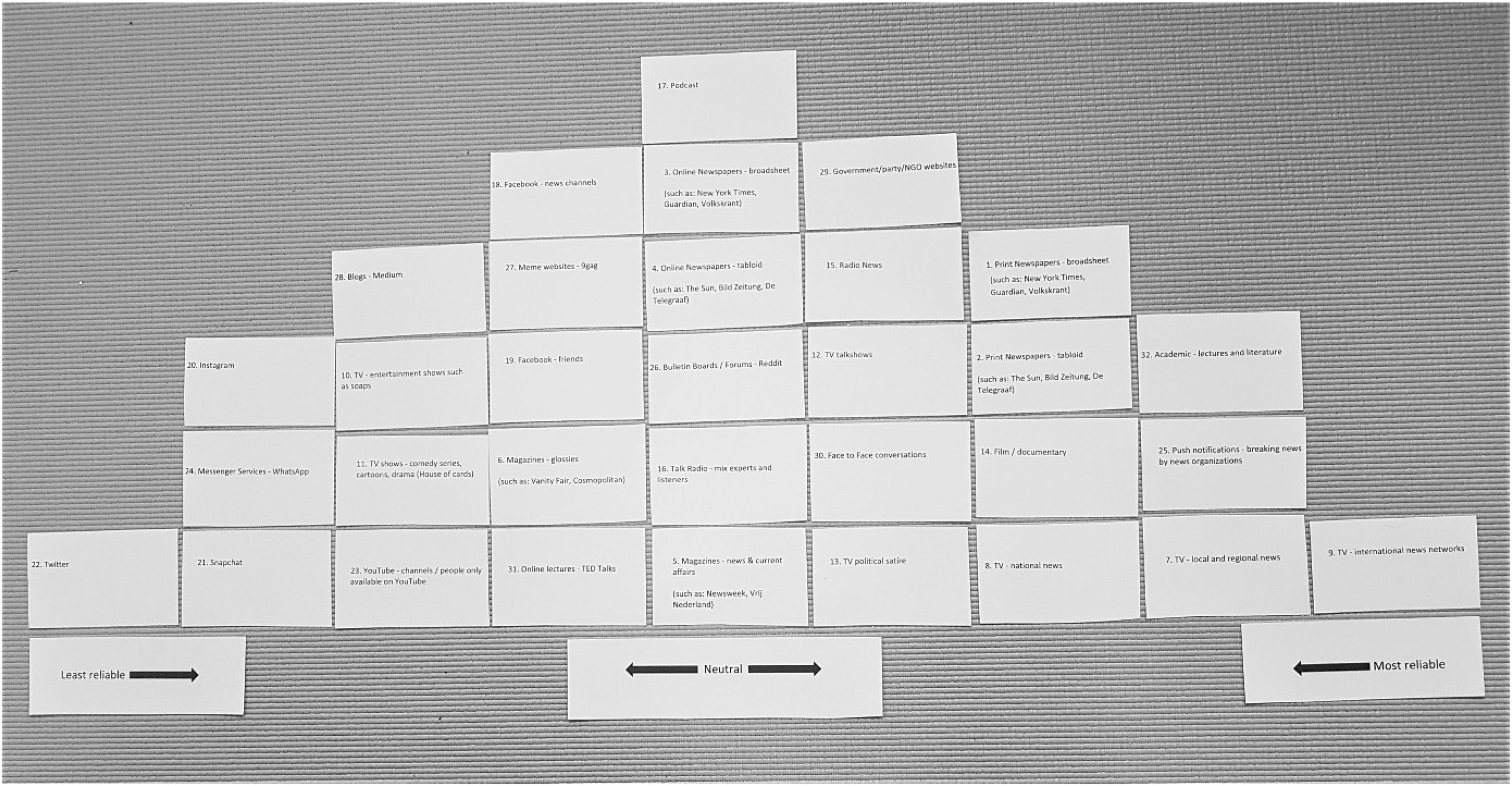
Example of card sort about the reliability of news. Card sort by Anne (19). Cards need to be sorted according to the given distribution on the grid, from “least reliable” on the left to “neutral” in the middle, and “most reliable” on the right.
All sessions were audio recorded, transcribed, and then coded line by line in Atlas.ti. The interviews were analyzed using a grounded-theory inspired approach (Charmaz 2006). After creating initial codes based on line-by-line coding, we went through all transcripts again to develop more focused codes. These were then again tested against the data, and so forth. Through this iterative process, we created a taxonomy of nine tactics (De Certeau 1984) that users employ to deal with issues of trust, ranging from practices that are primarily based on explicit knowledge (that can readily be articulated and shared) to tactics that strongly depend on tacit knowledge (based on intuition and personal experience) (Polanyi 1966). Adopting a practice-based philosophy of knowledge, we acknowledge that explicit and tacit knowledge should not be regarded as dichotomized, but as positioned on a continuum. All knowledge, and alas the tactics drawing on it, has both explicit and tacit characteristics, but the ratio between them differs (Collins 2010).
A Taxonomy of Tactics
Our participants were generally well aware of the normative ideals surrounding informed citizenship. For instance, they referred to the importance of keeping up-to-date on political news to be able to cast their votes in an educated manner and the need for reliable information as a prerequisite for participating as democratic citizens. However, their actual everyday patterns of news use did always not reflect this. Below we present a taxonomy of nine tactics citizens use to assess the reliability of news (Figure 2). Remarkably, these were similar across gender and cultural backgrounds.
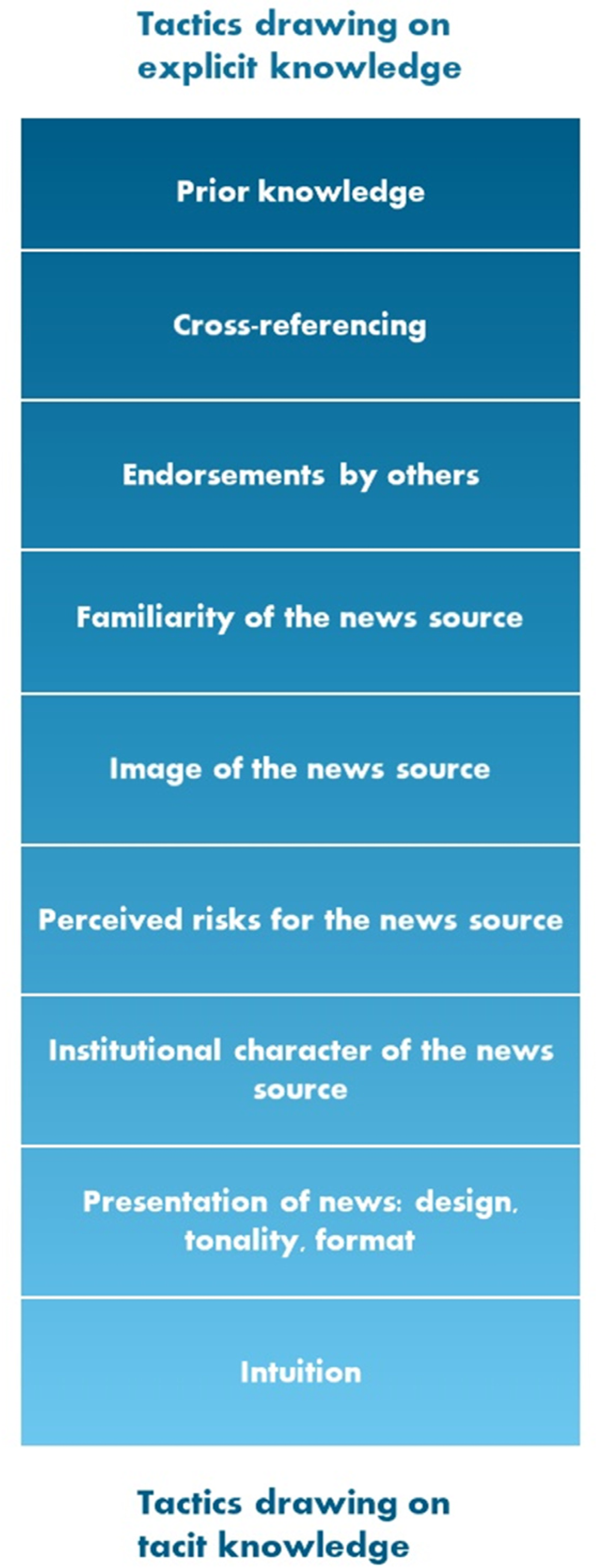
Taxonomy of citizens' tactics for assessing the reliability of political news.
Prior Knowledge
Relating news to one's prior knowledge about an issue draws most intensively on explicit knowledge. However, this was only discussed in terms of the lack of efficacy that participants felt when trying to determine the reliability of political news. David (20), for example, argued that assessing trustworthiness requires having an existing frame of reference that you can use to interpret and evaluate information: “You really need to be in depth of your news, in order to know if most of it is true or not.” He concluded that without any familiarity with the larger context in which a news event has taken place, he could only uncover an approximation of the truth, but never truth itself.
These doubts highlight the gaps between deliberative democratic norms and people's lived experiences (see also Ytre-Arne and Moe 2018). This caused participants to engage in a variety of more pragmatic tactics to minimize the risk of trusting (and potentially acting upon) unreliable information.
Cross-referencing
Media education, either in formal or informal settings, had taught participants to check the reliability of news by searching for additional information and comparing news with other stories on the same issue. Consequently, the respondents saw cross-referencing and verifying news as the best guarantee they would act upon reliable information. Participants stressed the importance of using sources that would consider news from multiple perspectives, including all relevant point of views. Such truth finding was perceived as an individual responsibility, as for instance illustrated by the following excerpt: You have to rely on yourself to filter the information that we get. You have to extrapolate your own truth, out of as many sources as you can find, if you actually want to know what is going on. (Sofia)
Endorsements by Others
A third tactic that respondents employed is what Sundar (2015) has dubbed the “bandwagon heuristic”; people's perceptions of news media are also shaped by their social networks (Ognyanova 2019). Endorsements by friends, family, or more distant opinion leaders, both on the level of news brands and of particular stories, boosted respondents' perceptions of trustworthiness. Sarah (18) considered print broadsheet newspapers as the most reliable source for political news for this reason: A lot of educated people read them and are of the opinion that these papers are good. Those are world-famous papers, and the articles are shared because they are good. If so many people think they are good, they must be.
Familiarity and Image of the News Brand
The most frequently mentioned tactics for determining the reliability of news related to checking the news brands that the stories consumed originated from. Participants rarely assessed the reliability of the brand by checking the brand's website or description, for instance to look for its political leaning or potential commercial influences on its content. Instead, they more intuitively interpreted the familiarity of the brand name as a cue that signaled the reliability of the information presented.
While such judgments sometimes related to positive previous experiences with the brand bolstering brand trust, for most participants, they were mostly based upon their affective perceptions of the brand—what sources feel trustworthy—, fostered by the medium's reputation and familiarity. This favors legacy news media brands in particular, because of their high brand awareness. For example, Lisa (18) remarked that the association of certain brand names with trustworthiness made her trust stories from those sources automatically: I always check the source where the news is coming from. Sources like BBC, New York Times and NOS, I do trust. Kind of immediately, even. I think I’m only really critical whenever there are elections. Usually, I assume that the articles that I’m reading in my news apps are based on facts.
Perceived Risks for the News Brand
A sixth tactic again relates to the reputation of news brands, but then from the perspective of what might be at stake if a brand would report misinformation. Our participants recognized that trust was core to the business model of legacy news media. The higher the perceived penalty for the news source in question when reporting misinformation or disinformation, the more they were considered reliable by the respondents. As Ruben (20) commented: “The New York Times and The Guardian are internationally implanted. [They’re] very popular newspapers that couldn't exist if they twisted the truth too much.”
Related to the previous tactic, our participants reasoned that with the large audience of these traditional news brands came an inherent degree of accountability. Jack (20) explained that well-known newspapers and broadcasters in his view have an image to uphold, one that can easily be damaged by missteps and scandals. “It is much easier to get sued. It is much easier to get caught or to be held accountable in these sorts of organizations. So, I think they just have to go through a more intense process of checks and balances, that the other stuff doesn't necessarily has to.” A similar argument was made for governmental websites (accessible to and thus verifiable for a wide public) and for academic sources for political news, pointing to systems of peer review.
Institutional Character of the News Source
The next tactic to approximate the reliability of news relates to the institutional character of the news source, such as the level of gatekeeping that producers need to pass before being able to communicate news via a certain medium. Respondents drew links between the openness of platforms like Twitter or blogs, and their perceptions of these platforms as less trustworthy. Because the production of news on social media is accessible to all, Amber (21) argued she considered news on these platforms as less reliable because “anyone can put anything on there, without proving its true.” Some respondents did nuance this by making distinctions between the trustworthiness of news shared by friends and that of news shared by news organizations or individual journalists on social media; others indicated to have an intuitive association of distrust with platforms like Facebook regardless of the sharing party.
Another example of gatekeeping strategies as an indicator of trustworthiness was the value that participants attached on the presence of experts. In particular, in relation to TV talk shows and current affairs programs, this was seen as an indicator of reliability. As James (21) remarked: “They are not biased towards one side. And they give a general picture of both sides of the argument.” The perceived knowledgeability of both the people presented in the news and of the news producers affected users' perceptions of its reliability. Sarah (18), for instance, argued that websites of governmental parties should be more reliable, as they had more inside knowledge of politics compared to friends or other users on social media.
Presentation of News: Design, Tonality, Format
Moving towards tactics that rely more on affect and intuition, several aspects related to the presentation of the news story acted as signposts for reliability. As, for example, Michael (23) remarked: I take many aspects into account. One of them is how it looks, because I feel like the less reliable sources are more flashy and bold, and look less serious.
Moreover, some participants argued that particular media formats leave less space for interpretation and thus enforce a level of factuality that increases its perception of trustworthiness. Bo (20), for instance, argued radio news was to be trusted, as “most of the time they don't have the time to tell more than just the most important things, so they keep it short and tell only the facts.” Similar arguments were made with regard to push messages and TV news bulletins, even though in principle, platforms' characteristics are not necessarily related to the reliability of their content.
Intuition
The tactic most explicitly drawing on tacit knowledge is relying on one's gut feeling. Our results confirm previous findings by Puustinen and Seppänen (2013) that trust in news has not only a cognitive, but also an intuitive dimension. In the second card-sorting exercise, participants were asked to sort various sources for political news based on their perceived reliability. Almost all respondents found this exercise challenging, pausing, or expressing hesitation when redistributing the cards. Moreover, they had difficulty articulating the reasons why they did or did not trust a particular source for political news. As one of them remarked: You can kind of see it. I do not know- I would not know how to tell you how. But like, you can kind of see it. Like I mean, there are [alarm bells] that start ringing when you first read it, and then like, you just look around. And if you notice that a news outlet is not reliable, then you can- You just notice it. (Marco, 19) I think you never really think about it, until you are asked to think about it. When you actually look at all the different sources, it's a lot, and you never really think about it that much. (Alexander, 20) How do I judge if political news is trustworthy? Probably by Googling the same issue and looking for other sources. But I only do that when something is really, actually interesting to me. If there is a strike, and something on the news says there's a strike, I’m not going to fact check that. I’ll just trust them. (Emma, 20)
Disregarding Reliability as Relevant or Important
Some participants did not engage in any tactics to assess the reliability of political news, but completely dismissed trustworthiness as relevant for their news consumption. Recent debates around misinformation and disinformation had increased skepticism towards the reliability of political news, sometimes even tipping over into cynicism. While most respondents trusted some sources more than others, they also remarked that they could never be completely certain a source provided accurate and reliable political news: hence, full trust was considered impossible.
Many participants expressed low confidence that they would be able to detect all the misinformation they were exposed to. As Anna (20), for instance, reflected, in response to the question to what extent she felt she could trust the news: Well, first of all, I gotta say, you never know. [Interviewer: “So there is no way to find out?”] In a sense. If you want to know, you gotta- You know you’re signing up for a little corruption and propaganda anytime. For me, that's the answer. To be honest, I wouldn't 100%- I wouldn't trust any of those cards. Even face-to-face, because you never know why anybody says what they do, and how big their knowledge is about that.
The most extreme example in our sample was David (20), who completely disregarded ideals of objectivity and truth as unachievable and unimportant: Maybe it's true, maybe it's not. I don't care. […] If five different sources have the same story, I still think it's always different in the story than like it really happened. Like, the concept of true and false is not that big with me. I don't really care if something is true or false. If I’m looking specifically for an opinion, which is what I do when I watch a YouTube video or look at a blog, I expect a biased opinion and not a fact. That does not make them less reliable in my opinion.
Conclusion
Democratic theories presuppose that people need to orient themselves to politics through reliable news sources, in order to be able to make informed decisions as democratic citizens. Without trustworthy information about the important issues in society, these models argue, they cannot fully participate in public life (Coleman 2012; Strömbäck 2005). Hence, following this line of logical reasoning, one would expect that people would only consume political news that they trust.
Yet, as our analysis shows, in practice, the relationship between trust and use is far more complex. Based on in-depth interviews with fifty-five young people from different nationalities, we have developed a taxonomy of nine tactics that citizens use to approximate the reliability of news content and sources. Our user-centric and practice-based approach shows that users not just rely on both explicit forms of knowledge to decide what news to trust. Contrary to normative ideals of trust as a conscious, deliberate process, many of the tactics we distinguish at least partially depend on tacit knowledge and more affective and intuitive considerations. Tactics such as relying on one's gut feeling or trusting sources based on tone or familiarity demonstrate that users' practices to assess reliability are usually by no means explicit, in-depth assessments of reliability, but instead can be characterized as tacit, pragmatic, and often (partially) intuitive solutions. These help users to manoeuver between norms of informed citizenship and the practicalities of everyday life. As Fisher (2016) notes, time-intensive cross-checking and validation practices do not accommodate for the incidental, unintentional manner, and the increased frequency in which young people nowadays encounter political news. While trust does play a role in young people's quality assessment of news and sources, this goes beyond questions of reliability: for tacit dimensions to trust, whether news meets their expectations is far more important (Coleman et al. 2009; Schmidt et al. 2019). In practice, therefore, our participants often used news that they believed was or could be unreliable. Moreover, we found that young people perceived trust as nonbinary. For them, the question thus was not so much what content or sources were most reliable, but rather, how to determine what was “trustworthy enough.”
While we have aimed to account for differences in gender and nationality via maximum variation sampling, our study is based on a relatively small sample. Hence, it is worth keeping in mind that the taxonomy developed might not be exhaustive. Future research could also take into account how people combine certain practices and if there are recognizable sequential patterns, and if this differs between different kinds of news, in terms of proximity and topic. A second limitation pertains to the artificiality of the card-sorting exercise: users were asked to rate news sources as more or less reliable in the abstract, rather than capturing how young people judge media in their actual, everyday use practices. Finally, despite the inclusion of participants from different countries, the research was conducted in the Netherlands, where media and institutional trust are comparatively high and could thus be less of a concern to citizens. Moreover, it is characterized by relatively low polarization of both politics and the media system, which may also explain the omission of partisanship as a cue for assessing reliability among our participants. Possibly, trust and use show greater similarities in countries with high levels of political polarization or where institutional trust is low in general. However, even in this context, our analysis shows we can problematize existing normative ideals around the rationality of trust and informed citizenship.
We argue that these gaps between norms and practices are indicative of three broader issues around news and trust. First, despite youth's innovative tactics, our analysis shows the limitations of assessing reliability in a digital news environment. The increased speed of the news cycle, serendipity, and abundance of news makes it difficult to make detailed, deliberate evaluations of trustworthiness in a time-efficient manner, resulting in a low level of agency. Second, this lack of efficacy that people experience for judging trust effectively and efficiently tends to increase skepticism about journalism. Our interviews confirm that increasing youth's media literacy and awareness of misinformation may actually be countereffective (see also Boyd 2017; Broersma 2019; Mihailidis 2009). Emphasizing the risks of trusting what might be misinformation led some of our interviewees to conclude that no source of political information could be trusted. Finally, our interviews highlight a broader lack of user confidence in their media literacy skills beyond evaluating the reliability of news and sources. Young people also struggled to discern partisan or commercial influences on news and to understand the socio-political context of news. Future research could consider how educational programs could build upon both explicit and tacit knowledge to move beyond critical scrutinizing of information, and teach citizens a wider set of competences that help them to grasp and deal with the omnipresence of media in everyday life.
Footnotes
Acknowledgments
The authors thank the University College Groningen students in Marcel Broersma's “Knowledge is Power” course on media and democratic theory for their enthusiasm and collaboration in this research project. The 2016–17 and 2017–18 classes conducted the interviews for this project, while the students in the first class were also actively involved in cocreating the research design for this project. We thank: Tom Barbereau, Anne de Vries, Marthijn Kinkel, Bogdan Tsypryk, Tamara Uildriks, Claire van der Wal, Roos Walstock, Lukas Bink, Claudio Cacciavillani, Isidora Cvetkovska, Matteo Ferrario, Claire Hudson, Lieke Jorna, Merle Jürgens, Ruben Kunze, Eelke Leemeijer, Maria Pedersen, Kelly Potasse, Anna Lotte Reitsma, Raphael Saba, Josien Scholing, Bart Swinkels, Liset van Eibergen Santhagens, and Emma van Nieuwkuijk.
Declaration of Conflicting Interests
The authors declared no potential conflicts of interest with respect to the research, authorship, and/or publication of this article.
Funding
The authors received no financial support for the research, authorship, and/or publication of this article.
