




Abstract
Legacy news consumption was found to be a predictor of getting news from social media influencers (SMIs) among respondents in seven nationally representative samples in Arab countries (N = 5,166). Getting news from SMIs does not seem to be an “alternative” for persons disenchanted with legacy media; SMI news use may, itself, be a form of legacy news consumption. The results provide strong evidence of the more-and-more phenomenon first identified by Lazarsfeld et al.
Social media influencers (SMIs) are trend-setters, marketers and guiders of individuals’ behavior (Coates et al., 2019). SMIs are “social media users who have established credibility in a certain industry or content type and have access to a wide audience. Influencers have a large-enough following to spark conversations, drive engagement, set trends, inspire action, and change behavior,” (Dennis et al., 2019, p. 74), and this is the definition of influencers employed in the current study.
While researchers noted as recently as 2019 that clear definitions of SMIs are lacking in academic literature (Enke & Borchers, 2019), frequent examples include athletes, entertainers, academics and other social media users with large followings whose accounts are not dormant. While not all SMIs share news, the dependent variable in the current study is the frequency with which people say that they actively seek news from SMIs, so influencers who do not share or discuss news do not apply. Some influencers are people who were well known in a domain before their prominence on social platforms, such as athletes or musicians, and their success drove their subsequent social media following, though some SMIs are self-branded persons who rose to prominence for what they offered social media users (see Khamis et al., 2017), such as news commentary or cooking tips.
Defining the term SMI is difficult, a bit like describing what a meme is, but there seems to be agreement that SMIs are social media accounts of individuals (or groups) that have a substantial number of trusting, engaged followers, some of whom act on advice from the influencer.
Scholarship on SMIs is typically published in marketing and advertising journals; little has been published on reliance on SMIs for news. Research on news acquisition from SMIs is needed, particularly in an era of misinformation, and also given how competitive online spaces are for news outlets vying for attention and ad revenue. Acquiring news from SMIs is also a timely research topic in Arab countries, as fake news and misinformation are perceived by internet users in Arab countries to be prevalent on social media platforms (Martin & Hassan, 2020).
Weeks et al. (2017) found that heavy social media users view themselves as opinion leaders, able to persuade others regarding news and politics, and that they frequently try to. But little is known about how much internet users rely on SMIs for news about current events, and predictors of doing so. This is despite that social media users often list news as a primary attraction for using a given platform. More Twitter users in seven countries, 59%, said they use the platform for getting news (Dennis et al., 2018), than for any other gratification, including getting entertainment. Of course, social platform users have agency in curating their social media feeds, particularly accounts they follow and/or are followed by, and some users may practice news avoidance on social media, particularly if they experience news overload (Park, 2019). And while some platforms, like Facebook and YouTube, are known for their capacity to disseminate news, others like Snapchat (2% of respondents in numerous high-income countries said they used Snapchat for news in the prior week; Newman et al., 2021) and TikTok (3%) were less formidable news disseminators (figures for Facebook and YouTube were 32% and 20%, respectively).
This study examined media use, media-related attitudes and demographics as correlates of reliance on SMIs for news and studied the same variables’ relationships to use of digital legacy news media and print legacy news media. The study is a secondary analysis of data from the Media Use in the Middle East study (Dennis et al., 2019). The study utilized research on opinion leaders, trust in news media and the more-and-more phenomenon of media use as frameworks to better understand correlates of SMI news use.
SMIs are often considered to operate outside, and to deliver different perspectives than, mainstream media, or “everyday people who are influential within their online social networks” (Leader et al., 2021, p. 350). This is partly because SMIs are conceptualized in academic literature as providers of commercial speech, rather than news. Suuronen et al. (2021) noted that SMIs’ discussion of politics has been an infrequent topic in prior research. SMIs have been recommended as an alternative pathway for tourism marketers to reach prospective travelers (Pop et al., 2022), beyond traditional advertising and news about travel. In some cases, SMIs describe themselves as alternatives to mainstream media; Lewis (2020) found that some YouTube influencers who broadcast political content consider themselves alternatives to mainstream news, which they deemed “social justice” advocacy.
The main hypothesis in our study, though, is that getting news from SMIs is not an alternative to traditional mass media, and that digital news use and print news use will positively predict SMI news use. The theoretical justification for this hypothesis extends back to Lazarsfeld et al. (1944) and their “more-and-more rule,” which maintains that people who get news from one medium tend to also get news from other mediums. This hypothesis is also bolstered by research on media-system dependency theory, which, at the individual level, holds that people who use a media channel for one purpose will utilize other mediums for the same reason (Riffe et al., 2008). Should our hypothesis be supported, the modern-day more-and-more tendency would blur some of the distinctions between media repertoires drawn by S. J. Kim’s work (2016)—such as “news on traditional media” and “internet only” personas—and so by testing relationships between broad measures of news consumption, the current study addresses several classic and contemporary theoretical relationships in mass communication.
Opinion Leadership, Trust in News Media, the More-and-More Phenomenon
Opinion leaders, as described by Katz and Lazarsfeld (1955), are heavy news consumers that less-active news consumers trust as experts, and with whom the latter share their interpretations of news. In early research, opinion leaders were usually laypersons (like some SMIs today)—not necessarily activists, policymakers or social scientists, though they could be—who got news from mainstream outlets and shared it with others via a two-step flow. The heavy news consumers Katz et al. described exhibited the more-and-more phenomenon in Lazarsfeld et al.’s (1994) prior work; that is, those who heavily consumed news in one format, say newspapers, tended to be heavy users of other news formats like TV and radio.
For a definition of news, we utilize Tully et al. (2021, p. 2): “The definition of ‘news’ has long been broader than that of journalism, and social media further extend this definition to include a variety of claims, stories and information about public affairs,” [emphasis ours] and we utilize that definition broadly. Thus, if, say, Kylie Jenner comments on an anti-LGBTQ law in Florida, the post would qualify as news, and, additionally, if Jenner shared her take on a consumer product available to the public, we would likewise consider that to be news, just as an assessment about the same goods in Consumer Reports would be considered news coverage. If a post is labeled “sponsored content,” we do not consider that news, though we acknowledge that sometimes commercial posts are not labeled properly (though countries increasingly regulate this ambiguity).
Traditional newspapers, broadcast outlets and online news organizations offer news more narrowly defined. For example, broadcast and news outlets, whether online or print, feature current events on a number of topics such as politics, business, international news and sports; tend to use a formal voice; and often include multiple sources in their reports. SMIs often use an informal voice in their posts, share news on a topic relevant to their expertise rather than on an array of topics and are often deemed different from traditional media, due, in part, to a high level of relatability with the audience (Lewis, 2020).
The current study examined getting news from digital opinion leaders, yet hypothesized that reliance on SMIs for news is not an alternative to digital legacy and print legacy news use, but rather it is correlated with them. Alternative news media have been defined as “correctives of mainstream news media . . . and/or are perceived as such by their audiences or third-parties” (Holt et al., 2019, p. 860). While some SMIs may consider themselves alternatives to mainstream news, this study projects that news consumers do not, at least primarily, seek news from SMIs as an alternative to mainstream news. Research has found that digital news consumption positively predicts use of legacy news media (see de Waal et al., 2005), though the current research is the first study specifically examining SMI news use in multiple countries.
When people broadly distrust news media, they sometimes get news from alternative media (Tsfati & Cappella, 2003). This study also tests the relationship between trust in news media and use of SMIs for news. As we posit that SMIs do not occupy a space in which news consumers access alternative news per se, we also hold that trust in news media will not correlate negatively with getting news from SMIs.
Believability is the essence of trust and is the extent to which news consumers believe information provided by a news medium is true and thorough (Bucy, 2003). People likely get news from SMIs for the same reason they get news elsewhere: they find SMIs they follow credible. Trust in news media more broadly has been similarly defined. The classic Gallup question about trust in mass media asks, “In general, how much trust and confidence do you have in the mass media . . . when it comes to reporting the news . . .” (Brenan, 2019). This question was examined in the current study as a potential correlate of SMI news use.
Believability also featured in a scale from Appelman and Sundar (2016) assessing message credibility, the three components of which are accuracy, believability and authenticity. Appelman et al.’s conceptualization of media credibility is particularly relevant in the current study, as authenticity—a lack of self-interest in a social media user’s posts, or at least some balance between posts that promote products or services in exchange for remuneration and those that do not—has been found to be a key component of trust in SMIs, Audrezet et al. (2020) wrote. They also noted that, while it is commonly understood some influencers make money on posts, audiences still value the authenticity of noncommercial orientations, and they caution SMIs on appearing too commercial.
We privilege the term “trust” in news media over “credibility,” as many of the questions employed in research to measure the concept use trust, such as the Gallup question. In contemporary parlance, “trust” is typically invoked to indicate one’s overall evaluation of a news medium, like TV news broadly (see Conroy, 2021), while “credibility” often describes an evaluation of a single news outlet (as in Skibinski, 2021).
It may seem intuitive that distrusting traditional news media would lead individuals to get news from social media, and perhaps SMIs—but research on this has been mixed; Bergström and Jervelycke Belfrage (2018) found the strongest predictor of getting news on social media was consuming digital news from legacy outlets. Tandoc (2019) found that Facebook users rated a Facebook friend as more credible than a legacy news outlet, yet rated a news story as more credible when it was posted by that news outlet than when it was posted by their friend. In some research, trust in a specific news medium is positively correlated with use of that medium (Kiousis, 2001).
SMIs have been described in some research as alternative information sources. Pang et al. (2016), for example, discussed SMIs as not a provider of news to social media users, but a new information source journalists can use in coverage they provide to news consumers: “Journalists are able to tap on alternative information and newsworthy content generated by SMIs, which can be repackaged and disseminated to news audiences” (p. 57). Other work has said SMIs represent “a new type of independent third-party endorser who shape audience attitudes” (Freberg et al., 2011, p. 90). This might suggest internet users who get news from SMIs do so to the exclusion of legacy news sources, but SMIs’ appeal is likely not different than that of legacy news media; consumers report motivations for following SMIs similar to those for accessing news outlets; social media users follow influencers they deem authentic and not commercially vested in their posts; “SMI followers value influencers’ intrinsic motivations and noncommercial orientation” (Audrezet et al., 2020, p. 1).
Noted earlier, the term social media influencer has lacked clear definition in academic literature, largely because research on SMIs has focused on commercial communication. Some research, for example, considers SMIs only those paid for endorsements by corporate brands (see Cheng et al., 2021). The definition of SMIs in the Media Use study did not distinguish between paid and unpaid SMIs, though it is not always apparent whether a social platform user is paid for their posts, which specific posts are sponsored, or how much they receive, which some SMIs might try to conceal if they think such details would harm their credibility.
Some SMIs participants in the Media Use study named (more later) are famous athletes or singers who earn sizable incomes outside social platforms, and whose followers might not suspect are paid for their posts, which might consist of updates on their careers. Either way, remuneration is not the only metric used to assess SMIs’ credibility; social media users are also more likely to follow an SMI if they believe that account is informative and trustworthy (Lou & Yuan, 2018), recalling the wording of Gallup’s trust question.
When internet users describe SMIs from whom they get information, however, they do not seem to use words like activist or grassroots. In qualitative interviews, Bergstrom et al. assessed news-seeking from social media opinion leaders among dozens of 16- to 19-year-olds in Sweden. Many interviewees said they follow opinion leaders who post frequently on social media and who post news or links to original sources, which suggests that some of the news the young Swedes are getting from social media users is not so alternative.
A unique aspect of SMIs as modern-day opinion leaders is that social media followers who get news from them have immediate quantitative data on just how influential of an opinion leader they may be, such as their number of followers and how often their posts are liked and shared. In the 1940s, however, while an individual who got news in-person from an opinion leader might believe that the individual is articulate and well-informed, they might have no idea whether that person qualifies as an opinion leader, nor any idea of how influential the person may be socially or in business or political circles.
While respondents from the survey examined in the current study were not asked specifically which news providers they use, and rather were queried on digital and print news use generally, this study considers print legacy media to be outlets like the print Al-Ahram newspaper and the Al-Arabi magazine, and digital legacy news media outlets like Al Jazeera online and Al Araby Al-Jadeed. The distinction between the two media is important because prior research has found different preferences and different effects among readers of online news compared to those reading print counterparts (Schoenbach et al., 2005; Tewksbury & Althaus, 2000).
There is no evidence to date in research literature that people who follow and track posts from SMIs do so at the expense of getting news from “more serious,” legacy news outlets. Rather, what Lazarsfeld et al. (1944) identified as the “more-and-more rule”—people who use a medium for one type of information tend to use multiple other media channels for the same information—has been observed in recent research. There is a significant association between internet behaviors even when the behaviors are not necessarily similar (Patwardhan & Yang, 2003).
Martin and Schoenbach (2016) found evidence of the more-and-more phenomenon while studying Arab bloggers, who were not predominantly motivated to blog by predictors like low trust in news media or unemployment; rather, Arab bloggers were mostly people who did other things online, like posting photos and communicating with friends. Bergstrom et al., again, found that getting news from legacy online news outlets was a strong predictor of getting news from opinion leaders on social platforms.
There is enough prior evidence, then, for us to hypothesize that consuming news generally will positively predict getting news from SMIs. Just as opinion leaders were not seen by Lazarsfeld et al. as alternatives to news, but rather as conduits for traditional news via the two-step flow, we hypothesize that measures of traditional news use will predict using SMIs for news.
Contexts of Media Use and SMI Reliance in the Arab Countries Under Study
It has been tempting in the past three decades to declare the birth of “alternative” media in Arab countries, given the arrival of news outlets like Al Jazeera in the 1990s as an alternative to government news (Miles, 2010), blogs as an alternative to newspapers in the 2000s (Hamdy, 2009), social media as an alternative to everything in the early 2010s (Howard et al., 2011) and SMIs as alternatives (Ayish & AlNajjar, 2019) to other social opinion leaders in the late 2010s to the present.
However, media alternatives to official sources have existed in Arab countries for 200 years (Polk, 2018). Of course, by some definitions, SMIs can be government officials, clergy or other legacy opinion leaders, but much of the discussion of SMIs involves lay people who have risen to prominence and yield sway on politics, culture and commerce (see Bacon, 2016) through the novelty and clarity of their ideas.
Many Arab countries are more digitally connected than Western nations, including the United States (see Pew Research Center, 2019). More Arab nationals than U.S. residents used the internet in four of seven Arab countries surveyed in the Media Use in the Middle East 2019, for example, and in five countries more Arab nationals owned a smartphone than did U.S. residents (Dennis et al., 2019). While some people in Arab countries may hold concerns about accessing news from SMIs who criticize the government or other existing structures in their country, use of VPNs in Arab countries is common; more than half of Saudi internet users use a Virtual Private Network (VPN), as do four in 10 Qataris and two in 10 Jordanians (Dennis et al., 2019).
Given high digital media penetration, it is perhaps unsurprising that Arab nationals report heavy reliance on SMIs for things like product recommendations and even political attitude formation; Figure 1 illustrates a range of motivations respondents in Arab countries have for following SMIs.
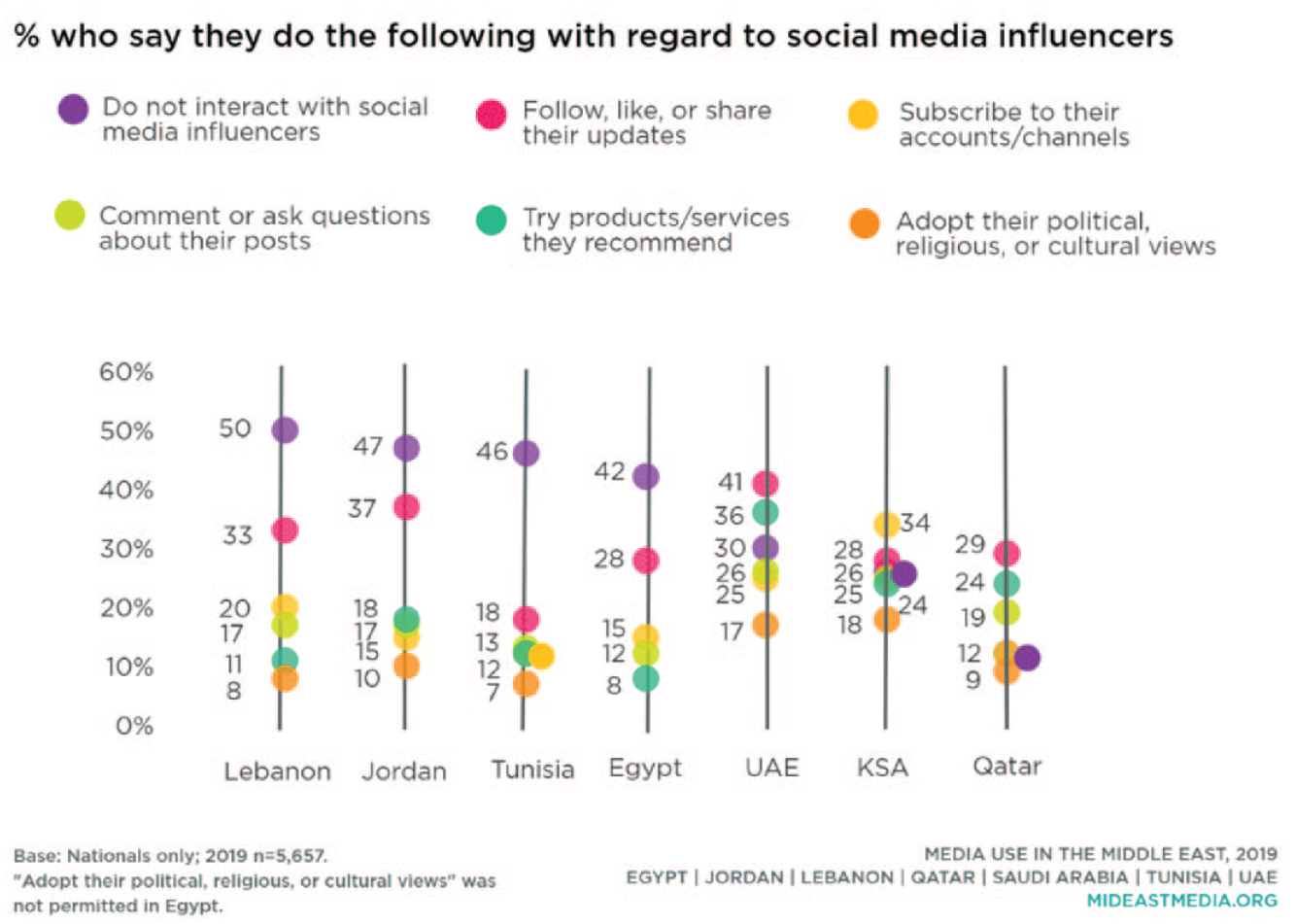
Arab Nationals Report Heavy Engagement With Social Media Influencers (Reproduced With Permission)
Qatar, Saudi Arabia and UAE could be said to have press systems loyal to those regimes (see Rugh, 2004), while Jordan and Egypt have opposition—yet persecuted—media sectors (Alazrak, 2020; Duffy & Maarouf, 2015), Lebanon’s media system, like much of the country, is currently chaotic and often unmonitored (Majzoub, 2020), while Tunisia’s media system is mostly free, though the government has been restricting media freedom since 2020 (Gouvy, 2021).
Dennis et al.’s study also compared respondents’ use of SMIs for news to getting news from daily newspapers. In four of the seven surveyed countries, more Arab nationals said they get news from SMIs than from newspapers. Eight times as many Jordanians, five times as many Lebanese and 2.5 times as many Egyptians get news from SMIs everyday as those who get news daily from newspapers. More Qataris and Saudis, however, get news from newspapers than from SMIs. Of course, this does not mean that newspaper consumption cannot be correlated with SMI news use, only that frequencies for the latter were greater in several countries.
One in nine nationals in six countries (Egypt barred the question) say they adopt political, social or cultural views of SMIs they follow. This is not one in nine internet users or one in nine people who follow SMIs, but one in nine Arab citizens. In five countries, all but Lebanon and Saudi Arabia, more nationals follow influencers’ posts on Instagram than on other social networks. Twitter was cited by more Lebanese, and Snapchat by more Saudis than were other networks. Just one in 10 Saudis and Emiratis say they look at influencers’ posts on Facebook.
More Arabs surveyed look at posts from SMIs everyday than check email every day. In all seven countries, half or more of Arab nationals look at posts from SMIs, including eight in 10 Qataris and Emiratis, and nine in 10 Saudis. In Qatar and UAE, four in 10 nationals say they look at posts from influencers at least once daily, as do 30% of Egyptians and 21% of Tunisians, despite that 25% of Egyptians and 28% of Tunisians do not use the internet.
Many Arab nationals admit to being swayed by SMIs, including commercially and politically. Thirty-six percent of Emiratis say they try products or services SMIs recommend, as do 25% of Saudis, 24% of Qataris and 18% of Jordanians. Again, these are not percentages of internet users or of social media users, but percentages of citizens in each country who say influencers inform their commercial transactions.
Who are some of the influencers Arab nationals follow? The current study does not examine qualitative data, but respondents in the Media Use study were asked to name a specific social media user or account that comes to mind when they hear “social media influencer,” and, while a wide range of names were provided, the researchers reported specific SMIs cited by at least 2% of respondents in a given country. Many Arab nationals named people of gravitas, though few, if any, of the persons named are journalists or other employees at major news organizations. We list some of the SMIs named and their number of followers on Facebook, Twitter or Instagram—whichever had the greatest number at the time of this writing.
While Arabic pop star Nancy Ajram and footballer Mohamed Salah led mentions in Lebanon and Egypt, respectively (2% and 3%; 2% in Egypt named doctor and businessman Ali Ghozlan), the most-named influencer in Jordan was religious scholar Mohammad Nouh (6%), and Saudis most frequently named (Kuwaiti) radio personality Ali Najem (5%) and activist Ahmad al-Shugairi (3%). Four of these influencers are most popular on Instagram, where Nancy Ajram has 31.5 million (Ajram, n.d.), Mohamed Salah has 46.2 million (Salah, n.d.), Ali Ghozlan has 3.2 million (Ghozlan, n.d.) and Ali Najem has 3.7 million (Najem, n.d.) followers. Nouh and al-Shugairi are most popular on Facebook, where they have 2.5 million (Nouh, n.d.) and 21.4 million followers (al-Shugairi, n.d.), respectively. These findings highlight who Arab respondents consider influencers to be, and their responses were largely activists, religious scholars, athletes and singers.
Hypotheses and Research Question
This study examined predictors of getting news from SMIs in seven countries and hypothesized that acquiring news from SMIs is not an alternative to getting news from legacy media, but that using legacy media such as newspapers, digital news apps and TV positively predicts SMI news use. The justification of the hypothesis, as stated earlier, comes from Lazarsfeld et al., Martin et al., Bergstrom et al. and Patwardhan et al., who found, generally, that information-seeking positively predicts additional information-seeking, evidence of the more-and-more phenomenon.
Finally, we compare the relationship between trust in news media and SMI news use to those between SMI news use and use of both digital legacy media and print legacy media. If the relationship between trust in news media and use of digital media and print media is similar to that between trust in news media and SMI news use, there is further evidence that SMIs represent mainstream news conduits. Strömbäck et al. (2020) reported that research on the relationship between news media trust and news use is complex and not always consistent, and Toff et al. (2020) concluded from 82 in-depth conversations about news that there is no uniform, trust in news problem, but rather challenges in supplying news to the public and the public’s demands to know what’s going on.
Method
This study examined predictors—news use, social media use, media-related attitudes and demographics—of getting news from SMIs and from legacy news media among nationals in seven Arab countries (N = 5,166), hypothesizing that the use of SMIs for news is positively associated with legacy news consumption. The study should not be considered a single cross-sectional study, but rather can be conceptualized as seven individual cross-sectional studies, using nationally representative data from seven countries.
The study is an analysis of data from Media Use in the Middle East 2019 (Dennis et al., 2019) and includes data from nationals in Egypt (n = 1,007), Jordan (n = 920), Lebanon (n = 998), Qatar (n = 240), Saudi Arabia (n = 751), Tunisia (n = 1,037) and the UAE (n = 240). Samples from Qatar and UAE are smaller than in the other countries, because noncitizens vastly outnumber citizens in those countries. Data were collected from June 20 to August 20, 2019, in all countries but Egypt, where delayed government approval of the questionnaire put fieldwork between September 2 and October 6, 2019.
Sampling, Data Collection
Data were collected in multistage random probability sampling, and survey interviews took place at respondents’ domiciles in all countries (except Qatar, where random-digit dialing was employed and surveys were administered by a human caller). Multistage random probability sampling involved randomly selecting geographical entities for sample inclusion, then randomly selecting respondent dwellings, and, finally, randomly selecting residents from within a given household. A country’s governates or provinces were divided into cities, towns and villages, which were denominated into administrative/municipal units and then into clusters. Each cluster consisted of several blocks of streets/roads. Each block, designated the primary sampling unit (PSU), was randomly selected for survey inclusion and then within each block researchers randomly selected 8 to 10 domiciles for inclusion. Finally, Kish grids were used to randomly select residents from a household. Data were rim-weighted by gender and geographic location in some countries where necessary. Respondents completed the survey in Arabic or English (also French in Lebanon, Tunisia). Response rates ranged from 44% in Jordan to 88% in Tunisia. Egypt and Jordan censor the Media Use questionnaire, barring some questions about media use, religion and certain attitudes about censorship and surveillance. Egypt has been more censorial than Jordan, banning even, “What’s your favorite news organization?” Still, most questions in the survey are asked in both countries, and in Jordan, none of the variables used as predictors in current study were barred in 2019, while in the regression models for Egypt “—” is used when a question/predictor was censored. Among the items blocked by Egypt were questions about media trust, censorship, religiosity, digital privacy and a few questions about media use. The specific items barred by Egypt are also identified in the “Method” section.
Dependent Variables
There are three outcome variables in this study: SMI news use, digital legacy news use and print legacy news use.
SMI news use
Six-point measure. “For news and information, how frequently do you use social media influencers as a source?” 1 = never, 2 = less than once a month, 3 = monthly, 4 = weekly, 5 = once a day, 6 = several times a day.
Some prior research has found no superiority in the predictive validity of multiple-item over single-item indicators when the question is clear to participants (see Bergkvist, 2015; Bergkvist & Rossiter, 2007). Note that this variable measures active retrieval of news from SMIs, asking respondents how often they “use” SMIs as a news source. The question does not assess incidental exposure to news on social platforms, which Fletcher and Nielsen (2018) found to be a significant phenomenon.
The definition of SMIs provided to respondents was, “social media users who have established credibility in a certain industry or content type and have access to a wide audience . . . [They] spark conversations, drive engagement, set trends, inspire action, and change behavior.” This definition affords a robust test of the study’s central hypothesis, as it suggested to respondents that SMIs can be somewhat edgy, even activist (“inspire action”), and if SMI news use correlates with legacy news use under this definition, the alternative news argument vis-a-vis SMIs is even harder to make.
Digital legacy media for news
Three-item index. “For news and information, how frequently do you use [digital news apps] as a source?” Asked also for [instant/direct messaging] and [the internet in general]. 1 = never, 6 = several times a day. Cronbach’s alpha = .70. In Arab countries, digital legacy media for news could be news apps from Al Jazeera or Al-Arabiya, browser-based websites of news organizations and digital messaging platforms like WhatsApp and Snapchat, both of which major news organizations use to reach audiences.
Instant/direct messaging is included in this index as many internet users have been acquiring news and information by these means since the 1990s, whereas SMIs have served as news providers much more recently.
Print legacy media for news
Three-item index. “For news and information how frequently do you use [newspapers] as a source?” Also asked for [magazines] and [books]. 1 = never, 6 = several times/day. Alpha = .746. In the United States, a print legacy newspaper would be something like the paper editions of the Chicago Tribune or the New York Times. In Arab countries, they might be print editions of papers like Al-Ghad (Jordan) or Al-Ahram (Egypt).
Potential Correlates
There are four blocks of potential correlates of SMI news use: news use, use of specific social media platforms, media-related attitudes and demographics.
News use
For a given regression model predicting any of the three outcome variables, the other two news use variables were included as potential correlates. So, in the regression model in which SMI for news is the outcome, digital legacy news use and print legacy news consumption are among the predictors, and so on. Additional news use measures are below.
TV news use. Six-point measure. “For news and information, how frequently do you use TV as a source?” 1 = never, 6 = several times a day. News of locales. Four-item index. “How frequently do you get news or news headlines about [your local community]?” Also asked for [this country], [other countries] and [countries outside the Arab region]. (Questions blocked by Egypt). 1 = never, 6 = several times/day. Alpha = .83. Soft news use. “How often do you get news or news headlines about [fashion]? Also asked for [arts and entertainment] and [education]. Alpha = .55 Hard news use. “How often do you get news or news headlines about [political and current affairs]?” 1 = never, 6 = several times/day. Also asked for [science/technology] and [business/economy]. Alpha = .644.
Social media use
Social media reliance. Three-item index. “How often do you use the internet to [post messages or comments on social media]?” 1 = never, 6 = several times/day. Also asked for [repost or share links or content created by others] and [post or share your own photos or videos]. Alpha = .76. Instagram, Facebook, Snapchat and Twitter use. “Which of the following do you use?” 1 = use, 0 = don’t use. Asked separately for each platform.
Trust in news media and other attitudinal measures
Trust in news media. Index of two, four-point items (1 = no trust, 4 = a great deal of trust): “In general, how much trust and confidence do you have in mass media—such as newspapers, TV, and radio—when it comes to reporting the news fully, accurately, and fairly?” and “In general, how much trust and confidence do you have in the news you access via social media?” Guttman split-half reliability = .644 (not asked in Egypt). Note that we intended to include these measures in the regression models separately, but the correlation between the two measures was so strong that, separately, the two variables imposed multicollinearity in the regression models, so we computed an index. Furthermore, that trust in news generally and trust in news from social media correlate so strongly aligns with the central hypothesis of the current study: that distrust of legacy media does not drive getting news from social media (influencers).
Supports free speech online. Two-item index. “It is OK for people to express their ideas on the internet, even if they are unpopular,” and “People should be free to criticize governments on the internet.” 1 = strongly disagree, 5 = strongly agree. Alpha = .53 (not asked in Egypt). Internet privacy concerns. Three-item index. “I am worried about governments checking what I do online,” “I am worried about companies checking what I do online” and “I am worried about other internet users checking what I do online.” 1 = strongly disagree, 5 = strongly agree. Alpha = .811 (not asked in Egypt). Culturally progressive. “Compared to most nationals in this country, how would you describe yourself?” 1 = culturally very conservative, 5 = culturally very progressive (not asked in Egypt).
Demographics
Education. “What is the highest level of schooling you completed?” 1 = no formal education, 11 = master’s degree or higher. Gender. 1 = female, 0 = male. Age. “What is your age?” Ratio-level measure. Religiosity. “How often do you attend religious services?” 1 = never, 9 = once a day or more (not asked in Egypt). Income. “What is your total monthly household income?” Egypt: 1 = <200 Egypt pounds, 13 = >10,000 pounds; Lebanon: 1 = <750,000 lira, 12 = >10,000,000 lira; Qatar: 1 = <3,000 riyals, 15 = >75,000 riyals; Saudi Arabia: 1 = <3,000 riyals, 12 = >45,000 riyals; Tunisia: 1 = <100 Tunisia dinars, 12 = >5,000 dinars; UAE: 1 = <3,000 dirhams, 12 = >45,000 dirhams; Jordan: 1 = <50 Jordan dinars, 12 = >1,000 dinars.
Analyses
Multiple linear regression models were built in SPSS 26, predicting frequency of getting news from, separately, SMIs, digital legacy media and print legacy media. Models were run separately for each country and for each of the outcome variables. While Arab-majority and Muslim-majority countries are often lumped together as a single group, they have stark historical, religious, economic and linguistic differences (Gregorian, 2003). Moroccan Arabic, for example, is unintelligible to an Arabic speaker from Egypt or Lebanon, and those latter two countries have Arabic dialects so different that U.S. universities offer separate courses in both. In addition, mass media systems differ markedly across Arab countries (see Richter & Kozman, 2021). It is important that readers of this study can easily compare standardized coefficients across the countries in the study.
Some variables could not be included for Egypt (noted in regression tables as “—”), as that country barred some questions. Multicollinearity tolerance was set at .20. No variables had to be removed for falling below that threshold. Pairwise exclusion of cases was used.
Bonferroni correction
Analyses yielded standardized betas for seven countries, times three dependent variables, times 20 variables in each model. To reduce likelihood of Type 1 errors, we used Bonferroni’s correction (Spiegelhalter, 2019), and divided what would otherwise be an acceptable p-critical (.05) by three (the number of regressions run on data from each country), so our significance threshold is .05/3, or p < .0167.
Results
This study examined the relationship between getting news from SMIs and from digital legacy media and print legacy media in seven Arab countries. The study hypothesized that legacy news media use positively predicts getting news from SMIs and, thereby, SMI news use is not, broadly speaking, an alternative means of news consumption.
Correlates of Use of SMIs for News—Standardized Betas|p-Values
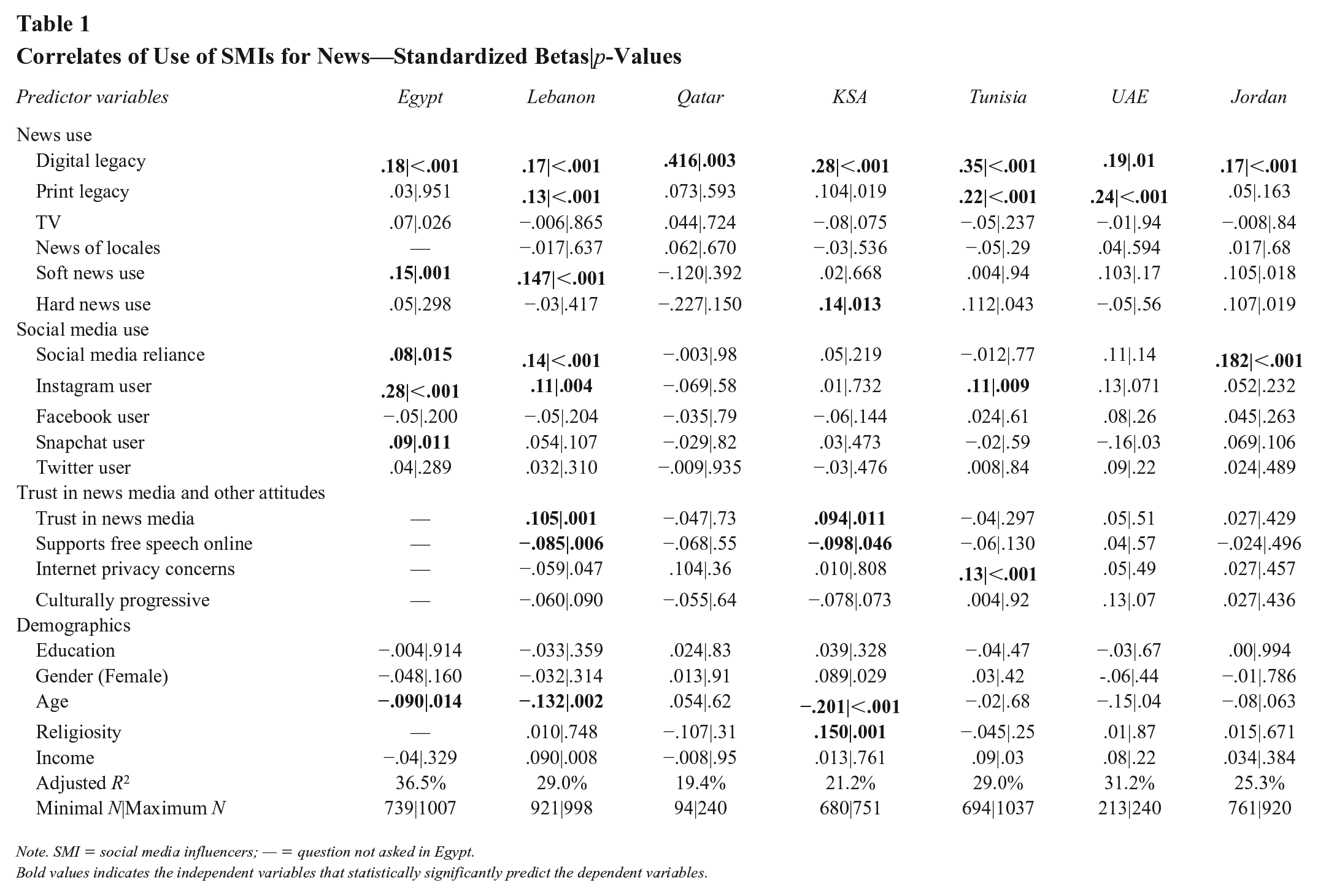
Note. SMI = social media influencers; — = question not asked in Egypt.
Bold values indicates the independent variables that statistically significantly predict the dependent variables.
The standardized betas across countries predicting SMI news use were robust: a one-standard deviation increase in digital legacy news use in Jordan predicted a modest .17 standard deviation increase in SMI news use, but the betas were much larger in the other countries: a low of .35 in Tunisia and a high of .416 in Qatar. Moreover, in four of seven countries (Lebanon, Qatar, Saudi Arabia, Tunisia), digital legacy news use was the single strongest predictor of SMI news use.
In three countries (Lebanon, UAE, Tunisia), print news use positively predicted SMI news use, and it would have been four countries (adding Saudi Arabia) if not for Bonferroni’s correction. Demographic variables did not consistently predict SMI news use, except age (negatively) in Egypt, Lebanon and Saudi Arabia.
Correlates of Use of Digital Legacy Media for News (Standardized Betas)
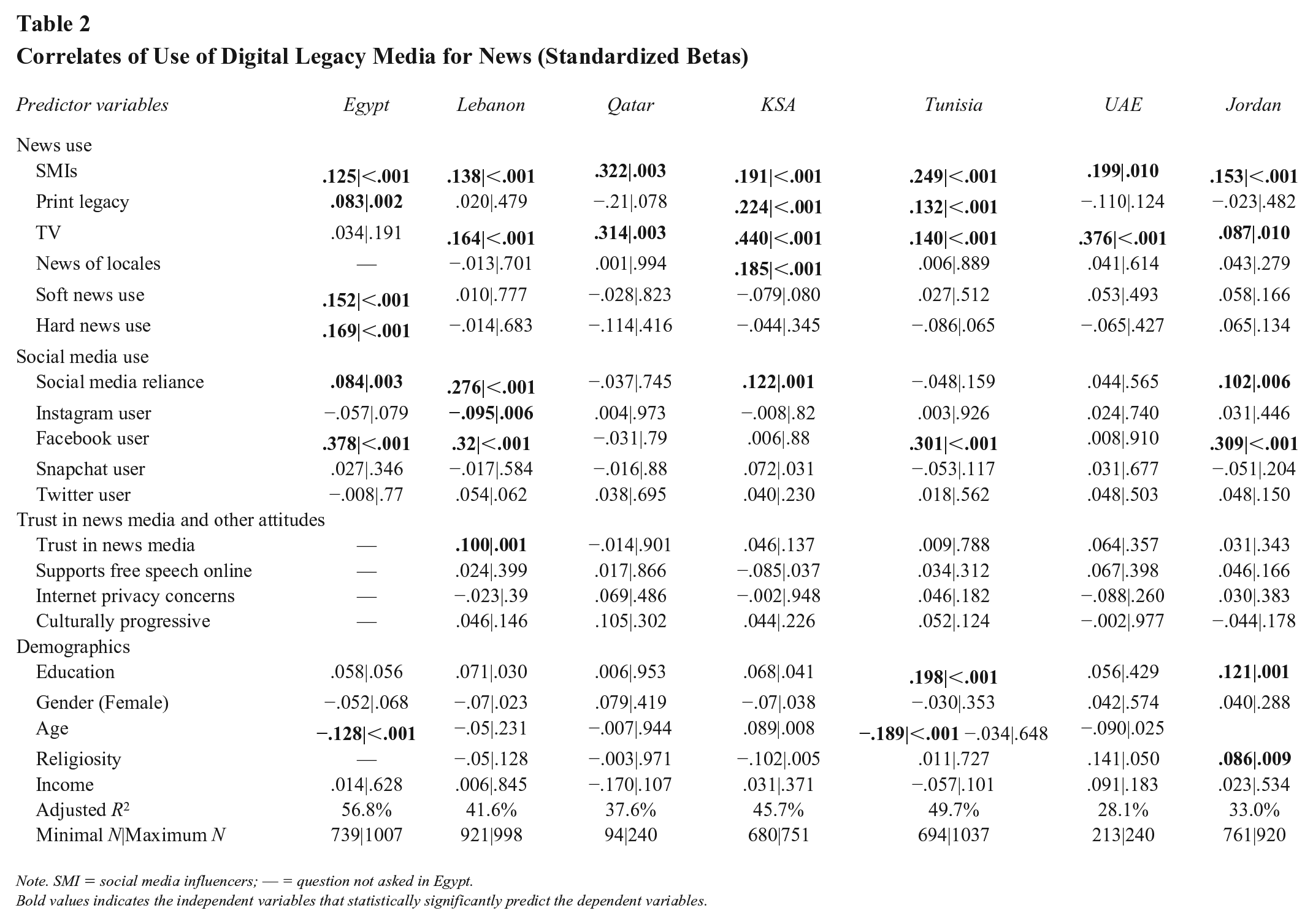
Note. SMI = social media influencers; — = question not asked in Egypt.
Bold values indicates the independent variables that statistically significantly predict the dependent variables.
Correlates of Use of Print Legacy Media for News (Standardized Betas)
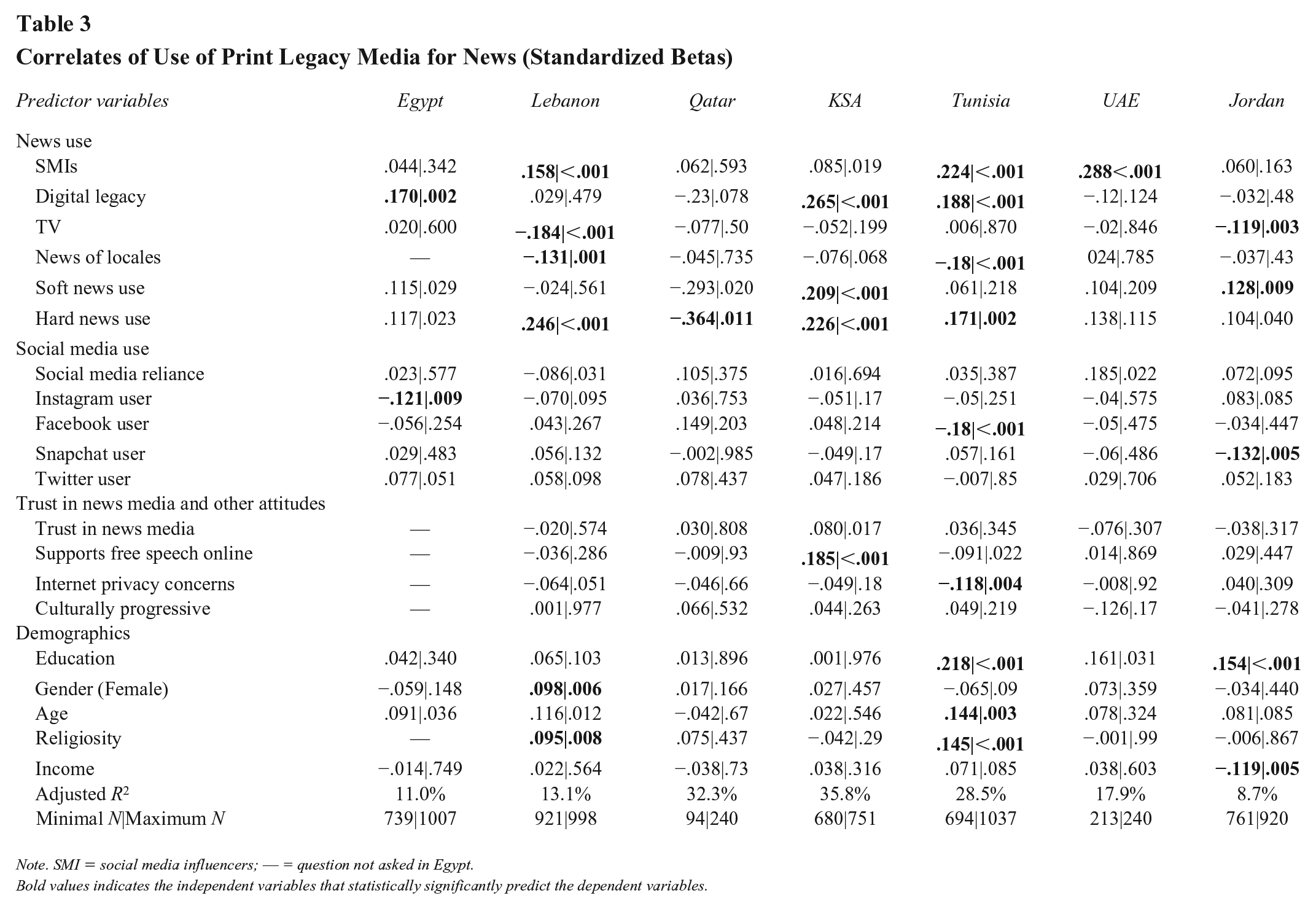
Note. SMI = social media influencers; — = question not asked in Egypt.
Bold values indicates the independent variables that statistically significantly predict the dependent variables.
While TV news use did not predict SMI news use, it positively predicted digital legacy news use in six countries (all but Egypt). Facebook use positively predicted digital news use in four countries, and the betas were all larger than 0.30. While using Instagram positively predicted SMI news use in a few countries, it was a negative correlate of digital legacy news use in one country (Lebanon). The most consistent correlate of print news use was hard news consumption, a positive correlate in three countries (though negative in Qatar).
The regression models predicting SMI news use explained sizable amounts of variance: from a low of 19.4% in Qatar to a high of 36.5% in Egypt. Models predicting print legacy news use explained less variance (8.7% in Jordan to 35.8% in Saudi Arabia) than those for SMI news use, while the models predicting getting news from digital legacy media explained more (28.1% in UAE to 56.8% in Egypt).
The RQ asked about relationships between trust in news media and digital legacy news use and print legacy news use. Trust in news media positively predicted digital news use in just one country, Lebanon, but did not predict print news use in any country.
Discussion
The core hypothesis in this study—that legacy news consumption would be correlated with using SMIs for news, countering the proposition that SMIs are an alternative to legacy news media—found support in the data. Not only did digital legacy news use positively predict SMI news use in all seven countries, consumption of news in print—the oldest mass medium—predicted SMI news use in three countries (Lebanon, Tunisia, UAE). A sizable amount of variance in SMI news use was explained by other news use, attitudinal and demographic variables: from 36.5% in Egypt to 19.4% in Qatar. The evidence of Lazarsfeld et al.’s more-and-more phenomenon in the data analyzed in the current study is substantial.
Work by the Pew Research Center has found that, not only does the use of social media not seem to supplant news consumption, social media are a key means by which people get news (Walker & Matsa, 2021). Similarly, rather than an alternative to legacy news outlets, SMI news use seems to accompany and complement traditional news use. Research on media repertoires has found evidence of platform-specific information consumers, such as “digital only” and “cable TV only” (S. J. Kim, 2016), but the findings in this study blur such distinctions—especially given that one of the countries in which print media use positively predicted SMI news use was the UAE, where internet penetration approaches 100% among citizens (Dennis et al., 2018)—at least in the Arab countries under study, while the findings afford evidence of media-system dependency behaviors at the individual level (see Riffe et al.). Getting news begets getting news, almost regardless of modality. News consumption broadly was a stronger predictor of SMI news use than the kind of news respondents consume; broad digital news consumption correlated with SMI news use more strongly than did the type of news, hard versus soft, that respondents consume, perhaps indicating SMIs provide a mix of hard and soft news.
Trust in news media was not inversely correlated with SMI news use in any of the countries. Again, if SMIs represented an alternative source of news, trust in news media would likely correlate negatively with acquiring news from SMIs. Moreover, trust in news media positively predicted SMI news use in two countries (Lebanon and Saudi Arabia). The Saudi press is loyal to Riyadh, and the Lebanese press is largely run by partisan political groups (Rugh, 2004), which may be why Saudis and Lebanese who get news from SMIs report having more trust in news media. As discussed in the study’s “Method” section, results may differ across these seven countries in part because, to wit, the countries have many cultural, historical, economic, linguistic and other differences (Gregorian, 2003; Richter et al., 2021).
There is substantial correlational evidence in this study that SMI news use might be a sophisticated endeavor. Indeed, in the models predicting print media use—getting news from newspaper, magazines, even books—SMI news use was a positive correlate in Lebanon, Tunisia and the UAE, where news consumers may supplement, say, their newspaper use with additional context or critique from SMIs. Any observers who lament that many people get news from social platforms may be comforted to know that such behavior is correlated with print media use, at least among several of the countries studied here.
We do not have the capacity in these secondary data to demonstrate temporal precedence—that use of legacy news media precedes SMI news use—nor was that the intent of this study, as Lazardfeld et al.’s more-and-more phenomenon has since its inception been expressed largely in correlative, not causal, terms. We did find compelling correlational evidence of the more-and-more phenomenon. Across countries, the strongest, most frequent predictor of SMI news use was consuming news via digital legacy sources. This finding also meshes with recent research by Bergström and Jervelycke Belfrage (2018), which found that the strongest correlate of getting news from social media was use of digital legacy news sources.
People who get news in many “old” ways tend to get news in new ways, too, and vice versa. These findings problematize the notion that new, digital ways of getting news, such as SMIs, are alternatives to legacy media, or that they represent a lack of seriousness or sophistication. The findings also challenge the idea that SMIs provide alternatives to “limited” news options in Arab countries specifically, like state-serving newspapers and broadcast networks. While obeisant media do exist in many Arab countries (Reporters Without Borders, 2016), “alternative” news outlets have existed in Arab countries for 200 years (Polk). Today, opposition news outlets are common in Lebanon, Tunisia, Kuwait, Palestine, elsewhere in the Arab region (see Richter & Kozman, 2021).
Self-expression values like support for freedom of speech online and concern about internet surveillance each predicted SMI news use in just one country, and progressivism did not predict SMI news use in any country. This suggests that the use of SMIs is not driven by a desire for a newfound frankness or for incisive news that cannot be accessed elsewhere, but may instead be a routine, legacy-like method of getting news among many people in Arab countries, especially given how heavily Arab nationals report following and tracking posts from SMIs generally (see again Figure 1).
In addition, trust in news media positively predicted SMI news use in two countries. News provided by SMIs may actually help counter online misinformation, as many SMI accounts on Twitter and other platforms are “verified,” meaning that Twitter has confirmed the person or persons behind the account (Hentschel et al., 2014). Were trust in news media negatively associated with SMI news use in numerous countries, we might infer that many people in Arab countries seek news from SMIs because they are unimpressed with legacy news options. Quite the opposite in two countries; trust positively predicted SMI news use in Lebanon and Saudi Arabia. News outlets in both Lebanon and Saudi Arabia tend to operate under the control of powerful institutions: political parties in Lebanon (El Richani, 2021) and the regime in Saudi Arabia.
There was also effectively no relationship in the seven countries between trust in news media and the other outcome variables of digital legacy news use (an exception was a positive correlation in Lebanon, where trust also positively predicted SMI news use) and print legacy news use. The Lebanese press, both historically and today, has been dominated by political parties (Richter et al., 2021), so it could be that Lebanese who use digital media and SMIs for news hold news media in higher general regard. Here, the strongest correlates of the three news use variables were measures of other kinds of news use, again, evidence of the more-and-more phenomenon. The best predictors of specific kinds of news use were not demographics like education and age, nor attitudinal variables like progressivism or support for free speech, nor measures of social media use, but simply other news use variables.
Subsequent Research and Limitations
Future research can go beyond this current study and further test the sophistication of getting news from SMIs. While getting news from SMIs might not equate to getting news from an alternative, non-legacy information outlet, SMIs may nonetheless act as secondary news gatekeepers. That is, SMIs might not function as a broad-spectrum news outlet like The Guardian or Al Jazeera, but instead may serve as a kind of secondary gatekeeper, selecting specific topics or tones of coverage from organizations like The Guardian, Al Jazeera and others. An internet user may get a tailored line of news curation from SMIs they follow.
Another matter future research should examine is getting incidental news from influencers. Fletcher et al. found that social media users are incidentally exposed to news on social platforms, particularly users with a weak interest in news (see also Y. Kim et al., 2013). Subsequent research might also look at the relationship between SMI news use and factual political knowledge, and also that between SMI news use and civic engagement, online political efficacy or propensity to vote. Future work could also do more regarding the mix of SMIs that internet users follow and engage with, particularly through network analysis examining the characteristics and output of SMIs, as well as characteristics and responses from their followers.
Footnotes
Acknowledgements
The authors would like to thank Dr. Ilhem Allagui of Northwestern University in Qatar for her key role in defining “social media influencer” in the Media Use in the Middle East 2019 study and in operationalizing the measurement of acquiring information from SMIs. The authors thank her for her substantial contributions to the survey that generated the current study. Her expertise is greatly appreciated.
