



Abstract
Journalism outlets are regularly looking for ways to reach their audiences. One of those ways that has increased in popularity over time is social media. However, little is known about how to best create content that connects to the audiences through these platforms. The current exploratory study utilizes quantitative content analysis to understand how three regional newspapers in the United States utilized Instagram for content distribution. Regional newspapers were selected to have non-elite levels of funding and staffing. Findings demonstrate three approaches to the platform from each of the outlets studied in terms of topic, visual approach, multimedia utilized, and more. The user responses to the content are also discussed.
Introduction
As journalists utilize different platforms to reach their audiences, it is important to understand how those platforms are being used. One such platform that has become increasingly popular over time is Instagram, with 47% of the US adults using the service (Pew Research Center, 2022). Additionally, almost 25% of the Instagram users state that they use the platform for news purposes (Pew Research Center, 2022). Despite the fact that these platforms are important within the modern journalism environment, little is known about the types of content that are posted to Instagram outside of a few limited cases and scenarios.
Instagram, itself, does not offer any direct support on best practices for journalists in the way other platforms, particularly Twitter, offers (Saks et al., 2019). As such, it becomes paramount for researchers and practitioners to critically analyze what content is being posted, how the audience responds to it, and utilize those findings in future content creation. That becomes especially important as many newspapers are dealing with limited resources and may not have the ability to devote the time or funding to examining the content of other or competing outlets.
The current study aims to better understand how regional newspapers are utilizing Instagram to connect with their audiences, and the audiences’ responses to that content. Regional papers are the point of the study to see how non-elite sources are working within the confines of the platform and navigating institutional limitations, such as limited workforce and funding. Given that there are more regional and local papers in the country than elite papers, it is important to understand how they utilize the platform. Through that, researchers and practitioners will be able to better understand how Instagram is being used across the United States by three different organizations instead of focusing on the select few that have significantly more resources to devote to less discussed platforms. The authors quantitatively analyzed the content from three regional papers’ (the Virginian-Pilot in Norfolk, VA, the Dayton Daily News in Dayton, OH, and the Sacramento Bee in Sacramento, CA) Instagram feeds. Only content from the Instagram feeds were analyzed, the current study does not focus on the separate Instagram stories feature. The Instagram stories are only available for 24 h and there's no way for the audience to know exactly how well they are received or how often they are viewed. That content was selected in to understand how different outlets are utilizing the platform while working within their constraints and so that others could more readily understand how some are using the platform, as Instagram is an understudied and underutilized application within the journalism social media ecosystem.
Literature Review
Despite its popularity, Instagram is a generally understudied medium for journalism scholars. What has been published tends to focus on specific topics, such as how the platform is used to market local TV (Greer & Ferguson, 2017) and how journalists present their professional identities and roles (Bossio, 2021). Other research has examined more generally how some accounts have utilized Instagram Stories (Vázquez-Herrero et al., 2019) while others have looked at lifestyle journalism on Instagram (Maares & Hanusch, 2020). Most studies conclude that Instagram is still a developing medium in terms of journalism usage with more research needed to better understand the platform.
Larsson (2018) examined how four Norwegian journalism outlets were utilizing Facebook as compared to Instagram. However, at that time, Instagram was “novel” and the study highlighted the disparities between the two platforms (p. 12). The study focused mainly on overall usage of the platforms and audience responses to that content, and not the specific types of content that the organizations posted. Since then, Instagram has become much more popular, with nearly double the monthly active users compared to 2018 (Rodriguez, 2021), and may have changed significantly. In terms of content, though, the author mentioned that social news users tended to prefer lighter content, especially on Instagram.
Hendrickx (2021) found a similar focus on lighter content in their case study of a youth-oriented Instagram account in Belgium. Hendrickx (2021) found a focus on specific news values, particularly relevance and entertainment content, for the audience thereby focusing on the audience's “wants” instead of “needs.” The author notes, “For @nws.nws.nws specifically, but for similar accounts and practices in general, it is desirable that its working journalists indeed offer their intended (young) target audiences (ephemeral) news content that appeals to them” (p. 11). However, that begs the question of what content appeals to the audiences. If others share the same philosophy, then one can surmise that the content shared by other accounts, including in the current study, is what each content producer believes that audience wants to see.
User Reactions to Content
While audiences of the past were thought to be passive recipients of news that was produced, packaged, and distributed via traditional media organizations, today's audiences take on an active role in the communication process. Today, everyone with a smartphone and access to social media has the tools necessary to like, share, comment, and reply to posts in real time, just as they have the power to create and distribute their own, independently produced, content (Dafonte Gómez, 2018). When considering social media platforms as an extension of the public forum, sites such as Facebook, Twitter, Instagram, and TikTok have allowed citizens the megaphone necessary to participate in the democratic process on a national, or even global, scale (Heldt, 2020).
As digital natives, who have navigated cyber technology and social media tools since early childhood, younger audiences are increasingly receiving most of their news via social media sharing, whether from the pages of their peers or more traditional media outlets. As generations of digital natives begin to replace older generations who relied on more traditional news outlets for their daily news, media organizations have had to expand their social media reach or risk falling into obscurity within today's media market (Boczkowski et al., 2018). As more likes, shares, and comments ultimately result in a wider viewership, it has been in the best interest of media organizations to not just increase their visibility across platforms such as Facebook, Twitter, Instagram, and TikTok, but to promote and publish posts in a way that would ensure high levels of audience interaction. As such, it is important that media organizations consider what methods may result in increased engagement.
A 2020 study by Guo and Sun found that message vividness and interactivity in Facebook posts were often found to predict news engagement. While the inclusion of tags and hyperlinks to posts were found to have no significant impact on how strongly audiences interacted with media posts, Facebook news posts featuring photos or images were more likely to elicit reactions (e.g., “likes”) and be shared. The study supported prior research, which found that photos were more likely to receive a response than videos, as images could be glanced at quickly, while videos required a great amount of attention (Liebrecht, 2015). The study found that political news coverage elicited more Facebook user comments but fewer shares, while news related to consumer interests saw the opposite trend. News stories related to crime, entertainment, civic information, sports, transportation, the environment, emergencies, weather, health, education generated moderate to low attention, and stories related to economic development received very little user interaction. Lastly, the research group found that the greater the number of words per post, the less likely users were to react to or share the respective content (Guo & Sun, 2020). As such, it becomes important to understand what types of content yield more comments and likes on Instagram.
Research Questions
RQ1: What types of content did regional newspapers publish on their Instagram feeds?
RQ2: What were the user reactions to the content posted?
Methodology
The authors conducted a quantitative content analysis of @virginianpilot, @daytondailynews, and @sacramentobee on Instagram to better understand the types of content that regional newspapers are distributing through Instagram as well as the audiences’ reactions to that content. All of the posts from a 6-month period were captured from each of the three accounts. The sample period included every post from June 1 to December 1, 2022 which equaled 411 posts across the three accounts. The unit of analysis for the study is an individual post, which includes photos, videos, or slideshows.
The three accounts were selected for their similarities and differences from a Wikipedia list of local newspapers. Multiple accounts were considered but the main factor in selecting the accounts was the number of followers while exploring different geographic regions. Each account represents a newspaper from different parts of the country but had a similar number of followers for each account. The number of followers at the times of the data collection ranged from 28,200 from the Dayton Daily News, 28,300 from the Virginian-Pilot, to 38,700 for the Sacramento Bee. That contrasts with other organizations with national/international followings like the New York Times (16.4 million followers) or the Chicago Tribune (213,000 followers). All three newspapers are owned by separate conglomerates, with the Dayton Daily News owned by Cox, the Virginian-Pilot owned by Tribune, and the Sacramento Bee owned by McClatchy.
The researchers coded for numerous variables to analyze the type of content that the three accounts were distributing, as well as the viewers’ responses to that content. The variables included whether it was a photo, video, or slideshow; the number of photos and videos in a slideshow; the visual features of the photos, videos, or slideshows so as to better understand if the organizations utilize all of the features within the Instagram feeds or not. The variables also included the number of likes and comments the post received to judge the audience's responses to the content; the length of the posts' caption to see how detailed the organizations were explaining the story; the number of other Instagram accounts that were tagged in a caption to understand if the organizations were highlighting the accounts of others; the number of hashtags included in a post's caption to examine if the organizations were trying to either start or maintain conversations around particular hashtags; whether the caption included a mention of a link to content in the account's bio to understand if the content lived only on Instagram or if it was related to information on the organizations’ websites; the content's topic category to see if specific topics were highlighted more than others; and the post's content type to better understand if specific types of content were more utilized than others. The topic category variable aimed to understand the topic of the post based on the fourteen categories identified by Stempel (1985). Those topic categories are: Politics and Government Acts; War and Defense; Diplomacy and Foreign Relations; Economic Activity; Agriculture; Transportation and Travel; Crime; Public Moral Problems; Accidents and Disasters; Science and Invention; Public Health and Welfare; Education and Classic Arts; Popular Amusements; and General Human Interest. In addition to those categories defined by Stempel (1985), the researchers also conceptualized two additional topic categories where the main purpose was advertising and an “other” category for any content that did not belong in the initial categories.
To differentiate how the content was utilized, the researchers created a variable to better understand the purpose of the content. The variable, named “content type,” had seven possible values: breaking news, nonbreaking news, commentary/opinion, profile/obituary, advertisement, non-news content, and other. Those values were identified and defined by examining patterns in the content types prior to the start of coding. Similarly, the formats of each photo and video were determined. The values for the photo format included: not a photo; photo with no text, photo with text, card, infographic, illustration, mixed, and other. For the video format, the values included: not a video, package, minor edits, visualization, and other.
Intercoder reliability with Krippendorff's Alpha was determined for all the variables in the study. The two authors of the study coded a random sample of 42 posts (a 10% sample from the population, rounded up). The values ranged from .818 for content type, .913 for topic, .952 for links to 1 for all remaining variables. All the intercoder reliability variables meet the criteria of >.8 as outlined by Krippendorff (2018). In addition, the two researchers discussed the disparities and proceeded to code the study's full sample.
Results
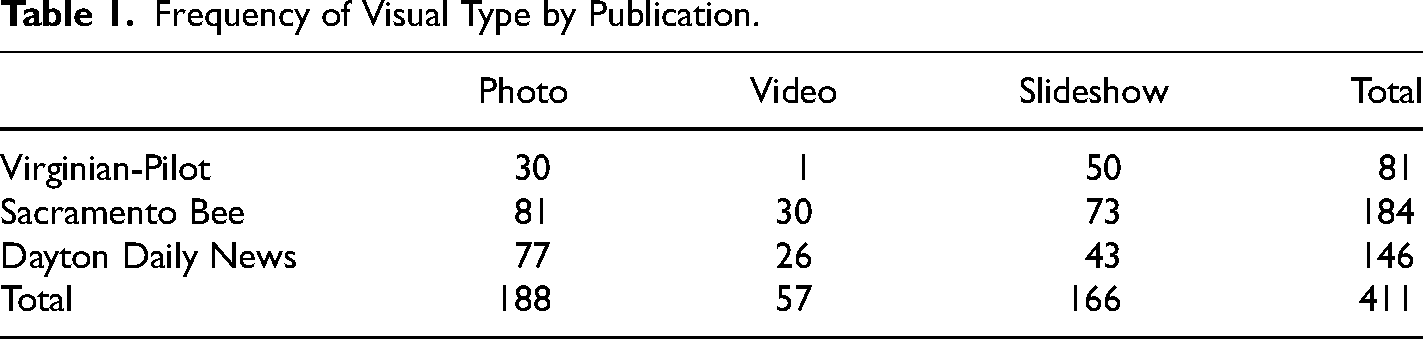
We will compare and contrast the three accounts that were included in the analysis to answer RQ1. The 6-month sample (184 days) consisted of a total of 411 posts from across all of the accounts. The Virginian-Pilot posted the fewest posts with 81, followed by the Dayton Daily News with 146, and the Sacramento Bee with 184. As such, each account posted on different schedules with the Bee posting on average one post a day and the other two posting fewer than one post per day. In terms of the visual type of the overall posts across all publications, 188 posts (45.7%) were single photos, while 166 were slideshows (40.4%) and only 57 were videos (13.9%). When comparing each publication's usage of different visual types, there was a significant difference in how each utilized the three different formats allowed in the Instagram feeds, χ2(4, N = 411) = 28.247, p < .001. See Table 1 for a comparison of the visual types posted by each publication. Within the slideshows posted by each organization, there was a significant difference in the number of photos included per slideshow [F(2, 163) = 12.018, p < .001] with the Bee posting the highest mean number at 4.72 (standard deviation [SD] = 2.16) followed by the Pilot (M = 3.98, SD = 1.19) and the Daily News (M = 3.07, SD = 1.53).
Frequency of Visual Type by Publication.
Breaking down the photos into their respective categories, each publication focused on different image types. The Pilot (N = 57, 71.2%) and the Bee (N = 91, 59.1%) focused heavily on images with no text, while the Daily News was more reliant on images with text (N = 58, 48.3%). The differences in how each publication used images was significant, χ2(10, N = 354) = 84.765, p < .001. See Table 2 for a full comparison of photo types by each publication. Similarly, there was a difference in how each publication used video, χ2(4, N = 63) = 37.293, p < .001. The Pilot barely utilized video with only two total videos, one of which was included in a slideshow. Both the Bee (N = 30) and the Daily News (N = 31) used videos more frequently. For the Bee, the overwhelming majority of the videos were repurposed videos from the organization's TikTok account (N = 27, 90%) while the Daily News was more evenly divided among minorly edited (N = 11, 35.5%), packages (N = 14, 45.2%), and TikTok videos (N = 6, 19.3%).
Frequency of Topics by Publication.

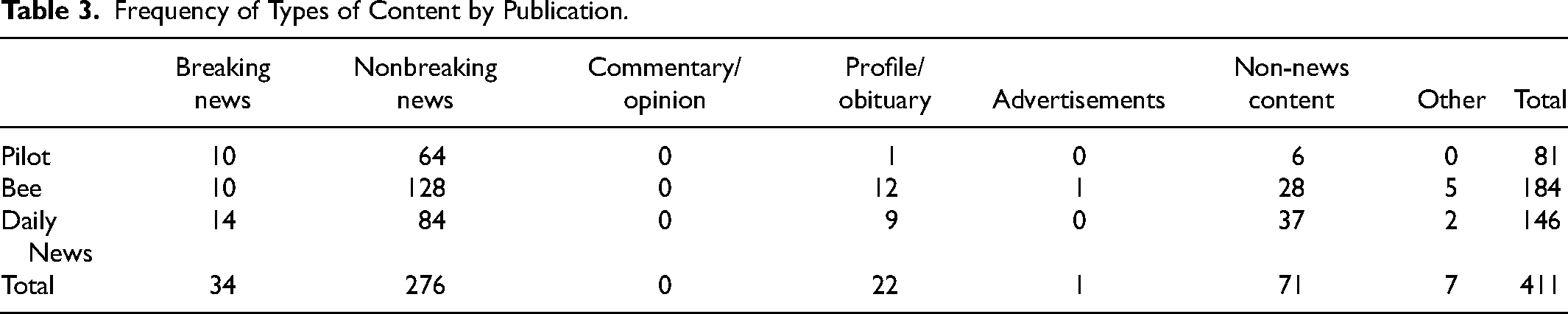
Transitioning to the types of topics on which each publication focused, all three organizations spent a large portion of their content on softer news coverage. A total of 166 posts (40.4%) were in either the General Human Interest or Popular Amusements categories across all three publications. That is in contrast to harder news categories, like Politics and Government Acts (N = 69, 16.8%), Economic Activity (N = 46, 11.2%), and Crime (N = 37, 9.0%) which were the three most frequent hard news categories across the sample. For a full breakdown of the topics by publication, see Table 2. The difference in topics was significant, χ2(30, N = 411) = 79.864, p < .001. For the types of content categories that each account posted, the majority of the content was nonbreaking news (N = 276, 67.1%) followed by non-news content (N = 71, 17.3%). Breaking news only made up 34 posts (8.3%) across the entire sample. However, there were still significant differences in how each publication utilized different types of content, χ2(10, N = 411) = 25.142, p < .01. For a full comparison of the types of news content shared by each account, see Table 3.
Frequency of Types of Content by Publication.
In terms of the length of captions, the Pilot wrote the shortest captions (M = 115.37, SD = 76.7) while the Bee (M = 164.29, SD = 109.4) and the Daily News (M = 160.73, SD = 108.7) had similar numbers. Using a one-way analysis of variance omnibus test and Tukey's Honest Significant Difference (HSD) post hoc test, that difference is significant between the Pilot and the other two, F(2, 408) = 6.883, p < .001. For hashtag usage, there was also a significant difference in how each account utilized them. Both the Pilot (M = 2.04, SD = 3.4) and the Bee (M = 2.84, SD = 4.4) averaged more than the Daily News (M = 0.04, SD = 0.42), which hardly utilized hashtags at all. When analyzing those means with a one-way analysis of variance omnibus test [F(2, 408) = 29.823, p < .001] and Tukey's HSD post hoc test, the Pilot and the Bee were significantly different from the Daily News (p < .001) but not each other (p = .165). The number of accounts tagged per post was somewhat similar with the Pilot (M = 0.53, SD = 0.71) and the Bee (M = 0.29, SD = .57) both tagging more accounts than the Daily News (M = .08, SD = .354). In analyzing those means with a one-way analysis of variance omnibus test [F(2, 408) = 19.118, p < .001] and Tukey's HSD post hoc test, the three accounts all utilized tagging other accounts significantly differently from one another. Lastly, the usage of hyperlinks or mentioning a link in each account's bio was significantly different amongst the accounts. For this analysis, the hyperlinks were collapsed into two categories: (1) having a hyperlink or mentioning a link in the bio and (2) no hyperlink or mention of a link in the bio. The Pilot did not utilize hyperlinks (N = 31, 38.3%) more than the other two publications. For comparison, the Bee (N = 34, 18.5%) and the Daily News (N = 31, 21.2%) each had similar whole numbers but significantly lower percentages, with each instead focused on including hyperlinks to other websites or links in their bios more often. The difference between hyperlink usage was significant across the three organizations, χ2(2, N = 411) = 12.88, p < .01.
To answer RQ2, we will now examine the responses to the content from the audiences for each account. Across the sample, the average number of likes was 260.26 with an SD of 297.13 while the mean number of comments was 10.99 with an SD of 19.83. The number of likes was significantly correlated with the number of comments (r = .501, p < .001). In terms of a publication by publication comparison, the Virginian-Pilot had both the most likes (M = 457.65, SD = 392.02) and comments (M = 15.07), followed by the Sacramento Bee (likes: M = 284.26, SD = 290.27; comments: M = 14.51, SD = 23.25) and then the Dayton Daily News (likes: M = 120.49, SD = 127.79; comments: M = 4.30, SD = 8.43). Those differences were analyzed using one-way analysis of variance tests. Both likes [F(2, 408) = 41.465, p < .001] and comments [F(2, 408) = 13.715, p < .001] were significantly different across the publications. A Tukey's HSD post hoc test showed that all of the publications were significantly different from one another in terms of likes, but only the Daily News was significant from the other two organizations in terms of comments.
In terms of the audiences’ responses to individual topics, there was a significant difference across the sample utilizing a one-way analysis of variance omnibus test for likes [F(14, 395) = 1.897, p < .05] and comments [F(14, 395) = 2.685, p < .001]. However, in looking at the pairwise comparisons from a Tukey's HSD post hoc test, there were few significant comparisons for both analyses. The most liked topic categories were Public Moral Problems (M = 510.71, SD = 542.13) and Crime (M = 426.95, SD = 429.42) and the least liked topic categories were Other (M = 87.4, SD = 76.80) and Transportation and Travel (M = 121.67, SD = 85.54). In contrast, the most commented topics were Crime (M = 19.92, SD = 24.30) and Politics and Government (M = 19.32, SD = 32.62) while the least commented topics included Diplomacy and Foreign Relations (M = 2.00, SD = 1.732) and Other (M = 2.30, SD = 3.057).
For the audiences’ response to content categories, there was a significant difference across the sample utilizing a one-way analysis of variance omnibus test for likes [F(4, 405) = 4.911, p < .001] and comments [F(4, 405) = 9.606, p < .001]. Despite not being utilized as often as nonbreaking news, breaking news received the most likes (M = 445.03, SD = 415.95) and comments (M = 28.65, SD = 35.13). In contrast, nonbreaking news received on average 261.32 likes (SD = 289.34) and 10.91 comments (SD = 19.09). Those differences were statistically significant for likes [t(308) = 3.309, p < .001] and comments [t(308) = 4.562, p < .001].
Some additional notable analyses showed that there was no correlation between likes or comments and the number of hashtags and tagged accounts. As such, it may not be necessary or advantageous to include either hashtags or tagging other accounts. Both could be used for other purposes like categorization or providing credit to other accounts but they may not yield positive results in terms of responses from the audience.
Discussion
The purpose of the content study is to better understand how regional newspapers are using Instagram so that others may learn from active practitioners of an understudied platform for journalism. The study examined three different accounts from publications across the United States. The results are but a piece of information about the current state of Instagram usage. Each organization had their own distinct strategies when approaching the platform. Additionally, this study only focused on the feeds by the organizations, not the Instagram Stories, which may or may not have a different approach or strategy.
Gatekeeping and Social Media
One consideration that is important for practitioners and scholars is the algorithm that Instagram uses to curate content. Not everything is known about how the algorithm works, but there are some features that are publicized and known. In particular, “at the end of 2021, Instagram's parent company, Meta, changed the platform's algorithm to prioritize videos, called Reels. Accounts that don’t regularly post the short-form videos appear below those that have embraced the format in users’ Instagram feeds, resulting in a notable drop in engagement on posts,” according to an article in the New York Times (Hughes, 2022). In that sense, the algorithm is acting as a gatekeeper to limit and curate what the audience sees more readily in their feeds. Not only that, through working within the confines of an opaque, proprietary algorithm, publishers and content creators are ceding control over their content to that platform (Caplan & Boyd, 2018). Journalists and editors are left guessing what content will appease the algorithm and what will be emphasized and what will not (Diakopoulos & Koliska, 2017). Caplan and Boyd (2018) go further by noting that, in the case of Facebook and the journalism industry, “the more dependent an industry becomes on one organization who is exerting a dominant administrative function (in this case, Facebook's News Feed algorithm), the more that organization will be able to exert change on other organizations that rely upon them” (p. 5). As such, it becomes more important to understand what types of content are being posted and what types of responses they are receiving from the audiences.
Descriptions of Results
Given the required visual nature of the platform, each organization tended to focus on different elements. The Pilot had almost no video content but had more slideshows than singular photos. The other two organizations had a more balanced approach, however many of their videos were repurposed from TikTok instead of original content designed specifically for Instagram. Additionally, in terms of photo style, each organization posted different types of photos. Both the Bee and the Pilot had more photos that stood by themselves without text as compared to the Daily News which had a greater emphasis on text. The Bee and the Daily News were also more likely to include multiple styles of photos in a slideshow as compared to the Pilot, which had no slideshows that varied stylistic elements.
Similar to what others (Larsson, 2018; Hendrickx, 2021) noted, the content posted by the three accounts had a focus on lighter content, particularly General Human Interest and Popular Amusements. For the content that did not fall into those two categories, the majority of it had a local focus and gravitated around a select few topics, particularly Politics and Government Acts, Economic Activity, and Crime. When looking at the topics covered by each organization, it is important to note not just what was posted, but what was not posted as well. Given the time frame, there were numerous high-profile national and international stories for which the regional publications did not devote much or any space. In particular, War and Defense was mostly non-existent despite two of the three publications being located near large military bases. Although the United States may not have been directly involved in large-scale conflicts like the Ukrainian-Russian war, one might expect more content in those areas. In contrast, many of the Economic Activity stories focused on local businesses or labor issues with direct connections to the local populaces, such as restaurants opening/closing or unions striking.
In looking at the types of content categories the organizations published, it makes sense that they focused on nonbreaking news instead of breaking news. Given Instagram's algorithmically curated feed, breaking news content may be buried behind others so focusing on content where timeliness is not as important may have been a clear choice, especially since that was the case across all the publications. As a contrast, however, given that breaking news received greater levels of likes and comments, it may show that the audience prefers that type of content compared to the nonbreaking news. Practitioners may want to focus more on breaking news despite the fact that it might not be seen immediately by the audience. It is also interesting to note that none of the publications included any commentary or opinion on Instagram. That is despite offering those types of content in print and digital newspaper options.
In terms of audience responses, the results show that the Pilot received the most likes and comments compared to the other two accounts. That is somewhat surprising given that the account posted very few videos, which should hypothetically be more visible within the average user's feed based on changes to Instagram's algorithm at the beginning of 2022. One other wrinkle in the algorithm details is that it might have also been downranking the videos that came from TikTok. Given that many of the videos in the sample were from TikTok, that may have been a negative rather than a positive in the eyes of the algorithm.
It speaks to the Pilot's strategy that despite having the fewest followers, it still received the highest amounts of responses. It could also be possible that the content was of higher quality or relevance to the audience given that it was posted less often overall. Additionally, the Pilot did not utilize links in its bio nearly as often as the other two publications. As such, the content might have stood by itself more so than the content for the other accounts. If the content was native and planned for Instagram, it might have conformed to the audience's expectations more than having to take a news story and modify it to fit Instagram's conventions. In general, there were not many comments across the whole sample with the mean hovering around 11 comments per post. That creates questions about the type of content that would garner more discussion, and if discussion is a goal of the organizations at all.
Conclusion
The current study examined three regional newspapers and how they use Instagram. It found that each had a distinct strategy in terms of visual usage. There was more consistency in terms of the topics that each organization posted, but much of it remained on the lighter side of the journalism spectrum, in line with other findings. The content tended to focus on nonbreaking news and non-news content as opposed to breaking news content.
Future research should examine the uses and gratifications for Instagram with regard to journalism. That is for both from the audience perspective as well as from the organizational side. What is the end goal of distributing content on these platforms? What is the audience looking for out of the journalism accounts? Given that there were differences in the amount of links included in the bios for each account, there may be other elements that the producers are hoping to gain other than simply clicks to the organization's website. Additionally, future research may want to consider other types of organizations that are not legacy, newspaper media. Could digital-first or digital-only outlets have a different strategy? The same might go for accounts of organizations from different media, such as television or radio. Additionally, future research should examine the comments on various news outlets’ Instagram accounts to better understand how the audience is receiving and discussing the information.
This study was limited to smaller, regional newspapers so as to see how average-level (not rural/community news and not national/international outlets) organizations utilized the platform. That limitation may have skewed the results as other outlets may approach the platform differently to serve their audiences’ different needs. Further, all the outlets were in the United States and part of conglomerates. Those characteristics were selected purposefully to create similar comparisons, however independent or single company news organizations might utilize the platform differently, potentially in ways related to advertising or other elements that were not present much within the current sample.
Footnotes
Declaration of Conflicting Interests
The author(s) declared no potential conflicts of interest with respect to the research, authorship, and/or publication of this article.
Funding
The author(s) received no financial support for the research, authorship, and/or publication of this article.
