




Abstract
Much has been written about the depiction of refugees in newspapers and television news, yet far less is known about how refugees are portrayed in Internet news. In this era of increasing Internet use, it is important to also study how refugees are depicted by Internet news websites. We used a quantitative coding sheet to investigate how Dutch news websites covered refugees. Our research found, first, that Dutch Internet news reports rather positively about refugees. This finding is directly linked to a conceptual decision, however, as we categorized references to victimization as positive coverage of refugees. Second, we found no significant difference between commercial and public Internet news sources in their depiction of refugees. Finally, we found a tendency towards depersonalization of refugees across all of the Dutch Internet news sources examined, which is reflected in the more frequent use of thematic over episodic frames.
Introduction
Refugees have increasingly sought asylum in the Netherlands in past years, with the number of asylum applications and requests for family reunifications peaking in the second half of 2015 (CBS, 2016). In line with this development, the newsworthiness of refugees also rose, with refugees seemingly especially newsworthy if they misbehave. Indeed, many news reports stress the negative consequences of refugee arrivals for receiving countries. Reports centre on sexual harassment and rape of ‘our’ European women by refugee perpetrators (AD, 2016; NRC, 2016; RTL Nieuws, 2016), violence in and around asylum seeker centres (Metronieuws.nl, 2016) and the threat of terrorists entering Europe under the cover of bona fide refugees (Elsevierweekblad, 2016). These kinds of reports likely incite fear and unfavourable attitudes towards refugees, which could lead to violence and racist protests against refugee resettlements in host countries. In fact, the Netherlands saw many such protests in 2015 (De Telegraaf, 2015a, 2015b; NOS, 2015a, 2015b).
Following Kang (2005), media depictions of refugees could be one of several sources for the negative image which people might have of refugees. That is, people construct what Kang (2005) calls ‘racial meanings’ either through direct contact with minorities or through ‘vicarious experiences’ which are stories about ‘the other’ told by the media or one’s own social network (p. 53). Attitudes formed by direct contact seem strongest, but because ‘vicarious experiences’ occur much more frequently, especially in the form of media consumption, these ‘vicarious experiences’ are much more influential in attitude-building (Kang, 2005: 53). An often studied ‘vicarious experience’ is exposure to media, and a growing literature suggests that media are in fact biased (see, e.g. Anastasio et al., 1999; Bovitz et al., 2002; Esses et al., 2013; Gentzkow and Shapiro, 2006). Media consumption might therefore lead to skewed attitudes towards refugees.
Use of the Internet is still growing in the Netherlands, unlike television viewing (MSS, 2016). However, until now, coverage of refugees in Internet news has been little studied. In light of the growing importance of the Internet as a news source, it is important to gain a better understanding of how Internet news covers refugees. This is the aim of the current research. The leading question is as follows: ‘How does Dutch Internet news depict refugees?’ We first elaborate on previous findings regarding news coverage of refugees, presenting hypotheses based on these earlier results. We then elaborate on the methods used in the current research to select and analyse Internet news stories. This is followed by a presentation of the results of our analysis. The final section draws and discusses key conclusions.
Influencing through the news
Framing
The way news is framed is important in attitude-building among readers and viewers regarding the subject matter of a story. ‘Framing’ can be defined as ‘the process of culling a few elements of perceived reality and assembling a narrative that highlights connections among them to promote a particular interpretation’ (Entman, 2007: 164). The process starts with the definition of what problems are newsworthy, and thus worth reporting on. Then, once a problem is chosen, a particular frame is selected for addressing the problem, encouraging certain moral judgements and favoured policies to tackle the problem (Entman, 1990, 2007; Scheufele, 1999). A particular frame can thus alter and shape interpretations and preferences of audience members regarding issues such as migration. The goal of framing is to ‘prime’ certain elements of stories, making them more salient, while downplaying or overlooking other elements. The ‘news bias’ achieved can activate schemas that encourage readers to think, feel and decide in particular ways (Entman, 2007).
News bias
Entman (2007) stressed the conceptual importance of discerning three kinds of news bias, though these are often confused with one another in public as well as scientific discourse. The first is decision-making bias. This refers to the biased motivations and mindsets of news producers. A consequence of decision-making bias is the second type, content bias, meaning that news favours a particular side of a story over others, instead of maintaining a politically neutral position. The third form is distortion bias, entailing a twisting or falsification of reality in news reports (Entman, 2007: 163). Distortion bias often produces unresolvable doubt as to what is real and what is ‘fake news’, and what are objective facts and what not (Entman, 2007). Importantly in this regard, facts need not be indisputable to influence audiences. That is, news does not have to be objectively ‘true’ in order to impact audiences’ attitudes (Entman, 2007).
Refugees in the news
Can we identify any of these types of news biases in reporting about refugees? According to Van Dijk (2000), the framing of news about ethnic minorities is one of a ‘new racism’ in which ‘the other’ is no longer seen as biologically inferior, but as merely ‘different’ from ‘us’, usually in a negative way. The subject matter of reports about ethnic minorities is very diverse. Among the most covered topics are political responses to migration and practical problems caused by migration, linked, for example, to housing, employment and the welfare state. Also frequently covered are illegal migrants arrivals, cultural differences, integration conflicts and threats posed by migrants, particularly those related to violence, crime, drugs and prostitution (Van Dijk, 2000: 38): [E]ven potentially neutral topics, such as immigration, housing, employment or cultural immigration, soon tend to have a negative dimension: immigration may be topicalized as a threat, and most ethnic relations [are] represented in terms of problems and deviance if not as a threat as well, most typically so in news about [the] crime, drugs and violence minorities are associated with.
Topics neglected might include ‘migrants leaving the country, the contributions of immigrant workers to the economy, everyday life of minority communities, and especially also discrimination and racism against minorities’ (Van Dijk, 2000: 38).
What is more, reports about refugees usually contain passive sentences, thereby downplaying the agency of refugees. Whereas reports focusing on negative actions of refugees, like criminality, tend to use active sentences, thereby stressing their agency. In this way, the reports remind readers and viewers that refugees are responsible for their own negative actions (Van Dijk, 2000).
Furthermore, journalists are prone to using terminology from natural disasters when they refer to migration processes. For example, they might talk about a ‘refugee flood’ (Wright, 2010 on Philo and Beatie, 1999: 183). Maybe partly due to such terminology, debates about ‘the refugee crisis’ have also tended to centre on concepts of border control and sovereignty, as in Australia (Hightower, 2014). In such debates, the focus typically lies on the possible threat these unknown ‘others’ may pose to a host country (Hightower, 2014).
One reason for negative representations of refugees in news reports might be journalists’ aim to achieve as much coherence as possible in their news stories. In practice, this leads news reporters to seek out facts that point in the same direction, though this may establish or confirm negative stereotypes about refugees (Van Dijk, 2000).
The literature suggests that the media depict refugees and other ethnic minorities overall as problematic for the host society. Unfortunately, little has been written specifically on the effect of Internet news coverage of refugees. Yet, since we have no reason to think that Internet news is different from that in other media outlets, our first hypothesis is as follows:
H1: Dutch Internet news emphasizes negative aspects of refugees more frequently than their positive aspects.
Sensationalism
The above-mentioned negative out-group representation might also be a direct consequence of the increasing commercialization of news production and intensified competition between news outlets. More viewers or visitors of a news website means more advertisement income for the news supplier. As a result, news sites aim to maximize the number of visitors to their websites (Gasper, 2009). This can be achieved not only by targeting a specific audience (Gasper, 2009), but also by choosing a more sensational news form and content (Vettehen et al., 2008). This is especially evident in coverage of migration (Benson and Saguy, 2005). Video news clips can be made more sensational by using more and different camera positions, which is called ‘pacing’. Greater pacing leads to higher emotional arousal and more liking, especially among young viewers of short news clips (Lang et al., 2005). Other sensational elements are zooming in and use of camera angles showing a witness’ viewpoint of news events (Grabe et al., 2001), though these latter elements do not necessarily lead to more emotional arousal (Vettehen et al., 2008).
Sensationalism can also be found in the content of news stories. Violence, accidents, disasters, celebrity news, scandals and sex are usually seen as sensational subjects, likely to attract more viewers than non-sensational subjects, such as economics, politics, education and health (Grabe et al., 2001). High interest in sensational subjects is also reflected in the emotional arousal generated by this kind of news and greater propensity to ‘like’ sensational reports (Vettehen et al., 2008).
Public vs commercial news
With regard to television, commercial news outlets have been found to bring more sensationalist news than public news outlets (Jacobs et al., 2016). This has been attributed to the fact that public broadcasters have traditionally enjoyed certain privileges and had certain obligations, typically paired with a stricter control structure to monitor performance in relation to these (Syvertsen, 2003). Privileges of public news outlets may include a monopoly on certain advertisement incomes, free or discounted licencing, government support and access to particular broadcast frequencies. Corresponding obligations could entail that news must be accessible to the entire population, that coverage should be diverse, that it should meet goals related to minorities and that it should enhance the national identity (Syvertsen, 2003). One could say that public news traditionally sees news consumers as citizens, with news conceptualized as a means to enhance rational debate (Syvertsen, 2003).
However, since the neoliberal 1980s this dominant model of public news has undergone some change in the Netherlands. Declining public funding has pushed Dutch public news outlets to be more cost-effective and, in a sense, more commercial. Many public news outlets have been privatized. This means they no longer receive money from the Dutch government, but have to seek out advertising income on their own (Syvertsen, 2003). Another development has been an increase in the number of news suppliers as a result of digitalization, leading to more competition for viewers between commercial and public news outlets in the Netherlands (Syvertsen, 2003).
Although there seems to be some convergence between the content of public and commercial television, differences are still found. For example, sensationalism has been found to be more widespread in commercial news, which has a greater tendency to spotlight conflictive interactions and negative emotions like anger and fear (Jacobs et al., 2016). Also, commercial news is more likely to take a narrative perspective, while public news is more likely to take a thematic perspective. Furthermore, commercial news covers migration items as ‘soft news’ more often (Jacobs et al., 2016). Soft news are those news stories whose primary aim is entertainment (i.e. news about criminality and scandals) (Baum and Jamison, 2008). Public news, on the contrary, has a greater penchant for covering ‘hard news’ (Jacobs et al., 2016), especially focused on informating its audience (f.e. news about economics and politics) (Baum and Jamison, 2008). Though both public and commercial news outlets tend to prefer negative over positive coverage, commercial news does this slightly more, especially with regard to migration (Jacobs et al., 2016). Commercial news is not only more likely to depict migrants as the cause of problems, but it also has a greater penchant for overemphasizing the negative consequences of migration (Jacobs et al., 2016). This leads to our second hypothesis:
H2a: Commercial news firms cover migration in a more negative manner on their websites than public news firms.
H2b: Commercial news firms cover migration in a less positive manner on their websites than public news firms do.
Thematic vs episodic framing
Besides the choice to emphasize more positive or negative characteristics of refugees, news outlets can also frame their content in specific ways. For instance, news outlets can choose between ‘episodic frames’ in which ‘a specific example, case-study or event-oriented report’ is presented and ‘thematic frames’ in which the ‘refugee crisis’ is presented ‘in a broader context, using generalities and abstractions instead of more concrete, real-life examples (Haynes et al., 2016: 119)’. Thus, whereas episodic news frames focus on the stories of specific refugees, and remind its readers that refugees are human beings, thematic news frames try to give a more general and abstract overview, thereby depersonalizing refugees by reducing them to mere numbers and statistics.
The use of thematic frames might be a cloaked means for media to criticize a governing political party, as this may be easier done by referring to numbers and groups (which ostensibly cause problems) than by referring to individuals (most of whom are likely well-behaved) (Khosravinik, 2010). However, journalists also use numbers and statistics to enhance the facticity and credibility of their reports (Van Dijk, 2000). Taking this into account, it might be expected that journalists tend to frame immigration in a more thematic way, by focusing on general numbers and statistics of immigration, instead of using the episodic frame relating to individual stories. We therefore also expect to find a prevalence of thematic framing in Dutch Internet news about immigration:
H3: Dutch Internet news tends to use thematic frames more often than episodic frames.
Methods: Content analysis
To test our hypotheses, we performed a quantitative content analysis. First, we selected relevant news articles. We then constructed a coding sheet and tested the reliability of our variables.
Selection
To select news articles, we accessed the four most popular news websites of the Netherlands: NOS.nl, RTLNieuws.nl, NU.nl and Telegraaf.nl (Appel, 2015). NOS is a public news outlet, which is responsible for covering news, sports and events not only through their website, but also through radio, television and teletext. In contrast, RTLNieuws.nl is a commercial news outlet, but just like NOS, it also offers radio, television and teletext next to its news website. Furthermore, next to their news website, Telegraaf.nl also offers news in the form of a morning paper. De Telegraaf is known for the high amount of sensational stories, although it should not be characterized as tabloid (Bakker and Scholten, 2011). NU.nl is the only news source that exclusively offers news via its website. Although the three other news outlets also offer news through other channels than only their website, we are only interested in the online news stories in this paper.
We selected news articles over two constructed weeks; that is, a random Monday, Tuesday, Wednesday, Thursday, Friday, Saturday and Sunday within two predetermined study periods. This method has proven to be more reliable than other random selection methods for online news, as it is less susceptible to the cyclic nature of news reporting (Hester and Dougall, 2007).
One constructed week was derived by drawing a random Monday, Tuesday, Wednesday, Thursday, Friday, Saturday and Sunday from all possible Mondays, Tuesdays, Wednesdays, Thursdays, Fridays, Saturdays and Sundays from 1 April 2016 to 30 September 2016. The second constructed week was similarly derived using the period from 1 October 2016 to 31 March 2017.
We searched each news website using the Dutch word for refugee (vluchteling), obtaining all of the news reports appearing on the selected days. A total of 85 articles were found: 52 from NOS.nl, 21 from RTLNieuws.nl, 10 from NU.nl and 2 from Telegraaf.nl. 1
We then constructed a coding sheet, which, following the literature and our hypotheses, focused both on positive and negative aspects of refugees for ‘our’ society and the frequency with which characteristics of episodic or thematic news frames were used in Dutch Internet news covering refugees.
Coding sheet
To construct the coding sheet, we employed multiple indicators for the main variables, which were ‘negative aspects of refugees’ and ‘thematic framing’. We did the same for their opposites: ‘positive aspects of refugees’ and ‘episodic framing’. The indicators reflected the diverse ways in which Internet news could cover refugees in a negative or positive manner, and the diverse ways in which journalists could frame news about refugees in an episodic or thematic way. Supplemental Appendix 1 presents the complete coding sheet.
In the first phase of construction of the coding sheet, the authors listed negative and positive ways that refugees could be covered in the news, based on the public debate about refugees. Characteristics of episodic and thematic framing were similarly listed, initially without referring to actual news reports.
In the second phase, the coding sheet was tested. This phase explored not only whether the categories were mutually exclusive, but also whether categories were missing. Where this was found to be the case, we added them to the coding sheet. After testing the coding sheet using 20 to 30 articles from June and July 2017, the operationalization of the main variables was deemed complete and the third phase of the content analysis began. This was collection of data using the completed coding sheet.
The first two steps produced a total of 10 possible ways in which Internet news could cover refugees negatively, for example, by portraying them as an economical burden, criminal or in some other way threatening. We found only five possible ways in which Internet news could cover refugees in a positive manner: for example, by stressing their talents and by emphasizing the humanitarian plight and thus the moral obligation to take them in (see Supplemental Appendix 1). The fact that more negative coverage categories could be listed than positive coverage categories does not necessarily mean that more articles would be found referring to the negative aspects. It merely indicates a greater diversity in topics of negative coverage. Furthermore, refutations or criticisms of each of these negative aspects were included as indicators for the opposite (positive) variables (see Supplemental Appendix 1).
A particular means of depicting refugees in the news is to victimize them, such as a news story emphasizing the harshness of life as a refugee. This could be done, for example, by stressing the loss of family members or the traumatic experiences refugees had undergone. People reading such articles might be more likely to welcome refugees into their country and neighbourhood, as they may feel more empathy towards refugees, and perhaps more sympathy. However, as victimization can be classified either as a particular kind of positive coverage, as Khosravinik (2010) seems to suggest, or as not positive at all, 2 we conducted our final analysis both with and without victimization included as a positive category.
Finally, we listed a total of 14 indicators of the thematic framing of refugees in news items, including referring to refugees as a group, numbers or statistics. Only two indicators of episodic framing were identified: calling refugees by their given names (e.g. Mohammed) or providing deeper information about a specific migrant.
The coders used all information from the articles selected. Thus, they coded not only the regular text, but also headlines, subtitles, picture captions, quotes, tweets and transcriptions of video clips where these were included. Also, in order to get an idea of the frequency of occurrence of the various indicators, the coders registered not only whether an article contained an occurrence of the indicators from the coding sheet, but also how often they occurred, making this a quantitative content analysis.
Inter-coder reliability
To ensure inter-coder reliability, a second coder examined and coded 15 of the 85 articles. Before undertaking this exercise, he received a training session spanning some 20 articles, to get familiar with the coding sheet and improve it where necessary. Before coding, the second coder received no information about the main hypotheses of the study, to prevent this from influencing his coding behaviour. After the training session, the main researcher deemed the second coder ready to code the subset of the articles. The coding of the 15 articles by the second coder was used only to assess the reliability of the coding sheet, and was not taken into account in the final analysis.
To measure the reliability of the separate variables and the indicators for these variables Krippendorff’s alpha was used. This measure was used because it is applicable to any number of observers, to any number of categories, scale values, or measures, and to any level of measurement. It is even applicable to incomplete or missing data, and does not require a minimum of cases (Krippendorff, 2011: 1). These calculations indicated that some of our indicators were unreliable. Our judgements on reliability followed the recommendations of Krippendorff (2004: 241–242): an alpha below 0.667 was considered unreliable, an alpha between 0.667 and 0.800 was considered suitable only for drawing tentative conclusions, and an alpha greater than 0.800 was seen as reliable (Krippendorff, 2004: 241–242).
Our primary variables (see Table 1) were made up of multiple indicators, some of which proved to be reliable and some unreliable according to these criteria. It was, however, possible to exclude indicators that turned out to be unreliable. This increased the reliability of the main variables of which these indicators had been part. We continued to exclude unreliable indicators until variable reliability reached an acceptable level. Supplemental Appendix 2 presents the Krippendorff’s alpha for the variables with all indicators. Supplemental Appendix 3 presents the results for the separate indicators. Table 1 displays the Krippendorff’s alphas calculated after exclusion of the unreliable indicators.
Krippendorff’s alphas of main variables after exclusion of unreliable indicators.
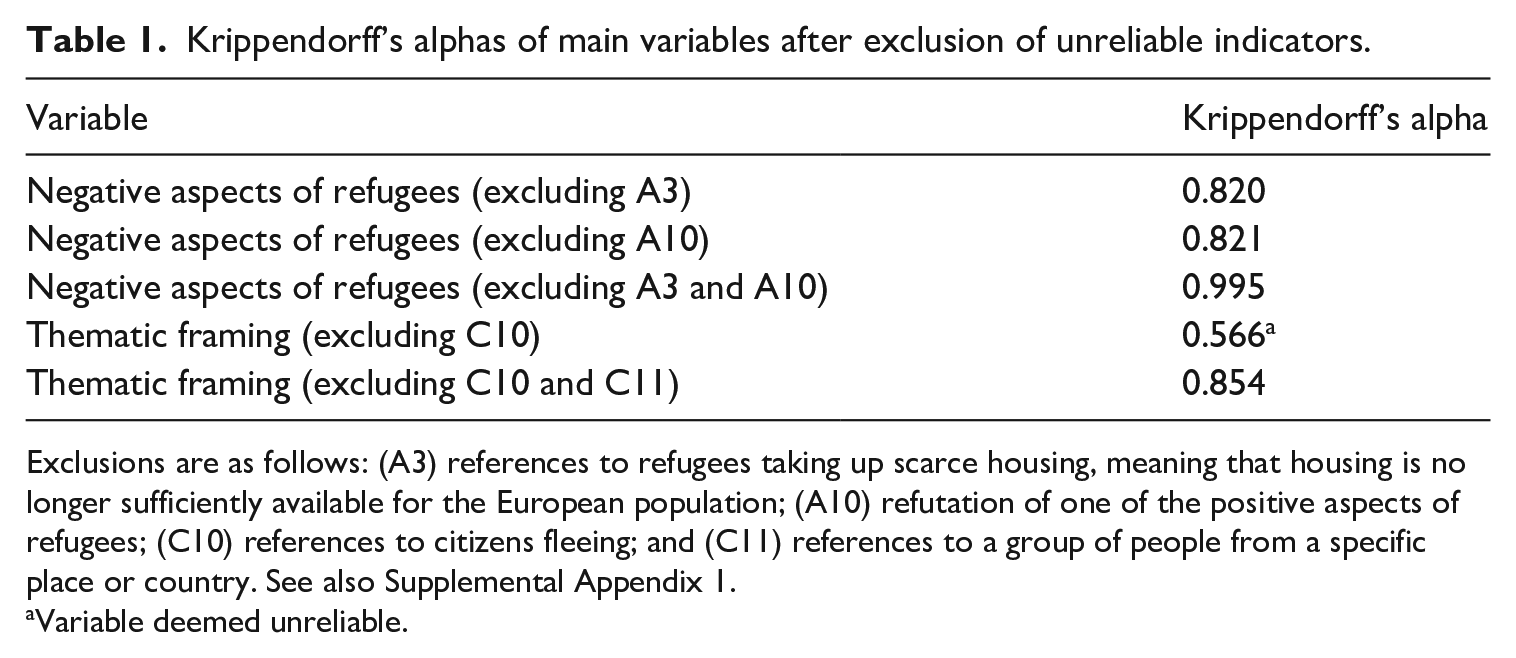
Exclusions are as follows: (A3) references to refugees taking up scarce housing, meaning that housing is no longer sufficiently available for the European population; (A10) refutation of one of the positive aspects of refugees; (C10) references to citizens fleeing; and (C11) references to a group of people from a specific place or country. See also Supplemental Appendix 1.
Variable deemed unreliable.
‘Thematic framing’ turned out to be unreliable and ‘negative aspects of refugees’ turned out to be suitable only for drawing tentative conclusions (see Supplemental Appendix 2). Looking first at the indicators for ‘thematic framing’ (see Supplemental Appendix 3), we see that indicator C10 had the lowest Krippendorff’s alpha (0.00). After excluding C10, Krippendorff’s alpha for ‘thematic framing’ was still only 0.566 and still unreliable. It was therefore necessary to exclude another indicator. In Supplemental Appendix 3 we see that C11 (0.337) had the lowest Krippendorff’s alpha after C10. Excluding both C10 and C11 increased the Krippendorff’s alpha for ‘thematic framing’ to 0.854 (see Table 1), an acceptable outcome according to Krippendorff (2004: 241–242).
Considering all indicators for ‘negative aspects of refugees’, Krippendorff’s alpha was only 0.678 (see Supplemental Appendix 2), meaning that this variable could be used only to draw tentative conclusions (Krippendorff, 2004: 241–242). We therefore went on to see which indicators could be excluded to obtain a better level of reliability. As can be seen in Supplemental Appendix 3, both A3 and A10 have a Krippendorff’s alpha of 0.00. Krippendorff alpha was again tested excluding only A3, excluding only A10 and excluding both. From Table 2 we see that the reliability of ‘negative aspects of refugees’ becomes acceptable if A3 is excluded (Krippendorff’s alpha = 0.820) and if A10 is excluded (Krippendorff’s alpha = 0.821). However, since a slightly higher reliability was obtained by excluding A10, we elected to do this in the final analysis.
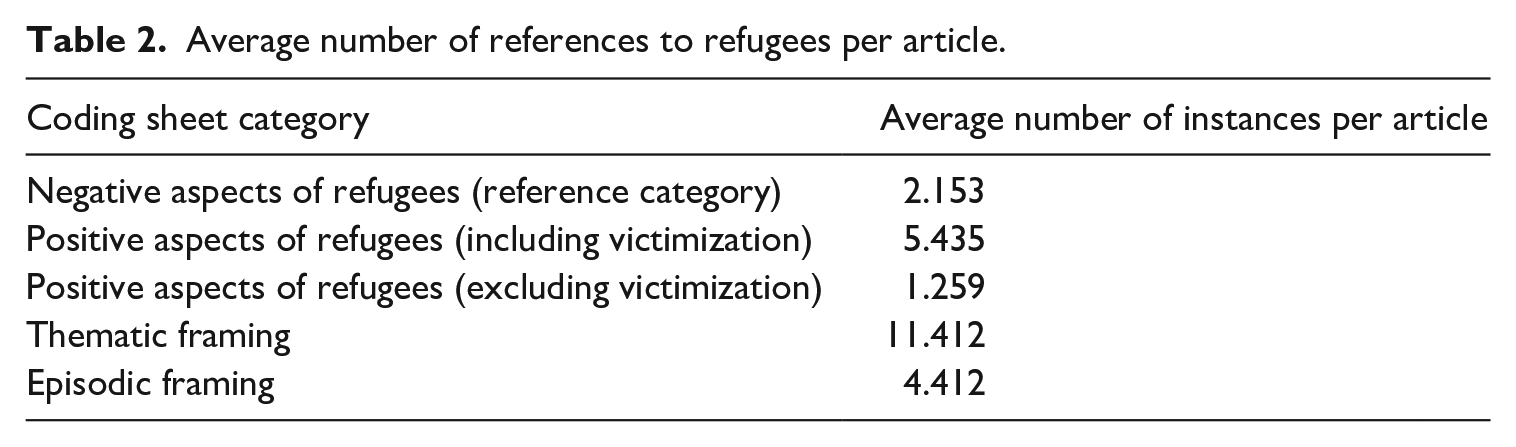
Average number of references to refugees per article.
Results
Let us now turn to the results of our analysis. Table 2 displays the average number of instances in which the articles studied contained the types of references to refugees described in our coding sheet. Our main variables were ‘negative aspects of refugees’ (reference category), ‘positive aspects of refugees (including victimization)’, ‘positive aspects of refugees (excluding victimization)’, ‘thematic framing’ and ‘episodic framing’.
Our first hypothesis was that Dutch Internet news emphasizes the negative aspects of refugees more than positive aspects. However, the mean score for ‘negative aspects of refugees’ was actually lower than that for ‘positive aspects of refugees’, as seen in Table 2. This refutes our first hypothesis. Thus, the Dutch Internet news sources we examined did not tend to emphasize the negative aspects of refugees more than the positive aspects. In fact, the mean score for ‘positive aspects of refugees’ was actually significantly higher than the mean score for ‘negative aspects of refugees’, as seen in the results of our paired samples t test (Table 3). Therefore, if articles about victimization of refugees are considered as presenting refugees in a positive light, as we did, Dutch Internet news actually offered significantly more positive reports than negative reports on refugees.
Results of paired samples t test.
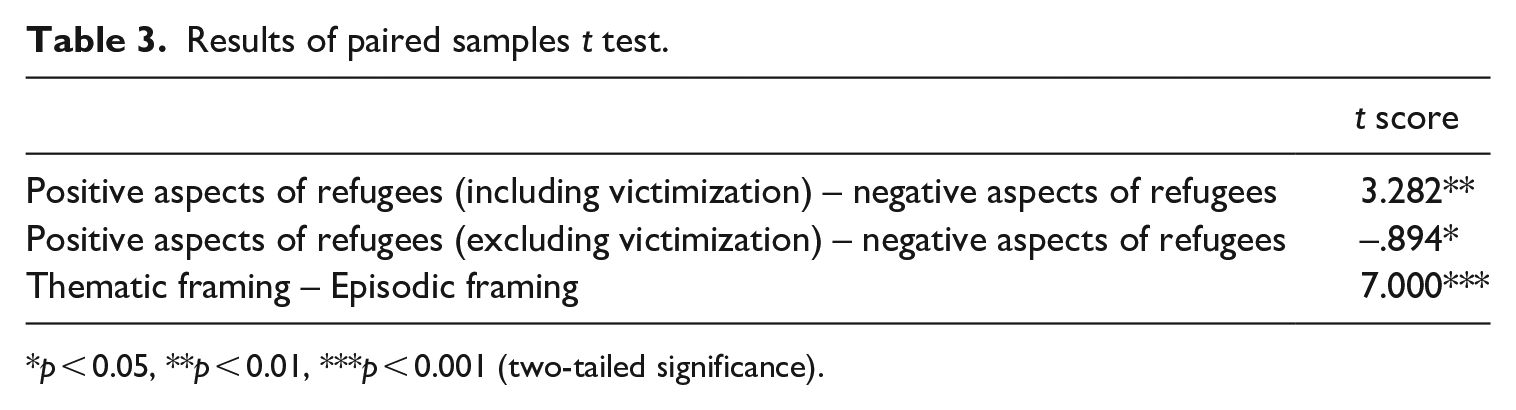
p < 0.05, **p < 0.01, ***p < 0.001 (two-tailed significance).
Indeed, this result is completely attributable to our decision to construe victimization as positive coverage of refugees. Excluding victimization from the positive aspects of refugees, our first hypothesis is no longer refuted. In that case, the Dutch Internet news examined did tend to emphasize the negative aspects of refugees more. In our paired samples t test, the mean score for positive aspects of refugees was significantly lower than that for negative aspects of refugees after victimization was excluded as an indicator of the former (see Table 3). Thus, our conceptualization of victimization played a crucial role in our outcomes. Our earlier question of whether victimization should in fact be seen as positive reporting about refugees is thus an important one for future research. Moreover, further research is needed to empirically verify whether more reports on refugee victimization in internet news really lead to more favourable attitudes towards refugees, and thereby whether our conceptual decision is justified. At this point, it must remain a reasonable assumption.
Commercial vs public news websites
Our second hypothesis suggested that commercial news sites cover migration in a more negative, or less positive, manner than public news websites do. Thus, for the Netherlands, we would predict that RTLNieuws.nl, a commercial news outlet, would cover refugees more negatively than the public broadcaster NOS.nl. 3 To test this hypothesis, we performed an independent samples t test for both positive aspects of refugees and negative aspects of refugees. However, since we counted the number of times indicators for both variables were found in RTLNieuws and NOS reports, we also had to control for the number of words these news sources provided. NOS used many more words in its reports (N = 28,199) than RTLNieuws (N = 7,768). More words would likely be correlated with more references to both positive and negative aspects of refugees. Since we do not want report length to influence our findings, we transformed our variables from total numbers of instances, to numbers of instances per thousand words. The average number of negative and positive references per 1000 words for the NOS and RTLNieuws are displayed in Table 4.
Average number of references to refugees per 1.000 words for Dutch commercial and public news outlets.
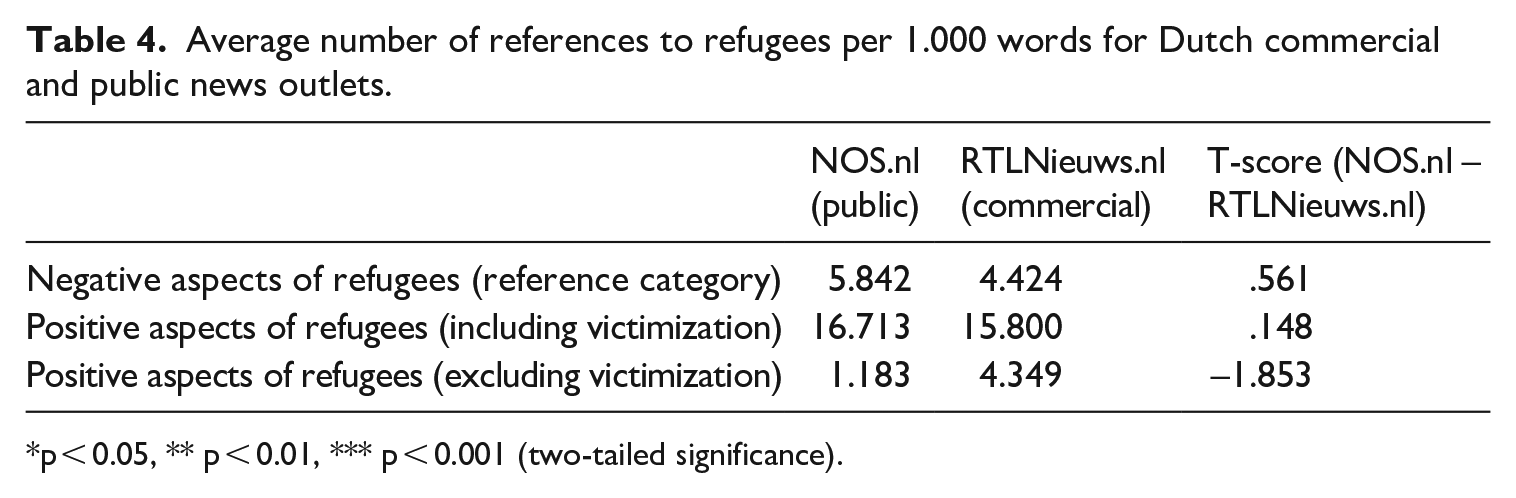
p < 0.05, ** p < 0.01, *** p < 0.001 (two-tailed significance).
Regarding the number of negative instances per thousand words, we found that the NOS (with a mean score of 5.8), actually scored higher than RTLNieuws (with a mean score of 4.4). However, this difference was not significant. Regarding the number of positive references to refugees per thousand words, the mean score of NOS (16.7) was higher than that for RTLNieuws (15.8). However, this difference was not significant either. Thus, our second hypothesis is refuted: the commercial news website we examined did not cover migration in a more negative manner than the public news website in our study. 4
Excluding victimization from the ‘positive aspects of refugees’ variable, the average number of times in which RTLNieuws covered refugees positively was 4.3 times per thousand words, whereas for NOS it was only 1.2 times per thousand words. However, this difference was not significant. The second hypothesis is therefore refuted regardless of our conceptual decision regarding the inclusion of victimization. However, it is remarkable to note that we almost find the exact opposite of what we expected if we do not perceive victimization as positive coverage of refugees. This is related to the fact that we found more instances of victimization in NOS articles than in articles of RTLNieuws.
Thematic vs episodic framing
Our third hypothesis was that Dutch Internet news tends to use thematic frames more often than episodic frames in covering refugees. Considering Table 3, there is no reason to refute this hypothesis. References to thematic framing occurred an average of 11.41 times per article, whereas references to episodic frames occurred only 4.41 times per article, which is a significant difference (see Table 3). Of course, we must keep in mind that there were more indicators for thematic framing (12 after the reliability test) than for episodic framing (only 2 indicators). However, in our analysis of positive and negative aspects, we already saw that more possibilities (in the form of indicators) for a variable need not lead to that variable actually having a higher score.
Conclusion and discussion
This study examined coverage of refugees in Dutch Internet news. Previous studies found that news tends to frame refugees negatively. Overall, they are portrayed as a threat and problem for the host society in various respects. However, we found this was not true for Dutch Internet news. That is, the Dutch Internet news that we examined mentioned positive aspects of refugees more frequently than negative aspects. Thus, the ‘news bias’ (Entman, 2007) in Dutch Internet news seems to favour the political left, not the political right. However, we must keep in mind the importance of our conceptual decision regarding victimization in this research. Had we not taken victimization to be an indicator of positive coverage of refugees, we would have found that Dutch Internet news did indeed cover refugees significantly more negatively than positively, creating a bias in favour of the political right. Future research should elaborate further on whether more coverage of refugee victimization really leads to more favourable attitudes towards refugees among news audiences, and thereby whether our conceptual decision is justified.
We also expected to find that commercial news websites covered refugees in a more negative manner than public news websites. Indeed, previous research showed that commercial news tends to be more sensational in their offerings than public news sources, and sensational news tends to be more negative (Jacobs et al., 2016). However, we found no significant differences in this regard between commercial and public news sources in the Netherlands. This could indicate a convergence in the content of news offerings from public and commercial outlets (Jacobs et al., 2016). However, a longitudinal approach would be needed to make such conclusions. We therefore recommend future research to examine whether commercial and public news have indeed become more similar over time.
To conclude, we found that thematic framing, which focuses on refugees in general, occurred more frequently in Dutch Internet news than episodic framing, which focuses on (the stories of) specific refugees. It has been argued that the use of such thematic frames can be a way for journalists to enhance the apparent facticity and credibility of their new reports (Van Dijk, 2000).
Overall, journalists appear to have become more ‘sympathetic’ in their reports about refugees (Hightower, 2014). At least in Dutch Internet news, it seems that producers have become more conscious of the impact their stories can have on society, and to have adjusted their coverage accordingly. They no longer portray refugees as significantly more negative than positive, but their tendency to choose thematic frames over episodic frames in reports about refugees has not disappeared. Whereas readers might get the feeling that they have a better general overview of the ‘refugee crisis’, the downside of thematic framing is that readers of such news might easily forget that this ‘crisis’ is essentially about real people with real stories.
Supplemental Material
sj-pdf-1-ejc-10.1177_02673231211035873 – Supplemental material for Refugee depictions in Dutch Internet news
Supplemental material, sj-pdf-1-ejc-10.1177_02673231211035873 for Refugee depictions in Dutch Internet news by Roy Konings and Natascha Notten in European Journal of Communication
Footnotes
Authors’ Note
At the time of publication Roy Konings works at the KU Leuven and dr. Natascha Notten is professor Healthy Society at Windesheim University of Applied Sciences.
Funding
The author(s) received no financial support for the research, authorship, and/or publication of this article.
Supplemental material
Supplemental material for this article is available online.
Notes
References
Supplementary Material
Please find the following supplemental material available below.
For Open Access articles published under a Creative Commons License, all supplemental material carries the same license as the article it is associated with.
For non-Open Access articles published, all supplemental material carries a non-exclusive license, and permission requests for re-use of supplemental material or any part of supplemental material shall be sent directly to the copyright owner as specified in the copyright notice associated with the article.
