




Abstract
Kazakhstan, Kyrgyzstan, and Uzbekistan are Central Asian, post-Soviet republics in which research ethics education is an underdeveloped field. Broad academic integrity issues are becoming a focus in Central Asia; however, knowledge of human participant research ethics remains scant. This paper explores the availability and understandings of research ethics education in the social sciences in three Central Asian countries. The mixed methods design collected data from internet searches of government and higher education websites, a quantitative online survey, and qualitative interviews. The findings show that research ethics education is not stipulated in national policies. A small number of mainly private higher education institutions provide research ethics education, mainly to students. Education has most frequently occurred within postgraduate research methods, especially in international contexts. The findings suggest that educating researchers about ethical research in these countries is not systematic, despite policies from the state emphasising the importance of research development. The development of a broader, systematic approach to research ethics education is recommended.
Keywords
Introduction
Regulation of ethical human participant research has increased since the development of the 1947 Nuremberg Code (Ghooi, 2011). Over 131 countries, and many international organizations, have laws, regulations, and guidelines for the protection of human research participants (OHRP, 2022). Consequently, there is increased emphasis on compliance with codes of practice and the necessity for researcher ethics education. However, many emerging research countries have not developed research ethics education in non-biomedical fields. Kazakhstan, Kyrgyzstan, and Uzbekistan represent three Central Asian (CA), post-Soviet Republics where research ethics education remains underdeveloped. While studies on research ethics education in developing countries have recently increased (Sumaira Khowaja, 2015), there is limited knowledge on the availability of research ethics education in Central Asia.
This paper uses multi-lingual internet searches, an online survey and interview data to explore the availability of research ethics education in higher education institutions (HEIs) for faculty and student researchers in the social sciences, in Kazakhstan, Kyrgyzstan, and Uzbekistan. Specifically, the paper addresses three research questions: To what extent is research ethics education available and accessible for social scientists in CA? How is knowledge of research ethics developed for researchers and students? What resources are available to develop knowledge of research ethics for researchers and students?
Background Policy Context
Researcher knowledge of the principles and practices of ethical human participant research is important for the protection of research participants and compliance with research codes (Global Health Training Centre, n.d.). Educating researchers, particularly those beginning their careers, is crucial for improving knowledge of and expertise in research integrity (Steneck, 2006).
The need for research ethics training can be traced to the 1947 Nuremberg Code, which required researchers to have the expertise to conduct human participant research. These requirements were further developed with the Declaration of Helsinki (1964), the Belmont Report (1979), and the Common Rule (1991). Since 1974, institutional review boards (IRBs) have been required to oversee biomedical and behavioural research in the US (Moon, 2009). In 1989, legislation was extended to cover graduate students working under National Institutes of Health grants. In 2000, the US government increased institutional requirements for the oversight of biomedical researchers’ ethical conduct (Rosenbaum, 2003). In comparison, ethical regulation in the social sciences is not prominent in many countries (Oellers & Wegner, 2009) and education about the ethical requirements for research in the social sciences is an underdeveloped field. The notion of risk to participants is more evident in biomedical research where experimental procedures may result in physical injuries. There is a perception that social science research relying on interview and survey methodologies involves minimal risk. However, psycho-social, financial, and reputational risks may be significant and for this reason, research ethics are highly relevant in the social sciences (Wassenaar and Nicole, 2012).
In the UK, guidelines for researchers, research organisations, and research ethics committees (RECs) are provided by The Economic and Social Research Council (ESRC, n.d.). In Europe, the Norwegian National Committee for Research Ethics in the Social Sciences and the Humanities (NESH) provides research ethics guidelines for responsible research (NESH, 2019). While these are examples from a few developed Western contexts, most countries in Central, East, and South-East Asia, with emerging research cultures, do not have national social science ethical guidelines. The capacity and willingness of countries to regulate differ according to each country’s socio-political and research environment (Israel, 2015).
Despite a national commitment to enhance knowledge production in CA, human research ethics policies do not align with contemporary global expectations (Jonbekova, 2020; Zhakupova et al., 2022). Little is known about institutional and researcher ethics practices. The Kazakhstan Education Research Association [KERA] developed a code of research ethics which recommended principles and practices of research ethics in education, within Kazakh legislative norms (Nazarbayev University, n.d.). However, there is little progress towards a system-wide approach to education for faculty and students on research ethics.
In Kyrgyzstan, the National Development Strategy for 2018–2040 (The Government of Kyrgyz Republic, n.d.) identifies applied research as the basis for social and economic development. The importance of research ethics is recognised in The Concept of Scientific and Innovative Development (The Government of Kyrgyz Republic, 2017) which states the intention to ‘implant international standards...related to the ethics of research and development’ (2017, p. 34). However, qualitative content analysis of national policy documents (Sagitova, Syrgak, & Parmenter, forthcoming) revealed the absence of policies regulating social science research. Similar to Kazakhstan, there is no explicit strategy for the education of faculty and students.
Despite a national initiative to expand and internationalise higher education in Uzbekistan, the development of human participant research ethics has occurred in only a small number of institutions. The Concept of Higher Education Development in Uzbekistan (The Government of the Republic of National Database of the Republic of Uzbekistan, 2019) was adopted to improve the quality of higher education, resulting in an increase in the number of HEIs from 60 in 2017 to 129 in 2021. Twenty-five branches of foreign universities and nine non-state universities were developed (SPHERE, 2021). Though one of the strategic development goals of Uzbekistan is an increase in research, education on research ethics principles has not been widely developed.
Whilst striving for impactful knowledge production, with reforms occurring in research and development in the CA countries of Kazakhstan, Kyrgyzstan, and Uzbekistan, little is known about the development of research ethics education, which may be necessary to achieve the stated policy goals. This research aims to understand the state of research ethics education to support the governments’ development goals for increased knowledge production and dissemination.
Literature Review
Internationally, there is increased provision of education resources and programs to enhance research ethics competencies (Kalichman et al., 2014). More HEIs are adopting education programs for students and faculty (Tammeleht et al., 2021) to promote responsible conduct of research (RCR). Some HEIs provide research ethics education in their undergraduate and graduate programs, either integrated into compulsory or elective modules or stand-alone courses. The length and format of research ethics courses vary including term-long, face-to-face, online or hybrid formats (Watts et al., 2017). Nho (2016) explains that ethics training in Korean HEIs, for students and staff, is predominantly provided as a single lecture or a workshop. Recent debates on research ethics education focus on content versus pedagogy, learning objectives, curricular approaches for research ethics instruction, instructional materials, and quality and effectiveness of instruction among others (see e.g. Antes, 2014; Kalichman et al., 2014; Todd et al., 2017).
Much of the scholarly literature on research ethics training is based on the highly regulated US framework, customised for biomedicine and natural sciences (Oellers & Wegner, 2009). A cross-field study by Mulhearn et al. examined similarities and differences in research ethics education in engineering, biomedical sciences, social sciences, and mixed fields. The authors concluded that ‘certain “golden rules,” apply generally to all fields’ that facilitate a fundamental understanding of research ethics (2017, p. 220), but a field-specific approach is recommended when teaching research ethics to recognise the ethical issues in specific fields. Social science research that ‘involves personal interaction with individuals and communities’ (Mertens, 2012, p. 21) entails complex issues that demand a greater ethical awareness and ability to make ethical decisions (Lau, 2010). Some specialisations in the social sciences, such as political science, encounter ethical challenges when working in non-liberal contexts (Collins et al., 2023).
For university students, especially at postgraduate levels, research ethics knowledge is an expected competence in many contexts (Hyytinen & Löfström, 2017). However, the best method for integrating research ethics education into the curriculum is contested. O’Leary and Cotter (2000) suggest that the integration of research ethics into the curriculum is most effective, whereas other studies argue that students are better motivated to learn research ethics in voluntary courses (Bernardi et al., 2011).
The education of academics is also important in promoting research integrity (Mumford et al., 2006). Even with international research ethics guidelines and codes of conduct, scholars argue that more guidance is needed on ethical dilemmas that researchers encounter in practice (Guillemin & Gillam, 2004). Hence, it is crucial for institutions to promote a culture of research ethics (Ferguson et al., 2007) among academics and students and to be proactive with education and supervision for improved ethical research (Hyytinen & Löfström, 2017).
Moreover, being knowledgeable in research ethics is required by funding institutions (Watts et al., 2017). HEIs seeking funding from sponsors have to consider ethical guidelines set by these institutions (Oellers & Wegner, 2009). In the US, human participant research ethics education is mandated by the National Institutes of Health (NIH) under their funding system (Rosenbaum, 2003). Consequently, research ethics education has become integral to the curriculum in US universities (Elliott & June, 2018). The Norwegian National Research Ethics Committee (2019, n.p.) also states that institutions ‘should communicate the guidelines for research ethics to their employees and students, and also provide training in research ethics and the relevant rules of law that govern research’.
Given the Western origin of research ethics documentation, it is unsurprising that educational resources reflect a Westernised approach, largely based on the four pillars of Principlism (beneficence, non-maleficence, respect for the autonomy of research participants, and justice) (Beauchamp & Childress, 2019). While this ‘principlist’ approach to research ethics is adopted in various regions (Israel & Hay, 2006), there has been increased critique from scholars about the extent to which principlist norms are appropriate to diverse geo-political, economic, and socio-cultural contexts (Collins et al., 2023).
In this regard, the development of alternative, more ethnorelativist or cross-cultural approaches (Ball & Janyst, 2008; Hayward et al., 2021) should be considered in settings like Central Asia, owing to its social, political, cultural and religious history. For example, while questioning ‘the fit between contemporary Western approaches to research ethics and historico-cultural and Islamic sources of authority’ (n.p.) in secular Muslim majority countries, Collins and Sharplin (2022) argue for cultural embeddedness of ethics frameworks and ethics education.
The argument for culturally relevant research ethics is supported by Nho (2016). He argues that despite rapid economic development and imitation of Western-style management in education and research, some ethical dilemmas are unique to Korean or Asian culture, related to collective thinking and top-down democracy. Nho argues that cultural values and differences should not be overlooked when teaching ethics but ‘wisely negotiated’ along global standards that can contribute to ‘sustainable knowledge-based development’ (2016, p. 10). In this regard, Rikhsiboev and Mukhamedjanova’s (2020) recommendations in the Uzbek context, include (1) adapting international research ethics requirements to local contexts and using them in practice, (2) implementing research ethics-related policies in HEIs, (3) establishing research ethics committees in HEIs, and (4) providing certified training for social science researchers.
The growth of digital learning has facilitated online ethics education, through organizations such as the Collaborative Institutional Training Initiative (CITI, n.d.), Training and Resources in Research Ethics Evaluation (TRREE n.d.) and Fhi360 (FHI360, n.d.). While some claim that online training is insufficient (Antes et al., 2009), it provides access where in-person research ethics education is not available or not affordable for low-income countries (Silverman et al., 2013). Meta-analysis of the effectiveness of research ethics training formats by Todd et al. (2017) indicated that each format has its own benefits and disadvantages. The authors concluded that online training is insufficient for improving ethical decision-making, while face-to-face training has been recommended for process-based content (Todd et al., 2017, p. 1741). Hybrid formats were most effective where online instruction is used for content such as teaching guidelines and face-to-face provision is used for more complex, process-based content (Todd et al., 2017).
Online resources increase the availability of ethics education but two significant problems remain accessibility to non-English speakers and the Western-centric nature of the available courses. Eaton (2020) noted the impact of the interpretation of key research aspects in guiding documents in different languages. Variations in the understanding of research ethics terms and norms may complicate the research process for both the researcher and participants in non-English contexts. One of the most widely used online programs produced by CITI is based very specifically on US legislation, so despite its availability in some languages other than English, there is limited relevance of US legislation in other countries. Thus, Eaton (2020, p. 850) calls ‘for a deeper dialogue about research ethics in both local and international contexts where the primary language is not English’.
This paper tackles the paucity of literature related to research ethics education in CA contexts by exploring the availability of research ethics education to faculty and students in the social sciences.
Methodology
To answer the primary research question concerning social science research ethics education and resources available in three CA countries (Kazakhstan, Kyrgyzstan, and Uzbekistan), a mixed methods design was adopted (see Figure 1). Mixed Method Approach: Systematized Review, Quantitative, and Qualitative Data Sources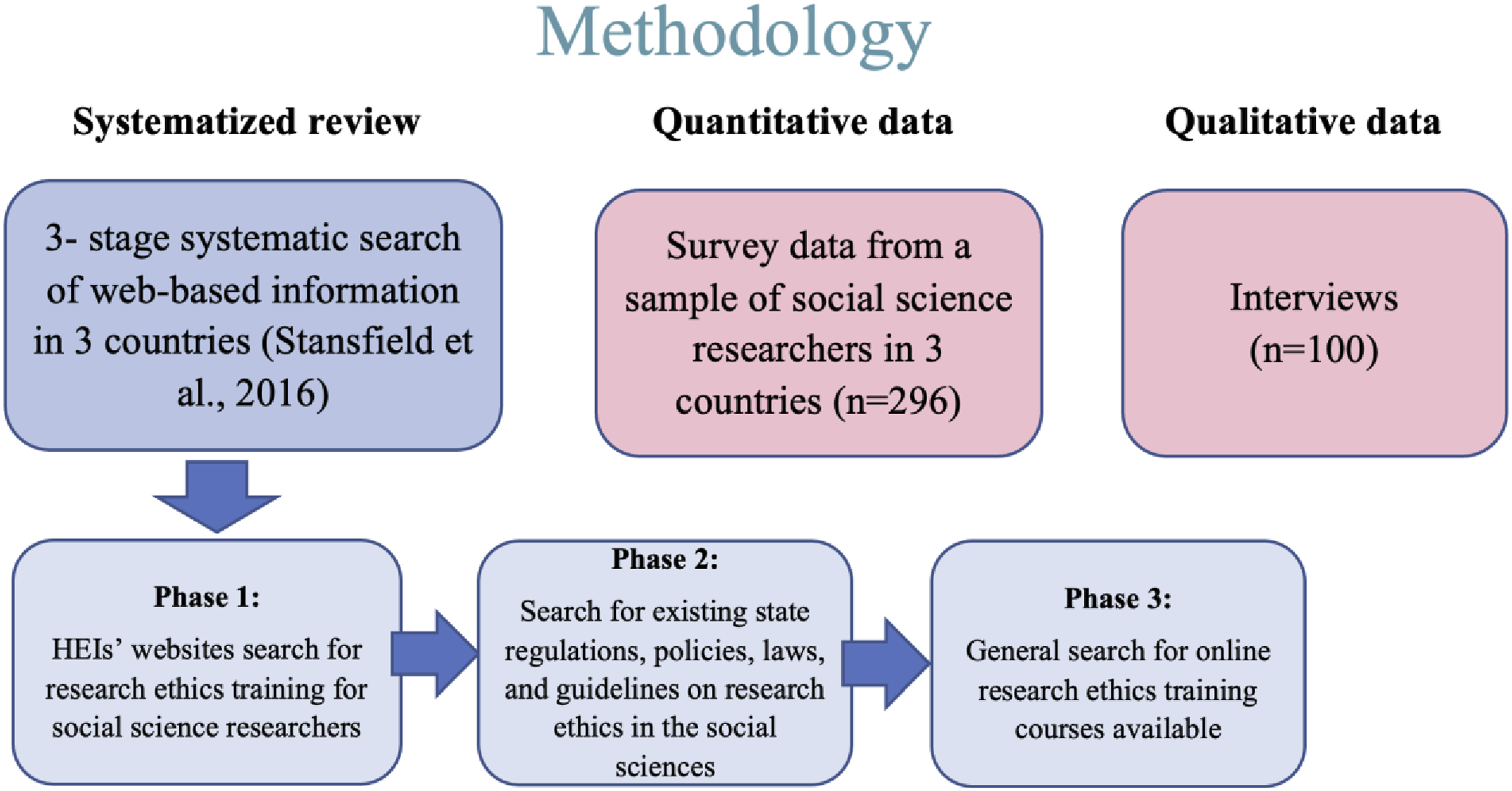
Systematized Review
A systematized review explored the grey literature (e.g. website information, government documents and reports) on the availability and accessibility of research ethics education for social science researchers. The systematized review used a comprehensive search strategy (Grant & Booth, 2009, p. 95; Stansfield et al., 2016, p. 1) with attention given to the ‘transparency, accountability, and reproducibility’ of searching procedures.
Three types of searches were conducted for each country (Kazakhstan, Kyrgyzstan, and Uzbekistan) (9 in total) in the respective national languages (Kazakh, Kyrgyz, or Uzbek), Russian, and English. The first search examined government-level educational websites for state regulations, policies, laws, and guidelines, relevant to research ethics education in social science subjects. This search scrutinized the teaching and research requirements for all HEIs (engaged in the social sciences) within each country. The search examined the availability of research ethics education in official social science curricula (Economics, Political Science, Sociology, Psychology, Philosophy, Education, History, Languages/Philology, Anthropology, and Archaeology) at HEIs. In some cases, no search function existed on government-level websites. Instead, pages within the sites were searched for relevant documents or links.
The second search examined websites of HEIs with social science and humanities faculties/ within each country. The search focused on university-level policy documents and evidence of research ethics education and resources, including news items about special seminars and workshops. The number of reviewed HEIs for each country is given in the findings section. The selected HEIs’ websites were manually searched for the presence of ethics policy documents, research ethics committees, and units with ethics-related courses because the websites had limited search functions.
The final search explored research ethics training available to social science researchers through international online courses (e.g. CITI, TREE, and Fhi360). The assumption was that HEIs or individuals might access online learning courses as an addition to or a replacement for research ethics training within institutions.
Quantitative Primary Data
Data was drawn from a larger cross-sectional online survey for the research project ‘Co-creating culturally relevant Social Science research ethics in Central Asia: Mediating local and global influences’. The data was collected in Kazakhstan, Kyrgyzstan, and Uzbekistan from October 2021 to January 2022. The survey was approved by the Nazarbayev University Institutional Research Ethics Committee (no. 433/07082021).
The online survey instrument used the Knowledge, Attitudes, and Practices framework from other studies of research ethics practices in diverse countries (El-Dessouky et al., 2011; Than et al., 2020; Mallela et al., 2015; Kandeel et al., 2011; Rababa’h et al., 2020). Recruitment emails with an anonymous Qualtrics survey link were distributed to HEI gatekeepers, heads of social science departments, and administrators at HEIs in the three countries. The online survey was available in five languages: Kazakh, Kyrgyz, Uzbek, Russian, and English. Five items from the survey focusing on respondents’ knowledge about research ethics were analysed for this paper. The final sample of respondents included 296 faculty engaged in teaching, research, academic administrators, and other individuals employed at HEIs (Kazakhstan: n = 212; Kyrgyzstan: n = 39; Uzbekistan: n = 45).
Survey Questions Focused On Respondents’ Knowledge About Research Ethics

Qualitative Data Collection and Analysis
One hundred qualitative interviews with social science faculty were conducted in three countries (Kazakhstan = 49, Kyrgyzstan = 21, and Uzbekistan = 30). The research process was approved by the Nazarbayev University Institutional Research Ethics Committee (No. 577/26052022). Interviews were conducted in Kazakh, Russian, and English, according to participant preference. The interviews were recorded, with the permission of participants, transcribed and translated into English. Data was analysed using Nvivo software with the generation of an evolving codebook by eight research assistants. The codes were amalgamated into categories and themes were generated. The codes, categories, and themes emerged in the process of continuous reflective discussion with the country-based teams for 3 months between February to May 2023. While the dataset consisted of rich and in-depth data on the overarching aim of the study, for this paper, we have focussed on only four code sets (formal education, informal education, lack of training, and future recommendations).
Findings
In the following section, the findings from each subset of data will be presented before synthesizing the findings to address the research questions. Where appropriate, data for each country will be considered independently, before synthesizing the results across countries.
Internet Searches
Kazakhstan
Two websites provide legal documents guiding HEI education in Kazakhstan. Adilet.zan.kz, the official source of legal documents in Kazakhstan, includes the State Standards for Higher and Postgraduate Education (The Government of the Republic of Kazakhstan n.d.). Competences for graduates are described, including the requirement to perform ‘according to public, business, cultural, legal, and ethical norms of Kazakhstani society’. Master and Doctoral degree holders are required ‘to collect and interpret information for the formation of judgments, taking into account social, ethical and scientific considerations’. To achieve this outcome, it is reasonable to expect HEIs to provide an educational foundation in research ethics. The Ministry of Science and Higher Education’s website announces information about international publications and research funding. The research funding application contains a section on methodology and ethical issues; however, there is no elaboration of requirements.
The institutional websites search, using the term ethics provided sources categorised as general academic conduct, (institutional policies such as The Rules of Conduct or the Rules of Ethics (pravila etiki) and Ethical Rules for University Staff (pravila etiki sotrudnikov) in the majority of HEIs. The documents outline corporate culture and behavioural standards to strengthen cooperation by building effective engagement and preventing conflicts within the university community. This is an official Ministry-level document that teachers of all educational organizations are required to follow.
While 12 out of 65 reviewed HEIs have Ethics Committee and Research Ethics regulating documents, the websites have scarce references to research ethics education. Public universities have standardised information, but no specific program details or course curriculum is posted. In postgraduate studies, there was no stipulation about research-focused education for students. Only one institution is utilizing an external online platform, as mandatory staff and student ethics training (CITI).
Some private, internationalized universities provide program details, including course descriptions. For example, one institution provided evidence that both undergraduate and postgraduate students are taught Research Methods which includes a research ethics component. One document described ‘the purposes of applied research, program evaluation, policy analysis, and research ethics’ (KIMEP, n.d.) in a social science course. Similarly, a PhD program document noted that students ‘strictly follow academic, pedagogical and leadership ethical principles in research, teaching and managerial practice’ (KIMEP, n.d.).
Some institutions have provided workshops or seminars related primarily to publication ethics such as How to address the problem of predatory publications? A recent conference for emerging scholars in one institution included a research ethics workshop for participants related to effective literature reviewing and publishing, but with no specific mention of human participant research. The conference also included a panel on Ethics, though the topics covered were concerned with student cheating and plagiarism.
Despite research policy goals in Kazakhstan, and some evidence of generic regulation of research institutionally, there is little evidence of institutional policy or curriculum requirements for research ethics education, nor infrastructure to support human participant research ethics processes for faculty or students.
Kyrgyzstan
The State Standards of Higher Professional Education by the Department for Higher Education and Department for Science mandates curriculum in HEIs. This document references ethics within graduate competence statements. Students are expected to develop ‘social-personal and general cultural competencies…as well as social skills associated with the processes of social interaction and cooperation, the ability to work in groups, to accept social and ethical obligations’ (Ministry of Education and Science of Kyrgyz Republic, 2021, p. 3). Postgraduate standards include professional objectives of ‘planning and organizing the activities of expert/professional groups/organizations…in accordance with the needs of society, the individual, taking into account ethical, regulatory and legal norms’ (Ministry of Education and Science of Kyrgyz Republic, 2021). There is no mention of research ethics requirements for research students.
A systematized review was conducted for 10 of the 40 private and 17 of the 33 public universities out of the 73 HEIs in Kyrgyzstan offering social science programs. The websites of four of the public institutions were not functional. In one institution, information was related to publication ethics, compulsory general ethics, and philosophy and morality courses. Two institutions offered seminars on professional ethics, such as Ethics of Pedagogy, Business Ethics and Lawyer Ethics. Similarly, courses such as Ethics and Aesthetics (Philosophy), Journalistic Ethics, Professional Ethics at the Faculty of Psychology, and Political Ethics were found on another website. In two other institutions, ethics related to anti-plagiarism and academic integrity were identified.
The review of 10 private universities’ websites identified research ethics education options available for staff and students. At two institutions, courses involved a research ethics component, most frequently within research methodology courses. Details were not provided to clarify if these courses included human participant research ethics. Two universities had historically advertised courses that are not continuing components of programs. The private universities provide generic courses in ethics as a field of philosophy or ethics related to professional fields, for instance, Pedagogy and Communication/Ethics and Philosophy; Philosophy, Professional Ethics of Lawyer, and Ethics of Business Communication. Philosophy seems to be a compulsory module in all majors; however, additional syllabus information was not available.
Only one institution in Kyrgyzstan was identified as having an IRB for ‘overseeing the ethics in research and reviewing the research proposals for compliance with the ethics in human subjects’ (AUCA, n.d.). The IRB was responsible for evaluating ‘compliance with ethical standards regarding issues such as informed consent, confidentiality, and assessment of risks to the participants’ (AUCA, n.d.). This institution requires all internal and external researchers, students, and collaborators to complete IRB training followed by an IRB Exam based on the IRB Manual available on their website. The Manual equips researchers with basic knowledge of compliance and research ethics including some case scenarios and possible solutions.
The search results indicate that public universities in Kyrgyzstan do not offer specific education on research ethics to students or staff. Some generic philosophy and professional ethics courses are available. Unless research ethics education is mandated in the Ministry of Education and Science State Standards, public universities are unlikely to implement education for students on research ethics. In contrast, private HEIs, especially those with international connections, provide some offerings in social science research methods.
Uzbekistan
Very scarce information on social science research ethics education was available on government-level educational and other websites in Uzbekistan. When the first round of searches was conducted in 2021, there were 26 institutions with social sciences and humanities departments, seven foreign branch campuses and four specialist HEIs (e.g. Tax Academy). No references were found to research ethics related to the social sciences. Six of the 26 HEI websites had ethical guidelines related to publication procedures, focused on the prevention of publication malpractice and plagiarism. None of the HEIs referenced education related to human participant research.
One internationalised university advertised ‘Weekly research training sessions [covering the] philosophy of research, design, posing questions, quantitative and qualitative data collection and analysis methods, and drawing conclusions and publishing results, including both theoretical and practical sessions’ (WUIT, n.d.). References to ethics guidelines or education were not identified. Although it is known that two more international universities have IRBs, no information is provided about them on their websites. One further institution regulates research procedures with approval from the main overseas campus.
Summary of Internet Search Findings
The methodology of website searches provided less rich data than anticipated. The functionality of websites in all three countries was limited with approximately a quarter of the websites not functioning effectively. Nevertheless, the findings generated from multilingual searches provide a comprehensive overview of social science research ethics training available and accessible in each country (Kazakhstan, Kyrgyzstan, and Uzbekistan). In the absence of other forms of publicly available information, this strategy provides one indicator that the concept of ethics is commonly identified in three ways: philosophical study of cultural norms and values, professional ethics and publication ethics. References to ethics in these areas were more prevalent than references to research ethics. The term ‘ethical norms’ is used in relation to graduate attributes and professional ethics. The term human subject or human participant research ethics was not part of the website discourses.
Specific educational offerings related to social science research ethics are rare and references related to human participant research ethics are even rarer. References occurred in websites of private higher education providers, affiliated with internationalised education. The references to research ethics were linked to research methodology courses. Only a very small proportion of HEIs referenced a process or structure for the evaluation of research ethics. The only reference to international online courses was to CITI training in Kazakhstan. It is noteworthy that no similar commercial online training is available in any local language.
Quantitative Findings
Descriptive Statistics on Sample Population by Country and in Total (n = 296)
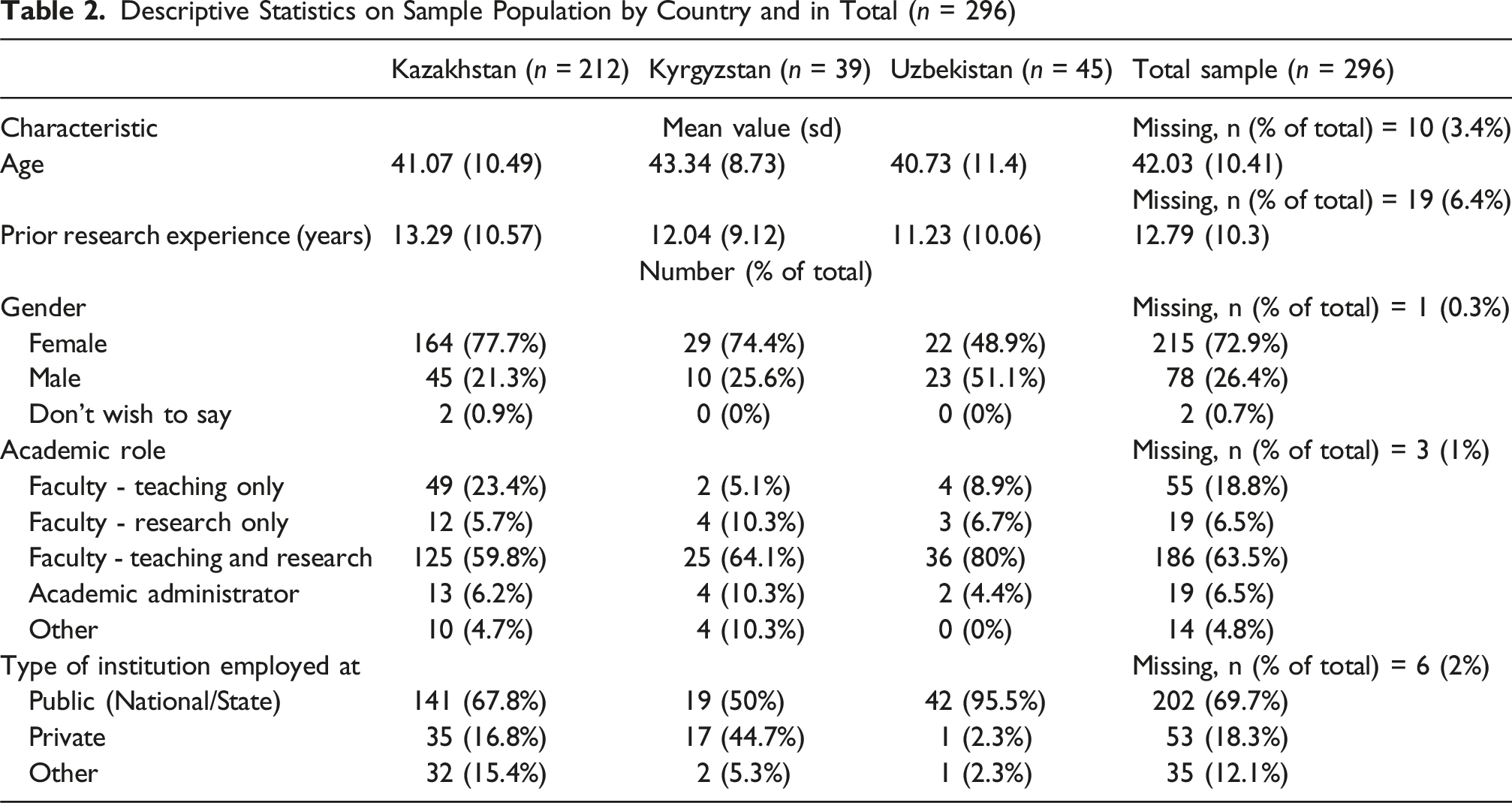
Despite the website search findings, indicating limited research ethics education options, more than half of respondents (64.1%, n = 148) reported research ethics training was available at their HEIs (n = 296, NA = 65). The remaining 35.9% of researchers (n = 83) reported that no research ethics course or training was provided at their institutions. The data revealed that 56.9% of social science researchers (n = 152) (n = 296, NA = 29) have taken a course, workshop, or training on research ethics, while 43.1% of researchers (n = 115) have not obtained any formal or informal research ethics education.
Despite the lack of educational experience, 76.5% of participants (n = 176 out of 230, NA = 66) were familiar with ethical principles that govern research with human participants (e.g. beneficence, autonomy), while 23.5% (n = 54) of researchers were not. Similarly, 67.1% of respondents (n = 159 out of 237, NA = 59) were familiar with research ethics practices used in human participant research (e.g. informed consent, confidentiality procedures), while the remaining 32.9% (n = 78) respondents were not.
Form and Provider of Research Ethics Training Attended by Central Asian Researchers in our Sample (n = 95, NA = 201)
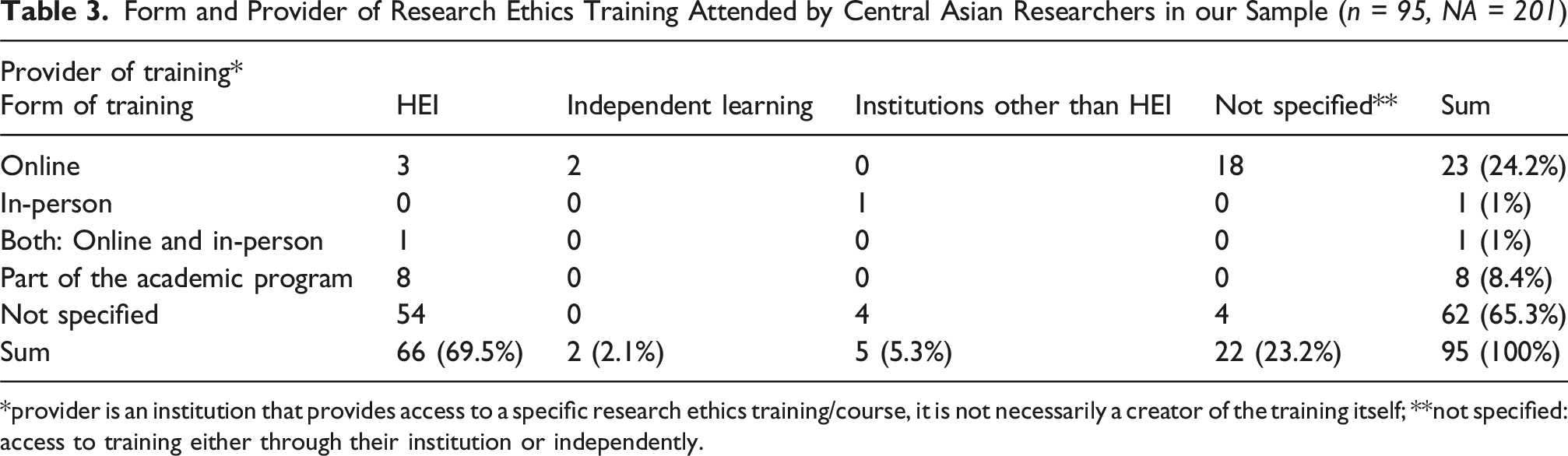
*provider is an institution that provides access to a specific research ethics training/course, it is not necessarily a creator of the training itself; **not specified: access to training either through their institution or independently.
Research ethics courses attended by local researchers were generally provided by: higher education institutions (HEIs, n = 66, 69.5%) and institutions other than HEIs (n = 5, 5.3%). In this case, a provider of research ethics training is defined as an institution or organization that grants access to specific research ethics courses, which are not necessarily developed by an institution or organization itself. For instance, Nazarbayev University would be classified as the provider of research ethics training if a researcher attended the CITI online research ethics course with access provided by Nazarbayev University. A few researchers (n = 2, 2.1%) attended research ethics courses independently from any institutions or organizations. Reportedly, they took their research ethics courses on the Internet through educational platforms such as Coursera. Some respondents (n = 22, 23.2%) did not specify whether their access to research ethics training was provided by their higher education institution or any other organization.
Qualitative Findings
The findings from the analysis of four Nvivo codes (formal education, informal education, lack of training, and future recommendations) from interviews with 100 participants provided additional insight into the quantitative findings. Six key findings will be presented here: the term research ethics is conceptualised in diverse ways, encompassing issues of academic integrity, professional integrity and values; research ethics education most commonly occurs within postgraduate programs; institutions offering an internationalised education or participants educated in international institutions are more likely to have received research ethics education; faculty are not systematically provided with research ethics education opportunities; knowledge of research ethics has been developed through informal mentorship and self-study opportunities and participants support increased access to research ethics education. Quotations from participants are presented by county.
The concept of research ethics is understood to be synonymous with issues of academic and professional integrity and misconduct. Participants, predominantly from Kazakhstan, substituted academic integrity for research ethics. They constantly push me that it is necessary to hone the research skills of students so that they understand that if I learn not just to correctly state my thought, but to reflect it correctly, observing the mandatory requirements that are generally indicated in the works, then this is the key to success. (KZ) I'm the chairman of the ethics committee at the university. Very often we have to see our students in not very pretty situations, when they order work, when they pay for the work done by another person. It just bothers me, I'm just going to say - ‘Well, how can a lawyer go like that?’ (KZ)
Other participants indicated that concepts more specific to human participant research ethics were encapsulated with training focusing on academic integrity and professional integrity. We had a seminar on academic integrity where we were told that the researcher must not violate the rights of his research participants. They must first fully inform them. … In order for them to know fully, they must agree to participate in order to be informed. To keep these results in secret. As well as data from our participants. Do not disclose personal data. (KZ) I remember, of course, that ethics taught me about plagiarism and maintaining trust with people. (KZ)
This suggests that there is ambiguity and flexibility with the terminology. This could be associated with challenges of cross-language translation, the focus on academic integrity within higher education publications in recent years, an indication of less refined understandings of the concept of ethics within social science research methodologies or as a result of more limited opportunities for education in the area of research ethics.
Ethics education for students is mainly included in methodology courses taken in post-graduate programs. This occurred more frequently for participants who studied internationally. I got acquainted with the basic ethical principles while studying at a university abroad. (KZ) I studied in Edinburg and I studied social and ethical standards, it is completely different there. (KG) There are no textbooks, no training, no training for doctoral students, undergraduates, and teachers on the ethics of interviewing. I know this because I had the opportunity to learn this in the USA, but I am afraid that this is not the case in Uzbekistan. (UZ)
The provision of systematic training for faculty was not evident. Many indicated that they had not received any education on research ethics. No, I didn't. Only in the master's program at the academy, when writing a dissertation, I learned some ethical concepts from my professors. But I think it is better to take such courses as well. Perhaps they will provide new information about ethics. (KZ) Very often we hold seminars and training, but we do not cover the issue of ethics, there is very little on this topic. I don't even remember any. (KZ) We do not undergo ethical expertise, this is the first time I have encountered this. I mean, I don't know, I didn't, I haven't come across this, nobody asked me. No one demanded it from me. (UZ)
Those who had taken research ethics education occurred mainly through short online courses, provided by internationalised universities or overseas agencies. I didn’t even take the informed consent from them, because then I didn’t really have an understanding of ethics, since we weren’t trained. I was just comparing learning patterns. (KZ) I went through a two-year training from the big project of the Soros Foundation … how to conduct these oral histories? And right there, it was there at these seminars that it was necessary to observe this confidentiality policy. (KG) We have organized a research ethics webinar conducted by London colleagues. (UZ)
The participants identified a range of informal learning approaches, from learning through their professional reading, and through the mentorship of supervisors and other peers. Training? No, but my senior research supervisor helped me a lot. Here's, let's say, she acquainted me with a scientific research paper and get acquainted with scientific criticism. And my senior research supervisor. (KZ) Uh, no. I read basically what is published, yeah, in a prestigious journal…in peer-reviewed Scopus journals… I try to work according to what they write, as they demand…but well, yes, self-learning. (KG) So, I will depend on my supervisor's expertise. Until today, we haven't had any information about research ethics. (KG)
The participants supported the need for increased research ethics education for students, commencing within undergraduate programs. But I think it's important to provide knowledge at a mandatory level… And if it was in the curriculum, it would be good. (KZ) The first thing to do is to systematize research training…starting from the Bachelor's base. (KZ) Novice researchers in Uzbekistan should be explained and taught about research ethics in order to reach international standards, about guidelines and informed consent. (UZ)
Participants also noted some recent examples of developments. Yes, of course, because there are different innovations, new rules, and now it [ethics] is mandatory to work with children with such disabilities. (KZ) Since this academic year, the ethics of scientific research has been introduced at our university for 4-year students. Yes, that is a new course …And this course on research ethics is being taught along with the research methods course. (UZ)
The qualitative findings indicated that research ethics was more widely available in Kazakhstan and developments were occurring in Uzbekistan, however, no systematic approach was evident in any of the countries.
Summary of Findings
The findings of the internet search indicate that the concept of human participant research ethics is not commonly used discourse in higher education institutions in Kazakhstan, Kyrgyzstan, or Uzbekistan. It occurs only in internationalised, usually private universities. Searches for the term ethics most frequently resulted in references to academic integrity and professional ethics. The search was unable to identify any systematic, sustained or embedded approaches to the provision of human participant research ethics education. Nationally mandated curriculum documents do not contain requirements for research ethics education; however, some education may be embedded in research methodology courses. Course-level documentation is not available on university websites.
The quantitative research results indicated that more than half of the participants had received some form of research ethics education at their institution. Three-quarters of the participants identified that they were familiar with research ethics principles. However, participants did not provide details of the courses that were offered by their institutions or that they had attended. The qualitative data indicated that research ethics education most commonly occurred within postgraduate programs, accessed from international or internationalised HEIs or through online training, often provided by international organisations.
Discussion
Though CA countries share similar challenges of educational reforms after independence in 1991, they demonstrated different development trajectories depending on their economic stability (Tabaeva et al., 2021). Unlike Kazakhstan and Kyrgyzstan, the HE system of Uzbekistan remained state-controlled (Ruziev & Rustamov, 2016; Usmonov, 2020). Internationalization of HE occurred only recently, with a shift from a Soviet-style centralized model to a more market-oriented economy (Yun, 2019).
The higher education system in the three CA countries was founded and evolved in the Soviet period when all HEIs were established as public entities, with a strong focus on teaching (Chankselliani et al., 2022). During the Soviet period, and in the early days of independence, research was conducted in Research Institutions and Academies, where positivist research paradigms dominated and priority was given to hard sciences (Lovakov et al., 2022). Consequently, HEIs are only beginning to develop as research-focused institutions, providing research-based education.
Because of the teaching workload of HEI faculty, relatively few faculty have research-based qualifications. For example, in Kazakhstan, the number of faculty with research degrees is 17,313 out of 36,378, in Kyrgyzstan this number is 5,161 out of 15,419 for 2021–2022. There is no data available for Uzbekistan. With the development of government strategic priorities to internationalise higher education, actions have been taken to introduce internationalised research practices through scholarships to complete postgraduate studies internationally, the use of visiting international scholars and the development of branch campuses or internationally affiliated universities (see e.g. Government of the Republic of Kazakhstan, 2023).
The number of students enrolled in research-focused degrees is low (Kazakhstan – 6,200 doctoral students out of 5,75,500 general student body, Kyrgyzstan – 7,128 Master’s students with no data on doctoral students out of 2,19,030 student body, Uzbekistan – about 4,500 doctoral students out of 8,08,400 students) and the dominant current practice is for ethical review to occur at the time of examination of research theses – not before commencement of a research process. This procedure is for checking plagiarism and methodology. Internationally practised ethical approval of research by IRBs was not a Soviet research tradition. The Soviet research legacy has continued since Independence (Jonbekova, 2020). Research ethics regulation and review processes are only developed in internationalised, private universities. The study suggests that most HEIs in CA countries do not have research ethics review and approval procedures in place.
The inconsistent use of terminology emerged as a challenge during this study. Because the study was exploratory, the researchers wanted to avoid using narrow Westernised conceptions of research ethics (in terms of Principlism theory and processes) to dominate. The study sought to understand the contextually relevant ways in which the concept of research ethics was conceptualised. Diverse understandings of the term research ethics emerged. This created challenges, particularly with the analysis of the quantitative data. Other limitations of the methodology will be considered below.
In the first 2 years of undergraduate studies in Uzbekistan, students are taught a mandated course in Ethics and Aesthetics covering historical and philosophical theoretical foundations in Ethics. Additionally, courses such as Philosophy of Ethics and Aesthetics, Ethics and Values, Applied Ethics and Aesthetics, Image of Civil Servant Ethics, and Analytical Aesthetics and Etiquette are taught to undergraduate students, however, the principles of research ethics remain excluded. This is consistent with the Soviet heritage view of ethics as a field of philosophy, which has not developed into applied areas such as research. In Kazakhstan, a module called History and Philosophy of Research is obligatory for all first-year Master’s students, however, no curriculum was available online to enable identification of research ethics modules.
A comparative analysis of the data suggests emerging developments in research ethics education more in Kazakhstan and Kyrgyzstan than in Uzbekistan, through internationalised predominantly private institutions. Several Kazakh flagship HEIs have started adopting institutional ethical regulations. Two institutions in Kyrgyzstan provide mandatory courses for both undergraduate and postgraduate students on Research Methodology which covers Research Ethics. This has been confirmed in qualitative interviews by participants from these institutions. Similarly, three institutions in Kazakhstan and one university in Uzbekistan cover research ethics as one of the topics within their Research Methodology modules.
What is similar in the three countries is the public and private HEI divide in the way research ethics is regarded. This is associated with staff qualifications. Private institutions have better opportunities to recruit academic and administrative staff with Western education profiles who promote research ethics in their institutions. The Bolashak Presidential Scholarship in Kazakhstan is a significant source of human capital enrichment. Kazakhstan has been state-funding an education abroad program that allows top-performing students to pursue academic endeavours in top international universities since 1993 (CIP, n.d.). Returning Bolashak scholars are expected to transfer knowledge and skills to improve systems and practices, including the advancement of research development. Small communities of Western-educated researchers at HEIs are contributing to ethical research within local associations such as the Kazakhstan PhD Association in the UK and the Young Researchers Alliance. The members of these communities are active on platforms promoting Western values and culture of doing research.
There seems to be more evidence of approaches toward responsible conduct of research in private universities. Private institutions, especially those with a higher international profile offer some systematized training for their students. For all three countries, where higher education is centrally governed, research ethics education is absent within their curriculum. For example, in Kazakhstan, institutional autonomy has been promoted only since 2018, allowing the HEIs to design 30% of undergraduate and 70% of postgraduate degrees. Those institutions in each country that adhere to ethical principles and internationally accepted standards in conducting human participant research are either managed by Western-educated leaders or professional staff who have an international education.
The survey data also suggest that international organizations like USAID or UNESCO contribute to the training of local academic and research staff. This data was confirmed during qualitative interviews where some participants indicated that the source of their knowledge on research ethics came from the training provided by such international organizations.
The strategic goals identified by all three countries may be enabled with the provision of a systematic approach to research ethics education for staff and students, within undergraduate and graduate programs and through professional development for academics. There is a need for training on the principles and guidelines of research ethics for the social sciences, that align with generic international principles, but that are tailored to the CA context, and are supported by resources available in local languages. An online trilingual research ethics course (Kazakh, Russian, and English) is currently in development to address some of the needs identified by this research team. This ‘add-on, online’ resource needs to be supported within an in-curriculum development approach as recommended by Todd et al. (2017) and Eaton (2020).
Conclusion
As we argue elsewhere (Gafu et al., 2024), neglecting policies and practices in social science research ethics exposes participants to potential harm in two ways. Firstly, researchers may unintentionally adopt methods that endanger participants, as there are often no accountability mechanisms, such as peer review, to identify and address risks. Secondly, applying research protocols designed for one cultural context to another can result in harm due to cultural mismatches. Thus, there is a need for a balanced approach that protects research subjects’ rights while acknowledging the unique methodologies of social sciences (Israel & Hay, 2006).
Despite the espoused state research policies in the three countries, the systematized review of publicly available documents in the national and institutional landscapes demonstrated that there is limited regulation of social science research ethics. Unlike Western countries, where social science research ethics has become increasingly prominent with well-established ethical standards, independent ethics committees (IRBs), and legal frameworks ensuring accountability and adherence to principles like autonomy, justice, and beneficence (Israel & Hay, 2006), Central Asia is gradually developing ethical frameworks influenced by international standards. However, the region faces challenges such as limited training, political constraints, the absence of national and institutional research ethics policies, and minimal or nominal references to research ethics.
In this study, the review of policies, HEIs websites, and survey results and interview data have shown that the provision of research ethics education is not systematised as a compulsory course for students and staff, except for some internationalised HEIs. For research integrity, quality and cultural advancement, training and educating researchers in responsible conduct of research is recommended to be prioritised in all three countries. Most importantly, this will provide additional protections to research participants, but additionally, the inclusion of research ethics education will empower Central Asian researchers to be competitive in broader international contexts.
Footnotes

Funding
Nazarbayev University (021220CRP0922).
Declaration of Conflicting Interests
The author(s) declared no potential conflicts of interest with respect to the research, authorship, and/or publication of this article.