



Abstract
Russian Federation, being de jure and de facto linguistically diverse multilingual country, can be described, at the same time, as being under a strong influence of monolingual language ideology, with Russian totally domineering in most public spheres. Minority languages and especially languages of migrants lack official recognition and support, and their speakers often have to face prejudices and negative stereotypes. The paper aims at revealing language ideology prevailing in modern Russia through analysis of attitudes to languages other than Russian as they are expressed in discourse about language, i.e. metadiscourse. When approaching it, it is important to distinguish state discourse (manifestation of official language policy) and public discourse (collective attitudes towards certain sublanguages and their users expressed more or less directly). The analysis shows that over the past two decades, official language ideology in Russia has shifted from guaranteeing linguistic equality and diversity to having an emphasis on unity and purity and giving support to the Russian language. This reorientation is realized through status planning, corpus planning, and acquisition planning. At the level of public discourse, analysis of collective attitudes towards the languages used by non-native speakers demonstrates that a significant part of the Russian-speaking population express negative attitudes towards non-native speakers and their poor Russian language skills, which once again confirms that there is dominant monolingualism and purism in public discourse. However, language practices in Russia are gradually becoming more diverse which can become a challenge for monolingualism and purism in future.
Introduction
Language attitudes and linguistic stereotypes play an important role in humans’ everyday verbal interactions: speakers tend to evaluate their interlocutors, among other factors, on the basis of their perceived linguistic abilities and the social meanings associated with the particular language variants they use. Those attitudes contribute to language ideology prevailing in a certain society and its being reflected in official declarations and regulations regarding language use 1 .
According to popular definitions, language attitudes are ‘the feelings people have about their own language or the languages of others’ (Crystal, 1997, p. 215), as well as the ‘assessments that speakers make about the relative values of a particular language’ (Myers-Scotton, 2006, p. 109). The term itself was first introduced to linguistic studies by Wallace Lambert (1967), whose focus was on social psychology. He distinguished the following components of attitudes in general: cognitive (knowledge), affective (evaluations and emotional reactions), and conative (readiness for action). Being, therefore, a part of emotionally loaded socio-cultural knowledge, language attitudes affect people’s behaviors and the ways in which they treat each other, which become especially important when they are faced with complex situations involving representatives of different ethnic, social, and linguistic groups, e.g., in multilingual settings (Khilkhanova, 2020a).
Nowadays, globalization, migration, and the resulting growth in ethnic and cultural diversity, sometimes to the level of superdiversity (Blommaert, 2013) provide serious challenges for the more traditional and conservative approaches to linguistic norms. The Russian Federation, being a de jure and de facto linguistically diverse multilingual country, 1 presents, in this sense, an interesting case for analysis. Despite its evident historical multilingualism, which has even increased recently as a result of labor migration, Russia can be described as being under the strong influence of a monolingual language ideology, with Russian domineering most public spheres in the country (Vanhala-Aniszewski, 2010; Gorham, 2014). Minority languages, and especially the languages of migrants (e.g., from Central Asian post-socialist countries), lack official recognition and support, and their speakers, thus, often face prejudice and negative stereotypes (Baranova & Fedorova, 2020).
Officially, 2 Russian authorities have declared the equality of all languages of ethnic groups that are native to the country, and some of them, due to the country’s federal design and the status of regional state languages, are used in education and in the media. However, especially recently, ethnic and linguistic diversity have been perceived as a potential threat to the unity of the nation, and several changes in the legislation confirm the existence of an actual asymmetry of power between Russian and other languages. The current “top-down” approach to the management of linguistic diversity aims at suppressing multilingualism and promoting Russian (Khilkhanova, 2020b; Zamyatin, 2015). Moreover, language purism, also typical for Russian language ideology, treats any non-standard variants as corrupt and extremely unwelcome (Gorham, 2006; 2014). All of these factors result in negative attitudes towards speakers who do not master what is regarded as ‘correct Russian,’ i.e., ethnic minorities and migrants.
Most studies on language policy in Russia, with rare exceptions (see, e.g., Arutyunova, 2018; Khilkhanova, 2020a; Pankova, 2021) deal only with legislation and practical measures of language maintenance, without focusing on the language attitudes of speakers and discourses expressing and constructing those attitudes. Meanwhile, according to B. Spolsky (2004, 2007), beliefs about language(s) contribute significantly to language policy and should, thus, be considered when studying it, alongside other related practices, such as everyday language use and language management, meaning any conscious efforts to keep or change those practices. Those beliefs or attitudes, organized into ideologies, may stay hidden behind the scenes, but they are crucial to take into account if we want to understand how and why certain measures are affecting people’s lives.
The purpose of this article, therefore, is to study the language ideology prevailing in modern Russia (over the period of the last 12–13 years) through the analysis of attitudes towards languages other than Russian—local ethnic languages and the languages of migrants—as they are expressed in discourses about language, i.e., in metalinguistic discourse. When approaching this topic, it is important to distinguish between state discourse—a manifestation of official language policy through laws, decrees, and public speeches of state representatives and public discourse—collective attitudes towards certain sublanguages and their users, which are expressed more or less directly by Russian speakers throughout the course of their everyday communication, including online communication. This paper first discusses the current official language policy in Russia and then explores collective attitudes towards the languages of local minorities and recent migrants on the basis of several social media studies. We try to summarize our own findings, as well as those of other researchers to be able to present a broader picture and explain certain trends that can be witnessed in modern Russia’s policy towards languages other than Russian.
Language Ideologies and the Politics of Difference
Language ideologies are more or less consistent sets of beliefs about languages and the ways in which they should be used (Irvine & Gal, 2000; Silverstein, 1979; Woolard, 1994). Particular beliefs and attitudes can be very diverse; however, there are certain general trends and tendencies, and the primary distinction should be made between essentialist (purist, normative, and prescriptive) and relativist (nominalist, diversity-oriented, liberal, and descriptive) approaches (Gasparov, 2004). According to the former, language is a core element of national identity or mentality; it is naturally, even organically, connected with ethnicity and is usually perceived through primordial lenses. Therefore, this ‘perfect language’ should be guarded against and protected from corruption and foreign influences. Purists see standard languages as objectively existing realities, and any non-standard variants are, thus, regarded as unwelcome deviations, therein ignoring the fact that variation is inherent in language and that the existence of different territorial and social dialects precedes language codification (Milroy, 2001; Thomas, 1991). The opposing, relativist approach to language is based on constructivist paradigm; it focuses on variation and change rather than stable norms, and regards different language variants as equal (although sometimes socially loaded and, consequently, affected by speakers’ socially determined attitudes towards them).
Another important ideological division can be seen between monolingualism and multilingualism. Purism as an ideology is quite often combined with monolingualism, with the same logic of one preferred standard being applied to linguistic diversity. The dominance of monolingualism in Europe is usually attributed to the development of nationalism and the formation of nation-states (Bonfiglio, 2010). Monolingualism absolutizes the concept of a native language—it treats speaking one language as the norm and bilingualism or multilingualism as rare exceptions; moreover, in this paradigm, languages are seen as competing with each other, and linguistic diversity is perceived as a potential threat to national unity (May, 2014). According to J. Irvine (2004, p. 99), where ‘standardized language is taken as the sign of what the nation holds in common and has inherited from its past, language’s variability must seem to signal a potentially perilous mutability.’
Usually, dominant language ideology takes the interests of more powerful groups, such as the ethnic and linguistic majority and/or the socio-economic elite, into account and ignores the perspectives of underprivileged groups (e.g., ethnic minorities, lower classes, illiterate people, migrants, etc.). In this sense, monolingualism and standard language ideology provide ‘a rationale for language-based discrimination against marginalized social group[s]’ (Milroy, 2000, p. 57). The effects of such discrimination can be witnessed in different social practices, including the underrepresentation of underprivileged groups in higher social positions, as well as in certain linguistic practices, e.g., in the lack of educational programs targeting minorities and the underrepresentation of some widely spoken languages in official use and in linguistic landscapes (Baranova & Fedorova, 2020). At the same time, language ideology is reflected in public discourse on language-related issues, i.e., metalinguistic discourse. It is created by all language policy actors, which, according to the modern approach (Spolsky, 2004), are not limited to state authorities but also include social institutions, the mass media, the business sector, public figures, and even all language users themselves. Metalinguistic discourse can be divided into two sub-discourses: state discourse (laws, state documents, and speeches by politicians and state officials) and public discourse produced by citizens in their everyday communication, including via social media (Ryazanova-Clark, 2016). We will follow the same division in our discussion of the metalinguistic discourse in Russia, with a particular focus on the attitudes towards languages other than Russian.
Correlations between language attitudes, language ideology, and state language policy, according to B. Spolsky (2004, p. 60).
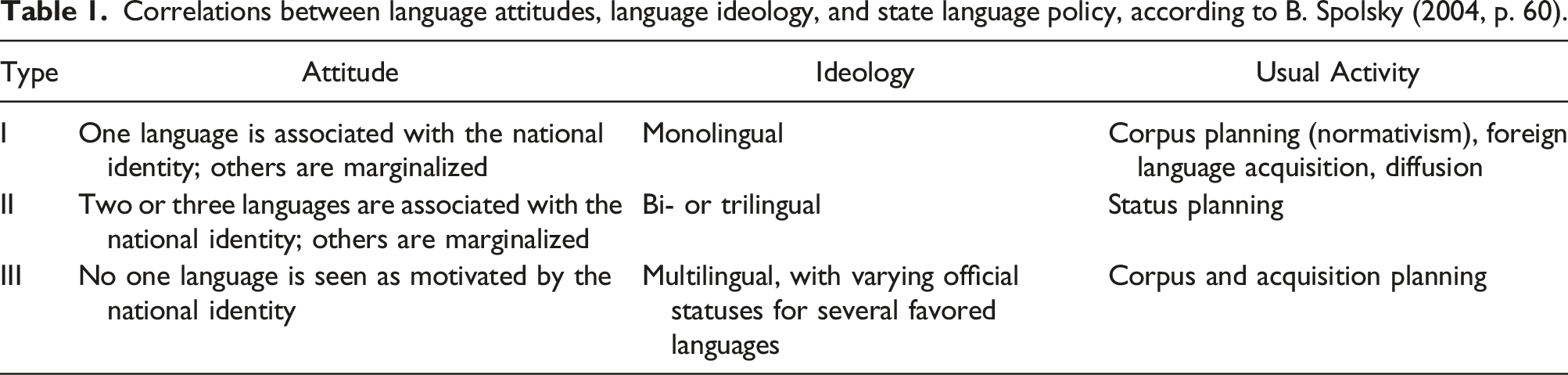
Obviously, not all real cases can be classified into such clear-cut types: Russian in Kazakhstan or Belarus, for example, is used officially despite the fact it can hardly be defined as a symbol of national identity. Russia, however, fits very well into this classification. It belongs to the first type: it declares only one language—Russian—as the state language and a staple of its national identity. Consequently, other languages, attitudes towards which are the focus of this paper, are not recognized as symbolically valuable for the nation. Naturally, as is often the case with officially monolingual countries, ‘the constitutional proclamation of monolingualism disguises much more complex practices and ideology’ (Spolsky, 2004, p. 61). While there are provisions for some languages in Russia’s state laws, there is a movement towards even more strict monolingualism in the state discourse, as we will show in the next section.
Public discourse is inevitably closely connected with state discourse, and this connection is by no means unidirectional. On the one hand, state policies and statements create a background against which relevant issues are discussed; moreover, the state can aim to influence such discussions and promote its own discourse via propaganda. On the other hand, public opinions, especially those expressed via mass media, influencers on social media, and experts in the field who make statements based on research (e.g., sociological polls), can challenge state policies and discourse. However, power imbalances between state and public discourses can vary significantly, and in democratic states, society is much more influential than in authoritarian ones, so changes in public discourse do not necessarily go in the same direction as the state discourse. Being more heterogeneous due to the unlimited number of actors involved, public discourse can reveal a more detailed picture.
When addressing attitudes in public discourse, it is also important to distinguish between two principal groups of actors: insiders and outsiders. Following J. Fishman’s (1999) approach, E. Khilkhanova (2020a) in her analysis of attitudes towards indigenous languages in Russia, shows the differences between the positions of outsiders, people not identifying themselves with certain ethnic minorities but belonging to Russian speaking majority, and insiders, people belonging to ethnic minority groups. While the latter are typically loyal to indigenous languages and hope for some language support measures by the state, the former can be neutral or even hostile towards them, seeing them as a potential threat to the unity of the nation and, thus, the monolingual ideology of the Russian state.
In the following, we will analyze state and public discourses separately regarding other languages in Russia to reveal changes and trends therein, as well as the differences between them. Certainly, a full political analysis of the Russian state is well beyond the scope of this article and the expertise of its authors. However, as we will try to show, authoritarian tendencies can affect any aspect of societal life and state policies, and it is impossible to ignore the influences they may have on the ways people treat other languages and their speakers as language policy, ‘reflecting the ideological views and orientations of a society, government, institutions, or individuals,’ ‘represents the whole political, social, and economic environment’ (O’Rourke & Hogan-Brun, 2012, p. 3).
Language Attitudes in Russian State Discourse
In the history of Russia, there have always been periods of more rigid and conservative, as well as more open and inclusive approaches to language, a fact noted by Yuri Tynyanov in his book ‘Archaists and Innovators’ (1929). The most radical changes occurred after the October revolution when, in the 1920s, official language policy favored multilingualism, and language planning for dozens of ingenious languages was initiated. This short but intensive period was replaced by another conservative turn in the late 1930s which gave start to the strongest ever wave of Russification (Kreindler, 1984). Modern metalinguistic discourse demonstrates yet another turn in language ideology. During Perestroika and immediately after the collapse of the USSR, state control over language was weakened. Public language use in the media, literature, official meetings, and speeches followed the same trend of ‘conversationalization’ (Fairclough, 1995) as in the West. Elements of colloquial speech styles, regional and social dialects, and numerous foreign words made Russian more diverse and less oriented towards strict normativism. M. Gorham (2006) views such trends as attempts to provide a wider range of people with access to public channels of communication. Simultaneously, the decentralization of power that occurred in the 1990s provided more opportunities for other languages in various regions of Russia, especially in national republics, resulting in language activism, the introduction or expansion of education in those languages, and their increased overall presence in the public sphere (Zamyatin, 2015).
However, the more democratic and diverse public language use became in Russia, the louder the voices of critics of such diversification sounded, who saw it as a corruption of the Russian language and a threat to Russian culture as a whole. At the same time, Russian was gradually becoming more and more prominent as a symbol of national identity that was to be protected and guarded from any unwelcome influences. According to many studies (e.g., Chevalier, 2018; Gorham, 2014; Prina, 2016), starting from Vladimir Putin’s first presidential term (1999–2004), official metalinguistic rhetoric moves from declaring principles of linguistic diversity to the focus on the state-building role of the Russian language (and later, in the 2020 amendments to the Constitution, also that of Russians as the biggest and most important nation-building ethnic group).
This reverse movement towards monolingualism and normativism becomes even more evident when we consider changes in the state discourse concerning all three aspects of language policy: status planning, corpus planning, and acquisition planning.
Status Planning
In the 1990s, both ideology and practice regarding the official use of minority languages were quite liberal. Ethnic languages were seen by their speakers as representative of their core values and fundamental to their respective cultures (Artunova, 2018). Moreover, this approach was shared by many hereditary speakers whose parents or grandparents had shifted to primarily speaking Russian but who then started to support indigenous language revival. The state had to respect those attitudes as part of the legacy of Soviet-time Russification. The declaration of this new policy even preceded the birth of the new state, the Russian Federation: the ‘Law on the Languages of the Peoples of the RSFSR’ was adopted in October 1991. It admitted regional official multilingualism by declaring Russian as a state language (Article 3.1) and guaranteeing the national republics the right to establish their own state languages in addition to Russian (Article 3.2). Moreover, Articles 11–14 stated that under certain conditions, languages other than Russian could be used in federal public communication, although there were no precedents of such uses in practice (Zamyatin, 2015).
In 1996, Russia signed The Framework Convention for the Protection of National Minorities, a multilateral treaty of the Council of Europe aimed at protecting the rights of minorities, including non-autochthonous minorities, i.e., migrants, which came into effect in 1998, on the highest point of the liberation of the state’s metalinguistic discourse. However, in the same year, the amendments to the 1991 law excluded provisions for other languages on the federal level. In 2005, a new law was passed, entitled ‘On the State Language of the Russian Federation,’ which drastically changed the official rhetoric. Initially, it was titled ‘On the Russian Language,’ but after several readings in the State Duma, the title was made more legally appropriate, but the content stayed more or less the same, with the focus being on Russian as a sole national language that had to be protected and promoted (Krongauz, 2016). Besides, the federal targeted program ‘The Russian Language’ was initiated and enacted during 2002–2020. It aimed at promoting and maintaining Russian and distributed significant budget funds for various related projects.
Corpus Planning
Official declarations and changes in legal terms, therefore, were motivated by growing conservative tendencies and fears of possible negative consequences of linguistic liberalization that had occurred in the previous decade. Practical efforts aimed at setting language norms and affecting the discussions around those efforts demonstrate the same trend: purism, striving to cleanse the language of various units considered substandard, started to dominate the scene from the end of the 1990s onwards (Karaulov, 2001; Krongauz, 2007). Some prominent and well-established linguists, such as the rector of St Petersburg State University, L. Verbitskaya, were involved in a campaign to promote the ‘correct language’ and testified to the dangerous state in which they saw the Russian language (see, e.g., Verbitskaya, 2015). L. Ryazanova-Clark (2016) noted the important role of the metaphors of danger, peril, and illness in influencing the official discourse of that time.
The same 2005 law, ‘On the State Language of the Russian Federation,’ in addition to granting Russian exclusive rights, prohibited public use of non-standard (meaning obscene) and foreign words (Article 1). For quite a long time, this prohibition remained a mere symbolic declaration of Russia’s commitment to purism. However, at first, there were no mechanisms to enforce this legal demand. But with the development of censorship and the introduction of penalties imposed on the media by Roskomnadzor (The Federal Service for Supervision of Communications, Information Technology, and Mass Media), the state control over public language use became more real. Finally, in December 2022, the State Duma approved a new law fixing the exclusively normative nature of public language use: in every public domain, only the words and constructions sanctioned by the official dictionaries and grammar books should be used and no foreign loan words should be permitted if there is a Russian synonym.
Acquisition Planning
Reforms in education conducted during the last two decades also demonstrated the shift from favoring multilingualism to strengthening monolingual and normative biases. In 1992, regional components (subjects dealing with local cultures, literature, and languages) became a part of the school curriculum, the content of which was determined by the regional authorities. However, in the 2007 version of the law ‘On Education,’ this was abolished again. The most significant changes occurred in 2018 when new amendments to the law introduced the principle of the voluntary choice of languages for studying at school. Before, national republics, such as Tatarstan or Sakha, could make their state languages obligatory subjects in schools for every student, but now, they were taught only to those who expressed a clear desire to study such a language, meaning that Russian-speaking students could easily and entirely avoid learning Tatar or Yakut. This issue was widely debated in public discourse (see the next section), but the amendments were passed anyway. The lack of state examination in national languages other than Russian also contributes to their marginalization in the curriculum: students have to focus on other subjects as they are more important for successful graduation and entering a university.
Another important factor contributing to the strengthening of monolingual ideology was the introduction of the Unified State Exam, which since 2009, is the only form of graduation examination in high schools. It is also the main type of preliminary examinations used in universities. As the exams can be passed only in Russian, non-native speakers of Russian have to work especially hard to master the language, and school administrations have to put more resources into teaching Russian, often at the expense of the time spent teaching regional languages. As a result, the asymmetry between Russian and other languages becomes even more pronounced (Zamyatin, 2012; Chevalier, 2018).
Until 2014, the state discourse entirely ignored linguistic issues resulting from mass labor migration to Russia from abroad, mainly from the former Soviet Union (Central Asia, Moldova, and Ukraine) and, in Siberia and the Far East, from China. However, the monolingual turn in the state language policy affected this area as well. The amendments to the law, ‘On the Legal Status of Foreign Citizens in Russian Federation,’ made passing an exam in Russian a prerequisite for obtaining a work permit or a temporal residence permit. However, the lack of infrastructure for teaching Russian to both adult foreign workers and their children in Russian state schools was not addressed at the state level. Moreover, some previously existing state programs of language assistance in schools were closed around the same time (Baranova et al., 2024).
Official language policy in Russia, therefore, currently aims at national unity, understood as Russian monolingualism, at the expense of other languages, which are seen as less important (e.g., languages of local ethnic minorities) or are not even considered in the first place (e.g., native languages of foreign citizens residing in Russia). It represents, therefore, the outsiders’ perspectives on languages besides Russian and creates an image of the Russian-speaking majority as a strongly monolingual group fearing any kind of diversity and multilingualism and perceiving other languages, as well as variability in language, as an existential threat to the ‘pure language’ of Russian and the Russian national identity.
Language Attitudes in Russian Public Discourse
Public metalinguistic discourse, naturally, is much more heterogeneous. Although while heavily influenced, as we will show, by the same xenophobic attitudes and monolingual and purist ideology as the state discourse, it still cannot be described as changing in the same direction with it. There are even certain tendencies that may lead us to suspect that, at some point, a mismatch between the state’s firm linguistic conservatism and society’s request for linguistic liberalization can occur.
Being more diverse and complicated, the public metalinguistic discourse is also much more difficult to study. Computer-mediated communication made it possible for nearly anyone to contribute to the public discourse (cf. Poster, 1997). In the pre-Internet epoch, private and public communication were strictly separated, and individuals who were not public figures had very few opportunities to communicate with strangers and make their opinions known to the people outside of their immediate environments. Nowadays, however, it is easier for everyone to enter public discussions via the Internet. On the one hand, there are sociologists trying to reach representatives of vastly different social strata to study their attitudes and opinions, who inevitably influence public discourse by publishing their research results. Moreover, as a result, polls have become so commonplace that almost everyone uses them on social media as a method to garner the opinions of their friends, subscribers, or the general Internet audience. On the other hand, people actively express their views and feelings on social media and in comments to any kind of Internet publication. With the development of machine translation and word processing, it has even become possible to get an idea of what is discussed online in languages one does not speak. All of this creates a universe of words, in which one can find all shades of the spectrum of opinions. However, certain common trends and reactions can be revealed via quantitative studies of Internet data, and qualitative analyses of typical phrases can help us to understand the meanings behind the figures derived from big data. In what follows, we will try to sum up the results of several studies on public metalinguistic discourse to see if it moves in the same direction as the state’s official policy and ideology. These studies, if not stated otherwise, were conducted by us during 2020–2022.
The first our study dealt with attitudes towards other languages in general. The data were collected from Russian online forums, mostly questions and answers on yandex.ru/q/and otvet.mail.ru, two large, well-known forums in Russia where people post any kind of questions that are then answered by registered experts and ordinary users; all of the answers also become public and can, thus, generate further discussions. We text-scraped
3
those forums using search terms such as  (non-Russian language),
  (ethnic language),
  (not speaking Russian),
  (non-Russian speaker),
  (non-Russian speech),
  (languages of peoples of Russia),
  (non-Russian accent),
  (local language),
  (dialect),
  (Latinization), родной язык (native language), etc. Those are emic terms Russian speakers use when discussing other languages in Russian, so their equivalents in English are not always the exact same terms one would use when analyzing these data in English.
First of all, it is important to mention that metalinguistic discussions belong to the periphery of most users’ interests. We managed to find rather few questions reflecting the thoughts of Russian-speaking people (not necessarily exclusively from Russia as those websites are also used by some Russian speakers from post-Soviet countries) on Russian and other languages inside or outside of Russia. The number of views of language-related questions were relatively low, hitting only 10,000 views at most for the whole period of being online, while many other questions, not related to languages, easily hit the same number within the first 3 days of being online.
The most popular questions we extracted using search terms were relevant to topics such as the Romanization (Latinization) of the Russian language,
4
the Romanization (Latinization) of the languages of the CIS, and the status of the Ukrainian and Belarusian languages. To compare the level of attention those topics received, we examined the data derived from yandx.ru/q/. For each three topics, seven most relevant questions are selected and views of these questions and answers are counted. Only the items that reached at least 100 views were considered. The results are presented in Figure 1. Graph comparing the number of views, derived from yandex.ru/q/.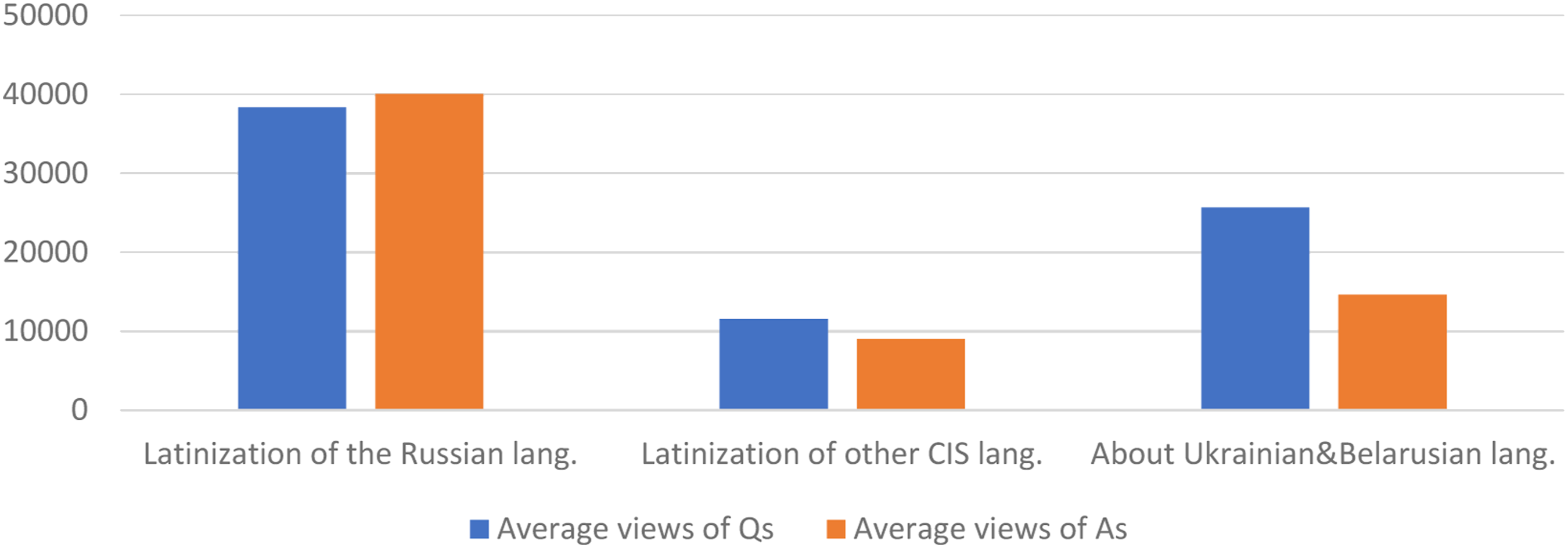
As the chart shows, the questions related to the Latinization of the Russian language, despite dealing with issues of purely historical interest, had the highest number of views. The questions about Ukrainian and Belarusian were viewed significantly less frequently; naturally, we should keep in mind that those posts date back to the period before February 24, 2022, and Russia’s open aggression against Ukraine, which was accompanied by a sharp increase in anti-Ukrainian propaganda in the Russian media. The least attention was paid to issues related to the Romanization of other languages, mainly Uzbek and Kazakh. 5 Our qualitative analysis of the questions and answers shows that Latinization-related topics focused mostly on issues of identity, disruption of culture, and communication between generations, as well as the economic costs of the transition from one writing system to another. However, there were differences as well. In the case of ‘Latinization of other CIS languages’ arguments, it was pointed out in terms of the cons that it could be a problematic social change affecting people’s lives, while the cons regarding the ‘Latinization of the Russian language’ stressed ‘cultural disruption,’ meaning that if such a transition would have happened, it would have polluted the cultural heritage of Russia. Kazakh or Uzbek cultures, at the same time, are not mentioned in the discussion and, we can assume, their existence is less important or even unknown to Russian speakers. Instead, opinions of the ‘Latinization of other CIS languages’ addressed political orientations of the countries in question. To be more specific, those opinions insisted that because the Latin alphabet is used by the Turkish language, switching from Cyrillic to Latin would mean becoming politically closer to Turkey, while turning away from Russia. On the other hand, there were also ‘pure linguistic’ arguments, asserting that choosing an alphabet for a language is a different issue from politics, government, or religion, and that it simply aims at selecting the most convenient writing system.
In addition to the questions about Latinization, there were questions with lower numbers of views that were consequently not included in the quantitative data, but which provided interesting material for discourse analysis. Thus, the issue of using foreign words in Russian was mentioned in many questions with relatively low number of views e.g., ‘Почему в России так стремятся загрязнить русский язык иностранными словами и это считается круто?' -‘Why are we so eager in Russia to pollute the Russian language with foreign words and it is considered cool?' 5.6 thousand views. However, the answers to such questions may generate further heated discussions between a limited number of very engaged users, some of whom state that loans are inevitable and useful for language development, while others express very strong purist views and react rather это не “загрязнение”, это издевательство и уничтожение родного языка' -‘This is not “pollution;” this is mockery and the destruction of the native language.’
In discussions about the Ukrainian language, it is evident that the audience was not homogeneous, and at least some answers were given by Ukrainian citizens/ethnic Ukrainians, Ukrainian-Russian bilinguals, or native speakers of Russian who identified with Ukraine in some way. They stated that Ukrainian was a language of its own, totally different from Russian, and that it should be maintained by all measures, including political restrictions for other languages: Если не заставлять его использовать в Украине, русский или другой язык, как английский, будет доминировать, и со временем страна исчезнет –‘If you don’t force it to be used in Ukraine, Russian and other languages, like English, will become dominant, and the country will vanish eventually.’ For them, Ukrainian, therefore, was seen as a counterweight to Russian influence, with Russian (and English) perceived, in due turn, as an existential threat.
Most ‘mainstream’ Russian speakers, on the contrary, claimed that Ukrainian is no more than ‘corrupted Russian,’ an artificially created chimera, a mere regional and very funny dialect, or just an accent of Russian. Thus, according to one commentator (2020), Taras Shevchenko, a famous Ukrainian poet не владел смешным современным украинским языком, который они недавно придумали. Они и сами его не понимают. Исковеркай до недоузнаваемости любое русское слово, и вот, это будет по современному украинскому –‘didn’t speak the funny modern Ukrainian that they had recently come up with. They don’t understand it themselves. Distort any Russian word beyond recognition, and behold, it will be in modern Ukrainian.’ Belarusian could also be seen as a dialect of Russian, and some people straightforwardly said it sounded funny to Russians. On the other hand, Belarusian received significantly less attention, it was treated as a minor issue, almost always as a side note in the discussions about Russian and Ukraine. When asked if they noticed accents when Ukrainian or Belarusian people spoke Russian, the answers were divided into two different categories: some commentators claimed that they could not recognize any accent, while others stated that they did recognize them and found them annoying.
What strikes us in this particular clash between two discourses, pro- and anti-Ukrainian, is that—at the basic level—they both follow the same monolingual ideology: multilingualism is represented as a zero-sum game—one language can gain power only at the expense of another. Very rare comments written with the use of professional linguistic terminology and applying scientific logic and factual data, argued in favor of multilingual ideology and policy, and their authors were promptly attacked by both Russian and Ukrainian ‘zealots of monolingualism.’
A similar polarization of opinions between the Russian-speaking majority, expressing negligence of or hostility towards other languages and supporters of other languages opposing them, driven by the same monolingual biases, can be found in some studies based on cases from within Russia, e.g., Tatarstan (Pankova, 2021). E. Khilkhanova (2020a) claims that there is a certain dynamic in the changes of attitudes towards minority languages among ‘insiders’—in terms of ethnic minorities, people express more positive feelings towards ethnic languages and people being able to speak them well (see also the detailed description of grassroots language activism in Baranova, 2023). However, Khilkhanova’s 2019own experiment on language evaluation in Buryatia revealed that speaking with an accent—both in Russian and in Buryat—provoked negative reactions among participants, regardless of their ethnic and linguistic identity. Her conclusion is meaningful for our topic: ‘I think the reason is that mass consciousness perceives native speaking as something natural and commendable, while non-native speaking marked with an accent is subconsciously associated with the violation of a norm, as something wrong’ (Khilkhanova, 2020a, p. 1943). The presence of monolingualism and purism remains strong in public discourse and attitudes, despite the rise in interest in language revival. On the other hand, covert attitudes tend to change only very slowly, long after the change in discourse as ‘stereotypes can be strongly resistant to change, and quite at odds with objective evidence’ (Garrett, 2010, p. 72). At least according to some polling data (e.g., Stepanova, 2015), the ‘normality’ of claiming two languages at once, e.g., Tatar and Russian, as native languages for one individual is becoming more wide-spread among ethnic minorities.
Another important aspect of language attitudes reflected in public metalinguistic discourse deals with non-autochthonous minority languages spoken by migrants. Those languages lack any form of official status in Russia, and their speakers have to face many problems (Klobukova, Molchanova & Golovina, 2020), also due to the toughening of legal regulations described in The Language Attitudes in Russian State Discourse. The state discourse focuses on the maintenance and defense of Russian and does not regard the languages of migrants as having any value. In general, the same appears to be true for the public discourse.
Previous studies on this topic based on qualitative analyses of interview data, Internet comments, and evidence from linguistic landscapes (Baranova & Fedorova, 2018, 2019, 2020) showed that Russian speakers tend to express negative feelings towards the languages of migrants (e.g., Uzbek, Kyrgyz, Tadjik, and Chinese) and their use in public spaces. There is even what can be called a linguistically and culturally based hierarchy of migrants: those that can speak Russian well and/or are ‘less culturally distant’ (e.g., Moldovans) are evaluated as more integrated and less ‘problematic’ newcomers. Sociological polls conducted in 2012–2013 in Novosibirsk also revealed that native Russian speakers evaluated speaking languages other than Russian in public either neutrally (48%) or negatively (49%), and that only 3% expressed positive feelings about this. Migrants themselves answered the same question differently: 29% declared a positive attitude towards this, 29% were neutral, and 35% expressed a negative view (Solodova et al., 2016, p. 114). The differences between the answers of outsiders and insiders are not surprising; however, the last figure— 35% of native speakers of Uzbek, Tadjik, and Kyrgyz claimed that their own languages should not be used in public—shows that a significant number of them had interiorized linguistic xenophobia of their host society (or at least could feel it and decided to comply).
Despite that evident lack of enthusiasm about linguistic diversity (and some efforts on the part of the state to diminish it), Russian cities, especially megalopolises like Moscow and St Petersburg, are becoming increasingly multilingual (Baranova & Fedorova, 2020). Certainly, this trend may reverse as there was a decrease in both migration and tourism from abroad, first due to the COVID-19 pandemic and then the war, including sanctions against Russia and their consequences for its economy. But still, there is a rather stable migration flow from Central Asia, and native Russian speakers are regularly exposed to communication in languages they cannot understand. Business actors have started to admit that their customers might have problems with Russian and would prefer to be served in their own languages. Thus, e.g., in 2018, McDonalds in Moscow added Uzbek, Tajik, and Kyrgyz to the language options in their digital screens for ordering. Even some state actors have shifted from totally monolingual policies in their communication with migrants and have started to make announcements and public signs targeting migrants in their own languages. 6 At the same time, such changes sometimes provoke extremely negative reactions among native Russian speakers. Thus, in the case of discussions following the changes in McDonalds’ language management, some people were furious about migrants’ languages having the same rights as ‘proper’ foreign languages (e.g., English and Chinese) and saw this as a demand for Russian citizens to accommodate to migrants, not vice versa (see Baranova & Fedorova, 2020, p. 684). If we keep in mind that such ‘accommodation’ does not mean learning or even hearing unwelcome languages but only seeing their symbols (such as the national flags of Uzbekistan, Tajikistan, and Kyrgyzstan) on the screen and admitting the fact that there are people who may choose them, it becomes clear that such attitudes are a prominent piece of evidence of a strong monolingual bias; other languages are presented as infringing upon the rights of Russian.
Public discourse regarding the languages of migrants, though, is not limited to simply positive and negative reactions; rather, it is more complicated and can also be studied via quantitative analyses of Internet data. In our study reported in Nam (2021) and Nam and Fedorova (2022), we analyzed messages posted in Russian on Twitter between 2009 and 2020 that dealt with the languages of migrants. The data were collected through web-scraping using search terms such as мигранты (migrants), свой язык (own language), нерусские (non-Russians), говорить (to speak), не по-русски (not in Russian), с акцентом (with accent), and many others. After morphological analysis, a database of 1351 messages was created and word cloud technology was applied to it. The results are presented in Figure 2. The word cloud of the most frequent words in tweets about migrant languages.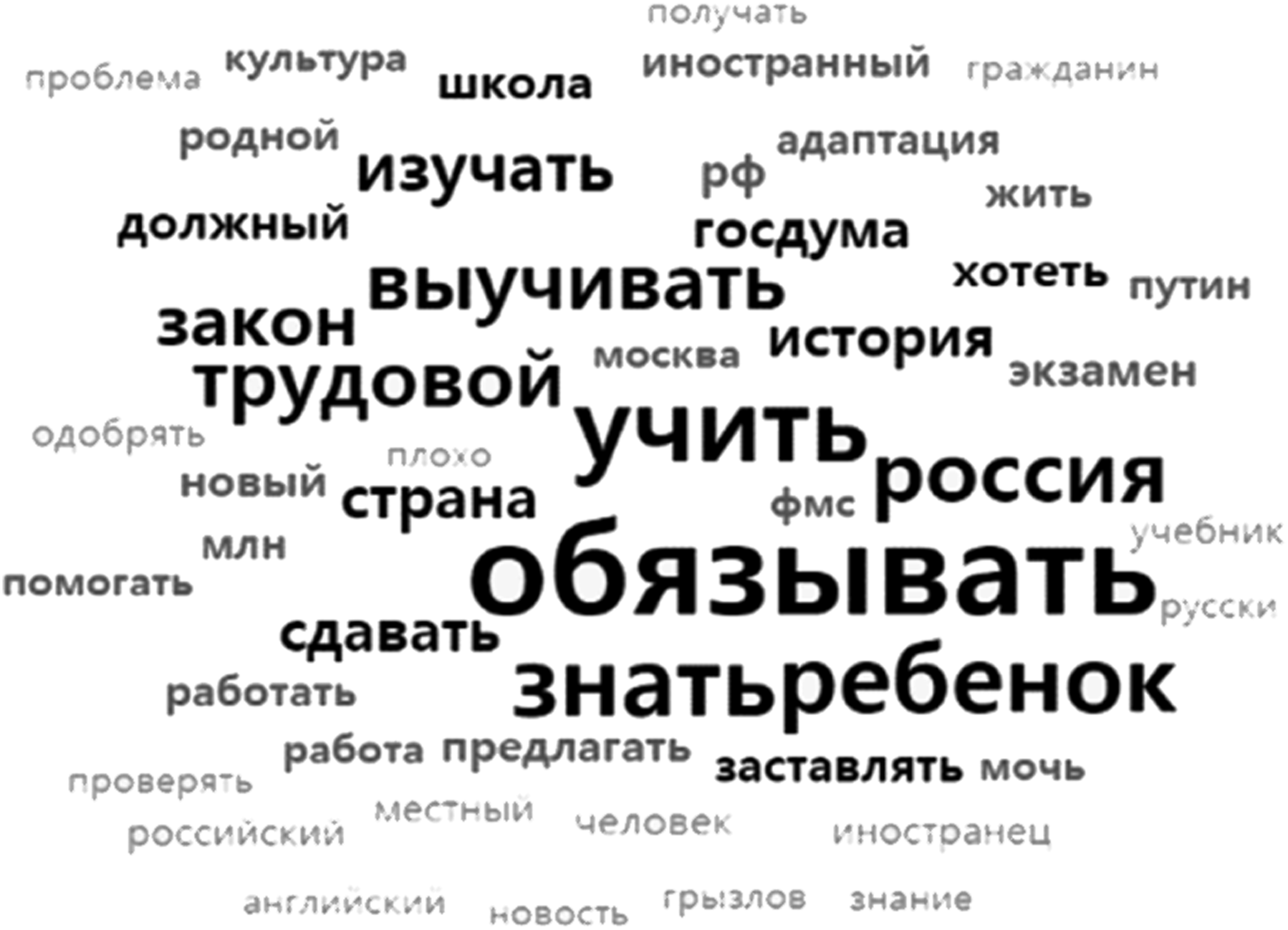
Here is the list of the most frequently used words (the number of usages is stated in parentheses): to oblige (267), learn [as a process] (199), know (183), child (173), Russia (150), to learn [as a result] (132), labor [adjective] (130), law (111), to study (100), country (78), to pass [exam] (74), history (68), State Duma [Russian Parliament] (65), to want (52), due (51), school (50), R[ussian] F[ederation] (47), to force (46), exam (43), new (40), to suggest (38), native (37), foreign (35), Putin (35), to work (34). Evidently, Russian speakers addressing the issue of migrant languages focus on the demand to learn Russian, given that such words as ‘to oblige,’ ‘to learn,’ and ‘to know’ prevail.
Further work with the data and sentiment analysis revealed that although in general, negative tonality characterized almost 80% of the messages, the number of positively toned tweets remained more or less stable, the number of negatively toned tweets reached its peak in 2012–2013 and was then on decline until 2018, which matches the conclusions of Eraliev and Urinboyev (2020) in their study of attitudes towards migrants from Central Asia and the influence mass media and state propaganda have on them. They demonstrated that anti-migrant sentiments in Russia were conditioned and reinforced by the media. For example, in 2014, when tensions between Russia and Ukraine were growing, the media strengthened anti-Ukrainian and anti-Western rhetoric, and due to this, the amount of negative information about migrants spread by journalists decreased, which led to a decline in anti-migrant sentiments in society.
Certainly, negative attitudes towards the languages of migrants resulting from monolingual ideology are almost impossible to distinguish from such attitudes towards the speakers of those languages related to more general xenophobic sentiments that are also widely spread in Russian society (Chapman et al., 2018). Another piece of evidence of such negative attitudes is the way in which the word ‘migrant’ is used in Russian, which can be studied using linguistic corpus analysis. In corpus linguistics, big data analysis helps to reveal more frequent and typical patterns of word usage, which can then be related to certain social meanings (Stubbs, 2001, p. 215; Teubert, 2004, p. 97). We used the concordancer ‘Sketch Engine’ (https://www.sketchengine.eu/) and its instrument ‘Words Sketch’ to find the most frequent collocations of the word мигрант (migrant) in the corpus Russian Web 2011 (ruTenTen 11).
7
The study’s main results are presented in Figure 3. Specifically, we discovered that, as a subject, it tends to be combined erbs like трудиться (to work), хлынуть (to gush), наводнить (to flood), while as an object, it tends to be combined with the verbs выдворять (to expel), депортировать (to deport), ассимилировать (to assimilate), обязывать (to oblige). Moreover, it is typically defined with adjectives such as нелегальный (illegal), трудовой (labor), вынужденный (forced), and инокультурный (belonging to other culture). In other words, in thousands of Internet texts searched by ‘Sketch Engine,’ migrants are described as illegal others invading Russia who should be either deported or assimilated. Word Sketch of мигрант (migrant) in Russian.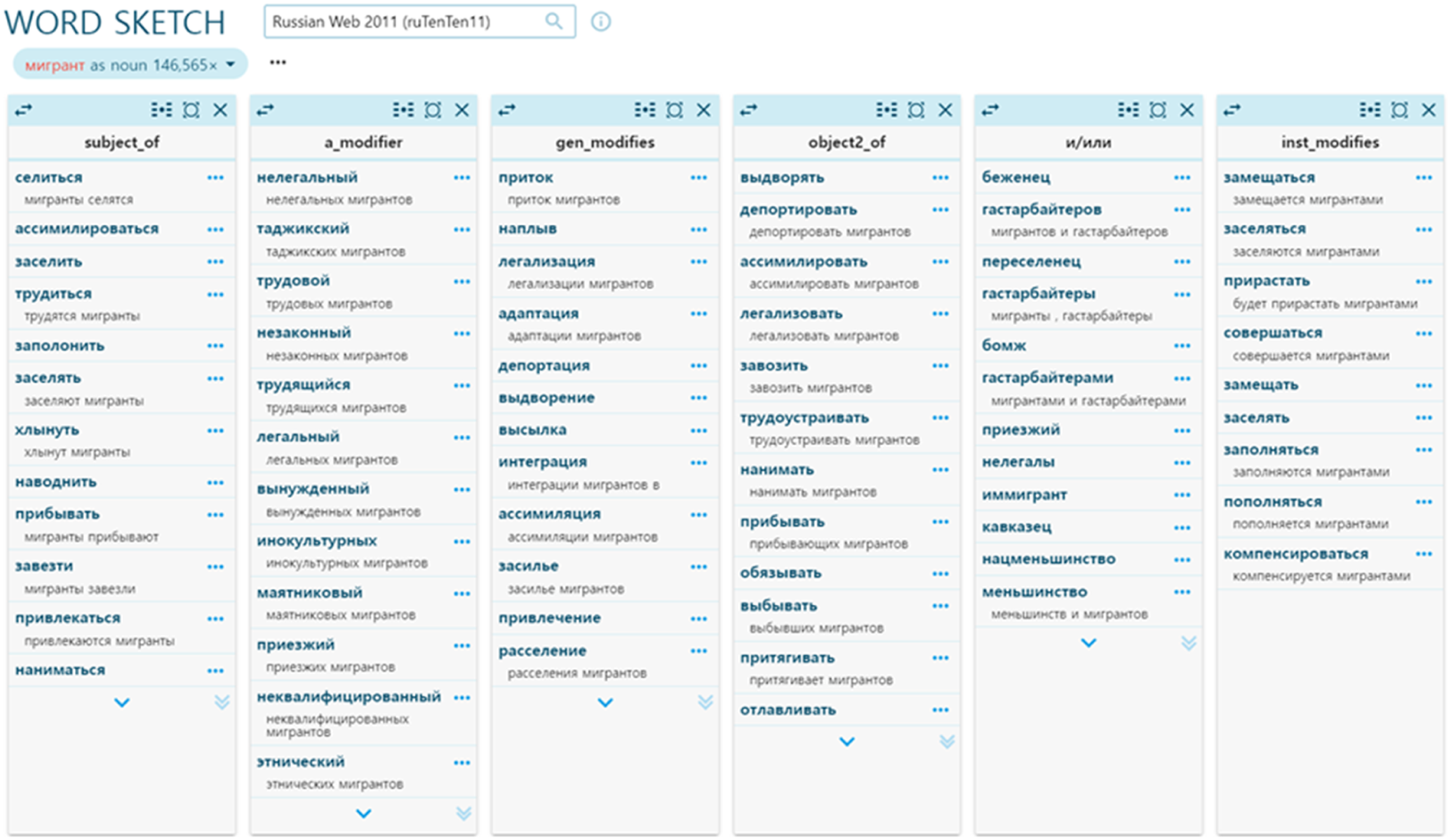
Nevertheless, migrants, the same way as local minority language speakers, are not passive objects of state language policy or societal hostility. Rather, they contribute to the public discourse and sometimes oppose native Russian speakers by questioning their monolingual bias, as, for example, in this comment on a YouTube video dealing with teaching migrant languages in Russian schools: Русские впервые пришли в Kазахстан ещё в 19 веке. Но всё ещё не знают казахский язык. Не пойму как мы это терпим --`Russians first came to Kazakhstan in the 19th century. But still, they do not know Kazakh. I can’t understand how we tolerate that.’ (YouTube ID: 58fAxFaUc8o, author: Мерей Болатов). Such insiders’ perspectives of languages other than Russian challenge the dominant monolingual and purist ideology of Russian speakers. Interesting examples of such empowerment and reclaiming agency in discourses on the part of non-native speakers can also be found in ethnic stand-up comedy and vlogs that make use of different ethnic accents and styles of speaking. Stand-up comedians like Rasul Chabdarov manage to turn exaggerated accents into a tool to confront prejudices and even attack their Russian-speaking audience (see examples in Baranova & Fedorova, 2022), and videos created by young people depicting and discussing numerous accents of Russian create a colorful picture of communication between minorities, thus making linguistic diversity more familiar for their viewers who are part of the Russian native-speaking majority.
Conclusions
In this article, we aimed to approach the issues of language ideology in modern Russia in relation to other languages and their speakers. We analyzed language attitudes as they are reflected in two metalinguistic discourses: state and public. In terms of official language policy, there is an evident and rather abrupt shift from ensuring linguistic equality and diversity to an emphasis on linguistic unity and purity, from multilingualism and variability to monolingualism and normativism. Other languages are presented as a threat to the only true norm—standard Russian. This reorientation can be witnessed on all levels of language policy, namely status, corpus, and acquisition planning. If we look for historical parallels, we find that this situation is similar to the transition from the diversity and pluralism evident in the language policy of the 1920s to the restoration of Russification and prescriptivism that occurred in the 1930s–1940s.
In public discourse, as we have seen, normative and monolingual orientations prevail. Russian speakers tend to express negative feelings towards other languages and their use in public spaces, demand the assimilation of newcomers, prefer to ignore the existence of ethnic minority languages, and do not want to tolerate the language variants that they perceive as wrong and ugly.
At the same time, the discourse is not homogeneous. First of all, speakers of other languages also actively contribute to it. While issues related to the languages of indigenous peoples of the Russian Federation attract almost no attention from Russians, the ethnic majority, ethnic minorities’ representatives are actively involved in grass-roots language policy and the production of a new narrative surrounding minority languages. Even if they share monolingual and purist attitudes, they apply them to other languages and, thus, make the public scene more diverse. Migrants also have increasing access to public discourse due to the development and affordability of the Internet and other digital technologies, and they can, thereby, oppose negative stereotypes of themselves and their language abilities represented in the mainstream discourse. And, certainly, native Russian speakers are not unanimously linguistically intolerant and hostile to other languages (and/or non-prestigious versions of Russian – those attitudes tend to correlate but should not necessarily match). There are voices of professional linguists, human rights activists, cosmopolitan-oriented intellectuals, and many other people who argue for multilingualism and variation as a norm and a positive trend.
Overall, language practices in Russia are gradually becoming more diverse, which can become a challenge for monolingualism and purism in the future. Moreover, this also means that the state and public discourses in Russia, although similar in many ways due to a strong prevalence of monolingualism and purism, do differ in terms of the directions of their changes. While the state discourse aims at gaining total control over speech and trying to suppress any diversity to bring reality to a desired norm, the public discourse, which is made up of many diverse voices, is reacting to the changes in this reality and shows some movement towards a less rigid and narrow approach to language. The future will show which trend prevails.
Footnotes
Declaration of Conflicting Interests
The author(s) declared no potential conflicts of interest with respect to the research, authorship, and/or publication of this article.
Funding
The author(s) disclosed receipt of the following financial support for the research, authorship, and/or publication of this article: This work was supported by the Yonsei University Research Grant of 2022 (2022-22–0187).
