




Abstract
Tajikistan, at the heart of Central Eurasia, had a population of 7,563,687 in 2010, estimated recently to be almost 10,084,935. Named for its majority nationality, Tajikistan has many other nationalities, most with their own language. This article explores what is known about the historical, development and current status of multiple languages in Tajikistan’s linguistic tapestry. We provide a tentative overview of Tajikistan’s evolving language ecology from earliest times when a range of Eastern Iranian languages were dominant, to the reduced use of Eastern Iranian languages following the entry of Arabic and New Persian (a western Iranian language) into the ecology with the Arab conquest, and the subsequent entry of Turkic languages, and more recently the entry of Russian under the late Russian empire and its spread under the Soviet Union. Following independence in 1991, a shift in balance among domains of use of Tajik and Russian has been ongoing at the same time as international languages, especially English, have entered Tajikistan’s language ecology. We review the current state of knowledge about contemporary sociolinguistic dynamics, monolingualism and plurilingualism in society, where the titular language, Tajik/Persian, is in interaction with local, regional and global languages. Against the background of changing post-independence language and language-in-education policies, we discuss the prospects for monolingual, multilingual and plurilingual education in Tajikistan among efforts to promote the official language, Tajik, and to provide minority language education, while also developing proficiency in foreign languages in Tajikistan, through initiatives such as English-medium instruction.
Keywords
Introduction
Tajikistan, at the heart of Central Eurasia, has a population of about 10,084,935 (Worldometer, 2023). Named for its majority nationality, Tajikistan has many other nationalities, most with their own language. 1 This article looks at the evolving ecology of local, regional and international languages in Tajikistan and reviews the implications for contemporary language policy in the education system.
The study in international research of language in actual use has developed rapidly, considering variability over geographic and social space (Britain, 2013; Chambers & Trudgill, 1980), multilingualism and plurilingualism (Cenoz & Gorter, 2013; Piccardo, 2013), diglossia and bilingualism (Ferguson, 1959; Fishman, 1967), 2 linguistic hybridity and linguistic interanimation (Bahry, 2021; Bakhtin 1934/81, 1940/81, 1941/81), and language ecology (Calvet, 1999; Haugen, 1972; Hornberger, 2002; Mühlhäusler, 2002). These phenomena are further complicated by widespread movement via trade, conquest and migration, which have accelerated in recent years and acted together on an even wider scale leading to globalisation, which is also mediated by multilingualism (Bahry, 2020a; Held et al., 1999).
Many languages, particularly English, have thus spread worldwide, a phenomenon taken up by Kachru (2006), focusing not on ‘Standard English’ but the actual World Englishes manifesting globally in several zones: the Inner Circle, where English has long been the main native language; the Outer Circle, former colonies where English is used as a second language for many social functions; and the Expanding Circle 3 , where it is increasingly learned as a foreign language and used for international interchange. Kachru argues that sociolinguistic realism requires consideration of all varieties of English in these environments and also how English is appropriated for use in local ways and for local purposes in the Outer Circle, as well as in the Expanding Circle.
The World Englishes approach focuses on wide scale colonial language spread by sea. Indeed, some have restricted the definition of colonialism to domination from overseas. Others have argued rather for colonialism to encompass large scale land-based empires (Lightfoot, 2016). By this analogy, the ‘World Englishes’ approach should extend not only to other cases of overseas West European colonial languages (French, German, Italian, Portuguese, Spanish), but also to any language seeing extraordinary extensions in space and function, and can be applied to understanding the evolving use of a series of languages in Tajikistan’s dynamic language ecology, with Russian and English as the most recent major entrants into its language space.
This article reviews the language ecology of Tajikistan and the varying choice of languages for Low status (L) and High status (H) uses in the past 4 , and, more recently, since independence in 1991. The study primarily relies on published secondary reports written in English, with very little primary research available. Our major source is the census of the Republic of Tajikistan, which has some limitations, but gives enough information for an exploratory description of the range of languages used in Tajikistan. We were able to access two accounts of classroom language use in Tajikistan, both conducted in a specific multilingual region of Tajikistan. In addition, we have relied on a research article that surveyed language use in the central town of that same province. Therefore, our data regarding the multilingualism and plurilingualism of the Tajikistan population are mostly drawn from statistical data for the entire country and survey and observational data in one province and are tentative.
Development of Diglossia and Multilingualism in the ‘Tajik-Speaking’ Language Ecology
Eastern Iranian languages such as Sogdian, Bactrian, Khworezmian and Saka/Scythian, as well as Western Iranian Old Persian were the oldest recorded languages in today’s Tajikistan. Sogdians traded along the Silk Road, learning neighbouring languages and even administering the Uighur Khanate in Sogdian. Sogdian was written in a script based on the Aramaic used in the Persian Empire. Sogdians were bearers of goods, ideas and the Aramaic script, and acted also as middlemen, interpreters and administrators along the Silk Road (Bahry, 2016a; de la Vaissière, 2005; Lung, 2013). With the Arab conquest, Middle Persian and Arabic entered Sogdia; for several hundred years, the colonial language, Arabic, took over from Sogdian H uses and was the language of administrators and scholars. Sogdian and other Eastern Iranian languages ceased to be written and were confined to oral L uses. A state of diglossia with bilingualism developed where Arabic for H uses and various Iranian languages for L uses occurred. During this period a transformed version of Persian, New Persian, developed and eventually replaced Eastern Iranian languages for L uses. Eventually, as New Persian became more used as a spoken language, debates among scholars arose as to the suitability of extending this local vernacular to writing and H uses. Some of those proficient in Arabic mocked the possibility of using a local vernacular for written H uses; the scholar Biruni, for example, said Persian was only suitable for ‘tales of kings and night-time story-telling’ (Tetley, 2008, p. 27). Once New Persian began to be written in Arabic script for some H uses, further debate on how purely ‘Persian’ or hybridized it should be developed. Ibn Sina tried to develop a non-Arabized scholarly New Persian, but it was an Arabized Persian that eventually replaced Arabic as the main H language of the Samanid Empire (819–999), which covered most of today’s Tajikistan (Bahry, 2016a; Tetley, 2008; de la Vaissière, 2005; Lazard, 1975). 5
After Turkic speaking peoples entered the language ecology at the end of the 10th century, Turkic vernaculars became dominant in L uses in some areas and in others Tajik/Persian remained the main vernacular language, while around Bukhara and Samarkand, Turkic-Tajik bilingualism developed, persisting until today. At the same time, Classical New Persian remained the major H language until the development of a parallel classical written Turki, Chaghatai, with much ‘interanimation’ of Turkic, Arabic and Persian/Tajik/elements. These areas exhibited trilingualism in Turki, Persian/Tajik and Arabic and diglossia of H and L varieties of Persian/Tajik and Turki (Bahry, 2021, pp. 157–159; Bakhtin, 1981; Beeman, 2010; Bodrogligeti, 2009; Finke & Sancak, 2012; Mahmoodi-Bakhtiari, 2018; Nourzhanov & Bleuer, 2013).
The Russian language entered Central Asia’s Tajik-speaking areas after defeating and later making the Emirate of Bukhara a protectorate in 1873. Subsequently, both some scholars in Bukhara emirate (jadidist education) and Russian authorities in Turkestan (Russian-local schools) advocated adding modern content and Russian language to traditional education in Persian, Turki and Arabic. As the Tajik-speaking areas of the emirate were not under direct Russian administrative control, Russian was learned as a second or foreign language by some, but not used officially. With the Russian revolution and the absorption of the former emirate came debate about the role of Russian for H uses (Dowler, 2001; Khalid, 1998; Nourzhanov & Bleuer, 2013; Schlyter, 2013; Schuyler, 1877).
Soviet policy in Central Asia required a delimitation of nationalities based on common language, territory, and way of life. Education was organized in ‘national’ schools 6 , and Tajikistan provided Tajik-, Uzbek-, Kyrgyz-, Turkmen-, Kazakh- , and Russian-medium schools, and in the 1920s, preparatory work was done for education in Pamiri (Eastern Iranian) languages in Mountainous Badakhshan Autonomous Province. 7 In the 1930s, Russian became a compulsory subject though some rural schools had no Russian and likely no English teachers. As poor Russian proficiency was blamed on language-heavy curriculum, in 1958, the central government allowed the enrolment of non-Russian students in Russian-medium schools thus prioritizing Russian and foreign languages (German, French, and English) over Tajik and other languages. Some of the Tajik elite wished to raise the status of Tajik, which in part contributed during Perestroika to a language law raising Tajik’s status in 1989, and suggestions to use minority Pamiri languages in education (Bahry et al., 2017; Bergne, 2007; Bilinsky, 1964; Dagiev & Faucher, 2019; Fierman, 1991; Foltz, 2019; Hammer, 1998; Jamshedov, 1991; Khasanov, 1987; Kirkwood, 1991; Korth, 2005; Landau & Kellner-Heinkele, 2012; Lewis, 1972; Nourzhanov & Bleuer, 2013; Rakowska-Harmstone, 1970; Schlyter, 2013; Sengupta, 2002; Shorish, 1976, 1988).
Post-Independence Language Ecology
Changing Demographics of Contemporary Tajikistan
Central Asian Nationalities in Tajikistan, 1989–2010.
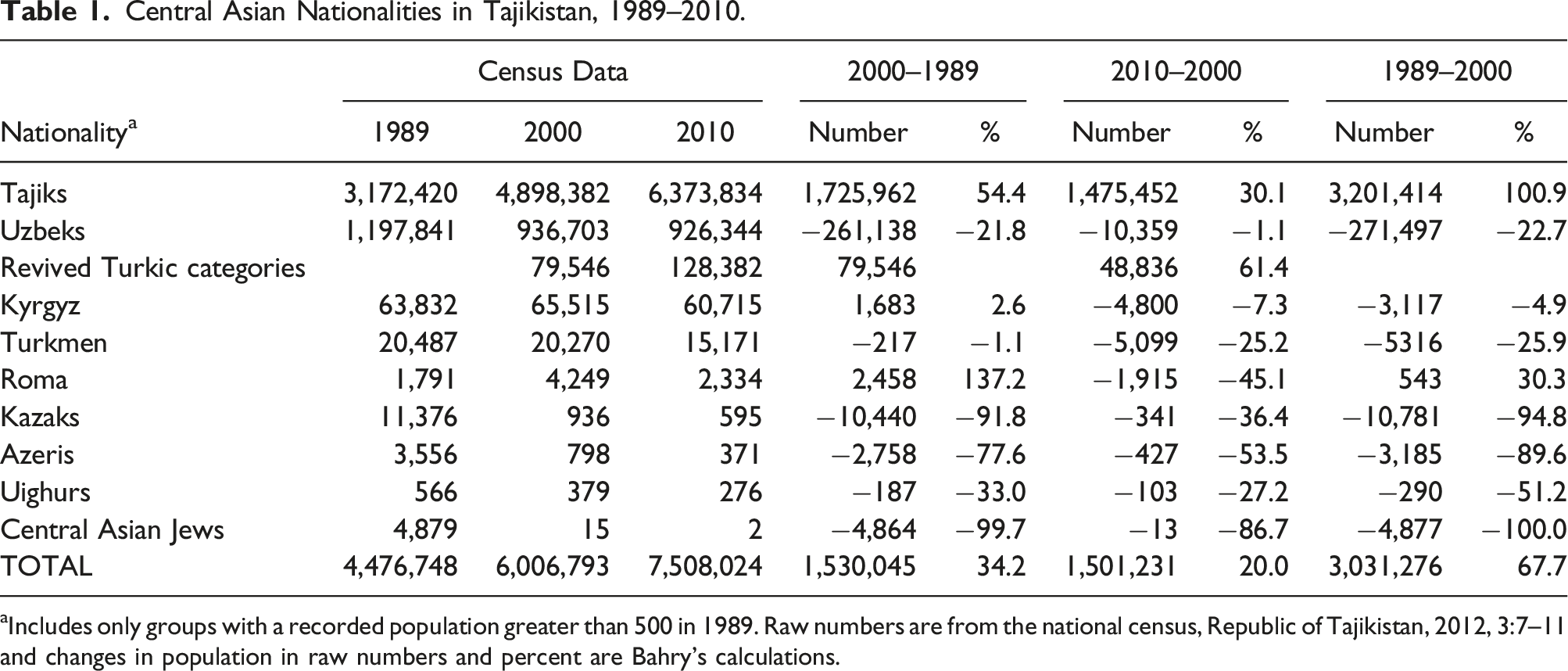
aIncludes only groups with a recorded population greater than 500 in 1989. Raw numbers are from the national census, Republic of Tajikistan, 2012, 3:7–11 and changes in population in raw numbers and percent are Bahry’s calculations.
Other FSU Nationalities in Tajikistan, 1989–2010.
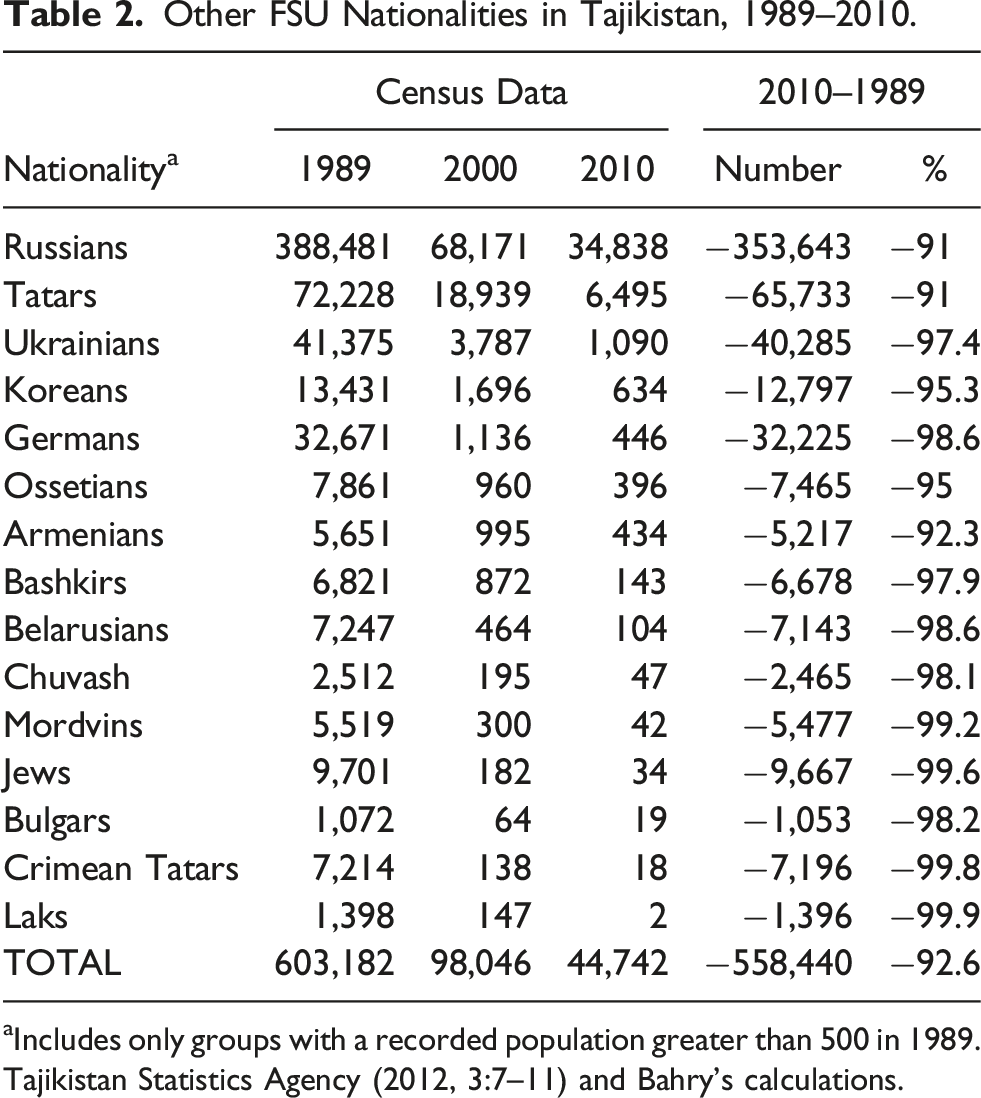
aIncludes only groups with a recorded population greater than 500 in 1989. Tajikistan Statistics Agency (2012, 3:7–11) and Bahry’s calculations.
Nationalities From Beyond FSU in Tajikistan, 1989–2010.
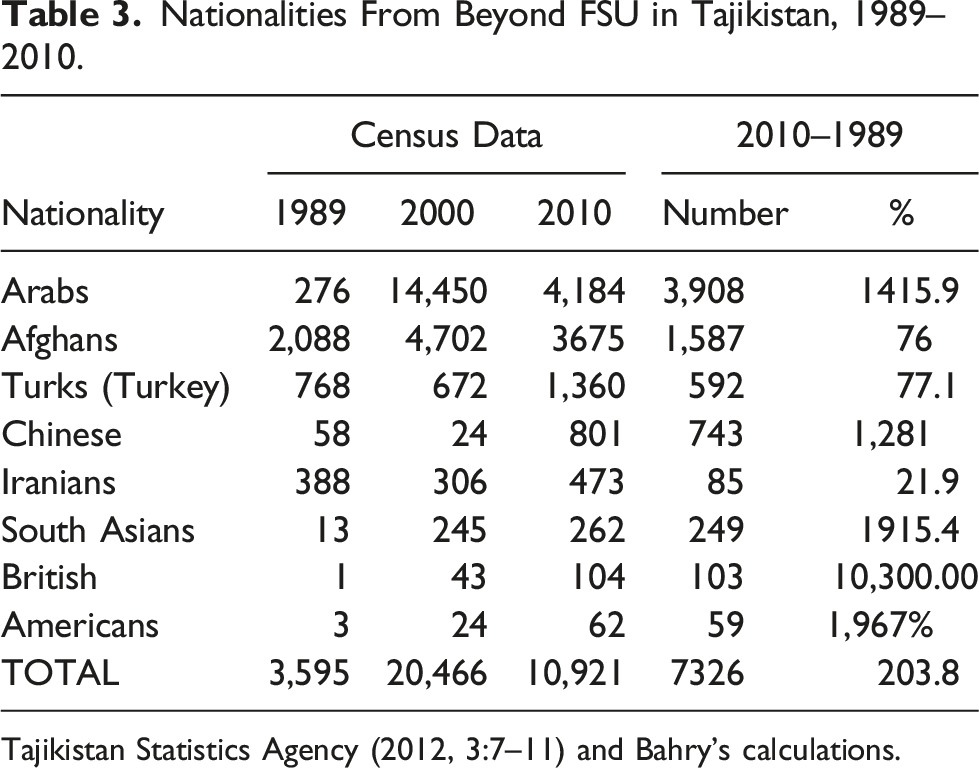
Tajikistan Statistics Agency (2012, 3:7–11) and Bahry’s calculations.
The drop in non-Central Asian former Soviet Union (FSU) nationalities by more than 90% in every case is stunning (see Table 2). All non-Central Asian Soviet nationalities have participated in this exodus – other nationalities have abandoned the country at an even higher rate than Russians. Thus, we can perhaps see this as in part desovietization and linguistic, more than ethnic, derussification (Landau & Kellner-Heinkele, 2012).
The immense rise in residents of Tajikistan with origins from beyond the FSU as shown in Table 3 is even more surprising. Besides large numbers originating in the wider Muslim world such as Afghans, Arabs and Turks from Turkey, residents with origins in China are also a growing number, who may be minority nationalities from northwest China. Groups seeing massively increased rates, if not absolute numbers, from 1989 to 2010, include Arabs 8 , Indians and Pakistanis, as well as British and US citizens.
These findings deviate slightly from what we might expect from a gravity model that gives greatest weight to larger population sizes and smaller distances in estimating influence between two spaces (Ramos, 2016, March). According to this model, there should be about similar numbers of immigrants from South Asia and China and Iran, due to their large populations and great distance, and from Iran due to its smaller population but much closer distance. Yet, the model predicts far fewer migrants from the UK and US, although a constant can be added to the model to accommodate, for example, similarities/differences across territorial borders, and also linguistic ones (Chambers & Trudgill, 1980; Dias, 2010; Ramos, 2016). 9
The differences between Iranian Persian and Tajik, the difference in scripts (Arabic in Iran and Cyrillic in Tajikistan) as well as the religious and political differences between Iran and most of Tajikistan could act as a factor limiting influence of the two societies on each other, while the language similarity between Iran and Tajikistan may act as a moderately positive factor (Beeman, 2010; Perry, 1999). The proximity of China and its size make the high number of Chinese residents not completely surprising; but one might expect that those counted as Chinese may be Turkic or Iranian speakers from Xinjiang, China.
The gravity model, however, cannot readily explain the significant growth in the number of migrants from the UK and USA; the great distance between the countries and lack of any linguistic or cultural commonalities make such a rapidly increasing, though still small, migration to Tajikistan run counter to the gravity model. In contrast to more conventional locally or regionally confined migration processes, this group appears to have arrived in Tajikistan through remarkable globalisation processes. Though such individuals would typically not be included in the census, it is possible that these English speakers have been involved in trade, diplomacy or INGO activities. These figures should correspond to such personnel who have somehow settled in Tajikistan. As in the case of Arabs, it is possible that immigration is not the only factor contributing to their dramatic increase. Perhaps some of them are Tajikistanis who obtained US or UK citizenship and later returned to Tajikistan.
Of course, outmigration from Tajikistan, particularly temporarily for labour, can influence the language ecology of Tajikistan. The shortage of work has driven many Tajikistanis to leave the country, sometimes to neighbouring countries in Central Asia, but for the most part to Russia. Older, more educated migrants have sufficient Russian proficiency to find better paid work, while for the younger, less educated and rural migrants’ Russian proficiency is low and leads them to unskilled labour in Russia (Dolzhikova et al., 2018; Laruelle, 2007; Yormirzoev, 2017). Thus, the need to learn Russian as a second language is supported by this, while returnees from Russia, and any children that may have accompanied them, may bring back with them enhanced Russian proficiency with possibly a greater frequency of Russian use within their linguistic repertoire.
Multilingualism and Plurilingualism in Demographic Change in Contemporary Tajikistan
Soviet censuses initially asked questions about one’s ‘native’ language. However, analysts found anomalous results, finding overcounting of loyal ‘speakers’ of the heritage language and undercounting of language shift to Russian. It was argued that ‘native’ language responses were a poor indicator of actual language use, and more a marker of linguistic heritage and identity than of usual linguistic practice of respondents (Anderson & Silver, 1983; Arel, 2002; Crisp, 2009; Silver, 1975). Subsequently, later Soviet and post-1991 republican censuses began to ask questions about language ‘ability’ in several languages so that inferences about multilingualism/plurilingualism can be better made. Tajikistan’s census asks about ability in the language of one’s own nationality, Tajik, Russian and/or another language (Ferrando, 2008). 10 We can use these data provisionally to estimate the range of languages spoken by the nationalities of Tajikistan. The 2010 census of Tajikistan provides fairly complete and recent data on ethnicity and language which can provide perspective on globalization and language in the region (Republic of Tajikistan, 2012). The next census has not yet appeared, likely due to a delay in data collection caused by COVID. In the meantime, nevertheless, as little published field work on language use in Tajikistan is available, we use census data cautiously as an approximate indicator of what general grass roots conditions may be.
Ability in Tajik, Russian and Central Asian Languages
Native and Second Languages of Central Eurasian Nationalities in Tajikistan.
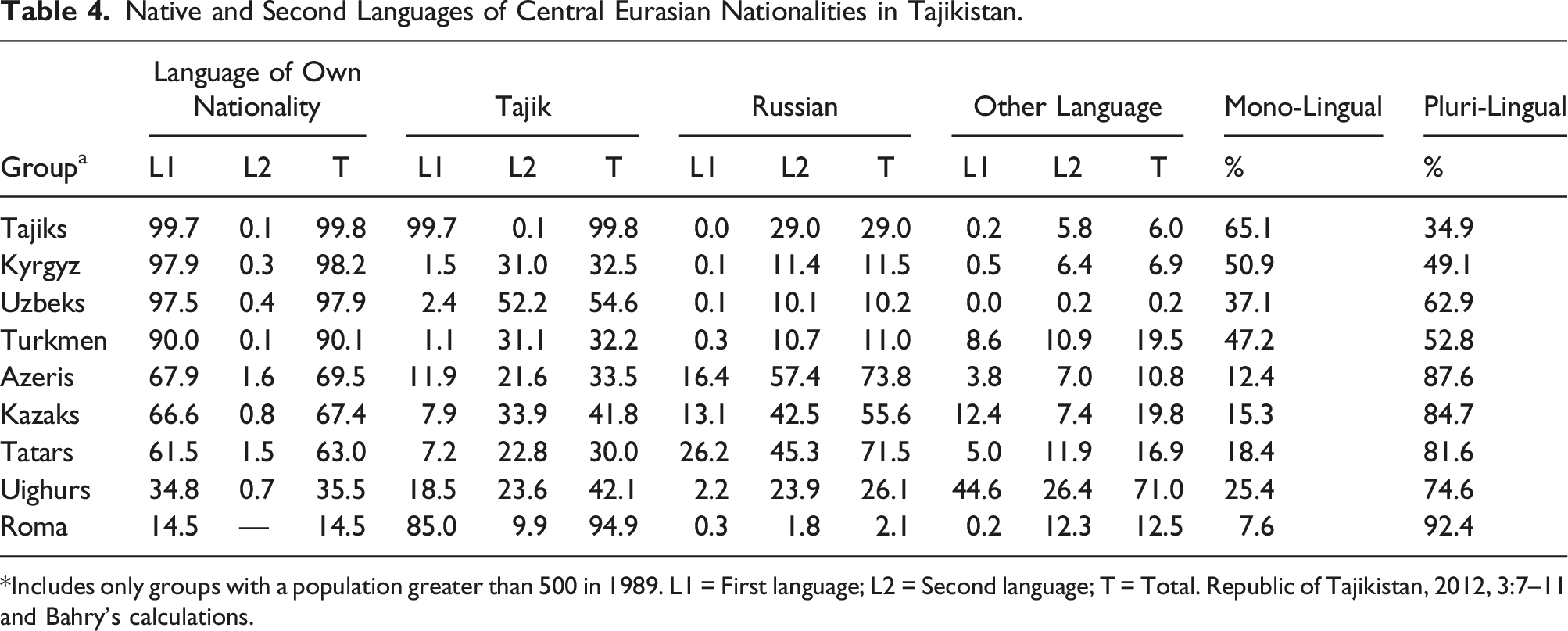
*Includes only groups with a population greater than 500 in 1989. L1 = First language; L2 = Second language; T = Total. Republic of Tajikistan, 2012, 3:7–11 and Bahry’s calculations.
The same data can be displayed graphically, allowing the multilingual social space of Central Asian nationalities in Tajikistan to appear more sharply in the figure below. Figure 1 shows the knowledge of languages (first and second language combined) as a space bounded by a coloured line. The overlap of these spaces suggests a relatively balanced social multilingualism and by inference a high degree of individual plurilingualism among Central Eurasian nationalities. Multilingual space for Central Eurasian nationalities in Tajikistan in 2010. Knowledge (L1 + L2) of Tajik, Russian, Language of Own Nationality and ‘Other’ Language (%). Data from Table 4.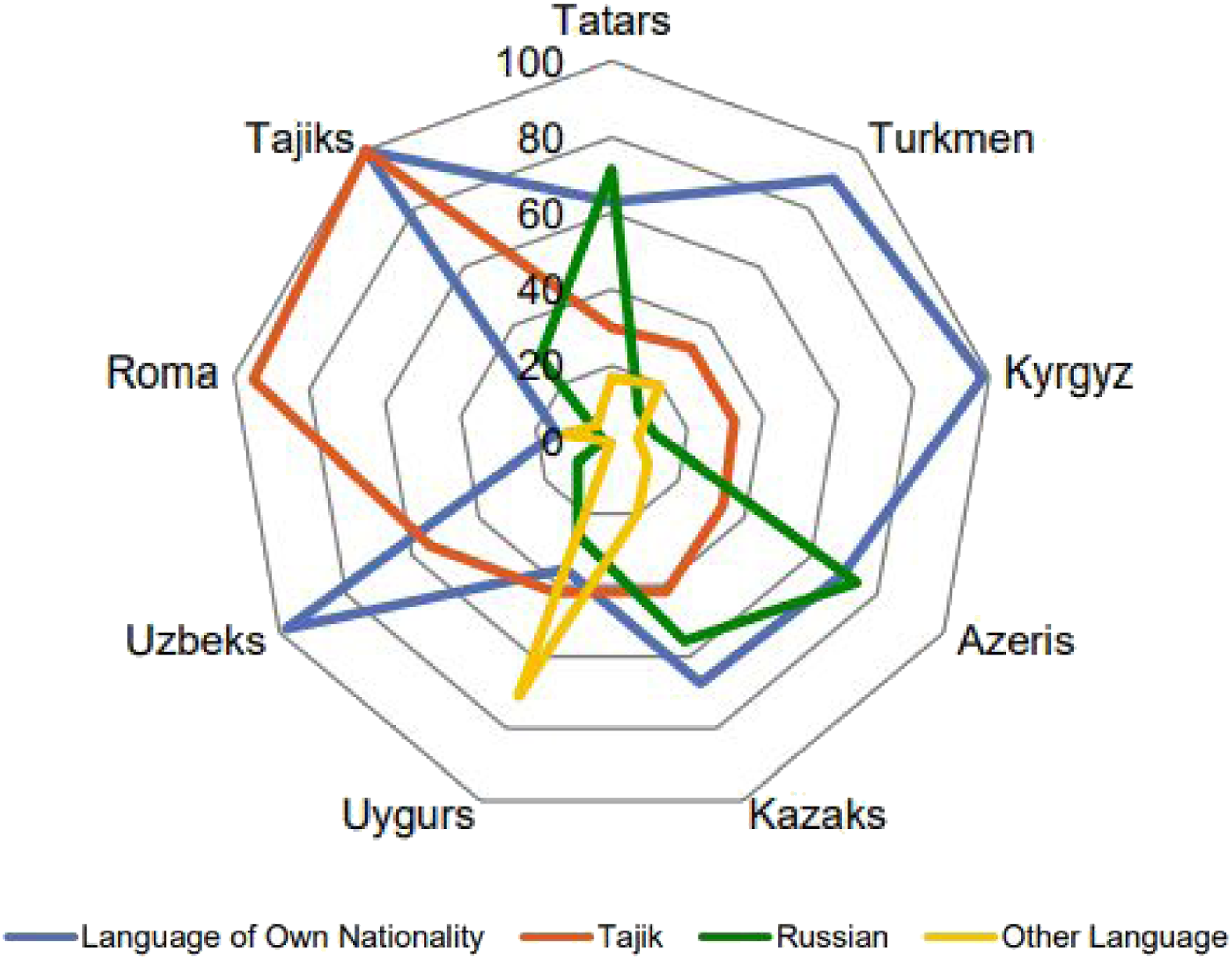
Tajik, Russian and Other Former Soviet Languages
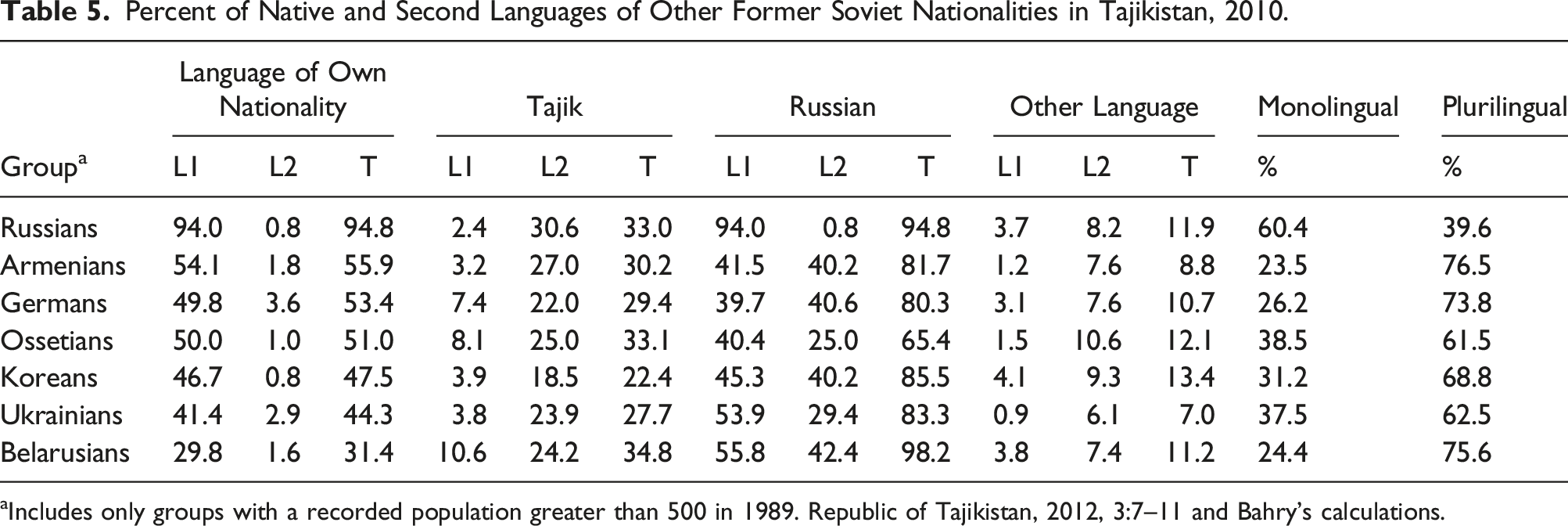
Percent of Native and Second Languages of Other Former Soviet Nationalities in Tajikistan, 2010.
aIncludes only groups with a recorded population greater than 500 in 1989. Republic of Tajikistan, 2012, 3:7–11 and Bahry’s calculations.
Figure 2 shows the hierarchization of language knowledge even more clearly: these nationalities know Russian as first and second language more than their ‘native’/heritage language, which they know more than Tajik, which they know more than other languages, indicating asymmetrical multilingualism. When these data are displayed graphically in Figure 2, knowledge of other languages is seen as nested within knowledge of Tajik, in turn nested within knowledge of the ‘native’ or heritage language of the group, which is in turn nested within knowledge of Russian. Multilingual space for former Soviet nationalities in Tajikistan in 2010. Knowledge (L1 + L2) of Tajik, Russian, Language of Own Nationality and ‘Other’ Language (%). Data from Table 5.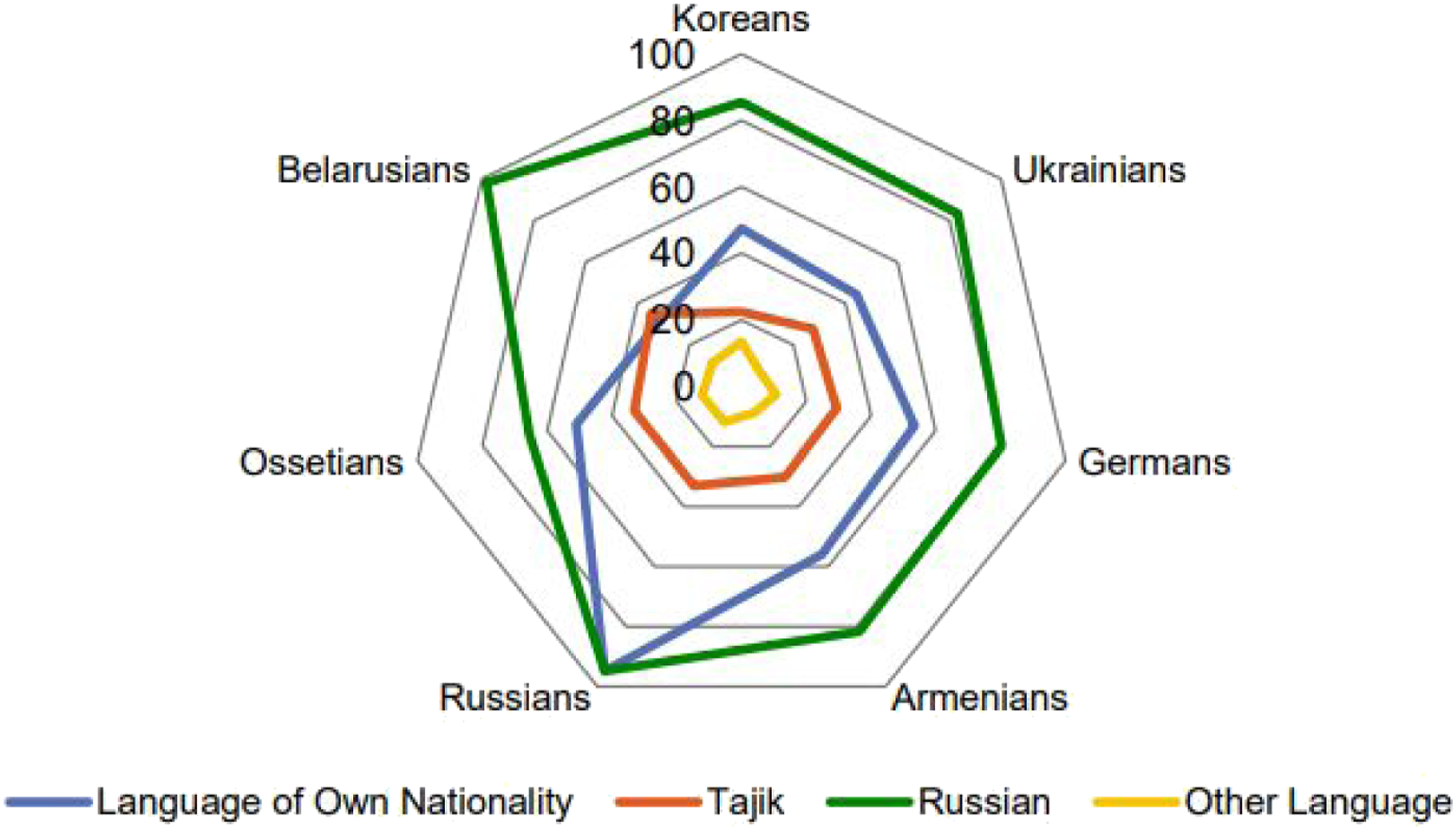
Except for ethnic Russians, all nationalities have more than 60% plurilingualism. These numbers indicate that either policy promoting the titular language is successful in expanding Tajik knowledge among former Soviet nationalities, or that it has caused more monolinguals to depart from the country.
Tajik, Russian and Languages From Outside FSU
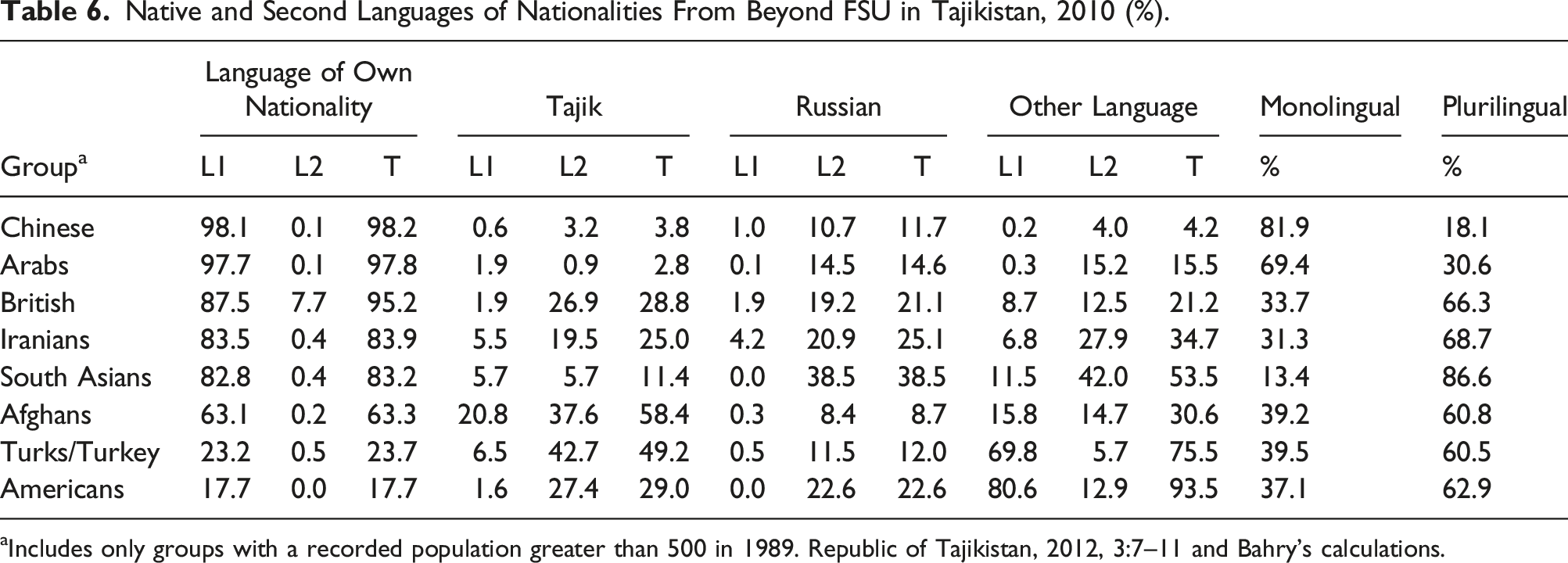
Native and Second Languages of Nationalities From Beyond FSU in Tajikistan, 2010 (%).
aIncludes only groups with a recorded population greater than 500 in 1989. Republic of Tajikistan, 2012, 3:7–11 and Bahry’s calculations.
Knowledge of Tajik is lowest among residents originating in South Asia and China. Turkish residents claim a higher level of Tajik knowledge than Russians and English-speaking UK and US emigrants do. About 29% of residents from UK and USA claim Tajik ability, despite arriving in Tajikistan relatively recently in contrast to the 33 percent of Russians claiming Tajik ability, with much longer residence in the country, confirming reports of asymmetrical local-Russian bilingualism in Central Asia during the Soviet era (Bahry et al., 2017; Guboglo, 1984, 1986; Khasanov, 1987; Korth, 2005). Figure 3 still shows some reduced hierarchization and asymmetry in plurilingualism, along with a roughly equal distribution of multilingual knowledge among nationalities. Multilingual space for non-FSU nationalities in Tajikistan in 2010. Knowledge (L1 + L2) of Tajik, Russian, Language of Own Nationality and ‘Other’ Language (%). Calculated by Bahry from Republic of Tajikistan (2012).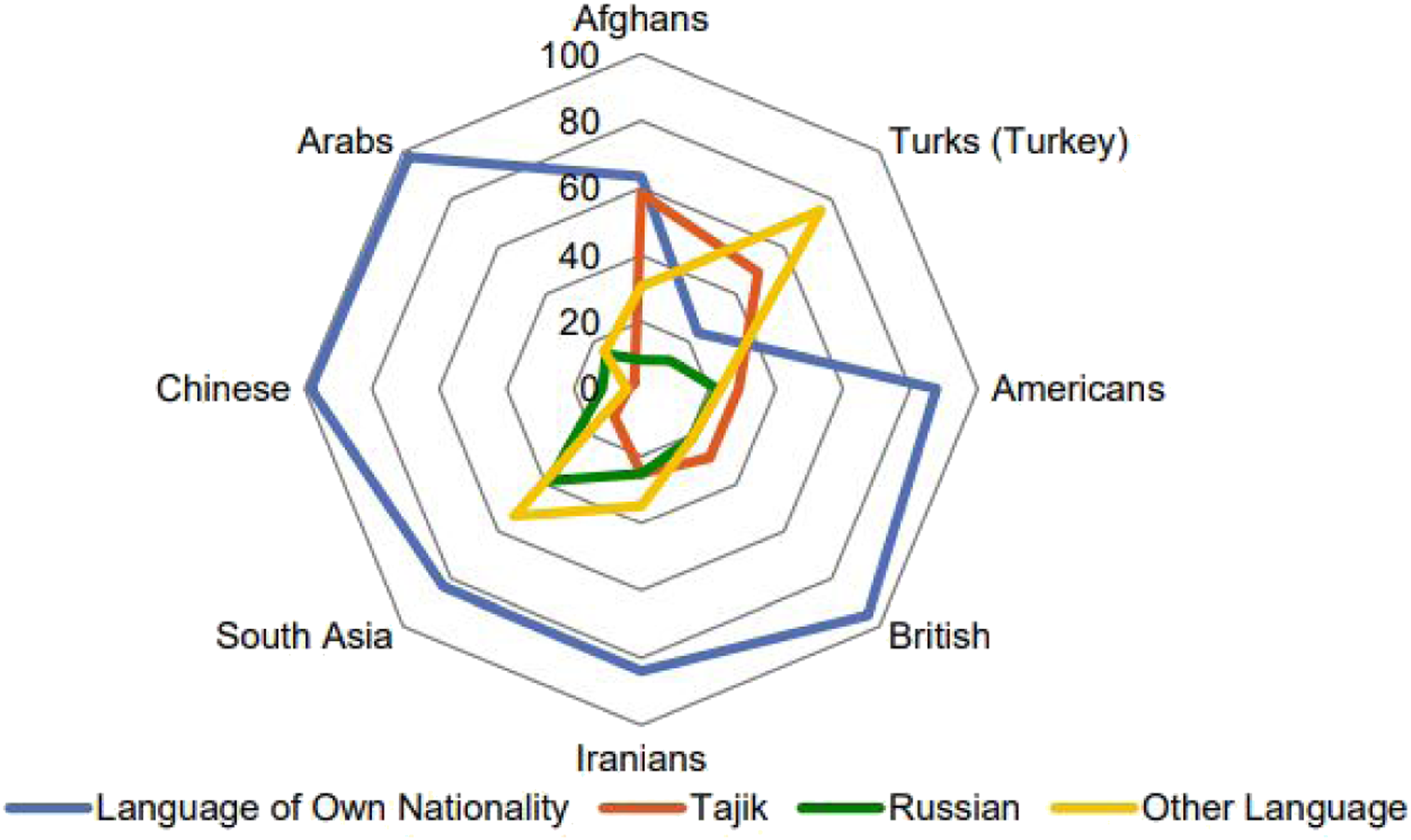
Meso Level Case: Mountainous Badakhshan Autonomous Province (MBAP)
An example of sociolinguistic specialization within the language ecology of one province of Tajikistan, Mountainous Badakhshan Autonomous Province, was identified in research conducted by Műller et al. (2005), asking residents in which domains they often, sometimes, or rarely used Shughni, Tajik or Russian. The results displayed visually in Figure 4 show the complex range of choices made according to genres, setting and domain. Thus, among speakers who claim to know Shughni, few use this language exclusively. Clifton (2010) has called this phenomenon stable multilingualism. Language Choice and Domains among Shughni Speakers (dominant use = 2, weak use = 1, not used = 0). Prepared by author from Műller et al., 2005, 165.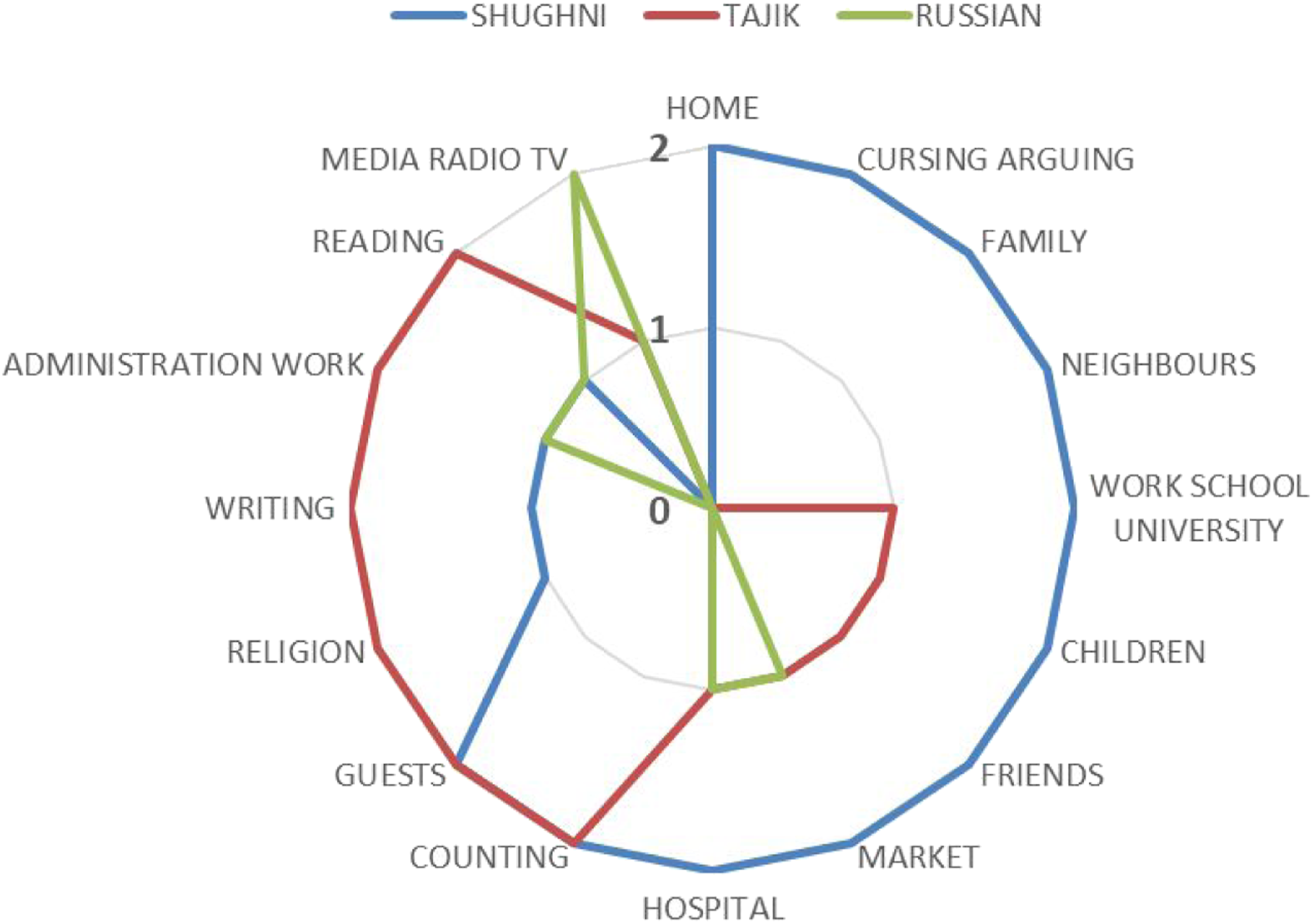
Language Functions in Khorugh, MBAP, Tajikistan.
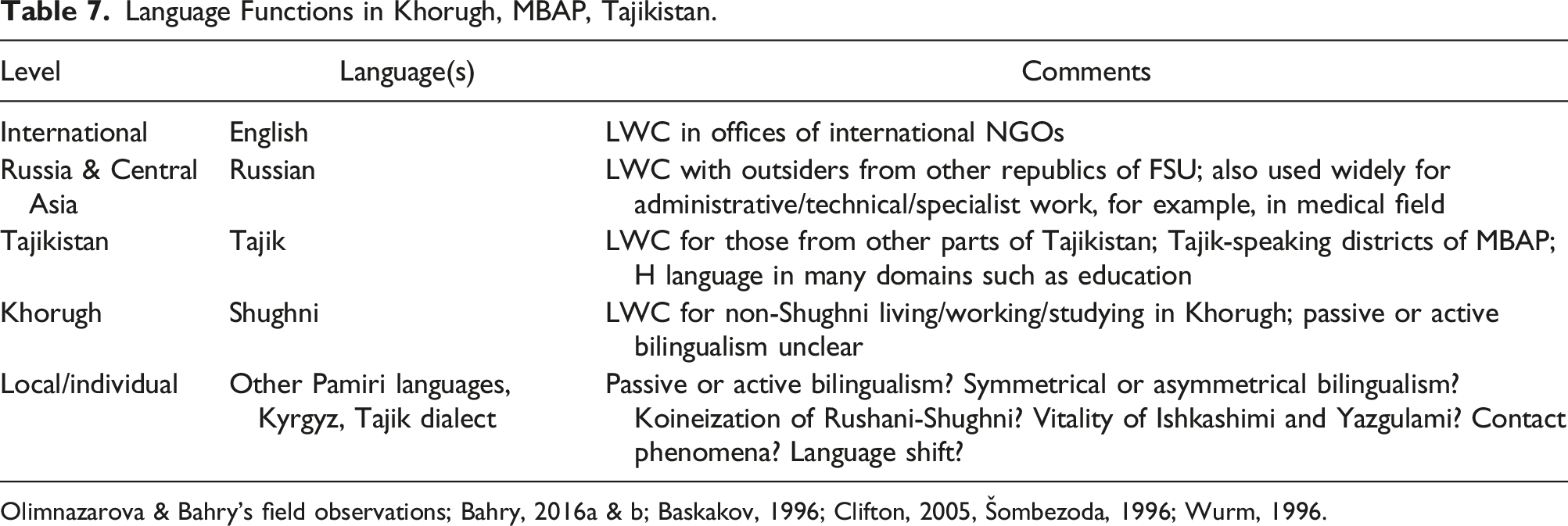
Olimnazarova & Bahry’s field observations; Bahry, 2016a & b; Baskakov, 1996; Clifton, 2005, Šombezoda, 1996; Wurm, 1996.
Language Ecology of Schools: Monolingual and Parallel Medium Schools Versus Multilingual, Plurilingual Schools
School Types by Number of Programs in 2009 & 2020 By Language(S) of Instruction (LOI) (N).
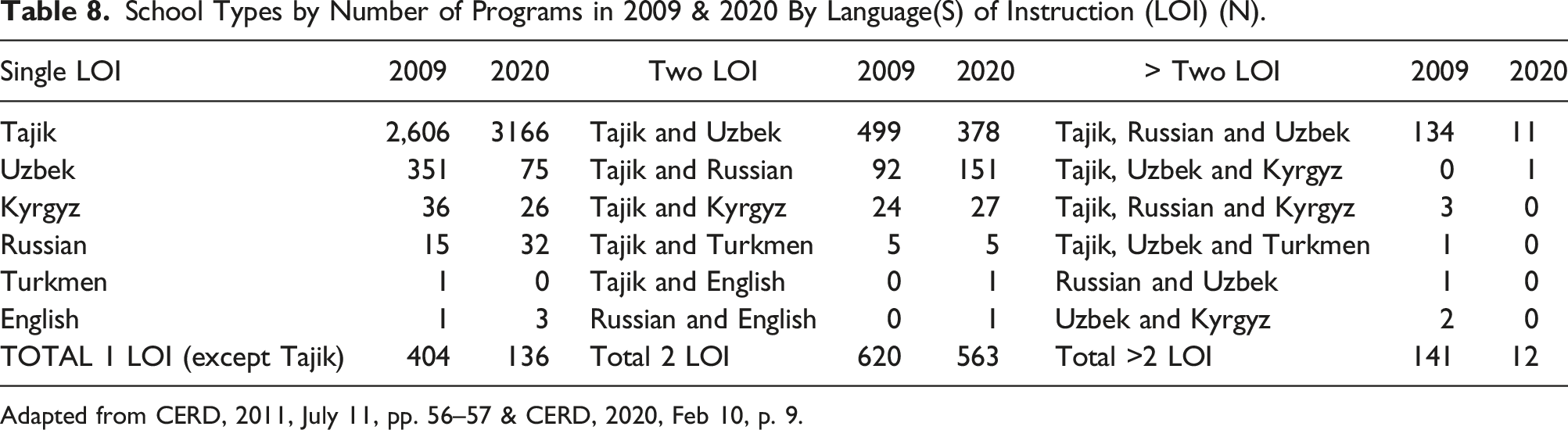
Adapted from CERD, 2011, July 11, pp. 56–57 & CERD, 2020, Feb 10, p. 9.
In recent years, education approaches worldwide have gone beyond not only one, but even the use of two or more languages, teaching curriculum content multilingually or plurilingually. A multilingual approach uses two or more languages of instruction but keeps the courses and languages of instruction apart in separate classes although all students will use two or more languages to learn content. A plurilingual approach is one in which within a single classroom and subject, two or more languages of instruction/communication can be used. Research shows that allowing the use of students’ stronger languages as resources in the learning of additional languages enables them to better understand, participate and learn via translanguaging (using more than one language to express their meaning); it also establishes conditions where underlying language proficiency can transfer from language x to language y, all of which should allow for better learning and a more positive experience for learners (Cenoz & Gorter, 2013; Cummins, 2021; García & Li, 2015; Piccardo, 2013).
Officially, educational programs in the Soviet tradition were monolingual. There were also, however, schools where programs using different LOIs existed at one school site, so called ‘parallel medium schools’ (Lewis, 1972). These would seem to be multiple monolingual programs rather than multilingual or plurilingual schools where each student would experience instruction in more than one language in one school. Within contemporary Tajikistan there are still many ‘parallel’ schools, which seem to keep their language programs formally distinct. Nevertheless, there is a possibility that there may be some informal overlap in LOI that goes unreported. Research elsewhere, for example in Welsh/English education and in Spanish English education (García & Li, 2015) and our experience (Olimnazarova, 2012) indicate that informal translanguaging among students and even teachers is quite widespread; however, research on translanguaging in Tajikistan has received little attention. Niyozov reported (2001) that in Pamiri speaking areas where the language of instruction was Tajik there was informal use of the local language by teachers to discipline children and to supplement teaching when understanding was weak. Olimnazarova (2012) reported on her own practice using translanguaging of multiple languages in teaching English (English, Russian, Tajik and Shughni) to facilitate learning and improve the atmosphere of learning. Indeed, Niyozov (2001) also reported an extracurricular activity for elementary school students on the history of the Great Patriotic War, where a local veteran spoke about his experience in Shughni, Tajik and Russian. It is likely that similar unofficial multilingual or plurilingual practices are going on in state and private schools in other parts of Tajikistan as well, but we have been able to find little research on this.
However, some domestic scholarly interest in multilingual education has recently appeared. An argument has been made by one scholar of Tajikistan’s languages that it is highly beneficial to Tajikistan’s educational and social development to prepare to open multilingual education programs, for example, Tajik–Russian–English schools, thus raising the level of multilingualism in high status languages alongside Tajik (Shambezoda, 2019). Of course, if multilingual and even plurilingual programs are widely opened, this would have some impact on language repertoires within Tajikistan.
Conclusion
The current article is a tentative exploration of the range of languages on the territory of Tajikistan, their functions of use, and their interrelationships as well as the degree of monolingualism and plurilingualism in Tajikistan. The main limitation of this study is that it is mostly based on published reports and with very little field work. We have also mainly relied on literature in English and may have missed some significant published literature in Russian and/or Tajik, as well as relevant grey literature (non-scholarly reports, etc.) on languages in Tajikistan. School-based observation is limited to two academic theses. Our findings towards multilingualism and plurilingualism of the Tajikistan population are largely inferred from statistics and our informal observation. Nevertheless, it is possible from available material to paint a general picture of the features of Tajikistan’s language ecology by bringing together multiple published data sources.
It is clear that Tajikistan is a highly multilingual society with many plurilinguals who are proficient in two or more languages. The degrees of multilingualism in Russian receded after independence, but is still relatively common. Knowledge of the Tajik language in the whole population is higher than before independence. Statistical data do not specifically mention languages other than Tajik and Russian, and those of the nationalities of Tajikistan: they only mention ‘other languages’. Thus, we cannot speak exactly about numbers of speakers of specific foreign languages, but anecdotal evidence and grey literature suggests rising use of English as an additional language.
Of course, there is a need for much more comprehensive research to fill in the gaps with more detailed statistical data on language abilities, school enrolment, etc., as well as qualitative field work on language proficiencies amongst the population, especially the frequency of multilingualism/plurilingualism in families, communities, and educational and other institutions. Further research in this area can help to inform the development, implementation, and revision of evidence-based language and education policies. We follow Kachru (2006) in calling for greater sociolinguistic realism in Tajikistan, considering all languages and language varieties, and how they are appropriated for use in local ways and for local purposes which can perhaps support research, policy, and practices that would align more closely with sociolinguistic reality in the language ecology of Tajikistan.
One evident policy and research implication of this study is in agreement with Shambezoda (2019) on the possibility of opening experimental multilingual and plurilingual educational programs, including Tajik, and/or international languages as well as other languages of Tajikistan. Our review suggests that the number of current parallel medium schools offers possible sites for implementation of multilingual or plurilingual educational programs, as all that is needed to establish a multilingual education program, is to soften the boundaries between separate language programs to allow each student to take some curriculum content courses in one of the other language programs. To establish a plurilingual approach, the first step is to allow students to use all languages within their linguistic repertoires as learning and communication resources within each class. There is a need also for further theoretical and practical research on multilingualism and plurilingualism in education, which could draw on some of the insights from international research, but also from assessing the experience of Kazakhstan with its trilingual education program, about which a considerable amount of research evidence is accumulating (Karabassova & San Isidro, 2020; Mehisto, 2015; Mehisto et al., 2014). Indeed, there may be fruitful opportunities for collaborative research between Tajikistan and Kazakhstan in the fields of language policy and multilingual education.
Footnotes
Declaration of Conflicting Interests
The author(s) declared no potential conflicts of interest with respect to the research, authorship, and/or publication of this article.
Funding
The author(s) received no financial support for the research, authorship, and/or publication of this article.
Notes
Author Biographies
References
