




Abstract
After the independence of the Central Asian (CA) republics, Iran has tried to develop its relations with these sates, especially with Tajikistan. The development of bilateral relations between Iran and Tajikistan has been very important for both sides. But after nearly 30 years of political relations between Iran and Tajikistan, bilateral relations have not developed much and have faced numerous limitations. By adopting Rosenau’s theory, the current study aims at investigating Iran’s foreign policy (FP) toward Tajikistan and the factors influencing the bilateral relations between the two countries. The present paper argues that societal, governmental, idiosyncratic, and role variables, respectively, have hindered the development of bilateral relations between Iran and Tajikistan. Finally, systemic variables have had the least influence on Iran’s relations with Tajikistan, and the results show that the U.S. and its sanctions have had insignificant effect on Iran–Tajikistan bilateral relations, and in terms of the systemic variables, Iran has faced more opposition from China than any other country in the development of relations with Tajikistan.
Introduction
The Central Asian (CA) region is located between Caspian Sea, China, and Mongolia, Siberia and Alborz and Hindu Kush Mountains. Southern and southeastern parts are surrounded by mountains and its central parts include plains and deserts. The CA region has an area of 3,494,400 square kilometers (The World Fact Book, 2020a). After the Soviet Union disintegration and creation of a power vacuum in the CA region, this region which has a set of values, opportunities, and potentials, has witnessed the rivalry of powers in order to gain these values and opportunities. Geographical location, energy resources, energy transmission lines and the consumption markets (Karimi, 2015) are among the most important values and potentials of this region.
The relations between the CA states and Iran have always had a very promising potential. When the CA republics became independent in 1991, the expectations of regional governments and Iran were high regarding the further development of relations. However, despite the substantial potential of promoting bilateral and multilateral relations, Iran’s influence has remained limited (see for example: Shakir, 2017; Ahmadi, 2019; Clark, 2015) in this region. Mutual expectations to further the relations were rooted in a vision for greater spheres of possible cooperation between Iran and the CA states. Whereas, the CA region is considered as a place of reducing self-isolation by Iran, where it can be an ideal political and economic partner to the states of the region (Kumar, 2015), the CA states by developing their relation with Iran intend to diversify their partnerships with countries outside the region (Karimi, 2015).
Among the CA states, the importance of Turkmenistan and Tajikistan is evident for Iran. Turkmenistan is the only CA state which is bordering with Iran and is a gateway to the region for Iran. The conflict over the legal status of Caspian Sea is another important factor in the bilateral relations between Turkmenistan and Iran. Tajikistan is one of the states of the region that shares common cultural and ethnic values with Iran such as having a majority of people speaking Persian and the presence of Nizari Ismaili Shi’ites in the country (3% of the population (The World Fact Book, 2020b)). Tajikistan considers greater cooperation with Iran as an opportunity to diversify its partnerships with countries outside the region, which is largely confined to Russia and China. Similarly, Iran has also tried to have a better term of engagement with Tajikistan, but has not been able to formulate its interests and goals, properly. This article explains the causes of limited engagement of Iran with Tajikistan from 2009 to 2019. Rosenau’s Theory of Foreign Policy Analysis (FPA) will be applied to explain the factors which determine Iran’s foreign policy (FP) toward Tajikistan.
Rosenau’s Theory of FPA
James N. Rosenau was the founder of comparative FP. Rosenau in an article entitled “Pre-Theories and The Theory of FP” (1966) tried to propose a pre-theory from FPA in a scientific manner. The main question which was addressed by Rosenau was “which variables have more predictive and decisive role in explanation of FP?” For Rosenau (1980), FP is a multilevel phenomenon affected by the following variables: A. Idiosyncratic variables which concern individual characteristics of decision makers. These characteristics pertain to the politicians' personal experiences, which are peculiar to policy makers. Talents, values, and prior experience are examples of these characteristics which discriminate between politicians with regard to their choices as well as behaviors. B. Role variables which concern administrative, organizational, and institutional characteristics. Every responsibility has its own special characteristics, and when a politician takes a political position, he/she is required to act based on the requirements of that position. C. Societal variables which concern the non-governmental aspects of a society that influence the decision-making behavior. These include constant (such as geographic location and historical experiences) and variable (such as ideology, political, and public culture) factors. D. Governmental variables which refer to the aspects of a government’s structure which weaken or enhance the FP. Some governmental structures like the nature of a political system and the constitution are considered here. E. Systemic Variables which concern external variables. According to Rosenau, every variable which is external to the state and affects the states’ FP is studied in the framework of systemic variables.
Rosenau’s analysis of FP behavior addresses two key questions, namely questions related to policy formation and questions pertaining to the nature of international systems and their connections with subsystems. The following section of the paper will discuss the relation between international system and subsystems.
International System and Subsystems
Regarding the importance of systemic variables in FPA, this section discusses the relation between international system and subsystems. Although this article investigates Iran’s FP toward Tajikistan, the bilateral relations between Iran and Tajikistan can be well understood in the regional context. For this reason, we investigate Tajikistan and Iran relations in the subsystem of the CA.
System analyses is rooted in behaviorists’ attempts who tried to “make the field of International Relations methodologically more systematic provided the foundation for the discussion of the level of analysis” (Karaca & Yüce, 2017, p. 161). This approach assumes that the state-based approach does not provide a comprehensive approach to understanding international relations, and other main elements such as states, interactions between states, structural determinants that guide the acts of the states, and regional subsystems which constitute the international systems should be considered.
Binder (1958) did the first study to address the existence and structural mechanisms of the regional subsystems. He emphasizes that the study of international politics has two main focal points: (1) the studies which are intended to provide systemic explanations and generalizations that can be applied to all the actors of the international system; (2) the “area studies” that try to explain international politics through the FP behaviors of states. Believe in global and holistic quality of the international politics is the most important assumption that lies at the basis of these explanations (Karaca & Yüce, 2017, p. 162).
Following Binder (1958), many scholars developed different methods and terminologies concerning regional subsystems in International Relations. Cantori and Spiegel’s (1969, 1970) works are the most important works in this domain. They (1970) define subordinate system as “consisting of one state or two or more geographically proximate and interacting states which share in some degree common ethnic, linguistic, cultural, social, and historical bonds and whose sense of identity is sometimes increased by the actions and attitudes of states external to the system” (p. 6). Based on this definition, “Central Asia as a core sector of a given region consists of a shared social, political, economic, or organizational background or activity among a group of states that produces a central focus of international politics in that region” (Bharti, 2020, p. 5). Cantori and Spiegel (1970) define four pattern variables which explain regional politics as follows: (1) nature and level of cohesion; (2) nature of communications; (3) level of power; and (4) structure of relations. Central Asia is consisting of the four pattern variables (Bharti, 2020), and is only one of the core regional subsystems of international relations that constitute Central Eurasia (Cutler, 2007).
Without ignoring the importance of the relation between international system and subsystems and its role in the FP of the states, this article will show that systemic variables have had the least impact on the non-development of bilateral relations between Iran and Tajikistan.
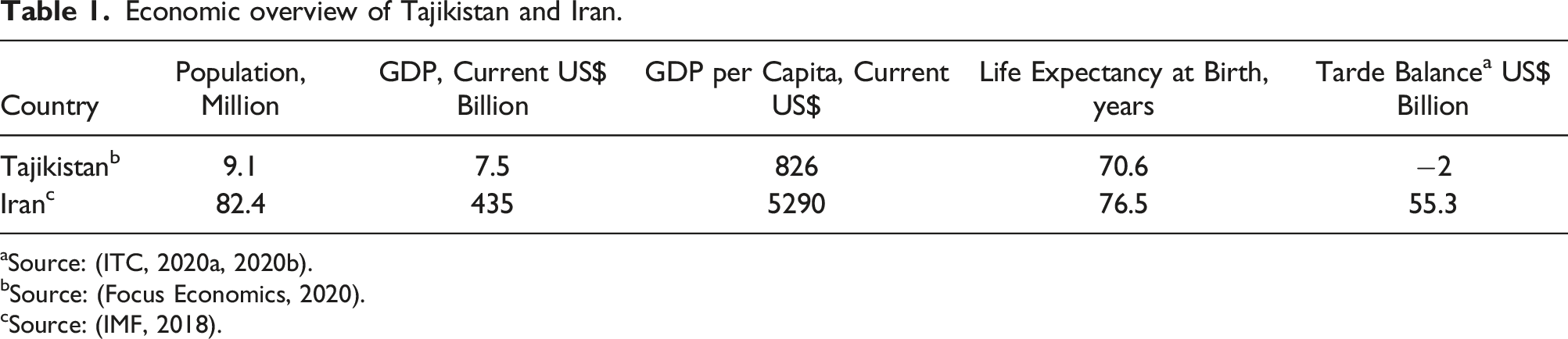
Economic Overview of Tajikistan and Iran
Tajikistan’s economy relies heavily on the extraction of minerals, the processing of metals, agriculture as well as remittances from citizens who are working overseas. Mineral resources include silver, gold, uranium, antimony, tungsten, and coal. The industry consists mainly of small obsolete factories in food processing and light industry, substantial hydropower facilities, and a large aluminum plant. Today, Tajikistan is the poorest among the former Soviet republics. Since less than 7% of the land area is arable and cotton is the predominant crop, Tajikistan imports approximately 70% of its food. The country has tried to implement reforms and build a privatized economy since the end of the civil war. However, the business climate is so poor that repels foreign investment. The economic growth in this country is negligible, but it heavily relies on remittances and narcotrafficking (Heritage Foundation, 2020).
Economic overview of Tajikistan and Iran.
aSource: (ITC, 2020a, 2020b).
bSource: (Focus Economics, 2020).
cSource: (IMF, 2018).
IRI’s Import from and Export to Tajikistan.

Source: (ITC, 2020c, 2020d).
Iran and Tajikistan are not considered important trading partners to each other. Tajikistan major trading partner countries for exports are Kazakhstan ($308M), Switzerland ($213M), Turkey ($196M), Uzbekistan ($110M), and Afghanistan ($83.2M). Also, the most common import partners for Tajikistan are China ($1.43B), Russia ($849M), Kazakhstan ($522M), Turkey ($177M), and Uzbekistan ($137M) (Observatory of Economic Complexity, 2018a), and Iran major trading partner countries for imports are China ($14B), United Arab Emirates ($9.11B), Germany ($3B), India ($2.84B), and South Korea ($2.29B). Also, the most common destinations for the exports of Iran are China ($18.9B), India ($13.4B), United Arab Emirates ($4.73B), South Korea ($3.64B), and Italy ($3.14B) (Observatory of Economic Complexity, 2018b).
Important Variables in Iran’s FP toward Tajikistan
Iran’s FP is comprised of a set of motivators or competing factors such as the threat perceptions of the state or the regime, the ideology of the Islamic revolution, national interests (Akbarzadeh & Barry, 2016) and the interaction of the Iranian regime’s various factions and constituencies. To pursue its FP, Iran utilizes its traditional diplomacy, promotes its values and interests, supports its allies by exporting materials, and seeks help from regional politicians and leaders (Katzman, 2017).
After the disintegration of the Soviet Union, Iran sought to build political, economic, trade, and cultural relations with the CA states. The Iranian decision makers tried to convince the CA states and in particular Tajikistan to warm up relations with Tehran. The main question here is that “which variables have hindered the development of bilateral relations between Iran and Tajikistan?” Using Rosenau’s (1980) FP theory, this section explains this issue during the presidencies of Ahmadinejad and Rouhani (2009–2019):
Idiosyncratic and Role Variables
The president is highest-ranking government official in Iran after The Leadership. Therefore, his personal characteristics, programs, decisions, and policies play an essential role in directing Iran’s FP. From 2009 to 2019, Ahmadinejad and Rouhani were the two presidents of Iran who were influential in Iran relations with Tajikistan through their personal characteristics, plans, decisions and policies.
Serving as the sixth President of Iran from 2005 to 2013, Ahmadinejad was influential with regard to the changes he made in Iran FP orientation with slogans like justice, fighting corruption, adopted confrontational-assertive as well as accommodationist-active FP (Haji-Yousefi, 2010). In his view, the national government is defined in the context of Islamic-Shi’ite ideology and not only is not secular in nature, but also has a purely religious and Islamic nature. This view has a kind of moral view towards the government and the establishment of a religious community based on the principles and values of Islamic Sharia. The identity of the Islamic Republic of Iran is emanated from the identity of Islam, the Islamic Revolution and Iran. During his presidency, the Islamic-Shi’ite nature and identity also defined national interests and goals. In other words, national interests and goals are defined in terms of Islamic values and principles (Ismaili, 2011).
To put it another way, he maintained that Iranian national identity is mainly characterized by Islam, showing the Islamic nature of Iran and its related responsibilities and functions (Haji-Yousefi, 2010). In this way, Ahmadinejad combined several themes—anti-imperialism (especially anti-Zionism) and anti-capitalism with a Shi’a eschatology and feeling of national exceptionalism (Akbarzadeh & Barry, 2016).
During this period, taking conflictive foreign policies caused Iran to be perceived as a security threat to the other states of the world. Adopting an aggressive and revisionist strategy toward the structure of the existing international system eventually caused Iran to fail in the field of foreign and economic policy, leading to the loss of economic partners and international markets for Iran. Adoption of such non-economic strategies by Iran paralyzed the Iranian economy and in the field of the international system caused the issuance of repeated Security Council resolutions, damage to international prestige, reduced success in attracting foreign investment and lack of appropriate development of economic diplomacy (Zolfaghari & Zeinivand, 2018).
This trend was also evident in the relations between Iran and Tajikistan during the presidency of Ahmadinejad. Iran failed to properly implement economic projects in Tajikistan as well as expand trade relations. Iran’s failures to open the Anzob tunnel as well as the Sangtuda 2 hydroelectric plant were examples of these failures. In addition, the image of Iran during Ahmadinejad’s presidency was tarnished in such a way that, according to WikiLeaks documents in 2010, Ahmadinejad’s presence in Dushanbe caused considerable worries and discomfort among Tajik officials. Suhrob Sharipov, the Director of the Tajik President’s Strategic Research Centre, in a private meeting with U.S. diplomatic officials expressed his concern regarding the close political engagement of Tajikistan with Iran. He maintained that the international reputation of the country can be tarnished by such an engagement (Clark, 2015).
Ahmadinejad’s beliefs and values caused serious tensions in Iran–Tajikistan relations. Conflicts intensified in areas such as television programs, relief foundation activities, and scholarships for Tajik students. In the negotiations related to the launch of the Iran-Afghan-Tajik TV channel, Asadullo Rahmonov as the chairman of the Tajikistan Committee for Television and Radio Broadcasting stated that they will make Iranian female presenters do not wear hijab, in case the Iranian government forces Tajik female presents to wear hijab. Some Tajiks considered Imam Khomeini Relief Foundation (IKRF) as a Torojan horse in Tajikistan, which aimed at propagating the values of Shi’a (Clark, 2015), since one of the main activities of these foundations was the distribution of Shi’ite religious books as well as Imam Khomeini’s books in Tajikistan (Shakir, 2017).
The increase in the scholarships given to Tajik students to continue their education in Iran was another source of discomfort for Tajik officials. As a reaction, Rahmon ordered Tajik students in neighboring countries to return home, fearing that they are inculcated with fundamentalist Islamic values which might result in the destabilization of the state, and they will return home later as extremists and terrorists (Clark, 2015).
Ahmadinejad’s personal characteristics as a fundamentalist and a believer in the Islamic-Shiite nature and identity of national interests and goals have had a negative impact on relations with Tajikistan and have aroused the negative reactions of the Tajik government. In a way that in March 2013, the president of Tajikistan expressed his concern regarding the increasing threats in the world such terrorism, fundamentalism, drug trafficking, and separatism after Tajikistan’s independence, and he put that these are threats that Iranian leaders claim to share. He emphasized on the expansion of relations with Iran, but since then, no major project has been announced by the Tajik government with Iran (Katzman, 2017, p. 27).
In June 2013, the election of Hassan Rouhani as the president of Iran was important regarding the changes in Iranian politics. Contrary to Ahmadinejad’s presidency, Rouhani’s presidency reflects disparate position regarding internal as well as external affairs, especially with regard to the West. Some sees Rouhani as a moderate or a reformist, but there are some skeptics in this domain (Menashri, 2013). However, like Ahmadinejad’s government, Rouhani’s government operates within the Iranism, Islam, and Shi’ism boundaries. Ahmadinejad and Rouhani have shared a same position in FP, they have chosen strategies that are radically different. Representation of the Islamic Republic’s corporate identity via a more temperate social identity is the strategy by means of which president Hassan Rouhani has tried to regain Iran’s credibility (Akbarzadeh & Barry, 2016).
Not only there was no significant change in Iran–Tajikistan relations during Rouhani’s presidency but also catastrophic setbacks emerged in bilateral relations. The most important reasons for this can be the listed as follows: accusations of Iranian meddling in the Tajik civil war, Iran’s sponsorship of the Tajik Renaissance Party, hosting its leaders in Tehran and a financial dispute involving the Iranian businessman Babak Zanjani who keeps his wealth in Tajik banks (Shafiev, 2016).
Societal Variables
In relation to societal variables, a set of constant variables (such as geographical location and energy resources) and variable factors (such as ideology, ethnic-linguistic composition) have affected Iran–Tajikistan relations. Iran is at the center of overlapping geopolitical regions and benefit from a special role and position due to its strategic maritime and land positions. In addition, Iran benefits from a strategic economic position that puts it at the crossroads of the world’s energy production and consumption centers. Iran is located in the center of the two energy resources including the Gulf and the CA-Caucasus regions. It is also located in the center of two energy-consuming regions including East Asia and Europe. Therefore, Iran, as the intersection of energy production and consumption axes, has a high distributor position (Dehghani Firouzabadi, 2013).
Tajikistan, on the other hand, is a landlocked country, and its geographical location and transportation restrictions have made it dependent on Uzbekistan and Russia in many ways, which are being used as a pressure tool against the country (Amirahmadian & Rezazadeh, 2012). In addition, Tajikistan is a member of Eurasian structures such as the Commonwealth of Independent States (CIS), the Shanghai Cooperation Organization, and the Russian-dominated Collective Security Treaty Organization (Rezvani, 2019). The geographic location can be a positive and constructive factor in the bilateral relations between Iran and Tajikistan, and Tajikistan can benefit from Iran’s geographical location to access open seas and the world markets and to balance the pressure of Russia and Uzbekistan.
Energy resources and energy-driven economic policies are important in determining the pattern of Iran’s foreign relations and also Iran’s relations with other international actors. Iran’s single-product economy requires certain patterns of foreign interactions. The country’s need for global markets to export energy, also the need for foreign investment to modernize and development of the energy sector, energy security and participation in the construction of energy transmission lines have forced Iran to adopt a conciliatory FP, normalization, and development of relations with other countries.
Energy transfer from Iran and CA to other countries is one of the variables influenced Iran’s relations with other countries. In contrast, the need to import energy in order to ensure energy security is an important factor influencing Tajikistan’s FP. 25 oil, condensate and gas fields have been discovered in Tajikistan, most of which are underdeveloped. Until now, the state balance of oil reserves includes 20 fields, of which 12 are located in the Fergana Basin and eight within the Afghan-Tajik Basin. The annual capacity of hydrocarbon raw materials in Tajikistan is 23.780 tons of oil and 1.600 thousand cubic meters of gas. The production volume of petroleum products in this country is insignificant compared to the imported petroleum products from abroad. Meanwhile, in February 2019, the country imported 27.4 thousand tons of petroleum products worth more than $18 million. Russia, Turkmenistan and Kazakhstan are the most important suppliers of energy to Tajikistan (Bakhtdavlatov, 2019). Although energy is Tajikistan’s most important imported commodity, Iran does not have a significant share and position in the Tajik energy market. For example, Iran is the 18th largest energy supplier to Tajikistan with energy exports worth $219,000 in 2019 (ITC, 2020e). Therefore, the energy variable, as one of the fixed national factors, has not had much influence in Iran-Tajikistan relations.
Ethnic, linguistic and religious minorities are one of the social characteristics of Iran. The existence of ethnic and linguistic ethnicities sharing commonalities with Iran settled in neighboring countries, while being tense and challenging, can also provide grounds for cooperation. Many Tajik citizens belong to the Tajik ethnic-linguistic group, which share a common culture with the majority of the Iranian people. This is one of the most important factors shaping the relations between Iran and Tajikistan, but it has not been used appropriately by the parties and it has not been an effective variable in the development of bilateral relations.
In relation to the ideological variable, the FP of the Islamic Republic is based on the export of Islamic Revolution. Therefore, one of the ideological principles and strategies followed by Iran in the field of FP action is its desire and intention to achieve divine sovereignty and the expansion of the Islamic values. One of the principles that has an ideological dimension and originates from the Islamic nature of the Iranian revolution and is enshrined in the constitution is the support of Islamic movements. This, in turn, shows the impact of the ideology of the revolution on the Iran’s FP orientations (Mahmoudikia & Dehshiri, 2020). The impact of this factor on Iran’s FP toward Tajikistan has manifested itself in support of the Islamic Movement of Tajikistan, which paved the way for the two countries to diverge.
In contrast, Islam has entered Tajikistan over the past 13 centuries, and the Islamic Movement Party has fueled Islamic awakening in the country. In this regard, Tajikistan has experienced Islamic education, the establishment of Quranic schools, and the construction of mosques. However, with the fall of the Soviet Union and its political independence, and with Emomali Rahmon adopting a policy of secularization, the process of Islamic awakening was moderated. The development of Iran’s relations with the Islamic Movement Party provoked and dissatisfied Tajikistan. This led to tensions in Iran’s relations with Tajikistan, especially in 2015, when Tajikistan declared the Islamic Movement Party as a terrorist organization. Under the leadership of Rahmon, Tajikistan continued to secularize its political system. In this regard, specific procedures were adopted to change Islamic identity and implement secularism; For example, a draft law was passed in 2015 to prevent the use of Arabic names and to prohibit the sale and purchase of Islamic cultural products (Shakir, 2017). Therefore, ideology as a factor of societal variable has limited the development of Iran-Tajikistan relations.
In general, among different societal variables, factors like geographical location, ideology, historical, racial and linguistic commonalities have played more important roles in determining the relations between Iran and Tajikistan.
Governmental Variables
For Rosenau (1980), governmental variables refer to the aspects of a government’s structure which weaken or enhance the FP. Some governmental structures like the nature of a political system and the constitution are considered here.
The goals of Iran’s FP are manifested in the Constitution of the Islamic Republic. These goals are as follows: human well-being, independence of the country, fighting with oppression, seeking justice, rejection of the world hegemony of superpower states, support of the rights of the oppressed, brotherly commitment to all Muslims, their coalition, the unity of Muslim nations and the unity of the Islamic world, as well as the defense of the rights of the Muslims of the world, non-commitment to the “imperial powers”, fight with colonialism, the prevention of foreign states’ influence, the preservation of territorial integrity, opposition with the treaties which can lead to domination of the foreign states on the country’s natural resources, economy, culture and army and finally peaceful reciprocal relations with non-combatant states (Articles 2, 3, 152 and 43 of the Constitution of the Islamic Republic of Iran).
In the Islamic Republic of Iran, the decision-making structure in FP is clear. There are political, social, religious and economic groups that are influential and react to the policies adopted by the official bodies. Among them are political parties, Combatant Clergy Society, Association of Combatant Clerics and Society of Seminary Teachers of Qom. But FP decision-making has a certain hierarchy and system. The formulation and implementation of FP in Iran is mainly in the field of powers of the leadership, the Legislature and the Executive branches, each of which has specific powers in this field.
Along with the constitution, the nature and type of political system is one of the influential variables in Iran’s FP. Iran’s political system is an ideological system that, since the beginning of the Islamic Revolution, has called for the fight against global arrogance and the protection of oppressed nations with the slogan of neither the West nor the East. Therefore, every person who is the president of this country must adhere to the ideology of the system and respect the interests related to the Islamism of the system (Ismaili, 2011). That is why, regardless of the fact that different people are presidents, there is not much change in Iran’s FP and there are only changes in strategies. But the question that arises here is: how does this variable affect Iran-Tajikistan relations?
The political-military nature of Tajikistan is secular and in stark contrast to the religious-ideological type of political system in Iran. During Rahmon’s presidency, secularism was enforced and implemented by the Tajik regime to change the country’s identity. For example, Arabic names or names with Arabic implications were prohibited by the government. Also, on September 29, 2015, the Islamic Renaissance Party was classified as a terrorist organization and key members of the party were sentenced to prison (e.g., Shakir, 2017). Also, tens of websites supported the party were blocked by the Tajik Supreme Court under the pretext of it criticizing the regime and averting a civil war.
Iran-Tajikistan relations were damaged by the above-mentioned actions, particularly, after providing the Renaissance Party with refuge by the Iranian government. The tensions between the two countries increased when Muhiddin Kabiri, the leader of the Tajik Islamic Renaissance Party, was invited to attend the Islamic Unity Summit in December 2015 in Tehran, where he met the Iranian Supreme Leader, Ali Khamenei (Shafiev, 2016). In a documentary made in 2017, the Tajik Foreign Ministry accused Iran of meddling in Tajik’s civil war. According to the documentary, Iran’s government supported the Tajik Islamic Renaissance party by providing money and training militants. Also, Iran’s government was accused of bankrolling diplomatic assassinations and involving Tajik diplomats in illegal activities (Shakir, 2017). Following, Tajik authorities banned the distribution of Khomeini’s and other prominent clerical books in the country. Earlier, the Tajik authorities closed the offices of the IKRF, the Iranian Cultural Consultancy, and the joint hospital for the Tajik- Iranian Red Crescents in Dushanbe (Tasnim News Agency, 1 December, 2017).
The adoption of Islamist and Shi’ite policies, as well as the ideological nature of the Iranian political system, especially during Ahmadinejad’s presidency, created a stalemate in Iran-Tajikistan relations. Since the Tajik government, with its secular nature, which considers Islamic movements as threat to its national interests, sees Iran’s policies as a threat to its very existence. All of these factors went hand in hand with the Tajik government shutting down institutions such as the Khomeini Supply Foundation, the Iranian Cultural Consultancy, and the joint hospital for the Tajik-Iranian Red Crescents in Dushanbe.
Systemic Variables
Rosenau (1996), in expressing different levels of FPA, considers the role of systemic variables. In this regard, the reaction of countries such as the U.S., Russia and China in regulating Iran’s relations with the CA republics, and especially with Tajikistan, is of paramount importance. The FP action of the Islamic Republic has taken different strategies with the change in the environment of the international system and has formed a variety of different policies. In a way that different forms of FP behavior ranging from “neither Eastern nor Western” politics and non-commitment in the bipolar world to the policy of “looking to the East, regionalism, multilateralism, and anti-hegemony in the postwar period” (Mahmoudikia & Dehshiri, 2020) can be characterized. Developing bilateral relations with Tajikistan finds importance in the form of looking at East in Iran’s FP.
In relation to the U.S., Iran’s foreign relations has been negatively affected by the change of international conditions and the withdrawal of the Trump administration from Joint Plan of Action (JCPOA), and the following re-imposition of sanctions against Iran. For the Trump administration, targeting the Iranian economy is the best way to deprive Tehran of the financial resources required to pursue regional policies and support allied and proxy groups. Therefore, imposing severe economic sanctions and preventing foreign investment in the main sectors of the Iranian economy, especially the oil sector, is one of the most important elements of the maximum pressure policy of Trump administration that can reduce the country’s income and Iran’s maneuvering power in the region. To that end, Trump imposed sanctions on Iran after leaving the JCPOA, urging Iran’s trading partners to suspend trade with Tehran (Azizi et al., 2020).
In the CA region, one of the most important strategies of the U.S. has been to prevent the CA region from becoming a sphere of influence for Iran. In this regard, despite the fact that Iran has a good position on the route of energy transmission lines to world markets, the United States has supported the east-west routes (Yuldasheva, 2017). In addition, solving energy problems and establishing constructive relations with Kazakhstan and Turkmenistan, preventing the increase of Russian and Chinese influence in the region while constructively cooperation with them, restraining Iran and especially preventing Iran’s presence in the energy sector of the region has been one of the most important goals of the United States in the CA (Kohkan & Sahabi, 2018). The U.S. economic and trade cooperation with Tajikistan must be taken into account to assess whether Iran’s relations with Tajikistan is affected by the U.S. sanctions against Iran, because the deeper the U.S. economic and trade cooperation with Tajikistan, the more reduction of Tajikistan’s relations with Iran due to the U.S. pressures.
The most common import partners for Tajikistan are China ($1.43B), Russia ($ 849M), Kazakhstan ($522M), Turkey ($177M), and Uzbekistan ($137M) (Observatory of Economic Complexity, 2018a), and the important point in the investigation of Tajikistan’s main import partners is that Iran and the United States do not have a significant position among Tajikistan’s main import partners. In fact, the total value of Tajikistan’s imports from Iran and the U.S. were $46 and $44.3 million in 2019, respectively (ITC, 2020e).
The most common destinations for Tajikistan exports are Kazakhstan ($308M), Switzerland ($213M), Turkey ($196M), Uzbekistan ($110M), and Afghanistan ($83.2M). Despite numerous neighborhoods and cultural, historical, and linguistic commonalities, the share and value of Iranian imports from Tajikistan is very low. In fact, the total value of Tajikistan’s exports to Iran was $21 million and to the United States was $1 million in 2019 (ITC, 2020f). Therefore, Tajikistan’s trade relation with Iran is not very affected by the U.S. sanctions on Iran due to Tajikistan’s low level of dependence on the U.S.
In relation to China, it should be noted that China considers the CA region as an important part of the stability and development of its western region. Tajikistan, Kazakhstan, and Kyrgyzstan have a special place in China’s diplomacy in the CA due to bordering with China. The three countries have minorities within China which have created a complex network of relationships and concerns. In addition to regional stability and security priorities, China attaches special importance to the geography of the CA region in order to implement the “The Belt and Road Initiative” and integrate Eurasia through the development of trade routes (Thornton, 2020).
China’s presence in Tajikistan’s economic and industrial dimensions is remarkable, and Chinese companies have invested heavily in Tajikistan’s mining and railway sectors. Even China’s engagement in different sectors of Tajikistan including politics, economy, culture, and education has also increased (Hedayati Shahidani & Azin, 2017). Since China is the largest foreign investor in the region, along with the increase in the number of joint ventures, the debts of the CA countries to China are also growing. Countries such as Tajikistan and Kyrgyzstan, which, unlike other CA countries, have lower export capacity due to the dependence on workers in other countries, are more exposed to China’s debt trap. In this regard, Tajikistan owes about $1.3 billion to Exim Bank of China, which accounts for about 40% of the country’s total debt of $2.9 billion. Due to the fact that Tajikistan does not have the economic capacity to repay its debts, Chinese companies have acquired mining rights (Kumer Gupta, 2020), which in turn could monopolize opportunities of economic cooperation with Tajikistan in the long run and reduce cooperation capacity with other countries such as Iran.
In relation to Russia, the main concern of its FP in the CA region is related to security issues than other factors. It considers the military and security affairs of the CA region as one of the privileges of its empire and defends it as its moral duty (Rezvani, 2020). In this regard, Russia, through the establishment of the Collective Security Treaty Organization, bilateral military treaties, and military bases in the region have established its military and security position in the region, but it is less influential in the economic sphere. For example, despite Russia’s concerns about China’s growing influence in the CA region, Moscow cooperates with Beijing, especially in the economic fields and energy sector. Cooperation with China will help Moscow not only regain some of its diplomatic space, but also settle the problems posed by Western sanctions. China continues to expand its economic presence in the region and maintains its leadership in the domain of foreign direct investment in the region. In this regard, China-CA trade between 2007 and 2019 doubled to about $40 billion (Safari et al., 2020). This suggests that Russia can be seen as an obstacle to Iran’s military and security cooperation with the CA, and in particular with Tajikistan, but in the economic and trade spheres, Iran is not faced with Russian obstacle except for the energy sector.
In general, a study of Tajikistan’s economic and political situation shows Russia and China’s prominent role compared to the United States in the country’s economic and political structure. This diminishes the effectiveness of the U.S. policies against Iran in the CA. Experiences of the sanctions before the JCPOA and Tajikistan’s high cooperation with Iran at that time also illustrates this point.
Concluding Remarks
Tajikistan, with its predominantly Tajik population, has many ethnic-linguistic ties with Iran, which has been seen as an opportunity by Iran to develop its relations with Tajikistan. An examination of Iran’s FP toward Tajikistan shows that despite ethnic-linguistic and to some extent religious ties, Iran and Tajikistan relations have been limited, and bilateral relations have not been developed to a desirable level, and bilateral relations have seen vicissitudes.
Using the Rosenau FPA Theory, this article investigated the limitations in the bilateral relations between Iran and Tajikistan. Applying this theory to Iran’s FP toward Tajikistan showed that idiosyncratic and role variables have played a preventive role in the development of bilateral relations. Within this framework, Mahmoud Ahmadinejad, with his own definition of FP goals within the framework of Islamic-Shi’ite ideology, caused tensions in the relations between the two countries, and although Hassan Rouhani took a different approach and tried to be different from Ahmadinejad’s Islamic-Shi’ite ideology, he tried to promote Shi’ite-Iranian values by using other strategies. The invitation of Mohiuddin Kabiri, the leader of the Islamic Renaissance Party of Tajikistan during Hassan Rouhani’s presidency to Tehran to attend the Islamic Unity Summit in December 2015 confirms this claim.
Other variables which influenced the development of bilateral relations between the two countries are societal variables. Islamic-Shi’ite ideology-as a variable factor-has an important place in the perception of Iranian FP officials and defines the requirements of the president’s role in the field of FP, which has hindered the expansion of Iran’s relations with Tajikistan. Iran’s geographic location and cultural-linguistic-ethnic commonalities -as important societal constant variables-can provide grounds for cooperation. But the ideology, governmental, idiosyncratic, and role variables prevent Iran from using these two potentials.
Other variables which hindered the development of bilateral relations between the two countries are governmental variables. The Constitution of the Islamic Republic of Iran defines the most important FP goals as the spread of Shi’ite-Islamic values and the export of the Islamic Revolution. It is obvious that Iran, with its ideological nature, and Tajikistan, with its secular nature (which is faced with the spread of extremist Islam in the country), have serious limitations in the development of bilateral relations. Closing some Iranian institutions such as the IKRF, the Iranian Cultural Consultancy, and the joint hospital for the Tajik-Iranian Red Crescents in Dushanbe are examples of conflict of views as well as interests between the two states.
The systemic variables are the last important variables influencing the development of Tajik-Iranian relations. One of the most important strategies of the U.S. in the CA region has been to prevent Iran’s influence in this region. Following the adoption of a policy of maximum pressure aimed at depriving Iran of trade interests, this strategy was strongly pursued by Donald Trump administration. But Tajikistan’s trade relations with Iran have not been much affected by the U.S. sanctions on Iran due to Tajikistan’s lack of dependence on the U.S. The other obstacle in developing Iran–Tajikistan relations has been China. It is the largest foreign investor in Tajikistan and has sought to monopolize long-term economic cooperation opportunities with Tajikistan and reduce Tajikistan’s capacity to cooperate with Iran. In relation to Russia, the main concern of its FP in the CA region is related to security than other factors. This shows that Iran is not faced with Russia’s obstacle in developing the economic relations with Tajikistan, except for the field of energy.
Regarding that societal, governmental, idiosyncratic and role variables, respectively, have hindered the development of bilateral relations, further development of Iran and Tajikistan bilateral relations in the future cannot be imagined. Because these variables are among the foundations of FP of the states, and the change in these foundations is not imaginable, especially in ideological regimes.
Footnotes
Funding
The author(s) received no financial support for the research, authorship, and/or publication of this article.
