






Abstract
The large majority of elections in the post-Soviet area, by some accounts the most authoritarian region in the world, are marred by large-scale electoral malpractice. Since the late 1990s, the final reports from OSCE election observation missions include numerical data on the quality of election-day procedures as judged by election observers. With these data it is possible to study trends and patterns in the prevalence of electoral malpractice in the post-Soviet area. This study accordingly explores the relationship between electoral malpractice and three variables: the type of elections (presidential or parliamentary), the presence of electoral competition (present in competitive elections, absent in hegemonic elections), and the advance of time. The findings suggest that electoral malpractice does not significantly decrease over time, is as widespread in parliamentary as in presidential elections, but, in line with expectations, is more severe in hegemonic elections than in competitive elections. These findings contribute to insights about the nature of authoritarian elections and are important for considerations about the future of election observation in the region.
Introduction
Over the past decade democracy has suffered a more significant setback in the post-Soviet area (outside the Baltic states), than in any other region in the world (Puddington, 2010; p. 140). Whereas there were great expectations for democratization in the early 1990s, the post-Soviet area at the end of the 2000s counted as the most authoritarian region worldwide next to the Middle East and North Africa (Swedberg & Sprout, 2008). The poor state, or absence of democracy in the post-Soviet area is witnessed in the conduct of elections: until 2010, nine countries in the region – Armenia, Azerbaijan, Belarus, Georgia, Kazakhstan, Kyrgyzstan, Tajikistan, Turkmenistan, and Uzbekistan – had not organized a single election that did not draw significant criticism from the Organizations for Security and Cooperation in Europe (OSCE) since that organization started observing and monitoring elections in the 1990s. A tenth country – Russia – received a more favorable assessment for its elections until 2003 but has since been seen as consolidating authoritarian rule (Shevtsova, 2007). The regimes of these countries for most of the 2000s could be divided into three types: competitive authoritarian regimes in Armenia and Georgia that featured real political competition but a consistently uneven playing field in favor of pro-regime forces; hegemonic authoritarian regimes in Azerbaijan, Belarus, Kazakhstan, Kyrgyzstan, Russian, and Tajikistan that organized uncompetitive elections in which large victories for the regime were a foregone conclusion but in which also part of the opposition could participate and sometimes even win some seats; and political closed authoritarianism in Turkmenistan and Uzbekistan under which true opposition is outlawed, let alone can compete in elections. 1
These three regime types are derived from the regime classification presented by Larry Diamond (2002); see also Howard and Roessler (2006).
The Nation in Transit reports can be consulted at http://www.freedomhouse.org/template.cfm?page=17.
As participating states of the OSCE, the undemocratic states of the post-Soviet area have an obligation to invite OSCE observer missions. In response to these invitations, almost every national election has been visited in nine of the twelve post-Soviet countries by election observation missions, each with at least one hundred, and in most cases several hundred observers. Large missions are no longer dispatched to Russia starting from 2007, while elections have been observed only by expert teams in Turkmenistan and Uzbekistan. Around the elections they observe, the OSCE missions publish a series of interim reports, a preliminary statement one day after the elections, and a final report, some two months after each election. The reports contain a wealth of information about electoral malpractice in every election. Electoral malpractice is understood here as any type of violation of the fundamental principles of free and fair elections. 3
This understanding of electoral malpractice is similar to that of Donno (2010). Schedler (2002) provides an overview of the fundamental principles of free and fair elections.
The final reports from observation missions to thirty-nine undemocratic elections since the late 1990s contain figures on the share of observers who assessed voting and counting procedures negatively or positively. 4
Reports from OSCE election observation missions can be consulted at: http://www.osce.org/odihr/elections.
Hegemonic and competitive authoritarian elections
The majority of elections in the undemocratic states of the post-Soviet area feature a gap in vote share between the winner of elections and the runner-up that is rarely seen in democracies. In Azerbaijan, Belarus, Kazakhstan, Tajikistan, it is common for the regime candidate in presidential elections or the ruling party in parliamentary elections to get more than five times the vote share of the main opposition force or candidate. Some elections in other countries in the region have equally been characterized by overwhelming victories for pro-regime forces. Distinctive about these hegemonic elections is that, unlike in competitive elections there is no serious doubt about the outcome prior to the elections: the regime, the opposition, and the public all anticipate a large victory for regime forces. Consequently, the period leading up to these hegemonic elections is often muted and uneventful. In its final report of the 2008 presidential elections in Azerbaijan, for example, the OSCE noted that ‘the pre-election period was characterized by the absence of a competitive campaign, the limited involvement of parties and candidates, and very low public interest in the campaign’ (OSCE/ODIHR, 2008, p. 12). Similarly illustrative is this comment from the OSCE final report on the 2004 Russian presidential election: ‘Campaigning for the 2004 Presidential Election was generally very low key. The few campaign events taking place were organized around visits by some candidates to the regions; otherwise there was almost no visible campaign activity beyond what was present in the media’ (OSCE/ODIHR, 2004, p. 12). There are, on the other hand, also genuinely competitive elections in the undemocratic countries of the region, albeit held typically under conditions that intentionally benefit regime forces. In these competitive elections, there is no near-total certainty about the outcome as in hegemonic elections, and pre-electoral campaigns consequently witness more intrigue.
The table at the end of this section displays the vote shares (in some cases seat shares) of the winner of elections and those of the main opposition force in the thirty-nine undemocratic elections for which numerical data on the quality of election-day procedures are available from OSCE election observation reports. All these thirty-nine elections were considered as significantly falling short of international standards by OSCE and were organized by regimes that at the time of the election were classified by the Freedom House Freedom in the World index as ‘partly free’ or ‘not free’. 5
Reports from the Freedom House Freedom in the World index can be consulted at: http://freedomhouse.org/template.cfm?page=15.
See Freedom House Nations in Transit reports for Belarus at: http://www.freedomhouse.org/template.cfm?page=17.
The second piece of information in the table below concerns assessments by OSCE election observers of the quality of voting and counting procedures during the undemocratic elections in the post-Soviet area that have been observed by ‘full’ observation missions, mostly over the course of the 2000s. The principal objective of OSCE election observation missions is to assess the fit between the conduct of elections and international standards for the conduct of elections. The key benchmark in this regard is the 1990 Document of the Copenhagen Meeting of the Conference on the Human Dimension of the CSCE (Copenhagen Document) that lists criteria for free elections, and to which all OSCE participating states are formally committed. OSCE's election observation can be considered a form of electoral assistance as it ultimately seeks to contribute to an improvement of the quality of elections. The other type of electoral assistance that the OSCE is involved in, often in conjunction with the Venice Commission of the Council of Europe, are reviews of electoral legislation, coupled with concrete recommendations on how to improve legislation and bring it into line with international standards.
The Copenhagen Document established the norm that OSCE participating states invite observers to their elections. Among the post-Soviet states, ‘full’ missions have never been dispatched only to Turkmenistan and Uzbekistan because, according to the OSCE, the conditions for the conduct of credible elections in these countries were too obviously lacking (Fawn, 2006, pp. 1137–8). The parliamentary and presidential elections in Russia in 2007 and 2008 respectively were equally observed by limited rather than ‘full’ missions, in this case because the Russian authorities refused to follow procedures that are usually followed when a mission is invited (Peuch, 2007). Full observer missions consist of a core team located in the capital, a few dozen long-term observers in the regions who arrive weeks before the elections and leave within a few weeks after the elections, and short-term observers, between one hundred and a thousand in number, whose work is focused on election day.
Around the elections, the missions issue a number of reports on the course of the election process. The most noted of the mission's publications is a preliminary statement that is presented during a press conference, typically with members of the European Parliament and the Parliamentary Assemblies of the Council of Europe and the OSCE, on the day following the elections. At these press conferences and in the preliminary statements, the observer missions choose a formulation to qualify the compliance of the election with international standards that is widely reported by national and international media and therefore is of significant political importance. The most informative of the mission's publications, however, is the final report, which is published around two months after election-day and which covers all stages of the electoral process. Starting from the late the 1990s most of the final reports, and often the preliminary statements as well, contain figures on the share of short-term observers who have positively or negatively assessed counting and voting procedures. Because these figures have been continuously reported since, is it possible to use these data for comparative analysis.
While the figures provide clues about the incidence of election-day irregularities, electoral malpractice can of course affect every stage of an electoral process. Apart from election day, important stages in the electoral process that can be manipulated include the drafting and amending of legislation, the registration of candidates, the drawing of district boundaries, the composition of election commissions, media reporting, and the handling of complaints and appeals. The final reports from OSCE elections observation missions provide much description regarding all these stages, but the only constant non-descriptive data are the figures on election-day irregularities.
Specifically, these figures present the percentage of observers that have replied ‘very good’ or ‘good’ – rather than ‘very bad’ and ‘bad’ – on their observation report forms in response to questions about the quality of voting and counting procedures. The table below displays the percentages for all thirty-nine undemocratic elections in the region since 1998 for which these percentages were reported in the final reports of OSCE election observation missions. In case a second round was held in elections, only the percentages from the first round are displayed. Voting procedures are typically observed in five to fifteen polling stations per observer team, while counting is only observed in one polling station per team. The number of observations that the percentages of positive assessments of counting procedures reflect, therefore, is the total number of short-term observers divided by two, while the number of observations regarding voting procedures is many times bigger, often amounting to thousands of individual observations Table 1.
Malpractice in undemocratic elections in the post-Soviet area, 1998–2010.
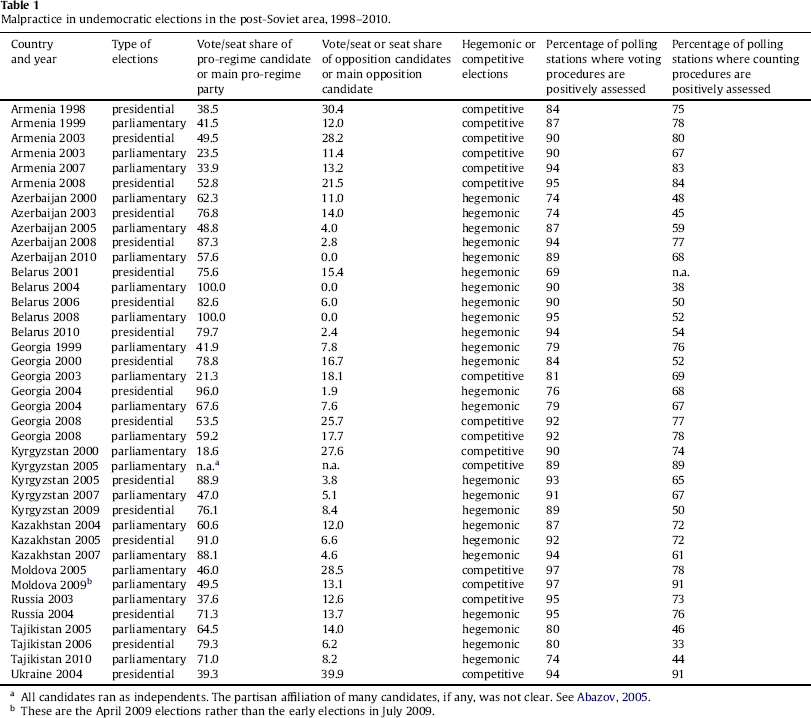
Malpractice in undemocratic elections in the post-Soviet area, 1998–2010.
All candidates ran as independents. The partisan affiliation of many candidates, if any, was not clear. See Abazov, 2005.
These are the April 2009 elections rather than the early elections in July 2009.
In addition to the mere percentage of observers who positively or negatively assessed voting and counting results, the final reports of observation missions also provide information about the irregularities that were most frequently observed during voting and counting, and that lead to a negative assessment by observers. Regarding voting procedures, the most common irregularities, according to the reports, include the presence in polling stations of unauthorized persons, multiple voting – individuals being given the opportunity to vote more than once – and ballot stuffing. Other irregularities that the final reports often mention are group voting and open voting, which both violate the principle of secrecy of the vote, and proxy voting, whereby a person (unlawfully) votes on behalf of someone else. Among the irregularities that are most often observed during the vote count are, again, the presence of unauthorized persons, tampering with results protocols – the changing of figures on those protocols – and the failure to publish the results at the polling station immediately after the count as well as the refusal to distribute copies of the result protocols to observers. While some irregularities that are noted on election day by observers may result from a lack of professionalism on the part of members of election commissions, most irregularities mentioned by the OSCE reports point to deliberate efforts to corrupt the election process. The following three sections look into the relation between the incidence of these irregularities on the one hand and the advance of time, type of elections, and presence of electoral competition on the other hand.
Does electoral malpractice decrease over time? Do authoritarian regimes become more adept at masking the manipulation of elections? Or are they unconcerned about the visibility of the manipulation and corrupt the electoral process on election day as much as before or even more? There are contrasting assumptions on the relationship between the advance of time and the degree of electoral malpractice. A simple reason to believe that electoral malpractice should have increased in the post-Soviet area is that, according to influential democracy indices, most of the ten states that were continuously undemocratic during the 2000s have become more authoritarian over the decade. Freedom House's Nations in Transit annual study of democratic development in the post-communist world also finds that the quality of the electoral process specifically has deteriorated over the past decade in all ten states, except for Turkmenistan, where it could not drop any lower, and Belarus, where it remained at 6.75 out of 7.00. A common sense assumption is that the degree of electoral malpractice goes up when electoral competition declines. An increase in overall electoral manipulation has indeed been documented with respect to elections in Russia (Treisman, 2009). Little if any solid evidence that would point to a similar increase in electoral malpractice in the other countries of the region that were persistently undemocratic during the 2000s, however, is unavailable.
The expectation of the increase of electoral malpractice over time in authoritarian states corresponds with a logic according to which undemocratic leaders increasingly grow confident that committing fraud will not be met with popular revolt. 7
For a detailed explanation of this logic, see Vorobyov, 2010.
There are, however, also reasons to believe that electoral malpractice over time will decrease. The argument that electoral malpractice is likely to decrease with the advance of time appears to be corroborated by the OSCE election observation reports, which almost invariably mention some form of progress that has been made by election-holding countries compared to previous elections. Moreover, observation reports of recent years are seemingly less damning than earlier reports in their assessments about the elections, although this may be primarily a matter of choosing different formulations. While some ten years ago it was common for the OSCE to state in its observation reports that elections plain and simple did not meet international standards, this type of formulation has been replaced by slightly more upbeat statements. About the 2001 presidential election in Belarus, for instance, the OSCE final report of the observation mission noted that the ‘election process failed to meet the OSCE commitments for democratic elections formulated in the 1990 Copenhagen Document and the Council of Europe standards’ and that among the flaws of the electoral process was ‘[a] political regime that is not accustomed to and does everything in its power to block the opposition’ (OSCE/ODIHR, 2001b, pp. 2–3). The final report for the 2010 presidential elections that were widely condemned, on the other hand, notes that the ‘presidential election indicated that Belarus has a considerable way to go in meeting its OSCE commitments for democratic elections’ (OSCE/ODIHR, 2011b, p. 1). Similarly, while, regarding the 2000/2001 parliamentary election in Azerbaijan, the OSCE found that ‘the overall process fell short of international standards for democratic elections’ (OSCE/ODIHR, 2001a, p. 1), the verdict on the 2010 parliamentary elections was that ‘the conduct of these elections overall was not sufficient to constitute meaningful progress in the democratic development of the country’ (OSCE/ODIHR, 2011a, p. 1).
Another reason why it could be expected that electoral malpractice will decrease over time is that the undemocratic regimes of the region are interested in international recognition. Taking the step of holding an election that is more credible and of better quality than previous elections could help to improve the international standing of a regime. It is not obvious, however, that the regimes are strongly concerned about their reputations, let alone that they would be ready to counteract electoral malpractice in order to improve their reputations. By effectively banning OSCE election observation since 2007, Russia has gone the furthest in demonstrating its lack of regard for the election-related activities of the OSCE. Within the framework of the Commonwealth of Independent States (CIS), and typically at the instigation of Russia, the undemocratic states of the region have also collectively criticized the practice of OSCE election observation. The CIS member states have repeatedly proposed to reduce the OSCE's ‘human dimension’, under which election-related activities fall, at the benefit of strengthening the security dimension (Tomiuc, 2004). In addition, the CIS has stepped up an autonomous election observation effort parallel to that of the OSCE. Approximately since the mid-2000s, almost every national election in the region has been visited by a CIS mission that is sometimes even bigger in size than the OSCE mission. Remarkably, CIS election observation missions have lended a stamp of approval to even the most uncompetitive elections in the region. 8
The reports from CIS election observation missions can be consulted at (in Russian) http://www.iacis.ru/html/?id=124.
The Convention on Standards of Democratic Elections and Electoral Rights and Freedoms in the CIS Member States can be found at http://www.cis.minsk.by/page.php?id=616; The Declaration on Principals of the International Observation of Elections and Referendums in the CIS Member States can be found at http://www.iacis.ru/html/?id=189.
Even if overall electoral malpractice remains on a high level, there could still be a decrease in the electoral malpractice that is committed specifically on election day. Bealieu and Hyde (2009) argue that in many undemocratic states electoral malpractice has shifted from relatively obvious fraud, committed mostly on election day, to less readily observable ‘strategic manipulation’ at different stages of the electoral process. While elections in these authoritarian states remain strictly unfair, the regimes are less likely to be taken to task for the electoral malpractice as the malpractice is not committed on election day. In Latin America, for example, the kind of ‘crude fraud’ that was commonplace until a few decades ago is said to have been virtually eliminated while electoral manipulation as such persists (Hartlyn & McCoy, 2001). Examples of ‘strategic manipulation’ include the manipulation of electoral legislation to benefit pro-regime forces, intimidation of opposition candidates, and tampering with voter lists. The reports from OSCE election observation missions abound with examples of strategic manipulation. Forms of electoral manipulation that are mentioned in almost all final reports of OSCE election observation missions of the undemocratic states of the former Soviet Union are the staffing of election commission with regime loyalists, bias in media reporting about the elections, and the use of so-called administrative resources such as public venues, government offices, and the labor of public servants, for the purposes of the election campaign of pro-regime candidates or parties.
The evidence from the post-Soviet area does not point to a significant trend in the prevalence of election-day regularities in either way: observers positively assessed voting procedures in elections until 2005 (n = 18) in 84 percent of observations against 90 percent of observations for elections since 2005 (n = 21). With regard to the assessment of counting procedures, however, the image is reversed: counting was assessed positively in 68 percent observations in elections until 2005 (n = 17), and in 66 percent of observations in elections since 2005 (n = 21). On the whole, these figures do not mark a notable trend. The limited evidence from the post-Soviet area does not provide support for the arguments outlined above regarding whether electoral malpractice is more prone to increase or decrease.
Is there a relation between the type of elections (presidential or parliamentary) and the incidence of electoral malpractice? The main reason to expect that presidential elections will see higher levels of malpractice is the winner-takes-all character of these elections. While even a relatively small vote share can win political forces some representation in parliamentary elections, anything other than a first place means total defeat in presidential elections. This is particularly pertinent to the undemocratic states of the post-Soviet area due to the weakness of legislatures vis-à-vis the presidency in those states. Formally, the political systems of Armenia, Azerbaijan, Belarus, Georgia (since 2004), Kazakhstan, Kyrgyzstan, Russia, Tajikistan, Ukraine, and Uzbekistan are semi-presidential, meaning that there is a directly elected president as well as a prime minister who is responsible to the legislature. The only purely presidential system among the undemocratic states of the region is that of Turkmenistan; Moldova by contrast is home to a parliamentary system. Of the three types of semi-presidentialism distinguished by Elgie (2005) – highly presidentialized semi-presidential regimes, semi-presidential regimes with a balance of presidential and prime-ministerial powers, and semi-presidential regimes with ceremonial presidents – nine semi-presidential regimes in the post-Soviet area fit the highly presidentialized type, while a tenth, Kyrgyzstan, did so until 2010. Most presidents in the region, whether formally or by virtue of political practice, are even more powerful, and certainly less accountable, than many presidents in purely presidential regimes, a situation that has been referred to as ‘superpresidentialism’ (Ishiyama & Kennedy, 2001). Whereas the legislative and judicial branches of power are formally separated, the executive in these countries tends to assume control over all branches of power, establishing a de facto monolithic political arrangement. The presidency, therefore, is the biggest political prize that can be won through elections, and regimes may be expected to engage in more electoral malpractice to ensure that the presidency is retained.
On the other hand, the incentive to engage in malpractice in presidential elections may be smaller than in parliamentary elections because the outcome generally is a foregone conclusion: of the seventeen presidential elections in the dataset above, only one was eventually not won by the candidate who had been nominated by the incumbent regime – the 2004 presidential election in Ukraine which led to the Orange Revolution. The authorities, arguably, can get the outcome they seek even without engaging in the costly effort of electoral corruption. In parliamentary elections, on the other hand, it can be more difficult for the regime to achieve the outcome it seeks - control over the legislature – and the incentive to engage in electoral malpractice accordingly may be stronger.
With respect to the undemocratic states of the post-Soviet area, however, the incidence of election-day electoral malpractice is seemingly unrelated to the type of elections: in parliamentary elections, voting procedures were positively assessed by 88 percent of observers, and counting procedures by 64 percent of observers. Analogous figures for presidential elections are 87 percent and 66 percent.
Does less competition mean more fraud?
The final relationship explored here is between electoral malpractice and the presence of competition in elections. Widely different and in part competing claims can be made regarding this relationship. The results of hegemonic elections by themselves may be seen as evidence of fraud: the margins between winners and runner-ups that are typical for hegemonic elections seem too wide to reflect the will of voters. In clean, democratic elections it is difficult to imagine that the winning candidate would receive eighty-seven percent of the vote against three percent for his closest competitor, as was the case in the 2008 presidential elections in Azerbaijan; or that not a single party beyond the winning party would clear a seven percent threshold in parliamentary elections, as happened in the 2007 parliamentary elections in Kazakhstan. Research on electoral fraud in Russia suggests that elections with large margins of victory indeed are more fraudulent: regions in Russia with the least competitive election results are associated with higher levels of fraud (Shpilkin, 2009).
A second and related reason to believe that hegemonic elections may feature a higher level of fraud is that a large margin of victory in hegemonic elections in itself contains benefits for the regime. A big electoral win allows authoritarian regimes ‘to project an image of invincibility and strength’ (Magaloni, 2008, p. 729). The circumstance that large-scale fraud is committed, often in a quite visible way, can further reinforce this image: a regime that commits fraud with impunity now is unlikely to be overturned in next elections. The signal of strength can have beneficial effects for the regimes at different levels: it can convince current regime insiders to stay loyal with the regime; it can discourage the opposition from further engaging in opposition activity (Magaloni, 2006); and it is likely to lead to lower turnout, especially among voters who are inclined to vote for the opposition (Simpser, 2004). Because of these benefits, authoritarian regimes are thought to rig elections even when they may not need to do so to win them.
The thesis that committing fraud with impunity enhances the perceived strength of a regime can explain why hegemonic regimes do fairly little to cover up much of the fraud that they commit in elections (Hyde, 2006) and why, as the previous section pointed out, electoral malpractice does not significantly decrease over time if it decreases at all. The election observation reports of the OSCE suggest indeed that comparatively obvious forms of fraud such as ballot-stuffing, multiple voting, vote-buying, and tampering with protocols are, as before, frequently applied in the former Soviet Union.
Still, the argument can be made that authoritarian regimes are disinclined to engage in the potentially costly act of committing fraud when they are likely to win elections by a large margin. This may be particularly so for hegemonic authoritarian regimes that firmly control the political playing field and do not allow a meaningful degree of competition in elections. The little political opposition that exists under the hegemonic authoritarian regimes of Azerbaijan, Belarus, Kazakhstan, Russia, and Tajikistan is fragmented and hapless and in no situation to pose an electoral threat to pro-presidential forces. Besides, the leaders of the regimes may calculate that much of the electorate that nourishes anti-regime sentiments is unlikely to turn out in elections.
Finally, a reason why especially competitive authoritarian regimes have an incentive to refrain from extensive and large-scale fraud on election day is the risk of post-election protests. A significant share of regime changes inside and outside the post-Soviet area in recent decades have transpired in the form of electoral revolutions (Bunce & Wolchik, 2006). In these revolutions, the popular perception that the regime has committed fraud in elections, or has even stolen elections, triggers mass protests which eventually bring an end to the regime. Three such revolutions in recent years in the post-Soviet area - in Georgia in 2003, in Ukraine in 2004, and in Kyrgyzstan in 2005 – gave rise to the belief that a new momentum for democratization was under way, and made leaders in the region aware of the risks that fraudulent elections entail. The circumstance that the three revolutions happened to competitive authoritarian regimes rather than to the hegemonic authoritarian regimes was not by chance. Among the ‘factors of success’ of the revolutions identified by McFaul (2005, p. 7) were the presence of a relatively strong opposition movement and some independent media through which the opposition was able to spread its message. These two elements are common under competitive authoritarian regimes, while political opposition is weaker and the media environment more constrained, under hegemonic authoritarianism. Competitive authoritarian regimes therefore seem especially at risk of facing the type of protests that can lead to electoral revolutions if they commit fraud. This poses a dilemma to authoritarian regimes that organize competitive elections as those elections by definition feature comparatively small margins of victory, and committing some degree on fraud on election day may be necessary to ensure regime survival. Regimes that organize hegemonic elections, by contrast, rarely are confronted with popular protests that can threaten the survival of the regime, and, as argued above, the fact that (large-scale) fraud is committed in these elections can even be seen as evidence of the strength of the regime.
Taken together, there are more, and more compelling, arguments which lead to expect that hegemonic elections in the post-Soviet area feature a greater degree of electoral malpractice than competitive elections do. These arguments are supported by the evidence. In the hegemonic elections of the data set (n = 24), voting procedures were on average positively assessed by 75 percent of observers against 91 percent in competitive elections (n = 15). An equally significant difference is found for counting procedures: observers saw a generally well-administered counting process in 58 percent of observations in hegemonic elections (n = 23), against 75 percent for competitive elections (n = 15). With respect to both voting procedures and counting procedures, then, hegemonic elections apparently are more tainted by electoral malpractice than competitive elections. This finding appears to lend credence to the argument that regimes that organize hegemonic elections aim for large victories by extralegal means.
Implications for election observation
OSCE's election observation is part of a larger electoral assistance effort that also comprises reviews of electoral legislation. Ultimately, the electoral assistance by the OSCE aims at contributing to an improvement of the quality of elections in the countries that are subject to the assistance. OSCE's own data suggest that the quality of elections does not improve in the states of the post-Soviet area that were consistently undemocratic during the 2000s. This finding can hardly be attributed to the growing pains of a political transition towards democracy, as most regimes in the region have been in place for a considerable time, and up to two decades in some cases. Instead, the failure to organize better-quality seems to point to a lack of political will on the part of the regimes. This pertains in particular to the regimes that organize elections without competition: this study finds, in line with expectations, that hegemonic authoritarian elections in the region feature significantly higher levels of malpractice than competitive authoritarian elections.
Like any form of democracy assistance, electoral assistance appears most appropriate in a context of democratization: when political leaders in formerly authoritarian states are genuinely committed to holding democratic elections and consolidating democratic government, the assistance can achieve its biggest impact. Election observation, however, has considerable merits even in undemocratic contexts: it reinforces the norm of free and fair elections, both in the country where the observation takes place and among the countries that contribute to the effort; it exposes large groups of people, including election officials, politicians, as well as ordinary citizens, to good practice regarding free and fair elections, which may turn out especially beneficial in the case of a democratic breakthrough; and, arguably, it helps to deter electoral fraud where observers are on the ground.
Still, its lack of effect on the quality of elections may prompt the OSCE to amend its policies regarding elections observation. One natural way to do this would be to expand the range of elections to which full observations missions are not dispatched to elections that are organized by regimes which perpetually fail to improve the quality of election procedures, routinely disregard OSCE recommendations, and do not allow for a meaningful degree of competition in elections. At the same time, the OSCE could demonstrate its continued commitment to the norm of free and fair elections by stepping up electoral assistance to countries when a fresh momentum for reform is noticeable.