



Abstract
In this article, the authors have sought to develop and present an optimal model of Iran’s countermeasures against the threats of the economic plans of the major powers in Central Asia. This qualitative research uses mixed-methods (i.e., thematic matrix and thematic network) to collect and analyze data. Since the thematic matrix was used as a data analysis method, an indirect observation study (analysis of textual material) was performed, data were collected through a purposeful sampling of existing textual materials, and finally, a comparison and an analysis were made to specify commonalities and differences. In addition, since the thematic network, research data were collected using a semi-structured interview with 10 experts, who were selected using theoretical sampling; the collected data were analyzed using the thematic network analysis method. Eventually, a conceptual network model was constructed and interpreted. Findings of qualitative research while identifying opportunities and threats revealed that the optimal model of Iran’s countermeasures against the economic plans of the major powers in Central Asia with three global themes, including the adoption of economic diplomacy by Iran, the adoption of soft diplomacy by Iran, and efforts to exit sanctions and remove sanction barriers, had reached theoretical saturation. The most appropriate strategy for Iran to confront the threats of the economic plans of the major powers in Central Asia is to adopt convergent diplomacy in the form of various kinds of diplomacy and the removal of the sanction barriers.
Introduction
The economy and its importance have been a cause of the rise and fall of many civilizations throughout human history. Those governments and civilizations that managed to have a strong economy and reduce poverty and unemployment flourished. On the contrary, those civilizations that could not reach a conceptualization of economic power diminished. Therefore, financial and economic activities have always been of immense importance. This is significant since human beings, whether individually or collectively and nationally, perceive it and find themselves engaged with it. Its importance for society is also because growth, prosperity, affluence, fortune, power, independence, greatness, and achieving the desired perfection for society are all affected by economic issues. Of course, it does not imply that the economy must be considered as a substructure; rather, it merely indicates its great importance and suggests that if a country is economically, industrially, and technologically advanced and developed, it will be superior in other political and cultural aspects as well. According to this argument, we can declare that the economy is not defined only in terms of subsistence and home management; rather, it encompasses a wide range of collective living dimensions. This issue has caused different countries to employ various strategies and methods to achieve development, especially in the economic field, not confine themselves to domestic potentials and resources and seek their financial and national interests beyond their national borders (Wu, 2018, pp. 5–12).
Thus, it can be stated that along with the process of globalization and the increase in the significance of economic development, countries are trying to pursue their national interests in economic dimensions and different regions through adopting various plans and programs. One of these regions is Central Asia: the Central Asian region, due to various reasons, has an exceptional significance in global geopolitics. This importance manifested itself differently for regional and international powers, specifically after the dissolution of the Soviet Union and the independence of the countries of the region, each having its unique ethnic, geographical, economic, and religious characteristics. Such an exclusive and unique location has led this important geopolitical area to undergo significant developments across its historical context and add to its economic importance in geoeconomical discussions. This happens because of two substantial issues. Firstly, the Central Asian region was a relatively closed region during the Soviet era in which regional and trans-regional powers could not enter and were relatively unknown. However, for more than two decades since the independence of these countries, the new economic situation has dominated the region. Secondly, given its geopolitical and economic importance, and human and natural resources, the Central Asian region has been a contact point for many cultural, civilization, political, and economic projects. We observe numerous economic projects such as Eurasian Economic Union, the New Silk Road, the Great Central Asia Initiative, “One Belt One Road,” TAPI Economic-Energy Plan, and North-South Corridor. Through the world’s great and middle powers, each of these plans could have opportunities and threat to Iran’s national interests.
The importance and necessity of this research are clear because the vast presence of these powers in the area may intensify the competition, and these great powers can become a serious competitor for Iran in terms of energy transit and transportation of goods and implementation of economic programs and they can affect Iran’s national interests seriously. Therefore, based on the arguments mentioned above, the present study aims to examine the opportunities and threats of the economic plans of the great powers in Central Asia for Iran and to develop an optimal model of Iran’s countermeasures against the threats of the economic plans of significant powers in Central Asia based on a qualitative study.
Statement of the problem
Central Asia is a region that has always been the center of attention of regional and supra-regional powers. All these powers are pursuing their economic goals in Central Asia, so they have implemented special plans in this region in the form of “Eurasian Economic Union,” “New Silk Road,” “The Wider Central Asia Initiative,” “One Belt One Road,” “Organization of Turkic States,” “The Turkic Council’s Modern Silk Road,” “TAPI,” and “International North-South Transport Corridor.” The most important incentives that forced these powers to implement the above plans are geopolitical calculations, economic interests, or maybe both. Thus, the interaction between economics and geopolitics affects the goals and intentions of these powers and makes two rational assumptions. The first assumption is that the great powers and the Central Asian states are pursuing their national economic interests. The second assumption is that the economic plans that the great powers implement in Central Asia may lead to many opportunities and threats for Central Asian states such as Iran.
Concerning heeding the opportunities, Saddiq (2004), Tammana (2006), Karami and Kuzagar Kaleji (2014), Ordabayev (2015), Rezapour and Simbar (2018), and Mishra (2015) have acknowledged opportunities, including the following issues: (a) Increasing Iran’s security role in the developments of the region, (b) the presence of the United States in the region and Afghanistan to establish security and fight with Taliban and its opportunities for Iran, (c) business and transportation, (d) increasing the significance of Iran’s transit position and Iran’s transportation, (e) increasing the significance of Iran’s transit position and Iran’s transportation, (f) upgrading Iran’s position in a global economy and diversifying energy importation sources, and (g) upgrading the significance of the North-South Corridor, respectively.
Furthermore, Garlick and Halova (2020) believe that Iran’s participation in the SCO and the China Belt and Road Project improves Iran’s influence and regional role. Thus, Iran can facilitate the development of its infrastructure and internal transportation network by participating in these frameworks.
Regarding the threats, Yazdani and Fallahi (2016), Taheri and Bayat (2018), Shafiee (2017), Mousavi et al. (2014), and Rezapour and Simbar (2018) have enumerated threats such as (a) Russia’s preventing Iran from entering energy exchanges in the region, (b) India’s policy in the area and assisting in the progression of America’s goals and targets, (c) America’s contribution to TAPI project and threatening Iran’s interests, (d) failure to Failure to start the peace pipeline (Iran-Pakistan-India gas pipeline) and decline in the role and position of the Islamic Republic of Iran in the region, and (e) China’s supremacy over Iran’s geoeconomics structure, respectively.
Moreover, Graber (2020) outlined Russia’s goal in implementing its economic plans to restore its influence and authority in the region and decrease the influence of the US, the European Union, Iran, and Turkey. Kazantsev et al. (2021) reported the threats such as the conflict between Russia and China and the intensification of multilateral foreign policy by countries in the region due to this conflict and the arrival of major powers into the region, which can pose security challenges for Iran.
According to the analysis of those abovementioned empirical records and the enumeration of the threats and opportunities of the economic plans of powers in Central Asia, it can be stated that the investigation of the financial goals of the major powers in Central Asia is significant in these respects. Moreover, these plans can have myriad threats and opportunities for Iran’s national interests. Yet, what distinguishes this study from other previously conducted studies is that this research’s attempt to present an optimal model and appropriate solutions for Iran’s policy-making apparatus enables them to deal with threats arising from these plans and use the available opportunities within them properly.
Therefore, the general questions of the present study are the following: What are the threats and opportunities for the economic plans of the great powers in Central Asia for Iran? What will be the optimal model of countermeasures by Iran against the hazards of the economic plans of the great powers in Central Asia?
Iran’s economic diplomacy in Central Asia
Based on the 20-Year Vision Document in the 2025s Horizon of Iran, which is considered as the most significant upstream document of the country after the Constitution of the Islamic Republic of Iran, the interactions and foreign trade development strategies are particularly emphasized with the Southwest Asian countries including Central Asia, the Caucasus, the Middle East, and neighboring countries. Accordingly, Iran pursues practical and constructive cooperation with its neighbors in North and Central Asia in the form of different organizations: The Economic Cooperation Organization (ECO) and cooperation in the Caspian Basin and the Shanghai Cooperation Organization. Figure 1 displays a map of Iran’s geographical location among its Central Asian countries. Map of Iran’s geographical location among its Central Asian countries.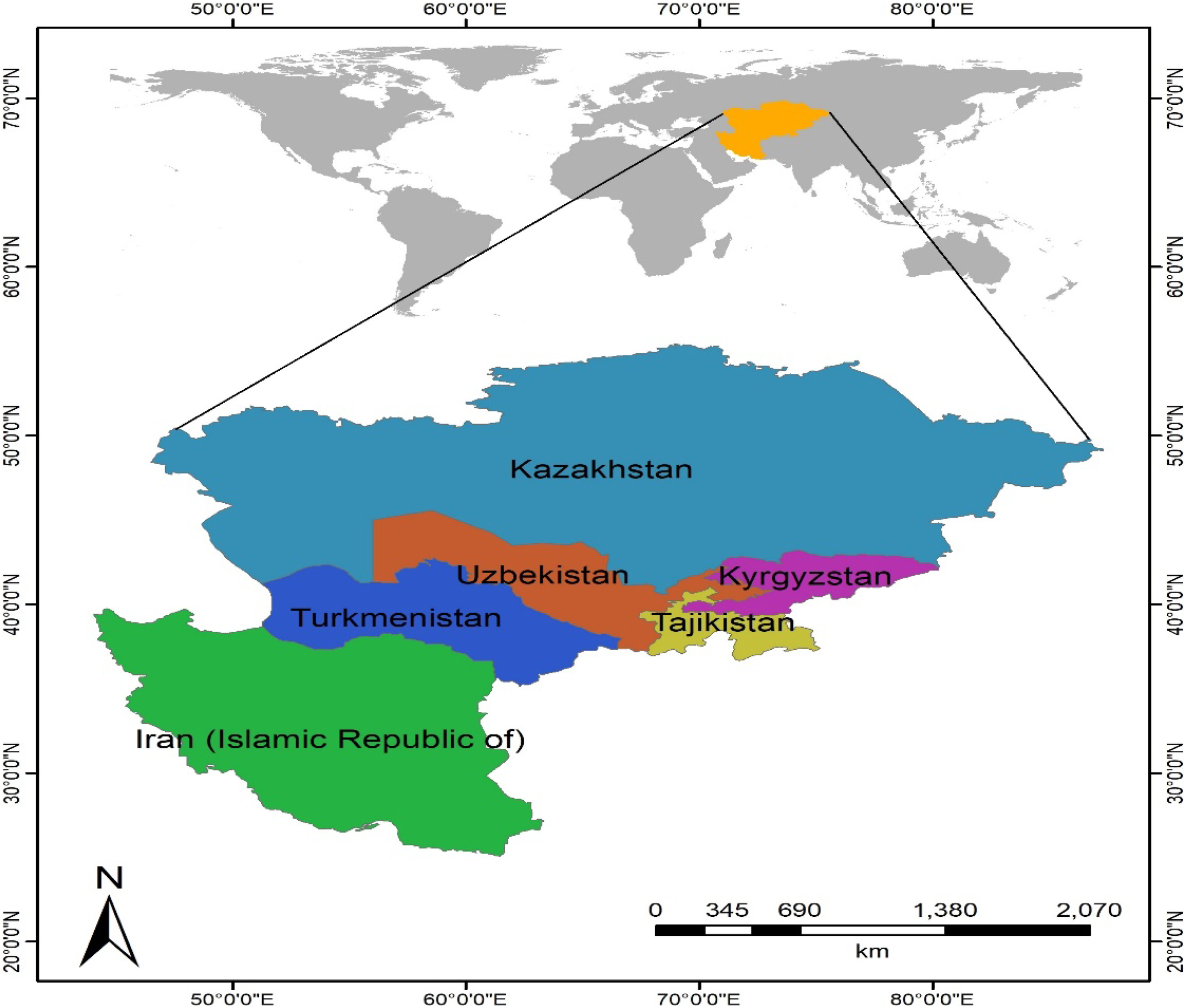
In general, evaluating the bilateral economic relations and different strategic economic plans of Iran in the Central Asian region indicates that Iran’s actions, especially in developing economic relations with Central Asian countries more than two decades after the independence of countries in the region, are considerable and have followed an upward and forward trend. In this regard, the volume of Iran’s trade relations with the countries of the Central Asian region during 27 years reached from about US$300 million in 1995 to about US$4 billion in 2005 (Kozhanov, 2012, p. 8 cited in Dehghani Firoozabadi & Daman Pak Jami, 2016, p. 49). Furthermore, this amount increased from about US$3.7 billion in 2011 to US$5.3 billion in 2015 (Kuzegar Kalchi, 2015, p. 126). Finally, the amount of Iran’s trade relations in 2022 was estimated at US$5.63 billion (IRNA—News Agency of the Islamic Republic of Iran, 2022.04.9).
Literature review
In general, the importance of the subject of the economy has made its role and influence undeniable in the formation of the theories of international relations. One of these theories is Neorealism. Based on this theory, the economy plays a pivotal role in international relations and the relations among the world powers since major powers and governments seek access to natural resources such as raw materials, oil, and gas in the form of energy sources to maintain their hegemony. Therefore, energy and energy transmission pipelines are of utmost use to attract foreign investment, provide a reasonable ground for developing the regional cooperations, consolidate economic infrastructure, increase the influence and political roles of the countries as an important diplomatic tool to accomplish and promote the bilateral/multilateral economic, political, and cultural goals of the countries and enhance cooperations among neighboring countries, and establish regional peace and stability.
According to the developments since the 1980s, theoreticians such as Cohen and Gilpin, citing theories like “hegemonic stability,” believed that one of the fundamental characteristics of the hegemonic power in any age is having control over resources, pipelines, and routes of energy transmission, and given that oil is a type of energy. Energy can be converted to money, and money generates control. Control is considered power. Accordingly, the ascendancy of hegemonic government relies upon having control over four types of resources, including control over the world’s raw materials and energy, control over the world’s capital resources, control over global markets, and control over the production of high value-added goods (Sadeghi, 2012, p. 22). This has led these powers to adopt economic plans in varying parts of the world and significantly impact geopolitical, economic, political, and security areas.
In this regard, the theory of Institutionalism also believes that individual interests should be neglected and collective economic interests must be pursued by forming unions and cooperative organizations in different countries. It is on this basis that financial plans in the form of the “Eurasian Economic Union,” “One Belt One Road Initiative,” “the Great Central Asia Initiative,” and “the New Silk Plan” can be investigated and studied. That is, powers such as Russia, China, and the United States seek to design and adopt economic policies that can serve the interests of themselves and their partners.
One of the critical points in the framework of the neo-liberal institutional theory that Richard Haass points out is the gradual politicization of the actors’ goals. That is, although actors may initially pursue technical and non-argumentative goals within the framework of cooperation, they gradually agree to use all possible and available instruments to achieve their technical–economic goals, which are called horizontal–vertical expansion or expanding logic and are claimed to broaden transnational cooperation from one sector to another to overcome new issues arising from the initial agreements (Daneshnia, 2012, pp. 148–149). Regarding the geoeconomic discussion, it can be stated that over the course of time and entering the 21st century, we are witnessing the replacement of the economic component with the military component, and countries determine their position in the world in this way. Geo-economics is the geographical context of a country’s economy that defines and determines the foundations of the economy in power relations through implementing an out-looking approach. When part or all of a country’s financial capabilities depend on geographical considerations, a geographical economy or geo-economy is formed. Geopolitics offers an economic recitation of the status quo and assumes a geoeconomic aspect, where the economy is the motive for power struggles. Thus, geoeconomics studies the impact of national, regional, or global factors or economic infrastructures on the political decision-making and power struggles and the influence on the formation of regional or global geopolitics (Gholizadeh and Zaki: 2008, p. 27). While in the past, superiority was based on military and strategic concepts or geopolitics, geoeconomics describes a different form of competition in which governments’ power is measured by economic progress in the current era (Mahkoubi & Goudarzi, 2019, pp. 521–522). Therefore, countries that can achieve economic development and manage to dominate natural, raw, and energy resources can impact international relations.
On the other hand, according to the Copenhagen School, it can be declared that security today does not have only hardware and physical dimension; rather, what constitutes the current structure of security is the eradication of destitution, unemployment, economic development, high per capita income, exceeding exports over imports, and so on. The definition of economic development demonstrates how the concepts of “economic development” and “security” are complementary and closely related. On that account, if a government fails to ensure economic security along with other security issues, it lacks any national security (Лапаева, 2014, pp 23–89). This affinity led to the redefinition of the concept of security based on economic components, since security, whether economically, socially, or politically, is one of the most important indicators and components of the development of countries that are related to the institutional characteristics of an economy, and can be defined as an institutional framework that encourages and builds confidence for savers and investors.
Anyhow, what is of utmost significance in summarizing the debate is that, firstly, economic interests and having access to raw and natural materials are the priorities for the major powers, which has led them to pursue their economic interests beyond their national borders. Secondly, given the sensitivity of the target countries to the political, economic, and security goals, the great powers are trying to follow their economic and political profits in the form of cultural goals under the banner of cultural diplomacy; since in cultural diplomacy, there is less opposition and resistance on the part of target countries, and civil society organizations mainly pursue it. Based on this critical and according to the definition by Milton Cummings, cultural diplomacy is the exchange of ideas, information, art, lifestyle, value system, traditions, and beliefs to achieve common concepts and enhance mutual understanding among nations and countries, and due to the long-term sustainability and effectiveness of cultural diplomacy, recognizing its sensitivity, investment, and policy-making in this area seem to be essential for those in charge. In this respect, the most important requirement and obligation are the training of efficient human resources who are familiar with the fundamentals of cultural development, fluent in the language, and competent in principles of negotiation in the world system (Salehi-Amiri & Mohammadi, 2016, p. 14). In an article entitled “Cultural Diplomacy, Political Influence, and Holistic Strategy,” John Lankowski lists the tools of cultural diplomacy. In addition to the elements such as art, history, cultural exhibitions, educational programs and exchange, language teaching, and media, he introduces religious diplomacy as an instrument and a topic for cultural diplomacy (Shaykh Al-Islami, 2012, pp. 104–106).
Therefore, in addition to cultural diplomacy, the world’s major powers have recently employed two approaches, namely, soft power and scientific and technological diplomacy. Joseph Nye, in the book Soft Power: The Means to Success in World Politics, mentions that a country’s soft power is the opposite side of its hard power, and unlike hard power that relies upon coercion, soft power emphasizes persuasion and strives to attract others through appeal. Soft power is the attractiveness of a country in the eyes of others (Nye, 2011). The premise of soft power is that actors need to attract others to their specific viewpoints that are considered legitimate and valid. If an actor attracts others to his point of view, more expensive sources of hard power will no longer be required. In the current situation, soft power results from the provision of information and the creation of attractiveness. Accordingly, it is a power source for countries on the international scene (Nye, 2011).
Furthermore, a country’s scientific and technological capabilities and interactions with other international actors in this field are called the diplomacy of science and technology. In other words, governments and other international actors (governmental and non-governmental international organizations) pay attention to both aspects of science and technology diplomacy (Riazi et al., 2019, p. 653). Since the progression of science and technology, which are developed in the world’s most influential scientific centers, has undeniably influenced international relations, the global economy, and the world community.
Concerning the Central Asian countries, this kind of diplomacy can be prominent for various reasons. Because, firstly, the countries of the region, due to scientific and technological flaws, are extremely required to expand their relations in this regard. Secondly, the dissolution of the Soviet Union provided the necessary ground for these types of relations with the great powers. Thirdly, this kind of diplomacy is largely non-sensitive and does not provoke opposition from other countries and governments. Eventually, it can be claimed that today, what distinguishes cultural diplomacy, soft power, and scientific diplomacy from different types of diplomacy is its direct relationship to national goals and interests. However, other sorts of diplomacy often are formed aiming at an economic or commercial benefit. Without the government’s direct involvement, cultural and scientific diplomacy is constructed upon the principle of mutual interests and common purposes. The relationship between the two parties can be the chief motive for cooperation. Consequently, it can be inspected that the world’s major powers have serious interests in pursuing and consolidating influence in their trans-regional territory which is exerted through the formation of a security coalition or the establishment of multilateral economic regimes. Both security alliances and economic initiatives can lead to integration and regional cooperation regardless of force or pressure on the external parties.
The important points of this discussion are as follows: (a) economic interests and access to raw materials and natural resources are the first priorities of the great powers; therefore, they pursue their economic interests outside their borders; (b) given the sensitivity of the target countries to the political, economic, and security goals, the great powers are trying to pursue their economic and political interests in the form of cultural goals and cultural diplomacy because target countries usually do not disagree with cultural diplomacy (Hasan-Khani, 2007, pp. 138–139). Therefore, the great powers have recently used soft power and scientific and technological diplomacy besides cultural diplomacy because (a) the Central Asian states are weak in science and technology field and need help; (b) the collapse of the Soviet Union paved the ground for this change of approach; (c) states are less sensitive to this kind of diplomacy and do not oppose it; (d) what distinguishes cultural, soft power, and scientific diplomacy from other types of diplomacy is its direct relationship with national goals and interests because sometimes the aim of other forms of diplomacy is economic and commercial interests without any direct participation of the government while cultural and scientific diplomacies are based on the mutual interests and common goals and the relationship that exists between the two parties is the main motivation for cooperation (Quoted by Koolaei & Azizi, 2017, p. 1049).
Research method
The researchers used a qualitative research method to answer the research questions. The data were analyzed through network theme analysis. Theme can be defined as an indicator of important information regarding data and research questions. To some extent, it demonstrates the meaning of the existing pattern in a set of data (Braun & Clarke, 2006). In other words, a theme is a repetitive and distinctive property in the text that manifests a thorough understanding and experience concerning research questions (King & Horrocks, 2010). From this point of view, thematic analysis is a method for identifying, analyzing, and reporting existing patterns within qualitative data. This method analyzes narrative and textual data and transforms diverse and scattered data into technical and detailed data (Braun & Clarke, 2006). Thematic analysis is conducted in different ways. In this research, thematic matrix and thematic network were used. Thus, the thematic matrix was used to identify and compare the opportunities and threats of the economic plans of the great powers in Central Asia for Iran. Also, this thematic study has been used to identify and formulate an optimal model of Iran’s countermeasures against the threats of the economic plans of the major powers in Central Asia.
Thematic matrix is a method first proposed by Miles and Huberman (1994). Thematic matrix is used for comparing themes with each other in textual data. In this way, textual data from various sources or individuals are compared to identify similarities and differences.
Therefore, the research data were collected as a purposeful sampling method from existing documents (traditional and virtual including books, sites, articles, and research) using thematic analysis method and thematic matrix type through indirect observation (text analysis). Then, the coding research data and basic concepts were organized through thematic coding. In addition, the opportunities and threats of economic plans of the great powers in Central Asia were identified and discovered and finally compared and analyzed in terms of similarities and differences.
The thematic network is a thematic analysis method and was developed by Attride-Stirling (2011). To obtain a thematic network, the following steps need to be performed: A. discovering basic themes (identifiers and key points within the text), B. discovering organizing themes (themes obtained from combining and summarizing basic themes), and C. discovering global themes (high themes containing the principles that govern the text as a whole). After performing these steps, the obtained themes are drawn as web maps.
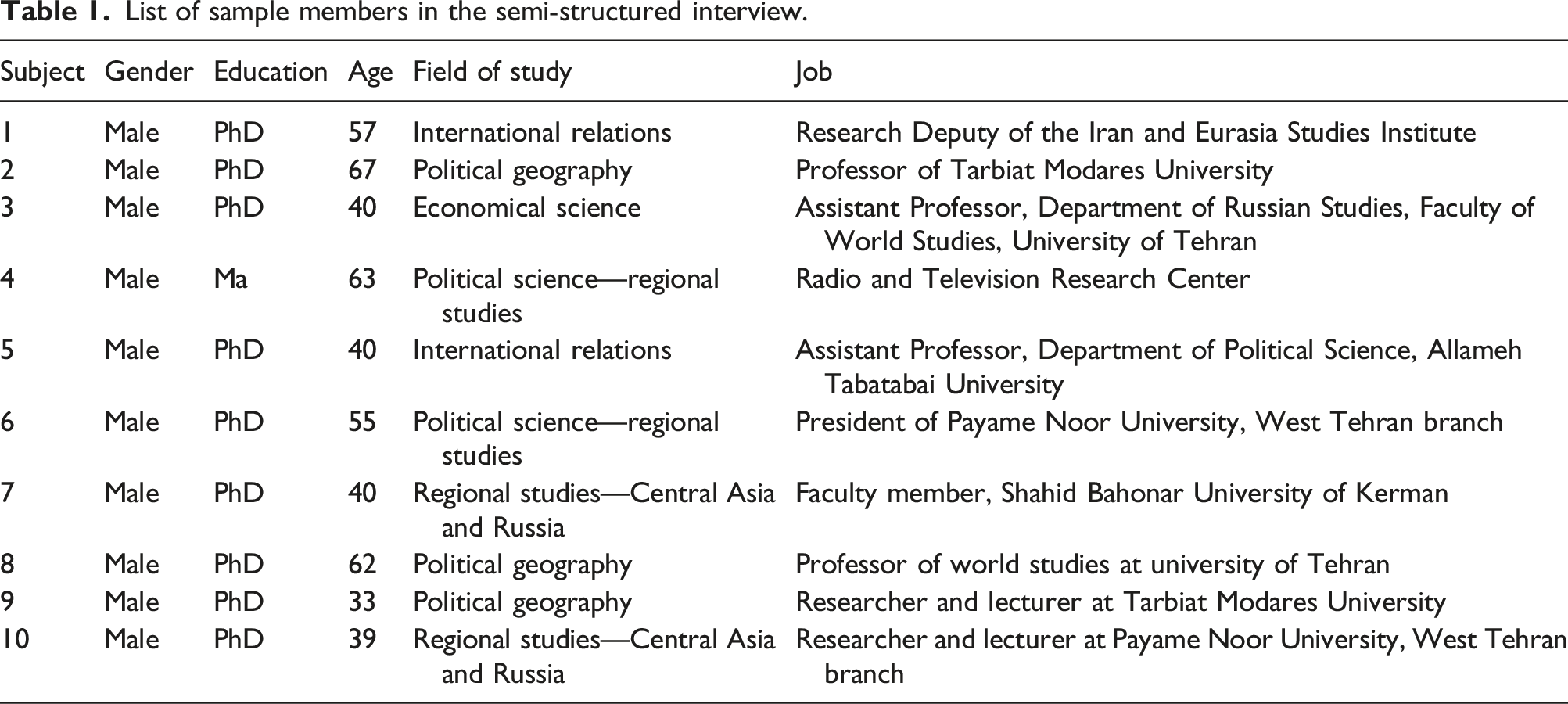
Therefore, through thematic network analysis, the research data were gathered and theoretically saturated by conducting a semi-structured interview with 10 experts and scholars in the fields of regional studies and international relations, who were selected through theoretical sampling.
According to Glaser and Strauss (1967), theoretical sampling is the process of collecting data for theorizing through which the analyst simultaneously collects, codes, and analyzes his data and decides what data to include in the next step. Next is to collect them and where to find them in order to formulate his theory during its formation. The theory being developed controls the data collection process (quoted from Flick, 2006). Therefore, the samples here do not have the authority to be visible and representative of the statistical population; rather, they are important in the sense that they help to construct the investigated phenomenon and formulate the theory.
List of sample members in the semi-structured interview.
Research findings
The findings of the content matrix
Different studies have investigated the economic plans of the great powers in Central Asia. Therefore, this section analyzes the threats and opportunities from domestic and international studies using the thematic matrix. When each of these threats and opportunities is highlighted, their commonalities and differences are also examined so that a model of coping strategies can be presented in the second section.
Thematic coding was conducted on the opportunities and threats that the economic plans of the great powers in Central Asia have for Iran, then the basic, organized, and inclusive themes. 1 They were identified, and then the opportunities and threats of different economic plans were compared based on the identified inclusive themes, and finally, their similarities and differences were specified.
The findings of the thematic network
In this section, qualitative findings are analyzed in three steps as follows:
Step one: Discovering basic themes
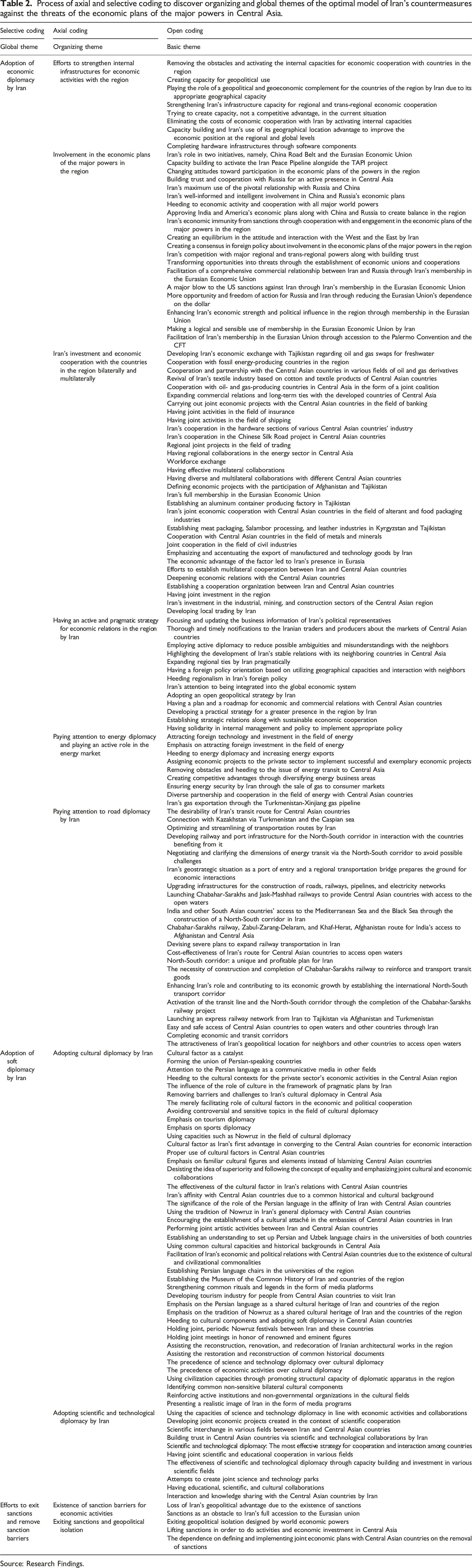
In the first step of thematic analysis, to achieve the optimal model of Iran’s countermeasures against the threats of the economic plans of the major powers in Central Asia, the data obtained from interviewing the experts have been compiled as declarative statements in the first place. Next, using the theoretical coding process and specifically, the open coding, basic themes or the identifiers and key points within the text were identified. Therefore, through the theoretical coding procedure (open coding type), 156 basic themes of the optimal model of the threats of the economic plans of the major powers in Central Asia were identified and enumerated*. (To avoid prolonging the article, the open coding table extracted from declarative statements, which were obtained from a semi-structured interview with experts, was not mentioned*.)
Step two: Discovering organizing and global themes
Process of axial and selective coding to discover organizing and global themes of the optimal model of Iran’s countermeasures against the threats of the economic plans of the major powers in Central Asia.
Source: Research Findings.
Step three: Developing the thematic network
Number of global, organizing, and basic themes of the optimal model of Iran’s countermeasures against the threats of the economic plans of the major powers in Central Asia.
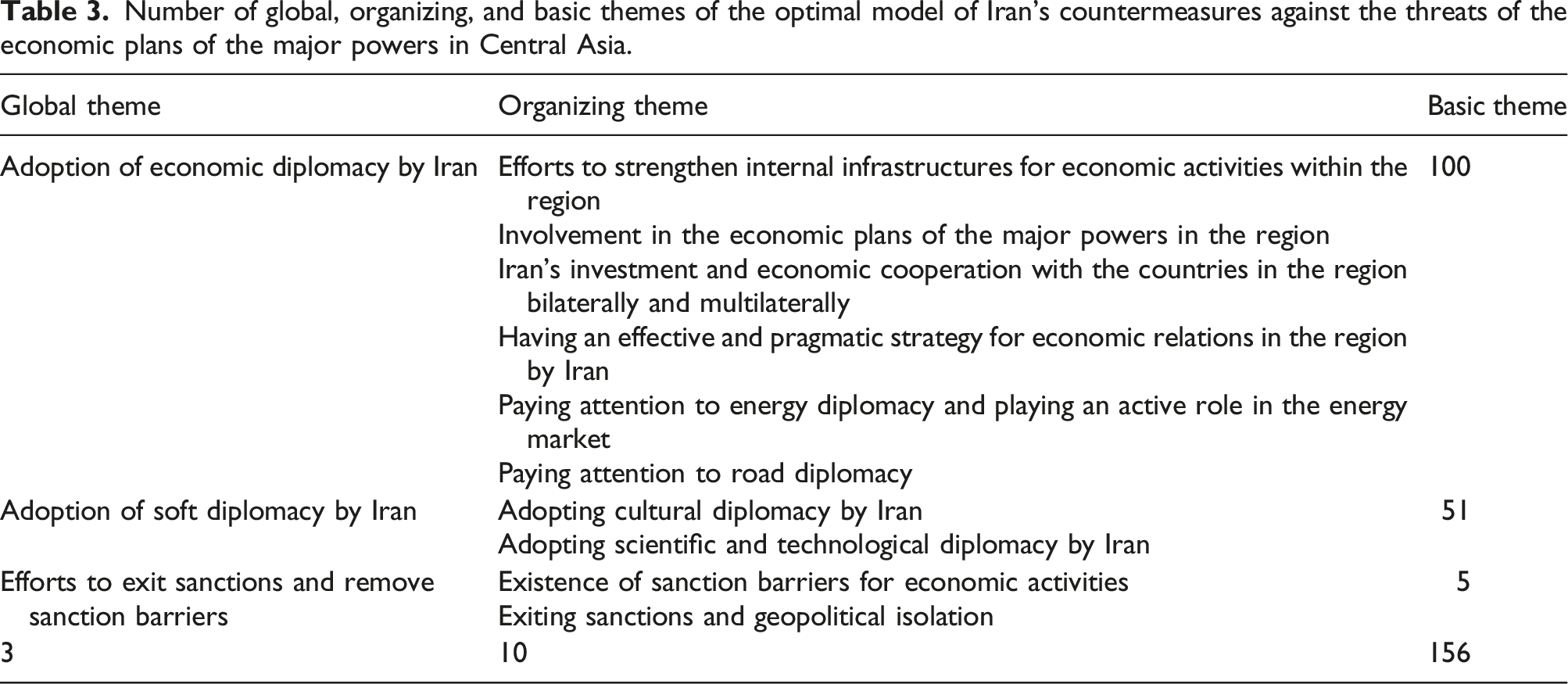
As Table 3 demonstrates, the optimal model of Iran’s countermeasures against the threats of the economic plans of the major powers in Central Asia has reached theoretical saturation with three global themes, ten organizing themes, and 156 basic themes based on a semi-structured interview with 10 experts in the field of regional studies and international relations.
After enumerating and extracting global, organizing, and basic themes of the optimal model of Iran’s countermeasures against the threats of the economic plans of the major powers in Central Asia, in this section, an attempt is made to draw a conceptual model or the formation of a thematic network of the optimal model of Iran’s countermeasures against the economic plans of the major powers in Central Asia (Figure 2). Optimal network conceptual model of Iran’s countermeasures against the threats of the economic plans of the major powers in Central Asia.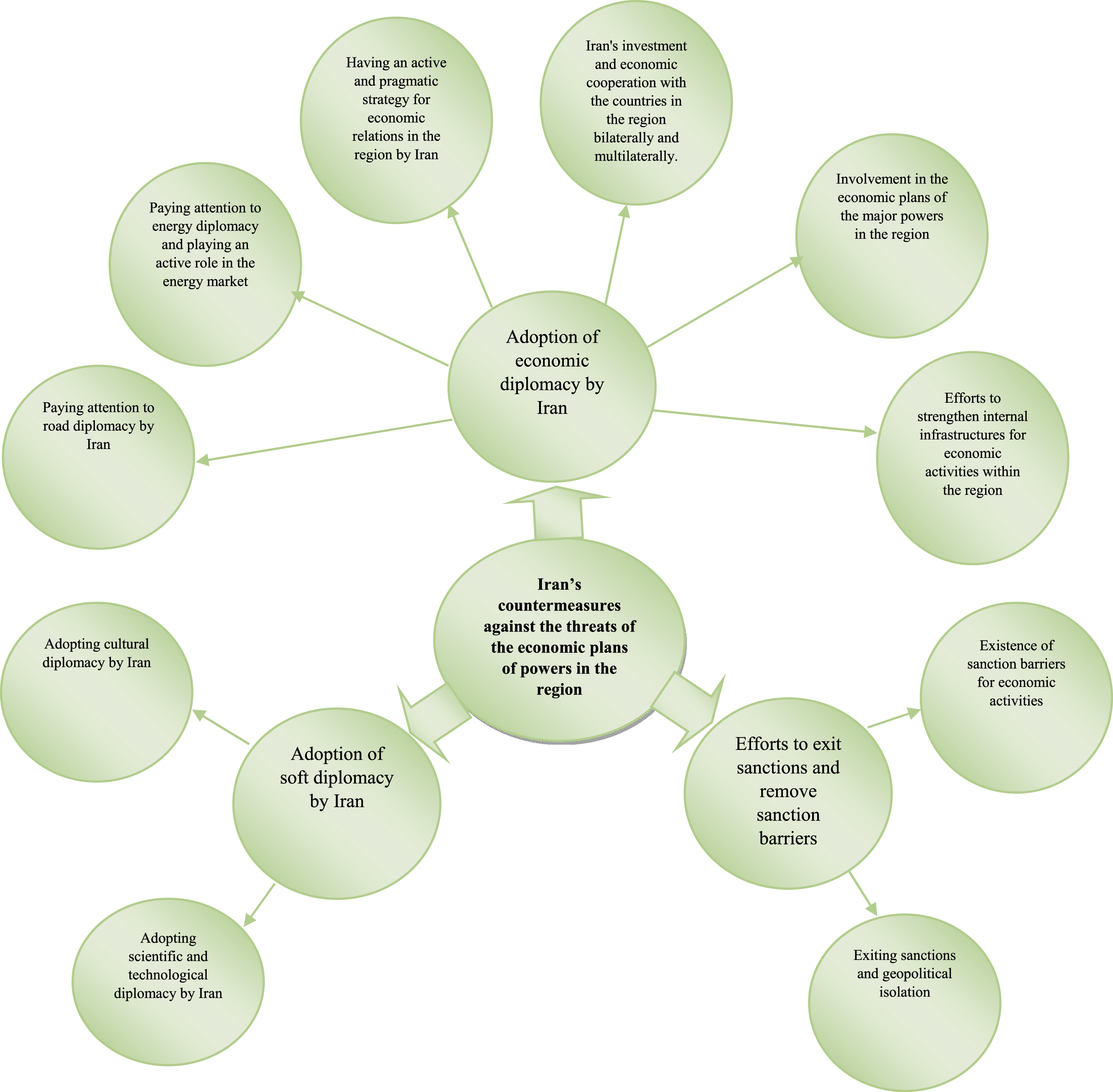
Discussion
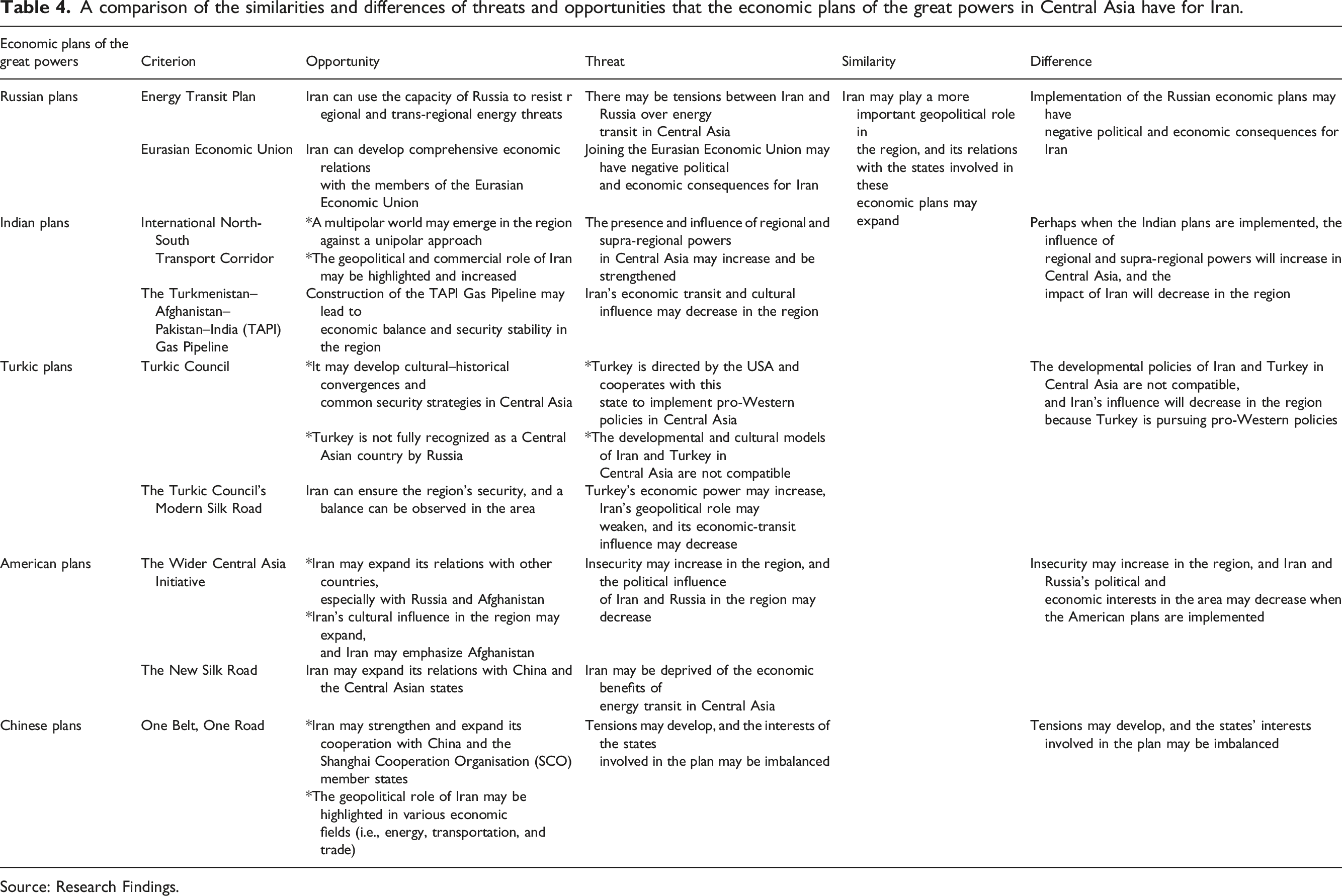
A comparison of the similarities and differences of threats and opportunities that the economic plans of the great powers in Central Asia have for Iran.
Source: Research Findings.
Thus, regarding the opportunities and threats of the economic plans of the powers in Central Asia, and to achieve an optimal model of Iran’s countermeasures against the economic plans of the major powers in Central Asia, a semi-structured interview with 10 experts and academic pundits in the field of regional studies and international relations was conducted. Therefore, the following results are obtained: A.
The above result, the adoption of economic diplomacy by Iran, is in line with the theoretical approach of Neorealism in the sense that economic factor plays a vital role in international relations and relations among the powers. In this regard, the theory of Institutionalism also believes that individual interests must be overlooked. The collective economic interests should be pursued in the form of unions and cooperative organizations in different countries. Moreover, geoeconomic theory, which studies economy and the relationship between geography and the power of countries, also emphasizes the importance of economy in the global arena on the formation of regional groupings based on the economy.
Therefore, according to the abovementioned theoretical records (the theory of Neorealism, theory of Institutionalism, and geoeconomic theory), Iran can pursue economic diplomacy in the form of heeding to and strengthening internal infrastructure, playing an active role in the energy market and the transit of goods, investment and economic partnership with the countries of the region, and collaboration in the economic plans of the powers in the region provided that it is based upon a wise policy and includes the greatest national interests of Iran. B.
Thus, according to the theoretical records mentioned above (cultural diplomacy, soft power, and diplomacy of science and technology), Iran can operationalize soft diplomacy in the form of cultural diplomacy and scientific and technological diplomacy against the economic plans of the great powers in the region. Because on the one hand, cultural diplomacy, due to its multifaceted impact and civilizational affinity of Iran with Central Asian countries, enjoys more effectiveness and legitimacy. On the other hand, conducting joint scientific and technological activities can prepare the ground for joint economic plans and programs. Therefore, cultural and scientific fields are one of the most important contexts that Iran can improve its level and amount of cooperation with Central Asian countries to revive its geo-culture and enhance its scientific influence in Central Asia and pave the way for more convergence in foreign policy, particularly in the economic field.
C.
The results mentioned above, efforts to exit sanctions and remove sanction barriers by Iran, are consistent and in line with the theory of Copenhagen School in the sense that security is a multifaceted concept and includes various developmental levels (social, political, and economic). As a result, the removal of development and growth obstacles can provide the citizens of a country with security in many aspects, specifically the economic dimension. The existence of sanctions and sanction barriers preclude regional and trans-regional economic collaborations and impede economic advancement that needs to be dealt with and addressed immediately.
Conclusion
The present study results indicated that the implementation of the economic plans of the great powers in Central Asia for Iran in terms of opportunities and threats have some similarities and differences. In this regard, the similarity of the economic plans of the great powers in Central Asia for Iran in terms of opportunity was an increase in Iran’s geopolitical importance and the expansion of Iran’s relations with the countries involved in such economic plans. In addition, the difference between the economic plans of the great powers in Central Asia for Iran in terms of threat were negative political and economic consequences for Iran through the implementation of Russian economic plans, increasing the influence of regional and supra-regional powers in Central Asia, and reducing Iran’s influence in the region through the implementation of India’s economic plans, the discrepancy between the development policies of Iran and Turkey in Central Asia and the weakening of Iran’s position because of pursuing the pro-Western policies in the region by Turkey, insecurity and reduced influence and political and economic interests of Iran and Russia in the region due to the implementation of the US economic plans and the emergence of tensions and imbalances of interests between the countries involved in China’s economic plan. Despite the opportunities and threats of the economic plans of the powers in Central Asia for Iran, the most appropriate strategy for Iran is to engage in convergence diplomacy in the form of cultural and economic diplomacy and remove sanction barriers to the implementation of Iran’s joint economic plans with its Central Asian neighbors to achieve the desired model of Iran’s confrontation strategies against the threats of the economic plans of the great powers in Central Asia. Undoubtedly, the realization of this issue for both sides will lead to a win-win game that increases Iran’s regional and international position, eliminate the threats of economic plans of regional and supra-regional powers, and provide the context for mutual economic development.
Limitations
With respect to the limitations of the present study, two cases can be mentioned in general. To begin with, the lack of sufficient empirical literature, nationally or internationally, concerning the subject of the present study was one of the scientific obstacles in order to compare the constructed conceptual model with their findings and results so that the commonalities and differences of the constructed model of the present study can be evaluated and compared to them in this perspective. Next, this study was based on a qualitative research strategy. Therefore, despite the efforts to assess the validity (credibility) and consistency (reliability) of the qualitative findings of the research, the external validity decreased to some extent due to the lack of evaluation and suitability of the measured conceptual model of the qualitative study in the quantitative study (specifically survey study). However, this is one of the weaknesses of all qualitative research and not just the present research.
In addition, this qualitative study failed to mention some internal factors (weakness and strength), such as the role of domestic politicians in foreign policy, the desire to expand cooperation with countries in the region and the world, capacity-building for the effective management of foreign relations, and the dominance of the hardware approach over the software approach in foreign policy and foreign factors (opportunities and threats) such as using the capacities of international and regional organizations, developments in Iran’s geopolitical environment, the transition of the international system, the dispute over Iran’s nuclear program, and the fragility of the Central Asian economy and their dependence on Russia. Thus, these factors can be further investigated following the SWOT study and the design of an optimal model for Iran’s strategic economic management in Central Asia.
Footnotes
Declaration of Conflicting Interests
The author(s) declared no potential conflicts of interest with respect to the research, authorship, and/or publication of this article.
Funding
The author(s) received no financial support for the research, authorship, and/or publication of this article.
