




Abstract
This article examines the policies of development cooperation promoted by Japan and Korea in Central Asia, focussing on the roles of discourses treating Japan and Korea as potential non-Western models for the region’s development and modernisation in their relations with Central Asian states. We trace the evolution of relevant developmental approaches made by Japan and Korea, analysing discourses and practices of sharing experiences, as well as the key drivers behind those shifts, and we seek to locate these changes in the larger context of regional political economy and international relations. Furthermore, the article seeks to address the ideational and normative aspects of Japanese and Korean development cooperation in Central Asia. We conclude with a recap comparison of Japan’s and Korea’s sharing of development experiences.
Introduction
Since post-Soviet Central Asia’s independence in 1991, Japan and the Republic of Korea (further Korea) have built solid relationships with the region. An important aspect of both countries’ appeal – especially for Japan early on, later followed by Korea in that regard – was the emphasis on their potential to serve as development models for Central Asian (CA) states, which embarked on post-socialist transition to the market economy and were contemplating various modernisation scenarios following the collapse of the USSR.
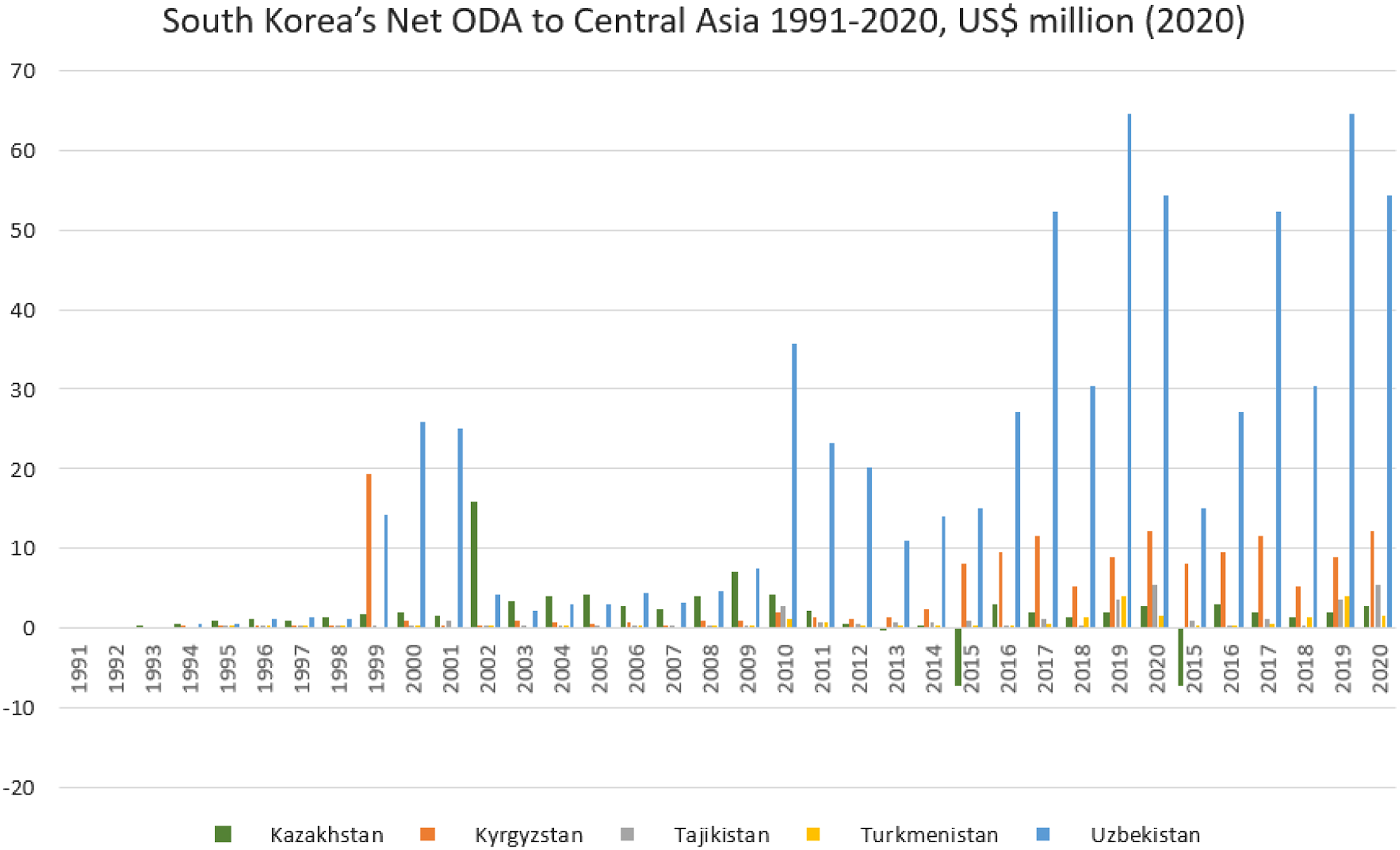
Both Japan (Japan International Cooperation Agency, 2022b) and Korea represented non-Western models of economic catch-up development per se, while also being major providers of development assistance with approaches distinct from Western donors. Japan has been a member of the Development Assistance Committee of the Organisation for Economic Cooperation and Development (OECD-DAC) since the 1960s, thus covering all the period of its relations with independent CA states since 1991. Korea joined OECD-DAC in 2010, that is, two decades into its relationship with Central Asia, although its accession to the OECD started in 1996, when it also began its motion for OECD-DAC. Yet, as we demonstrate further in the article (see figures), Korea started supplying assistance to CA starting from 1993 onwards. In that sense, the 2022 commemoration of the 30-year anniversary of establishing diplomatic relations with CA states by both Japan and Korea is equally relevant for development cooperation.
According to Japanese development practitioners, Japan’s and Korea’s approach towards development was different in that, unlike many Western donors, they would avoid putting pressure on an ‘underdeveloped’ country to develop via adopting their model(s) but would rather enable the recipient instead to realise the problem it wanted to address and help resolve it; hence the emphasis on using the term ‘development cooperation’ in both countries (Communication, 2022). Although both North-East Asian economies have been actively establishing their regional footprint as development sponsors, some CA countries, namely Kazakhstan, subsequently transitioned from the recipient status to that of donor, changing the regional development landscape. At the same time, the region, similarly to many other states, has been dealing with the challenge of demodernisation, which kept relevant the agenda of development path and modernisation scenarios.
Although the debate around development models was particularly salient in the 1990s and later somewhat faded or was side-lined by other agenda, this topic remains important in the region and was rekindled due to leadership transition over the past five years. Pressures for reforms, development and modernisation that CA states have been experiencing since 1991, as they embarked on building their independent statehoods, are still there, together with expectations from new leaders, especially that some reforms had failed or yielded a mixed record. Meanwhile, adverse processes like demodernisation have taken their toll, while supply-side competition from donors diversified the options CA countries face when choosing between competitive modernities of Western and other states (Rabkin & Minakov, 2018; Van den Bosch et al., 2021).
For instance, in November 2021, Uzbek President Mirziyoyev’s explicitly mentioned Germany as a potential development model for Uzbekistan on the occasion of his inauguration upon re-election:
‘Why do I study Karl Marx a lot? (...). “Take the great Germany [for example]. Despite many crises, there is education, there is knowledge, there is science. Thanks to science, the German economy keeps [afloat] in a crisis. We must learn from them too." (Opyt Germanii Planiruetsya, 2019).
Mirziyoyev further added that he was planning to dispatch the Uzbek prime minister to Germany with a commission in order to thoroughly study and implement the experience of this country in all areas. This rhetoric, for what it is worth, indicated that search for development models was a current topic at least discursively and begged the question about the roles of Japan and Korea, long-time development partners of Uzbekistan and wider CA.
There has been a robust emerging body of scholarship examining Japan’s and Korea’s bilateral and multilateral relations with CA states per se (to name a few: Dadabaev, 2019a, 2019b; Fumagalli, 2016; Insebayeva, 2019; (Len et al., 2008); Murashkin, 2015; Rakhimov & Ki, 2016; Murashkin, 2020; Varpahovskis, 2020; Yoneda, 2012 and others). However, extant scholarship did not often cover the topic of development models and their roles in the relationship, and when it did, it was synthetically, tangentially, with some exceptions, often focussing rather on Japan and China, than Japan and Korea or not taking account of the latest regional developments in CA, such as the power transits, leadership changes and re-elections in 2019–2022. By focussing on the role of discourses concerning development models and taking stock of the latest developments and newly available sources, we seek to address the aforementioned gap in our research and tackle the following three research questions: 1. What are the key aspects of the narrative around national development models in Japan’s and Korea’s cooperation with CA countries. 2. How did Japan and Korea promote national development models among CA states and what means do they use: for instance, bilateral meetings, human resource development programs, loans, reform advice and other means? 3. What are the attitudes toward Japanese and Korean development models in CA republics?
To answer the research questions above, we employ the following methodology: bilateral comparisons, content analysis and discourse analysis of official statements, reports, interviews, memoirs and other publications, including those by development practitioners and other relevant officials, available in the English, Japanese, Korean and Russian languages. As 2022 marks the thirtieth anniversary of the establishment of CA states’ diplomatic relations with Japan and Korea, we attempt to do justice to the three elapsed decades. The span and coverage are qualified, however, by the changing relevance of the development model debates with their euphoria and fatigue stages, as well as by available material. We also consider the difference in critical junctures: Korea as a donor joined the Development Assistance Committee of the Organisation for Economic Cooperation and Development (OECD DAC) in 2010, while Japan has been its member throughout the entirety of its 30-year relationship with CA states. Although we attempt to cover all five CA states, Kazakhstan and Uzbekistan tend to figure more prominently due to their comparatively larger and more industrialised economies and relatively larger scale of financial assistance received, due to eligibility to loan aid. Given the self-evident volume limitations stemming from the bipartite structure of the paper, we do not intend to provide an exhaustive generalisation of either Japan’s or Korea’s development cooperation with CA per se. Although juxtaposing the two East Asian countries’ relationships with the region, this paper is not aiming to provide anything like a ‘ranking’ of the two countries in that field or to assess their ‘performance’ vis-à-vis one another.
Literature review
The appeal of Japan and Korea as ‘success stories’ of development stems from their experience of modernisation from Asian and non-Western background, portraying them as countries from the ‘East’ that have accomplished the feat of catching up with the advanced industrialised countries of the ‘West’/‘global North’ and ultimately became a part of ‘traditional donors’. Japan before the Meiji Restoration was considered to be a half-developed (半開) country by leading intellectual Fukuzawa (1875). After World War 2, although Japan’s vast industrial, economic, financial and administrative legacy of the pre-war era and earlier modernisation played an important role in its development, the country was also a recipient of development finance from the World Bank and formally became recognised as a developed state upon joining the OECD in 1964. Korea in that sense also technically has an appeal of a postcolonial ‘success story’ development.
The early origins of development as an international political phenomenon can be traced back to the Cold War as evidenced in U.S. President Harry Truman’s oft-cited Point Four Program (Committee on Foreign Affairs, 1949; Escobar, 1995). If the much-discussed ‘New Cold War’ metaphor proves relevant to describing international relations in the 2020s – which itself is debatable, as this metaphor is ideologically and emotionally charged – then Japan and Korea are likely to have another source of attractiveness as development models. Although maintaining close links to the U.S., in the field of development cooperation they are also able to exercise autonomous agency and boast South-South ties, thus providing an alternative available to recipients seeking to avoid binary choices between the U.S. and China.
Models of development thus also depend on foreign relations and external environment, shaping internal policy choices of adopting countries. On the one hand, the U.S. played a major role as a security, financial and trading partner in Japan’s and Korea’s post-World War 2 economic successes. Meanwhile, the legacy of Soviet-era modernisation and subsequent model of development in post-Soviet Russia significantly affected CA’s conceptualisation of economic models and understanding of development (Islamov, 1998, p. 67, Kitamura, 2010, p. 103, Insebayeva, 2022, p. 11). On the other hand, Japan’s pre-war development model did not rely on support from a single major ally, which also happens to be the case for post-Soviet CA states, known for their foreign policies aimed at constantly diversifying external partners, including the policy choices of adopting one or another development model fully or partially. In the case of Kazakhstan, the country transitioned from the Soviet-era position of recipient of flows from the union centre toward benefiting from Western development aid in the 1990s, which influenced its development strategy and subsequent foreign aid policy (Insebayeva, 2022, p. 11–12).
The Soviet legacy set the scene for CA states, since the USSR was a socialist type of catch-up modernisation and exhibited certain elements of the developmental state (Erlich, 1967; Fukuyama, 1993; Sakwa, 2013) – a concept developed by Johnson (1982) in relation to post-war Japan. In that sense, the appeal of Japan and Korea for post-Soviet and in particular CA states in the 1990s was that of alternative modernisation models in the wake of the USSR collapse – in other words, more of a re-modernisation, re-development, follow-up modernisation or ‘neo-modernisation’ (Sakwa, 2013), rather than that of modernisation completely from scratch. At the same time, recent scholarship has challenged the non-critical assumption according to which Central Eurasian states imperatively needed the borrowing of European, Western or global best practices to achieve stability and development, making the case for internal resilience and capacity-building, grounded in the context of the geography and ecology of Central Eurasia (Kalra, 2022).
As shown by Dadabaev (2017, p. 36–37), Japan, as well as China, did, in fact, envisage its own model of development for CA states. For instance, Prime Minister Hashimoto Ryutaro stressed the usage of Japan’s experience in facilitating CA’s transition to a market economy in his 1997 Eurasian Diplomacy initiative. As we show in the analysis sections, this idea was consistently expressed by Japanese stakeholders, including government officials, both for Central Asia and more generally, as well as echoed in Central Asian scholarly literature. At the level of specific projects, extant literature covered, for instance, such landmark format of Japan’s development cooperation with Kyrgyzstan and other countries as One Village One Product (Dadabaev, 2016; Tjia & Lim, 2021).
Concepts such as the East Asian development state traditionally associated with Japan and Korea (The World Bank, 1993) and Akamatsu’s (1961, 1962) ‘Flying Geese’ model for industrial development, where Japan’s development cooperation played a role (Black, 2017), evidently have only partial and limited relevance to Japan’s and Korea’s relationship with CA. The ‘Flying Geese’ model sought to explain the catching-up process of industrialisation of Asian latecomer economies through intra-industry, inter-industry and international aspects of product and industry development, suggesting that Japan led a flock of emerging East Asian economies as its production networks expanded and it transferred technologies to the followers as it was moving up the value chain (GRIPS Development Forum, 2002). This model was not expanded to post-Soviet CA or did not take off there due a variety of contrasts between CA and East Asia or Southeast Asia (Murashkin, 2015). However, as post-Soviet CA states reconfigured their presence in Asia in a new, sovereign, and ‘capitalist’ capacity, Japan, as a key player in the process of economically structuring and ‘reifying’ Asia (Tamaki, 2015), played a role in incorporating CA into the post-1991 economic order. Inter alia, Japan helped to diversify CA’s eligibility in several development institutions, such as OECD DAC, the market transition-oriented European Bank for Reconstruction and Development with a political mandate, and the Asian Development Bank with a non-political poverty reduction mandate (Murashkin, 2015; Wang, 2021).
At the initial stage of post-1991 transition reforms, Kazakhstan and Kyrgyzstan have embraced the ‘shock therapy’ path, Uzbekistan opted for its version of gradualism, while in Tajikistan and Turkmenistan reforms were delayed for a while by domestic political reasons (Islamov, 1998). According to a former senior World Bank official, Kazakhstan was the best ‘pupil’ of the ‘shock therapy’ approach but lacked capacity to duly implement those market transition reforms, as many early post-Soviet leaders, including Kyrgyz President Askar Akayev failed to fully grasp the contemporary meaning of the market economy (Interview, 2012c). The 1990s were a period of crossroads and active debates on development models, as newly independent CA states were finding their feet in new circumstances, while the international donor landscape was dominated by Western European and North American donors, as well as Japan. According to Lee (2006), the perception of Japan’s MOF during the 1997 Asian Financial Crisis was that of US-Japan rivalry over economic development models – state-led and market-based, as Japan was defending the Asian model of economic development against the U.S.-led IMF bailout operation in Thailand. Furthermore, Japan’s position as provider of concessional loans without political conditionality was particularly appreciated by the region’s governments. Subsequently, from the onset of the 2000s, CA governments focussed on solidifying and extending their power positions, while also enjoying the tailwind of commodity supercycle and its windfall profits, growing labour remittances from overseas migrant workers and diversifying donor landscape, where other donors, such as China, Korea and Turkey, gained prominence. In the late 2010s–early 2020s, however, all countries of the region in one way or another started facing power transition, which contributed to the resurfacing of such topics as modernisation and development model on the agenda, although with a varying scale and altogether less intensively than in the 1990s.
More specifically, Uzbekistan went from the Karimov-rule model (1991–2016) involving the elements of comprehensive political control, ‘self-reliance’, declared export orientation, isolationism (Fazendeiro, 2017) and ‘post-socialist development state’ (Bolesta, 2022) to a less dirigiste and more internationally open model of the Mirziyoyev presidency (2016-present) (Dadabaev, 2019c); (Dadabaev & Djalilova, 2021). Furthermore, Uzbekistan’s developmental state model was also reflected in its foreign policy (Dadabaev, 2019a, 2019b).
Ahrens and Stark (2014) argued that Kazakhstan’s developmentalist practices differed from the East Asian model but they still counted Kazakhstan among Asian developmental states by reconsidering the key features of this concept. According to them, President Nazarbayev gradually developed a developmentalist strategy in his rhetoric, justifying a recentralisation of power, which enabled him to exert power over the private sector despite the Kazakh state’s structural institutional deficit, which limited the role of the bureaucracy. Relying on several institutions, Nazarbayev managed to discipline national actors and channelled foreign investment towards strategic sectors similarly to developmental states (Debanes & Lechevalier, 2014).
The literature on exporting the Korean model of development can be divided into several types. Korea’s development experience has been extensively researched from various angles. For example, there are a number of studies devoted to analysing the ‘miracle on the Han River’ and its abandonment of developmental state model characterised by symbiotic cooperation between government and businesses (e.g. Lee & Han, 2006; Lim, 2010; Minns, 2001) and comparing Korea’s development path to that of Japan and Taiwan, and China (e.g. (Kim, 2016) Kim & Heo, 2017; Kuznets, 1988). This spectrum of literature is useful in recognising that the Korean economic development experience is a complex phenomenon stretched over time and that at its various stages the Korean economy faced miraculous raises and economic declines featured with economic system transformation.
In a critical review of debates surrounding the Korean development model, Moon and Chung (2014) present three strands of debate. The first debate focuses on determining whether the 1960s–1980s South Korean case can be classified as an East Asian development model characterised by a state-centred and export-oriented economy. The second line of debate seeks to understand aspects of the transformation of the South Korean system after the 1997–1998 crisis and whether the South Korean Post-Developmental Model can be qualified as a neoliberal economy. And the third kind of debate is devoted to the determination of the future model of Korea (Moon & Chung, 2014).
Alternative discussions stem from the factors that made it possible for Korea to create this miracle. Among the factors mentioned are state-centred economic planning, export-oriented industrialisation, smart use of foreign loans (Kim & Heo, 2017) and the cultural and ideological-value aspects of the country (Kim & Park, 2003).
The third broad layer of the literature in this field is aimed specifically at analysing Korea’s policy of promoting the national development model abroad. Korea is famous for employing its successful transition from developing to developed leap narrative when approaching partner states that seek to boost their economic development. South Korean example spurred interest in its experience and several scholars outlined strategies that developing countries should learn from South Korea to succeed: for example, long-term strategies in dealing with foreign direct investments (FDI) for Ethiopia (Hauge, 2019), public sector discipline for Cameroon, Côte d’Ivoire, Nigeria, South Africa and Zambia (Lufumpa, 2020), transition to knowledge economy for African countries (Asongu, 2017), emulation of the East Asian Developmental State Model for Central Asian countries (Stark, 2010, 2012).
The key tool for promoting the national development model is the so-called ODA (Overseas Development Assistance) diplomacy. Korea’s activity within this framework is explored in multiple case studies: for example, in Africa (Kim, 2017) (Park, 2014; Shamilov, 2016), in Latin America (Faure, 2017) and in Myanmar (Kim, 2018). Moreover, within ODA diplomacy should be outlined a so-called Saemaul Undong (New Village Movement), a development program for rural areas, that originated during Park Chung-Hee’s era and was later rebranded and re-designed for export purposes as a part of national development strategy (Engel, 2017; Kim, 2022). The question of efficient policy transfer is open since there were both successful cases and not (Hwang & Song, 2019; Kim, 2022). Even though Korea is helping multiple countries through ODA-related means there remain other concerns too. For example, whether Korea overemphasises the role of the state control, whether this help is just a soft mean to enter markets of developing states (Shamilov, 2016; Varpahovskis, 2017, 2020), whether ODA diplomacy incorporated into middle power narrative is rather a nation branding instrument (Ayhan, 2019; Kim, 2022).
Although Korea is actively building its own image as a middle-power country (e.g. Easley & Park, 2018; Kim et al., 2018; Lee, 2016; Vorontsov et al., 2020), trying to actively engage in niche diplomacy and, without any imperialistic leanings, assisting developing nations, including Central Asian states, the question of how Korea articulates the national development model or parts of it installation among Central Asian partners remains underdiscussed. The existing literature on South Korean cooperation with Central Asia is rather scarce. South Korea’s activities in Central Asia were examined in a number of papers (Fumagalli, 2012, 2016; Hak, 2009; Hwang, 2012, 2016; Park, 2016; Peyrouse, 2010; Steane, 2020; Varpahovskis, 2020), with a significant focus on Uzbekistan (e.g. Dadabaev, 2018, 2019; Rakhimov & Ki, 2016). Although those works indicate and discuss South Korean diplomacy towards Central Asian states mentioning various contributions into the development of those countries, including loans (Fumagalli, 2016), consultations and developmental project’s assistance (Kim & Tcha, 2012), they do not examine whether Korean development model was advertised to Central Asian countries and whether it was considered, even though Central Asian countries demonstrated preoccupation with development paths after gaining independence (e.g. Ahrens & Stark, 2014; Dadabaev & Djalilova, 2021; Spechler, 2000; ).
In particular, Uzbekistan’s first President Karimov sought to elaborate so called ‘Uzbek Road’ model of development that Uzbekistan was anticipated to pursue after abandoning Marxist–Leninist ideologies. As it was noted by Spechler (2000) ‘Uzbek Road’ looked more like the Chinese development model and was characterised by government’s obsession with political and social stability while implementing gradual reforms. Central role of the state in industrialisation, food and energy self-sufficiency, introduction of legal basis for reforms and private sector and efforts aimed at protection of privileged and marginalised groups (Spechler, 2000).
In 1997, Kazakhstan’s first President Nazarbayev, in his speech devoted to the introduction of Kazakhstan’s development programme ‘Kazakhstan-2030’, credited the successes of the so-called Asian Tigers (South Korea, Taiwan and Singapore) and Malaysia, Indonesia and Thailand, which were joining them at that time. Following his idea, these countries were able to climb out of poverty and industrialise, so Kazakhstan can do it too. Elaborating on the metaphor, Nazarbayev noted that there are no tigers in Kazakhstan, and therefore Kazakhstan should strive to become the first ‘Snow Leopard’, which will have its own distinctive features from tigers. Nazarbayev envisioned the Snow Leopard to possess both ‘Western elegance, multiplied by the advanced level of development, and Eastern wisdom and endurance.’ (Nazarbayev, 1998)
In becoming the first Snow Leopard, Nazarbayev highlighted the necessity of the best international experience in the field of macroeconomic indices. That involves ‘low inflation, budget deficits, a solid national currency, and a high savings rate’. According to him ‘this recipe has worked in Japan, Korea, Indonesia, Taiwan and Chile’, and ‘it will also work in Kazakhstan’ (Nazarbayev, 1998). Among major goals in this strategy were mentioned elimination of state interference in business; accomplishment of privatisation of small and middle enterprises and agro-industrial sphere; pursue judiciary reform (Nazarbayev, 1998). In this context, it is essential to highlight that Asian Tigers’ experience could not be blindly copied because former Soviet Republics had to pass through an additional stage of privatisation as a part of transition from the planned economy that was not relevant for Korea or Japan.
As for Kyrgyzstan, its national strategy 2018–2040 explicitly indicated that ‘Kyrgyzstan cannot copy someone’s development model’ (Ministry of Foreign Affairs of the Kyrgyz Republic, 2018) and that ‘Kyrgyzstan should develop own ideology’ and Kyrgyzstan will have to do this in ‘conditions of remoteness from the main transport routes, adaptation to the new conditions of economic development within the EAEU [Eurasian Economic Union], taking into account the lack of development of physical and digital infrastructure and the small size of the Kyrgyz economy’. (Ibid.: 5). However, at the Kyrgyz-Korean business forum in 2019, the Prime Minister of Kyrgyzstan Mukhammedkalyi Abylgaziyev declared that Kyrgyzstan is willing to ‘to adopt from Korea a successful model of agricultural development, regional development, digitalisation, green economy and national health’. (Abraeva, 2019).
Works that merit special mentioning are also those that highlighted the importance of South Korean or East Asian development history or aspects of the national development model, like export orientation or a transformation into knowledge-based economy, and calling for implementation of those in Kyrgyzstan (Mavlianov, 2012), Kazakhstan (Ahrens &Stark, 2014), Uzbekistan (Juraev, 2014), Tajikistan (Yusupov & Lee, 2014). Even though newly independent republics were fascinated by the growth of Asian Tigers, the leaders of CA countries looked into not only Japanese or South Korean experience, but also at other countries whose features could match CA better – for example, the Chinese ones, if we consider the level of authoritarianism as a factor and bolstering of economic development while containing political pluralism or, the Indonesian one, if considering the factor of spread of Islam among population (Ahrari, 1996).
Key aspects of the narrative around national development models in Japan’s and Korea’s cooperation with CA countries
Japan’s experience
The idea of sharing Japan’s own development and modernisation history as a potential ‘model’ or rather, as a source of references and lessons has been recurrently publicised and promoted by Japanese politicians, statesmen and development practitioners in various regions, as can be evidenced from official publications and works by development experts (Kato et al., 2016); Ministry of Foreign Affairs, 1968, 1997; Toyoda et al., 2012 and others). From the late 2010s, this approach was further crystallised and systematised in Japanese International Cooperation Agency (JICA)’s activities, as exemplified by its Development Studies Program and JICA Chair Program (JICA, 2022b), drawing from Japan’s Meiji-era modernisation and Japan’s post-World War 2 recovery.
When it comes to the history of Japan’s relations with post-Soviet CA specifically, in 1995, the European Bank for Reconstruction and Development’s (EBRD) Temporary Alternate Governor for Japan Nakahira Kosuke summarised the Japanese vision for the bank’s regional operations as follows:
‘In the central Asian republics, what is required on the one hand is – whenever possible – the modernisation of the traditional structure of the economy. On the other hand, certain sectors, which have a comparative advantage must be identified and strengthened so that growth in these sectors will spill over to other sectors. This dynamic approach needs to be adopted predominantly by the governments of the countries concerned. As a country which achieved economic take-off by identifying strategic priority sectors, Japan is ready to participate actively in discussions about such a process. If our experience should make even a modest contribution to the development of central Asian republics, it would give us great pleasure’. (Ministry of Finance, 1995).
Certain CA states, such as Kazakhstan, picked up both this rhetoric and, to an extent, the policy approach; we elaborate on that in the subsequent sections.
As shown by the reception in Kazakhstani media in the 1990s, Japanese development experts then advocated – in general, not only in Central Asia – the adoption of a model offering industrial policy and the priority of production as an alternative to neoclassical economics and views promoted by the Western-dominated international financial institutions. In 1996, Kazakhstani business publication Panorama provided the summary of general discussions on Japanese aid among Japanese officials and academics a Tokyo conference, with the following twofold rationale: firstly, these discussions were relevant to the new prospects opening up for Kazakhstan upon Japan becoming its major donor, and, secondly, since the Japanese themselves most of all valued intellectual assistance and the extent to which it is received, this publication also attempted to determine the main differences between the Japanese view on creating a market economy, ‘significantly different’, according to the outlet, from the views of the international financial community. The publication then summarised key takeaways from recommendations, made by major Japanese development economist Ohno Kenichi and based on Japan’s own experience, as follows: the prevalence of policy priorities specific to local realities over universal one-size-fits-all solutions, long-term orientation and patience with building a market economy, and pragmatic attitude to government-market relations (Panorama, 1996).
Gradualism(s) and intellectual aid
Another notable instance of Japan’s support to development models alternative to ‘shock therapy’ was cooperation with Uzbekistan during the country’s ‘gradualist’ reform policies in the 1990s, in particular as evidenced by intellectual aid (Hirano & Hirano, 2020). As shown in extant research, in the 1990s, some Japanese officials providing policy advice to Central Asian governments supported Uzbekistan’s gradualism (漸進主義; also 漸進的改革, ‘gradual reforms’) as a reform approach alternative to the ‘shock therapy’ approaches (Murashkin, 2015). Publications by Ministry of Finance (MOF) officials contained references to Japan’s own development experience, including the mention of the Meiji era, which is when the term 漸進主義 started being current in relevant lexicon, and the post-war era.
Namely, according to Munenaga Kensaku – the fifth Japanese official to hold the office of the First Deputy Rector of the BFA – based on the case of Japan, which has succeeded in reforming and developing after the Meiji Restoration while adapting to the rules of Europe and the United States, Uzbekistan, which has succeeded in its own gradualism, may consider changing its perspective in order to develop further (Nagafusa et al., 2016, p. 30). Another MOF official, Kashiwagi Shigeo, recurrently pointed to post-war Japan’s experience as a source of inferences for Uzbekistan in the context of its gradualist reforms (Kashiwagi, 2014, p. 17, 18, 20). For instance, in 1997, Japan’s MOF prepared the Uzbekistan Tax Reform Recommendation Report for the Uzbek government, which was then implementing gradualist market policies. The report came to be known as the Ishi report named after the name of its author Ishi Hiromitsu. The report’s authors kept in mind the role played by the Shoup Mission’s recommendations for Japan’s post-war tax reform and establishment of a tax collection system, thus attempting to convey the past experience of Japan (Ibid.: 20).
However, not all of the Ishi report’s recommendations were taken on board by the Uzbek government (Ibid.: 20), and according to other sources, although the report was generally welcomed in Tashkent, in practice it was immediately shelved by the Uzbek government (Interview, 2022b). A similar fate was met by a 2002 Japanese mission to Karimov-era Uzbekistan for exchange rate policy and the Mission Memorandum on Financial Reform in Uzbekistan, submitted to the Uzbek government but left without any particular action (Ibid.). Uzbekistan’s foreign exchange was drastically reformed only when then newly-elected president Shavkat Mirziyoyev’s government ended currency controls in 2017.
Nevertheless, aside from the nuances already addressed in the literature review, Karimov-era gradualism in Uzbekistan and Japan’s support to it warrant further contextualisation. When senior Japanese MOFA and MOF officials started their duties for Uzbekistan early in the 1990s, they considered ‘gradualism’ in social and economic reform in the context of President Karimov’s arguments which were already very clear in that period. Incidentally, Japan’s diplomatic prioritisation was then attached to Uzbekistan among CA countries due to its historical and cultural background (including the regional central function in the Soviet era), stable economic situation, the largest population and other reasons, whereas Kazakhstan was still in an embryonic stage of the oil and natural gas sector development. Most importantly, President Karimov was highly pragmatic in his approach. Meanwhile, in this period, many Japanese technical assistance and intellectual aid advisers were already aware that the radical reform approach could be relevant in Central European transition countries, but also most irrelevant to Eastern Europe including Russia and especially to Central Asia due to numerous unexperienced or unknown factors (Interview, 2022b).
Furthermore, the applicability of the Japanese version of gradualism to Uzbekistan’s case is also limited. Japanese ‘gradualism’ in the Meiji era was a complex matter; in many cases, it included radical reform aspects as well, especially as compared to slower modernisation of the Qing China and Joseon Korea. Similarly, in the early post-war period (1946–51), Japanese reformist bureaucrats, in cooperation with the U.S. occupation authorities, were very enthusiastic for land reform, zaibatsu dissolution, a shift to local self-government system, and later for the so-called Shoup Mission’s Report on Japanese taxation and others, which, according to some experts, were not based on gradualism, but rather represented radical changes (Interview, 2022b; Kaizuka, 1992).
There are also important differences between Japan’s and Central Asia’s experiences of receiving intellectual aid. In contrast to the Meiji-era policy of inviting and employing foreign experts in Japan, Japanese advisors in the 1990s were not employed in Uzbekistan or other CA states, aside from several notable exceptions, such as the first deputy rectors of Uzbekistan’s BFA (Nagafusa et al., 2016, p. 29) or Tanaka Tetsuji who formally held the office of supreme advisor at the Kyrgyz central bank (Japan National Press Club, 1993). Their basic approach and scheme were prepared carefully in Japan and their expenditures, including travel and accommodation, were paid by the Japanese government. This approach was different from the Meiji-era model of receiving foreign intellectual aid, whereby the original plan was largely prepared in Japan at Japan’s own initiative, while almost everything was paid by the Japanese government. In contrast, in the 1990s, there was practically no burden on the side of CA recipient states, while the initiative was shared by both sides. More generally, in the 1990s and 2000s Central Asia, the initiation of post-1991 transition and subsequent process were mostly driven from outside and significantly sponsored by external parties, making the whole process mostly ‘guided’ rather than self-driven (Interview, 2022b).
Ultimately, an intergenerational differentiation also transpired: although in the 1990s the first generation of Japanese officials to deal with Karimov-era Uzbekistan supported its brand of gradualism, by the time the reforms seemingly stalled toward the late 1990s–early 2000s (Kitamura, 2010, p. 75), a newer generation of officials providing policy advice was in favour of more daring approaches (Interview, 2012a, Interview, 2012b). On the one hand, the Uzbek government increasingly wanted investment in addition to concessional loans, which it was now able to source from a wider range of donors in addition to increasing income from resource exports and inbound remittances. On the other hand, CA’s relatively slower market transition rate perpetuated the limitation of Japanese business operations in the region to mostly ODA projects (Shimoyashiro, 2008, p. 60), keeping the appetite for investment low among Japanese private companies.
Finally, sharing Japan’s experience of development cooperation represents another instance of intellectual aid that gained traction in CA. Scholars stressed the proximity of Japan’s experience with Southern donors in general, arguing that, firstly, values that informed southern and Japanese donors lied outside of the OECD DAC framework; and, secondly, that the normative framing of Southern donors and Japan contrasted with that of the DAC donors particularly in attempting to neutralise the power asymmetry that characterises donor–recipient relationships (Fukuda-Parr & Shiga, 2016). In the case of Central Asia, recent scholarship found that Japan helped Kazakhstan shape its model of development cooperation, as the country embarked on its own bilateral aid programme (since 2006, Kazakhstan has also been a donor, in conjunction with Russia, in the Eurasian Development Bank). According to (Insebayeva, 2022), Japan played a crucial role in the institutional design and overall establishment of Kazakhstan’s International Development Agency (KazAid), as well as in norm diffusion in the realm of foreign assistance. This suggests that, if viewed from norm socialisation perspective, Japan acted as a socialiser of an emerging donor.
Value-oriented discourses
Aside from the approach to development paths, Japan has distinguished itself from Western donors in terms of using a more nuanced value-oriented rhetoric. For instance, at a 2020 meeting of future leaders from developing countries (from various regions, not only CA), JICA’s then-President Kitaoka Shinichi explained major and significant reforms that Japanese leaders had implemented during the Meiji Revolution of 1868 (JICA, 2020a). Furthermore, he stressed that Japanese experiences of modernisation could be utilised in the development of the future leaders’ home countries in present times. Now, as far as values are concerned, while Kitaoka emphasised the significance of stable relationships with countries that share universal values, such as liberty, peace and the rule of law, he also added a qualifier distinguishing Japan’s approach from many Western countries, saying that those values were flexibly defined reflecting the history, culture and the status of development of respective countries.
Although contextually these remarks were made in parallel with the introduction of the Free and Open Indo-Pacific (FOIP) vision, thus not directly concerning CA geographically, Japanese development-related rhetoric has adopted a similar value-oriented language vis-a-vis CA on other occasions. For instance, a 2020 exhibition organised by JICA and devoted to Japan–Uzbekistan development cooperation included texts involving the ‘free and open’ wording. Although not referring to the FOIP region, the accompanying language used the term ‘free and open development’ (自由で開かれた発展) and echoed the image of Uzbekistan as a newly reopened country promoted by President Mirziyoyev from the start of his presidency in 2016 (JICA, 2020b). Separately, some of MOFA’s webpages addressing relations with Uzbekistan recognised the country as an important partner in the ‘free and open international order’ (Ministry of Foreign Affairs, 2020, 2022).
One may also trace a certain continuity and consistency of the 2020s rhetoric on freedom and openness with the early 2000s: language relating to Central Asia’s development using ‘free and open’ in reference to recommended reforms (自由かつ開放的and 自由で開放的な) has also appeared in statements by Japanese alternate governors of the EBRD in particular at the 2003 and 2005 annual meetings of the bank (Ministry of Finance, 2003, 2005).
Financial assistance and human resource development
In terms of key instruments of sharing Japan’s development experience, while large-scale financial assistance through loans, grants and technical assistance provided without political conditionality and on the request-based principle has been a well-known feature of Japan’s development cooperation, its other and equally prominent pillar has traditionally been the human resources training.
The philosophy behind relying on loans was not only that of increasing the responsibility and discipline of the recipient but also drawing from Japan’s own experience. Japan was a borrower of the World Bank after World War 2, having repaid these loans by the late 1980s–early 1990s (Abe, 2011). Many of the proceeds went to the industrial and transport development of the Pacific Belt Zone in Japan.
Japan has been the largest donor of development aid to Uzbekistan in the late 1990s (Yoneda, 2012) and temporarily regained this position in the mid-2010s. In general, in the past decade, Uzbekistan has remained the largest recipient of concessional loans from Japan among CA states. Moreover, the increase in the volume of development assistance to Uzbekistan in the mid-second half of the 2010s was observed both in the Japanese ODA (See Figure 1) and in the South Korean one (See Figure 2), reflecting, on the one hand, the economic scale and importance of Uzbekistan, and, on the other hand, perhaps the step-up of foreign relations of Tashkent after the 2016 leadership change. Japan’s net ODA to Central Asian states in 1992–2020. (Source: OECD). South Korea’s net ODA to Central Asian states in 1992–2020. (Source: OECD).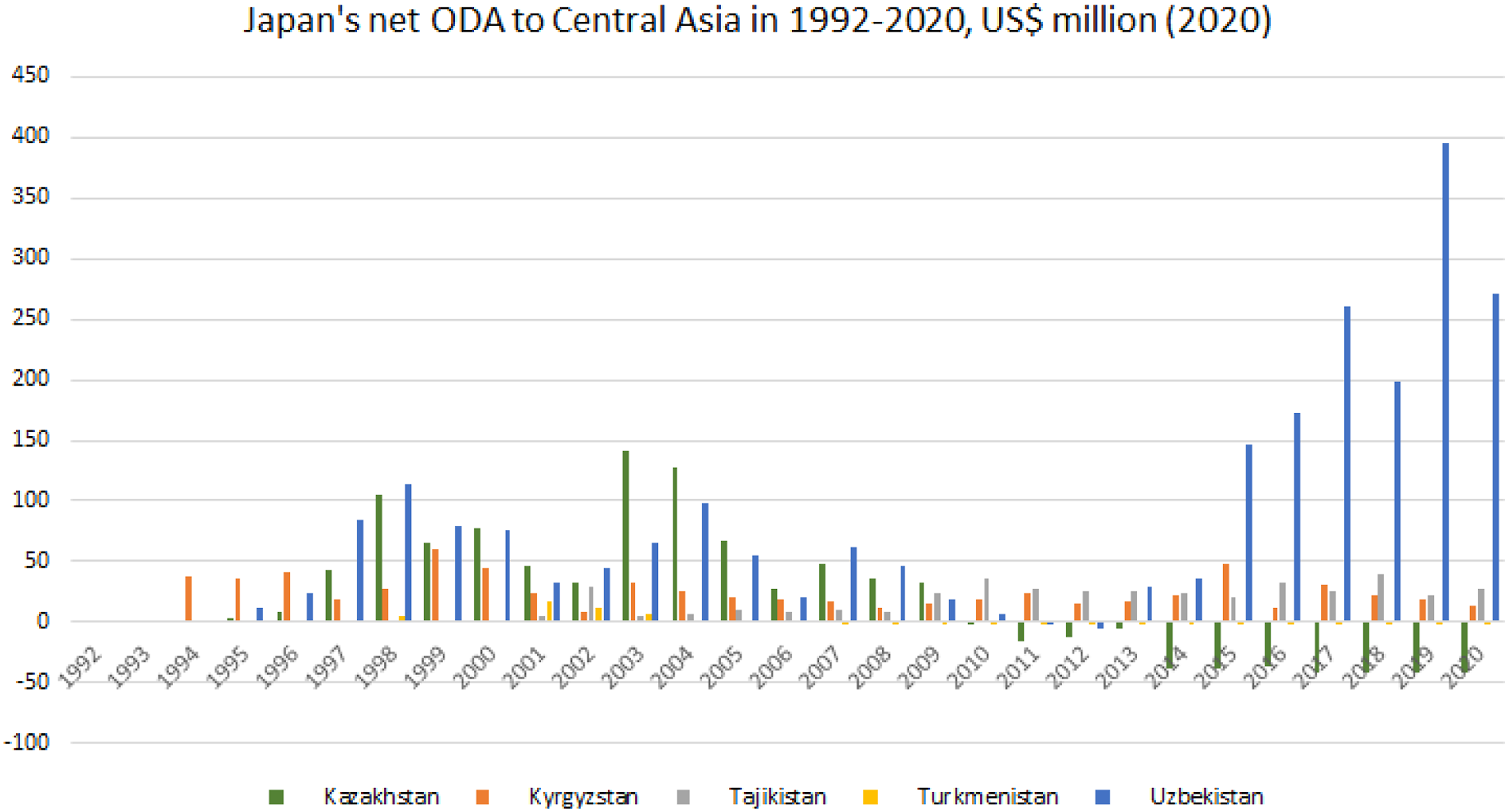
Human resources training has been another pillar of sharing Japan’s development experience both in Japan and in the region in line with Japan’s general philosophy of development cooperation, which can be summarised as ‘nation-building is human resource capacity-building’ (Japan International Cooperation Agency, 2014, Japan International Cooperation Agency, 2022a). Former Japanese Ambassador to Uzbekistan Nakayama Kyoko described Japan's approach to technical cooperation in the following way: "For the people of Uzbekistan, who are striving for nation-building using Japan as a model, not only financial assistance but also the dispatch of researchers and engineers from Japan are valuable." (Nakayama, 2005: 192). Between 1992 and 2017, Japan had sent 2587 expert consultants to CA and, in turn, received 9668 trainees from Central Asia of various professional backgrounds (Glava, 2017). Many of them subsequently rose to high positions in the governments of their countries, up to the level of minister and deputy minister (Hirogaru Chinichiha Gyōseikan, 2021).
Although the example above illustrates well the emphasis placed on raising future leaders, what Japan has been doing more systematically to share its development experience is the establishment and operation of human resource development centres and dedicated specialised programs. Namely, in Kazakhstan, Kyrgyzstan and Uzbekistan, JICA operates well-known Japan Centres, acting as knowledge repositories and training hubs. In the field of industrial development, the Japanese government agreed to provide assistance in training Kazakhstani staff in charge of policies regarding auxiliary industries of the natural resources sector and training staff at Kazakhstani industrial companies through the dispatch of Japanese experts and receiving Kazakhstani specialists in Japan for internships (Memorandum Vtorogo Zasedaniya, 2010). A notable example of Japan’s approach to Uzbekistan’s human resources training has been the 2015 agreement on the establishment of a Uzbek-Japanese Youth Innovation Centre at the Islam Karimov Tashkent State Technical University, which received direct support and supervision from top-level government officials (Interview, 2022a; President of Uzbekistan, 2016). Another avenue has been provided through training programs run in conjunction with Japanese universities. For instance, Nagoya University has been a long-established hub for numerous Uzbek students focussing on law programs; in the 2010s, the university opened its satellite campus in Uzbekistan as well as the Research and Education Centre for Japanese Law.
Japanese philosophy behind the emphasis on human resources training in the modern era can also be traced to its own experience as far back as the Meiji Revolution. Firstly, in 1871–1873, the Japanese government dispatched the Iwakura Mission which has spent about 18 months collecting information and knowledge about Europe and North America to bring it back to Japan and use in Japan’s modernisation. Secondly, during the modernisation Japan pursued the policy of inviting foreign experts, known as o-yatoi, to help its development in various fields. Japanese researchers of intellectual aid to Uzbekistan (Kashiwagi, 2014, p. 25) refer to this history, as well as to mediaeval Japanese missions to the Chinese dynasties of Sui and Tang, as examples of how Japan itself benefitted from intellectual aid in its development.
Since 1993, Kazakhstan has been running a national scholarship programme called Bolashak, enabling its students to study in foreign universities. Furthermore, Kazakhstani researchers praised the Iwakura mission and examined issues with Kazakhstan’s similar endeavours undertaken in the 1990s–2000s. According to Kassenova (2008), Kazakhstani politicians and officials have made tens of thousands of study trips to foreign countries, and many foreign consultants have been invited to Kazakhstan. However, the results were less impressive than those of the Iwakura mission for the following reasons: firstly, a relatively lower level of devotion of political elites to strengthening the country and state interests; secondly, the lack of a conceptual approach, such as formal borrowing without insufficiently understanding the essence of borrowed mechanisms, or even a conscious superficial borrowing to camouflage an insufficiently presentable reality. Ultimately, according to Kassenova, these imitative processes hinted at the main problem hindering the state and nation-building in Kazakhstan at the time – a lack of understanding of the need for fundamental principles. To illustrate this point, she provided an example of a prominent Kazakh legal expert deploring how the officials from the country’s Ministry of Justice called all domestic law ‘applied’, not considering it necessary to be guided by the spirit of the law, its basic principles (Kassenova, 2008).
Exporting development success recipes rather than the model: Korea’s development narrative for CA
South Korea is certainly a country that has made the leap from extreme poverty to the G20, and from an OECD recipient to donor. Such a leap is necessarily part of the current image of Korea that has been propagated by successive presidential administrations. The economic development model primarily associated with the Park Chung-Hee administration has played a significant role in this rapid development. Subsequent administrations built on Park’s economic successes and transformed Korea into a developed country. At the same time, there was a parallel democratisation of society, which eventually evolved into the Korean version of democracy.
Although Korea is concerned about its national image, which is reflected in its active national branding policy, and Korea’s rapid economic growth is one of the pillars of this image, the promotion of the Korean model of economic development itself has been only fragmented.
Despite the fact that among developing countries or countries with economies in transition (UNEP classification), as Central Asian countries, there is a demand for recipes for dynamic and efficient economic development, the experience of Korea or other East Asian tigers, in general, is not unambiguously successful.
The East Asian model of development was seen as an alternative to the economic development model dictated by the Washington Consensus. But the crisis of 1997 called into question the effectiveness of the East Asian model of development (Pang, 2000). Therefore, promoting a national economic model may have negative implications for the national image. Therefore, one can observe Korea trying to articulate a narrative in the direction that Korea shares its development experience and some proven recipes, rather than imposing a national model in its entirety.
In addition to the fact that Korea does not promote the national model in its entirety because of some of its failures, it becomes obvious that the application of the Korean economic model is complicated for developing countries by the fact that they are not Korea. That is, their development conditions, geographic location, economic indicators, culture and external factors (e.g. the formation of international institutions and the environmental agenda in the world) do not allow them to copy the model.
Since Korea today is a democracy in which different parties come to power, these groups may have different perceptions and interpretations of different ideological constructs. For example, Kim (2016) shows how the understanding of Korea as a country of the middle power has changed from administration to administration due to political goals, linguistic features of the Korean language, and other factors. A similar problem is identified by Ayhan (2020), who examines the evolution of the term public diplomacy, one of the key tools of Korean foreign policy. He also points out that although high-ranking officials have used the term from administration to administration, and there is formal definition presented in the public diplomacy act, still there is no sufficiently defined interpretation of the term.
Thus, it can be emphasised that the promotion of a national model of economic development could be hindered by the fact that there is no unambiguously formulated, universally accepted and undisputed Korean model. Moreover, depending on the party in power, the attitudes towards the economic development measures taken by Park Chung-Hee may vary. Also, Korea’s foreign policy partners (e.g. the US) may be uncomfortable if Korea promotes authoritarian models of power as necessary and a starting point for economic development.
Moreover, South Korea in promoting itself through developmental role-model should take into consideration modern challenges and circumstances, hence it is more relevant to boast with and share knowledge about modern achievements. Thus, the strategy of promoting only certain components of economic development can be considered the most compromising approach. Therefore, Korea promotes the national economic model in a fragmented way, rather its experience through various projects.
One of the key tools through which components of national development or experiences are promoted is the so-called Knowledge sharing program (KSP), an advisory program aimed at promoting the socio-economic development of partner countries through experience sharing. Hyun Oh-Seok, former Korea Development Institute President, in one of the final reports highlighted that Ministry of Strategy and Finance supports the KSP ‘with the understanding that learning from Korea’s development experience and obtaining economic policy advice tailored to the needs of developing and transition countries may be the greatest gift that Korea can offer to the world’ (MOSF, 2010, p. 9). The message claims that Korea through this program rather shares its experience, based on demand and needs of partner countries, in a very specific fields rather exporting its national development model, as a whole.
When developing recommendations for CA partners, the experts acknowledge the difference in conditions of development with Korea, for example, when developing an Industrial-Innovative Development Plan experts highlighted that ‘Kazakhstan today is in a much better position [than Korea that relied on foreign loans in the 1960s and 1970s] to use its own resources for development’ (Ministry of Strategy and Finance, 2010; p. 26). Furthermore, recommendations typically refer to Korean successful cases from modern times that may include agro-processing clustering (based on Munkyung Cluster for apples) and development of Korea-style Techno-Parks (Ministry of Strategy and Finance, 2013), development of Free Economic Zone (with reference to Incheon FEZ) (Ministry of Economy and Finance, 2019) (both for Uzbekistan), human resources management and performance management reform (with reference to Korea’s trials and errors in strategic human resource management and performance management during several presidential administrations) (Ministry of Strategy and Finance, 2016), efficient management of ODA support with a reference to successful case of Korea (Ministry of Strategy and Finance, 2016) (both for Kyrgyzstan), advancement of access to public housing using the experience of Korea’s Housing Guarantee Fund as the nation’s public housing guarantee provider (Ministry of Economy and Finance, 2020) and small and middle enterprises (SME) development using Korea experience and recommendations (Ministry of Strategy and Finance, 2011) (both for Kazkahstan).
Turkmenistan and Tajikistan have not yet partnered with Korea via KSP. It is worth noting though that Kyrgyzstan was a latecomer in cooperation through this program. The participation in it coincided with Kyrgyzstan’s transition to a lower-middle-income country status. Korea is famous though for concentrating on low middle-income countries when distributing its ODA, while paying lesser attention to countries with lower economic status (Kim & Oh, 2012; Smart, 2011; Varpahovskis, 2019). It is reasonable to assume that Tajikistan and Turkemnistan would be able to cooperate within KSP after they reach certain economic status and report interest in learning Korean experience of development. Moreover as of 2021 Korea selected Uzbekistan, Kyrgyzstan and Tajikistan as ‘Priority Partner Countries’ in receiving Korean ODA (CIDD, 2021), and all three countries are currently classified as LMIC (OECD, 2022). Nevertheless, Uzbekistan still receives 17 times bigger amount of help than Tajikistan and six times more than Kyrgyzstan (CIDD, 2021).
An alternative program, through which Korea is sharing its experience of becoming a developed country, touches upon development of rural areas of the country and is known as ‘New Village Movement’ (Saemaul Undong, kr.새마을운동). This program boasts with listing its archives in the Memory of the World Register by UNESCO highlighting the words of 11th International Advisory Committee about Saemaul Undong’s importance for countries seeking to eliminate poverty in rural areas. Formally, the project has ideological component (Saemaul spirit) that ignites in rural dwellers ‘can-do’ attitude and urges to transform from passive obedient community into self-assured community.
So far, Saemaul projects are mainly enjoyed by Kyrgyzstan: starting from 2010 Kyrgyzstani government demonstrated its interest in Korean rural development experience, that primarily is associated with Saemaul movement (Musaeva, 2021). The intense dialogue between Korea and Kyrgyzstan resulted in numerous trainings on Saemaul conducted for Kyrgyzstani citizens, and the launch of My Village project (Menin Ayilym, kg: менин айылым) that is executed via KOICA and incorporates the instalment of the Saemaul model in about 30 pilot areas in three regions of Kyrgyzstan. Even though there is a recognition of program’s contribution to Korea’s development from Kyrgyzstani side (Abraeva, 2019), the program design and ideological component had to be re-designed to include Ashar (kg: ашар) concept that refers to traditional voluntary participation (Musaeva, 2021).
Besides Kyrgyzstan, Tajikistan representatives are reported to participate once in Saemaul training in Korea (joint event with Kyrgyzstan) (KSUK, 2018) and Turkmenistani Ambassador visited Saemaul Undong Center in Korea in 2016 to discuss cooperation (KSUK, 2016), but cooperation between Korea and Turkmenistan within Saemaul framework has not demonstrate any progress.
Korea have developed Saemaul project in Dostlik village, near Tashkent, Uzbekistan, but as it was discussed at the Minutes of the National Audit Committee on Foreign Affairs and Unification with the Embassy of Korea in Uzbekistan, this project unexpectedly was not as successful as in other countries. Among possible reasons was a lack of cooperation from the local government side because they thought that this project made locals more conscious and instigated to act independently from the government (Foreign Affairs and Unification Committee 2018, 23 October: 7). The KOICA Director in Uzbekistan who expressed concern that Uzbekistani government misunderstood goals of the project and were concerned with his rhetoric about ‘instigating’ (“선동한다”) of villagers to act was recommended by the Committee to amend narrative and use ‘guidance’ and ‘enlightenment’ (‘계도한다, 계몽한다’) instead (Ibid). This episode on the one hand illustrates that deployment of even peaceful rural niche projects that are not aimed at toppling the regimes are not easy to export, and on the other hand it indicates that even for Korean government representatives the rhetoric around national development-related projects are fluid.
It is worth noting that even though Saemaul Undong programs appear as ODA tools in previous and current Presidential administrations’ arsenals, there is an explicit difference in enthusiasm of implementation of aid under Saemaul Undong brand, rhetoric surrounding them and promotion intensity. For example, during Park Geun-hye’s era KOICA’s (2015) report contained 30 mentions of ‘Saemaul’ programs, while the latest KOICA (2020) report mentions it only three times. This drastic distinction can be explained by the different attitudes towards Park Chung-Hee era. Namely, Park Geun-hye, a daughter of Park Chung-Hee, had more positive attitude towards Park Chung-Hee’s heritage, while Moon Jae-in’s administration did not show enthusiasm about Saemaul Undong programme’s promotion. It should not be expected that Saemaul Undong programmes will disappear but the intensity of its implementation is determined by ruling party’s attitude towards Park Chung-Hee’s heritage and modern aid principles that the government chooses to follow.
Additional channels of intellectual aid
Besides KSP and Saemaul programs Korea exercises other set of projects with Central Asian republics. For example, within the framework of KOICA’s Development Experience Exchange Partnership (DEEP) Program Korea’s National Human Resource Development Institute (NHI) exercised a multi-year long program ‘to share Korea’s national development experience through public HRD [Human Resources Development] and administrative policy consulting’, where it gave developed curriculum and gave trainings to a multiple Uzbekistani bureaucrats (NHI, n.d.).
There is also a special program organised by NHI for training of senior officials (‘Leadership Capacity Enhancement Program for Senior Officials from Uzbekistan’) (NHI, 2019) . The Uzbekistani interest in education and training with NHI was even highlighted by former President Karimov who ‘personally ordered selecting NHI as a strategic partner for the reform of education and training’ (Hwang, 2016). Less senior civil servants representing developing countries (including Central Asian republics) can join South Korean higher education institution, boost their knowledge in the selected fields and obtain Master and doctorate degrees via KOICA Scholarship Program. This program functions within public diplomacy and knowledge diplomacy frameworks that entail that on the one hand the alumni will use gathered knowledge about Korean development assistance to contribute to home country’s development on the other hand it will contribute to the perceived Korea’s country image (Kim, 2012; Varpahovskis, 2021).
Finally, Korea is active in promoting development experience through multilateral approach: namely Korea-Central Asian Forum, that evolved from an annual forum into institutionalised organisation with headquarters in Seoul. This institution functions both as consultative body for multilateral and bilateral relations of South Korea and Central Asian states, and a platform where Korea shares its economic development experience (KF, n.d.).
Recent attitudes to development models and cooperation in Central Asia
As described in the introduction, President Mirziyoyev mentioned Germany as a potential model, making this reference as recently as in 2021, 30 years into Uzbekistan’s independence and decades into the debates on the applicability and benchmarking of various country models. Although this approach of learning from international best practices has become widespread by the contemporary era, it is nonetheless reminiscent of Japan’s 1871–73 Iwakura Mission discussed earlier above.
A comparison of similar recent policy speeches and inaugural addresses by the leaders of Central Asian countries provides an insight into the rhetoric of top-level authorities with implications for the discourse on development models. Among the five regional states, presidents of three – Kyrgyzstan, Turkmenistan and Uzbekistan – have made an inauguration speech in 2021–2022; since in Kazakhstan and Tajikistan such speeches were delivered earlier, in 2019 and 2020, respectively, we have also examined recent presidential addresses for these two countries, made by President Tokayev in March 2022 and by President Rakhmon in December 2021.
In general, Japan or Korea were not mentioned in any of those speeches except the 2021 inauguration speech by Uzbekistan’s President Mirziyoyev – he mentioned both of those East Asian countries among eleven key partner states outside Central Asia. This absence in other speeches does not, however, carry any negative implications for the overall quality of relevant bilateral relationships. By contrast, the Kyrgyz president’s inauguration speech from 2021 and President Rakhmon’s 2021 address to parliament did mention other states, whereas the Kazakh president’s 2019 inauguration speech and 2022 parliament address did not. Mentions of other countries were also absent from the Turkmen president’s 2022 inauguration speech, possibly in line with the country’s long-standing foreign policy of neutrality; however, the text expresses willingness to boost cooperation with international financial institutions and multilateral development banks, such as the IMF, the World Bank, the EBRD, the ADB and the Islamic Development Bank.
What we also deem interesting is the prevalence of certain topics, in particular the mentions of political modernisation in Kazakhstani President Tokayev and Uzbekistani President Mirziyoyev’s speeches and national development strategies. For instance, President Tokayev’s March 2022 parliament address made modernisation (12 mentions) one of its key focal points and made clear that this modernisation was planned to be of political nature. For comparison, Tokayev’s 2019 inauguration speech mentioned modernisation once – as a pledge that, as then-newly elected president, he would prioritise working on Kazakhstan’s Third Modernisation. Kazakhstan’s Third Modernisation is a policy proclaimed by then-President Nazarbayev in 2017, aimed at succeeding the country’s (per Nazarbayev) First Modernisation (transition from planned to market economy in the early 1990s) and Second Modernisation (adoption of Strategy-2030 announced in 1997 and moving the country’s capital from Almaty to Astana) (President of Kazakhstan, 2017).
Importantly, Nazarbayev’s Strategy-2030, announced in 1997, contained three mentions of Japan and three mentions of Korea and, as we showed earlier, outlined specific policy priorities that he wanted to employ in Kazakhstan from international best practices that have worked in Japan and Korea, as well as Indonesia, Taiwan, and Chile, which were also mentioned among models in this respect: low inflation, budget deficit, strong national currency and high savings rate (Nazarbayev, 1998).
Although Tokayev’s speeches did not make references to Japan or Korea, their emphasis on modernisation is cognate to Japan’s recent development cooperation policies, which included efforts to share Japan’s history of the Meiji-era and postwar-era modernisations development experiences and nation-building to other states (Japan International Cooperation Agency, 2022a, Japan International Cooperation Agency, 2022).
Although Uzbek President Mirziyoyev’s speeches did not contain references to modernisation, this is not the case of Uzbekistan’s national development strategies adopted in the beginning of his respective terms. The 2017–2021 strategy mentioned modernisation 19 times, of which five had a general context with implications for political reforms and liberalisation (President of Uzbekistan, 2017). The 2022–2026 strategy mentioned modernisation twice, of which one had a general political context, referring to the legislative system (President of Uzbekistan, 2022).
According to an Uzbek development practitioner, although in the 1990s Uzbekistan was at the crossroads in terms of deciding on a reform path, so its government was considering various models, including Turkey, Japan, Korea and other ones, later the government switched to the promotion of its own Uzbek model, briefly outlined above. Theoretically speaking and in terms of discourse, East Asian culture had a certain appeal at that stage due to its perceived emphasis on discipline and subordination as opposed to Western neoliberal models. Importantly, according to the same source, what also made Japan and Korea attractive as development cooperation partners to the government at that time in practical terms was these countries’ willingness to provide concessional loans – firstly, without political conditionality differentiating them from Western powers; and, secondly, without harbouring an agenda that may have been viewed as ‘suspicious’, thus differentiating them from China (Interview, 2022a). In the mid-2000s, some Uzbek academic scholars admitted that visiting Japan to study its economy made them think that the Japanese economy was one of the best models of market economy for other developing countries (Mavlonov, 2006, p. 10). However, Uzbekistan post-2016 opening towards Western countries from 2016 made Japan’s and Korea’s comparative advantage less marked (Interview, 2022a).
Recent testimony from Kazakhstani academics participating in human resources training hinted at the persisting salience of localisation philosophy and attitudes towards it. In December 2021, a faculty member of Kazakhstan’s Nazarbayev University, Zhanat Kappasov, participated in an online training program sponsored by JICA, organised jointly with Mie University and aimed at developing advanced industrial human resources through Japanese-style engineering education in Central Asia. Kappasov opined on the differences between Japanese and Kazakhstani industrialisation in the following way. Around the 16–17th centuries, Europeans introduced firearms to Japan, but subsequently the Japanese acquired that technology and replaced all Europeans in the manufacturing process. Furthermore, the Japanese started their own manufacturing process and opened dedicated institutes for mathematics and physics to support the industrialisation. However, in Kazakhstani steppes, according to Kappasov, even with the appearance of firearms, nomads did not learn that technology and there were no specialists to acquire that technology. As a result, the industrialisation came from outside Kazakhstan, and the Kazakhs did not open their own institutes for supporting their own industrialisation. The professor suggested that since that the Kazakhs of the past did not have the relevant ‘mentality’. For example, a Kazakhstani exhibit displayed shown at the recent World Expo was not made in Kazakhstan, or programmed by Kazakhstani experts grown up locally. Kappasov admitted to learning from Japanese industrial experts and academia professors that Kazakhstan needed to build up that mind-set of making technology localised at home (Nazarbayev University, 2022).
When it comes to the younger cohorts of Central Asians, many of them tend to have a notable consideration of Japan and Korea as models of economic development. According to a survey done with Japan-based foreign students to questionnaires, when asked which country is regarded as a model of economic development for their own society, 7.7% of respondents from Uzbekistan and 17.3% of respondents from Kazakhstan picked Japan out of a list of some 17 options, making Japan the third and second most popular option, respectively. The share of respective responses for South Korea was also relatively significant, hovering around 3–4% (Asian Student Survey, 2018). This suggests that the appeal of Japanese and Korean development models may have some prospects among Central Asia’s future generations.
Conclusion
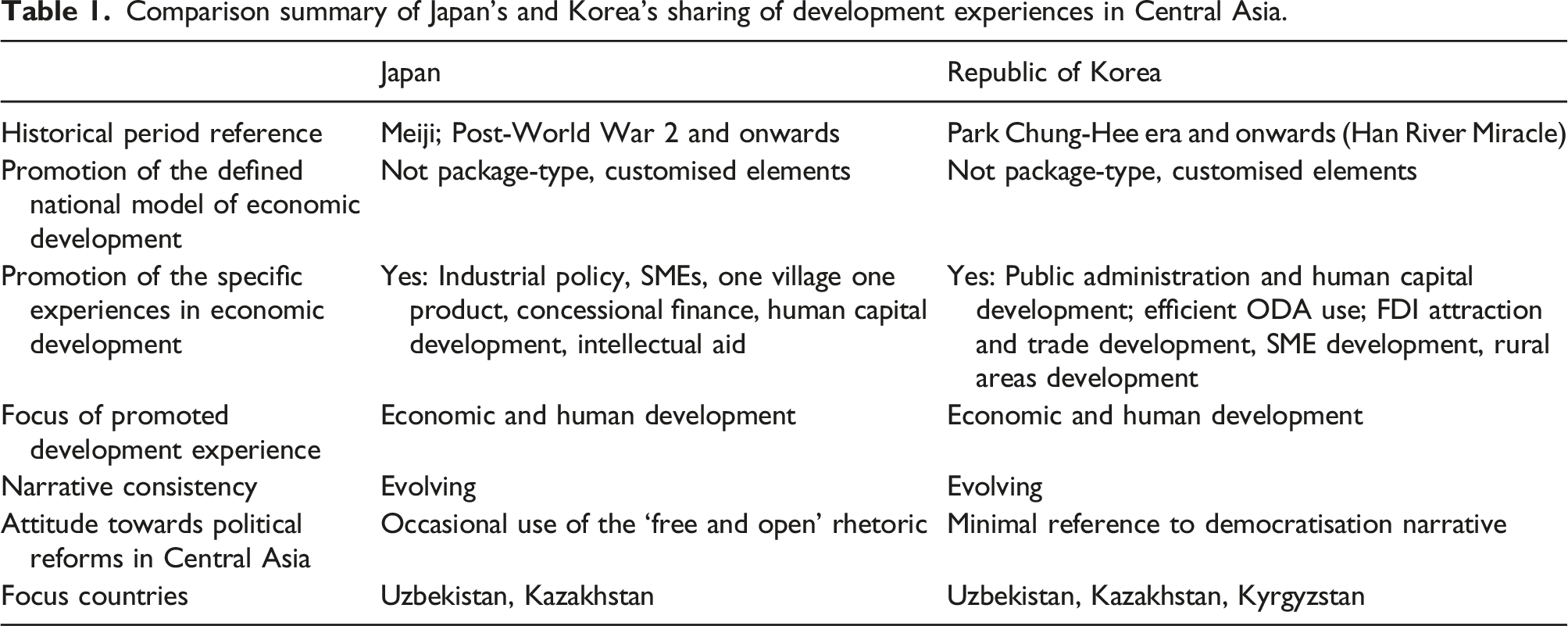
Comparison summary of Japan’s and Korea’s sharing of development experiences in Central Asia.
At the same time, while there is some evidence that Japan and Korea have formed and provided some recommendations to the CA states, it does not mean that the CA republics have blindly copied this experience and declared from whom this model has been adopted: on the basis of intellectual and financial aid from Japan and Korea CA states would rather develop their reforms, adapt to local realities and not openly refer to external assistance in order not to undermine the government image in the eyes of local population. In a way, that localisation approach does not contradict Japan’s development experience, which extensively used localisation and translative adaptation.
Despite the fragmented promotion of national development by Japan and Korea in Central Asia, both East Asian countries constructed a narrative that emphasised the historical experience of these countries: Japan operationalised a narrative showcasing the Meiji Revolution and post-World War 2 development as milestones, while Korea emphasises the historical connection of the Park Chung-Hee period and further post-Park periods. It is also worth emphasising that both Japan and Korea tended to promote economic recipes for successful development and are not inclined to demand democratisation as part of their aid conditionality among the Central Asian republics. Speaking of promotion tools, it is worth noting that both countries operate a number of programs that help citizens of the CA republics to acquire knowledge for the successful development of their home countries. Korea places the strongest emphasis on assistance and national branding through ODA-related institutions. Although Japan’s national branding such as Cool Japan is promoted separately from aid, despite differences in Japanese and Korean experiences of development, both integrate their transformation from a recipient country to a donor country into development-sharing narratives, although in the case of Korea this transformation is more recent than for Japan and is of the key aspects of national branding.
In terms of country focus, while operating in all five CA states, both Japan and Korea have become primarily focused on Uzbekistan, and to a slightly lesser extent on Kazakhstan, especially as Kazakhstan graduated from foreign aid. In recent years, Korea has become more active in cooperating and providing development prescriptions to Kyrgyzstan, but the volume of relations and assistance is not yet comparable with Kazakhstan and Uzbekistan.
Footnotes
Author’s Note
The views expressed in this text are those of the authors only and do not purport to reflect the opinions, views, or the official positions of any organisations. All errors and italics are the authors’ only.
Declaration of Conflicting Interests
The author(s) declared no potential conflicts of interest with respect to the research, authorship, and/or publication of this article.
Funding
The author(s) received no financial support for the research, authorship, and/or publication of this article.
