




Abstract
The introduction of open government has been used in many countries to improve the transparency, accountability of the state, and promote participation by citizens in collaborative governance. Its potential for public services improvement, citizen empowerment, and a positive impact on reducing corruption have attracted scholarly attention. Set alongside this, open government initiatives have facilitated greater access to information which can be used to hold governments to account and, in so doing, build trust between citizens and the state. While open government principles sit easily in democratic systems, some authoritarian states have also adopted this concept. This raises two questions. First, is there evidence that open collaboration, as the most developed form of open government, has empowered citizens in autocracies? Second, and more generally, why would authoritarian regimes seek to adopt open government when the concepts of autocracy and openness are antithetical? This paper attempts to address these questions using three case study countries in Central Asia: Kazakhstan, Uzbekistan, and Kyrgyzstan which adopted open government policies. It finds evidence of co-optation, network authoritarianism, and state unresponsiveness/resistance to citizens’ inputs.
Introduction
The term ‘Open Government’ in the academic literature is most closely associated with freedom of information, anticorruption, and transparency (Nam, 2012). In the popular mind it is synonymous with former US President Obama’s Open Government Directive in 2009 which focused on how, via three principles, Open Government should work (Thorhildur et al., 2013). Obama elaborated in the following way. First, using new technologies government should be more transparent and provide information to citizens on what they are doing. Second, government should be participatory by engaging with citizens and, as a result, promote government effectiveness and improvement in the quality of the decision making process. Third, government should collaborate across all levels of government and with non-profits and business (Wirtz & Birkmeyer, 2015).
Open Government has long been promoted as a tool for development. Looking specifically at Open Government in developing countries, the OECD offered the following definition: Open Government initiatives are a driver of inclusive growth as they form the foundation for inclusive institutions that offer broad citizen participation, plurality and a system of checks and balance which, in turn, provide better access to services (OECD, 2017, p. 42).
Based on this definition the OECD suggests four core principles which should underpin the growth in Open Government: citizen engagement; transparency; accountability; and, integrity. These core principles of open government do not resonate well with authoritarian states, yet we see evidence of autocratic countries embracing the concept. The aim of this paper is therefore to investigate the impact of open government policies on the empowerment of citizens living in authoritarian countries.
The structure of the paper is as follows. First, we locate our area of research in the wider literature on open government. Second, using three case studies of autocratic states in Central Asia (Kazakhstan, Uzbekistan, and Kyrgyzstan) we investigate, using primary data from 47 interviewees, open government initiatives. Finally, we discuss our findings based on five key themes which emerge from the research and consider the wider implications of adopting open government in authoritarian states.
Open government
Open government framework.
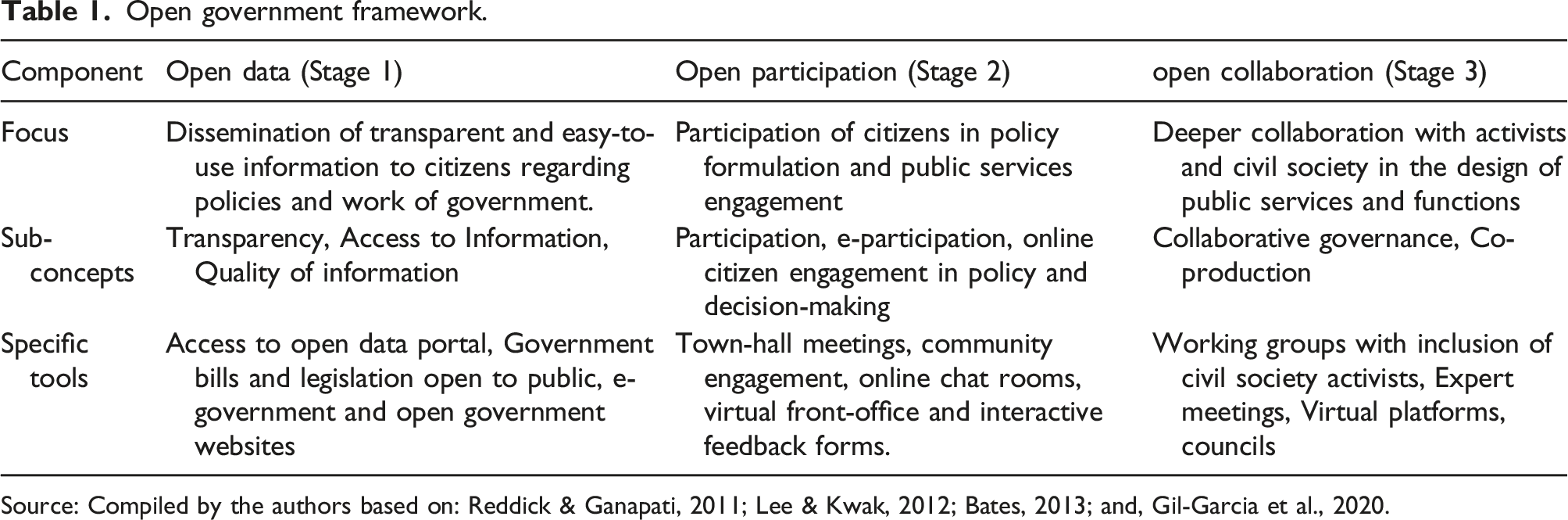
Source: Compiled by the authors based on: Reddick & Ganapati, 2011; Lee & Kwak, 2012; Bates, 2013; and, Gil-Garcia et al., 2020.
Although much of the scholarship on open government derives from the developed world, there has been a noticeable increase in studies which compare autocratic regimes with democracies (Fu & Distelhorst, 2020; Guriev & Treisman, 2019; Harrison & Sayogo, 2014; Pirannejad et al., 2019). E-participation, open data, and open government reforms have emerged to encourage interaction between citizens and the state (Alstrom et al., 2012; Martin, 2014; Piscopo, et al., 2017). Some scholars have questioned whether this has resulted in increased collaboration and accountability in non-democracies (Kalathil & Boas, 2010; Wirtz & Birkmeyer, 2015). In an interesting experiment on the use of internet voting in Russia (stage one in our framework), researchers concluded that the ruling elite deployed the tool to disempower opposition activists and create the façade of transparent, accountable, and responsive government (Toepfl, 2018).
Hence, the literature has focused on how authoritarian regimes used new technologies, e-participation, and e-government, as tools to either promote economic development and modernization (Altayar, 2018; Linde & Karlsson, 2013), or to oppress, manipulate citizens, and legitimize autocracy (Gerschewski, 2013, 2018; Guriev & Treisman, 2019; Kendall-Taylor et al., 2020; Kudaibergenova, 2018; Marechal, 2017; Omelicheva, 2016; O’Connor et al., 2019). As an example of the latter, open government can be used to legitimize autocratic regimes by allowing citizens to freely express their opinions about social problems and injustices on-line while at the same time violating the human rights of those who appear to threaten the regime, described as “networked authoritarianism” (Kim et al., 2021; Li et al., 2016; MacKinnon, 2011; Maerz, 2016, 2020; Pearse & Kendzior, 2012; Tsai, 2016). On the wider question as to whether open government has facilitated citizen empowerment, the limited evidence available to date is mixed. An empirical study in Bangladesh concluded that open government data initiatives enhanced the citizen empowerment process and “ensured their involvement in government policymaking process by enabling collaboration with government” (Hossain et al., 2018, p. 674). By contrast, researchers found that the use of open government budgetary data in Brazil did not influence the construction of the policy agenda (Craveiro et al., 2016). Bangladesh is a parliamentary republic and Brazil a federal presidential republic and these findings may not read-across to autocracies.
Extant research on open government is therefore focused largely on the developed world but with an increasing emphasis on how it might be used to empower citizens in autocratic countries (Knox, 2019; Knox & Janenova, 2019). Authoritarianism offers fertile ground for the adoption of open government but, to date, research has tended to focus on the “softer” side of this initiative: open data and open participation (stage 1 and 2 in our framework). This paper attempts to fill a gap in scholarship by examining case studies in open collaboration as the most developed form of open government in three authoritarian states: Kazakhstan, Kyrgyzstan, and Uzbekistan. We are therefore interested in two broad research questions. First, is there evidence that open collaboration has empowered citizens in autocracies? Second, and more generally, why would authoritarian regimes seek to adopt open government when the concepts of autocracy and openness are antithetical? Open collaboration with citizens and civil society is at odds with top-down autocratic style leadership.
Methodology
Autocracies in Central Asia.
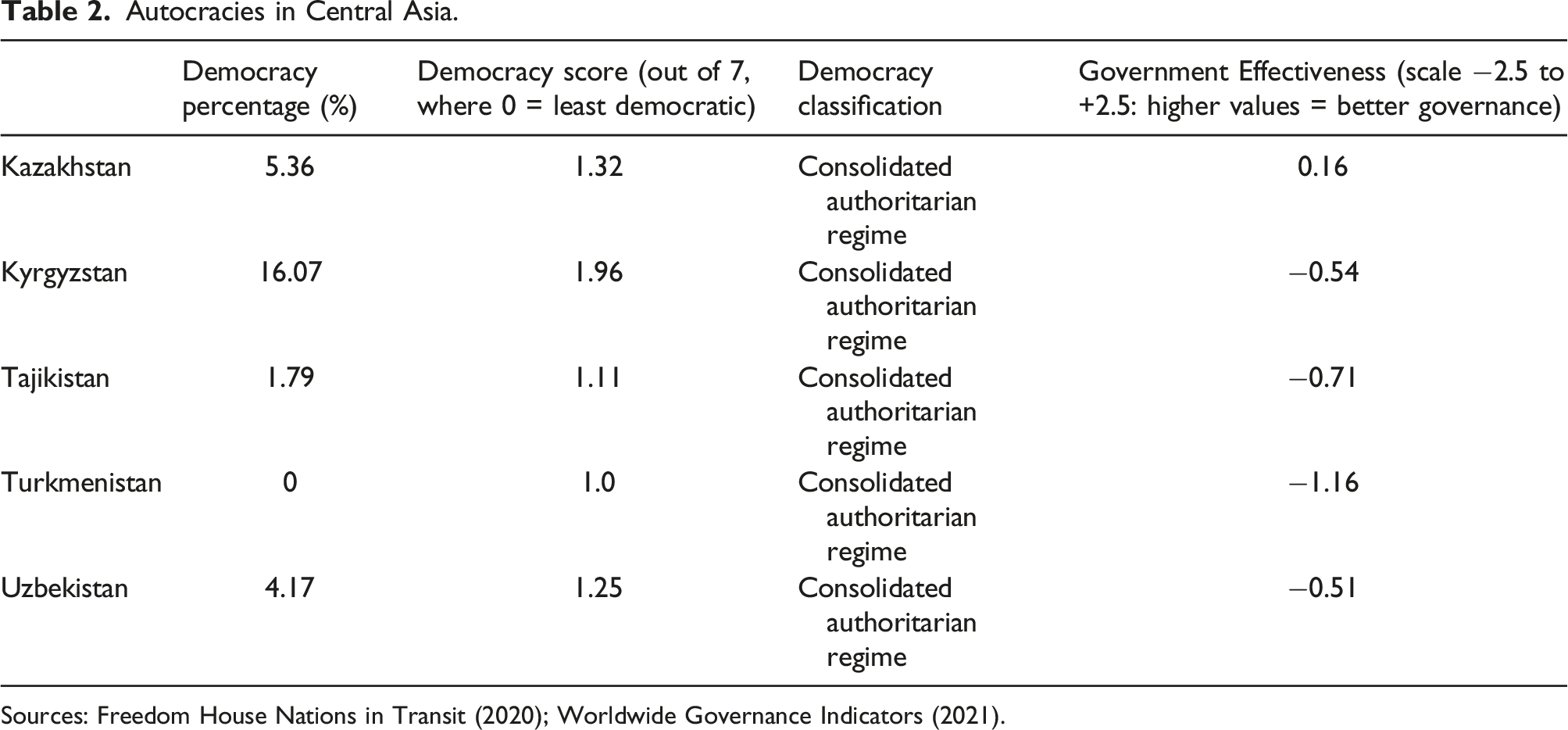
E-Participation index in Central Asia.

Fourth, the focus is on examples where the government in each case study country initiated top-down open government initiatives and therefore, prime facie, is interested in engaging citizens. There are alternative examples of bottom-up schemes which may attract resistance from government and had the potential to fail. The selection of case studies was therefore judicious in the sense that we were interested in tracking cases with the best chances of success given their top-down origin.
There are however limitations to the case study approach. The first limitation relates to external validity. These are small N case studies and hence it is implausible to make a broad generalization with regards to other authoritarian countries. Second, as with all case studies, the issue of omitted variable bias could pose a risk – in our research, things like internet literacy or the digital divide in each case study country may impact on the findings. Governments could argue that they are well intentioned to move through the various stages of open government (Table 1) but are hampered by the technology and IT capacity of their citizens.
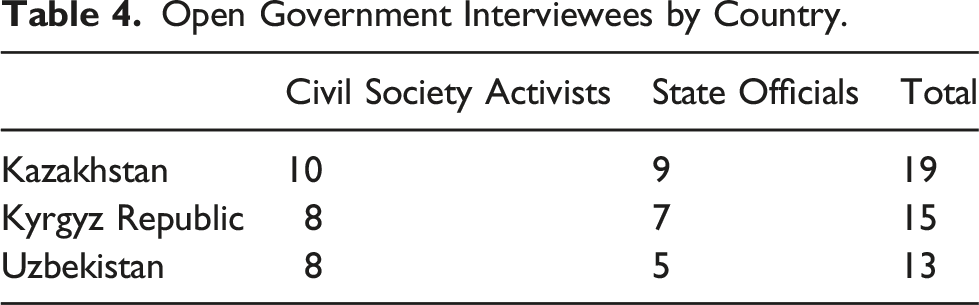
Open Government Interviewees by Country.
Kazakhstan: National Council for Public Trust
National council for public trust in Kazakhstan.
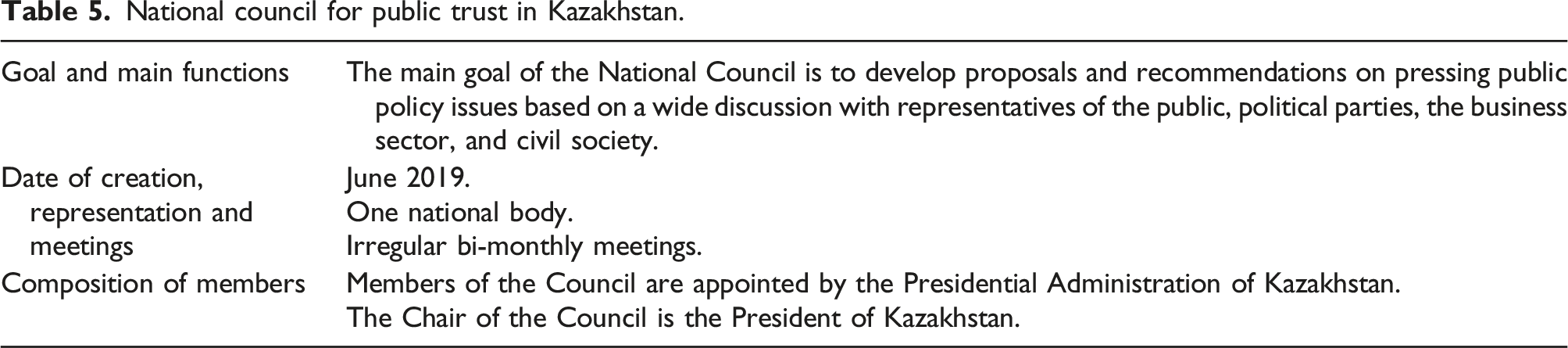
The composition of the National Council is prescribed by its Chair, the President of Kazakhstan. The first list of Council members comprises 44 state officials and civil society representatives, including some notable activists. According to interviewees, the key decision on the membership of the National Council was made by high-level officials in the Presidential Administration based on their potential influence in society and social media (Kazakh State Official #1, 25.10.2019). The selection process and composition of the Council were criticized by activists as follows:
It is possible to gather people, but whether it is representative is another question. The Council tries to replace Parliament. What are the criteria for selecting members of the Council? (Kazakh Activist#1, 30.10.2019).
The Council is a recommending body and cannot develop legislation or monitor the work of state bodies. Its primary function is to conduct a public examination of draft legal concepts, state programs and regulation, and “significant strategic issues” taking into account the views of the public and civil society. The Council is also tasked to ensure dialog between state bodies and civil society.
The first meeting of the Council, chaired by the President, took place on 6 September 2019 and there have been 14 meetings at the time of writing (March 2022). Agenda items are eclectic and controlled by presidential advisors. Topics have included: the development of civil society, foreign migrants, gender equality, modernization of state bodies, and the prevention of fake news. Increasingly though, the meetings are used to hear progress reports from Ministers on their work. These are delivered in the form of ‘speeches’ with no opportunity for engagement. One senior official acknowledged the forum as a form of co-optation
National Council is a tool. Its goal is collaboration, as well as communication of key information to the public. The creation of the Council is an attempt to institutionalize dialogue with the public. There are also other feedback tools, such as public councils, social monitoring networks, and acceptance of appeals (Kazakh State Official #4, 10.12.2019).
The President has also used the forum to promote his reform agenda on peaceful protests and the need to preserve the stability and sovereignty of Kazakhstan. Contemporary public policy issues facing Kazakhstani citizens, particularly during a pandemic period (significant deficiencies in the health care system, lack of social welfare for vulnerable people) have not featured on the agenda. A secondary analysis of proceedings from the meetings shows the dominance of the state narrative embellished with state officials’ perpetual praise for the government’s efforts in establishing interaction with citizens on public services (Zhulmukhametova & Adilbekov, 2019). Umarova, a leading journalist and Kazakh activist, raised the issue of press freedom in Kazakhstan to limited effect (Auespekova, 2020). The meetings are broadcast via Facebook and the official website of the President (Akorda) and are strictly choreographed. In its relatively short life span, several vocal critics have been removed from its membership under the guise of “the need for rotation” of participants (“Changes in the Council”, 2020).
Several motivations and themes have been uncovered during our research into the work of the National Council. Interviewees highlighted how the Council has been used to institutionalize and co-opt citizen participation with malign intent: to impose government control and induce citizen engagement for tokenistic reasons. Overtly, the Council responds to the needs of the population and active engagement of civil society but, in reality, it merely incorporates them in the status quo—it institutionalizes their participation. One government official described it in this way:
Society groups are involved through the Council to work out solutions on key issues. There is a structuring [institutionalization] process through business groups and society associations (Kazakh State Official #5, 13.02.2020).
The National Council has become an integral part of the “listening state” concept—a mantra coined by President Tokayev and linked to the expansion of information and social media. There was however a grudging acceptance that times had changed and the state needed to react to the voice of citizens and respond to their needs.
Only closed countries can afford not to have an open government. Kazakhstan does not belong to such closed countries. Citizens can easily receive information from social networks. In the old days the state used to have a monopoly on information, now there is no such monopoly. Now citizens have requested changes (Kazakh State Official #1, 25.10.2019).
However, other interviewees doubted the potential for citizen engagement through such institutions as the National Council. Officials claimed that citizens could not be incorporated directly into decision making because it would embed populism (Kazakh State Official #5, 13.02.2020). The National Council therefore relied to a much greater extent on the knowledge of “experts” rather than citizens, still less young people (Arynov, 2021). Even when citizens coalesced around pressing social issues to articulate societal views to the National Council, their efforts were rebuffed. State officials denounced the ability of citizen activists to provide effective inputs for the purposes of policy change.
You can attract citizens, but it has limited effectiveness. There is an issue of quantity versus quality. Surveys of the population cannot help decision making. This is populism. Another thing is the use of experts (people who are paid money for their advice). This is much more effective (Kazakh State Official #5, 13.02.2020).
Activists highlighted the weakness of the National Council in a non-democratic setting. They argued that the Council was an “artificial” and “compensatory” instrument to forestall public protest which could not become an effective institution to represent various groups that comprise the population. Instead, it was being used as a source of legitimization and co-optation to strengthen the rule of President Tokayev.
Tokayev uses the Council to endorse and legitimize his decisions. He wants to seem like a liberal to Western countries and the world (Kazakh Activist #1, 30.10.2019).
Three working groups of the National Council were set up to examine economic, political, and social issues. Their aim was to collaborate with state bodies and develop policy solutions. However, activists claim the groups were ineffective since state bodies showed an unwillingness to cooperate on the concrete policy areas, simply “going through the motions” (Kazakh Activist #1, 30.10.2019).
Working groups have low efficiency. It is only possible to involve certain experts in decision-making, if they are paid for their involvement (Kazakh Activist #1, 30.10.2019).
The President’s official representative on the National Council, Yerlan Karin, claimed that seven bills were signed based on the deliberations of the Council (Yergaliyev, 2020). It is however difficult to establish a clear causal link between the work of the National Council and this legislation. Overall, the evidence points to the National Council being used as a state legitimization tool through government-controlled citizen participation which offers a veneer of respectability to external investors and foreign observers.
Uzbekistan: Citizens’ virtual receptions
Uzbekistan President Shavkat Mirziyoyev’s election in 2016 heralded a new era of reform following the legacy of his hard-line predecessor. He began his presidency with a direct pledge to the Uzbek population to improve public services and enhance the responsiveness of state bodies to its citizens. The President announced that 2017 year would be called the “Year of Dialogue.” He said at the time: “The authorities must meet the aspirations of the people, know their pressing problems, and have close contact with the population,” (Mirziyoyev and the Year of Dialogue, 2016). The Uzbek President introduced open government reforms broadly categorized in three main areas: promotion of transparency and the creation of citizen interaction platforms; opening up internet and social media outlets; and, public services optimization.
The example chosen here is a citizen interaction platform initiated by the President entitled Citizens’ Virtual Receptions, the purpose of which was to demonstrate to Uzbek citizens that the President was serious in his intentions to promote openness and responsiveness (Uzbek Activist #5, 22.12.2020).
The virtual reception was a large distribution hub where state officials distributed requests from citizens, as well as monitored their execution and kept statistics. There was a special department in the presidential administration that analyzed all statements as big data. The administration tried to learn trends about population through the activity of citizens (Uzbek State official #3, 05.02.2020)
Three major aspects of virtual receptions are examined here: their outworking, impact on the responsiveness of state bodies, and key motivations for their work.
Virtual receptions were quickly implemented and became popular among Uzbek citizens who used them as a mechanism to complain about public services delivered by local and central state agencies. One Uzbek activist described the fora in this way:
Previously Uzbek citizens needed to go to the authorities with a piece of paper begging for change and expressing their concerns. Now they started to write their appeals, complaints, and proposals online, which was easy. Some 3.7 million appeals have been submitted as of today. Gradually, the population is getting used to the fact that government agencies are no longer such remote organizations, but they can be contacted online (Uzbek Activist #6, 23.12.2020).
Initially, state bodies were responsive to the wave of citizen complaints. Citizens, in turn, experienced for the first time a level of state accountability for poor public services.
The virtual reception for citizens is working effectively. Government agencies now operate with an eye to this tool and how citizens can react to their decisions. Citizens are experiencing real benefits from the virtual receptions (Uzbek Activist #6 23.12.2020).
The government deployed a team of IT experts and state officials who used big data techniques to analyze complaints coming from a range of electronic platforms (Uzbek activist #4, 10.08.2020).
Our goal is to help other state bodies introduce new technologies aimed at improving transparency. We also provide assistance to the special center created at the Ministry of Finance that is tasked with enhancing Uzbekistan's ranking in global indexes including the UN E-government index, similar Open Data index (Uzbek state official #4, 07.02.2020)
Citizens’ inputs were then used to adjust or significantly amend some public policies. Such was the state’s responsiveness that the Uzbek President occasionally removed local heads of administration and middle-level officials, ostensibly based on complaints from citizens received through virtual receptions. However, it is not clear how often this happened or whether virtual receptions were used as a ruse to oust officials who attracted the displeasure of the President for reasons other than those linked to complaints about public services within their remit.
If the President received a high number of complaints from a specific region or rayon, the Uzbek Presidential administration would fire the key members of the local administration: khokim [governor], prosecutor and head of local Ministry of Interior Affairs [police] (Uzbek activist #4, 10.08.2020).
As time passed, however, state bodies which initially responded well to citizens' demands regressed to erstwhile bureaucratic habits of procrastination, tokenistic engagement, and outright resistance to the process of being held to account. One official flagged some of the limitations:
Open government measures in Uzbekistan are aimed at reducing corruption and improving the efficiency of government agencies. The focus is on promoting open data, but not all data are disclosed. The process of openness and involvement of officials takes place mainly in large cities (Uzbek State official #2, 05.02.2020)
Many Uzbek state officials and street-level bureaucrats are an integral part of a patrimonial and patronage system which characterized the former Karimov era. Virtual receptions had a superficial appeal under a “new broom” but when reality dawned and the real potential to upset their involvement in nepotism, rent seeking, and unethical behavior emerged, state officials pulled back. One activist noted the following:
There is a growing problem with the virtual reception - citizen requests and appeals are often sent to the state body that the population complains about. As a result, formal rather than substantive responses [otpiska] come back (Uzbek Activist #5, 22.12.2020).
Another issue with the virtual reception is that it failed to reach its potential as a mechanism to discuss serious policy issues or to initiate significant political and economic reforms. According to field data, the platform has become a tool for the resolution of citizens’ mundane issues, some of which were not related to the area or functions of state bodies.
There were many calls of a stupid nature (like: help me find a husband). People did not quite understand why the virtual reception is needed. No serious topics were raised (Uzbek Activist #5, 22.12.2020).
Activists also noted that the virtual reception transformed from a tool of responsiveness and open participation into a formalized communication channel for state bodies. A top-down focus on public services modernization and economic development became the dominant purpose for state officials who discarded the original conceptions of bottom-up accountability and transparency (Uzbek Activist #4, 10.08.2020).
In the first year virtual receptions worked effectively. Officials monitored issues and made decisions based on citizens’ requests. However, then everything changed - a year later. Now they just give replies. These interactive tools are used simply as a communication channel with government agencies (Uzbek Activist #4, 10.08.2020).
The virtual reception became a popular tool for citizens’ grievances in Uzbekistan from 2017. However, their full potential has not been realized. Serious public policy issues are not being discussed at the platform, while responses to citizens sometimes turn into an exercise of bureaucratic formalism and tokenism (otpiska). Officials blamed lack of involvement by citizens: Government agencies need to develop a culture of interaction because citizens are not willing to engage in dialogue. However, we are working to involve people in the discussion of bills and try to respond to the opinions of citizens (Uzbek State official #1, 07.02.2020)
In short, after a promising start, virtual receptions lost their original appeal and purpose and were diverted by state officials from their key objective of citizens holding government to account.
Kyrgyz Republic: Open government partnership
The Kyrgyz Republic has arguably achieved more progress in the transition toward democratic institutions than its authoritarian neighbors in the Central Asian region. However, political instability has not led to the formation of robust democratic practices and institutions. The country has a vibrant civil society sector and it has oscillated between a parliamentary republic and autocracy. As a result of these political developments, Kyrgyzstan has a relatively free media, and the government affords citizens significant openness on the internet and in social media activism.
All of this suggests a propensity for open government and access to information which would allow citizens to hold government to account. The Kyrgyz civil society sector was one of the driving forces that influenced the Prime Minister’s office to join the Open Government Partnership (OGP) in 2017. The Open Government Partnership is an international initiative established in 2011 to promote accountable, responsive, and inclusive governance. Seventy-eight countries and a growing number of local governments—representing more than two billion people—along with thousands of civil society organizations are members of the OGP (Open Government Partnership, 2020). One of the key principles of the OGP is the establishment of partnership and cooperation between the civil society sector and state.
Joining the OGP was an important milestone for Kyrgyzstan. One interviewee (Kyrgyz Activist #2, 08.01.2020) noted: “the fact that the Kyrgyz Republic was the first Central Asian country to join the Open Government partnership was hugely significant to both state and civil society organizations.” NGOs pressed the government for OGP membership to promote open data and optimization of public services (Kyrgyz Activist#1, 08.01.2020). The Prime Minister’s Office supported the initiative as a means of public sector reform and reducing corruption rather than to explicitly promote open collaboration with citizens.
Another important factor that informed the decision of Kyrgyzstan to join the OGP was the influence of foreign donors and international organizations. The local UNDP office in the Kyrgyz Republic provided funding for an initiative on Open Parliament. The OSCE financially supported work of the Secretariat and National Forum of the OGP (Kyrgyz Activist #1, 08.01.2020). The World Bank funded capacity building on openness in public procurement. Significant foreign donor funding became conditional on the Kyrgyz Republic “abiding by international standards to satisfy the requirements of membership of the Open Government Partnership” (Kyrgyz Activist #2, 08.01.2020).
The key mechanism for the implementation of OGP was the creation of the Open Government National Forum. The Forum comprises 38 representatives from civil society and state authorities on an equal basis. It was established to select initiatives that would constitute a country-specific open government agenda. The first meeting of the Forum was held in June 2018 at which the National Action Plan (NAP) began to emerge. This developed into a 2-year National Plan of Action (2018–2020) for the Kyrgyz Republic to build open government which was subsequently approved by the Decree of the Government of the Kyrgyz Republic in October 2018.
The Forum evolved through an incremental process. At the first stage, all citizens of the Kyrgyz Republic can provide their ideas and suggestions on open government development in the country. Citizens can also monitor the work of the Forum through the official website. At the second stage, various civil society organizations and citizen activists are invited to become active members of the National Forum on the basis of specific proposals they outline. However, the realization of such proposals (also called commitments) is subject to an agreement between both state and civil society organizations. Hence, civil society organizations cannot start open government commitments without the consent of their respective state bodies.
The activism of civil society organizations has driven the inner workings of the Forum. According to one Kyrgyz Activist #3 (10.01.2020), “civil society organizations have a strong influence over the agenda of the National Forum and its commitments.” More than 80% of the commitments in the National Action Plan 2018–2020 were proposed by civil society organizations; state bodies suggested only two commitments while the remaining 20 were proposed by civil society organizations. Civil society organizations and activists came with the ideas they wanted to implement within the Open Government Partnership (Kyrgyz Activist #6, 22.10.2020). Most of the work on the realization of OGP commitments was conducted by the civil society organizations and activists (Kyrgyz State official #2, 05.10.2020).
The commitments in the National Plan which originated from civil society organizations included: open data policies in various public services such as education and health; inclusion of citizens in the discussion of draft laws; an auditing system with public participation; involving civil society in the fight against corruption in the state bodies; and, the disclosure of information about state and municipal property. The focus of open government commitments was therefore quite broad, varied and, to some extent, unstructured. Many of the initiatives were aimed at providing open data and information to citizens. Some focused on parliament and anti-corruption activities yet overlooked executive state bodies. Almost all the initiatives involve the inclusion of civil society organizations rather than citizens directly which reflects the specific Kyrgyz institutional context.
The research interviews revealed several problems that were associated with the outworking of the National Forum. “The implementation of obligations under open government is roughly 20%” (Kyrgyz Activist #5, 09.01.2020). Only one commitment was fully completed in November 2020 while other commitments were partially or not completed at all (Kyrgyz State official #2, 05.10.2020). As key interviewees noted, the state bodies resisted the implementation of open government. This lack of strong support by the government bodies was also mentioned by a small number of state officials (Kyrgyz State official #3, 07.10.2020; Kyrgyz State Official #5, 30.10.2020). Three major themes/motivations were uncovered in interviews that potentially explain this phenomenon: lack of direct benefits and hence low motivation, bureaucratic resistance, and a high turnover of state officials. First, state officials did not actively participate in the OGP commitments since they did not see direct career benefits (Kyrgyz State Official #4, 27.10.2020). Civil servants in the Kyrgyz Republic do not consider it important to be responsive or transparent to citizens and open government as a concept is widely misunderstood by officials. Several interviewees highlighted lack of comprehension on the key open government premise—why do we need it?
The enthusiasm coming from the government was only intended for political purposes. There was a lot of hype and promise, but there was no work. The real attitude of government officials for open government is weak (Kyrgyz Activist #7, 25.10.2020).
Second, there was bureaucratic resistance by state officials in the realization of OGP commitments. “Civil servants and officials do not like to take on extra work and responsibility” (Kyrgyz State Official #5, 30.10.2020). The implementation of open government commitments was considered as something additional to the current workload of state officials. Hence, there was an ongoing problem of assigning a responsible/accountable person at the state agency level to realize open government commitments. This problem was exacerbated by the lack of competent public servants and staff to implement the initiative. The low level of average salaries in Kyrgyz public service is a serious concern. Hence, without the effective capacity of state bodies, it became impossible to implement or promote open data and open collaboration initiatives with citizens.
The low efficiency in fulfilling commitment [of open government] is caused by the low level of expertise among government agencies and the limited time frame. Staff turnover reduces efficiency. Capacity is extremely low, and the Kyrgyz state bodies do not attract competent experts (Kyrgyz Activist #4, 09.01.2020).
As the result of bureaucratic reticence, a formal but superficial approach to the implementation of open government initiatives became evident. Interviewees noted that state officials publicly embrace the concept but take little responsibility for its realization. They prefer the implementation of events (“meropriyatiya”) that are linked to commitments, without paying attention to substantive outcomes. Political support of heads of specific state agencies was critical to the effectiveness of implementation (Kyrgyz Activist #6, 22.10.2020; Kyrgyz State Official #6, 09.11.2020; Kyrgyz Activist #8, 17.11.2020). However, most state bodies did not show the political will to promote commitments (Kyrgyz State official #2, 05.10.2020).
Third, there was a major issue relating to the high turnover levels of state officials responsible for implementing OGP commitments. In October 2020, only three state officials on the National Forum stayed in their positions. Meanwhile, around 15 state representatives left without providing a replacement in the Forum (Kyrgyz State official #2, 05.10.2020). Since the start of the initiative, numerous cadre changes have affected the ability of state officials to coordinate a unified policy. A good example of this problem is the work of the State Committee for Information Communications and Technology. The Committee should be responsible for the incorporation of digital technologies in the delivery of public services and the implementation of e-government in the country (Kyrgyz Activist #1, 08.01.2020). However, the Committee has failed so far to introduce any significant changes. Political instability and corruption have led to a high level of turnover of state officials which has resulted in unfulfilled commitments in the Open Government Partnership.
Discussion
All three country case studies above point to significant limitations associated with the introduction of open government policies in Central Asia. So why are authoritarian states motivated to pursue open government? The National Council for Public Trust in Kazakhstan served as means of internal co-optation of President Tokayev’s regime. The Council was intended as a mechanism for open participation and collaboration in the country. However, it became a tool for the Kazakh regime to reinforce its image as an open and ‘listening state’ when, in reality, it compounds the status quo. In the face of an increasingly vocal citizenry, the state has (ab)used open government to control citizen participation, masquerading as an open government reform. It has done this by engaging in isomorphic mimicry of Western open government practices but with the intention of controlling and forging a government narrative. Both these motivations are interconnected.
The Uzbekistan case reveals several similarities with Kazakhstan despite different public sector development trajectories. The Uzbek state has facilitated the creation of a relatively free digital space and a seemingly responsive platform for citizens to hold state bodies to account for the provision of public services. However, once citizens started to articulate their needs on social media and organic citizen engagement evolved, the Uzbek authorities pulled back as these became threatening to the status quo—the “genie was out of the bottle.” The state’s response was to control and impose government-induced forms of open participation in virtual space and circumscribe the role and impact of activists. As in Kazakhstan, open government tools have allowed the Uzbek authorities to monitor the public discussions of political and public policy issues while maintaining the state narrative, a form of information autocracy.
The Kyrgyz Republic offers a more nuanced form of control given its history of political activism and the strength of the NGO sector. Notwithstanding this context, the state has been able to thwart the best intentions of the Open Government Partnership while, at the same time, collaborating at face value with activists. Though Kyrgyz civil society organizations managed to influence the selection of the Open Government commitments, implementation stalled through bureaucratic resistance. The Open Government Partnership has failed to produce any meaningful outcomes for openness and responsiveness, while the political regime in Bishkek used it for co-optation purposes. Open government reform has become vacuous in Kyrgyz Republic. In short, Central Asian consolidated authoritarian regimes have learned to incorporate open government in the face of greater social media activism but used the mechanism to control and reinforce the state narrative. One way in which they have done this is to co-opt activists or repress those who promote an alternative state perspective. Co-optation writ large. Figure 1 distils the key themes from our qualitative data analysis using NVivo. Items clustered by coding similarity.
Conclusions
To conclude we return to our two research questions. First, is there evidence that open collaboration, as the most developed form of open government, has empowered citizens in autocracies? Second, and more generally, why would authoritarian regimes seek to adopt open government when the concepts of autocracy and openness are antithetical? Clearly we cannot speak to all autocratic states but evidence from our case studies would suggest that open government in Central Asia has not moved beyond stage 1 in our open government framework (open data—see Table 1 above). One should not diminish the value of this achievement. Our qualitative data analysis highlighted the benefits of digitalization and how it has transformed the way in which multiple public services are delivered. Open data channels (e-government) have also limited the opportunities for face-to-face interactions between citizens and state officials where corruption is rampant. However, electronic delivery of public services is one thing, participating and collaborating (stages 2 and 3—Table 1 above) in government policies is another, and remains a step too far for Central Asia at this point. This research has demonstrated that non-democratic regimes in Central Asia use open government reform to legitimize their rule and ensure its long-term survival. The efforts of Central Asian governments are aimed at coercing and co-opting citizens and activists to support the regime, which is consistent with the framework of networked authoritarianism.
The data suggests that rather than empowering citizens, the state has institutionalized and engaged in co-optation of citizen activism. There is a façade of openness and freedom to express one’s opinions but a simultaneous cynical and sometimes sinister opportunity on the part of the state to violate the rights of those they perceive to criticize and threaten the status quo. Our case studies also suggest that Central Asian autocracies adopt open government policies to raise their profile with the international community. Kazakhstan, for example, has set itself the strategic goal to become one of the top 30 developed countries by 2050 and to join the OECD. Kyrgyz Republic’s decision to join the Open Government Partnership was driven by local non-government organizations who sought the funding and expertise of foreign donors. Open government is synonymous with international respectability and our data show Central Asian countries are engaging in isomorphic mimicry to gain access to the global community of developed countries. The implications of this research would suggest that regime type matters when it comes to the potential for open government to fulfill its ambitions of open data, open participation, and open collaboration. Consolidated authoritarian regimes may show initial intent by embracing open government best international practices but as citizens exploit its full potential, they see it as a threat and respond in kind through strategies such as co-optation, network authoritarianism and open resistance to bottom-up engagement. Speculation beyond our case studies is fraught with problems but this research shows the need for further empirical work across the Eurasian continent specifically in the Caucasus and Eastern Europe. This would offer further testing of the concept of networked authoritarianism used to legitimize regimes under the guise of strengthening citizens’ voice.
