



Abstract
This article reflects on two proposals to classify and stage Parkinson's disease (PD) and related conditions based on the presence of aggregated alpha-synuclein (ASN) detected by alpha-synuclein aggregation assay (SAA). The authors highlight the significant shortcomings of the proposals: detection of ASN by SAA is not specific of PD or other well-established clinical conditions; they do not allow prediction of clinical course and prognosis; and they are not suitable as an endpoint for clinical trials. To move forward with proposals reflecting so many uncertainties and unknowns will just sow confusion and misunderstanding within the PD community.
Plain language summary
This article is a commentary on two proposals to classify and stage Parkinson's disease (PD) and related conditions based on the presence of aggregated alpha-synuclein (ASN) detected by alpha-synuclein aggregation assay (SAA). Alpha-synuclein is a protein which has been hypothesized to play a key role in the origin of PD. SAA is a recently developed lab test to detect ASN. The authors highlight the significant shortcomings of the proposals: detection of ASN by SAA is not specific of PD or other well-established clinical conditions; they do not allow to foresee how people will behave in terms of development of symptoms and evolution of the possible medical condition. SAA is not suitable as an endpoint for clinical trials. To move forward with proposals reflecting so many uncertainties and unknowns will just sow confusion and misunderstanding within the PD community.
Keywords
The current attempts to classify and stage Parkinson's disease (PD) and related conditions based on biology1,2 are inspired by clinical and research successes in the field of cancer. In oncology, the identification of biomarkers that are associated with clinical, therapeutic, and prognostic features led to the development of definitions and stagings that accelerated research and the development of effective treatments, providing significant help for patients and physicians. Success with this approach is exemplified in the staging of breast cancer. 3 Starting with databases containing clinical and biological details of several thousand patients, researchers worked to correlate these parameters with therapeutic response and prognosis. Their success allowed a comprehensive understanding of the biological factors involved in the development of the existing disease, its course and response to targeted therapy based on biological markers. Importantly, they did not attempt to create multiple separate diagnoses from a single clinical definition of breast cancer, nor did they combine breast cancer with other malignant neoplasms to define a new disease. Advances in breast cancer care have had global impact because their developers included representatives of different parts of the world to assure that the final classification and staging allowed equity of access at a global level and to ensure that every patient they served clinically was included in their framework. The process has been ongoing for eighty years with regular revisions to incorporate new data. This has resulted in a classification and staging system that is useful as an outcome in clinical trials and allows clinicians to make diagnoses which guide therapeutic choices and define prognosis.3,4 The example of oncology remains as the holy grail that other areas of medicine, including degenerative diseases such as Alzheimer's Disease (AD) and PD aim to replicate. The goal of this viewpoint is to present reflections on the clinical and trial implications of recent proposals of biological diagnosis and staging of PD and related conditions.1,2
Unfortunately, the scenario in PD and associated conditions is quite different from oncology. The current consensus on the biological definition of PD has focused on evidence of dopaminergic cell dysfunction, not ASN aggregation. 5 Importantly, symptomatic treatment for patients with loss of dopamine cell function in the basal ganglia has been effective, regardless of SAA status. 2 The current knowledge of the underlying pathophysiology of PD is fragmentary at best, which undermines the two proposals. Their cornerstone is the presence of aggregated alpha-synuclein (ASN) as demonstrated by alpha-synuclein aggregation assay (SAA).6–8 There is growing evidence that ASN is not fundamental for the development of clinical PD2,6: First, patients with clinical PD have dopaminergic deficits and loss of nigral neurons regardless of their ASN status, assessed by SAA or otherwise. Second, carriers of PD with LRRK2 mutations, a common genetic defect, often lack ASN deposit, have PD.6,8,9 Third, it has become evident that co-pathology is essential to the pathogenesis of neurodegenerative diseases, including PD. 10 In this line, a recent pathological study suggests that tau pathology precedes the accumulation of alpha-synuclein in ‘synucleinopathies’. There is also evidence that defects in cellular mechanisms of proteostasis may be the common driver of such co-pathology.11,12 Other proteins and cellular processes, not included in either model but currently being probed in trials, 9 play a major role in the pathogenesis of PD. For instance, understanding the LRRK2 kinase is informing therapeutic development. It is also well established that pathogenic protein aggregation is impossible unless facilitated by defects of proteostasis, encompassing protein synthesis, folding, trafficking, and degradation and genetic defects affecting these are linked to Parkinson's risk. 13 The exclusion of mutations associated with clinically definitive PD and linked to proteostasis but without SAA positivity overlooks the complex genetics of the clinical disease. 14 There are also data showing that one given mutation can have opposite effects (protective versus toxic) depending on the ethnicity of the individual.15,16 Fourth, the proposal of staging aspires to be based on biology, however the biomarker assays are only used for diagnosis, not progression. 2 Recent data show that the specificity of SAA is not perfect even for diagnosis. In fact, in some conditions, such as tauopathies (progressive supranuclear palsy and corticobasal syndrome), up to 35% of individuals may test positive for SAA.17,18 True biological staging remains an important future goal as it informs a survival model that accurately predicts clinical progression, delivering results faster and more precisely than clinical evaluation. In recent clinical trials, confirmation of the diagnosis of PD in early-stage participants was principally done using [123I]-FP-CIT SPECT dopamine transporter imaging. 19 The biological anchors used by Simuni et al. 2 offer the additional risk of a diagnostic lumbar puncture without any quantified additional benefit from improved diagnostic accuracy. Furthermore, no evaluation has been done to consider the benefit of SAA testing in addition to or as an alternative to dopamine transporter imaging. None of the three biological evaluations—dopamine transporter imaging, SAA positivity, or genetic mutations—inform understanding of progression as they do not change throughout the course of PD. This finding seriously limits the models’ biological contribution to diagnosis and staging. This has significant implications for their adoption in clinical trials. Hopeful supporters argue that the new proposals will help to expedite clinical trials to test potential disease modifying treatments by allowing to identify individuals at a very early stage of disease. Available data suggest that this might not be true. For biomarkers to improve our ability to develop therapies, marginal improvements in diagnostic accuracy would offer little clinical benefit. The biomarkers that will improve trials are those qualified by showing that the effects of interventions on the biomarker parallel the effects of the intervention on clinical outcomes. 20 The original goal of the PPMI study was a disease progression biomarker, that would deliver a biomarker-based surrogate endpoint useful for drug development by providing a metric of progress along the causal pathway of the pathological process.21,22 SAA has been demonstrated to neither (a) meaningfully improve diagnostic accuracy in late prodromal or manifest PD, nor (b) provide a measure of disease progression suitable to speed trials by providing a surrogate endpoint. Further, the extracellular alpha synuclein that is the focus of SAA has failed as a therapeutic target, since efforts to eliminate extracellular ASN have not halted PD deterioration.23,24 It is important to highlight that the already mentioned qualitative nature of SAA makes it an unsuitable surrogate endpoint as it remains unchanged as PD progresses. Given these shortcomings, it is not surprising that the authors of the staging proposal rely on yet-to-be defined scores of the MDS-UPDRS, a clinical assessment, to describe progression of the diseases. Rather than moving towards the future, this simply reiterates the 2008 recommendation that PD progression be measured through clinical evaluation. 25 Finally, the staging model simply erases the concept of PD, dementia with Lewy Body (DLB), and REM sleep behavior disorder (RBD), proposing to re-define most, but not all patients, as having the so-called ‘neuronal alpha-synuclein disease’ (NSD). Such biological clustering of distinct clinical diseases has yet to be shown to provide a benefit to patients in any condition. In fact, this creates the risk of recruiting individuals for clinical trials who may have different biological conditions.
The issue here is not just a potential offense to a century-long history. Despite controversies and heterogeneity, patients, care partners and health care professionals know well what the features, clinical course, and management of PD, DLB, and RBD are. NSD is diagnosed via positive SAA where the positive-predictive value is less than 10%, based on reported 87.7% sensitivity and 96.3% specificity, 6 resulting in a hodgepodge ranging from entirely asymptomatic individuals to others with disparate clinical features with radically different prognosis. For instance, an individual with idiopathic RBD may remain decades without any other clinical feature.26,27 In contrast, an unfortunate person with LBD will certainly have a rapid and dramatic progression with a significantly shortened life expectancy. On the other hand, there are even subjects who are entirely devoid of any clinical feature who will also receive the diagnosis of NSD. 6 While SAA positivity may be useful in epidemiological studies, it is not a useful diagnostic finding to inform clinical care. As previously mentioned, there is a significant number of individuals with the clinical and pathological diagnosis of PD who are SAA negative and, conversely, diseases not primarily characterized by deposition of ASN are known to have SAA positivity.
The acceptance of these new proposals for diagnosis, classification and staging of PD results in the departure from a centuries-long concept of disease as a set of symptoms and signs indicative of a rupture of a healthy status. This might be acceptable in oncology where the presence of a cell cancer invariably leads to catastrophic, potentially fatal, onset of symptoms and signs. However, as previously reviewed, positive SAA does not share any of the features of the biomarkers in use in oncology. The proponents of the biological diagnosis and staging of PD and related conditions refer to the AD field as the model to be followed. However, recent developments offered sobering lessons. The situation of the AD field, that has been an inspiration for the proponents of the classification and staging proposals in PD, teaches sobering lessons. The use of amyloid positivity as the key marker for the diagnosis of AD led to the development of immune anti-amyloid agents. The clinical trials have shown that although the antibodies are effective in decreasing the brain amyloid burden, they deliver at best a subtle clinical benefit often at a high-risk of developing severe complications such as brain hemorrhage. There is increasing evidence bringing into question the role of amyloid accumulation as the defining step of the pathogenesis of AD.28–30 Recently, a group of international investigators pointed out that a substantial number of asymptomatic individuals who test positive for biomarkers associated with AD will never develop any clinical abnormalities. 31 In the real-world scenario, just a limited number of individuals are eligible to receive the approved anti-amyloid agents.32–35
The proposal to move from a clinical to a biological definition of the diseases loosely clustered as synucleinopathies is not just upsetting a century-old concept of PD and the clinical approach to its management. There is a greater risk that it would be a disservice for patients. A hypothetical case report well illustrates their risks and dangers. Imagine that a previously healthy 36-year-old woman suddenly develops a severe headache, prompting her to seek help at an emergency care. Although her physical examination and brain MRI are normal, the attending neurologist decides to do a spinal tap on her to rule out a subarachnoid hemorrhage. As she has a family history of PD, the doctor orders an SAA of CSF. The test comes out positive and the neurologist communicates the result to the patient, who asks the doctor what the diagnosis is. The answer is ‘you have a condition called NSD’. The patient reacts with perplexity and anxiety to the name that she had never heard before. After the neurologist explains the concept of NSD to the patient, she then asks the doctor what symptoms she will develop. The answer of the doctor is ‘I don’t know’. The next question to the neurologist is ‘when am I going to develop symptoms?’. The answer of the neurologist is ‘I don’t know; it can vary from weeks to decades.’ The patient finally asks the doctor what can be done to prevent the development of symptoms of NSD. The neurologist says, ‘at this point there is nothing to offer you to prevent the eventual clinical onset of NSD’. This fictional case demonstrates that there is a real risk of placing a sword hanging over the head of a multitude of individuals, a situation similar to what Damocles experienced in the court of Dionysius I. This may sound a rather farfetched scenario since the authors of the proposals make it clear that they are research intended. Similarly, the biology-based diagnostic criteria of AD have also been created to be used in research. As serum-based kits for detection of AD biomarkers are commercially available, they have been widely used in the clinical setting. 36 Finally, oncologists have always kept in mind the need to create classification and staging schema that are accessible to individuals at all the corners of the world. The two proposals put forward in the PD field are based on markers available just to a small proportion of individuals at a global level, including the developed world. They will just reinforce the inequality of care that most patients already suffer. Using a conservative approach, it is estimated that at least 83% of the subjects currently diagnosed with PD do not have access to SAA. 37
SAA is an attractive tool for differential diagnosis to enrich very early prodromal trials in early phases, potentially replacing dopamine transporter imaging for this purpose. However, there is a risk to patients that a focus on ASN would harm or delay trials. Promising trials of potentially disease-modifying drugs such as GLP-1 agonists 38 and LRRK2 kinase inhibitors 9 target neuroinflammation and autophagy. Their effect on extracellular ASN is neither known nor evaluated in ongoing trials. Should any of the many trials of disease modifying agents be successful, and it be later established that a biomarker based on a measure of ASN would have served as a proxy for the clinical outcome, that would be the time to propose an ASN measure as a surrogate endpoint. Today it is premature.
When there is a knowledge of all or at least most factors involved in the pathogenesis of a given condition, it is possible to understand the cause, clinical course, treatments, and prognosis of the disease. In such a scenario, biology-based diagnosis and staging systems allow early diagnosis, understanding of the clinical features, establishment of proper and effective treatments, accurate definition of prognosis, and development of clinical trials capable of finding disease-modifying treatments. This is what happens in oncology. Unfortunately, the shortcomings of the current proposals1,2 reviewed here and by others 39 mean that the holy grail is still a mirage in the field of PD. Moving forward with proposals reflecting so many uncertainties and unknowns may just sow confusion and misunderstanding among professionals, people with PD and related conditions and their care partners. At this moment, the first and most important step is the establishment of global collaboration to raise data that can accurately and comprehensively describe the biology, pathology, pathogenesis, clinical features, and prognosis of PD and related conditions. Once the analysis of these data is available, it will be the time for the development of biology-based PD definition and staging.
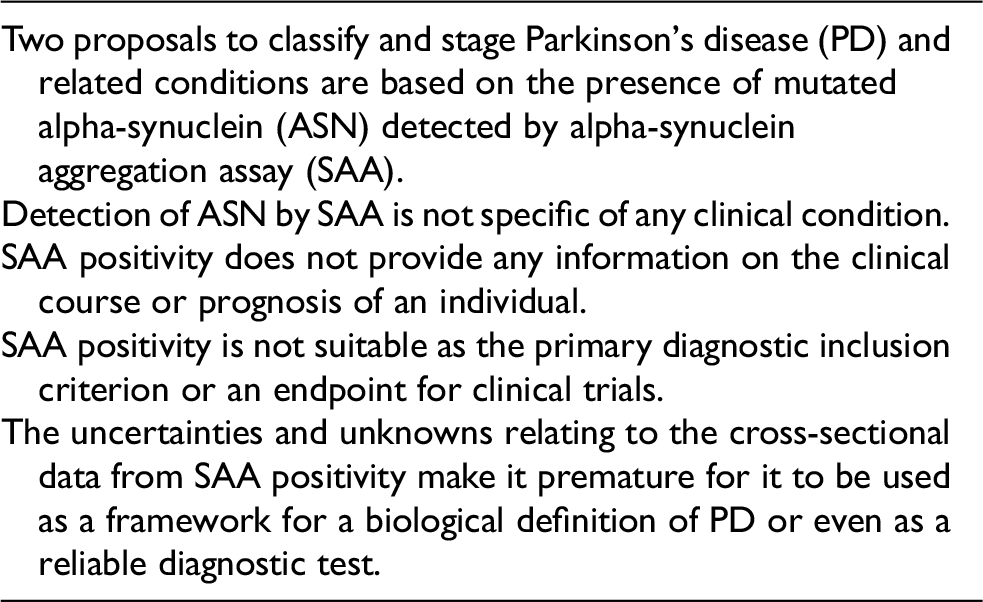
Take home messages
Footnotes
Acknowledgments
The authors have no acknowledgments to declare.
Funding
The authors received no financial support for the research, authorship, and/or publication of this article.
Declaration of conflicting interest
The authors declared the following potential conflicts of interest with respect to the research, authorship, and/or publication of this article: FC has received honoraria to provide educational activities for the International Parkinson and Movement Disorders Society and Torrent. PS is employed by Rho, Inc. where his role includes overseeing the conduct of clinical trials under NIH grant U01AI178773 and serves as a scientific advisor to commercial sponsors of clinical trials in Parkinson’s disease.
