



Abstract
The informal economy is a highly important topic for macroeconomic accounting to provide better measures of economic well-being and to account for new informal types of economic activities facilitated by digitalization. At the same time, macroeconomic accounting is required to provide a comprehensive picture of the informal economy. Importantly, macroeconomic statistics on the informal economy can go beyond measuring production. They can, for example, include an analysis of informal labour in the labour accounts and in the earned income account. The paper proposes that countries compile indicators on the contribution of the informal (market) economy to household income and to use them as headline indicators on the extent of informality in the economy alongside the contribution of informal sector production to GDP. In addition, the paper aims to contribute to an increased understanding of the macroeconomic perspective on the framework for the informal economy among labour statisticians and national accountants by clarifying terminology used in the SNA and the 21st ICLS resolution concerning statistics on the informal economy.
Introduction
Background
Interest in the informal economy continues to attract considerable attention. In addition, new informal types of economic activities are emerging, creating new types of jobs that could be characterized as being less formal or even informal in nature. Informal production activities provide employment and income to many people who might otherwise be unemployed. These are often associated with lower and uncertain income for workers, since informal workers and enterprises are less protected against negative economic shocks. This may have broader consequences for inequality and poverty.
Understanding and describing the informal economy is key to supporting the development of policies that address the very concerns of informal workers and enterprises. Failure to accurately identify and measure this phenomenon could lead to biased or misguided policy decisions. For decades, the informal economy has served as a vital source of employment for the most vulnerable populations, providing cheap and accessible goods and services to communities. Despite its importance, measuring the informal economy remains quite challenging in practice. However, efforts to do so would provide valuable information to guide policy makers.
The updating of the System of National Accounts 2008 (SNA) 1 and the 6th edition of the Balance of Payments and International Investment Position Manual (BPM) 2 and the revision of the statistical standards of informality over the last few years, allowed macroeconomic statisticians and labour statisticians to successfully collaborate to ensure consistent measures of informal production and informal labour inputs.
The International Labour Organization (ILO) established the standards for statistics on the informal economy adopted by the 21st International Conference of Labour Statisticians (ICLS) in 2023. 3 Chapter 39 of the forthcoming 2025 SNA a and Chapter 18 of the forthcoming BPM7 summarizes the ILO standards, giving emphasis to the concepts, definitions and classifications used in the ILO standards and explaining their relationship with the SNA and BPM. Whilst there is commonality between the concepts and definitions in the ILO standards and those in the SNA and the BPM the meaning of these concepts and definitions is sometimes different from those used in the SNA and BPM.
Definition of the informal economy
The informal economy encompasses all productive activities carried out in the general boundary of the economy which are not covered by any formal arrangements in the country of production such as national regulations and laws. The informal economy goes beyond the SNA production boundary to include some services produced by the household institutional sector for their own consumption.
The key distinction between informal and formal productive activities lies in their coverage by formal arrangements. It is noteworthy that informality can be present in the formal sector when labour inputs are not covered by formal arrangements (see Section 3 for more details).
Informal economy and exhaustive measures of production
The main purpose of the national accounts is to offer an exhaustive description of an economy. A core challenge for national accountants is to ensure that activities that should be included in the accounts from a conceptual perspective are also captured in the accounts in practice. Some activities in the economy, are however difficult to capture using regular statistical enquiries (informal sector production, illegal production, underground production, household production for own final use). This hard to capture part of the economy is known as the non-observed economy. There is very important and established guidance (notably the handbook Measuring the Non-Observed Economy 4 ) that helps national accounts compilers ensure that these activities are included in the sequence of economic accounts. Because of this importance, many macroeconomic accountants have thought of the informal economy mainly as a challenge to overcome in their goal to compile exhaustive accounts.
The purpose of the framework for the informal economy is, however, not to be a tool to ensure exhaustive measures of production. Instead, it aims to provide a comprehensive and consistent picture of the informal aspects of the economy.
Objective and organization of the paper
Section 2 of this paper aims to show that providing such a comprehensive picture of the informal economy is highly relevant for macroeconomic statistics, especially considering the priority to provide better measures of economic well-being and to account for new informal types of economic activities facilitated by digitalization.
Section 3 presents the framework for the informal economy, aiming to contribute to an increased understanding of the macroeconomic perspective on the framework and clarifying relevant terminology used in the SNA and the ICLS for labour statisticians and macroeconomic accountants respectively.
Section 4 describes how macroeconomic accounting can contribute to statistics on the informal economy beyond an analysis of informal production. It proposes that a thematic account on the informal economy can also disaggregate informal and formal labour in the labour accounts and provide a picture of the contribution of the informal economy to household income in the earned income account. In addition, the section includes a proposal for two headline indicators on the extent of informality in the economy. Lastly, Section 4 will discuss data sources and anticipated challenges.
The importance of statistics on the informal economy from a macroeconomic perspective
The informal economy holds a significant importance, not only in developing countries but across the globe. It is, therefore, not surprising that it continues to attract interest from policymakers, academics, and researchers.
The informal economy is an important component of the global economy
Informality is a global phenomenon present in all countries, including advanced economies. According to the World Bank, informal sector output in emerging markets and developing economies (EMDEs) accounts on average for about one-third of GDP and informal employment constitutes about 60 per cent of employment. 5 It is also important to highlight, that only about one-half of informal output is in EMDEs. While the informal economy is relatively larger in EMDEs, the informal economy remains relevant in high income countries as well.
The size of the informal economy alone is one of the reasons why statistics on the informal economy are important from a macroeconomic perspective. Only ensuring that the informal economy is exhaustively captured in the aggregates of the sequence of economic accounts is not sufficient. One of the strengths of the SNA is its flexibility which would facilitate the production of additional information and macroeconomic indicators on the informal economy in the form of thematic and extended tables/accounts. Such accounts on the informal economy would enable policy makers to make informed decisions with respect to the informal economy.
The digitalization of the economy creates new types of jobs that can be considered informal
The Fourth Industrial Revolution has reshaped the global economy by creating new opportunities for economic growth and development through innovations and advanced technologies. This revolution led to increased integration of economies worldwide and the emergence of one global market. According to the United States Bureau of Economic Analysis, the digital economy real value added grew by 6.3 percent compared to total U.S. real GDP growth of 1.9 percent in 2022. 6 The digital transformation of the economy created new types of jobs and business models such as the sharing economy, the gig economy, and the platform economy which disrupted traditional industries. Digitalization has created new opportunities to engage in informal productive activities, for example, through informal employment in the gig economy, or through households producing goods and selling them on online marketplaces.
The informal economy plays a critical role in income generation and poverty alleviation
The informal economy provides jobs and food for a significant number of people. According to the ILO, more than 60 per cent of the world's employed population aged 15 and older are in informal employment. 5 Many rely on these activities as their primary source of income. These activities encompass small-scale businesses, street vendors, and self-employed individuals who typically provide goods and services in their communities. By providing opportunities for self-employment and entrepreneurship, the informal economy helps reduce poverty and improve living standards for millions of individuals. In many countries it is seen as a rampart against unemployment.
The informal economy typically has lower entry barriers, allowing individuals with limited resources or skills to start their own businesses and earn a living. It often offers flexibility in terms of working hours and conditions, allowing individuals to balance work with other responsibilities, such as childcare or household duties. This stimulates economic activity and creates a multiplier effect, benefiting other businesses and individuals in the area. As a result, the informal economy has a substantial impact on the wellbeing of people. Beyond informal production, the framework for the informal economy forms the conceptual basis for macroeconomic statistics on the contribution of the informal economy to household income.
Informality results in vulnerability of economic units and workers and is a critical well-being concern
Informal workers frequently face challenges such as job insecurity, lack of social protection, and limited access to financial services. While the informal economy can provide income for these workers, alleviate poverty, and contribute to food security, those working in this sector often experience fragile economic conditions and are vulnerable to shocks. The COVID-19 pandemic has underscored the vulnerability of the informal market economy.
A lack of detailed data and information on the informal economy undermines policymakers’ efforts to alleviate the vulnerability of informal workers, as these workers are often overlooked or hidden in policy-making processes. It is crucial to acknowledge the significance of the informal economy in the economy to foster inclusive economic growth and to implement policies that facilitate the transition of informal workers into a system where their vulnerability is at least mitigated.
The framework offers an opportunity for producing comparable quality data across the world. It can help policy makers understand the dynamics of informality including its extent, composition, and exposure on one hand and working conditions and contextual vulnerabilities on the other. This understanding is essential for designing effective policies to address issues such as taxation, labour rights, and social protection. The framework provides valuable inputs for economic analysis, and allows for the comparison of informal economy data across different regions and time periods, facilitating benchmarking and evaluation of policy interventions.
Vulnerability in the informal economy is an important wellbeing concern. Improving the wellbeing of communities is a key area for policy making. While this concept may be subjective and goes beyond the notion of informality, decent income and employment contribute to its improvement. Macroeconomic analysis can help account for the distribution of income sourced from informal activities and how the policy makers can support economic units.
Women's economic empowerment is also a wellbeing concern. It is connected to the informal economy and its components such as unpaid household and care work. Women in the informal economy are usually less protected, less visible and are thus more vulnerable. In most countries, women outnumber men in the informal economy. Vulnerable workers such as domestic workers, home-based workers and contributing family workers are mainly women. For instance, in Latin America and the Caribbean, women make up over 90% of domestic workers in 2019. 7 Analysis of the informal economy can benefit from data according to gender. Coherent data would support accounting for wellbeing by analysing the distribution of household income, consumption and wealth.
Framework of the Informal Economy
This section presents the framework and the delineation of the sectors of the informal economy and the identification of informal productive activities in the formal sector, informal sector and the household own-use and community sector. It will present the framework from the perspective of the economic unit but remains fully consistent with the 21st ICLS Resolution Concerning Statistics on the Informal Economy.
Informal productive activities
Informal productive activities are defined as all productive activities carried out by persons or economic units that are – in law or in practice – not covered by formal arrangements. 3
Informal productive activities of economic units are informal production. Informal productive activities carried out by persons are informal work – informal labour inputs to production in macroeconomic terms. For the framework of the informal economy, these productive activities can extend the SNA production boundary to the general production boundary.
The difference between the SNA production boundary and the general production boundary is that the former excludes household production of services for own use, except for owner-occupied housing and own-use production of services undertaken with employees. Contrary to the framework for the informal economy, the SNA sequence of economic accounts only includes production within the SNA production boundary – so most household production of services for own use is excluded from the accounts and key statistics such as gross domestic product.
It is important to highlight here that production undertaken with informal labour inputs can be either formal or informal. However, all informal production exclusively uses informal labour inputs. This means that informal work is at the heart of the framework for the informal economy.
Informal economy
The overarching concept of the informal economy comprises all informal productive activities of persons or economic units, whether or not they are carried out for pay or profit. 3 The informal economy thus consists of all informal production and all informal labour inputs to production.
Informal market economy
The concept of the informal market economy is defined as all production for pay or profit in the informal sector and all productive activities of workers in employment that are – in law or in practice – not covered by formal arrangements. 3 The defining characteristic of the informal market economy is not market production, in the SNA sense, but work for pay or profit. Work for pay or profit can be an input to non-market production and household own-use production as well as market production.
The treatment of illegal and illicit activities
Illegal and illicit activities where the production of goods and services are forbidden by law are excluded from the informal economy. However, the production of goods and services, that are usually legal, but become illegal when carried out by unauthorized producers should be included in the informal economy. 3 This is in contrast with the SNA which includes all illegal productive activities that fit the characteristics of transactions. They are treated the same way as legal actions and are therefore included within the SNA production boundary.
Informal cross-border trade
The framework for the informal economy relates to the production of goods and services in the domestic economy. It is, however, possible to extend the framework to account for the external transactions related to production of goods and services in the informal economy, which include:
Informal trade in goods (exports and imports) Informal trade in services (exports and imports) Informal employment of non-resident workers Remittances related to the informal economy.
Assigning economic units to the three sectors
The framework for informal economy statistics assigns all economic units to one of three sectors: the formal sector, the informal sector or the household own-use production and community sector. The term “sector” used in the 21st ICLS Resolution Concerning Statistics on the Informal Economy does not have the same basis as the usual use of the word sector throughout the SNA. In the SNA, sectors are made up of complete institutional units; in the context of the informal economy only the productive activities are considered and other activities of the unit such as consumption and accumulation are excluded.
The conceptual framework has two criteria to assign economic units to the three sectors:
Whether the economic unit is formally recognized as a producer of goods and services; and Whether the production is mainly intended for the market with the purpose of generating a profit or income.
3
The formal sector comprises economic units that are formally recognized as distinct producers of goods and services for the consumption of others and whose production is mainly intended for the market with the purpose of generating an income or profit or for a non-profit purpose (i.e. non-profit institutions), or non-market production for use by other economic units including society as a whole.
3
Economic units in all institutional sectors – except for the household sector – are automatically assigned to the formal sector. This includes general government, financial and non-financial corporations, including quasi-corporations (household unincorporated market enterprises that keep a complete set of accounts for tax purposes and are either part of the corporations or financial corporations institutional sectors), and formally recognized non-profit institutions serving households (NPISHs).
Institutional households, that is, groups of persons staying in hospitals, retirement homes, convents, prisons, etc. for long periods of time (2025 SNA, 5.4), are excluded from the informal economy.
Within a household, many different types of production activities may take place. The framework for the informal economy treats each type of production activity separately, which can be assigned to the different sectors of the framework. This also means that even within the same household, some of these activities may be included in the informal economy and some excluded.
Households, in their capacity as market producers – the SNA refers to them as household unincorporated market enterprises (2025 SNA, 4.224) – are either part of the formal or the informal sector. They can be engaged in virtually any kind of productive activity: agriculture, mining, manufacturing, construction, retail distribution or the production of other kinds of services. They can range from single persons working as street traders or shoe cleaners with virtually no capital or premises of their own to large manufacturing, construction or service enterprises with many employees.
The SNA usage of “unincorporated enterprise” is taken to mean the totality of all unincorporated activity undertaken by a household even though in a supply and use table, for example, this may be partitioned by types of activity and be grouped with establishments of corporations undertaking the same activity.
The use of the term unincorporated enterprise in the 21st ICLS Resolution Concerning Statistics on the Informal Economy does not correspond to the sum of unincorporated activity of a household but to each activity separately. In SNA terms, the unincorporated enterprise is broken down into a number of unincorporated establishments. This is also done to present the informal economy in the macroeconomic accounts to distinguish informal and formal unincorporated enterprises.
Household unincorporated market enterprises are part of the formal sector if they are registered in a government established system of registration or if they employ one or more persons to work as an employee with a formal job. 3
Household unincorporated market enterprises that are not registered and do not employ persons to work as an employee with a formal job, comprise the informal sector. Informal household unincorporated market enterprises, for the sake of brevity, can also be referred to as informal enterprises. 3
Households, in their capacity as producers of goods and services for their own final use, are part of the household own-use production and community sector. Household production for own-final use includes households that produce mainly for the household's own final use, or for the use of other households, without the purpose of generating income and profit for the producing household or households. It also includes groups of households that are pooling volunteer labour to produce goods and services to serve their community if they are not formally recognized as a producer of goods and services. 3 The SNA calls these groups informal or temporary non-profit institutions serving households (2025 SNA, 31.40). Despite the name, they are part of the household institutional sector and not the NPISH sector.
Identifying informal productive activities
The framework identifies informal productive activities in each sector of the framework. This paper focuses on the perspective of the economic unit and is therefore primarily concerned with identifying informal production.
Informal sector
In the informal sector all production and all labour inputs to production are informal. 3
Formal sector
Production in the formal sector is never part of the informal economy. Labour inputs to this production can, however, be informal. 3
This also means that underdeclared and undeclared production by formally recognized producers is not informal production. Importantly, production in the formal sector does also not become informal if informal labour is used as an input to this production.
Household own-use production and community sector
Identifying informal production in the household own-use community sector is more complex. The framework allows the distinction of production in two dimensions: (1) whether the production is part of the informal economy and (2) whether it is within the SNA production boundary or outside (but within the general production boundary).
In the SNA, housing services are an important service consumed by households. If a household owns the accommodation they live in, the household is producing housing services for its own consumption. The SNA calls this owner-occupied housing services and they are included in the SNA production boundary (2025 SNA, 32.52). By convention, no labour is used in the production of these services (2025 SNA, 16.35). Owner-occupied housing services are excluded from the informal economy.
The production of households through direct volunteering and production that is undertaken through informal and temporary NPISHs is always informal.
All other household own-use production has to be distinguished as either undertaken using only the labour of household members or the labour of one or more household employees. Production undertaken with household employees is always within the SNA production boundary and is informal if the household employee has an informal job. Household own-use production undertaken with formal employees is excluded from the informal economy.
The own-use production undertaken using the labour of household members is typically informal. There are, however, exceptions. For example, when household members, who provide full-time childcare for children living in the household, receive compensation for this activity from the government. If registration is required to receive the compensation, the production can be considered formal.
An important observation is that informal production only takes place in the household institutional sector. Table 1 provides an overview when household production is informal and allows a distinction between informal production within the SNA or general production boundary. Figure 1 provides a decision tree to identify informal productive activities.
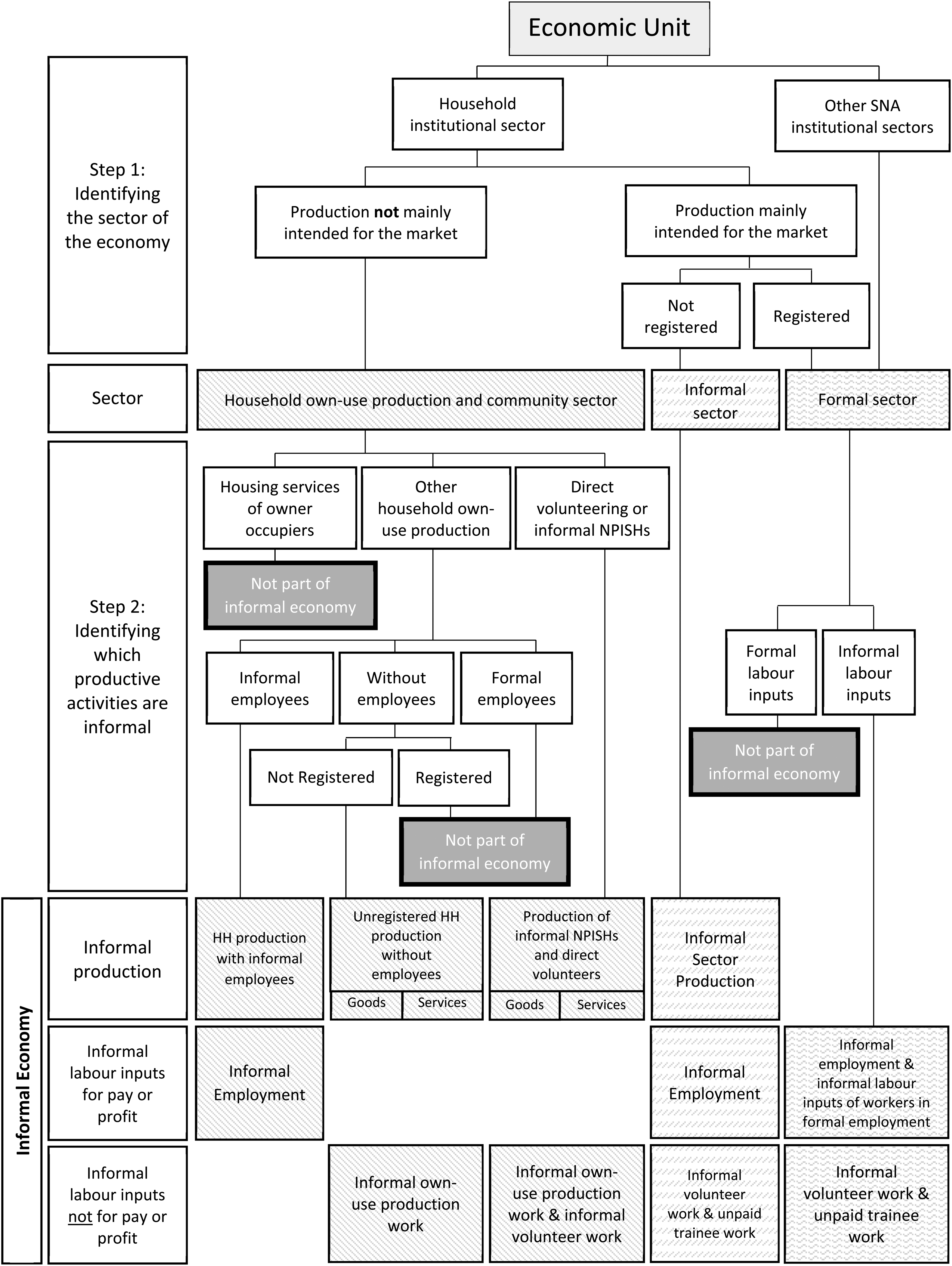
Decision tree to identify informal productive activities of economic units. Source: 2025 SNA, Figure 39.1 Decision tree to identify informal productive activities of economic units.
The delineation of informal and formal household production, within the SNA or the general production boundary.
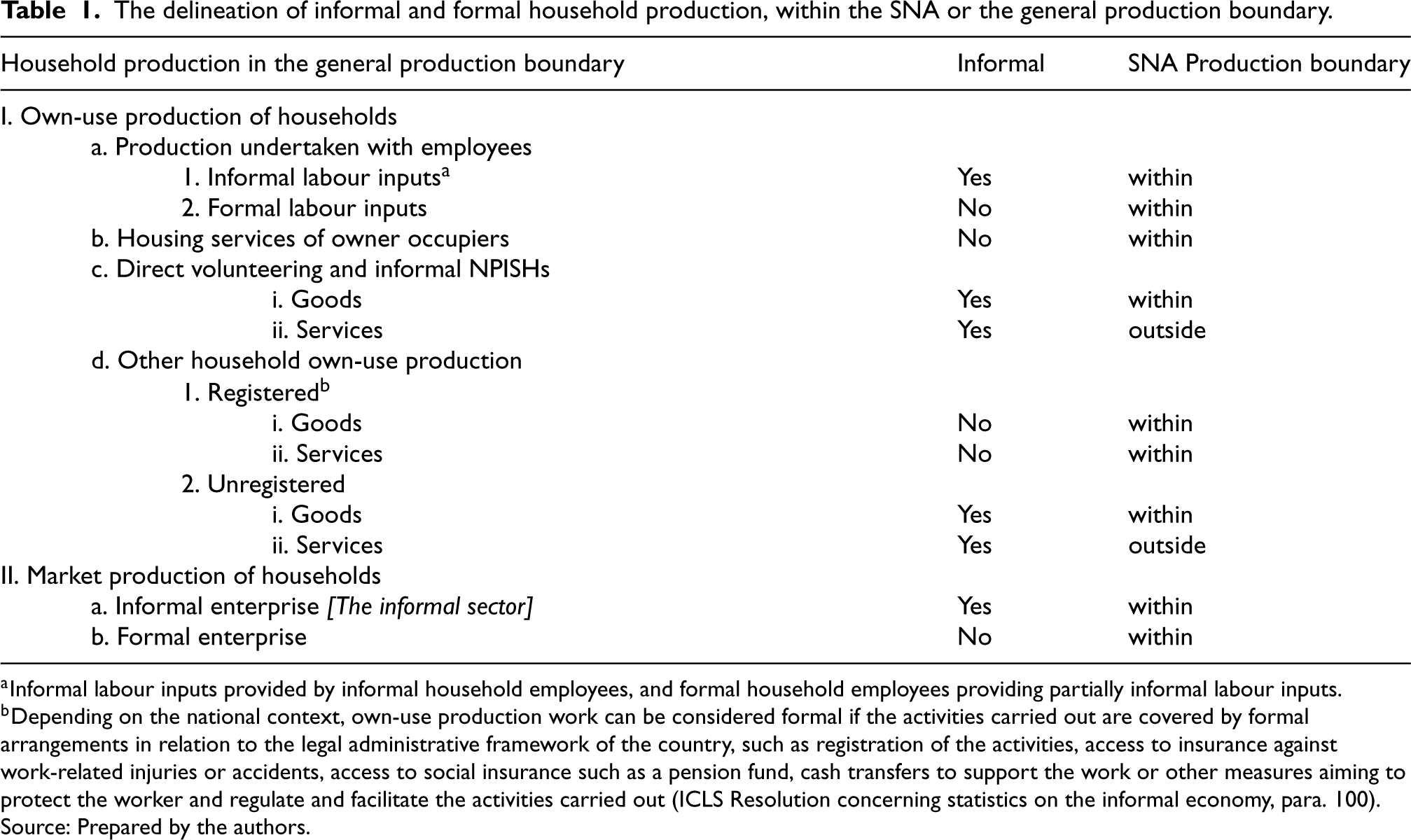
Informal labour inputs provided by informal household employees, and formal household employees providing partially informal labour inputs.
Depending on the national context, own-use production work can be considered formal if the activities carried out are covered by formal arrangements in relation to the legal administrative framework of the country, such as registration of the activities, access to insurance against work-related injuries or accidents, access to social insurance such as a pension fund, cash transfers to support the work or other measures aiming to protect the worker and regulate and facilitate the activities carried out (ICLS Resolution concerning statistics on the informal economy, para. 100). Source: Prepared by the authors.
In general, the purpose of thematic accounts is to increase the visibility of key phenomena by bringing all the pertinent data together in one place, and by presenting detail that is subsumed in broader aggregates in the sequence of economic accounts, for example by compiling a more granular decomposition of some of the accounts. Extended accounts are used to present concepts that can expand or modify the SNA boundaries. The links to the sequence of economic accounts enable thematic and extended accounts to inherit the rigour of the SNA framework ensuring the consistency of the estimates with each other and higher-level aggregates (see 2025 SNA, chapter 38).
While the informal economy also extends the production boundary, its primary purpose is to increase the visibility of the informal aspects of the economy. A macroeconomic presentation of the informal sector can, therefore, be considered a thematic account and an extended account for the informal economy as a whole.
An extended account for the informal economy is concerned, first and foremost, with a more granular decomposition of the production account. However, it is also possible to further analyze informality in the earned income account and to identify informal labour in the new labour market table framework of the 2025 SNA.
When combined with supply and use tables, thematic labour market tables would allow an analysis of various aspects of labour inputs, such as persons employed, jobs, hours worked and income earned, for each industry in relation to the corresponding output produced (2025 SNA, 16.55). Distinguishing informal and formal labour inputs in these tables allows for an in-depth analysis of the relationship between informality from the perspective of workers and production.
An analysis of the informal economy in the earned income account can focus on households as recipients of earned income. The informal economy is an important source of income for households in many countries worldwide, and it can therefore be meaningful to analyze the contribution of the informal economy to household income.
The next subsection discusses why the contribution of the informal economy to household income is a suitable headline indicator for the extent of informality in the economy.
Macroeconomic indicators on the extent of informality in the economy
The ICLS resolution on the informal economy includes a set of indicators and is accompanied by a larger indicator framework. 8 While most of the indicators focus on labour statistics, there are some production indicators. The resolution identifies six dimensions of informality, one of which is the extent of informality – indicators on various dimensions of the size of the informal economy.
Traditionally, the headline macroeconomic indicator intended to capture the extent of informality in the economy is the contribution of the informal sector to GDP. While this indicator should remain a critical headline indicator for the informal economy, the new framework clarifies that focusing on this indicator alone ignores important aspects of informality and does not capture the full extent of informality.
The ICLS resolution includes a set of indicators – i.e., explicitly not a single indicator – related to the contribution of the informal economy to GDP. The resolution states that the indicators should cover the following components, reflecting informality in the three sectors:
Contribution of the informal sector to GDP, by economic activity. Contribution of informal production in the household own-use production and community sector within the SNA production boundary to GDP. The contribution by informal employees, formal employees carrying out partly informal productive activities and persons carrying out informal work other than employment to the production by economic units in the formal sector.
3
As a reminder production in the formal sector is never informal, even if informal labour is used as an input to the production. An indicator on the contribution of informal production to GDP would only include (a) and (b) and completely ignore the extent of informality in the formal sector (c).
It is not possible to directly sum up all three components to compile a single indicator. Both (a) and (b) are indicators on the productive activities of economic units – production – but (c) is an indicator on labour input which is only one of the factors of production. This means the unit of measurement of (c) is different from those of (a) and (b) (and also from GDP) and can therefore not be combined.
Alternative headline indicators, proposed in this paper, to capture the extent of informality in the economy in a meaningful, intuitive and conceptually sound way are:
Contribution of the informal market economy to household earned income. Contribution of the informal economy to household earned income (within the SNA production boundary).
The denominator of both indicators is the total household income receivable in the allocation of earned income account.
Households can be the recipients of various forms of earned income: remuneration of employees, mixed income of household unincorporated enterprises and property incomes receivable (minus payable) from the ownership of financial assets or non-produced non-financial assets. Of these sources of earned income, only remuneration of employees and mixed income of household unincorporated enterprises are related to the informal economy.
The draft Glossary of terms and definitions in macro-economic statistics defines these terms as follows:
Remuneration of employees: Total remuneration, in cash or in kind, payable by an enterprise to an employee in return for work done by the latter during the accounting period. Mixed income: Income earned by an unincorporated enterprise from the use of the owner's labour and capital in the production of goods and services during an accounting period.
Remuneration of employees includes wages and salaries, as well as employers’ social contributions.
Mixed income is the remuneration of members of the household who work in a household unincorporated enterprise. It is termed mixed income, because the contribution of the work of the household member and the contribution of the capital of the household cannot be distinguished.
Figure 2 provides a visualization of the components of the informal market economy, compared to the informal economy. All activities in the informal market economy are within the production boundary and contribute to the earned income of households.
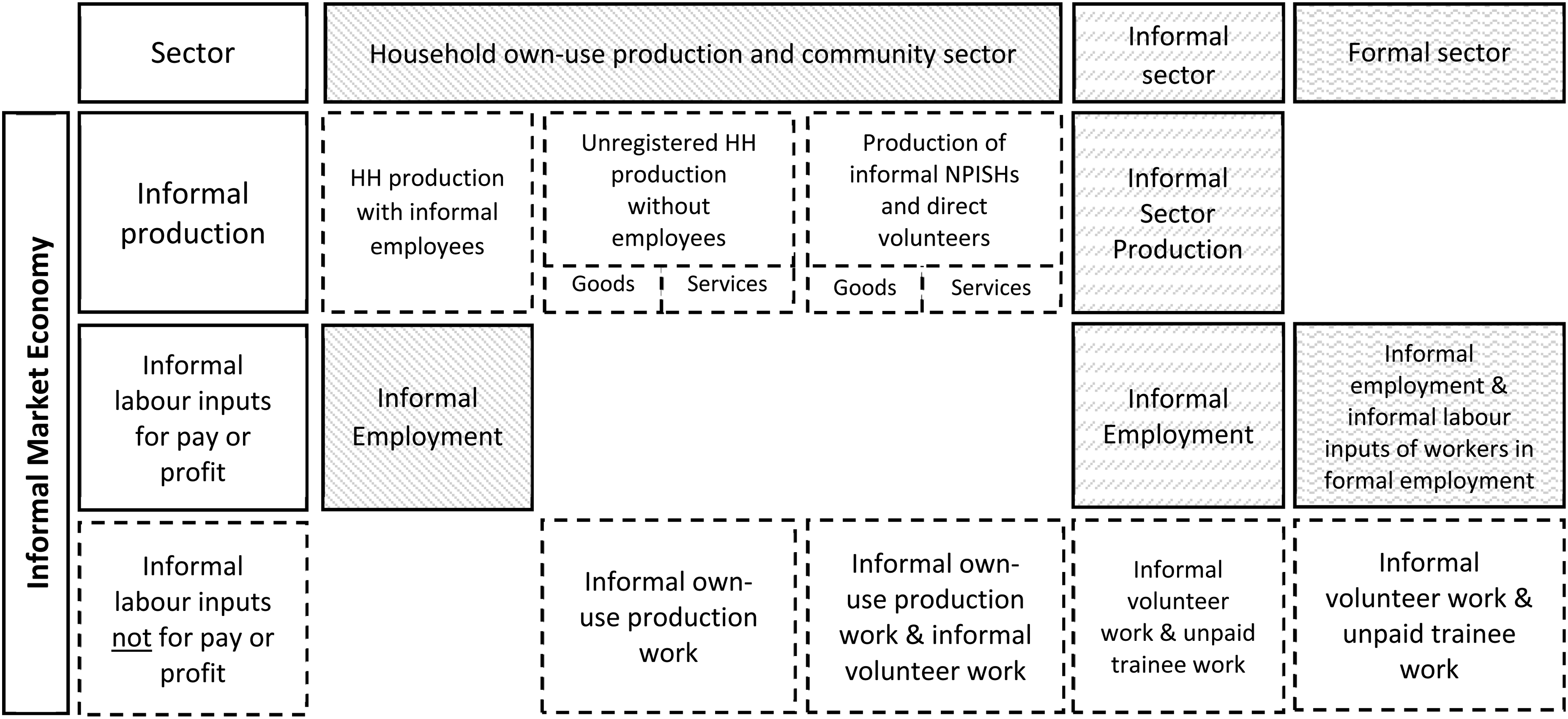
Informal productive activities in the informal market economy (boxes with a dashed outline are outside of the informal market economy but within the informal economy). Source: Based on Figure 39.1 in the 2025 SNA with amendments by the authors to indicate what activities are part of the informal market economy.
Persons in informal employment in the household own use production and community sector are employees whose labour is used in the own-use production of a household (that they are not part of, even if they live in the same accommodation). The household of the employee is a recipient of income in the form of remuneration of employees.
Persons in informal employment in the informal sector include:
Members of the household who work for profit in the informal unincorporated household market enterprise (independent workers, dependent contractors, and contributing family workers) – thus the household receives mixed income. Employees of the informal unincorporated household market enterprise. The household of the employee receives income in the form of remuneration of employees. Informal dependent contractors, who own and operate a formal household unincorporated enterprise (but do not have access to formal arrangements intended to reduce the economic risk related to the job), thus they receive mixed income. Informal employees of economic units in the formal sector. The household of the employee receives income in the form of remuneration of employees. Informal contributing family workers in economic units in the formal sector. The work of contributing family workers does not result directly in household income. It is, however, captured indirectly through the mixed income of the household if the assisted household member owns and operates a formal unincorporated household market enterprise, or by the remuneration of employees if the assisted household member is an employee in an economic unit in the formal sector. This also means, that there is no contribution of the informal economy to earned household income, that can be captured if informal contributing family workers assist a household member with a formal job. For employees, where part of the paid hours or tasks carried out in relation to the formal job are not covered by formal arrangements, for example when earnings and hours worked are not declared for taxation or mandatory job-related social contributions (cf. para 94 (a) in
3
). For independent workers and dependent contractors where part of the activities carried out in relation to the formal job are not covered by formal arrangements, for example when income is not declared for taxation (cf. para 94 (b) in
3
).
Persons in informal employment in the formal sector include:
In addition, income derived from partly informal productive activities of workers in informal employment in both the formal sector and the household own-use and community sector is also part of the contribution of the informal market economy to earned household income. Productive activities are partly informal under the following conditions:
In both cases, the contribution of the informal market economy would be the undeclared income.
In addition to the contribution of the informal market economy to household earned income, other productive activities become relevant if the contribution of the informal economy to household earned income is of interest.
For this indicator, only productive activities within the SNA production boundary should be considered. Figure 3 shows which parts of the informal economy are within the SNA production boundary.
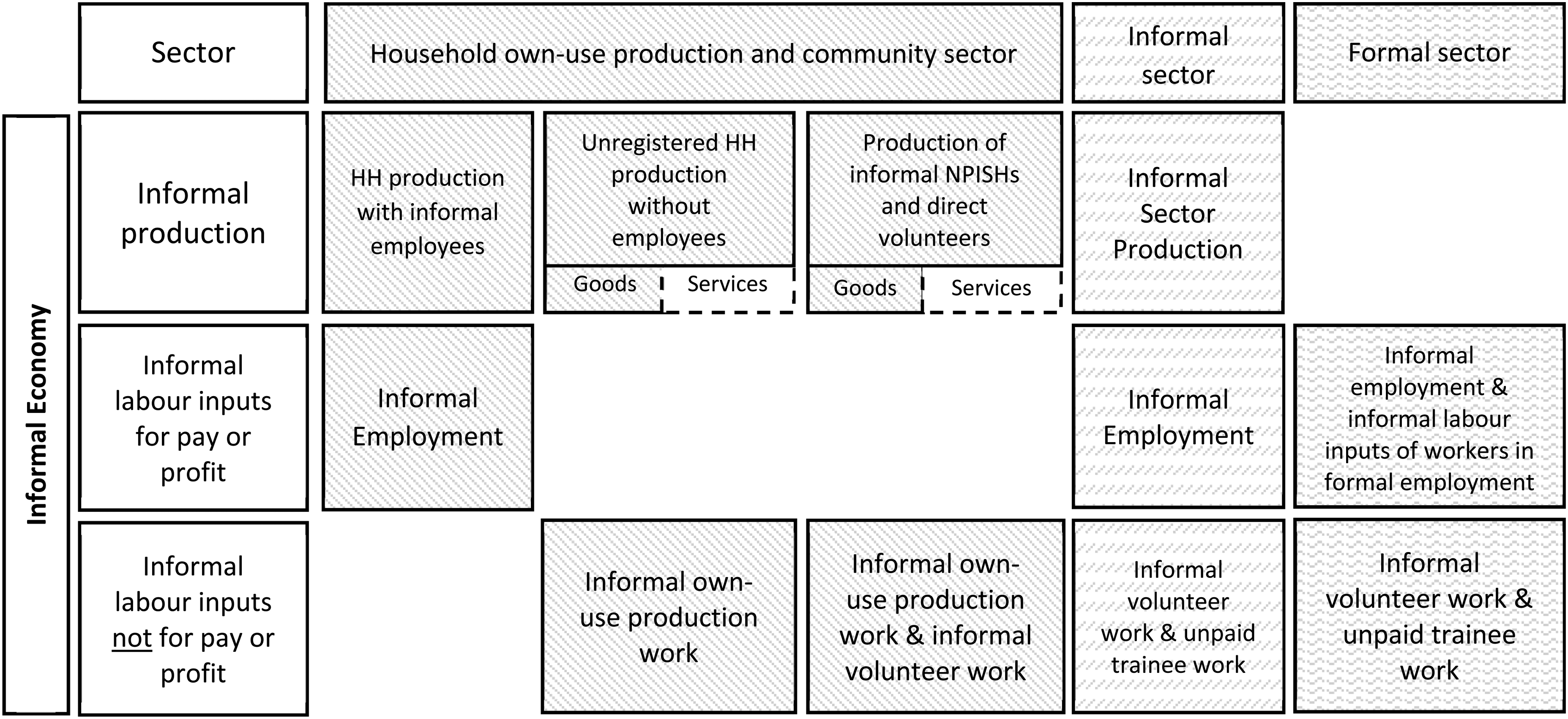
Informal productive activities in the informal economy within the SNA production boundary (boxes with a dashed outline are outside of the SNA production boundary but within the informal economy). Source: Based on Figure 39.1 in the 2025 SNA with amendments by the authors to indicate what activities are part of the informal market economy.
In addition to those listed in Section 4.1.1, the following informal activities within the SNA production boundary contribute to household earned income.
Household own-use production is considered to take place in household unincorporated enterprises in the SNA (household unincorporated enterprises reflect the household in its capacity as a producer). If the own-use production of goods is undertaken using the labour of household members and not of employees, the household generates and receives earned income in the form of mixed income. Direct volunteer work used to produce goods for the use of other households is considered own-use production of households. As established, own-use production of households takes place in household unincorporated enterprises in the SNA, and therefore these activities contribute to the earned income of households in the form of mixed income. Production in informal NPISHs is also considered own-use production and it likewise contributes to the earned income of households in the form of mixed income.
All activities that contribute to household earned income, except for those already captured in the informal market economy, take place in the household own-use production and community sector. Both informal organization-based volunteer work – i.e., volunteer work in the formal and informal sector – as well as unpaid trainee work, do not contribute to earned household income. Table 2 provides an overview of the sources of household earned income, and links income to the sector and the ICSE-18-R classification of work.
Linking household earned income to forms of informal work and sector.
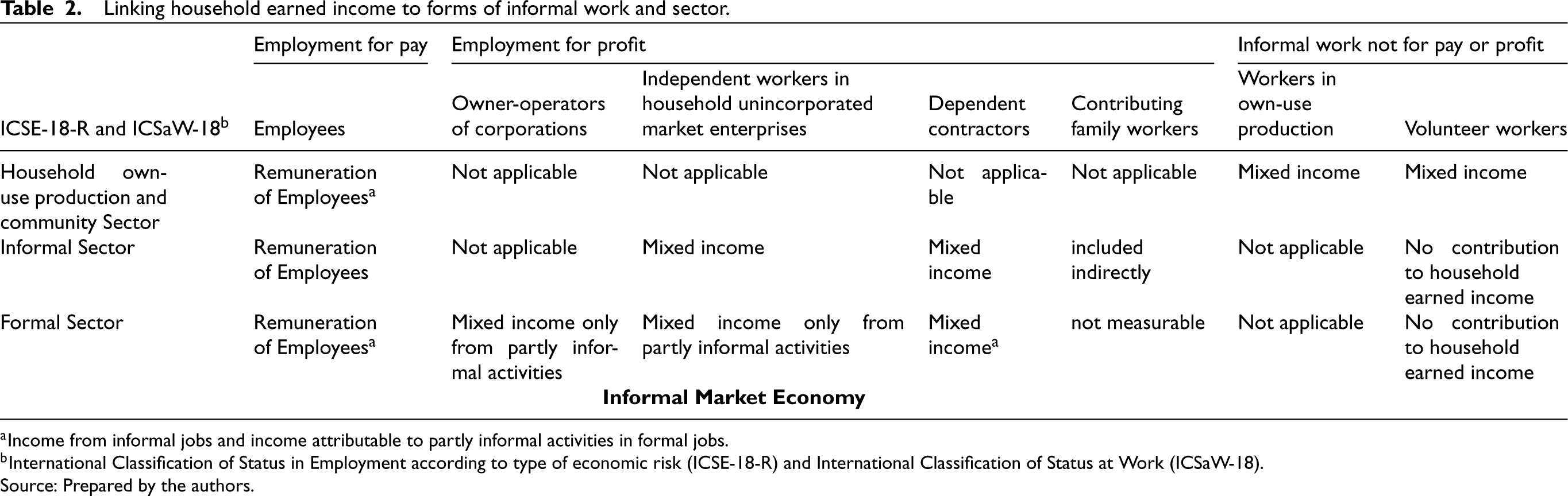
Income from informal jobs and income attributable to partly informal activities in formal jobs.
International Classification of Status in Employment according to type of economic risk (ICSE-18-R) and International Classification of Status at Work (ICSaW-18).
Source: Prepared by the authors.
High-quality and harmonized data is the backbone of compiling and calculating comparable statistical indicators. A country's statistical capacity and priorities typically determine the methods and data sources that can be used in compiling macroeconomic statistics, including statistical indicators on informality. In general, economic censuses, enterprise-based surveys and mixed surveys are the main data sources for the analysis of economic units in the formal sector or informal sector, their characteristics and contribution to GDP. Household economic surveys and censuses, such as poverty and living standards surveys, household income and expenditure surveys, mixed surveys or 1–2 and 1–2–3 surveys, are comprehensive sources of information not only on household income generation and use, but also on other social issues such as poverty, inequality, and living standards.
Additionally, labour force surveys are authoritative data sources for producing statistics on informality and for monitoring the extent of informal and formal jobs, social protection, and vulnerability. They provide information on employment, unemployment, characteristics and working conditions of persons in informal and formal jobs, and offer a comprehensive structure of the labour market.
These surveys and censuses combined with other specialized household surveys such as time-use surveys provide direct estimates to support the development of national policies and interventions for addressing informality. The major challenges of these traditional data sources are related to frequency, timeliness, and resource constraints.
Measuring production in the informal sector is, while difficult, a topic for which many resources exist. Often mixed household-enterprise surveys are used to first create a sampling frame of informal enterprises through questions in a household survey, and then have a separate enterprise survey using this frame. During that second phase, the mixed income of the owner and remuneration of employees for any other workers working for pay in the economic unit can also be identified.
As for the household own-use production and community sector, labour force surveys are likely the best source to identify the production of households undertaken with informal employees. Labour force surveys can also be used as a source of the respective remuneration of employees.
The own-use production of goods by the household for its own use without employees and the production of goods by informal NPISHs and direct volunteers are virtually always informal. This means that if this production is measured so it is included in GDP, it can also be used for statistics on the informal economy, without any additional information. The most important source to measure this production are household income and expenditure surveys. The biggest challenge is to adequately capture subsistence food production, which is of particular importance in developing countries. The mixed income of households from these activities is equal to the value added.
Regarding household own-use production of services without employees, compilers can largely follow guidance on capturing unpaid household services which use time-use surveys as its main data source. Similarly, production of services through direct volunteering and informal NPISHs can be produced using existing guidance. 9 For many countries, these activities are always informal. Those countries where this type of production can be formal (as explained in Section 3), can consider adding modules to their surveys.
The other aspect to cover is to identify informality in the formal sector. A highly relevant part of the contribution of the informal economy to household income is the remuneration of informal employees in the formal sector and the remuneration of formal employees attributed to their partial involvement in informal productive activities. The most important data source are labour force surveys that include modules to capture informality. Identifying these employees and their income is also of great concern from the labour statistics perspective, which are in need of the same instruments.
Overall, the data required to compile information on the production in the informal economy and the indicators on the contribution of the informal (market) economy to household income, are also necessary to produce labour statistics on the informal economy or are important for exhaustive measures of production in the national accounts. The only exception are the statistics on the informal sector, which require a dedicated data collection effort.
Countries that compile both labour statistics on the informal economy, as well as statistics on the informal sector, should therefore be in a position to produce the additional macroeconomic measures proposed in this section.
Conclusion
There is wide recognition that there are important policy goals related to the informal economy and linked to the SDGs (such as Goals 1, 2, 4, 5 & 10). Addressing issues inherent to the informal economy is a requirement to fully achieve the goals and lack of progress towards the goals will lead to an increased size of the informal economy. 10
To effectively design and monitor policies addressing the informal economy, there is a clear need for statistics on the informal economy. Beyond the importance for official statistics in general, the informal economy is also important from a macroeconomic accounting perspective specifically to provide better measures of economic well-being and to account for new informal types of economic activities facilitated by digitalization.
In addition, the size of the informal economy in many countries is reason alone to produce statistics on the informal economy, to fulfil the main purpose of the national accounts of providing a comprehensive picture of the economy. Without specifically addressing the informal economy, economic policies will lack effectiveness in these countries. Due to the different nature of the informal economy, simply ensuring that the informal economy is included in the aggregates of the national accounts is not sufficient to enable decision makers to make evidence-based policy decisions. Instead, macroeconomic statistics on the informal economy are required.
Macroeconomic statistics can also contribute greatly to a comprehensive picture of the informal economy beyond describing informal production. Thematic and extended accounts on the informal economy can also include labour accounts disaggregated by formal and informal labour, and further analyze the informal economy as a source of household income in the earned income account.
There is great user demand for indicators on the relative size of the informal economy. While a single indicator on the contribution of the informal economy to GDP, as opposed to the informal sector to GDP, cannot be compiled without making arbitrary assumptions, the contribution of the informal market economy to household earned income can be a suitable alternative. Together with the contribution of the informal market economy to household earned income and the contribution of the informal sector to GDP, three headline macroeconomic indicators can be produced on the size of the informal economy.
The compilation of such indicators does not necessarily require entirely new types of datasets. Traditional data sources, such as household-based economic surveys and labour force surveys, can be utilized for producing macroeconomic statistics on the informal economy within the newly adopted framework.
Footnotes

Note
Declaration of conflicting interests
The authors declared no potential conflicts of interest with respect to the research, authorship, and/or publication of this article.
Disclaimer
The views expressed in this publication do not necessarily reflect the views of the United Nations Secretariat and are those of the authors.
Funding
The authors received no financial support for the research, authorship, and/or publication of this article.