




Abstract
Informality is widespread globally, with many workers and enterprises lacking formal arrangements. Effective statistics on the informal economy are essential for policy development, improving working conditions, and promoting decent work. Over the past 30 years, the establishment of statistical standards on informality has helped countries better measure and understand the informal sector and informal employment.
Recent revisions to these standards, driven by evolving statistical labour standards and growing national experience, have led to a new resolution on informal economy statistics. Adopted at the 21st ICLS in 2023, this resolution offers a comprehensive framework for defining and measuring informality. It introduces concepts such as informal productive activities, the informal economy, the informal market economy, and informal work, setting the structure and boundaries for informality statistics.
By integrating the 19th ICLS resolution on work, employment, and labour underutilization and the 20th ICLS resolution on work relationships, including ICSE-18, the new standards align with previous resolutions, promoting coherence in labour statistics.
The resolution includes improved definitions of the formal and informal sectors, household own-use production and community sector, and formal and informal employment, enhancing data quality and harmonization across countries. Overall, the 21st ICLS resolution significantly enhance countries’ capacity to produce harmonized, policy-relevant statistics on the informal economy, aiding efforts to formalize it.
Introduction
The informal economy occupies a central role in the global economy and significantly influences the circumstances under which people are carrying out their work. Globally it is estimated that almost 60 percent of all persons in employment have an informal main job and are therefore considered to be in informal employment [1]. In other words, a majority of persons in employment carry out their work under conditions that are characterized by the absence of effective coverage of formal arrangements intended to regulate and protect workers and enterprises. This leaves the worker in a more exposed situation for example in the event of sickness, injury, or retirement. The absence of formal arrangements is also limiting to enterprises in their access to markets, skills and finance thereby restricting the potential for growth. Nevertheless, the informal economy remains a vital source of livelihoods, providing employment opportunities to many, sometimes by choice, but more often due to a lack of other alternatives.
The ILO has a long history of addressing informality as informal employment and the informal sector play pivotal roles in shaping government policies and programs aimed at employment creation, social protection and formalizing informal jobs. Statistics on informal employment and the informal sector are indispensable for crafting and assessing economic and social policies, enhancing working conditions, and striving towards decent work for all. Acknowledging the vulnerability and poverty prevalent among workers in the informal economy, it is evident that addressing decent work deficits requires a thorough understanding of informal sector and informal employment dynamics. Such insights enable governments to tailor policies that effectively counter these challenges and evaluate the impacts of broader economic shifts on employment patterns. Furthermore, informal employment and the informal sector serve as crucial indicators for monitoring gender disparities in the workforce. Women are disproportionately represented in more vulnerable forms of informal employment, such as domestic work and home-based work, necessitating targeted policies to address gender inequalities in employment. The importance for all countries to provide regular data on informality is also highlighted by the inclusion of informal employment as indicator 8.3.1 in the 2030 Agenda for Sustainable Development. Pointing at the high continuing relevance of the concept as part of achieving the SDG goal 8 to promote sustained, inclusive and sustainable economic growth, full and productive employment and decent work for all.
Statistics on the informal economy are therefore vital for economic and social analysis. In countries with high informality rates, these statistics are essential for understanding labour market structures and associated risks. They aid in estimating national accounts, inform policy design for employment promotion and poverty reduction, and are crucial for monitoring gender gaps. In countries with lower informality rates statistics are still needed to ensure a further reduction of informality and to prevent informalization of formal jobs and enterprises.
Important steps have been made to enhance countries’ capacities for measuring and providing statistics on various components of the informal economy over time. Beginning with the establishment of the first statistical standards concerning informality in 1993, these efforts culminated in the recent adoption of the Resolution concerning statistics on the informal economy at the 21st International Conference of Labour Statisticians (ICLS) in 2023. This article delineates this progress, with a particular focus on outlining the key components of the new resolution. The first part of the article delves into the historical milestones that laid the groundwork for the new standard. The second part explains the underlying reasons why a revision of the previous standards was necessary. This is followed by an outline of the new resolution starting with the more comprehensive statistical framework integrated into the resolution that for the first time, incorporates a statistical definition of the concept of the informal economy. The next section describes the conceptual and operational definitions of the formal sector, informal sector, own-use production and community sector, emphasizing the principal differences compared to the previous definition of the informal sector. Finally, the article describes the different concepts related to the informal economy concerning persons, work, and employment and the indicators that have been introduced with the new resolution. The discussion encompasses the definition of the novel concept of informal work, as well as the conceptual and operational definitions of informal employment and informal jobs, once more focusing on the new aspects of these definitions and the improved recommendations for how countries can operationalize these concepts and produce user relevant indicators.
A long road toward statistical standards on the Informal economy
While earlier and related work had been done in the 1950s and 1960s by for example W. Arthur Lewis [2], the term informality emerged in the 1970s. Keith Hart, one of the first using the term, introduced “informal income opportunities” and the concept of informal sector as part of his studies of income opportunities in urban areas of Southern Ghana. In this work the informal sector was viewed as including a range of legitimate and illegitimate activities such as farming, transport utilities, shoe shiners, hustling and smuggling, typically carried out outside the organized labour force on a non-permanent and non-regular basis [3]. The concept of informal sector was picked up by Hans Singer and Richard Jolly and used in the International Labour Organization (ILO) Kenya report [4]. The report outlines the concept of the informal sector emphasizing that the informal sector was not a peripheral phenomenon including a specific type of activities or occupations but rather characterized by how the activities are carried out and organized. According to this view, informal activities exhibit distinct characteristics. These include a reliance on indigenous resources, often involving family ownership of enterprises. Operations also tend to be labour-intensive and conducted on a small scale, with skills typically acquired outside the formal education system [4, p. 6].
These initial attempts to conceptualize informality, particularly the informal sector, shared the common feature of creating boundaries on the basis of typical characteristics of the informal sector such as the type of activities (as with Hart) typically undertaken in this sector, or by typical production characteristics (as observed in Singer and Jolly), rather than relying on more objective criteria. Furthermore, an intriguing divergence arises even at this early stage between examining informality through the lens of the individual (Hart) versus through the perspective of the production unit (Singer and Jolly). Both of these aspects had consequences for the subsequent development of statistical standards regarding informality.
The discussion around the concept of informal sector continued within the ILO. The need to provide statistical guidelines on the measurement of the informal sector was raised at the 13th ICLS in 1982. An important event at the ICLS was the adoption of the Resolution concerning statistics of the economically active population, employment, unemployment, and underemployment. The resolution addressed the issue of informality and recommended countries to develop methodologies and data collection programs to measure informal sector activities: “In particular, suitable definitions and classifications should be developed in order to identify and classify the economically active population in the urban informal sector and those engaged in the rural non-agricultural activities” [5, Paragraph 33].
The work with developing statistical standards on the informal sector reached an essential milestone in 1993 at the 15th ICLS. This was the first time since 1949 that a new topic was discussed at the ICLS with the objective to adopt a resolution [6]. It was a recognition that the topic was challenging as “…informal sector activities do not easily lend themselves to statistical measurement. The major difficulties requiring internationally agreed guidelines relate to the statistical definition of the informal sector and survey methodology” [7]. Despite the challenges the conference adopted Resolution concerning statistics of employment in the informal sector, marking the first international agreed statistical definitions pertaining to informality [8].
The concept of “employment in the informal sector” defined in the resolution combines the perspective of persons/individuals/jobs captured by the element of employment, with the perspective of production units captured by the component of production units in the informal sector. The definition therefore rests on defining production units in the informal sector and based on that, creating a defined boundary of the informal sector. The conceptual definition of the informal sector in the resolution echoes the early thoughts in the ILO Kenya report by creating the definition around typical characteristics of the units and their production in the informal sector. Conceptually, the informal sector is defined as consisting of units that are engaged in production with the primary objective to generate employment and income concerned. These units often operate at a low level of organization with small scale production and limited or no division between labour and capital as input to the production [8]. While it can be argued that this conceptual definition primarily characterizes economic units within the informal sector rather than strictly delineating them, the operational definition also outlined in the resolution indirectly and directly establishes a foundation for more precise statistical criteria to use.
The first step in the operational definition places the informal sector within the “household sector” as defined by the System of National Accounts (SNA). This first step in the operational definition is important because it creates a clear link between the concept of the informal sector and the SNA but in addition, it also indirectly, and maybe less visibly, points at different operational criteria for defining the scope of informal sector. By placing the informal sector in the SNA household sector this excludes Government units, Corporations (incorporated enterprises and quasi-corporations) and Non-profit institutions serving households (NPSI) from the scope of the informal sector. Different criteria such as whether the economic unit is a government unit or a NPISH or if it is a private enterprise, whether this private enterprise is incorporated or has a complete set of accounts are needed to identify and exclude these units. These criteria therefore become part of the operational definition of the informal sector even if not explicitly stated in the resolution. The next step in the operational definition is to define the informal sector among the units that have some market production within the SNA household sector i.e., within the boundary set by these criteria.
In this second step a relatively high degree of flexibility is introduced. Either countries can use size of the economic unit and define all enterprises with fewer employees than a given threshold as informal enterprises, or countries can use registration as a criterion and define all those enterprises that are not registered in a national registration as being informal [8, Para 6 (2-3)].1 The two different criteria size and registration were viewed as representing two different perspectives of the informal sector, that is the economic perspective which was based on how the informal units are organized and carry out their activities versus the legal-administrative perspective which reflects whether the units are embedded in the legal-administrative framework of the country (7, chapter 3.4.1). As registration was viewed to be a problematic criterion due to the multiplicity of registration systems between countries and differences in enforcement etc., it was deemed that a more pragmatic approach would be to base a definition on the characteristics of the producing units. Own-account enterprises were to be the core part of the informal sector. Countries could then expand this concept by also including enterprises of informal employers below a given size or alternatively employers who have employees that lack legal and social protection (termed non-regular employees) [7]. During the discussion at the 15th ICLS, the proposed criterion of “no employment of any regular employee” (7, Annex, para 10) was changed to “non-registration of the enterprise or its employees” (7, Annex, para 9 (2) (ii)). The two different perspectives of economic characteristics and embedment in the legal-administrative framework were thereby built into the operational definition in the resolution. This created flexibility in the sense that countries could choose between using one or both. In addition, if using size, countries also had to determine the size threshold at a national level thereby creating further flexibility.
The statistical work with improving the measurement of the informal sector continued and in 1997 the Delhi Group on Informal Sector Statistics was set up by the United Nations Statistics Division (UNSD) with the objective to improve the quality and comparability of informal sector statistics [9]. In the years following there was a growing recognition that the concept of informal sector, while being essential, does not capture the totality of informal employment, as the concept of informal sector relies on an enterprise-based definition and not a job-based definition which would be more closely linked to the concept of employment [10]. In other words, the concept of informal sector was designed to identify informal enterprises but not necessarily all informal workers. To address this criticism the ILO developed a statistical conceptual framework of informal sector and informal employment [11] and by that introduced the concept of informal employment to complement the concept of informal sector. Informal employment was proposed to include informal jobs held by own-account workers and employers in the informal sector, and in addition informal jobs held by contributing family workers and employees independent of whether they worked for a formal economic unit, informal enterprise or for a household.
The proposed conceptual framework that introduced the complementary concept of informal employment was endorsed by the Delhi group at its fifth meeting in 2001 [9]. The framework also formed an important foundation for the discussions at the 90th International Labour Conference (ILC) regarding decent work in the informal economy. The concept of informal economy used in relation to this standard setting, referred to “all economic activities by workers and economic units that are – in law or in practice – not covered or insufficiently covered by formal arrangements.” (12, Paragraph 3), thereby reflecting the two statistical concepts of informal sector and informal employment. The definition of informal economy in the resolution also marks an important step towards viewing informality from the perspective of a lack of embedment in the legal administrative framework and by that, a lack of access to formal arrangements such as access to social protection, public infrastructure and benefits, limited possibilities to enforce contracts or have security of property rights, rather than viewing informality as a specific set of economic characteristics or a specific type of activities [13]. The lack of coverage of formal arrangements, defining the informal economy in the resolution, may be because the economic unit or worker operates “outside the formal reach of the law”, or “although they are operating within the formal reach of the law, the law is not applied or not enforced” (12, Paragraph 3). In this way, the two different situations are both included within the concept of the informal economy.
A year later, at the 17th ICLS, the statistical framework of informal sector and informal employment was discussed and led to the adoption of the Guidelines concerning statistics on the informal employment [14]. While the concept of the informal economy was not used or defined in the guidelines, the definition of informal employment, provided by the guidelines and the definition of the informal sector provided by the 15th ICLS resolution, in combination, provides statistical definitions of the main components of the informal economy (15, Chapter 3.1).
The 17th ICLS guidelines defines informal employment as the total number of informal jobs. While the guidelines do not provide a conceptual definition of informal employment, this points to a job-based concept of which the definition of informal employment relies on the definition of an informal job. The operational definition of an informal job in turn depends on the status in employment category as defined by ICSE-93. For employers, own account workers, and members of producers’ cooperatives there is a direct link between the definition of the informal sector and the definition of informal jobs. If these workers own and operate an informal enterprise in the informal sector or are producing exclusively for own final use, then their job is to be considered informal. If they own and operate a formal enterprise then, the job is considered formal. Contributing family workers are considered to have an informal job by definition, due to the informal nature of their jobs, while for employees’ additional criteria are needed [14]. The definition in the guidelines created an essential link between the definition of informal employment, informal jobs, the status in employment category and the definition of the informal sector. In addition, it also expanded the boundaries of informality as it is not restricted to the informal sector but includes informal employment in all three sectors (the formal sector, informal sector, and households), thereby going beyond the 15th ICLS resolution and its focus on the informal sector.
An important contribution of the guidelines was the inclusion of own-use producers of goods exclusively for own final use, contributing family workers and employees in all sectors within the boundaries of informality. Own-use producers of goods solely for own final use and contributing family workers by default were considered to have informal jobs. However, employees were recognized as having informal or formal jobs depending on whether “their employment relationship is, in law or in practice, not subject to national labour legislation, income taxation, social protection or entitlement to certain employment benefits.” (14, Paragraph 5) The definition of informal jobs (and indirectly formal jobs) for employees to a large extent reflects the absence of an effective coverage of formal arrangements and embedment in the governmental system. The operational definition in the guidelines does not include the specific operational criteria to use for defining formal and informal jobs among employees, but points at different possible criteria and that the exact criteria need “to be determined in accordance with national circumstances and data availability”. This high degree of flexibility to implement the operational definition of informal and formal jobs for employees can be viewed as an approach to enable countries to begin to measure informal employment and thereby gain experience on how to most effectively identify informal and formal jobs also among employees.
After some years another important milestone took place in 2015 during the 104th ILC with the adoption of Recommendation No. 204 concerning the Transition from the Informal to the Formal Economy. The recommendation has become a key policy standard that encouraged countries to work towards formalizing the informal economy and to prevent informalization of formal jobs and formal economic units. The definition of the informal economy in the recommendation is the same as the definition provided in the resolution on decent work in the informal economy, thereby defining the informal economy as comprised by informal workers and informal economic units that -in law or in practice- are not covered by formal arrangements. (16, Paragraph 2). The recommendation also further states, in line with the resolution on decent work in the informal economy, that the informal economy does not include illicit activities where the provision of the services or the production, sale, possession, or use is forbidden by law. (16, Paragraph 2). The exclusion of these activities from the informal economy points at the normative concept of informality and the underlying objective that countries should strive towards formalizing the informal economy. This is a different objective than that in relation to illegal activities where the goods and services themselves are illegal and where the objectives would be to reduce or abolish them or in some cases make them legal and through that, potentially formal. The recommendation also stresses the importance of statistics and states that countries should “where possible and as appropriate, collect, analyse and disseminate statistics disaggregated by sex, age, workplace, and other specific socio-economic characteristics on the size and composition of the informal economy, including the number of informal economic units, the number of workers employed and their sectors…” (16, Paragraph 36).
The evolution of statistical standards pertaining to informality, alongside the development of policy frameworks targeting the informal economy and emphasizing the necessity of data for informed policymaking, has significantly increased the number of countries measuring these concepts. In 2018, as part of the preparation for the 20th ICLS, the ILO circulated a country questionnaire to collect information on national measurement of informal employment and informal sector. Of the 107 countries responding, 67 countries stated they had carried out a direct measurement of informal employment typically using the national labour force survey (17). In addition, the ILO has been able to process micro-data for more than 100 countries representing more than 90 per cent of the world’s employed population to produce global and regional estimates of informal employment and employment in the informal sector [18]. In assessing how countries operationalize the definitions, while differences remain between countries in the criteria used, there was a general convergence in the main criteria. For example, countries clearly tended to use registration of the enterprise instead of size in defining the informal sector, and contribution to social insurance as a prioritized criterion for defining formal and informal jobs among employees [17]. This finding pointed to the possibility of limiting the inherit flexibility within the definitions to better harmonize data across countries.
Why was a revision needed?
The increase of countries measuring informal employment and informal sector led to calls for a strengthening of the operational definitions to better reflect country practices, contributing to increased harmonization across countries. However, other crucial factors also necessitated a revision. Notably, there was a pressing need to align the statistical standards on informality with the fundamental changes in statistical labour standards that have taken place during the last decade.
The adoption of the 19th ICLS resolution I concerning statistics of work employment and labour underutilization in 2013 changed the very foundation of labour statistical standards. The resolution introduced the concept of work, aligned to the SNA general production boundary, introduced five different forms of work, and re-defined the concept of employment creating a closer link to remuneration [19]. These important changes had a direct impact on the concept of informal sector as defined in the 15th ICLS resolution and particularly on the concept of informal employment as defined in the 17th ICLS guidelines. Informal employment, as defined in the guidelines, became too broad, as it included not only employment as defined by the 19th ICLS resolution but also activities that now formed part of different forms of work such as own-use production work, unpaid trainee work, volunteer work and other work activities. At the same time the concept was too narrow as neither the 15th ICLS resolution nor the 17th ICLS guidelines recognized activities outside the SNA production boundary but within the SNA general production boundary such as own-use previous of services, activities that with the 19th ICLS resolution formed part of the concept of work.
In 2018 at the 20th ICLS the new resolution concerning statistics on work relationships [20] was adopted and replaced the previous International Classification of Status in employment (ICSE-93). The new resolution and the revised classification of status in employment (ICSE-18) were aligned to the changes that took place with the 19th ICLS resolution. Since the categories of the classification of status in employment are an integral part of the definition of informal employment, there was a need to align the statistical standards on informality to the changes that took place with the new ICSE-18. In particular the new status category of dependent contractors consisting of workers with commercial agreements that are dependent on another entity for their work needed to be integrated in the classification.
The significant changes to statistical labour standards witnessed at the 19th and 20th ICLS underscored the necessity for a more comprehensive statistical framework. There was a strong need to create a more exhaustive framework, that better meets the policy need to access data on the different components of the informal economy. While the preceding standards, namely the 15th ICLS resolution and the 17th ICLS guidelines, were closely intertwined, it became evident that a more cohesive framework was necessary to further highlight the connections between the two perspectives of informality: that of economic units and that of workers. The need for a more comprehensive and coherent statistical framework was further emphasized as part of the 2025 revision of the SNA. Although the various concepts of informality and their relationship to the SNA are addressed in the 2008 version, it was deemed that there was a strong need to develop a more coherent set of statistical standards for the purpose of the SNA that conceptually and operationally defines the different concepts necessary for measuring work and economic activities in the informal economy [21].
The need for a revision of the statistical standards was raised and discussed at the 20th ICLS in 2018. The ILO received a strong mandate from the conference that a revision was necessary and was asked to initiate this work with the objective to present a proposal for revised standards for discussion at the 21st ICLS in 2023.
The process of revision
The revision of the standards followed the inclusive and thorough process typical of the ILO in statistical standard setting. After the 20th ICLS decided to revise the statistical standards on informality, the ILO established a working group comprising members from national statistical offices, ministries, international organizations, NGOs, workers’, and employers’ organizations. The group met four times between 2019 and 2022, making significant progress in drafting a proposal for a new resolution concerning statistics on the informal economy. The proposals were discussed within the United Nations Statistical Commission at its fifty-third session in 2022 and gathered strong support for the proposed changes (22, Item (t)). To gather more feedback on technical feasibility, considering regional differences, the ILO presented the proposals in a series of regional meetings of labour statisticians throughout 2022.
The working group closely collaborated with the Joint Informal Economy Task Team, established by the UNSD and the International Monetary Fund, to ensure alignment between ILO’s statistical standards and the treatment of the informal economy within the SNA. The guidance note produced by the task team did to a very large extent build on the framework developed by the ILO working group [23].
In 2023, a Tripartite Meeting of Experts consisting of experts from 12 countries, 6 workers representatives and 6 employers’ representatives was held in Geneva as part of the preparation for the 21st ICLS [24].
At the 21st ICLS in 2023, a committee was established to review the proposal developed by the working group. The outcome of the discussions within the committee including the amendments identified were presented back to the ICLS, which unanimously adopted the Resolution I concerning statistics on the informal economy [25] to replace the previous statistical standards on informality, marking another milestone in the development of statistics on informality.
The resolution concerning statistics on the informal economy
The 21st International Conference of Labour Statisticians and its resolution presented a milestone for statistics on the informal economy. The resolution introduces a comprehensive statistical framework combining the two distinct yet interconnected perspectives from previous standards, aligned with the latest statistical labour standards. It includes conceptual and operational definitions of the formal sector, informal sector, and household own-use production and community sector, along with conceptual and operational definitions of formal and informal employment and jobs. Moreover, the resolution broadens the scope of informality beyond employment to encompass volunteer work, unpaid trainee work, and own-use production. It also identifies essential categories of informal work and offers guidance on data collection methods and indicators, positioning data collectors to collect and produce improved data capturing different aspects of the informal economy depending on the specific needs and objectives. The resolution is accompanied by a Conceptual framework for statistics on the informal economy [26] which provides an expanded discussion and input on the different components and definitions in the resolution.
The framework on statistics on the informal economy
Some significant changes brought about by the 21st ICLS resolution include the introduction of the underlying concept of informal productive activities and the overarching concepts of informal economy, informal market economy, and informal work. These fundamental concepts delineate the boundaries of statistics on informality, organize the various components, and establish a clear connection between two linked yet distinct perspectives of informality: the viewpoint of economic units and that of persons/jobs.
Informal productive activities in the resolution are defined as “all productive activities carried out by persons or economic units that are – in law or in practice – not covered by formal arrangements.” (25, Paragraph 10). This underlying concept serves as a foundation for understanding informality from a statistical standpoint. The overarching concepts, such as informal economy and informal work, along with more detailed components like informal employment or informal sector, are all rooted in this foundational concept.
The definition encompasses various essential elements. Firstly, it acknowledges productive activities by both persons, constituting work, and economic units, in terms of production, thus highlighting the inclusion and necessity of both perspectives in the statistical understanding of informality.
Secondly, the definition also emphasizes that what characterizes these productive activities as informal is their lack of -in law or in practice- coverage by formal arrangements established by regulations and laws within countries. These regulations may include stipulations regarding the rights, responsibilities, and obligations of economic units and workers, commercial laws governing productive activities, procedures for reporting economic activities (such as fiscal obligations), and labour laws and regulations (25, Paragraph 11).
Finally, the definition explicitly highlights that the absence of formal arrangements may stem from two distinct reasons. It can result from i) legal gaps wherein certain types of activities are unregulated or workers or economic units with certain characteristics are legally exempted from a coverage of the -de jure- and -de facto- formal arrangements or ii) a lack of coverage in practice despite legal coverage where there is a lack of a -de facto- access to those formal arrangements. While discerning whether informality arises from legal gaps or a lack of effective access is essential for formulating effective policy measures, from a statistical perspective, whether informality stems from one situation or the other has no bearing on the statistical definitions of the different concepts of informality as they both generate a situation where the productive activities, the worker and the economic unit lack any effective access to formal arrangements.
Informal economy
While the concept of the informal economy has been widely used, until the 21st ICLS resolution, there had been no internationally agreed-upon statistical definition of this concept. The introduction of a statistical definition for the informal economy therefore marks a significant milestone brought forth by the new resolution. The resolution defines the informal economy as comprising “…all informal productive activities of persons or economic units, whether or not they are carried out for pay or profit.” (25, Paragraph 13). The definition builds on the underlying concept of informal productive activities as it includes all informal productive activities within the SNA general production boundary, both those carried out by persons (i.e., informal work) as well as those carried out by economic units (informal production).
The broad boundaries set by the definition of informal economy expand the boundaries of informality beyond those set by the previous concepts of informal sector and informal employment as defined in the 15th ICLS resolution and the 17th ICLS guidelines. The informal economy is not only constituted by informal production carried out by informal enterprises in the informal sector, but also informal production carried out by households producing for own-final use (both goods and services) as well as informal production by non-formal non-profit institutions. Looking at it from a labour perspective the informal economy does not only include informal employment but also informal activities in relation to forms of work other than employment, such as informal activities in relation to volunteer work, own-use production work and unpaid trainee work. The informal economy thereby encompasses all informal work which aligns the framework to the 19th ICLS resolution and the definition of work. From the point of view of the SNA this is also essential as it thereby captures all informal labour input within the SNA production boundary independent on its specific form of work.
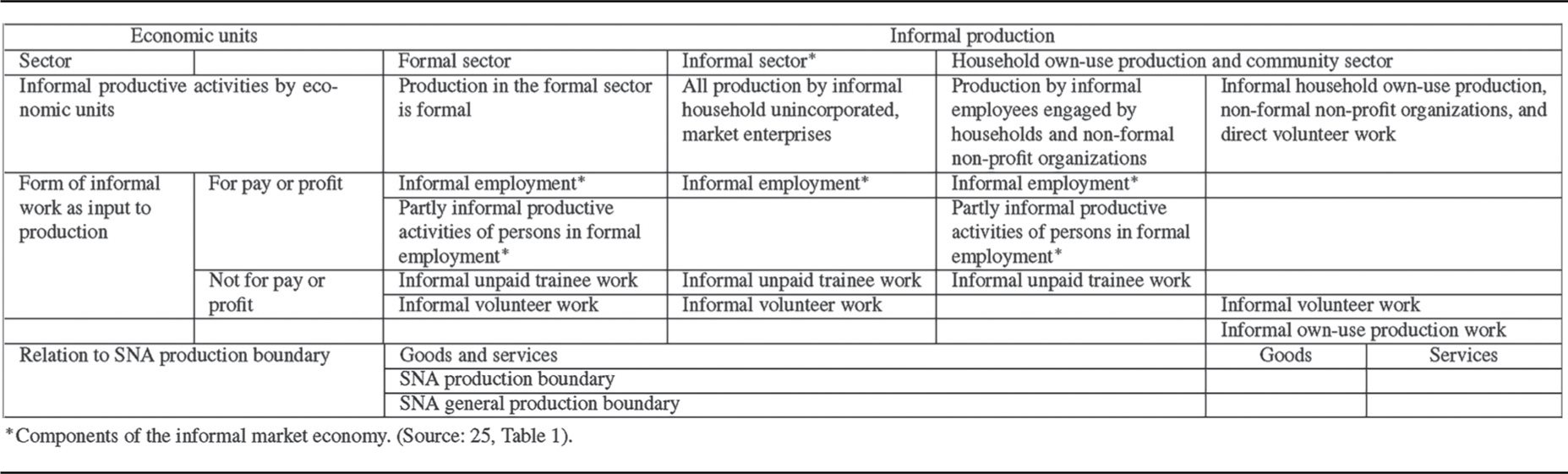
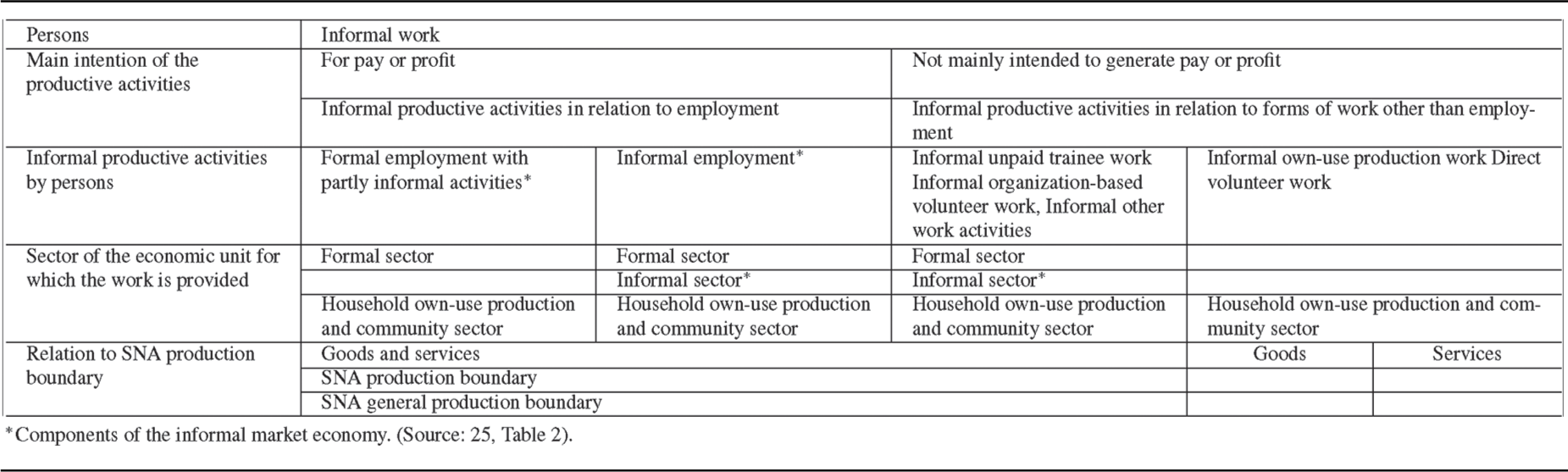
Tables 1 and 2 outline the components of the informal economy from respectively the perspectives of economic units and persons, and include the following components:
Informal productive activities of economic units, i.e., informal production carried out by:
economic units in the informal sector;
households producing for own final use, including direct volunteer work, and the production by non-formal non-profit organizations (Paragraph 16).
Informal productive activities of persons, i.e., informal activities and duties carried out in relation to:
informal employment;
formal employment carrying out partly informal productive activities;
unpaid trainee work, volunteer work, own-use production work and other work activities (25, Paragraph 15).
Informal productive activities by economic units in the informal economy.
Informal productive activities by persons in the informal economy.
An aspect pertinent to informality, that was not addressed in the previous standards, is the treatment of illegal and illicit activities. Activities that are illegal form part of the concept of work and employment as defined by the 19th ICLS resolution (19, paragraph 6 (a)) and illegal production is included in the boundaries of the production within countries (27, paragraph 6.43). However, the definition of the informal economy in the 21st ICLS excludes activities where the goods or services as such are prohibited – such as human trafficking or trafficking in illegal narcotics – while including production that becomes illegal when carried out for example without authorization such as conducting construction work without the required building permits (25, paragraph 14). This conceptual boundary contributes to creating a policy relevant concept of informal economy aligned with the policy objective of formalizing the informal economy [12, 16]. The concept of informal economy thereby becomes a concept, to some extent overlapping but also differing from concepts such as non-observed economy or illegal and illicit economy.
The concept of informal economy is a broad and encompassing and not necessarily intended to be measured in its totality. Rather, it should be viewed as a conceptual framework that lays out the different components of informality to allow countries to measure those that are deemed to be of relevance within the country, depending on policy objectives and need. However, at the same time, there are essential components within the framework that countries are strongly encouraged to measure regularly. To highlight this aspect, the concept of informal market economy was introduced within the resolution. The informal market economy is defined as “…all production for pay or profit in the informal sector and all productive activities of workers in employment that are – in law or in practice – not covered by formal arrangements” (25, Paragraph 18). It includes the very core concepts of informal employment and informal sector which would be of high relevance for all countries to measure. The concept thereby points at the core elements in the broader concept of informal economy that have a high policy focus in relation to formalization and for preventing informalization.
The three sectors
The 21st ICLS resolution introduces conceptually and operationally, three distinct and mutually exclusive sectors within a coherent framework: the formal sector, the informal sector, and the household own-use production and community sector (HOC-sector). This is a significant advancement from previous standards, that while identifying three different types of sectors, only provided an explicit definition of the informal sector in the 15th ICLS resolution. The formal sector could be “indirectly” identified based on the definition of the informal sector, and the third sector could be understood as constituting households producing exclusively for own-final use and were to be excluded from the informal sector (8, paragraph 14).
Furthermore, the 21st ICLS resolution enhances clarity on the conceptual basis for defining these sectors by introducing two dimensions: the intended destination of production and the formal status of the economic unit (25, paragraph 22). The first dimension considers whether the economic unit mainly produces for the market to generate income or profit, or if the production has a different intention for example when the services or goods produced by the household members are mainly intended to be used by the same household members. Notably, the 21st ICLS resolution revises the threshold for identifying production intended for the market, aligning it with standards set in the 19th ICLS resolution on work, employment, and labour underutilization, as well as the SNA for identifying market producers. As a result, activities classified as own-use production work in the 19th ICLS resolution are now placed within the HOC-sector, thus excluding them from the informal sector.
The second dimension concerns the formal status of the economic unit, capturing whether the unit is “formally recognized by government authorities as a distinct producer of goods or services and is thus covered by formal arrangements.” (25, Paragraph 25). This dimension establishes a direct connection to the underlying concept of informal productive activities and ties the definitions more closely to the legal-administrative perspective of informality by reflecting whether the units are embedded in the legal-administrative framework of the country and through that have a coverage of formal arrangements.
Based on the two dimensions the three different sectors have the following mutually exclusive definitions:
As can be seen in Table 2 the informal economy includes all production within the informal sector (as this by default would be informal production) and the informal production carried out by households and non-formal non-profit organizations in the HOC-sector. In addition, the informal economy would include the informal labour input that is used for this production. This creates a link between the three different sectors, informal production and the concept of informal work which is used as labour input to that production. While the production in the formal sector, is defined as formal production and hence does not form part of the informal economy (25, Paragraph 37), the formal sector still has relevance for the informal economy as formal economic units may use informal work as input to the formal production.
Operational definitions of the three sectors
The two dimensions, namely the intended destination of production and the formal status of economic units, serve not only to define the three distinct sectors in the resolution but also to categorize economic units within these sectors. This categorization depends on how an economic unit aligns with these dimensions. This approach fosters a clearer connection between the conceptual and operational definitions of the sectors, thus enhancing clarity compared to the previous standard.
Operational criteria to determine the formal status.
Operational criteria to determine the formal status.
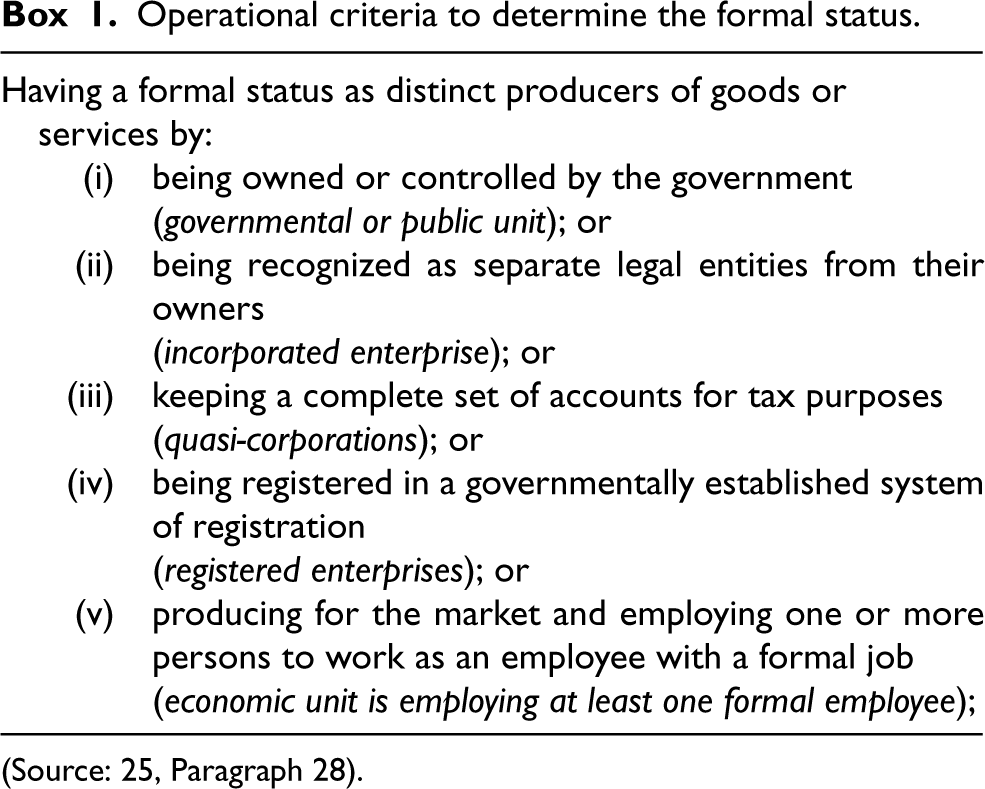
(Source: 25, Paragraph 28).
Most of the operational criteria used to determine the formal status of an economic unit were already implicitly or explicitly part of the previous definition of the informal sector as per the 15th ICLS resolution. By situating the informal sector within the SNA household sector, it was indirectly indicated that governmental and public units were excluded from the informal sector, implying their formal status. Similarly, incorporated enterprises (known as corporations in SNA terminology) and quasi-corporations (enterprises with a full set of accounts that act as corporations, albeit not incorporated) were also excluded from the informal sector on the outset as these do not form part of the SNA household sector and by that could be understood as formal economic units.
With the 21st ICLS resolution, these criteria are explicitly defined and directly linked to determining the formal status of an economic unit. This highlights that formality and informality, for economic units, largely hinge on whether they are officially recognized and integrated within the legal-administrative framework of the country, thus being covered by formal arrangements. This clarification sheds light on the statistical rationale behind employing these specific operational criteria.
Moreover, this linkage is reinforced by the refined definition of the operational criteria outlined in the 21st ICLS Resolution. For instance, the criterion of maintaining a complete set of accounts has been bolstered by emphasizing that it should be a full set of accounts for tax purposes, indicating compliance to laws and regulations and formal acknowledgment of the economic unit’s production activities. This underscores that accounting practices should not solely serve a personal need to keep track of costs, income etc. but should reflect formal recognition within the broader legal and regulatory context.
Registration forms one of the key criteria. Firstly, it to some extent overlaps with the other criteria, for example an incorporated enterprise or an enterprise with accounts for tax purposes would be a registered enterprise. In addition, it is a key criterion on its own. Having a registered enterprise, if the aspect of registration is effectively operationalized, implies that the enterprise is embedded and recognized within the legal and administrative framework of the country. The economic unit, and its production would thereby be covered by the formal arrangements that within the country comes with being registered, such as obligations to keep accounts, to pay tax on the income, deduct VAT etc. The formal arrangements would differ between enterprises depending on for example the turnover, the size, and the legal form. However, registration would still be a formal recognition that the enterprise exists, that production is taking place and that there is access to the formal arrangements that follows from this. It is also a precondition for ensuring an outreach of formal arrangements put in place by countries to support formal enterprises, an aspect that became visible during for example the Covid pandemic where countries implemented different forms of support typically targeting formal (registered) enterprises.
The criterion of registration is a key criterion that countries need to implement taking into account the national registration system, as these varies substantially among countries. The previous standard provided some basic input on what type of registrations that could be relevant, specifically that it should be a registration enacted by national legislative bodies, such as commercial acts, tax, or social security laws (8, Paragraph (3)). The 21st ICLS resolution includes further recommendations for what countries should take into account when operationalizing registration within the national context. In particular it stress that the registration(s) used should be linked to a registration in the given country for granting access to benefits such as tax deduction, obtaining a legal identity, as well as carrying obligations such as paying business tax or keeping accounts. In other words, the registration(s) should be linked to formal arrangements (obligations and benefits) that cover economic units and their production.
An important change in the operational criteria is the removal of size as a main criterion. This settles an important ongoing discussion that in essence reflects different views on informality. The removal of size as a main criterion was strongly supported by the ILO working group and the 21st ICLS, as in most countries smaller companies may be perfectly formal (being registered, incorporated) while larger enterprise might not, even if less likely. Using size as a criterion would also to some extent be an arbitrary threshold. Depending on if for example enterprises with fewer than three employees are considered informal or if the threshold is set at ten employees, this would have a direct impact on the size of the informal sector.
In addition, the 21st ICLS resolution also introduces a new criterion i.e., that enterprises engaging a formal employee defines that economic unit as having a formal status. The criterion is directly linked to the definition of formal jobs among employees and removes the existence of formal employees in the informal sector, which was a possibility in the 17th ICLS guidelines. If an employer fulfills the commitments and requirements of employers and where the employee has an effective access to formal arrangements, this would assume a formal status of the enterprise. This change was strongly motivated by feedback from countries that measuring this particular group and particularly explaining it to users was considered challenging and contradictive.
Informal work defined in the resolution as consisting of “…productive activities performed by persons that are – in law or in practice – not covered by formal arrangements” (25, Paragraph 53) reflects the informal economy from the perspective of persons, jobs, and work activities.2 It is a broad encompassing concept that includes informal productive activities within the SNA general production boundary carried out by persons in relation to the different forms of work (See Table 2). The concept thereby aligns the framework of informal economy to the framework of the 19th ICLS resolution. Informal work would include informal productive activities in relation to employment as well as in relation to forms of work other than employment, i.e., within unpaid trainee work, volunteer work, own-use production work and other work activities.
Informal work can be carried out for economic units categorized in the formal sector, informal sector or household own-use production and community sector as can be seen in Table 2. This creates a linkage between the perspective of persons, jobs or work activities and the perspective of economic units and thereby also between informal work and (informal or formal) production as the informal work in the informal economy is used as labour input to the production carried by economic units.
The concept of informal work needs to be viewed as an overarching concept that consists of its different components and that creates a clear link to the underlying concept of informal productive activities which form the basis of the framework in the resolution. The intention with the concept is not that countries necessarily should measure it in its totality nor to start to produce estimates on “persons in informal work”. It is rather an enabling concept that outlines the outer boundaries and organizes its different components. The core focus is still expected to be on the concept of informal employment complemented with essential categories of unpaid informal work such as informal activities carried out by unpaid trainees and subsistence food stuff producers. However, the resolution opens the possibility of also exploring informality in relation to for example volunteer work or own-use provision of services, if there is such a need and where relevant systems exist in the country.
Informal employment
Informal employment is a core concept in the resolution defined as “…any activity of persons to produce goods or provide services for pay or profit that is -in law or in practice- not covered by formal arrangements such as commercial laws, procedures to report economic activities, income taxation, labour legislation and social security laws and regulations providing protection against economic and personal risks associated with carrying out the activities” (25, paragraph 56).
Informal employment consists of activities carried out in relation to informal jobs, as it follows that these would be informal productive activities. This creates a link between the definition of informal employment, the definitions of informal jobs and the status in employment categories as defined by the International Classification of Status in Employment. The definition of informal jobs needs to be tied to the specific type of job as delineated by ICSE, as different work relationships entail distinct characteristics that impact on how to understand informality and thereby on how to define it conceptually and operationally.
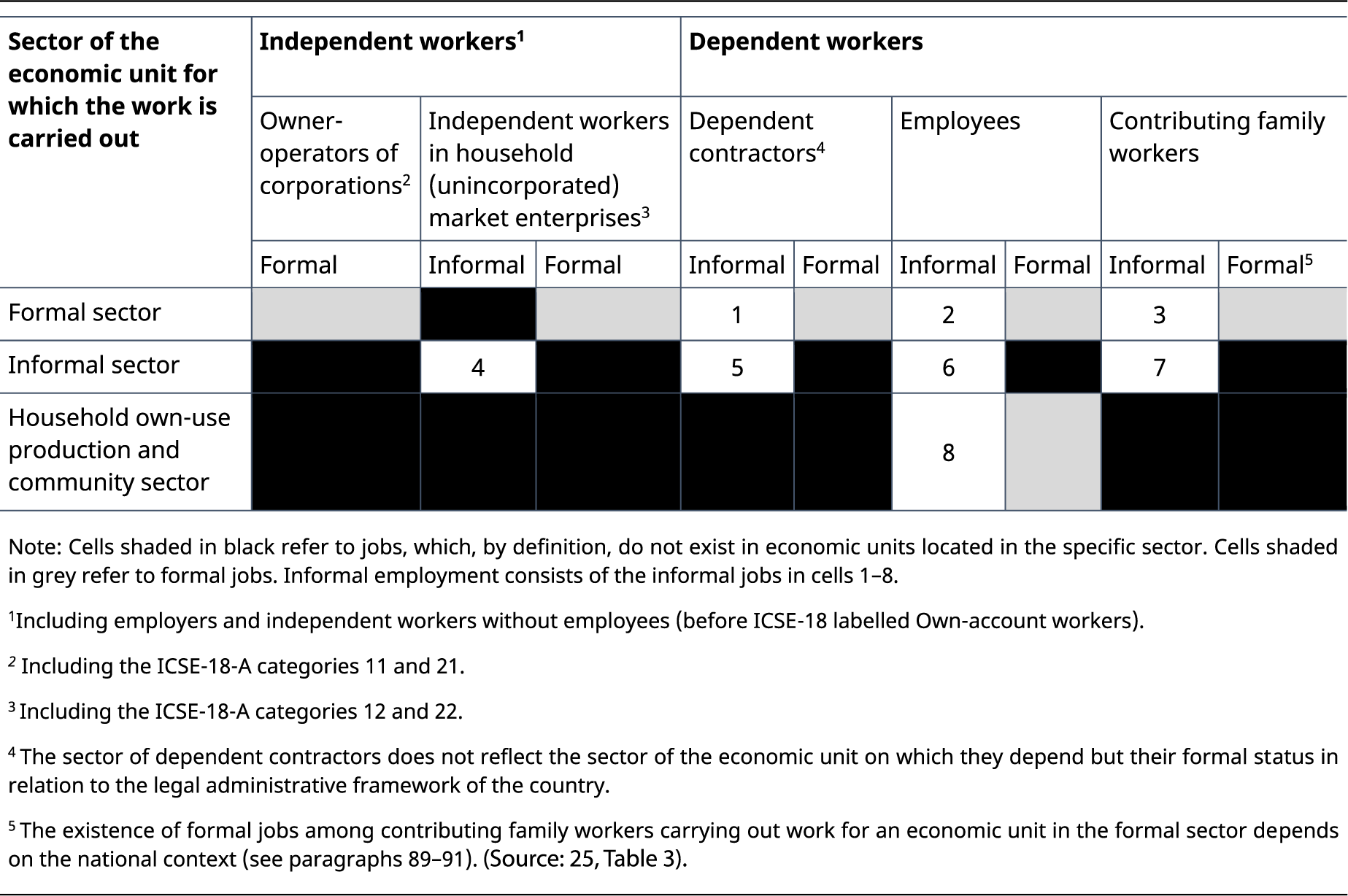
As can be seen in Table 3 for independent workers3 there is a direct link between the formal status of the enterprise they own and operate, and the formal status of the job held by the independent worker. If an independent worker, owns and operates an informal enterprise4 they are defined as having an informal job, while if they own and operate a formal enterprise the job is formal. For dependent workers, however the link is less direct. Dependent workers5 may have an informal or formal job when carrying out work for a formal economic unit but would have an informal job when carrying out work for an informal enterprise, and finally employees might have an informal or formal job when working for a household as a domestic worker. In other words, additional criteria are needed to determine the formal or informal status of the job beyond the informal or formal status of the economic unit.
Informal and formal jobs by status in employment and sector.
Informal and formal jobs by status in employment and sector.
Operationalizing the definitions of informal and formal jobs effectively is paramount for accurately measuring informal employment. The challenge lies in identifying pertinent and robust criteria that are meaningful within a country’s context while contributing to the production of harmonized data across countries. The definitions provided in the 17th ICLS guidelines concerning a statistical definition of informal employment, include a relative high degree of flexibility in the criteria to use for defining informal and formal jobs. At the time, this was necessary, as countries had little experience in measuring the concept. However, with time and experience, countries have move toward a more harmonized view on the main criteria to use [28].
The 21st ICLS resolution advances previous standards by including stronger input and recommendations for criteria, taking into consideration the evolution in measurement practices over the past two decades. In line with previous standards, the definition of informal and formal jobs for independent workers is directly linked to that of the informal and formal sector. Therefore, the same criteria for determining whether the economic unit is informal or formal are also used to determine the informal or formal status of the job held by independent workers. The strengthening of the operational definition of informal and formal jobs for independent workers, thereby follows the strengthening of the definitions of the three sectors as previous discussed.
However, for dependent workers, additional criteria are necessary to determine the formal or informal status of their jobs, as the status of the economic unit alone is insufficient. The 21st ICLS resolution introduces crucial changes and enhanced recommendations in this regard, enabling data collectors to more effectively identify informal and formal jobs across all categories of employment.
Defining formal and informal jobs for dependent contractors
Dependent contractors is a new status in employment category introduced with ICSE-18, encompassing a variety of activities across sectors and occupations such as homeworkers, digital platform workers, or consultants with a single client. Despite this diversity, they share common characteristics facilitating their statistical identification. Essentially, they occupy the space between employees and independent workers without employees. Similar to independent workers, dependent contractors engage in commercial agreements and, as they by definition do not have an incorporated enterprise, operate as workers in employment for profit. However, resembling employees, they rely on another entity for work that exercises operational and/or economical control, thus classifying them as dependent workers [20].
Incorporating dependent contractors into the statistical standards on the informal economy was essential for aligning the standard to ICSE-18. However, their unique ‘in-between’ status presented a challenge, as neither the approach for defining informal and formal jobs for independent workers nor the approach used for employees are directly applicable to dependent contractors. Instead, dependent contractors require a unique definition reflecting their unique status [29].
The definition in the 21st ICLS resolution, takes into account the specific situation of dependent contractors. Like independent workers, the definition is based on the formal status of their economic unit, rather than the formal status of the unit they depend on. If a dependent contractor operates a formal enterprise or is registered for payment of tax on the profits made from the activities, they are categorized in the formal sector, as their activities are recognized and integrated into the legal administrative system of the country. Conversely, if these conditions are not met, the dependent contractor is categorized in the informal sector.
Dependent contractors that are categorized in the informal sector are by default considered as having informal jobs, similar to all other persons in employment. If there is no formal recognition of the activities, then these activities and the job are informal. However, for dependent contractors, an additional requirement must be met for their jobs to be considered formal. The additional criterion, having an effective access to formal arrangements such as job-related social insurance, points to their similarity with other dependent workers in particular employees. In some countries, these types of formal arrangements would automatically come with the registration because registration implies mandatory fees or taxes that provide social insurance coverage or other benefits. In other countries the situation may be different; any coverage of these types of social insurances would potentially be in a separate and voluntary system [29]. This raised the need to develop an operational strategy that would produce harmonized outcomes across the different systems.
In practical terms the operational definition requires countries to assess their system to decide the operational criterion that are needed. In a given country is it possible to register in relation to tax on profits without registering an enterprise (in which case both types of registrations need to be included as part of the measurement) or is there one single type of registration (if so, it would be sufficient to include this single registration)? Additionally, the link between registration and access to formal arrangements such as job-related social insurance needs to be assessed. Do sufficient formal arrangements come with registration in the country (in which case registration would be sufficient criterion) or is this done in a separate system (in which case it would be necessary to add and additional criterion)? This treatment should not however, be viewed as a flexibility within the definition that reflects different views on informality but rather a flexibility that ensures the same outcome independent of the specific system and thereby the same view on how informality should be understood for dependent contractors.
Strengthening the definition of formal jobs and informal jobs for employees
Much of the flexibility in the definition of informal employment has concerned the operational definition of informal and formal jobs for employees. The 17th ICLS guidelines concerning a statistical definition of informal employment mention several possible criteria to use but did not provide any information on which of these criteria to prioritize or how the criteria should be combined [14]. The 21st ICLS resolution concerning statistics on the informal economy, has been an important step forward to improve this situation as it includes a strengthened operational definition and stronger recommendations for implementation. The resolution identifies employers’ contribution to a statutory job-related social insurance as being a prioritized criterion. This implies that if the employer contributes, fully or partly, to job-related social insurance on the behalf of the employee then the job held by the employee is to be considered formal. Following this, a defining characteristic of informal jobs for employees is an absence of such contribution (25, paragraph 78 and 84). Employers’ contribution to social insurance is the most frequently used criterion among countries as part of their measurement of informal and formal jobs for employees [28]. However, there are also additional strong arguments for why social insurance is recognized as a prioritized criterion as it captures several essential elements in relation to informality. The use of social insurance as a criterion links the operational definition to a coverage of formal arrangements that provides protection against economic and personal risks, as this is precisely the main purpose with social insurances. That the social insurance should be a statutory social insurance creates a strong link to the legal administrative system of the country, as it should be a social insurance that is embedded in national legislation and regulation. It is thereby a recognition of the job in relation to the general government. That it is job-related and not for example universal social insurance creates a direct link to the specific job held by the employee. That contributions are actually made by the employer captures the “in-practice” access to the formal arrangements. The criterion thereby manages to capture that there is a formal recognition of the job by the employer in relation to the legal administrative system, and that this recognition implies an in-practice access to formal arrangements for the employees. The criterion should therefore not be understood as a question of the employees’ general access to social protection. Formal workers including employees may have access to a range of different types and degrees of social insurances, job-related, universal, and private insurances etc. and informal workers might also have access to some social protection. Social protection is therefore a multi-dimension topic in its own right. However, in relation to defining informal and formal jobs for employees the criterion is used as a strong indication of whether the specific job should be considered formal or informal.
In addition, the resolution highlights that having access to paid annual leave and paid sick leave as being two relevant criteria that can be used, either if information regarding employers’ contribution to social insurance is missing, or in direct combination with the criterion of social insurance. In the former case the job held by the employee would be considered informal if the employer does not contribute to social insurance, however if the information regarding whether the employer contributes is missing, then the job would be considered formal if the employee has access to both paid annual leave and paid sick leave, and informal if access to one or none. In the latter case, access to paid annual leave and paid sick leave would be used as main criteria i.e., the job held by the employee is considered formal also in the case when the employer does not contribute to social insurance, but the employee has access to paid annual leave and paid sick leave.
However, independent on the exact combination of the criteria the employee would need to have access to both paid annual leave and paid sick leave for the job to be considered formal, and if the employee only has access to one or none, then the job is considered informal (25, paragraph 79). This is an important clarification as it rules out the so called “weak formality” approach, used by a few countries, where a job is considered formal even if the employee only has access to one of the criteria (for example paid sick leave) but does not have access to any of the other criteria.
Finally, the resolution also recognizes the possibility of using additional national criteria to further support the operational definitions, such as absence of a written contract or severance pay, if it is deemed useful within the country context. However, data collectors are encouraged to always include the three main criteria as part of the measurement.
The improved definition of informal and formal jobs among employees still includes some degree of flexibility to ensure that data collectors can operationalize the definition in a meaningful way. However, flexibility has been significantly reduced which will contribute to increased harmonization across countries.
Creating the possibility of formal jobs for contributing family workers
In the previous definition of informal employment, contributing family workers were automatically defined as holding informal jobs due to the informal nature of their work [14], since these workers lacked written contracts and typically were not subject to labour laws or social security regulations in their respective countries [15]. However, over time, some countries have established formal arrangements specifically targeting contributing family workers. For instance, in France and Belgium, assisting spouses are required to register their employment and contribute to national social protection schemes. Similarly, Tunisia has implemented a national social insurance scheme aimed at female contributing family workers [30]. While such initiatives remain relatively rare globally, they signify the potential for extending formal arrangements to this group.
The 21st ICLS recognizes that in some countries it is possible for contributing family workers to have formal jobs. Further, it points to a possible route for formalization beyond shifting employment status. Despite a global decline in the number of contributing family workers over the past two decades, significant numbers remain, particularly in low- and middle-income countries, and women are overrepresented among these workers in all types of national economies. Therefore, acknowledging the potential for formalization carries significant gender implications and enables countries with existing policies and arrangements to assess their effectiveness [30].
However, since the vast majority of countries do not have formal arrangements in place for contributing family workers, the definition in the resolution includes the possibility to by default define their jobs as informal in these countries. However, in countries that do have such arrangements, contributing family workers can be considered formal if the following conditions are met: the family business is formal, the job is registered, and the contributing family worker has access to job-related formal arrangements such as social insurance.
Formal jobs with partly informal productive activities
One of the aims in revising the statistical standards regarding informality was to increase their applicability to high-income countries. Despite informality being present across all countries, there are notable gaps in measurement, especially within high-income countries [28]. While the expectation would be that the share of informal employment is relatively small in these highly regulated labour markets (which potentially could explain the lack of interest in measurement), there might still be a significant challenge with persons having formal jobs where parts of the activities are formal while other might be informal (e.g., when part of the work is undeclared and not covered by social protection, employment benefits etc.).
The previous standards did not address these types of situations. However, the introduction of the underlying reference concept of informal productive activities enables the differentiation between informal and formal activities within a specific job. In the 21st ICLS resolution, this is captured by the complementary concept of formal employment with partly informal productive activities (25, paragraph 92-96). Such employment would occur when for example an employee holds a contract for 10 formal hours but is working an additional 15 undeclared hours without social contributions or compensation in case of illness. Similarly, for independent workers, it includes situations where business owners operate formally but engage in a mix of declared and undeclared activities.
While further methodological work is necessary to develop recommendations and approaches for measurement, estimating working time spent on or income derived from informal and formal activities within formal jobs holds considerable policy interest. This is particularly relevant in countries where such practices are prevalent while the share of informal employment is low. Such estimates would not only inform policy decisions but also contribute valuable insights to the SNA for the comprehensive measurement of all informal productive activities.
Informality and forms of work other than employment
An important objective with the 21st ICLS resolution concerning statistics on the informal economy was to align statistics on informality to the framework of the 19th ICLS resolution concerning statistics on work, employment and labour underutilization. This required not only an integration of employment as defined in the standard, but also addressing the different forms of “unpaid” work such as volunteer work, own-use production work and unpaid trainee work from the point of view of informality. The underlying concept of informal productive activities and the overarching concept of informal economy includes all informal activities defined as work independent of whether it is done for pay or profit (such as in relation to employment) or with a different intention, as long as the activities -in law or in practice- are not covered by formal arrangements.
This raises questions, however, about the meaningfulness of this statistical concept when almost all of us are carrying out informal activities such as caring for own children or households’ members, preparing meals, or helping out neighbours and friends. In addition, it might not be clear how formal arrangements should be understood in relation to some of these activities. While governments typically would have extensive regulatory frameworks in place for employment this is much less so in relation to forms of work other than employment. In some cases, there might be no incentive for them to establish a regulatory framework to reduce risks and promote participation. Moreover, policy relevance and objectives may vary widely depending on the specific form of work.
However, there are similarities between employment and the other forms of work. They all include a productive activity and there is both an economic and personal risk associated with the activities. A family can rely on the food produced by own-use production of goods, a person carrying out volunteer work might be injured. There are also examples of regulations in some countries covering some specific activities within the different forms of work, for example a coverage of health and injury insurance for unpaid trainees or access and contributions to pension for persons caring for own family members.
From a statistical standpoint, it is evident that including forms of work other than employment in the informality framework isn’t aimed at estimating every type of informal work. Such data wouldn’t effectively inform policies. However, the inclusion of all forms of work within the framework of informal economy, is an important recognition, pointing out that much of the work people are carrying out is informal. In addition, there are essential groups within these forms of work, such as subsistence food stuff producers and unpaid trainees that would be important for countries to provide statistics on to give a better picture of the structure of informality within the country. There might also be informal productive activities in certain domains, such as care work or agriculture, that go across multiple forms of work and that could be of interest, from a policy perspective, for the application of the dichotomy of informality and formality.
To facilitate this, all forms of work would need to be categorized as informal or formal. Understanding formal arrangements in forms of work other than employment is in that regard crucial. While many of these activities may be unregulated, exceptions exist, and some countries may have formal arrangements for specific activities. In addition, there is currently little experience with measuring informality and formality in relation to forms of work other than employment. While some of these activities conceptually were included in the previous definition of informal employment the focus was on the activities carried out for pay or profit and to some extent on own-use production of goods. Taking this into account, the definitions provided in the resolution in relation to own-use production of goods, unpaid trainee work, volunteer work and other forms of work, can be viewed as definitions that point in the direction of how informality and formality can be understood statistically in relation to these forms of work. Enabling countries and other data collectors to start to explore how to effectively operationalize these definitions as well as the general usefulness of the data.
Indicators and Measurement
Collecting data on informality serves several crucial objectives, including supporting policy development and monitoring aimed at addressing the different challenges associated with informality. This data also aids in improving working conditions for both formal and informal workers, promoting formalization of the informal market economy to tackle decent work deficits, poverty, inequality, and to enhance productivity and inclusive growth. While the informality-formality dichotomy is valuable for these aims, there’s a strong need for more detailed data to grasp the diverse characteristics, levels of protection, and vulnerabilities within the informal economy. This includes data reflecting that informality-formality in reality is not so much a dichotomy but rather a continuum where informal and formal workers and enterprises might be in very different situations.
An essential aspect of the 21st ICLS resolution is therefore the inclusion of a set of indicators that guide data producers in what indicators that would be of relevance to produce to show the extent of informality within the country, its composition, the exposure to informality depending on socio-demographic and employment related characteristics, working conditions and levels of protection and different contextual vulnerabilities such as poverty, inequalities and discrimination.
The indicators in the resolution supported by the broader Informal Economy Indicator Framework reflect the broad concept of informal economy and enables in-depth analyses of the informal economy from the perspectives of persons, jobs, and work activities as well as from the perspectives of economic units and the contribution of the informal economy to GDP. The broad range of indicators that are closely linked to policy measures, calls countries to prioritize the indicators relevant to the country reflecting the national context, priorities, policy objectives and available statistical sources.
Collecting statistics on the informal economy and to produce the broad range of indicators will require the use of multiple statistical sources. The choice of sources and methods has to depend on the national priorities and measurement objectives as well as on the available statistical sources. Household surveys, such as labour force surveys, are crucial for generating statistics with persons and jobs as reference units, making them highly suitable for monitoring informal and formal employment, assessing levels of informality, and identifying those most exposed to and most represented among informal jobs. However, other sources, like poverty surveys or income and expenditure surveys, may provide better insights into how informality relates to these issues. When other options are limited or there’s a need to focus on small population groups or areas, population censuses can also be useful for providing statistics on informal employment.
Little work has yet been done on measuring informality in forms of work other than employment. However, time-use surveys could assess informality in the own-use provision of services, and questions about informality could be included as part of measurement of volunteer work or own-use production of goods. These efforts would begin to explore how informality can be meaningfully and statistically operationalized in relation to these types of activities.
Economic censuses, enterprise-based surveys, and mixed surveys are potential sources for collecting statistics and producing indicators on informal and formal sector economic units, their production, and their contribution to GDP. Enterprise surveys often have limitations because they may not capture economic units likely to be informal, such as small units, agricultural activities, units with non-fixed premises or home-based activities. Mixed surveys, however, overcome this challenge by combining multi-stage household and establishment surveys, ensuring a comprehensive coverage of informal economic units.
Using different statistical sources to cover the informal economy’s various components will require a strong collaboration among the different national institutions, including data users, statistical offices, and producers of economic and labour statistics. Harmonizing concepts and definitions across sources and being transparent about any limitations in measurement will be crucial for achieving national-level harmonization and for the general understanding of the statistics.
Support and guidance for measurement using different statistical sources is essential for producing high-quality statistics covering the different components of the informal economy. While much has been done to develop effective questions and methods for measuring informal employment in household surveys such as the labour force survey (see the ILO resource page for informality) [31], less recent work has focused on providing statistics on informal enterprises and their production for input to the SNA. Despite the experiences made by countries, compiled in the ILO manual on the informal sector and informal employment [32], more methodological work is needed to align data collection with the latest statistical standards and improve efficiency and flexibility. This will encourage more countries to produce statistics on the informal sector thereby potential reduce some of the current data gaps.
Additionally, there is a need to further explore measuring the new aspects in the resolution, such as effectively estimating partly informal productive activities in formal jobs and exploring the usefulness and potential statistical operationalizations of identifying informality in forms of work other than employment. While the 21st ICLS resolution on statistics on the informal economy is a significant step forward, it does not mark the end but rather points toward the next steps to be taken.
Summary
Informality is a widespread phenomenon and globally a majority of persons in employment carry out their activities in an informal job thereby lacking effective access to formal arrangements that protect and regulate workers and enterprises. Providing statistics on the different components of the informal economy is key for crafting and assessing economic and social policies, enhancing working conditions, and strive towards decent work for all.
The development of statistical standards on informality has been essential for enabling countries to measure the core concepts of informal sector and informal employment. These standards have resulted in an increasing number of countries measuring and providing statistics on the informal sector and informal employment and by that gained increased experience with measurement during the last 30 years.
Due to the changes in statistical labour standards during the 19th and the 20th ICLS as well as the increased experience of countries in measuring informality, there was a strong need to revise these standards and provide a more coherent statistical standard that better explains the statistical meaning of informality and that can contribute to clarifying historical debates around how informality should be statistically defined and measured.
The new resolution concerning statistics on the informal economy, provides a comprehensive framework that by introducing the underlying concept of informal productive activities and for the first time statistically define, the overarching concepts of informal economy and informal market economy introduces a framework, aligned to the latest statistical labour standards.
The introduction of the three mutually exclusive definitions of the three sectors, i.e., the formal sector, informal sector and household-own-use production and community sector, as well as the improved conceptual and operational definitions of these sectors, will lead to better data describing economic units, their production, and their workers. The new resolution also clarifies aspects that previously were somewhat unclear, including the clarification that agriculture activities are to be included within the informal sector, registration constitutes a key criterion to be preferred above the criterion of size and that economic units employing formal employees defines the unit as formal.
The concept of informal work can be viewed as capturing the informal economy from the perspective of persons, jobs, and work. It is to be viewed as an overarching concept that consists of its different components. The intention with the concept is not that countries necessarily should measure it in its totality but should rather be viewed as an enabling concept that outlines the outer boundaries and organizes its different components. The core focus is still expected to be on the concept of informal employment complemented with essential categories of unpaid informal work such as informal activities carried out by unpaid trainees and subsistence food stuff producers.
The changes in relation to the definitions of formal and informal employment and jobs, will also contribute to improved data quality and increased harmonization across countries and regions. The integration of ICSE-18 including dependent contractors in the definition of formal and informal employment means that the statistical standard on informal economy is fully aligned to the 19th ICLS resolution concerning statistics on work, employment and labour underutilization, as well as the 20th ICLS resolution concerning statistics on work relationships. This creates coherence between the different statistical labour standards. The improved recommendation on operationalizing the definitions, particularly in relation to defining informal and formal jobs for employees further clarifies statistics on informality and will likely lead to increased harmonization across countries.
The 21st ICLS resolution opens the possibility for contributing family workers to have formal jobs in countries where formal arrangements are in place. In countries where this is not the case the practice established in the previous statistical standards to by default define their jobs as informal can be maintained. This shift marks an important change that points at a possible route of formalization of this group beyond shifting their employment status and has important gender implications.
As one of the objectives of the revision of the statistical standards on informality was to increase its relevance for high-income countries, a complementary concept of formal jobs with partly informal productive activities has been introduced in the new resolution. This captures situations in which a person has a formal job in which some of the activities are considered formal while others are undeclared and not effectively covered by any formal arrangements. The concept that is complementary to the concept of informal employment, would be particularly relevant in countries characterized by a relatively low share of informal employment but where these types of situations might be relatively common. However, how this is to be effectively measured needs to be further explored as there are currently a lack of good practices and methods for direct measurement.
Forms of work other than employment, such as unpaid trainee work, volunteer work and own-use production have also been integrated in the framework of the resolution thereby ensuring alignment to the latest statistical labour standards and an expansion of the boundaries of informality. The 21stICLS resolution includes definitions that points at how informality and formality can be understood in relation to forms of work other than employment. However, countries and other data collectors need to further explore this area to create a better understanding of how the definitions of informal work in relation to forms of work other than employment can be effectively operationalized as part of measurement. This needs to be done in close collaboration with the policy side to also gain a better understanding of the usefulness and relevance of data on informality as part of policy making in relation to forms of work such as volunteer work and own-use provision of services.
Finally, the resolution also includes a comprehensive set of indicators to guide statistical offices and others on the type of statistics to produce and disseminate. The indicators have a clear linkage to policy making so the specific indicators to be produced would depend on the need of the country and the policy objectives.
The 21st ICLS resolution is an important step forward in relation to the collection and production of statistics on the informal economy. The resolution will contribute to strengthening countries capacity to provide policy relevant statistics in a more harmonized way thereby increasing the evidence base needed for addressing and formalizing the informal sector. At the same time there is a strong need to continue the conceptual and methodological work within this area. While an increasing number of countries are measuring different aspects of the informal economy in particular informal employment, there is still important data gaps, not at least among developed countries. The data gaps are even wider in relation to statistics capturing the informal production by enterprises and households. This points at the need for further development of effective tools and resources that can support countries in its measurement and by that create more comprehensive statistics reflecting the informal economy.