




Abstract
In 2021, El Salvador declared bitcoin legal tender. According to President Nayib Bukele, the measure was intended to expand access to financial services in a country with a high proportion of unbanked people and to cheapen and ease remittance flows for migrants and their families. In this article, we inquire about the use of bitcoin as a tool for financial inclusion and contend that this policy needs to be seen in the broader context of democratic backsliding. We show that bitcoin has not translated into financial inclusion, but instead, the bitcoin law serves as a public relations tool to capture new support from like-minded constituencies, build closer relations with them, and empower international “crypto-bros.” On the other hand, this is a tool to benefit a close circle close to the president with the use of public funds, as part of a broader historical shift of elites in El Salvador.
Introduction
On February 4th 2024, El Salvador re-elected President Nayib Bukele by an overwhelming 84 per cent of the vote. In this election, his Nuevas Ideas party received an almost-complete majority of the Legislative Assembly's seats, with 56 out of 60. The election result was both unsurprising and the culmination of a process of democratic backsliding that is leading to the consolidation of a new electoral autocracy in Central America. Bukele's government in his first administration concentrated power in the executive, undermined the independence of the judiciary, persecuted journalists and opponents and sought a friendly interpretation of the constitution that allowed him to run for re-election despite a clear constitutional prohibition (Meléndez-Sánchez, 2024).
Democratic backsliding is an issue of concern worldwide, as the rise of new populist regimes and far-right movements have joined other authoritarianisms in undermining liberal democracy. To be clear, increasing inequalities and a growing disconnect between liberal elites and constituents both in the global north and global south account for deficits that contributed to distrust in both the liberal international order and democratic states (Colgan and Keohane, 2017; Ikenberry, 2018; Sanahuja et al., 2023). Despite the remarkable resilience of democracies in Latin America over the past several decades, the region too has been facing the threats of weakening democracies and authoritarian tendencies (Cameron, 2021; Levitsky and Loxton, 2015; Mainwaring, 2012; Marsteintredet, 2020). As explained by Cameron and Jaramillo (2022: 11), Cuba's revolutionary regime, and the “electoral authoritarian regimes” of Venezuela and Nicaragua “do not meet the criteria for classification as democracies.” In addition, “oligarchies with electoral facades” in Central America have also undermined electoral democracies (Cameron and Jaramillo, 2022: 11). Nonetheless, other countries’ democracies in the region have been struggling, with authoritarian leaders threatening to undermine institutions and norms from within, or organised crime subjecting the state and society to its will. The region is thus facing the challenges of the middle-quality trap where flawed democracies and low state capacity inhibit the possibilities for equitable growth and democratic consolidation (Mazzuca and Munck, 2020). 1
El Salvador's case is one where the drastic decay of its existing institutions and traditional parties has led the way for the rise of a populist leader who has been able to use his popularity to undermine principles of electoral democracy and divisions of power to capture state institutions for the benefit of the incumbent, at the expense of constitutional constraints (Meléndez-Sánchez, 2021; Moallic, 2021). In this process, Bukele has made bold policy choices, which often cause international concern but also spur his popularity in some corners at home and abroad. Much focus has been centred on his government's dealing with the powerful armed gangs in a controversial plan that has included a prolonged state of exception, stealth negotiations with armed groups and denunciations of human rights abuses of detainees, many of whom have been captured without due process (Cuéllar, 2022; Rosen et al., 2023).
Amidst El Salvador's democratic backsliding, Bukele's leadership has also prompted scrutiny as it relates to the country's political economy and economic policymaking (Bull and Hoelscher, 2023; Rosales et al., 2023; Vázquez, 2022). Building on the specific policy of bitcoinisation, El Salvador's democratic backsliding includes the embrace anarcho-capitalist ideas and right-wing libertarian populism in conjunction with iron-fist security policies of a strong state (Boos, 2024; Cuéllar, 2022). This mixture may well be part of the broader rise of right-wing populism in recent times with disdain for liberal democratic principles that takes different shapes in various contexts and regions (Boos, 2024; Sanahuja et al., 2023; Stefanoni, 2023b). A similar configuration to that of Bukele seems to be emerging in Argentina with the rise to power of economist Javier Milei, a self-described libertarian who galvanises conservative and militarist forces in Argentine society, and it may be adapted and promoted in Ecuador by President Daniel Noboa (Stefanoni, 2023a; Ospina Peralta, 2024).
The declaration of bitcoin as legal tender in 2021 is notable in this process of backsliding. It was a surprising announcement that was made public in a Bitcoin conference in Miami, through a video message broadcast in English (Vázquez, 2022). Just a few days later, Bukele sent a bill for approval to the National Assembly that was swiftly passed by his party's supermajority in parliament. The decision of the Salvadoran president has been justified by his government to benefit the people of El Salvador by promoting financial inclusion and enhancing development via new technological investments, with the inspiration of Bukele's “disruptive” leadership. As Dania González (Nuevas Ideas) head of the finance commission of the Salvadoran National Assembly, argues “the bitcoin law is a policy of financial inclusion” (interview with an author, May 2022). Another promise of the bitcoin law was that using bitcoin to capture remittance flows to El Salvador would cheapen and ease the procedure for migrants and their families (Gorjón, 2021). Government officials emphasised the importance of offering Salvadorans an alternative, inexpensive mechanism to send remittances to families at home, bypassing expensive and predatory services that extract large percentages in fees and commissions. The law has been touted as a visionary act from a counter-hegemonic leader seeking to expand his country's autonomy in the global economy. Moreover, the bitcoin law has attracted media attention and some foreign support from crypto-enthusiasts who are not only bitcoin advocates but also Bukele's defenders (Pérez, 2023; Valencia, 2023).
In this article, we inquire about the policy of promoting bitcoin as a tool for financial inclusion in El Salvador. Following data from the country's central bank and government statistics, financial inclusion is indeed a problem that merits public policy attention. Nevertheless, we show that the concrete policy of the bitcoin law has not yet translated into financial inclusion, improvement in access to services and spurred economic growth. It has not contributed to increased and cheapened remittance flows. This does not mean, however, that the bitcoin policy has not had other effects. Seen through the broader context of democratic backsliding, the bitcoin law serves as a public relations tool to capture new support from like-minded constituencies and build closer relations with them, mostly from abroad. On the other hand, it functions as a conduit for favouring cronies close to the president with the use of public funds, through the establishment of the government-funded Chivo wallet company, in charge of the implementation of the bitcoin policy. 2 While this is not necessarily surprising or unique about this policy (cronyism seems to be pervasive in other policy areas too), it is important to highlight bitcoin's role in it for several reasons. Bitcoin has been promoted as a futuristic tool of free markets that promote autonomy and individual emancipation through an innovative governance structure (Kera et al., 2023). Moreover, blockchain solutions have been touted in different parts of the global south as mechanisms to increase transparency, facilitate green transitions and improve poor peoples’ access to resources and their fulfilment of rights (Howson et al., 2019; Howson, 2023). The case of El Salvador adds to critical scholarship on blockchain technology and bitcoin's potential to contribute with the opposite, the consolidation of authoritarian governance.
This article draws from primary and secondary research and qualitative methods. Primary sources were collected during two field research visits to El Salvador, one in May of 2022 (by Rosales) and another one in March of 2023 (by Meijering). These visits included fieldwork in San Salvador and El Zonte. In each of these visits, we conducted semi-structured interviews with three groups of subjects. In total we conducted 46 interviews (twenty-four in May 2022; twenty-two in March 2023). We interviewed politicians (sixteen in total), mostly members of parliament, who are leaders of the most representative political parties, including leaders of the governing Nuevas Ideas and top bureaucrats. We covered a broad spectrum of ideological and party affiliations that made up the 2021–2024 Legislative Assembly. We also interviewed scholars and policy analysts with positions in think-tanks and major academic institutions in El Salvador (nineteen interviews). Lastly, we carried out interviews with crypto-enthusiasts, and investors in the cryptocurrency ecosystem in the country (eleven interviews). This work also builds upon data from large representative surveys conducted by the Salvadoran Central Bank and private business-associated institutions. We have conducted a review of media articles in Spanish and English that served to triangulate in part the findings from the most salient issues stemming from interviews and statistics. We traced the process of implementation of the bitcoin law with the goal of assessing how it has addressed the objective of financial inclusion. Moreover, we identify the broader context of democratic decay in the country as factors affecting the implementation of this policy. We frame our discussion around the literatures of democratic consolidation and backsliding as well as development policy on financial inclusion.
Democratic Backsliding: El Salvador in Context
Soon after the polls closed in El Salvador on February 4th 2024, President Bukele announced his remarkable victory. In a post on the social media app X, Bukele said that based on their numbers, he had “won the presidential election with more than 85 per cent of the vote and a minimum of 58 out of 60 deputies in the Assembly.” He went on to say that this was “a record in the world's democratic history” (Bukele, 2024). The official results showed a slightly lower margin and two fewer deputies, although it is indisputable that this was a resounding victory for Bukele. Yet, analysts and scholars see this election as the confirmation of an electoral autocracy, after years of democratic backsliding (Meléndez-Sánchez, 2024).
As Przeworski explains succinctly, “democracy is a system in which parties lose elections” (1991: 10). Minimal electoral democracy, in this sense, not only implies the right to rule of the majority, which in this case Bukele has, but a system where “there are parties: divisions of interests, values, and opinions. There is competition, organised by rules. And there are periodic winners and losers” (Przeworski, 1991: 10). In El Salvador, the government of Nuevas Ideas has managed to re-arrange the rules of the game in a way that prevents contestation, as all institutions are aligned with the party in power, but moreover, the rules themselves have been effectively re-written. There is no “government pro tempore” as Linz argued, but rather the establishment of a strong man via elections (quoted in Przeworski, 1991: 10).
There are many and often confusing symptoms of democratic backsliding, however. Often, leaders in hybrid regimes use their electoral majorities to challenge entrenched interests with the intention, or so they argue, of expanding rights to majorities traditionally excluded from malfunctioning democratic systems and increasing the capacities of states to address these deficits (Cameron, 2009, 2018; Velasco, 2022). Nonetheless, the weakening of checks and balances, judicial persecution of the opposition, elite control of the state, use of majorities in congress to crowd out opposition, lack of accountability and transparency, or politicisation of the judiciary contribute to the erosion of the rules of democratic contestation regardless of the intentions of leaders and their movements (Cameron, 2018; Levitsky and Ziblatt, 2019). The erosion of institutional autonomy and outsized power of the executive may coexist with majority rule in some instances, but gradually, the possibility of alternance is undermined when that majority is lost. This explains the different outcomes after increasing disaffection with incumbent regimes in Venezuela and Ecuador, for instance, where the former went through a process of authoritarian consolidation whereas the latter allowed alternance in a context of political instability (Bull and Rosales, 2020; Jaramillo, 2022; Rosales and Jiménez, 2021; Wolff, 2018). Subverting the rules of the game for executive perpetuation and aggrandisement are at the core of backsliding dynamics and they are present in the first administration of Nayib Bukele. Among the implications of backsliding are the facade of legitimacy that frequently surround these tactics. That is, elected officials employ the very tools of democracy, like referenda, legislative acts, and supermajorities, to advance authoritarian objectives, trump the rights of minorities and expand their own power (Levitsky and Loxton, 2015; Levitsky and Ziblatt, 2019).
Two crucial moments within Bukele's first administration were testament of executive aggrandisement and the subjugation of autonomous institutions designed to provide checks on governmental power. The first was the violent incursion into the Legislative Assembly in February of 2020 by the armed forces and the president. This was a call by Bukele to intimidate and coerce legislators into approving funds for his security plan, which remains until today, largely secret (Bull and Hoelscher, 2023). The irruption became the start of a broader campaign in favour of electing loyal members of parliament to replace the opposition-controlled assembly. The second was in 2021, upon the inauguration of the new slew of members of parliament, where pro-government forces secured a supermajority, the legislators of NI fired the Attorney General (AG) and the members of the Constitutional Chamber of the Supreme Court. They later packed the court and replaced the AG with government loyalists (Bull and Hoelscher, 2023; Meléndez-Sánchez, 2021).
Beyond the control of political institutions, Bukele has also punished dissent in the media, through both legal persecution (such as in the case of El Faro) and by attacking opponents with propaganda and counter-propaganda campaigns (Meléndez-Sánchez, 2021). Furthermore, the government has used the Israeli spyware Pegasus to surveil journalists, researchers, and opinion makers 3 (Amnesty International, 2022). Both the use of propaganda and coercive strategies are commonly used by the government to establish popular public opinion trends. Bukele's background as a publicist is an important asset that he uses masterfully. His use of social media outlets, notably X (formerly known as Twitter), as well as catchy messaging about both his policies and promises are a fundamental part of his success.
The conditions that allow the dismantling of democratic institutions in El Salvador relate to the deep discredit of traditional parties in the country the Frente de Liberación Nacional Farabundo Martí (FMLN, leftwing) and Alianza Republicana Nacionalista (ARENA, rightwing), largely seen as corrupt, which allowed for an alternative leadership to emerge. As Artiga-González explains (2020), this is the result of the progressive erosion of trust in the leadership that emerged in the 1980s in the context of the civil war, and was consolidated after the Chapultepec Peace Accords were signed. The pacted democratic system failed to reform and provide answers to the needs of the population, but more importantly, this post-peace accord system of alternance placated but did not eliminate the incentives for authoritarian emergence and executive aggrandisement (Artiga-González, 2020). Similarly, violence permeated Salvadoran society due to the increased control of organised criminal groups with transnational reach, which made the country one of the most violent in the world. High rates of homicide, territorial control, and subsequent extortions on most people in the country facilitated the dislodging of social trust and a steep decline of trust in political parties and other democratic institutions. In this context, the Salvadoran people did not come to the rescue in the face of threats to traditional parties and institutions. Instead, for many a relatively inexperienced and charismatic rupturist leader with fiery rhetoric and some administrative credentials in local government was a bet they are willing to take.
Banking the Unbanked: Financial Inclusion Through Bitcoin?
Financial inclusion has gained attention recently as policy objective in both international development and national policymaking, to help spur economic growth, by addressing inequalities of access to financial services. The argument is that exclusion to financial services hinders overall socio-economic progress, and limits access to markets, jeopardising the exercise of economic freedoms and rights (Ferreira et al., 2023). A basic definition from the World Bank (2022) states that “financial inclusion means that individuals and businesses have access to useful and affordable financial products and services that meet their needs – transactions, payments, savings, credit, and insurance – delivered in a responsible and sustainable way”. Financial inclusion means ideally that both individuals and businesses can gain access to appropriate financial products and services that fulfil their needs (Gupta, 2018). These financial services encompass a wide array of operations such as transactions, payments, insurance, savings, and credit. Further, these services should not solely be accessible, but also be provided within a framework that protects principles of transparency, dignity, and fairness (Gupta, 2018). Sustainability and dignity ought to translate into reliability and stability. In short, financial inclusion pertains both to mechanisms that bridge different populations and include them into the financial markets, but also to a network of infrastructure that allows those mechanisms to reach diverse populations (Kirwan, 2021).
Recent economic development literature stresses the importance of financial inclusion as ensuring broad based participation in the economy, especially for the most socially and economically marginalised (Gupta, 2018). The idea of full financial inclusion extends beyond the mere provision of credit; it is not just a means to interact with financial institutions and services. It also necessitates the delivery of these services in a manner that supports the user's financial literacy (De Jong et al., 2022; Tapas et al., 2019).
In contexts of poverty and limited income, however, financial inclusion may not necessarily expand to investing, management and saving, but would focus on reducing marginalised groups’ high transactional fees and improve safety and durability that cash may not provide (Omar and Inaba, 2020). Access to credit is also important, as many people with lack of disposable income tend to be unable to access affordable and reliable credit (Omar and Inaba, 2020). Informal credit networks can emerge in contexts of poverty and marginalisation, some of which can be rooted in principles of solidarity, but others are common to be predatory and led by usurer economic actors in local communities (Kear, 2016). Regulation of these informal activities can be dealbreakers in emerging forms of financial inclusion for developmental purposes.
El Salvador: Globally Integrated, With Domestic Exclusions
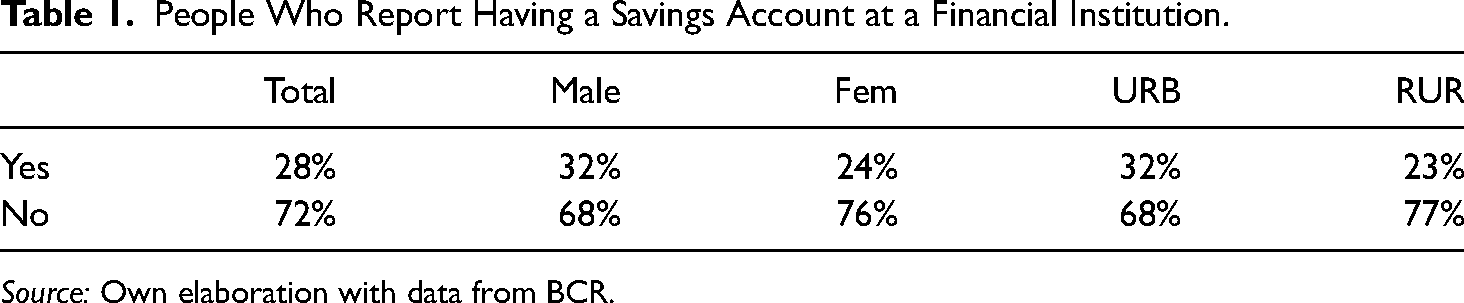
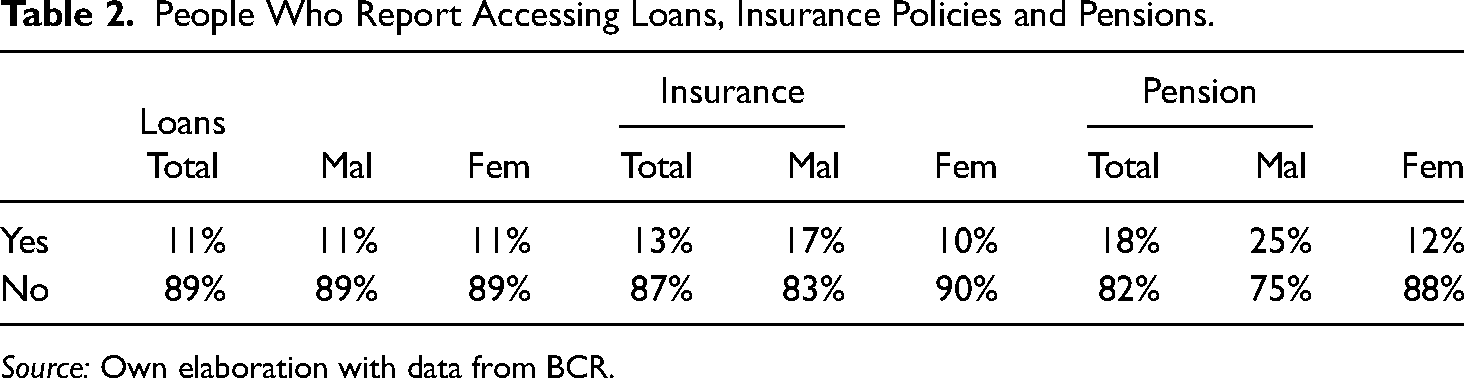
In El Salvador, cash remains at the centre of everyday financial interactions, especially for the working classes and the poor. The propensity towards cash and informal payment networks stems from the substantial portion of Salvadorans who are unbanked (Ulku and Zaourak, 2021). Salvadoran people tend to value cash as a trustworthy means of financial management and, in their perspective, cash provides immediate security, control, and a familiar comfort in an often-turbulent economy (Alvarez et al., 2022). The country's central bank (BCR, for its name in Spanish) 2022 national survey on access to and use of financial products and services by Salvadorans is clear: a mere 28 per cent of the population holds a savings account with a financial institution (see Table 1), while only a small fraction has loans (11 per cent) or insurance coverage (13 per cent) (see Table 2). Moreover, the low rates of pension savings (18 per cent) and digital money usage (14 per cent) further underscore the pervasive lack of financial engagement. Regarding savings accounts, gender and regional disparities are evident, with 76 per cent of women and 77 per cent of the rural population reporting no ownership compared to 68 per cent of men and urban dwellers (see Table 1). Access to financial services in El Salvador is considerably lacking. Approximately 75 per cent of the global population has some access to a bank account, although this average is skewed by industrialised and emerging economies. Nevertheless, the situation in El Salvador is worse in terms of access to financial services compared with equivalent economies in neighbouring countries of the northern triangle of Central America. In contrast, 44 per cent of Guatemalan adults have access to deposits accounts (Benni, 2020). In Honduras, the ratio is even greater, with 50.3 per cent (Comisión Nacional de Bancos y Seguros, 2020). Larger economies in Latin America such as Mexico and Argentina have greater access to financial services, with a penetration of 60 per cent and 90 per cent of the population respectively (BCRA, 2020; INEGI, 2021).
People Who Report Having a Savings Account at a Financial Institution.
Source: Own elaboration with data from BCR.
People Who Report Accessing Loans, Insurance Policies and Pensions.
Source: Own elaboration with data from BCR.
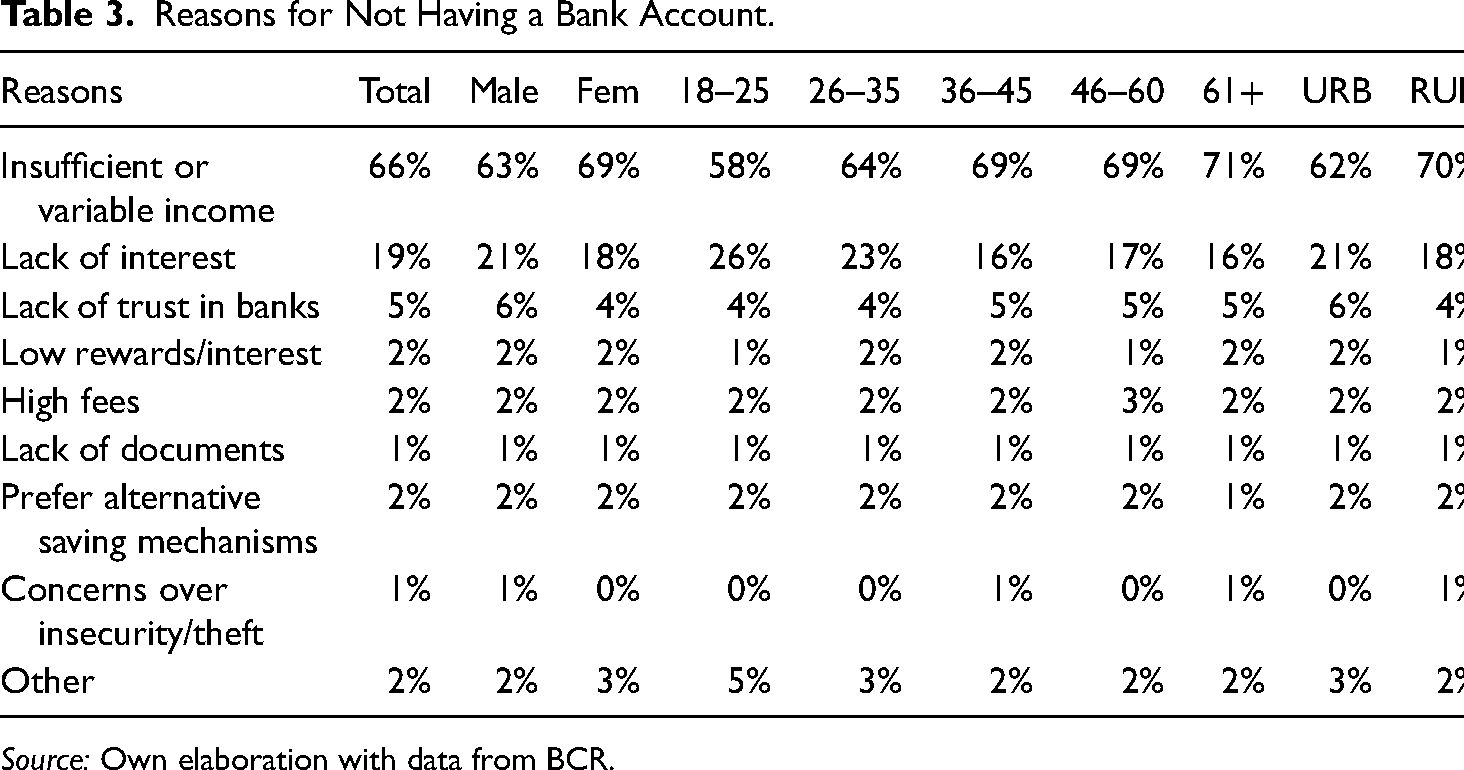
The most important barriers to saving in El Salvador include variable or insufficient income (66.3 per cent), lack of interest or need (19.3 per cent), and mistrust in banks (4.7 per cent). Age significantly affects these trends, with older Salvadorans (61 and above) being less likely to save due to inadequate income. Two thirds of respondents said that the main reason for not having an account was insufficient or variable income (66.3 per cent). In second place was lack of interest or need (19.3 per cent), and mistrust in banks (4.7 per cent) was a distant third reason, (see Table 3). These trends intensify with age, with the 61 and above age group reaching the highest percentage of 71.4 per cent attributing it to insufficient income (BCR, 2022).
Reasons for Not Having a Bank Account.
Source: Own elaboration with data from BCR.
The dependence of the Salvadoran economy on remittances is another kay factor to consider, given remittances’ significant contribution to the country's GDP. Remittances amount to approximately 25 per cent of the GDP (Herrera and Huezo, 2023). It is noteworthy that most of these remittances, which seem to be channelled into the daily cash economy rather than long-term investment or savings, come from Salvadorans residing mostly in the United States, as indicated by the BCR survey. As already mentioned, for financial inclusion policies to be equitable, reliable, and effective, they must address the needs and context of the local population. In the case of El Salvador, variable and lack of income is at the core of people's preference of cash. Other important variables refer to urban–rural divide in the penetration of financial institutions as well as gender and age inequalities.
Financial Inclusion Through Chivo Wallet
President Nayib Bukele declared bitcoin a legal tender in 2021 through an executive legislative initiative that would be quickly approved by Parliament. Bukele, along with members of his family who are part of the inner circle of decision-making within the presidency, were already owners and enthusiasts of bitcoin. They expressed interest in expanding the ongoing experiment in the coastal town of El Zonte, where a group of bitcoin evangelists had established local payment systems, and a bitcoin donation provided locals with the opportunity to use the cryptocurrency (Fieser, 2021).
The decision of the president was promoted to encourage financial inclusion and enhancing development via new technological investments. The way the bitcoin policy was operationalised was through a national wallet, Chivo, which was created with government funds. The government requested a USD$200 million credit from the Parliament to finance the project. Included in this was a USD$30 incentive that was given to every Salvadoran citizen who downloaded the app. A trust fund of USD$150 million was created to allow automatic convertibility between bitcoin and dollars by those purchasing and exchanging funds between the two. Part of these funds came from a loan granted by the Central American Bank for Economic Integration, originally purposed to help support medium and small enterprises affected by the COVID-19 pandemic (Kurylo, 2024). A portion of those funds went into setting up the technology and infrastructure for the measure, as well as funding public awareness and education about the technology. Around 200 Chivo ATMs were set up throughout the country, as well as in Salvadoran consulates in the United States and Canada. Nonetheless, journalistic reports refer to an expenditure of USD$425 million, with over half not accounted for by regular budget procedures (Sigalos, 2022).
One way to potentially measure financial inclusion through the bitcoin policy would be through the reach and use of the Chivo wallet as a financial tool. In practice, however, most Salvadorans solely downloaded the Chivo-wallet to get the $30 bonus that was used as incentive. Claudia Ortiz an opposition member of the Legislative Assembly argues: “they invested $200 million. And it failed dramatically because people used the Chivo for a very short time. They withdrew the $30, because, you know, in a country as a survivor, $30 is like the income of a week for a family” (interview with an author, 2023). Most users did not keep on using the online wallet after getting the bonus, with the biggest part of the users immediately paying for their expenses (Alvarez et al., 2022). The ATMs depict a same pattern, with only half of Chivo-users having accessed them (Alvarez et al., 2022).
Reflecting on the Chivo wallet's limited usage, several other factors contribute to this outcome of limited participation. It was plagued by malfunctions and uncertainties from the onset. The preference for cash transactions among many Salvadorans, coupled with trust issues surrounding the digital wallet, also played a significant role (Alvarez et al., 2022; Rosales et al., 2023). The hasty rollout of the Chivo app introduced many technical glitches, leading to security violations. Various fraud schemes arose, leading to theft of personal IDs, and the spread of enticing schemes promising quick, high returns in exchange for personal information also proliferated (Valencia, 2022). Furthermore, from the outset, there has been increasing doubt about the coin's convertibility to U.S. dollars. According to the company Athena, who was part of the roll out of Chivo, Salvadorans who convert bitcoin back to dollars may not be fully guaranteed their funds, but some form of stable coin tokens (SEC, 2022). According to a survey conducted by José Simeón Cañas Central American University (UCA), nearly 80 per cent of participants said they had little to no confidence in bitcoin (Instituto Universitario de Opinión Pública, 2022). Adding to these, documents from political party Nuestro Tiempo (2023) highlighted that nearly 70 per cent of participants had never transacted in bitcoin, with a considerable segment expressing mistrust in bitcoin and advocating for the end of government expenditure on it. For economist Tatiana Marroquin, it was encouraging to find out that many people do not use bitcoin. She stressed: “So people are not using it. Why? Because it is too risky. For me this is a really great decision from people. They do not understand that much about financial risks, but they understand that if they put in money there, they can lose it. And if they lose it, they probably will not have money to eat.” Despite the government's lack of transparency, something that critics say aligns with its broader authoritarian opacity, various surveys have shown this trend of low to insignificant uptake of the wallet and bitcoin. At the end of 2021, the business association think-tank FUSADES revealed a survey carried out among retail commerce. In this survey, 78 per cent of businesses said that between 0 and 5 per cent of their sales were done in bitcoin (FUSADES, 2021). But that trend continued in the business sector to the point that most report making no sales in bitcoin at all. In January 2024, the UCA published another survey that shows 88 per cent of people polled not having made any transaction in bitcoin throughout 2023 (EFE, 2024). A survey conducted by the U.S. Bureau of Labour Statistics revealed that most transactions in bitcoin happened early in the rollout of the policy, some 40 per cent of downloads of the Chivo wallet happened in September 2021, presumably for users to take advantage of the 30$ incentive. The same study shows “virtually no downloads in 2022” (Alvarez et al., 2022: 2). These figures suggest that despite the government's claims of making remittances more affordable and accessible, most Salvadorans continue to rely on traditional remittance services, with the use of cryptocurrencies for international transactions remaining limited.
Government officials emphasised the importance of offering Salvadorans an alternative, inexpensive mechanism to send remittances to families at home. Carlos Hernández, Nuevas Ideas Member of Parliament, said that migrant workers “often pay USD $12 or $13 just to send a small remittance; that made our government work to facilitate the use of a cheaper way” (interview with an author, 2022). The adoption of bitcoin for remittance is insignificant, however. Former Central Bank President Carlos Alvarado argues that “the use of bitcoin for remittances remains below 2 per cent of the total, and not for political reasons, as many in the diaspora support the president; it is simply because of practicality issues” (interview with an author, 2022). Indeed, the use of cryptocurrencies, particularly bitcoin, for remittances in El Salvador has not made a significant impact on the country's economy, according to recent data from the Central Bank. The statistics reveal that during the first two months of 2023, remittances sent via cryptocurrencies fell by 17.8 per cent compared to the same period in 2022. In total, El Salvador received $15.98 million in crypto remittances, accounting for a mere 1.34 per cent of the overall remittance amount received by the country, which exceeded $1.2 billion. In 2023, another decline brought the percentage of remittances to 1.13 per cent (La Verdad Panamá, 2024). Mario Gómez explains that the regulations imposed by the SEC in the United States for cryptocurrency transactions make the storage of legal ID mandatory to create a wallet, something that many irregular migrants would be hesitant to do for fear of deportation (interview with an author, 2022).
The State as a Vehicle of Elite-Making and Consolidation
Opposition members of parliament agreed that a major concern for them in the implementation of the bitcoin law has been the lack of transparency in the use of funds and the bypassing of regular budgetary procedures to approve public funds expenditures. The opacity with which public funds have been used in this project raises questions about the motives of behind its approval. According to President Bukele's announcements on X, the government may have purchased as much as USD $100 million or more in bitcoin (Sigalos, 2022; Valencia, 2022). In 2024, when the price of bitcoin soared once again after its “halving” the government finally released a website where the funds invested in bitcoin by the state are recorded (https://bitcoin.gob.sv/). Until then, it was not possible to verify the purchases nor was it possible to verify the volatility of the investment, raising public concern and desire for scrutiny. Anabel Belloso, Member of Parliament for the left-leaning FLMN stated in an interview that “we barely know about the apparent bitcoin purchases through Bukele's tweets (posts); we have not seen a single official confirmation of that” (interview with author, March 2023). Claudia Ortíz from VAMOS said that “the law never stipulated the government's acquisition of bitcoin, but the use of bitcoin as legal tender” (interview with author, March 2023). Indeed, the rollout of the bitcoin policy included massive purchases of bitcoin at times of a price dip, which bear the question of what strategy, if any, the government was pursuing with these investments. Even after the publication of the government's website, questions remain regarding the risk management of these investments and the legality to use international reserves to invest in a volatile asset. The government website still does not offer information about the sources of the funds that went to purchase bitcoin and, importantly, whether the central bank is the entity responsible for safeguarding those funds (Alvarado, 2024). There are questions about potential contracts made for financial intermediation, which have not been disclosed to the public. When confronted with such criticisms, Bukele often doubled down on his plans, making more purchase announcements and remarks of the country betting for a future “bullish” market and had continued to promote the “hodl” (holding on for dear life) of bitcoin long-term as a state policy (Bastardo, 2023).
The company Chivo was created by the government with state funds, and yet it is considered a private company (Alvarado, 2021a; Rauda, 2022). Its board of directors has been appointed directly by the government and it has many close associates of the president. The company has been operating as a financial institution, but it is not treated as such. Instead, it is protected by state secrecy. The strategic ambiguity – conveniently private and yet funded by public funds and managed by associates of the government – connects with a history of state-sponsored theft that usually engages the power-generation state company, CEL. The main concerns that arise from this ambiguity relate to potential channelling of public funds for the benefit of a private clique, close to the president's circle. Members of the company's board have been partners in business and political deals of Bukele's that date back to his time as Mayor of Nuevo Cuscatlán, outside of San Salvador (Alvarado, 2021b).
Critics have raised the concern that Chivo may have been used as a mechanism to divert public funds for personal embezzlement. Johnny Wright Sol emphasises how bitcoin can be turned into an opportunity for money laundering, as “a means to move money around to acquire assets without being traced back” (interview with an author, May 2022). Wright Sol explains that the governance structure of Chivo Wallet reminds Salvadorans of previous schemes of corruption in the country: “the electric sector has been a focal point of corruption in the Salvadoran state.” He argues that “after the 1990s and the neoliberal reforms and policies of privatisation of public enterprises, the electric sector was partially privatised, but power generation remains under the state control” (by Comisión Ejecutiva Hidroeléctrica del Rio Lempa, CEL). Based on this model, Chivo was created by CEL as a private enterprise, but that does not generate power. In that sense, Wright Sol argues, “this sector continues to be the cash cow of the state, after every administration. There has always been theft of public funds that originate in power generation” (interview with author, May 2022). Thus, through the Chivo Wallet, the Salvadoran government is able to use a public utility to promote private wealth (Rosales et al., 2023).
The potential use of Chivo to enrich a small group in the president's circle is not necessarily a sign of a major structural transformation in El Salvador's business elite or economy. However, it may be part of a broader historical elite shift that is empowered from the state. Traditionally, an oligarchic state where a select group of elite families controlled the country's productive capacity, El Salvador became an agro-exporter economy with the push from landowners of coffee plantations (Bull, 2019). The influence of coffee growers declined in the 1980s with the increase in remittance flows as major component of the country's revenues, which shifted the interest and capacity to capture the benefits of the increasing outsider income. This shift generated an increased imbrication of elite groups with the financial sector, the service industries and multinational corporations, which were ultimately tied politically to ARENA (Bull, 2019). Nevertheless, with the shift in power, an emerging faction of an alternative business elite recognised opportunities within the FMLN, particularly upon its ascent to power in 2009 under Mauricio Funes, and even more notably during the presidency of Salvador Sánchez Cerén (Expediente Público, 2021).
Part of this elite shift included the management of new funds coming from Venezuela's oil diplomacy known as ALBA Petróleos. In El Salvador, the Venezuelan cooperation policies began before the FMLN's arrival to power, as local mayors signed deals with the Venezuelan government to receive subsidised oil and other financial support. In turn, ALBA Petróleo became a mechanism to sift money to other companies in the food distribution business, alternative energy, urban planning, among others. According to various reports, this consortium has managed over UDS $800 million, and at the centre of the scheme is Jose Luis Merino, a political operative of the FMLN, and his brother Sigfredo Merino, who came to occupy managerial positions in companies that received ALBA Petróleo funding (Expediente Público, 2021; Lemus, 2014). During his time as mayor of Nuevo Cuscatlán, Bukele benefited from ALBA Petróleo investments. The business groups that emerged from this scheme continued to support Bukele after his break away from the FMLN. Currently, among Chivo wallet managers are members of the business groups that emerged through ALBA Petróleos funding and are political-economic operatives of Nuevas Ideas and Bukele's administration (Alvarado, 2021a, 2021b).
Assessing the question of the bitcoin law as a financial inclusion tool can lead to a simple answer: it has failed. But that answer falls short of explaining how it has included or benefited business groups that have in recent times been associated with different mechanisms of state and international cooperation financing, often through opaque or corrupt means. In addition, it leaves the apparently benevolent goal of banking the unbanked through bitcoin, rather than exploring how state funds have been channelled through a volatile investment with little to no oversight mechanism, in the context of a nascent authoritarian regime.
A Hub of Global Crypto-Bros
In addition to encouraging a domestic business coalition that would set itself as a major force in the Salvadoran elite, the bitcoin law also supports international like-minded constituents. Bukele has harnessed the narrative surrounding bitcoin – a symbol of futuristic thinking, disruption, and unparalleled innovation – to redraw El Salvador's identity on the world stage, or the idea that this policy has placed the country on the world map. This rebranding has not gone unnoticed. The goal has centred on encouraging crypto-enthusiasts as potential investors, who are welcome into the country with lax regulations and a promise of residency and citizenship with just modest investment commitments. The country thus attracted the attention of a specific demographic – the “crypto-bros” or venture capitalists linked to bitcoin fundamentalism (Howson, 2023). These cryptocurrency enthusiasts have been drawn to El Salvador's proactive bitcoin strategy, resulting in an uptick in visits from this sector. An important figure in this ecosystem, COO and executive director of El Salvador's first “neobank” N1CO, Alejandro McCormack explains in an interview that “the adoption of bitcoin in El Salvador represents much more than a financial experiment or an economic strategy. It is not about bitcoin: it is about the crypto-bros that back us up now. It is part of a broader, well-thought-out plan designed to rebrand the country's global perception” (interview with an author, March 2023). Nevertheless, foreign direct investment shrunk in El Salvador since 2018 until 2022. In 2022, it experienced negative FDI, although it has recovered moderately since then until late 2024 (BCR, 2024).
With their support for Bukele – even as he carried out arrests of thousands of potentially innocent people and managed to rig constitutional norms to secure a reelection – the influence of crypto-advocates now settling in the country is growing (Faux, 2022; Howson, 2023). These advocates have made clear that Bukele is not merely an ally to the bitcoin enthusiasts; he is one of them. His presidency reflects and amplifies the core “silicon-valley ethos” of this group and embodies the purported spirit of disruption and innovation that crypto-enthusiasts champion. According to developer and entrepreneur Samson Mow “it is just good governance from Bukele. You already see a lot of crypto businesses popping up in El Salvador; Bitfinex and my company have established a presence there as an entity” (interview with an author, March 2023).
Key crypto-enthusiasts such as Jack Mallers and Samson Mow have had significant influence in promoting bitcoin as solution to El Salvador's dwindling socio-economic conditions (Alvarado and Rauda, 2022; Rauda and Gressier, 2021). Early crypto-billionaire Jack Mallers and his firm Strike helped shape the Chivo wallet and was involved in the El Zonte experiment (Fieser, 2021). Mallers stated in an interview with McCormack that he had been instrumental in shaping the bitcoin law, by petition of one of Bukele's siblings (Alvarado and Rauda, 2022; Rauda and Gressier, 2021). On another front, Bitfinex, a cryptocurrency exchange firm once prohibited in New York due to dubious financial activities, became the first global crypto company to receive approval under El Salvador's Digital Assets Issuance law. As of April 2023, the company has received a licence granting them the legal capacity to issue bonds in the country (Bitfinex, 2023).
As per Ricardo Valencia, a former diplomat and Salvadoran scholar based in the United States, two prominent crypto investors associated with Bitfinex, Max Keiser and Stacy Herbert, have acquired significant influence within the Salvadoran government under Bukele's administration (Valencia, 2023). Keiser was a former TV host for Russia Today and, together with Herbert, has become spokespersons of the Nuevas Ideas government (Howson, 2023). The couple was appointed to lead the freshly established National Bitcoin Office, granting them broad and legal authority to design and implement bitcoin policies within the country (Valencia, 2023). They are now vested with the power to regulate the influx of crypto investors in the country and to create bitcoin embassies globally (Howson, 2023). Keiser and Herbert's participation in the Salvadoran government and their plans to introduce “volcano bonds” to facilitate the construction of a fantasy-project Bitcoin City suggest an increasingly tight relationship between the state and a small group of business interests with rather dubious connection to any real productive enterprise (Howson, 2021). Policy choices in this case are catering to financialised business interests whose main underlying asset is extremely volatile and high-energy consuming, instead of other potential developmental projects. Moreover, individuals such as Keiser and Herbert, are not officially in government positions nor are they accountable to traditional oversights and have yet been endowed with substantial influence.
Conclusions
Recent scholarship on the spread of cryptocurrencies in the global south has shown some spaces for marginalised populations to contest neoliberal norms and find potential for emancipatory politics through blockchain (Crandall and Vázquez, 2022). Nonetheless, much attention has been given to the potential oppressive implications of blockchain and cryptocurrencies in re-enacting forms of colonial dependencies and upholding imperial powers’ logics and interests (Atiles, 2022; Campbell-Verduyn and Giumelli, 2022; Crandall, 2019; Howson, 2023; Howson et al., 2024). In this case, these authors argue that blockchain and cryptocurrencies emerge not as a panacea of free markets, anonymity and networked exchanges, but rather as forms of predatory schemes designed to extract profits from the poor, and create new forms of dependency, take advantage of poor labour conditions and appropriate energy resources from run-down electric grids (Howson et al., 2024; Howson and de Vries, 2022; Rosales, 2021). These sets of scholarship have drawn connections between crisis, vulnerability and extraction with cryptocurrency expansion (Howson, 2023; Rosales et al., 2023; Vázquez, 2022).
Building on these contributions, we have narrowed our objectives to explain how bitcoin can be a tool of emerging autocracies and authoritarian governance. President Nayib Bukele is often seen as a leader with “mixed” inclinations, some forward-looking, usually drawing from policies such as the bitcoin law or his use of social media to reach his base, and others inspired by traditional autocrats’ policies of mano dura (Stefanoni, 2023b). Nevertheless, we emphasise the connection of these seemingly futuristic policies with the authoritarian nature of the regime. Originally designed to promote financial inclusion, banking the unbanked, cheapen remittances and open opportunities for development, we demonstrate that the bitcoin law has not produced the results of financial inclusion it promoted. Further, it has been implemented in a broader context of democratic backsliding, so its implementation has been tainted by opacity, while benefiting a group of associates of the president. The bitcoin law implementation undermined accountability and transparency in the use of public funds, it empowered a group of well-connected business personally tied to the president and a rising niche of unconventional international investors with obscure business goals. From its approval process, which was rushed and lacked meaningful debate, to the implementation of the law, bitcoin official adoption in El Salvador has been plagued with irregularities and failure, but it has nonetheless strengthened a small number of constituencies at home and abroad through opaque mechanisms.
While in El Salvador broad changes to security policies, governance mechanisms and judiciary procedures may be greater testament of democratic undoing than the bitcoin policy, its exploration reveals that it may not be a futuristic exception to an otherwise authoritarian unravelling. The exploration of bitcoin's potential use for authoritarian governance is, we believe, important for future analyses on the rise and expansion of new far right forces in Latin America and beyond. Bitcoin can serve as a useful tool for the embrace of libertarian and radical free market ideas but that can be tied to illiberal forms of conservatism and reactionary politics. In Latin America, future studies may explore how leaders such as Javier Milei may be able to mobilise crypto-enthusiast forces in his ostensibly libertarian agenda. The question in Argentina is important because, together with Venezuela, it is the other country in the region with most adoption of cryptocurrency solutions in the face of inflation and currency controls. The strengthening of far-right movements also in the Global North including in the United States can signal possible alliances with cryptocurrency business actors who simultaneously endorse disinformation campaigns, conspiracy theories with gendered and racialised undertones, as well as conservative militarism. The case of El Salvador, however small and remote the country is, may be a blueprint for other authoritarian leaders and practices.
Footnotes
Declaration of Conflicting Interests
The authors declared no potential conflicts of interest with respect to the research, authorship, and/or publication of this article.
Funding
The authors disclosed receipt of the following financial support for the research, authorship, and/or publication of this article: This work was supported by the Social Sciences and Humanities Research Council of Canada (Grant No. 430-2022-00402).
