




Abstract
This paper investigates the phenomenon of authoritarian nostalgia in Indonesian politics. Drawing on data from a Populi Center public opinion survey, we explore the characteristics, patterns and workings of authoritarian nostalgia. On the one hand, we find authoritarian nostalgia prevalent in the survey data and also anecdotally. Many in the public remember the New Order era fondly and have positive impressions of President Soeharto despite 32 years of military authoritarian rule. At the same time, we find that much of the nostalgia revolves around economic issues. Furthermore, our study shows that key age cohorts who lived during the New Order period have the most support for the authoritarian era. This paper also contributes to our understanding on how Indonesian people perceive and behave to their current Indonesian political development.
Keywords
Introduction
In an era of global democratic regression (Diamond, 2021), scholars have pointed to authoritarian nostalgia as a key mechanism mediating and facilitating the erosion of democratic norms and practices around the world including in Asia (Chang et al., 2007). Indonesia too has experienced democratic decline especially in the past several years and a corresponding revival of authoritarian tendencies. This paper explores whether and how authoritarian nostalgia has figured into Indonesia's democratic decline.
Though Indonesia has procedurally remained a democracy since the reformasi movement and the fall of the New Order in 1998, it is also increasingly fragile and uncertain (Slater, 2023). Elections, though mired in clientelism and patronage, are broadly seen as competitive and legitimate (V-Dem Institute, 2022), but critics have pointed to a slew of factors that indicate growing problems. Post-Soeharto presidents have tended to create super-majoritarian coalitions with limited checks on their power, leading governments to push through unpopular legislation including the criminal code and omnibus bills. Critics have also pointed to growing illiberalism such as the increasing intolerance of religious minorities, conservative Islamic mobilisation that has upended politics especially in 2016, heavy-handed government measures to quell public dissent, and increasing threats to personal liberties (Muhtadi, 2020; also Power and Warburton, 2020). Previously, there were movements to postpone the 2024 elections despite popular opposition to their delay (Kimura, 2023).
At the same time, legacies of the past authoritarian regime abound in Indonesia hinting at an acceptance and even nostalgia of the past era. For example, Golkar, the main political party that was founded by president Soeharto, continues to play a central role in the political system. The party has adapted to a new competitive era of elections but it also retains key figures from the New Order era and much of its institutional strength especially in the rural areas derives from its legacy as the only allowable party to operate at the regional level (Harjanto, 2023; Tomsa, 2008).
The military, too, continues to have a strong influence in Indonesian politics (Pepinsky, 2021; Slater, 2023). National polls have revealed the steady rise in public confidence in the TNI, Indonesia's armed forces. This tendency, which shows a persistent overall favourable attitude toward military institutions, is potentially also a strong indicator of the public's desire for a strong leader, who might have military affiliation, to lead Indonesia. It is plausible that Indonesians will eventually accept authoritarian regimes more warmly as a result of their widespread support for the military or figures associated with the military.
Notably, an ex-military commander named Prabowo, won the Indonesian presidential election in 2024. Prabowo spent most of his career in the Indonesian military, eventually rising to the position of lieutenant general in the army, before ultimately being discharged from the military in the wake of Soeharto's fall from power. He emerged in the years following as a politician establishing a new political party Gerindra and playing a major role in every national election in Indonesian since 2009.
As Aspinall notes, “Prabowo is one of the purest imaginable products of the authoritarian New Order regime (1966–98) of President Soeharto” (Aspinall, 2014). This refers both to Prabowo's close personal ties with Soeharto as well as his long and notorious career in the military. Given his background, Prabowo's rise may be interpreted not only as the public's warm acceptance of a more authoritarian administration but also a desire to return to the past.
Our main focus then is to investigate in what ways, does the fragility of Indonesia's democracy emerge from a nostalgia of the authoritarian past? Although we see both the decline in democracy as well as the rise of authoritarian nostalgia, relatively few have investigated the relationship between the two. If anything, scholars and observers have largely assumed that nostalgia feeds into the pattern of democratic regression. Meanwhile scholars of democratic regression have pointed to other features of Indonesia's political system to explain democratic decline (Aspinall et al., 2020; Schäfer, 2019; Warburton and Aspinall, 2019).
We argue that the general population appears to hold a favourable perception of the New Order era characterised by authoritarian governance. However, we distinguish between different forms of nostalgia and find that economic considerations drive authoritarian nostalgia rather than other forms. We also find publics who are nostalgic of the past are less likely to support democracy and more likely to support military leaders. We argue that this helps us to understand the current political moment where Indonesians have elected Prabowo Subianto after his third run for president.
Understanding Authoritarian Nostalgia
Authoritarian nostalgia, broadly defined, is a longing for the authoritarian past. The word nostalgia originates from the latin terms nostos and algos, literally referring to the pain one feels due to their desire to return home (Merriam Webster Dictionary). The original meaning thus connotes a geographical or spatial longing, or what we might today call homesickness. In modern use, nostalgia refers also to a temporal longing, back to a specific and idyllic time period. Authoritarian nostalgia then assumes a temporal break in the life of a nation or a community, where the political system has shifted from authoritarianism to democracy. It is a collective political memory that is painful because the past is perceived in positive and even idyllic ways.
One way to understand the emergence of authoritarian nostalgia is to explore how political leaders invoke the past to mobilise voters and supporters. For example, in his book “On Tyranny,” Snyder (2017) alerts readers to the dangerous symbols that contemporary ultra-nationalistic political personalities connect to the past and seek to emulate, such as the swastika, a neo-nazi symbol, for current political gain.
At the same time, Belmonte and Rochlitz (2017) has found that the degree of authoritarian political support depends on collective memories of a past experience with democracy, and that it can be costly for a dictator to manipulate such memories through propaganda. Publics may have alternative memories of the past which bump up against efforts to mobilise authoritarian nostalgia. In these situations, political elites might respond to the public's demand warily because it might have an impact on their chances of winning elections soon. Said differently, there can be real limits to elite mobilised authoritarian nostalgia as well.
A key question then is also what kinds of individuals are more prone to authoritarian nostalgia. Some have argued that personal characteristics and predispositions may lend voters to look back fondly on an authoritarian era and to favour anti-democratic values. Profound and long-lasting orientations or personality traits can shape how people experience and interpret their surroundings. For example, Kim finds that certain personal character traits such as emotional stability and extroversion lead to stronger tendencies to support authoritarianism and therefore authoritarian nostalgia (Kim, 2022: 120).
Others have argued that rather than personality traits, the capacity of individuals to draw connections between the lessons they have learned in the present and the experiences they have had in the past is one factor that can be used to predict how people will behave in political arenas (Gerber et al., 2010; Mondak, 2010).
Tyler et al. (1989) finds that personal interactions with government institutions influence perceptions regarding the government as a whole. Specifically, past authoritarian exposure may have significant impact on political favourability towards authoritarian figures when they have been socialised by undemocratic values when they are young. Exposure to non-democratic regimes during formative years, for example, may permanently erode democratic values (Matías and Mou, 2018). Conversely, support for authoritarians may not be forthcoming when the voters do not have direct experience with authoritarian regimes in their past. Many citizens may have been born after the authoritarian era ended which may shape their views of the past different from those who did.
Another way to approach our understanding of authoritarian nostalgia centres on the question of what publics are nostalgic about. Scholars investigating this question have pointed to a number of different factors.
One type of nostalgia may be a longing for a particular leader. Often authoritarian leaders have a personalistic style of leadership, are charismatic, and even develop a cult of personality. Those who long for the past may look for characteristics that are associated with the particular leader such as “kindness” or “strength.” Mulunda argues that in the Congo for example, the former dictator is depicted as “a larger-than-life figure, framing him in almost superhuman terms, transcending the role of political leader and entering the realm of myth” (Mulunda, 2022).
Another component of nostalgia may centre around an economic past. In South Korea for example, the authoritarian period was also an era of robust economic growth and modernisation. Millions of people experienced a growth in income, more economic opportunity, and an improved standard of living and attribute much of that to the policies of Park Chung Hee, the repressive autocrat who ruled from 1962 to 1979 (Kang, 2016).
A third and related area of nostalgia may revolve around political and social stability. In the transition to democracy, countries go through the process of democratisation which can often lead to social and political disruptions including the rise of ethnic and/or religious tensions and violence, elite level conflicts, and increases in mass mobilisation all of which may have been suppressed or repressed during an authoritarian era. Many new democracies are thus inherently fragile and some groups may pine for a more certain and stable past.
In many countries, military institutions garner a great deal of trust from the public, suggesting that people in many post-authoritarian societies still have a predisposition to follow political authority that instills law and order. This kind of public trust towards military institutions may increase especially as former military figures engage in politics, especially through the democratic system to gain public office (Angerbrandt and Themnér, 2021). Conversely, there is also declining faith among publics in institutions that make up the justice system including the police and the judicial system which form the underpinnings of institutional legitimacy (LaFree, 1998) and procedural justice frameworks (Tyler, 2004), also leading publics to be more nostalgic of the past as well.
These varieties of nostalgias suggest that publics may have a more nuanced view of authoritarianism and democracy, even if they have nostalgic views of past authoritarian leaders. In fact, the public may be nostalgic of the past despite authoritarian tendencies rather than because of them.
Based on the discussion above, we propose three hypotheses about authoritarian nostalgia in Indonesia:
The rest of this paper is organised into four sections. First we explore the manifestations and patterns of authoritarian nostalgia. Second, we explore what form authoritarian nostalgia takes. We then employ statistical testing to explore relationships between authoritarian nostalgia and support for military leadership and support for democracy. Finally, we explore specifically the case of Prabowo Subianto to further investigate the effectiveness of authoritarian nostalgia. Finally, we conclude with some observations and discussion about the nature of authoritarian nostalgia in Indonesia.
Methodology
Methodologically, one question that arises is how to identify and operationalise authoritarian nostalgia in practice. One approach has been to assume support for authoritarianism by definition as a form of authoritarian nostalgia. An article in the Journal of Democracy boldly titled Authoritarian Nostalgia in Asia mentions the word nostalgia only twice in the entire text and says almost nothing about voters' preferences for the past (see Chang et al., 2007: 72). Instead, the authors assume that support for authoritarianism in the present is a proxy of authoritarian nostalgia. But an appeal to authoritarianism or a drift away from preferences for democracy in and of itself may not indicate signs of nostalgia. Therefore, while evidence and patterns of support, especially increased support of authoritarianism may indicate signs of authoritarian nostalgia, we also consider other ways to show the presence and effects of authoritarian nostalgia.
We conduct a three-step analysis to support our claims, mostly using data from the Populi Center's General Survey conducted from 9 October to 17 October 2022. In order to obtain the data, face-to-face interviews were carried out using the survey application in 464 urban areas and 736 rural areas spread across thirty-four provinces in Indonesia. There are 1,200 respondents in the sample, and they were randomly selected at each stage of regional clusters using multistage random sampling.
The first step of analysis begins with the coder carefully classifying survey data collected from the field using an open-ended question about the New Order era and Soeharto into positive, negative, and neutral categories. 1 The use of open-ended questions allows us to better understand the public's association with and perception of nostalgia for the New Order and Soeharto. The data can be organised categorically to enable additional statistical testing by categorising the nostalgic data.
The second step of analysis involves statistical testing. We conduct two kinds of statistical analyses. First, we observe the statistical association between variables connected to nostalgia (positive view of New Order and Suharto) and age groups. Our dependent variables are positive views (for both New Order and Suharto) coded as 1, otherwise is coded as 0. The age group is categorised into Pre-Baby Boomers, Baby-Boomer, Gen-X, Millennials, and Gen-Z. Our main purpose here is to analyse inter-generational perceptions of both New Order and Suharto. It will test the first hypothesis that those who experienced living under New Order are more likely to have positive view of the New Order.
Second, we conduct regression analyses observing the relationship between authoritarian nostalgia (operationalised as having positive view of New Order) and democratic support. Here, we operationalise democratic support with two proxies. First, we asked respondent to what extent they agree or disagree that democracy is the best form of governance in the country. We assign the value of 1 if respondent agrees or agrees strongly that democracy is the best form of governance in the country and 0 otherwise.
Finally, we asked the respondent which kinds of candidate they would support in the general election. We code the value of 1 if the respondent would vote for candidate with military background and 0 otherwise. We run logistic regression estimation for all these models and clustered the standard errors at provincial level to avoid bias in standard errors due to intercorrelation across observations within each province. We include other demographic controls in all the analyses to tackle potential spurious relationships.
Is There Authoritarian Nostalgia in Indonesia?
As a way to assess the presence of authoritarian nostalgia in Indonesia we began our survey by asking respondents to assess Indonesia's presidents. As shown below, Soeharto ranked on par and/or higher than other Indonesian presidents. When people were asked about their assessment of the Indonesian Presidents, people gave the highest assessment to Susilo Bambang Yudhoyono with accumulated good/success from scale 6–10 of 82.3 per cent. The second highest rating is Soeharto with 79.6 per cent, then Joko Widodo (79.4 per cent), B.J. Habibie (78.5 per cent), Soekarno (78.4 per cent), Abdurrahman Wahid (75.8 per cent), and Megawati Soekarnoputri (61.8 per cent). On a 1–10 mean scale, Soeharto ranks second only to former president Sukarno (Table 1).
Assessing the Indonesian Presidents.
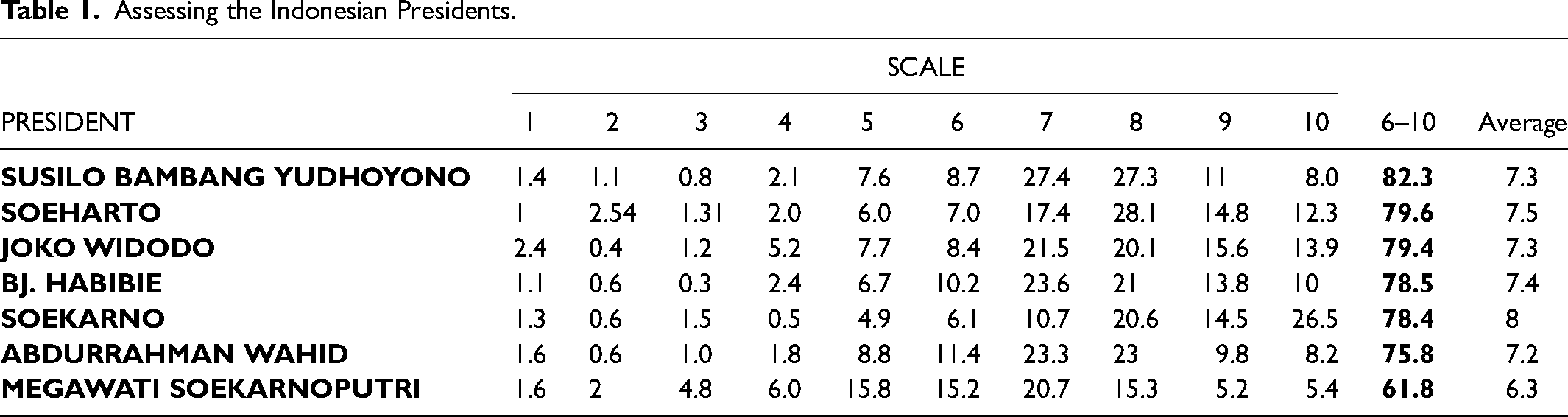
This popularity of Soeharto is in many ways remarkable for a president who was ousted from power in 1998 after massive street demonstrations protesting his rule. And while this poll is a snapshot in 2022, it is consistent with the broader pattern of efforts to rehabilitate Soeharto's image and capitalise on his legacy since his fall from office and after his death.
For example, the vendors at the markets on Jalan Malioboro in Yogyakarta and elsewhere have sold t-shirts with the former president Soeharto emblazoned on them. Stickers and decals with the photos of the former strongman have also sold well and appear on cars and trucks (The Jakarta Post, 2014). A common motif on these Soeharto paraphernalia include a photo of the smiling general, the former president, with the quote “Piye kabare, penak jamanku to (How are you doing, my era was better, no?).” In the digital age, these images have in turn jumped to and spread around social media in the form of popular and viral memes.
When businessman turned politician Abu Rizal Bakrie (Ical) ran for president under the mantle of Golkar in 2014, he pointed specifically to the Soeharto t-shirts as well as various stickers and other campaign merchandises as evidence that voters were nostalgic for the New Order and that therefore Golkar should embrace its record under Soeharto (The Jakarta Post, 2014). In 2017, on the anniversary of the celebration of Supersemar, candidates for governor and deputy governor of Jakarta visited Masjid At-Tin in East Jakarta, a mosque that Soeharto built in memory of his wife. This was clearly a kind of homage paid to Soeharto in exchange for political support (Vann, 2019).
In the same presidential election cycle of 2014 Soeharto's children also tested their political viability in Indonesia's Legislative election in 2014. Before the 2014 general election, a sizable billboard depicting Siti Hediati Hariyadi, Soeharto's fourth child, alias Titiek Soeharto's face, her father's photo, and the Golkar Party insignia was put up near the Giwangan junction in Yogyakarta (Hutabarat, 2018). The billboard was intended to raise Golkar's profile in the Yogyakarta region ahead of the 2014 general election. It was also seen as an attempt to capitalise on the popularity of Titiek Soeharto, who had been a long-time member of Golkar.
She also ran an effective media campaign, utilising slogans such as “Princess Ngayogyakarta,” “Putrine Pak Harto,” and “Pak Harto OKAY! Miss Titiek YES!” to gain more attention (Hutabarat, 2018). She was able to connect with the people of Yogyakarta on an emotional level, as the locals had a fondness for Soeharto and the New Order. Additionally, she made sure to visit different regions of Yogyakarta to spread her message and gain more support. Her hard work and her father's legacy paid off, as she was able to secure her seat in the parliament (Hutabarat, 2018). Ultimately, Titiek's success in the election was attributed to her father's political legacy and her own efforts.
Aside from elections, there have been broader indications of Suharto's rehabilitation. In Yogyakarta in the Kemusuk Hamlet of Bantul Regency, a museum was opened in 2013 entitled “Museum HM Soeharto.” The museum features a collection of historical artefacts related to Soeharto's life and times, such as photos, documents, and other pieces of memorabilia. The museum also features an educational section where visitors, especially school groups, may learn more about Soeharto's life and achievements. There are interactive activities as well, including a 3D model of Soeharto's childhood house and an interactive timeline of his life. The museum is unsurprisingly funded by Soehartos’ family members and celebrates Soeharto in what one scholar calls “an unproblematic general and president who knew and did what was best for the nation (Fuller, 2013).”
This perspective is also consistent with Bourchier's notion of Indonesia as an organicist “family state.” In this conception of the state, liberalism and individualism are cast aside and there is an emphasis on harmony and bounded by custom and tradition (Bourchier, 2015: 5). The New Order State is conceived of as a larger family or village, and Soeharto was the benevolent father figure (Bourchier, 2015: 2). This benevolence of a father figure is what is on display in the Soeharto museum.
Also, in 2018, on the 10th anniversary of Soeharto's death, thousands of people also made the pilgrimage to Astana Giribangun, Soeharto's tomb complex, also in Central Java (Sodiq, 2018). Caretakers at the mausoleum noted the rise in visitors since the early years after his fall, when the family complex was temporarily closed for safety. Since then, they cite rising average daily visits of 300 visitors and thousands of visitors on holidays and anniversaries.
The evidence above suggests that there is nostalgia for president Suharto which indicates? a manifestation and proxy for New Order nostalgia as well. We have focused on Soeharto initially because within the society, it is the most sell-able and therefore visible way to reference the past. But as we continued our investigation, we seek to evaluate the relationship between memories of Soeharto and memories of the New Order more empirically by asking the question: what are people nostalgic about and who tends to have stronger feelings of nostalgia?
What are they Nostalgic About?
In order to dig deeper into the question of how the public perceives Soeharto, we also posed a completely open-ended question in our survey asking Indonesians how they regard Soeharto and the New Order. In one question, we asked respondents what comes into their mind when they hear the word “The New Order?” 20.5 per cent of respondents answered “Soeharto,” followed by “authoritarian” (8.2 per cent), “affordable price” (7 per cent), “prosperous life” (6.5 per cent), and “reformasi” (4.7 per cent). All other answers received percentages below 4 per cent. When sorted roughly into different categories, we found that answers ranged from broadly positive assessments (22.5 per cent), neutral or uncertain assessments (21.6 per cent), and negative assessments (21.8 per cent) (Figure 1).
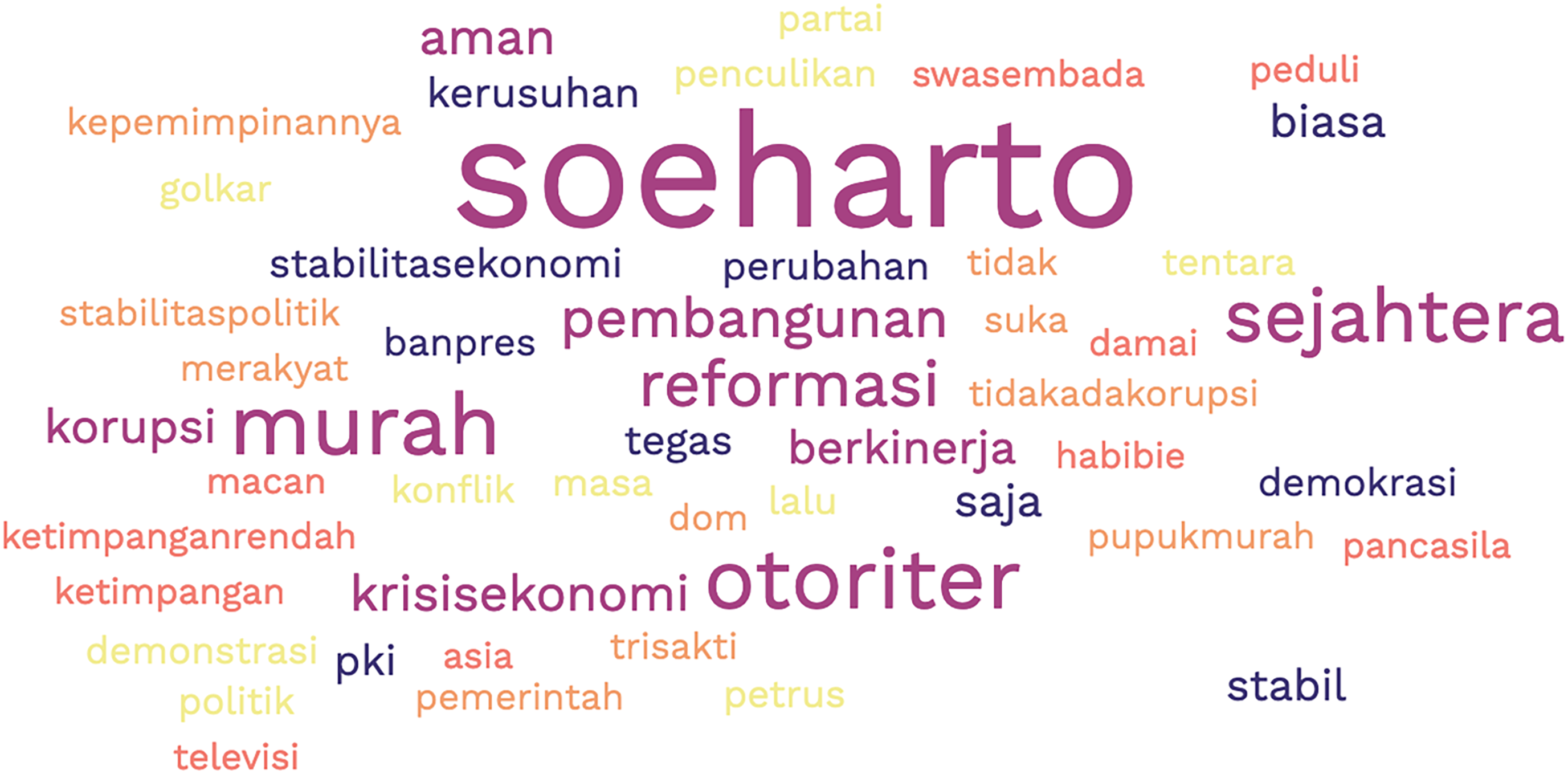
Word Association about New Order Era.
We also asked with open-ended questions what respondents think of when they hear the words “President Soeharto.” In this case, 9.8 per cent replied firm/assertive, followed by authoritarian (9.3 per cent), prosperous life (7.1 per cent), good performance (6.3 per cent), affordable prices (4.8 per cent), former president (4.7 per cent), and kind (4.2 per cent). The other answers received less than 4 per cent. Categorised roughly, most answers tend to have a positive tone (44.4 per cent) or neutral tone (Figure 2).
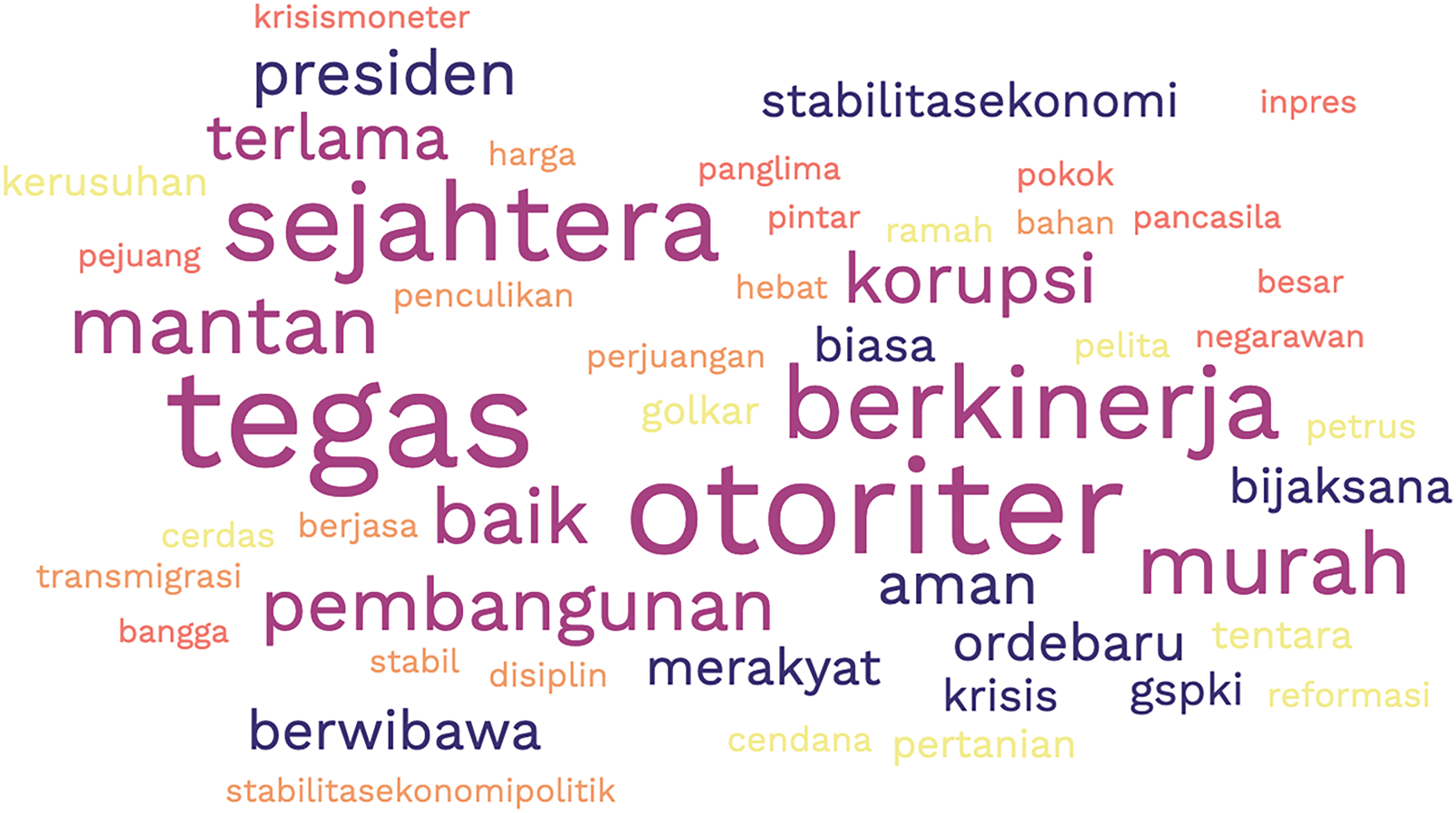
Word Association about Former President Soeharto.
The open-ended questions asked respondents unprompted and offered a number of insights. First, although Suharto is often portrayed as the “smiling general” and anecdotal evidence highlights how his image is meant to portray a gentle, fatherly figure of the nation, these do not emerge in the responses in the survey. A small sliver of respondents associated Suharto with the term “kind” or “great” but these were much smaller than other associations and responses. The responses suggest relatively limited evidence of a “cult-of-personality” or charismatic nostalgia for Soeharto and the New Order regime.
To the extent that respondents have positive impressions of the New Order and of Soeharto, they revolve around economic aspects. For example, in responses to both Soeharto and the New Order era, respondents associate them with terms such as “prosperous life,” “good performance,” “development,” or “affordable price.” These suggest that respondents value the policies and resulting growth that emerged during the New Order era, which historically saw a broad rise in the standard of living from the 1960s to the 1990s.
Finally, we also find that respondents associate Suharto and the New Order with a strong-handed regime. Respondents clearly associate the New Order with Soeharto and both with authoritarianism using the exact term (otoriter) in their associations. Respondents also invoked words such as “firm” or “assertive” in their reply. This supports the idea that people associate stability/order with the New Order though whether these are viewed nostalgically or not cannot be determined from this set of questions.
We asked a further set of questions specifically around positive perceptions of the New Order. When the public was asked whether they knew/had heard of some crucial issues during the New Order, 52.7 per cent answered that they knew/had heard that the prices of basic commodities during the New Order were more affordable, followed by Indonesia as Asian tiger country in the past (44.7 per cent), political figures during the New Order government were more charismatic than current political figures (36.1 per cent), the political situation was more stable during the New Order government (35.7 per cent), political parties were limited in number during the New Order government (34 per cent), and the army should participate in public affairs, including in political affairs (29.6 per cent).
When people who know/have heard of several important issues during the New Order period were asked further on a scale of 1–10, 1 referring to strongly disagree and 10 strongly agree with the statements on crucial issues during the New Order, the highest issue with great percentage of agree is Indonesia as an Asian tiger country in the past (87.8 per cent), followed by the prices of basic commodities that were more affordable (85.2 per cent), then political figures in the New Order government were more charismatic than the current one (83.3 per cent), stability of political situation (83.9 per cent), limitation of the number of political parties (66.8 per cent), and the acceptance of army member participate in politics (67.5 per cent). The remaining numbers fall into the category of not knowing/no answer.
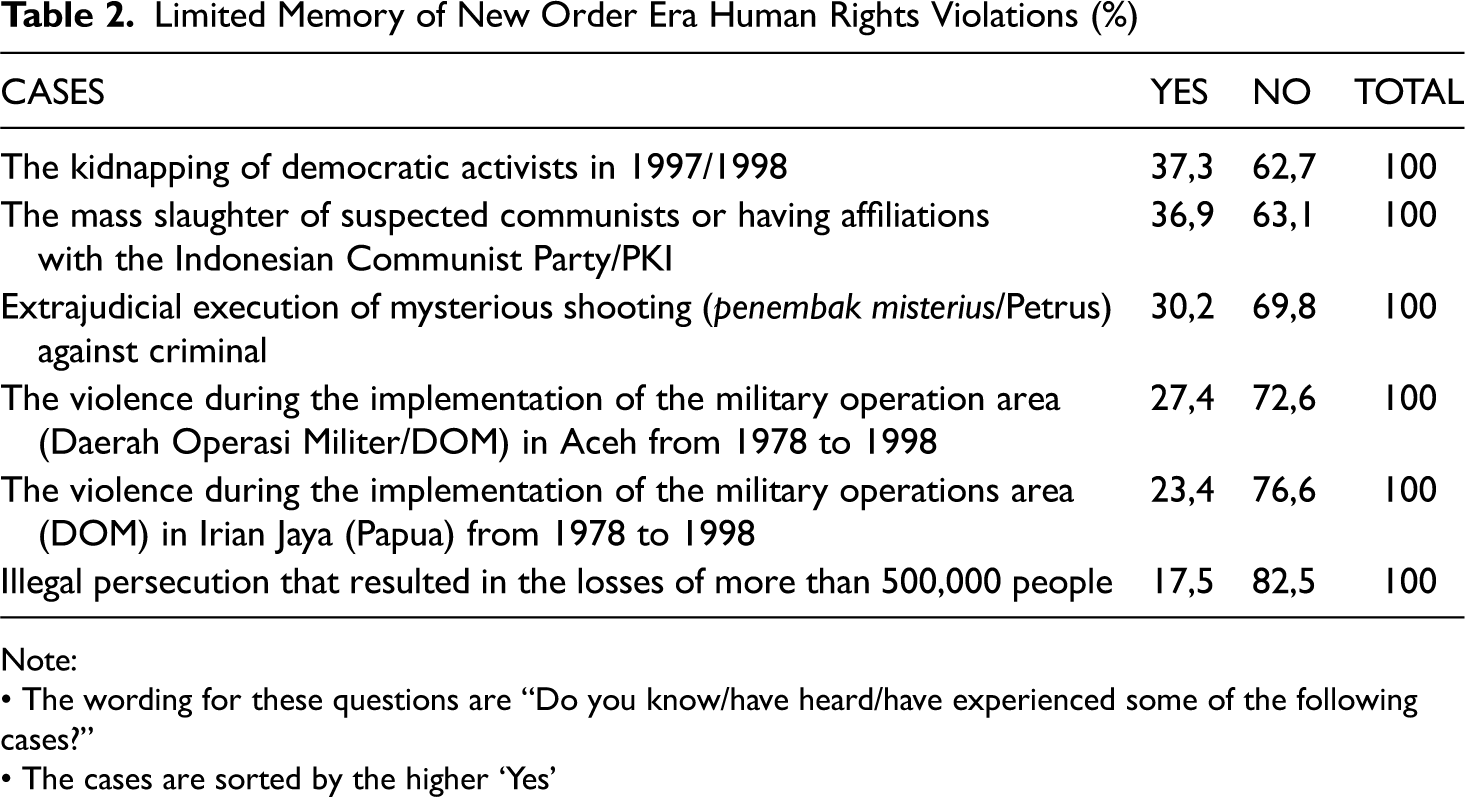
At the same time, we also see evidence of what we call authoritarian amnesia rather than nostalgia. Many respondents indicate limited awareness of or experience with issues around human rights or related kinds of events during the New Order era. Only 37.3 per cent of respondents said that they were aware of the kidnapping of democratic activists in 1997/1998 and that was the highest of all incidents posed in the questions. The killings of PKI (36.9), the shooting of criminals (Petrus) (30.2), violence in Aceh and Papua (27.4 and 23.4), and issues of forced disappearance and mass incarceration (17.5) all ranked lower (Table 2).
Limited Memory of New Order Era Human Rights Violations (%)
Note:
• The wording for these questions are “Do you know/have heard/have experienced some of the following cases?”
• The cases are sorted by the higher ‘Yes’
In sum, we find limited evidence of a nostalgia of “cult-of-personality” that is common in some other post-authoritarian states. Instead we find strong evidence in this section that respondents are most nostalgic about the New Order's economic past. Given the country's tremendous growth during the 1970s through 1990s? this association makes sense. Respondents also acknowledge the leadership of the era as “firm” or “strong.” At the same time, we find that respondents tend not to remember issues of human rights violations. This suggests then that authoritarian nostalgia and authoritarian amnesia are not necessarily mutually exclusive, but rather reinforcing views of the past.
Who has Authoritarian Nostalgia?
Another key finding in our survey is that there is age variation in the general public's perception of the New Order era. Publics who lived in the New Order Era have a significantly more positive perception of the New Order past than others. Those classified as Gen Xs (aged 42 to 57) and Baby Boomers (aged 58 to 76) as well as Millennials (aged 26–41) had favourable attitudes about the New Order past. Each relationship is significant and positive at .001 and .016, and .038, with a 95 per cent confidence level. These findings indicate that older generations have some form of positive nostalgia for a period they have previously experienced. This can be seen in the left panel of Figure 3. This finding seems to support our first hypothesis that those who have experienced living under New Order are more likely to have more positive view of the New Order regime compared to those who have not.
A slightly different pattern is found when we observe intergenerational perceptions of Suharto. Respondents from all categories of age tend to have a more positive view of Suharto regardless of whether or not they ever lived under Suharto rule. Though Gen X, Millennials, and Baby Boomers still contribute larger proportions to this positive view of Suharto, most Gen Z respondents also have a more favourable view of Suharto. Thus, though they have never lived under Suharto, they still view Suharto positively. The right panel of Figure 1 summarises the intergenerational views of Suharto. This pattern is further elaborated from our first statistical test below.
While Figure 3 above graphically shows the perceptions of New Order regime and Suharto across generations, we might suspect that the pattern might be spurious. Therefore, it is important that we verify our hypothesis by running logistic regression model that enable us to control for some confounders that can bias our conclusion. Our regression analysis as shown in Table 3 shows that the Millennials, Gen X, and Baby Boomers have significantly more favourable views of the New Order while only Gen X and Baby boomers have more positive views of Suharto. To be sure, these generations also experienced the New Order era in different ways. Some people, notably the Millennials and Gen X generation, lived through the New Order era when they were still young. The Baby Boomers, a different group of people, experienced the New Order era as adults. Nonetheless, all had a favourable opinion of the New Order era and Suharto. Thus, the result supports our first hypothesis that those who lived under the New Order have more nostalgia than those that did not live under the New Order.
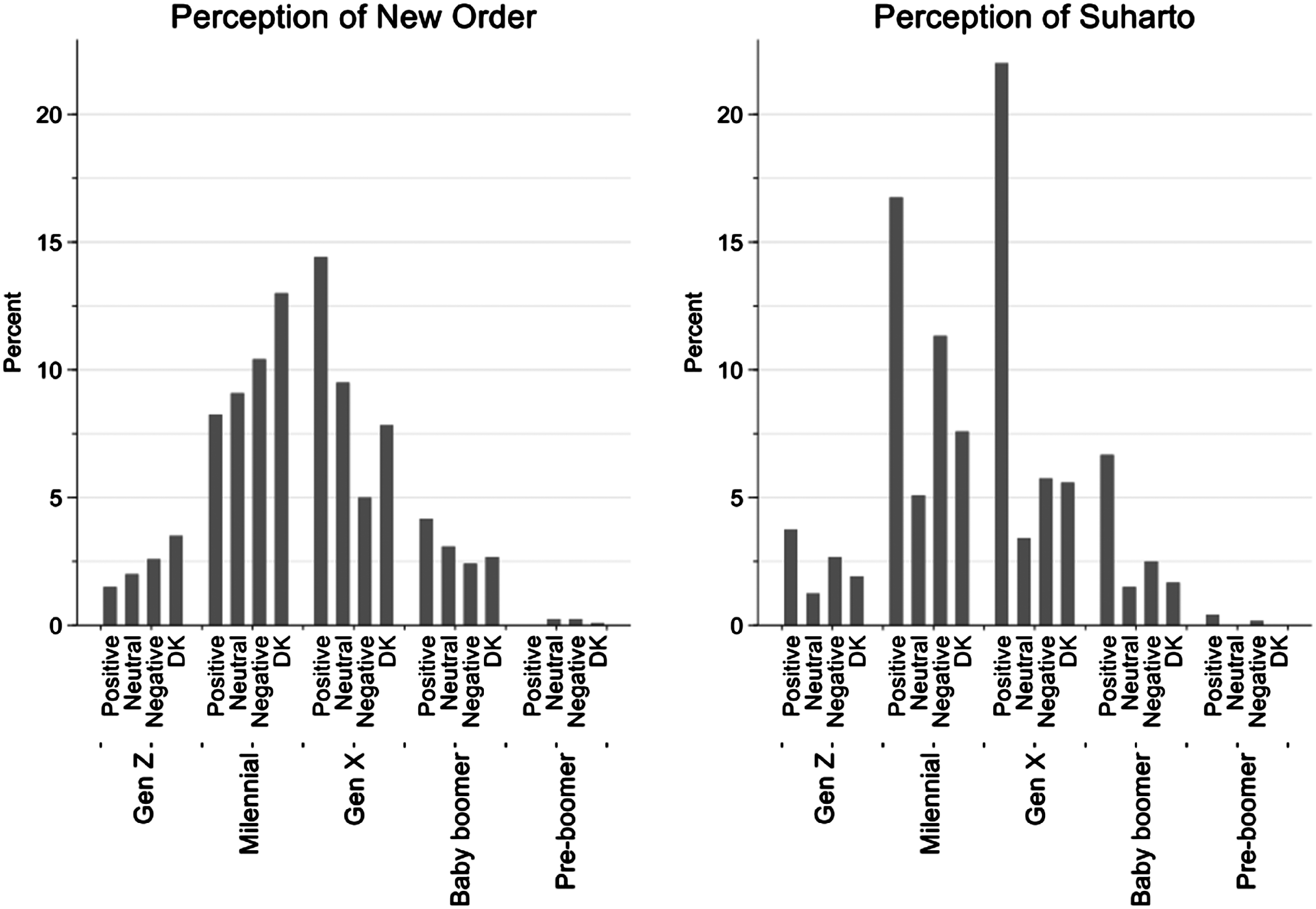
Perceptions About New Order and Suharto Across Generations.
Intergenerational Perception of New Order and Suharto.
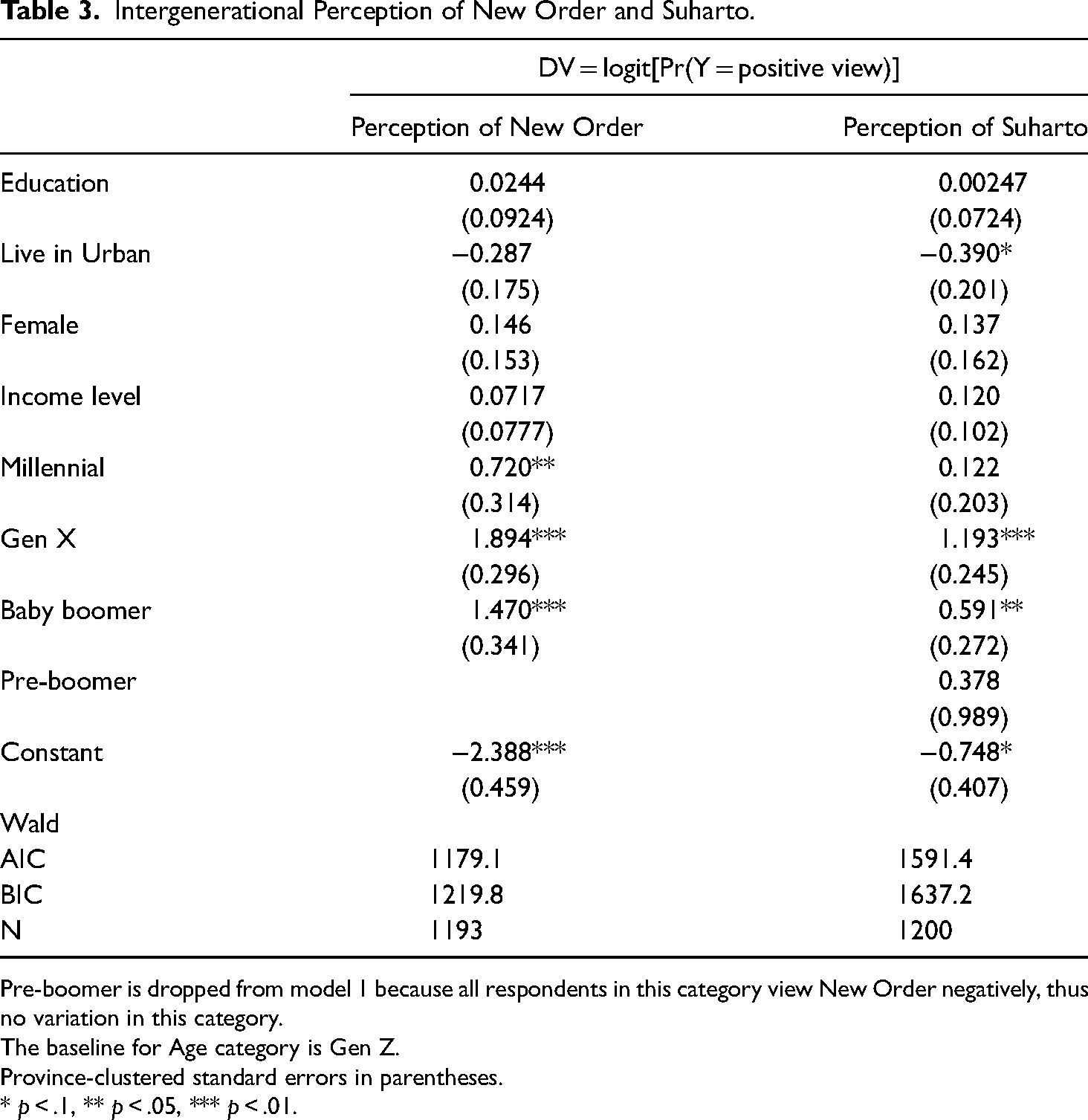
Pre-boomer is dropped from model 1 because all respondents in this category view New Order negatively, thus no variation in this category.
The baseline for Age category is Gen Z.
Province-clustered standard errors in parentheses.
* p < .1, ** p < .05, *** p < .01.
This is consistent with cases elsewhere such as Korea, where older citizens in the country tend to have a stronger and more positive association with Park Chung Hee, the former authoritarian president. The origins of this positive association comes from two potential sources: socialisation from the past, and dissatisfaction of the present (Kang, 2016). As we have suggested above, older generations will have experienced economic growth and development under the past regime, which may seem retrospectively more impressive than the current economic situation. In addition, those who experienced the New Order directly ostensibly lived and absorbed its ideology and were socialised to have a positive association of the regime while those who did not live or grow up during the regime had no such association.
To that end, our findings are also consistent with the idea that the prevalent sentiment is that the New Order Era had substantial economic successes. “Piye kabare, isih penak jamanku to?” the aforementioned Javanese slogan associates Soeharto's era as a robust economic growth period and is reminiscent of this type of nostalgia that many today may use to counteract their displeasure with the current political and economic situation.
What are the Effects of Authoritarian Nostalgia?
Having explored the presence of authoritarian nostalgia, its characteristics, and question of who in particular has authoritarian nostalgia, we turn to the question of the relationship between authoritarian nostalgia and people's attitudes towards democracy as well as military leaders.
Given that we have found that age and in particular, experience with living under the New Order seems to be correlated with positive and nostalgic views of the New Order and Suharto, we then explore another proxy for gauging nostalgia, namely, the support of democracy in the current era. We have hypothesised that those who have nostalgic views of the past will then be the ones that will be most critical of democracy in the present. As a result, our test attempts to capture the link between nostalgic view of the past – operationalised here by the positive view of New Order – and support for democracy.
There are two proxy variables we use to represent our idea of support for democracy. First is the direct measure of respondent's support for democracy. We do not define democracy for the respondent. Instead, we ask the respondent to what extent they agree or disagree with the statement: “democracy is the best form of governance for our country.” Here we expect that those who are nostalgic about the past authoritarian rule, in contrast to newer generations, are less likely to agree that democracy is the best form of governance.
The second proxy that we use to represent support/not support for democracy is whether respondents tend to vote for a candidate with military background. This variable is coded dichotomously where 1 is assigned if respondents voted for a candidate with military background and 0 otherwise. Our assumption in using this proxy is that those who are nostalgic of the authoritarian past are also longing for strong leadership and only those from military background have this leadership style. Though leaders from military background do not necessarily govern undemocratically (e.g. President SBY), people generally expect them to be a strong leader who can focus on stability and the strength of the country rather than individual liberty.
As Table 4 shows, the democratic support model (1) shows that those who view New Order positively are less likely to support democracy. This finding is consistent with the military support model (2) that those feeling nostalgic of the past (positive view of New Order) are more likely to vote for a candidate with military background. These results confirm our hypothesis that those feeling nostalgic of the past tend to have less favourable views of democracy.
Authoritarian Nostalgia and Support for Democracy.
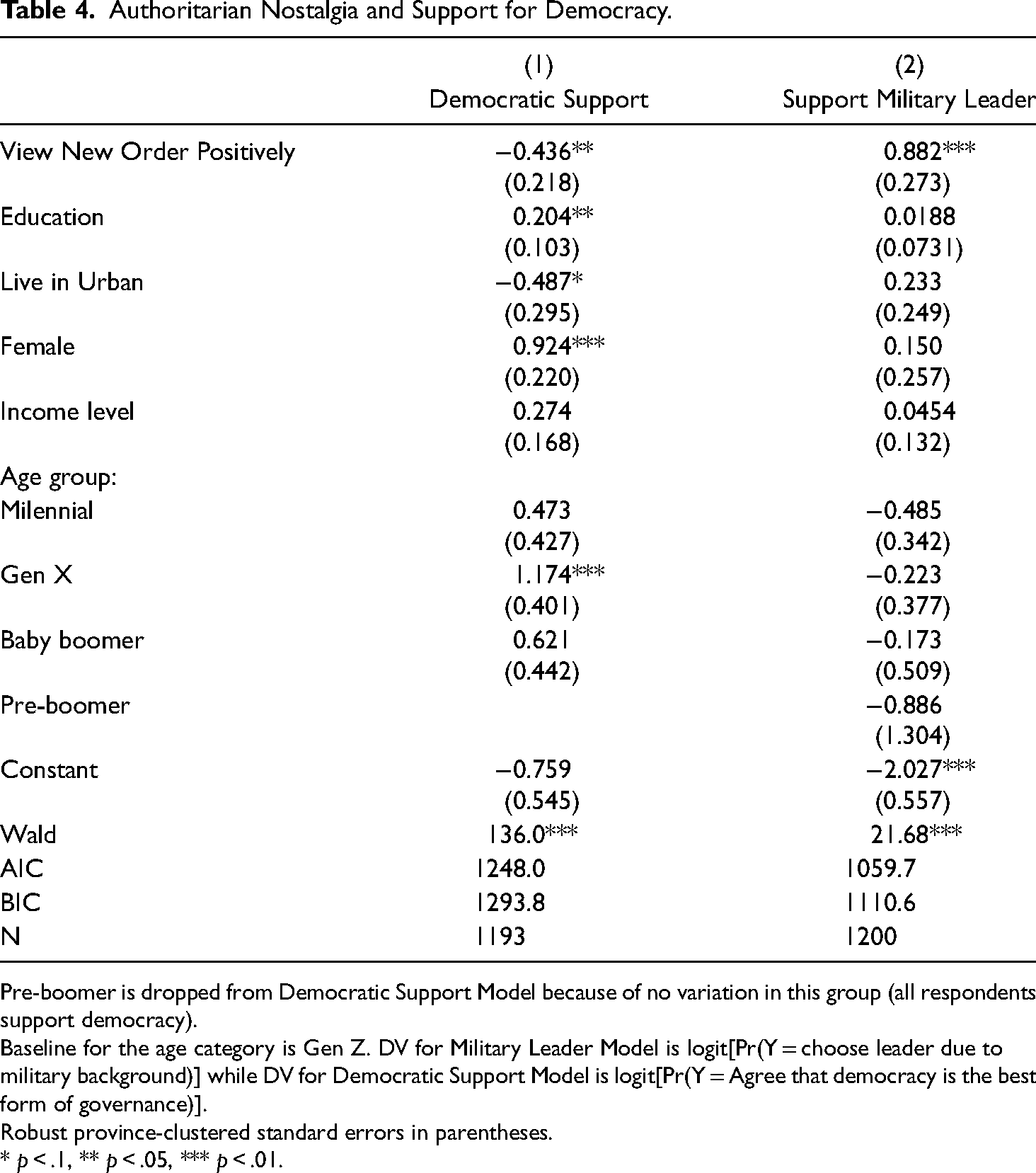
Pre-boomer is dropped from Democratic Support Model because of no variation in this group (all respondents support democracy).
Baseline for the age category is Gen Z. DV for Military Leader Model is logit[Pr(Y = choose leader due to military background)] while DV for Democratic Support Model is logit[Pr(Y = Agree that democracy is the best form of governance)].
Robust province-clustered standard errors in parentheses.
* p < .1, ** p < .05, *** p < .01.
Testing the various impacts of nostalgia on three proxies of authoritarian regimes – positive perception to New Order Era and Soeharto; and ambiguous or no support for democracy and favourable view on military figure indicates that the nostalgia for the New Order and Suharto has real implications for attitudes towards Indonesia's politics. The hypotheses that we outlined at the outset of the paper are confirmed and suggest that at least for those who support the New Order era, issues of economic well-being and political stability are important factors to consider and may lend support to military figures and lead to ambivalence or even aversion towards democracy.
Voting and Authoritarian Nostalgia
A final way to explore the effects of authoritarian nostalgia is to return to the recent election of Prabowo Subianto raised at the outset: Does Prabowo's victory illustrate the rise of authoritarian nostalgia in Indonesia? This answer, combined with the evidence above requires nuance. If nostalgia for the New Order and Soeharto broadly conceived could explain Prabowo's victory, then the question is why it took him three different campaigns to finally win. We investigate this question here.
We have already noted that for many observers and many critics of Prabowo his ascension in politics is considered a return to the New Order. He spent most of his professional military career in the elite military units, the Special Forces Command (Komando Pasukan Khusus, Kopassus) and the Army Strategic Reserve Command (Komando Cadangan Strategis Angkatan Darat, Kostrad). There he participated in various special operations and counter-insurgency campaigns including in East Timor, where accusations of mass human rights violations followed him (van Klinken, 2014). In 1995 he was appointed the commander of Kopassus and in the waning days of the Soeharto administration, he and his units have been accused of being centrally involved in some of the key violent events such as the shootings of students at Trisakti, the kidnapping of student activists and the riots in Jakarta in 1998 (McBeth, 2013).
After the fall of the New Order, Prabowo was able to mobilise a political machinery via the creation of The Great Indonesia Movement or Gerindra that has enabled his party to get votes in elections, seats in the legislature, and positions in the president's cabinets (BBC.com, 2023). Within Gerindra, he formed a paramilitary force, the Garda Merah Putih or Red and White Guards, composed of cadres and his loyalists. The founding of the Garda Merah Putih not only helped Prabowo consolidate his position within Gerindra, but it also allowed him to project his military image outside of the party and has allowed him to maintain a significant presence in Indonesian politics (Ng, 2021).
In his first presidential campaign for president, Prabowo doubled down on this image and campaigned as a nationalist strongman. He emphasised his military background and projected an image of a strong decisive leader. Through his party's manifesto and in various speeches, he criticised the constitutional reforms passed in 2002, and called for a return to Indonesia's 1945 Constitution, in which among other things, the president is chosen by the MPR, People's Constitutive Assembly (Butt, 2014). The 1945 Constitution gives a great deal of power to the president and one that Sukarno and Soeharto used to great effect. He also advocated eliminating the direct election of local and regional heads of government preferring that they be appointed positions rather than elected positions (Aspinall and Mietzner, 2014).
One of the lasting iconic images of that campaign was Prabowo riding a horse flanked by two other riders reviewing his “troops” at a campaign rally in the massive outdoor stadium in Jakarta. But the campaign issues and concerns also emerged in the media about his military and human rights record that he continually and angrily dismissed.
In his second campaign in 2019, Prabowo emphasised much less his military background or strongman image. Instead, his campaign made concerted efforts to draw conservative Muslim groups into his camp by projecting himself also as a champion of Islamic values and interests. He used religious rhetoric in his campaign, emphasised his commitment to protecting the rights of Muslims in Indonesia, and aligned himself with influential Islamic figures to mobilise those religious voters.
In the 2024 campaign, Prabowo softened his image yet again, this time through a social media campaign that highlighted his “gemoy” or cute and jovial nature. This approach complete with signature dance moves, employed particularly on Tik Tok appealed to Gen Z voters and proved to be a massive boon for Prabowo's electoral support. This generation, born largely after 1998 had little exposure to the issues around reformasi and specifically the allegations Prabowo faced during that time period.
Prabowo also strategically positioned himself as the heir to the popular Jokowi administration, which has been popular in no small part due to the president's economic developmentalist policies. Prabowo selected President Jokowi's son, Rakabuming Raka as his vice-president and thereby secured Jokowi's endorsement and his voters. The implied message of the campaign was that Prabowo would carry on with the pet projects of Jokowi such as nickel mining and the construction of Nusantara, a new capital for the country. Prabowo also campaigned on populist promises such as a national plan to distribute free school lunches, increase village funds, and offer direct cash assistance to the poor.
In sum, Prabowo's careful cultivation of his image enabled him to negotiate the dynamic political culture in a way that eventually led to his victory in 2024. With regard to authoritarian nostalgia specifically, his losses and his victory reinforce our argument that to the extent that Indonesian voters are nostalgic about the New Order past, it is around the economy. In 2014, Prabowo's militaristic strongman image did not propel him to victory. Nor did he win by mobilising identity politics in 2019. Instead, he softened his imaged and presented himself as the candidate of continued economic development and prosperity which helped to push him over the finish line.
Conclusion
In this paper, we have sought to explore authoritarian nostalgia and how it operates in the political context of Indonesia. The results of our survey suggest that large swaths of the population still regard Suharto and the New Order positively. Soeharto remains ranked as among the top presidents in Indonesian history. Open-ended survey responses suggest that positive and neutral views tend to outweigh the negative views of Soeharto. Furthermore, examination of the kinds of things people are nostalgic about tends to lean towards economic issues.
We explore this further by looking for specific patterns of nostalgia. One finding is that the generations that lived during the New Order era, specifically pre-boomers, baby boomers, and gen Xers, as well as Millennials all had more positive views of the New Order than those that were born after the New Order. Furthermore, we find significant connections between authoritarian nostalgia and those who support military candidates and are critical of democracy.
These findings suggest that respondent's memories can be fickle and compartmentalised. This may also be a particularly important factor at a time when Indonesia and the rest of the world climbs out of the COVID-19 pandemic where economic turmoil and government disillusionment also may persist. Respondents tend to remember better economic times but not the harsher political times. The implications are also clear that this associates clearly with attitudes towards leaders with military backgrounds and towards the larger notion of democracy.
The recent election of Prabowo Subianto mentioned at the outset of this article likely benefited from authoritarian nostalgia, but we argue that this needs to be understood in a more nuanced fashion than a simple return to the Soeharto and New Order era. Prabowo carefully distanced himself from some parts of his past and instead remade himself into a cute or “gemoy” figure employing social media and presented himself as a candidate of continuity with the Jokowi governments economic developmental policies.
We do point out some caveats as well as further areas of investigation. The responses point to the challenges to surveying respondents retrospectively. Many individuals may have faulty memories of the past. However, we argue that what is important in this article is not the accuracy of their memories, but what kinds of memories individuals have and what implications emerge collectively as a result.
We also acknowledge that our analysis is not a comprehensive explanation of the democratic regression in Indonesia. There are an important slew of factors that account for this phenomenon. However, the recent trends towards the decline of democratic norms and practices including supporting figures who have espoused direct criticisms of democracy in the past should be understood in part based on the attitudes espoused in the findings of this article. While we cannot predict how Indonesia's politics will proceed in the coming years, these findings help us understand that part of the challenge may be around how people understand and remember the past.
Footnotes
Declaration of Conflicting Interests
The authors declared no potential conflicts of interest with respect to the research, authorship, and/or publication of this article.
Funding
The authors received no financial support for the research, authorship, and/or publication of this article.