



Abstract
All around the globe, populism has become increasingly prominent in democratic societies in the developed and developing world. Scholars have attributed this rise at a response to the systematic reproduction of social inequalities entwined with processes of neoliberal globalisation, within which all countries are inextricably and dynamically linked. However, to theorise populism properly, we must look at its manifestations in countries other than the West. By taking the case of Indonesia, the third largest democracy and the largest economy in Southeast Asia, this article critically analyses the role of the political campaign industry in mobilising narratives in electoral discourses. We use the Gramscian notion of consent and coercion, in which the shaping of populist narratives relies on mechanisms of persuasion using mass and social media. Such mechanisms allow the transformation of political discourses in conjunction with oligarchic power struggle. Within this struggle, political campaigners narrate the persona of political elites, while cyber armies divide and polarise, to manufacture allegiance and agitation among the majority of young voters as part of a shifting social base. As such, we argue that, together, the narratives – through engineering consent and coercion – construct authoritarian populism that pits two crowds of “the people” against each other, while aligning them with different sections of the “elite.”
Introduction
Academic discussions on contemporary populism have increased exponentially, specifically to explain its effective mobilisation by right-wing politicians in multiple democracies around the world. In two decades, we have witnessed the emergence of conservative leaders in Europe and America, such as France’s Le Pen, Austria’s Heider, and the United States’ Trump, as well as in Asia and the Middle East, such as India’s Modi and Turkey’s Erdogan. Such a phenomenon has somewhat redirected academic views on contemporary populism beyond dominant comparative approaches that are centred in advanced, liberal democratic, and established capitalist societies, as well as the more classical populism in Latin American economies. In this article, we extend this attempt to decentre the body of work on populism without discarding its theoretical ground. We do this by explaining its distinctive manifestations that depend on the local, historical context by taking the political campaign industry as the machine that generates populist narratives in twenty-first-century electoral politics (Chomsky, 2017).
The theoretical grounding that we refer to understands populism as a specific response to the adverse effects of neoliberal globalisation, which involves various forms of social dislocations (Hadiz and Robison, 2017). Harvey (2005) has linked this social dislocation as being caused by accumulation by dispossession, deregulation, or the state’s withdrawal from areas of social services by means of privatisation, and an upward redistribution of wealth (p. 71). This, according to Harvey (2005), has invented surpluses that are usually extracted from disenfranchised social groups, leading to social inequality that is intertwined with threats to the identities of those feeling socially dislocated (p. 2). The economic insecurity and social anxiety brought by neo-liberal transformations had created a fertile soil for far-right populist politics, which mobilises discourses of “the people” that is deeply ambivalent (Gandesha, 2018: 63).
Morelock (2018) theoretically traced the discursive mobilisation of “the people” to Frankfurt School’s warning regarding the move towards authoritarianism in liberal-democratic societies in the 1940s and 1950s. Morelock extends on these concerns and picks up the work of “authoritarian populism” first used by Hall’s (1988, in Morelock, 2018: 57) work on 1970s’ British Thatcherism (1978). They propose “authoritarian populism” as a reaction against the failures of modernity that manifests as a desire to overcome social dislocations; and that this has led to the rise of authoritarianism expressed by those who feel demoralised.
By operationalising the concept of authoritarian populism, we understand the rise of right-wing politics in advanced liberal democracies (Albertazzi and McDonnell, 2008) and developing democracies (Mizuno and Phongpaichit, 2009) as a distinctive symptom of the structural problems brought about by neoliberal globalisation. By focussing on mass electoral politics, we show how the appeal of authoritarian populism helps different factions of the elite in the struggle over power. This social process is aided by processes of engineering consent, carried out by an established and dynamic political campaign industry. We understand the campaign industry as a cluster of organisations – economic or otherwise – as organs of political order (Gramsci, 1976: 220–221). We explain how this dynamic plays out by taking the case of electoral politics in post-authoritarian Indonesia, the third largest democracy in the world and the largest economy in Southeast Asia.
Indonesia’s Electoral Democracy
This section provides a historical examination of Indonesia’s democracy and its political campaign industry. It describes how and why the formation of political and economic interest in this context are inseparable, which we posit is crucial to set before any discussion regarding the shaping of popular consent (Gramsci, 1976 in Eagleton, 1991: 112).
For the general observer, electoral democracy in post-authoritarian Indonesia (1998 to the present) might display contradictory developments. Some studies have shown the consistent improvement of political participation in electoral campaigns (Suaedy, 2014) with an increasingly resilient civil society (Mietzner, 2012). Others have even claimed that this resilience has saved Indonesia’s democracy (Sefsani and Ziegenhain, 2015). Yet some studies suggest that Indonesia’s democracy is stagnating and even showing worrying signs of illiberalism (Diprose et al., 2019; Mietzner, 2012; Power, 2018). Significantly, some scholars, with whom we agree, have highlighted the continued existence of the oligarchic elites (Hadiz, 2007; Mietzner, 2015), and the effectiveness with which they have responded to neoliberal changes in consolidating their power. Such has been observed by Sherlock (2005), for instance, in the way there is a narrower chance for small political parties to run against big ones (as seen by the imposed threshold, requiring parties to form coalitions to nominate a candidate). Likewise, corruption, weak rule of law, and inequality persist in Indonesia more than two decades after the end of the authoritarian rule (1965–1998).
We begin with the premise that the state of Indonesia’s electoral democracy is deeply interlinked with a shifting social and economic base. There has been a steady rise of inequality since 2000, despite the government claiming to have successfully halved its poverty rate (Tjoe, 2018). This increasing social and economic inequality despite Indonesia’s rapid economic growth, with an average 4 per cent gross domestic product (GDP) per capita per year (2000–2017) – a growth only third to China’s (9 per cent) and India’s (5.5 per cent) among G20 countries. This economic growth has been enjoyed by mainly the top 20 per cent (World Bank, 2016), or a consumer class that might expand from 70 million to 135 million people by 2030 (McKinsey Global Institute, 2012). Meanwhile, there are large inequalities in education among the youth (Utomo et al., 2014), who also have to deal with excesses of labour market flexibility (Yasih, 2020). Such a precarious social base paints the gradations of the young, lower, and middle classes who aspire for, or are aggravated in their lack of, upward mobility, and their votes are crucial during the elections.
In relation to such aggravations, studies pertaining to Indonesia’s electoral democracy reveal a link between the steady increase of inequality with the rise of Islamic conservatism (Warburton and Muhtadi, 2019). Likewise, identity politics and Islamic conservatism have become more prominent in Indonesia’s electoral politics, seen in full display during the 2017 Jakarta gubernatorial election and the 2019 presidential elections (Lindsey, 2017). Significantly, the massive mobilisation of the Muslim lower and middle classes demanding the trial of the Christian, Chinese governor Basuki “Ahok” Tjahaja Purnama for blasphemy against Islam comprised mainly those in their twenties (60 per cent) with at least a high school degree (97.5 per cent; Hadiz and Rakhmani, 2017). The kind of social mobility promised by modern education for lower- and middle-class Muslims who participated in the rally was not accompanied by an improvement of material conditions. As such, the rise of right-wing politics can be seen as a response towards “the broken promises of modernity” (Hadiz and Chryssogelos, 2017).
In this article, we build on these assumptions by first providing an overview of the political campaign industry. To achieve this, we use primary and secondary data through unstructured interviews with political campaigners. A total of thirty-one campaigners who have secured their position as part of the industry were interviewed. Purposively selected, they are representative of the alliances with different sections of the elite.
Second, we elaborate their campaign practices and link this with the constellation of political elites prior to and during the 2019 presidential elections. Third, we illustrate the mobilisation of divisive narratives by cyber armies as well as the kind of persona constructed by campaigners using data mining. We flesh out their narratives by illustrating representative social media posts, as social media has become an increasingly prominent milieu for the production of campaign narratives since the 2012 Jakarta Gubernatorial Elections, to describe the industry narratives in building the electability of presidential candidates.
We utilise the concept of authoritarian populism to show how the elite has maintained rule by means of influencing the direction of political participation through consent and coercion, within which the machination of the political campaign industry is instrumental. To prove this, we look into the divisive narratives of Indonesia’s 2019 presidential election. In this article, we elaborate the workings of political campaigners in shaping an authoritarian appeal that can be exchanged and mobilised into strengthening internal conflicts among voters. Such a conflict, we argue, is useful to better secure political support towards specific presidential candidates.
Elite Alliances and the Political Campaign Industry
This section aims to give a description of the relationships between diverse campaigners and different political candidates. This is done by providing a broad explanation pertaining to the expansion of the political campaign industry after the fall of the authoritarian regime, which took shape within larger neoliberal changes.
As such, the development of the political campaign industry in Indonesia is intricately connected to the liberalisation of the electoral and media systems in Indonesia since the 1990s, which was more systematically institutionalised at the end of the authoritarian rule in 1998. Importantly, since 2004, the electoral environment of post-authoritarian Indonesia requires the president to win the popular vote by means of a direct presidential election.
Consequently, Indonesian presidential candidates were no longer able to rely on the machinery of political parties as did authoritarian President Suharto throughout his rule (1965–1998). Post-Suharto Indonesian presidential candidates must employ new forces beyond political parties to secure the support of electorates, which opened the door for the political campaign industry to carve its significance in Indonesia’s electoral politics.
The fast-moving commercialisation of political campaigning was mutually symbiotic with rapidly expanding media markets (Ufen, 2010), which involved political consultants and media professionals. The influx of capital into the campaign and media industries by old and new elites demanded novel strategies to win over voters in the newly transformed electoral environment. The adaptability of market mechanisms to the needs of different sections of the lower- and middle-class voters played a prominent role in increasing the responsiveness of elite rule in Indonesia.
In this article, the political campaign industry is understood as an assemblage of companies and individuals offering services to assist political parties and politicians to win the elections. This constellation shows how liberties enabled by media markets and the innovative tools of social media have aggravated social divisions for the interest of the struggle over power. The services range from political consultancy to image-making, data analytics, and media consultancy that formed clusters (Figure 1).
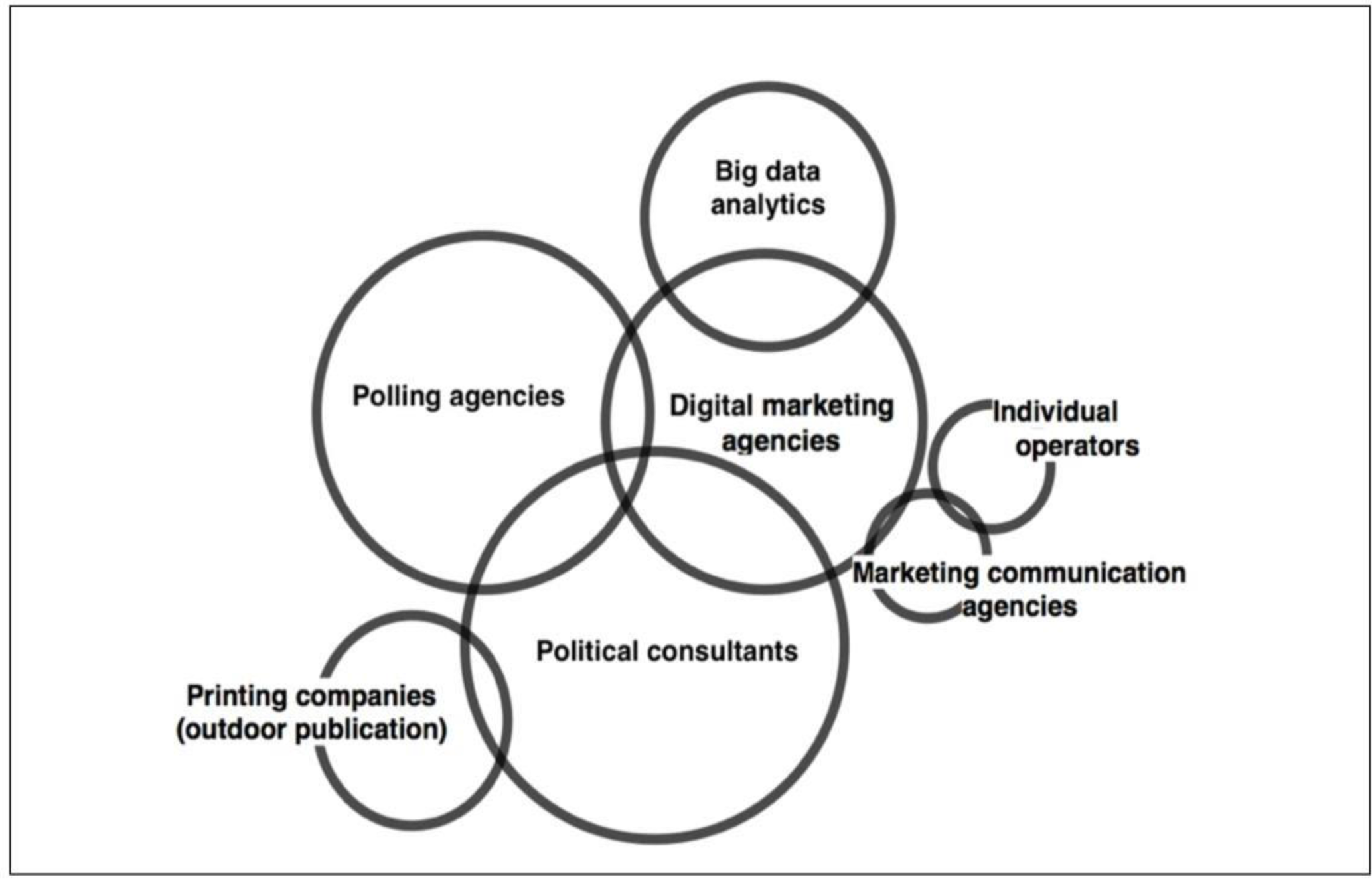
The Political Campaign Industry.
Each cluster has overlaps with others: polling agencies might provide political consultancy, while big data companies could join forces with digital marketing agencies to provide end-to-end digital campaign services for their clients. The assemblage of clusters essentially provides “a full range of services needed to secure the victory of a candidate–from strategic planning, to conceptualising a candidate’s ‘vision and mission’, from campaigning door-to-door and designing and organising media campaigns to providing poll monitors on election day” (Qodari, 2010: 132).
The extent to which the political campaign industry is able to offer all-encompassing services for politicians does not solely rely on political commercialisation (i.e. creating mediated and direct relationships between politicians and their voters), and neither is it underlined by shared political ideology (i.e. loyal social base). Instead, it is formed and reformed by the alliances between the candidates and the broader political economic power the elites possess, which, in turn, the industry can latch on to. This is why the relationship between the candidates and the political campaigners are not only far from stable, but they also mutate as swiftly as they are formed. Such an explanation interprets and applies Gramsci’s notion of forming consent within the current socio-economic conditions, as it, at times, involves “material concessions made by the ruling elite” (Gramsci, 1971 in Gilbert, 2015: 30).
We use several examples to flesh out this argument. The first example is Budi Purnomo Karjodiharjo’s rise to prominence in the political campaign industry. Karjodiharjo is a professional public relations specialist and owner of a marketing communication and media agency Rep+ (Reputasi Plus, Plus Reputation) – a member of the Asosiasi Perusahaan Public Relations Indonesia (APPRI, Indonesian Public Relations Company Association). He is primarily known as one of the main communication professionals supporting Prabowo Subianto in the 2014 and 2019 presidential elections (PR consultant, interview, 9 September 2018). However, his reputation within the Indonesian political campaign industry in fact started when Prabowo’s rival, Joko “Jokowi” Widodo, then mayor of Surakarta, recruited Karjodihardjo to support his campaign team during the 2012 Jakarta gubernatorial election.
The second is political consultant Eep Saifullah Fatah who owns the political consultancy firm Polmark (Campaign strategist, interview, 5 October 2018). Similarly, through his political consultancy firm, Fatah supported Joko Widodo in the 2012 Jakarta gubernatorial election and in the 2014 presidential election. However, in the 2016 Jakarta gubernatorial election, Fatah worked for the Anies Baswedan campaign, who challenged Ahok, Jokowi’s lieutenant who became the governor of Jakarta following Jokowi’s presidential election victory in 2014. Employing heavy identity narratives to sway Muslim voters in his campaign away from Christian Indonesian–Chinese Ahok, Anies was able to win the election.
Both Karjodihardjo’s and Fatah’s involvement in Jokowi’s campaigns in the 2012 Jakarta election and the 2014 presidential elections were made possible partly because Jokowi was a newcomer in the national political scene. Before climbing up the national political ladder, Jokowi was a furniture businessman from the Central Java city of Surakarta who became a mayor of the city in 2005. In less than ten years, the furniture businessman was able to become Indonesian president through a series of elections that he never lost.
The elites’ contributions have been essential in Jokowi’s victories in all the elections he had competed in. Behind Jokowi is a line of Indonesian political economic elites, with Megawati Sukarnoputri, the daughter of Indonesian first president Sukarno and the chairperson of Partai Demokrasi Indonesia Perjuangan (PDIP, Indonesian Democratic Party of Struggle) being his main matron. In addition to Megawati, there are the likes of media moguls and politician Surya Paloh as well as former general and businessman Luhut Pandjaitan, who have since become Jokowi’s closest allies.
When Joko Widodo competed in the 2012 DKI Jakarta gubernatorial elections and again in the 2014 presidential elections, he was supported by a small number of political parties. In the Jakarta election, Megawati’s PDIP and Prabowo’s Partai Gerakan Indonesia Raya (Gerindra, Greater Indonesian Movement Party) were the only political parties that supported him. Other major parties, such as secular-nationalist Golongan Karya (Golkar, Functional Groups) and the Partai Demokrat (Democratic Party), as well as Islamist Partai Amanat Nasional (PAN, National Mandate Party), Partai Keadilan Sejahtera (PKS, Prosperous Justice Party), and Partai Persatuan Pembangunan (PPP, United Development Party) supported the incumbent Governor Fauzi Bowo. A similar situation re-occurred in the 2014 presidential election, when Joko Widodo was supported by only two major parties, PDIP and Islam-based Partai Kebangkitan Bangsa (PKB, National Awakening Party), while Prabowo secured the support of other big parties such as Gerindra, Golkar, the Democratic Party, and Islamist parties PAN and PKS. Thus, a candidate running for the first time in the presidential election, Joko Widodo was in need of support from forces other than political parties, which included Karjodiharjo and Fatah, who were also relatively newcomers in the political campaign industry.
Joko Widodo’s opponent, Prabowo Subianto, who directly competed against him in the 2014 and 2019 Indonesian presidential elections, represented the old Indonesian elite. Prabowo is not only a former general, but he is also the son of a Javanese aristocrat and former Minister of Trade Soemitro Djojohadikoesoemo in Soeharto’s first development cabinet, as well as his former son-in-law. Prabowo has a stake in large companies in mining and plantation businesses. His campaign was also supported by a number of tycoons, including, among others, his brother Hasyim Djojohadikusumo, his vice-presidential candidate Sandiaga Uno, and members of the Soeharto family. He was also supported by Zulkifli Hassan, the speaker of the Majelis Permusyawaratan Rakyat (People’s Consultative Assembly, MPR), a politician from PAN and owner of mining companies.
With his broad political economic capital, Prabowo became the first known Indonesian politician to have access to and was able to employ foreign campaigners to support his political venture during his participation in Golkar’s party convention in 2004 (Political consultant, interview, 25 July 2018). To help him win the Golkar convention and win the ticket to the presidential election, Prabowo employed US consultants identified as Alex Castinallos, a former consultant to the US Republican Party and George W. Bush, and advertisement media consultant David Axelrod (Ufen, 2010). In 2009, Prabowo and the party he founded, Gerindra, continued to employ foreign campaigners, identified as US. political communications expert Rob Allyn, who worked on George W. Bush’s campaign for the governorship of Texas in 1994. Allyn was also employed by Prabowo’s team in the 2014 presidential election. In addition to foreign political consultants, Prabowo also employed a host of national and local campaigners such as the prominent PR agency Ida Sudoyo and Associates, Indonesian Development Monitoring and Think Big Indonesia, a digital and marketing communication agency.
In 2019, Joko Widodo ran for the second time in the presidential election in 2019. As the incumbent, he was able to form a coalition of ten political parties to back his campaign in addition to securing the support of political economic elites such as media conglomerate-turned-politician Hary Tanoesoedibjo and tycoons Erick Thohir and Garibaldi Thohir. However, Prabowo only maintained the support of five political parties, two of which were new political parties connected to the Suharto family that did not gain any seats in the House of Representatives.
While the political party machinery is understood to be crucial to reach out to voters, relying on political parties to run a presidential campaign is no longer adequate in post-authoritarian electoral democracy due to several reasons. First, the focus of presidential candidates and political elites is not solely to win the presidential election, but also to secure the support of political parties. Moreover, they need to maintain the stability of their coalition and their diverging interests during the electoral campaign period. This is particularly important considering the formation of party coalitions is not based on common ideologies (Hamid, 2012; Slater, 2004), but an alliance of convenience to organise and accumulate capital in neoliberal times.
Key actors in the political campaign industry who are able to shape more stable relations with presidential candidates have commonly formed links to members of the political elite. Here we take the example of big data analytics company PoliticaWave that specialises in monitoring political conversations on social media. The company was a newcomer in the political campaign business, but it successfully monetised the links its co-founder has with political elites in Indonesia, specifically with PDIP executives. PoliticaWave was co-founded by communication specialist Sony Subrata, who is also the founder of marketing and advertising companies Tridaya Media and Arwuda Indonesia. After Jokowi’s victory in the 2014 presidential election, Subrata was made commissioner of state-owned cement company PT Semen Indonesia. PoliticaWave too was later involved in Jokowi’s campaign during the 2019 presidential elections. Also, Jokowi has employed polling agencies such as Lembaga Survey Indonesia (LSI), Lingkaran Survey Indonesia, Charta Politica, Cirrus Surveryors Group, and Cyrus Network in some of his campaigns.
In addition to the dynamic and shifting alliances between political and economic elites with actors in the political campaign industry, there is also increasing pressure to appeal to the changing voter demography, with the number of young voters (seventeen- to thirty-five-year-old) or known as “millennials” among campaigners, at around 40 per cent (BPS, 2019). This requires not only expertise and technical skills to speak in the same language as this floating social base, but also the kind of vigour that enables actors in the political campaign industry to set their foot in the political economic domain dominated by the oligarchy. This can be seen in campaigners strong focus on millennial voters, due to their significant number, and their active social media use.
Millennials are difficult [to manipulate]. We focus on late millennials, born between the [19]80s and [19]90s. Early millennials are born between the [19]90s to 2000s, they are difficult to be played with. They only like music, film, sports, they are indifferent. [Older millennials] are still affected by religious and ethnic issues, they are pious and they are above 30 years old. What’s important is to keep the moment alive, like the 212 moment, and we can connect anything to that moment and maintain it. We don’t maintain the [candidates], but the [social movement] because they mobilise 212. We maintain it by shaping polarisations, every issue is polarised. If it’s the issue of illegal migrants from China, it will divide candidate supporters. If there are other issues like [halal food], that is mobilised to keep the spirit, so they keep fighting. (Big data analyst, interview, 2 April 2018)
The claim made the campaigner is consistent with survey results (Hadiz and Rakhmani, 2017) about the participants of the Action to Defend Islam, also known as the 212 movement. The 212 rally comprise of participants mostly in their twenties and thirties, whose majority education attainment is relatively high (tertiary education) but their social position is in the lower middle-class or borderline middle-class bracket (Hadiz and Rakhmani, 2017). Because moderate Muslim organisations are deemed incapable to address this gap (Hadiz, 2018), the media has become sites of contestation to shape, divide, and clash identities – religious and otherwise – among different sections of floating heterogenous voters.
We argue that the political campaign industry’s main function is to mobilise voters through the production of narratives. To fulfil this function, their roles can be divided into two. The first is to understand the voters’ background and behaviour. This is the domain of polling agencies. The second role is producing and assembling themes into a larger narrative to suit the voters’ specific backgrounds and behaviours. This is commonly done by agencies specialising in the persuasion businesses such as such as PR, advertising, marketing agencies, and the media.
Mapping the background and behaviour of voters provides the basis for the production of campaign narratives, which is especially important to target the shifting social base lacking political loyalty. To address this, groups of target voters are defined by demography – cultural (locality, ethnicity) and social demography (age, sex, religion, social class) – and social psychology (lifestyle, value, attitude, and behaviour). The detailed data of voter demography and social psychology are necessary for the production of campaign narratives that enable candidates to capture their attention and appeal to their needs. Since the industry consists also of a significant number of commercial campaign agencies, the narrative production strategies are adapted from those with commercial purposes. In fact, there is not much difference between the narrative production of commercial advertising and that of political campaigning, as they both have to be “safe, memorable and marketable” (Sussman, 2005: 41).
Such a process, we posit, fleshes out what Morelock and Narita (2018) mention as the structural problem of politically representing the “people,” as the “people” are inherently divided in their sets of interests. Rather than addressing this structural problem, the alliance between political campaigners and the elite take advantage of it. This alliance, more conceptually, benefits from “the diffuse yet pervasive cultural pressures of unsatisfied social demands that challenge prevailing political norms” (Morelock and Narita, 2018: 138). Such dissatisfaction is nurtured by campaigners through systematic attacks to shape alliances through processes that include agitation with social media. We dive deeper into this by explaining the work of cyber armies.
Cyber Armies and Symbolic Coercion
This section provides a description regarding the way the political campaign industry mobilises voters through divisive narratives. This is done specifically by using the feature of anonymity, the possibility of opening multiple accounts by a single person, which are provided by most popular social media platforms, as well as automated postings made available through free software and websites. This gave rise to the emergence of millennial social media campaigners popularly known as “cyber army.”
The first recognised cyber army group was set up in 2012, known as JASMEV (the Jokowi–Ahok Social Media Volunteers). JASMEV was founded by, among others, Sony Subrata (PoliticaWave) and communication practitioner Kartika Djumadi. This group was a loose volunteer group working without pay during the DKI Jakarta Gubernatorial Election in 2012, comprising of Jokowi and Ahok supporters. JASMEV pride themselves for being inclusive, as they are driven by social media volunteers (Tempo, 2012).
JASMEV turned into the first visible cyber army volunteer group in Indonesia’s electoral politics, with 10,000 members at the end of the 2012 campaign (Saraswati, 2021). JASMEV was reactivated for the 2014 Presidential Elections, renaming themselves as Jokowi Advanced Social Media Volunteers (Fadil, 2014). These so-called volunteers, who were trained by Arwuda Indonesia, consisted of mostly students and office employees, who were taught to engage in social media campaigning by marketing professionals. The training provided meticulous guidance for the volunteers to engage in cyber wars, aimed at both encouraging Jokowi’s supporters and provoking the supporters of his opponents.
The campaigners prepared political themes and issues for the volunteers to discuss on social media. They also provided instructions on how to produce social media content based on these issues; including the most effective time to post this content. The guidance also outlined how to respond to social media content that undermined Jokowi and his running mate.
The establishment of JASMEV, seen widely by campaigners and politicians as a success, was followed by other groups such as the Muslim Cyber Army (MCA) and Saracen. These two groups were also set up to engage in online campaigning with a focus on engaging Muslim social media users. MCA was a loosely connected network of groups that started to gain attention for its consistent opposition against Ahok in 2017. The membership of its Facebook account was highly moderated. MCA was able to provoke violent responses not only from online users but also offline, and they did so by producing and distributing rumours such as the resurrection of the Indonesian Communist Party (Partai Komunis Indonesa–PKI) and the attack against Islamic clerics. MCA was accused of publishing private information and locations, a practice known as doxxing, of social media users they identified as opposition (Sudrajat, 2018), which amounts to a veiled threat.
The pattern of MCA’s provocation is centred around its two key figures, a lecturer who formulated key messages to be disseminated online, and Luth, who received funding and creates content (Sudrajat, 2018). Ten members of the MCA WhatsApp group organised a larger group called United MCA, comprising 102,064 accounts managed by twenty admins. The task of the United MCA is to spread disinformation.
The second group, Saracen, was one of the largest and most notable disinformation producers in Indonesia. Saracen’s organised operation was on Facebook. It had more than 135,000 members and operated around 800,000 accounts for the production and distribution of fake news. Prior to their administrators’ arrests in August 2017, they spread made-to-order divisive content. According to the police, the syndicate was paid between IDR 75 and 100 million (approximately USD 6000–7500) per project in producing and distributing disinformation.
While the three groups have different strategies to accumulate profit, they share one similarity: they employ a significant number of paid individuals, or better known as admins and members of the cyber armies, in the production and distribution of online narratives. The individuals may be anyone, from university students and housewives to office workers. These cyber armies played an increasingly bigger role in Indonesia, even beyond electoral campaigns. They are in fact a crucial part of the political campaign industry’s main selling point, namely, their ability to sway public opinion in platforms as specific as WhatsApp messenger groups.
As an illustration, the resulting themes mobilised by cyber armies can be seen in Figure 2. Between the campaign period of 23 September 2018 to 13 April 2019, 143,666 posts on Facebook could be organised to understand the issues of disinformation attacking Jokowi (42 per cent) and Prabowo (58 per cent). The two most dominant disinformative posts (30,515 posts) are “Radical Islam behind Prabowo” and the second is “Jokowi communist” (21,096 posts). But these banners are not definitive. Cyber armies also experiment with mobilising issues such as “Prabowo communist” (10,336 posts). Such overlapping themes are useful as it makes it easier for campaigners to mobilise the same issue against or for a differing candidate – in other words, experimenting on and maintaining the openness of the narrative to include or exclude future politicians.
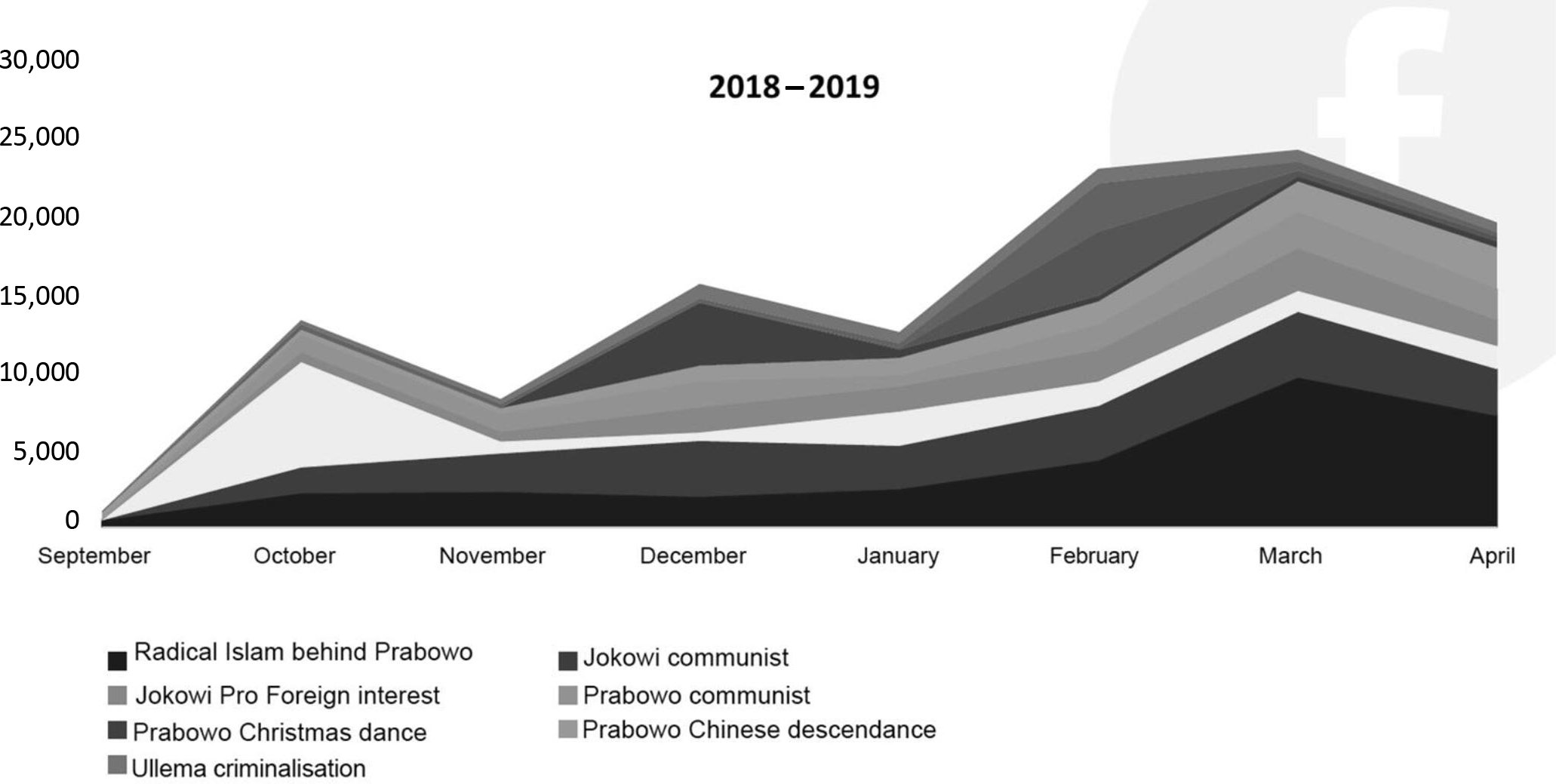
Top 10 Disinformation Issues on Facebook.
uch implied militarism in the machination of cyber armies poses the question of consent and coercion (Gramsci, 1976). The term cyber army and the strategies taken entail symbolic violence using anti-communist and anti-Islamist sentiments as well as digital intimidation. While social media campaigning does not involve physical violence per se, the way doxxing and fake news are fabricated require sophisticated and calculated strategies of attacks. We posit that what is known as cyber wars among campaigners and voters alike, engineer symbolic violence with the effect of coercion – voters are coerced or herded into going against a presidential candidate and their supporters. Such strategies aim to polarise and aggravate voters against each other and in support of candidates, which in turn maintains an atmosphere of warfare in the electoral arena.
Engineering Consent with Emotive Appeals
Political campaigning that employs organised cyber armies requires strategic warfare. But there is another kind of campaigning that is produced by advertisers and PR consultants. Their work involves building a persona and image, and unlike spreading fake news, this method of campaigning tries to win over voters through legitimacy. However, they have a similar primary function as the cyber army strategy – which is to sway voters by choosing emotively, or engineering consent, rather than by reasonably weighing and discussing the policy issues advocated by the candidates.
In fact, the narrative construction often reflects the development of a likeable and trustworthy public persona (without actually saying much about their policy promises). This is done to attract the attention of swing voters from various segments while maintaining the loyal voters the candidates have already attained (as informed by pollsters). This can be seen by looking at the ways political campaigners simplify complex political and social economic issues into abstract threats and enemies. They are also able to mask these issues with sophistication behind the creation of personas that would project the candidates’ ability to strongly and authoritatively manage notional threats. The narratives developed are mainly superficial images of leadership that align with the surveyed demography of their targeted floating social base.
During the 2019 presidential election, campaigners constructed narratives by building the public image of political candidates that could appeal to as many undecided voters as possible. The candidates’ personality moved to the centre of the campaign strategies, sidelining party identity. Such narratives allowed the candidates to present an authoritative image of a leader capable of running a nation ridden with elite power struggle.
To understand some of the narratives that were distributed online during the 2019 presidential election campaign, this article delved deeper (as inspired by the top ten issues on social media) using parts of a research of around 7,500 online material obtained from Indonesian news media and blogs from 13 March to 13 April 2019 (Wattimury & Saraswati, forthcoming). These materials were organised by focusing on the mentioning of keywords “Joko Widodo,” “Jokowi,” “Prabowo Subianto,” and “Prabowo-Sandi” (Wattimury & Saraswati, forthcoming). The articles were then thematically coded to understand the narratives. Select narratives about the candidates in the 2019 presidential election are explained below.
Narratives of Jokowi: The Professional, Pluralist Family Man
Jokowi’s political campaign team, both during the elections and after he was re-elected, sought to create three main narratives: first is that of a working leader who envisions an optimistic future, second is Jokowi as a Muslim who values diversity, and third, Jokowi as a committed family man. The narrative of Jokowi as a working leader was constructed by projecting images of the nationwide massive infrastructure projects developed during his first term. This narrative constructs an image of a leader who works for a progressive and more prosperous future for citizens.
In line with Jokowi’s jargon “work, work, work (kerja, kerja, kerja),” this narrative stressed on his capability to manage and improve the nation’s productivity and national economy. Such a persona was reinforced through pictures and texts regarding his administration’s economic accomplishments during his first term. Specifically, attention is given to infrastructure projects, new tax exemption scheme, and the increasing number of Indonesians receiving high subsides for healthcare and education.
This particular narrative was in fact different from that in 2014, during his first run in the presidential election. The narratives built then was that of Jokowi as a commoner who rose to prominence as a meritorious leader based on his professional track record both as Surakarta mayor and DKI Jakarta governor. While different, both narratives construct professionalism and future-orientation.
Figure 3 is representative of such themes. The headline on the photo says “Build infrastructure for Indonesia’s future,” while its subheading says “President Jokowi, ‘The Father of Indonesia’s infrastructure’ with ‘Field general’ Basuki Hadimuljono.” The image constructed in this post, and many others like them, is that Jokowi’s infrastructure development is indicative of Indonesia’s progress under his professional and authoritative (directing a “general,” no less) leadership. In this frame is Hadimuljono, the Minister of Public Works and Public Housing, who notably also approved a USD 62 million loan to bail out Bakrie group to settle compensation for Lapindo mudflow disaster victims in Sidoarjo, East Java (Parlina, 2014).
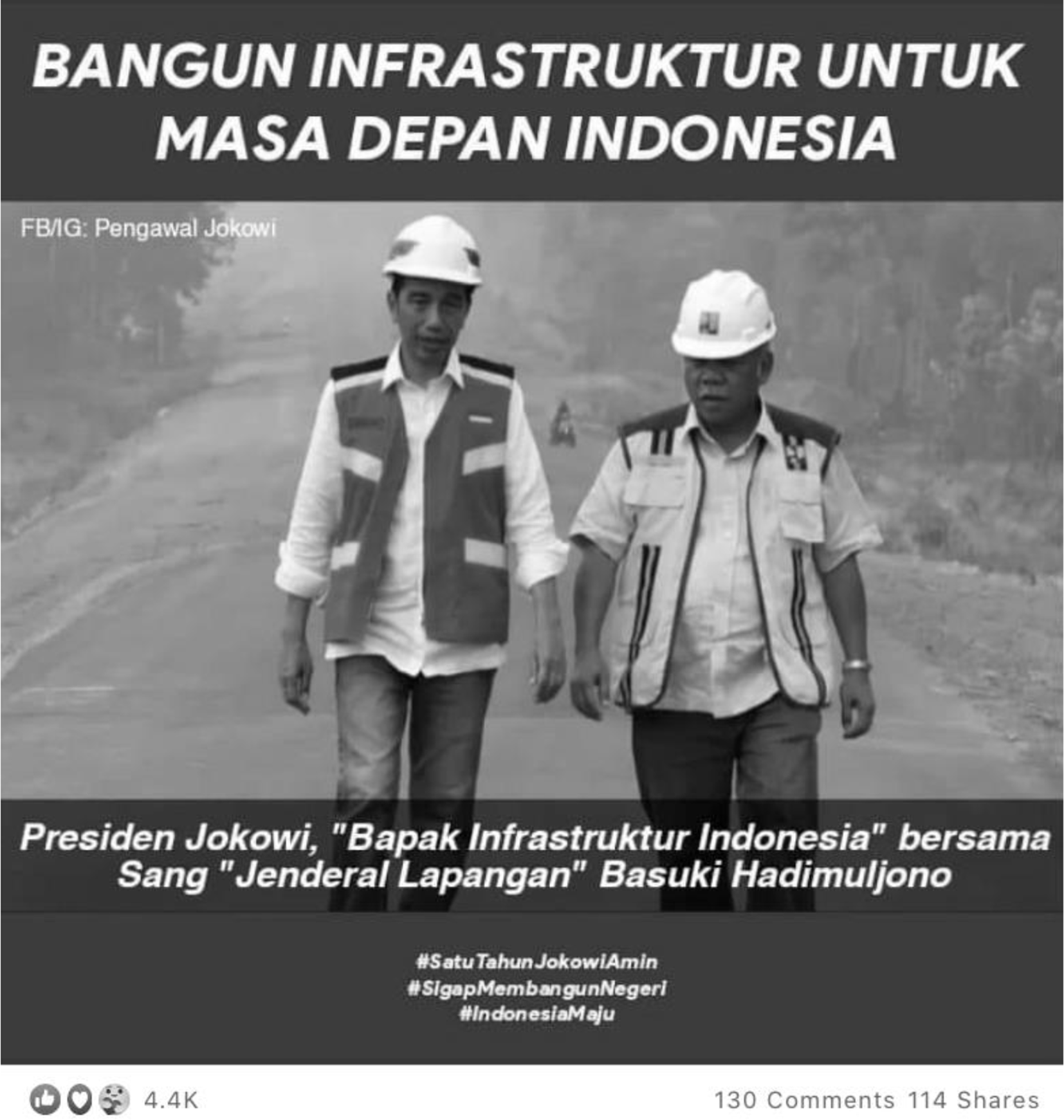
Jokowi Advances Indonesia with Infrastructure Development.
The second narrative around Jokowi was him as a pluralist Muslim leader. During the 2012 Jakarta election and the 2014 presidential election, Jokowi’s campaign had been blighted with wild rumours that undermined Jokowi’s Islamic credentials. In the 2019 presidential election, Jokowi decided to take in a controversial cleric, Ma’ruf Amin, to run as his vice-presidential candidate. Amin is a senior Islamic cleric from Nahdlatul Ulama, the largest Islamic organisation in Indonesia, and deputy of the Indonesian Ulema Council (Majelis Ulama Indonesia–MUI) who passed the blasphemy fatwa against Ahok in 2017. Jokowi’s decision to take Amin was seen by pundits as his attempt to build his Islamic credentials, although Amin is largely not well-known among grassroots-level Muslims. This move was seen as an attempt to garner support for Jokowi among pious Muslims although it clearly upset a segment of Jokowi’s secular-pluralist supporters, who considered Amin responsible for supporting the blasphemy case against Ahok.
In 2019, Jokowi’s campaign team faced an even bigger problem than in 2014, as the narratives attacking Jokowi’s Islamic credentials then is now magnified by Ahok’s conviction in the blasphemy case. The decision made by Jokowi’s campaign team to develop a narrative to affirm Jokowi’s Islamic credentials was not only based on his party coalition (which included some Islamic parties such as PKB) but also on the magnitude of the issues raised by his political opponents that he had to counter.
Figure 4 shows a banner created by Jokowi supporters, with him and Amin in front of the national flag and Bali, the Hindu-majority island, in the background. The text reads a rhyming poem (translated contextually) “Bali’s beaches are such a sight, waters so clear our reflection is seen, let’s welcome an Indonesia so bright, with Jokowi and K.H. Ma’ruf Amin.” Thus, the image presented is that of Jokowi being a clear-minded Muslim who values progress and diversity. This post, and many other like it, visually reinforces Jokowi’s decision to take in a Muslim cleric as his deputy, while presenting them as pluralists who support Hindu rituals.
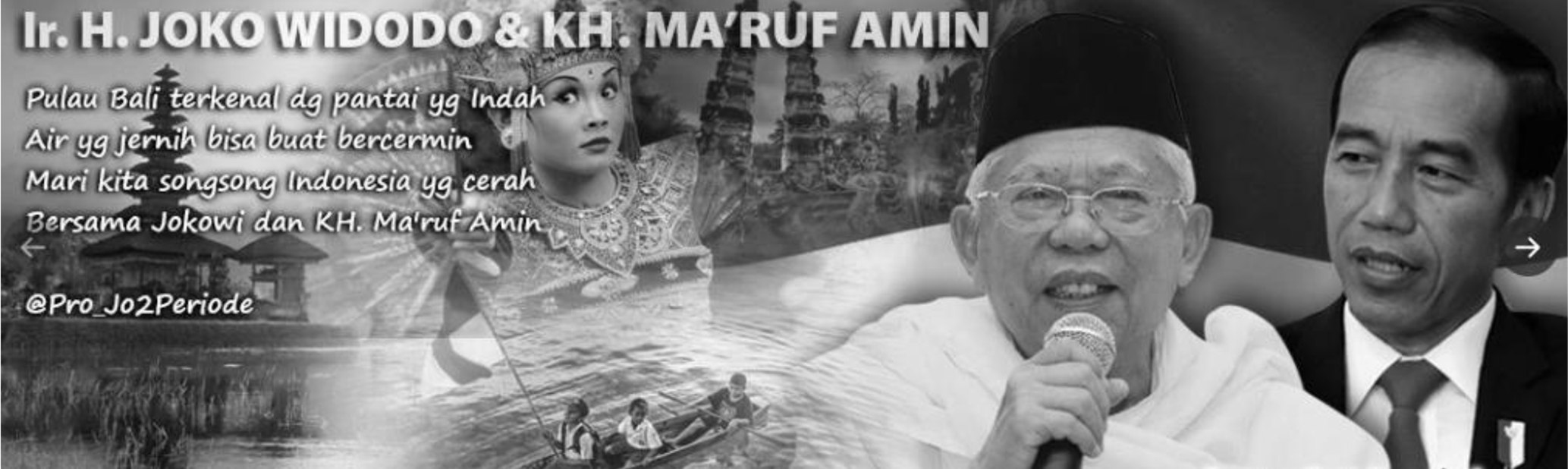
Jokowi, the Pluralist, Allies with Islamic Authority.
The third Jokowi narrative is one that projects him as a committed family man, a caring father and grandfather figure. This narrative somewhat continued on those during the 2014 presidential elections, as he was represented as a commoner with no family ties to the old New Order elite – an ordinary man. Capitalising on his background as a candidate without personal or marital relations with the elites, this post affirms Jokowi’s image as an ordinary family man who happens to be a politician that is not tainted by New Order oligarchic connections.
The caption in Figure 5 says “Visiting relatives [silaturahmi] from the Ngayogyakarta Hadiningrat palace family on the third day of the Ied festivities [Lebaran] in Yogyakarta, today.” The term silaturahmi originates from the Arabic word shihah (relating) and ar rahm (relatives). It is a term that means maintain and developing bonds with relatives. This post merges several themes: Islamic rituals, bhinneka tunggal ika (Indonesia’s unity in diversity slogan), and Jokowi’s family values (visiting with his wife and grandson).
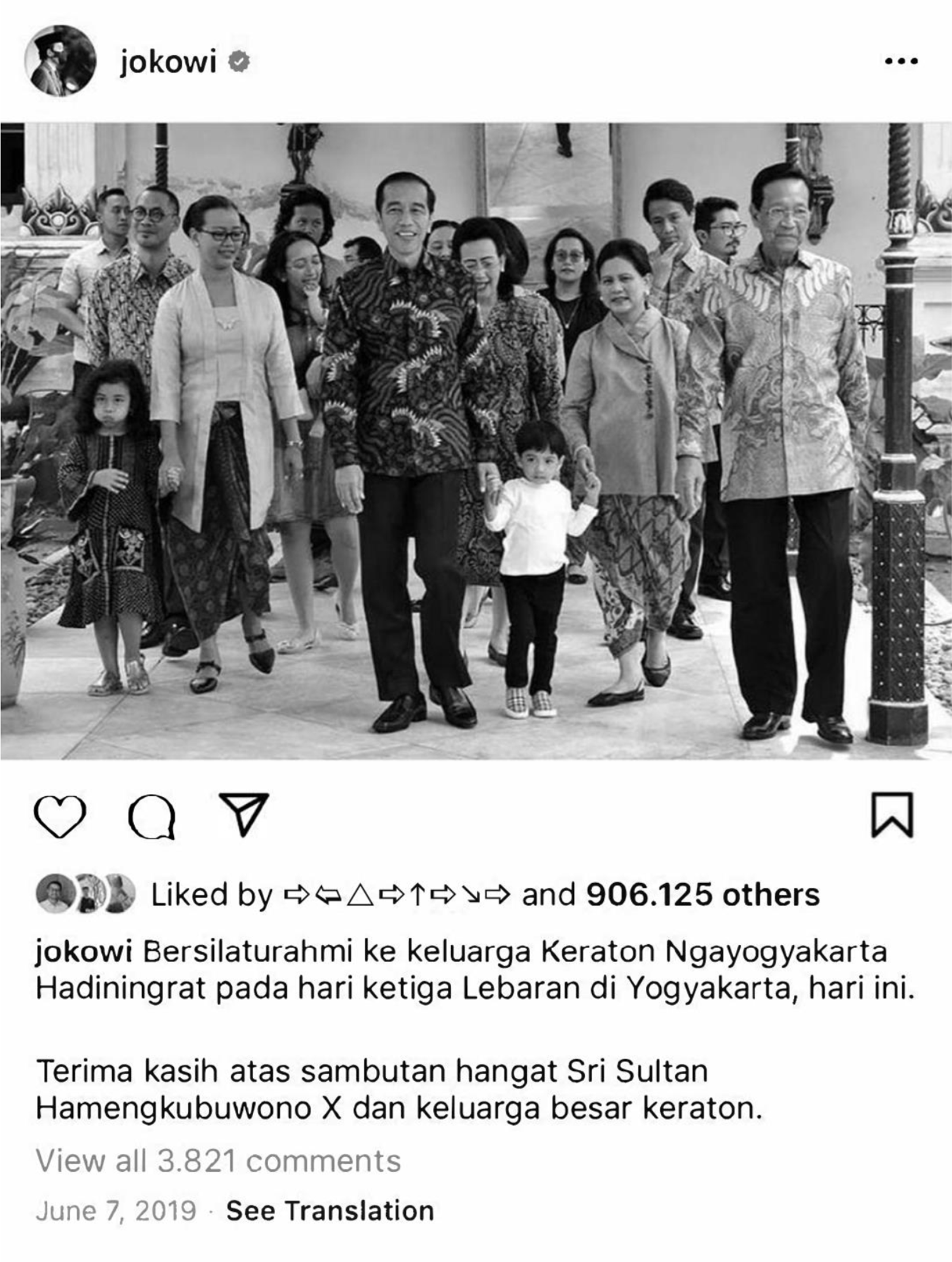
Jokowi, the Family Man.
The change of the narrative from a commoner to an established, authoritative family man worked because Jokowi was the incumbent who became a grandfather in 2019. Jokowi’s young grandchildren often appear in headlines of online news portals targeting young couples and middle-aged home makers, who comprise the majority of swing voters (Augustine, 2019). The multitude of posts show the image of Jokowi and his family in their supposedly natural, daily setting. He often brings his grandchildren to national engagements open for the media to cover. This media attention to Jokowi’s grandchildren has raised objections from the Prabowo camp who cannot capitalise on the image of a family man being an unmarried widower with an adult designer son, who is also unmarried.
These three narratives project Jokowi’s persona as a patriarchal authority able to lead the nation’s infrastructural development. This image casts aside the fact that while he does not have as strong a tie with the New Order elite, Jokowi is a political elite with the backing of a coalition of political parties. Campaigners present Jokowi as being one of the many middle- to upper middle-class professionals who work hard to achieve larger dreams of tomorrow through various mass and social media channels. And this, unsurprisingly, harmonises well with the aspirations of young voters he needed the most to win the elections.
Narratives of Prabowo: The Protector Entrusted by Ulama to Counter Foreign Threats
Challenger Prabowo Subianto’s narratives emphasised strength during massive social changes. This strength is generated from, first, his assertive stance – supported by his military background – of being the defender of Indonesia’s sovereignty. Second, it comes from the strong support given by Muslim clerics to Prabowo. His campaign team magnified these narratives through multiple communication platforms to project a persona of Prabowo as a powerful leader capable of safeguarding a nation continuously experiencing political (Figure 6). Such a determined and forceful leader, the campaign erects, can only come from a figure who is tough enough to unite a fragmented and polarised nation.
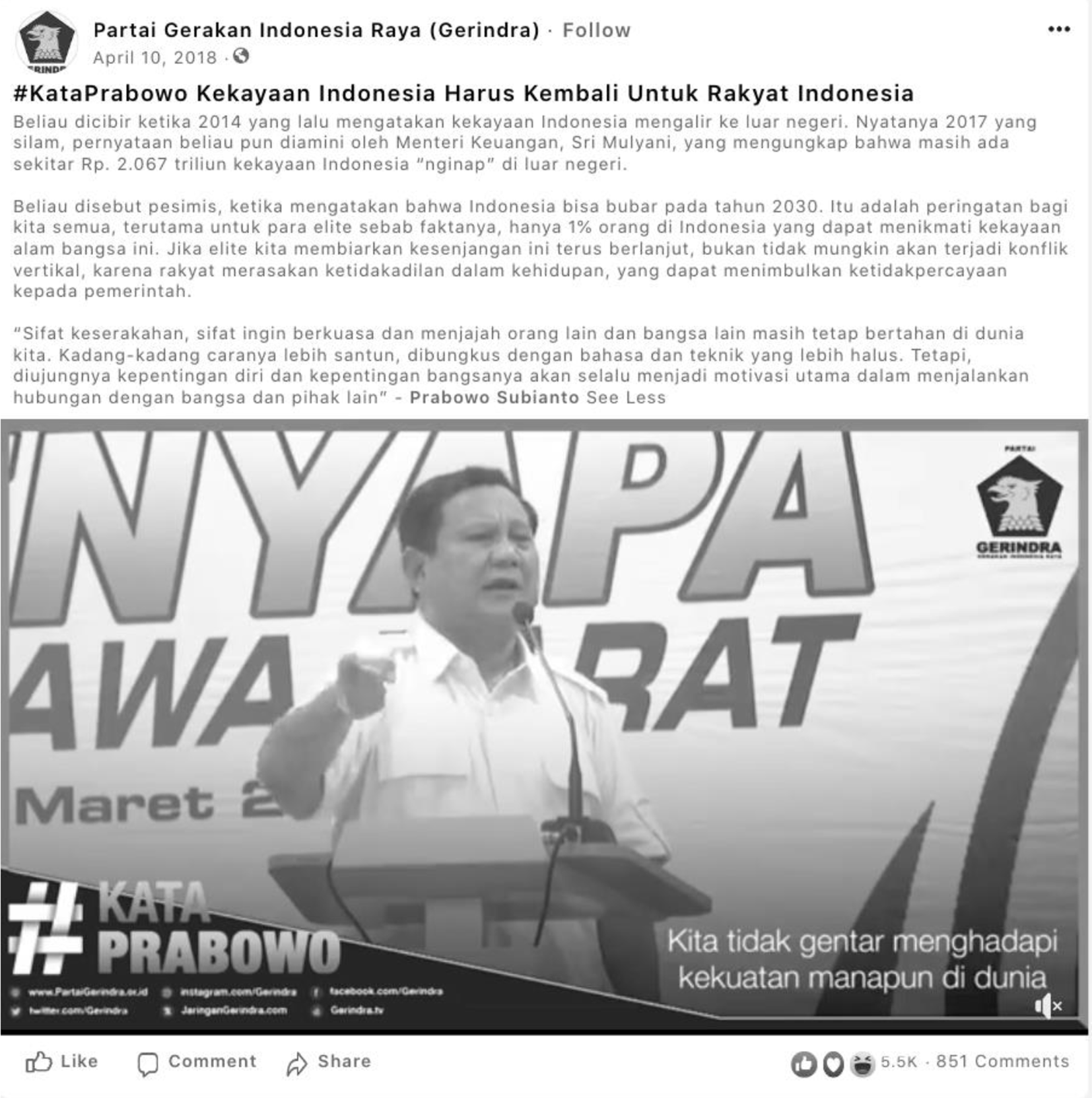
Prabowo Protects Indonesia’s Wealth.
The first narrative was notably built through the controversies surrounding Prabowo’s speech uploaded by Gerindra’s Facebook account. In the video, wearing a black Malayan headdress and white shirt, Prabowo predicted that Indonesia is going to disintegrate by 2030. Quoting fiction author P.W. Singer and security analyst August Cole, campaigners presented the image of Prabowo as competent amid a pessimistic narrative of Indonesia. Based on this narrative, Indonesia – facing the endemic problem of corruption, massive social inequality, and foreign interest wanting to exploit its natural resources – needed Prabowo, the strong leader to protect the country.
The speech went viral on social media (both reposted by his supporters and by Jokowi’s to ridicule) and was widely reported by the mass media. Prabowo warned party constituents and voters that Indonesia’s wealth is being siphoned off to foreign countries. Gerindra’s official account, following the virality of the speech video, stated that “… when [Prabowo] mentioned that Indonesia will disintegrate by 2030. It was a warning for all of us, especially towards the elite because factually, only 1 per cent of Indonesians are able to enjoy the natural resources of this nation.” Themes of social and wealth inequality resonated well with those advocated by Muslim clerics.
Prabowo campaigns benefited from the endorsement of conservative ulamas, which is a shift from his 2015 campaign narrative. His coalition with the ulamas could be traced to the Aksi Bela Islam (the Action to Defend Islam) on 2 December 2016. The massive peaceful protest, also known as the 212 movement, was successful in their campaign to oust Ahok. The group’s next target was to build a narrative to replace Jokowi as President, using the online movement hashtag #2019ChangePresident (#2019GantiPresiden). These groups overwhelmingly backed Prabowo and his vice-presidential nominee Sandiaga Uno as the ideal candidate for Muslims. This alliance was made possible through the support of Islamic clerics, who were temporarily unified against Ahok in 2017. Despite Prabowo’s lack of Islamic credentials and being a non-practising Muslim from an actual mixed religious family, the firm support of Islamic clerics towards Prabowo helped secure the votes of their Muslim social base.
Prabowo formed a coalition with conservative Islamist activists and groups, who had endorsed his candidacy in the 2019 presidential election. As a result, Prabowo has amassed backing from conservative activists such as Rizieq Shihab, leader of the Islamic Defenders Front (Front Pembela Islam–FPI), and Amien Rais, formerly a Muhammadiyah leader and founder of the National Mandate Party or PAN. His running mate, Sandiaga Uno, also began portraying himself as a young and pious Muslim entrepreneur. The Prosperous Justice Party or PKS – an Islamist party that also backs Prabowo – described Sandiaga as “a new santri of Post Islamism.”
Many of the clerics and organisations who backed Prabowo were affiliated with the National Movement to Support the Ulama Edicts (GNPF-MUI), a loose organisation that was central in the Action to Defend Islam. A key message in this narrative was the Islamic obligation to follow the ulama’s political fatwa to defeat Jokowi-Ma’ruf by supporting the victory for Prabowo. The advocated motivation to vote for Prabowo was, significantly, a religious one, and campaigners widely disseminated the Second Ijtima Ulama (Grand Gathering of Ulama)’s consensus to support Prabowo to reinforce this. Such tones were repeatedly distributed online and offline through campaign rallies and canvassing (Figure 7).
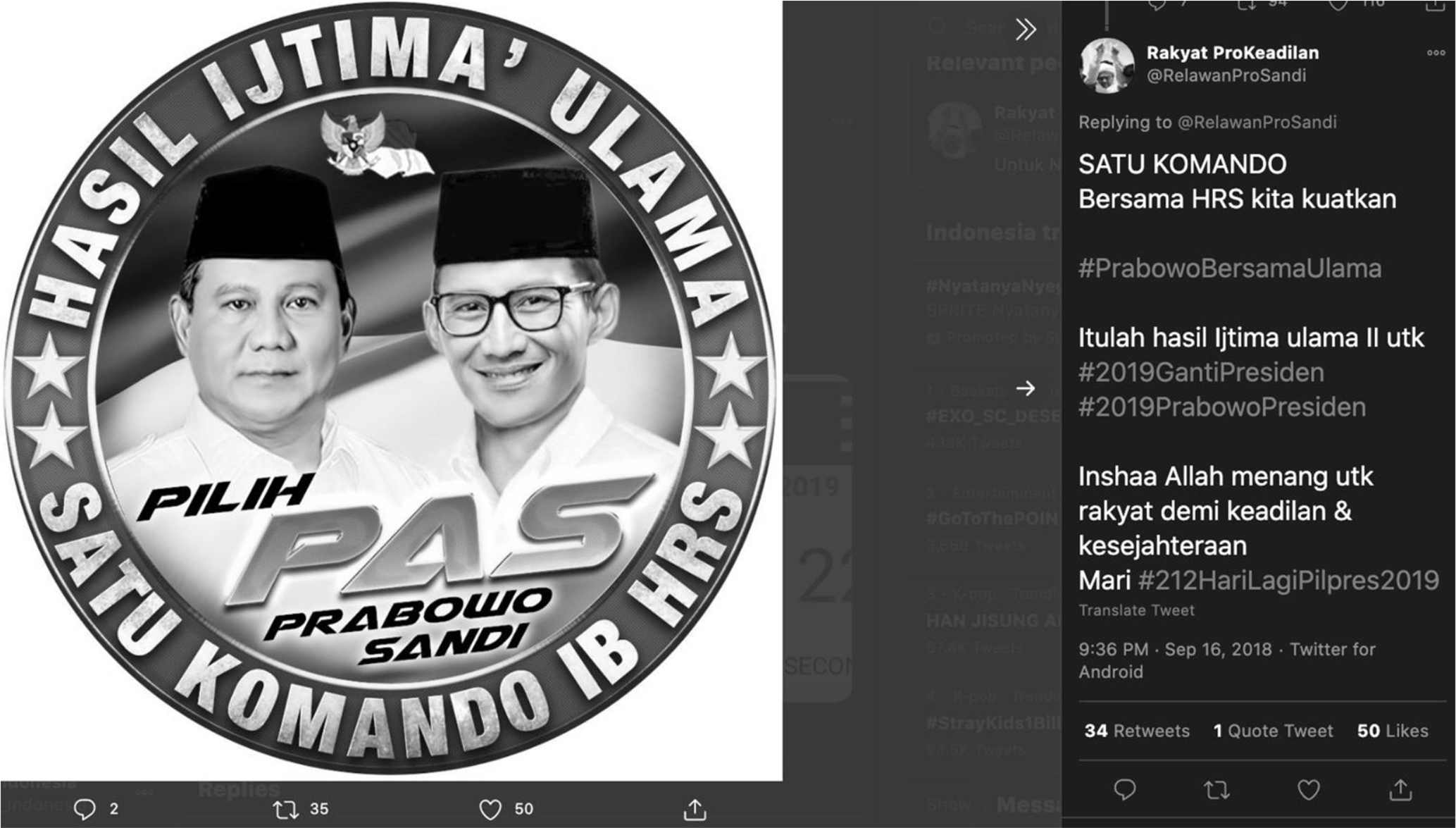
Prabowo Endorsed by Ulama.
Figure 7 shows the endorsement of the profile picture to be used by Prabowo supporters, widely circulated on WhatsApp groups, Twitter, and Facebook. The badge reads “Consensus of the Grand Gathering of Ulama,” “One Commando [under] the Great Imam Habib Riziq Syihab,” and works with the #2019ChangePresident movement organised by female Muslim celebrity Neno Warisman.
Together with this, a group calling themselves the Fraternity of the 212 Alumni (Persaudaraan Alumni 212) expressed they will follow FPI’s lead in their support for Prabowo. The recommendations given by the Third Ijtima Ulama (Hatta, 2019) mentions that there was massive fraud during the organisation of the 2019 presidential elections, and that they put forth legal objection towards electoral fraud and to cancel or disqualify candidates Jokowi and Amin.
Thus, on 21 and 22 May 2019, after results of the 2019 Presidential Elections were announced, Prabowo supporters rallied to protest the outcomes. The Indonesian police stated that more than 1,300 demonstrators, from various regions in the country, rallied in support of Prabowo. Importantly, the rally, which culminated after the spread of fake news on social media, was the first time the Indonesian government limited social media use in order to prevent hoax and mis-/disinformation (Subinarto, 2019). The government blocked connection to hinder the spread of photos and videos sent through WhatsApp, Facebook, and Instagram – a policy effective because it was enforced by the five largest internet service providers and telecommunication state enterprises in the country (which dominates the internet and mobile infrastructure in Indonesia).
The themes reinforce Prabowo’s persona as a nationalist authority able to protect the country against foreign threat towards national resources, which is only enjoyed by a small elite. The representation of Prabowo as an elite protecting the downtrodden through is reinforced through advocating the support of Muslim clerics who support his candidacy. This persona, however, obscures the fact that he is part of the 1 per cent his campaign criticises. Therefore, Prabowo’s campaign conceals his elite status and keeps the authoritarian populist narrative (Morelock, 2018) in place, despite the complex political economic dynamic behind this narrative.
Concluding Remarks: Authoritarian Populism in Indonesia’s Democracy
This article problematised the relationship and alliances built between electoral campaigners and political candidates during electoral competition. It discussedIndonesia’s elections, more specifically the 2019 presidential elections, and shows how campaigners construct authoritarian populist narratives in their attempt to win over diverse and undecided voters. They did so by constructing an image of strong leaders who can safeguard Indonesia’s future.
The narratives built for both candidates leaves no room for alternatives. By flooding the media space with images that reinforce the candidates’ persona, mobilising cyber armies to defend them, and attacking those opposing them, the actual socio-economic problems that grip Indonesia are lost in circular debates during the presidential campaign. Moreover, media spaces dominated by such narratives are designed to be short-lived and appeal to as broad a social base as possible, thereby disengaging voters from deliberating and articulating their grievances, and mobilising them towards banal discussions that distract them from their material dissatisfactions. As Morelock (2018) explains:
‘Populism’ is defining a section of the population as truly and rightfully ‘the people’ and aligning with this section against a different group identified as elites. Together, ‘authoritarian populism’ refers to the pitting of ‘the people’ against ‘elites’ in order to have the power to drive out, wipe out, or otherwise dominate Others who are not ‘the people.’ Generally, this involves social movements fuelled by prejudice and led by charismatic leaders that seek to increase governmental force to combat difference. It is commonplace for governments under the direction of authoritarian populists to condense and centralize authority, so that more power rests in the hands of fewer people, (p. xiv)
The kind of populism Morelock was talking about aligns the notional “people” against those identified as “elites.” The proficiency with which campaigners develop key messages and steer voters online with voluntary and paid cyber armies shows that this alignment maintained through political divisions by means of mediated agitations and wielding allegiances with specific factions of the elite.
Through this article, we emphasised on a point that Morelock (2018) has not addressed. In Indonesia, authoritarian populist narratives are constructed in ways in which the “ummah” – which is one variation of the “people” – are aligned with an “old elite” backed up by Muslim clerics. The “ummah” too, is pitted against supporters of a “new elite,” receiving the support of big political parties.
Morelock and Narita (2018) discussed that in the attempt for proper theorising of populism, we must take into account its manifestations in countries other than the West, where the “people” are narratively constructed against the narratively constructed “elite.” In the case of Indonesia’s elections, we can see how racialised and pious people (the “indigenous ummah” and the “pluralist”) are narratively constructed to align with differently racialised and pious sections of the elite. The construction of a charismatic leader (be it as a professional, pluralist family man, or the national protector of sovereignty) is primarily similar between the two camps: an engineering of popular consent, but to be mobilised against specific factions of the elite.
We agree with Morelock that authoritarian populism is indeed a reaction towards the failures of modernity, and there is desire, be it from optimist or pessimist voters, to overcome social dislocations brought about by neoliberal transformation. This has contextually led to rise of Indonesia’s authoritarian populism.
In this process, Indonesia’s political campaign industry has served as an adaptive engine, one that reproduces consent and non-violent coercion to benefit governing power (Gramsci, 1976 in Eagleton, 1991: 112). The political campaign industry’s central role in the transformation and engineering of such narratives continued to enable the oligarchic elites to further consolidate, notable in the subsequent appointment of Prabowo as Minister in Jokowi’s cabinet (Fachriansyah, 2020), and re-capture the diffused power following the end of the New Order government.
Footnotes
Acknowledgements
The authors would like to thank the Asia Institute and the Indonesian Democracy Hallmark Research Initiative (IDeHaRI), the University of Melbourne, co-organisers of the "2019 Indonesian Elections: Electoral Accountability and Democratic Quality" public panel and workshop. The authors' participation in the workshop and feedback given by fellow participants improved the coherence of the article's argument.
Declaration of Conflicting Interests
The author(s) declared no potential conflicts of interest with respect to the research, authorship, and/or publication of this article.
Funding
The authors received funding the the Indonesian government through the Basic Research for University Excellence grant (PDUPT) which funded data collection. The authors participation in workshops to improve the quality of the article was funded by Universitas Indonesia's International Publications grant (Q1Q2).
Author Biographies
Email:
Email: