



Abstract
Research on voting behavior in Southeast Asia has yielded numerous valuable insights, but it relies on observational data and rarely adopts a comparative approach. This article analyzes five original candidate choice experiments conducted in Indonesia, Malaysia, the Philippines, Singapore, and Thailand. We independently manipulate a wide range of candidate attributes, enabling precise identification of each factor's effect on candidate selection, and investigate how the effects vary across countries and groups of voters. Results reveal a strong voter preference for candidates with a track record of delivering development funds to their constituencies. However, other factors, including partisanship and policy stance, also significantly influence voter preferences, especially in some countries and for certain voters. Additionally, voters consistently prefer candidates from middle- and working-class families to those from more privileged backgrounds. These findings underscore the complexity of voting behavior in the region, demonstrating that it should not be reduced to a single dimension.
Keywords
Introduction
The process through which citizens evaluate and select electoral candidates is crucial to understanding democratic accountability and representation. Research on Southeast Asia has shown that candidate choice is complex, as voters evaluate a range of factors ranging from the candidate socio-demographic traits to their partisanship, ideology, and promise to deliver material benefits. Existing work, however, has yet to study systematically the relative importance of such factors, and rarely adopts a comparative perspective. This study leverages survey experiments conducted in Indonesia, Malaysia, the Philippines, Singapore, and Thailand to identify the effect of several candidate attributes on candidate choice, exploiting the diversity of the samples to analyze how effects vary across country and group of voters.
Southeast Asia provides a unique empirical context for studying voting behavior. Many countries in the region continue to bear the imprint of authoritarian rule, with hybrid regimes that constrain political competition and individual freedoms while allowing limited but significant electoral processes (Jayasuriya and Rodan, 2007). While party systems vary considerably across countries (Hicken and Kuhonta, 2011), they generally display lower levels of institutionalization compared with established democracies and a stronger incidence of clientelistic linkages, especially for certain segments of the electorate. Beyond targeted benefits, economic development is a primary concern for voters across the region, many of whom value material progress and political stability above liberal principles (Pepinsky, 2017). Social and ideological issues too are highly salient in many Southeast Asian countries, including, for instance, debates over the role of religion in Malaysia and Indonesia and the controversial role of the monarchy and military in Thailand. Southeast Asia presents an interesting and complex mix of region-specific institutional constraints, substantial cross-country variation in political systems, and political dynamics reminiscent of those observed elsewhere.
While existing research on voting behavior in Southeast Asia has provided valuable insights, it suffers from two significant limitations. First, most studies focus on single-country case studies. While this is understandable given the region's diversity, there is no comprehensive study offering a regional overview that systematically examines commonalities and differences across multiple Southeast Asian nations. This lack of comparative analysis limits the ability to identify broader regional trends and the extent to which political dynamics are shaped by country-specific versus shared factors. Second, existing studies overwhelmingly rely on observational data, whether qualitative or quantitative, to analyze voter behavior. While such approaches have been foundational in shaping our understanding of political behavior in the region, they are less effective in identifying causal relationships or assessing the relative magnitude of various factors influencing voter preferences. For these reasons, our current knowledge on the subject, while rich in detail, remains partial, and further exploration of the drivers of voting behavior in the region is warranted.
This article builds on previous studies by analyzing five original conjoint experiments conducted in Southeast Asia. These experiments independently manipulate various candidate attributes, including gender, class background, partisanship, policy positions, and incumbency record, which enables precise identification of each factor's effect on candidate selection. In so doing, we make three contributions to our understanding of political behavior in the region. First, we offer a comprehensive investigation of how a wide range of factors, including candidate gender, social class, partisanship, ideology, and ability to deliver material benefits influence voter decision-making in Southeast Asia. Second, this study is the first to study voting behavior comparatively across five Southeast Asian countries by applying an experimental approach. This allows for cross-national comparisons and highlighting both similarities and differences in voting patterns in these diverse political and institutional settings. For example, our findings show that while voters in most countries do not exhibit strong preferences regarding candidate gender, women candidates face a significant disadvantage in Indonesia, where they are notably less likely to be selected. Third, we analyze heterogeneity across voter groups, showing that responses to candidate attributes are mediated by a voter's demographic, ideological, and partisan features. As further discussed later in the article, our findings emphasize the complexity of the cognitive processes underpinning voting behavior in the region, and they allow us to identify important commonalities and differences in drivers of candidate choice across countries and individuals.
Comparative Approaches to Voting Behavior
Historically, research on voting behavior has centered on the determinants influencing citizens’ choices among political parties, and two influential theoretical frameworks, or “schools” have developed over the years to account for electoral outcomes. The sociological approach posits that voting behavior is rooted in social structures and group affiliations, such as class, religion, and ethnicity or region, which create enduring political cleavages (Lipset and Rokkan, 1967). In contrast, the rationalist perspective (Downs, 1957; Popkin, 1991) views voters as rational actors who make electoral decisions to maximize their utility, constantly evaluating parties according to their perceived competence and their positions on issues they care about. These two approaches have shown how voting behavior is shaped by a combination of deep-rooted social allegiances and more volatile evaluations of individual voters.
The insights developed from this research have increasingly been applied to study the process of candidate evaluation and selection. The ability to directly vote for candidates provides a powerful mechanism to keep politicians accountable, as voters can reward those who are perceived as performing well with an additional term and punish others by voting them out of office. To be sure, some electoral laws limit voters’ ability to choose individual candidates. In systems with closed-list proportional representation, for example, party affiliation typically plays a dominant role, making individual candidate attributes less salient in voter decision-making. However, in more candidate-centric systems (Carey and Shugart, 1995), such as those employing single-member districts or open-list proportional representation, voters have substantial influence over which individuals are elected, making candidate evaluation a crucial component of the electoral process. Furthermore, many scholars have long identified an erosion of traditional partisan affiliations (Dalton, 1984), a process which has developed in tandem with the increasing personalization of politics around influential political figures (Garzia et al., 2022; Salmon, 2010). Factors such as media exposure and political marketing have contributed to this shift, making candidate evaluation increasingly important even in traditionally party-centric systems (Bennett, 2012).
In response to these developments, scholars have increasingly focused on understanding how voters evaluate and select politicians, and the statistical analysis of survey data, both observational and experimental, has emerged as a particularly powerful analytical tool. Since the early 2000s, as survey data collection became less expensive and more technologically sophisticated, conjoint or choice experiments (Hainmueller et al., 2014) have gained a particularly important place in candidate choice research. These experiments are valuable because, first, they allow researchers to systematically manipulate specific candidate attributes and observe their effects on voter preferences, thereby isolating causal relationships. Second, they enable the examination of a wide range of candidate characteristics simultaneously within a single study, facilitating comparisons of their relative significance. As a result, conjoint experiments have become an expedient and powerful method for studying voter decision-making.
First important class of factors shaping candidate choice includes socio-demographic traits, especially those associated with underrepresented groups, such as women, individuals from lower socioeconomic backgrounds, and ethnic minorities. Gender, for instance, has been extensively studied. Earlier research emphasized biases against women candidates, while more recent studies suggest that voters do not systematically prefer male politicians (Schwarz and Coppock, 2022). There is also a robust body of work examining attitudes toward working-class politicians, with findings indicating that voters generally do not hold negative views toward candidates in blue-collar professions (Carnes and Lupu, 2016). Indeed, voters often express a preference for politicians with “humble beginnings,” valuing their perceived relatability and empathy as members of the same class (Vivyan et al., 2020). Factors such as candidate career and political experience have also been highlighted, particularly in contexts where partisanship plays a less central role (Kirkland and Coppock, 2018). Ethnicity, too, is a critical factor, as shown in recent meta-analyses (Van Oosten et al., 2024), as it can be a source of both negative stereotypes and in-group solidarity, significantly shaping candidate evaluations. Age is another important attribute, with studies showing that voters tend to dislike older candidates (Eshima and Smith, 2022). Collectively, these studies reveal a substantial mismatch between voter preferences and the composition of political elites: while voters often prefer candidates who are younger, less affluent, and more representative of marginalized groups, political systems often produce elites who are disproportionately male, wealthy, and older, due to entrenched structural barriers. 1
Beyond socio-demographic traits, many studies have examined the influence of more explicitly political attributes of a candidate's profile. Chief among these is partisanship, which has consistently been found to strongly shape candidate choice (Rahn, 1993). Initially thought to serve primarily as a cognitive heuristic for less sophisticated voters, later studies have indicated that knowledgeable voters as well rely on partisanship as a cue (Albright, 2009). Other choice experiments have investigated more specific policy positions, such as stances on economic redistribution, immigration, or the environment, revealing how single-issue preferences can sometimes outweigh broader partisan or ideological considerations (Arceneaux, 2008; Mummolo et al., 2021). A candidate's incumbency record is another critical factor (Carson et al., 2007), as incumbent may benefit from higher name recognition and voters may view them as more experienced and capable than challengers. Taken together, these factors highlight the multifaceted nature of candidate evaluation, underscoring how voters synthesize a range of political attributes personal candidate traits to make their electoral decisions.
Despite the extensive body of research on candidate choice, there is a notable paucity of studies employing choice experiments for candidate evaluation in Southeast Asian countries, particularly studies based on large and diverse samples. 2 Some notable exceptions include research on Vietnam, which has shown that uncertainty about candidate positions consolidates incumbent advantage (Malesky and Schuler, 2020) and that voters are less likely to select women candidates when primed about clientelism (Schuler, 2024). Similarly, a study on Malaysia has found that women are perceived as less likely to engage in corruption than men (Jansen, 2024). However, no research to date has employed this methodological approach to conduct cross-country comparisons in the region to offer a comprehensive study of how various factors influence voting behavior. This gap represents a significant omission in the comparative literature, as it restricts our ability to understand candidate evaluation in non-Western political settings. It is also a critical issue for understanding voting behavior in Southeast Asia, as using choice experiments is crucial to identify and quantify the effects of specific candidate attributes, and study how they vary across counties and voters.
Investigating Voting Behavior in Southeast Asia
Electoral processes in Southeast Asia unfold within a socioeconomic and political context that diverges significantly from that of Western nations. First, most countries in this region exhibit lower levels of socioeconomic development and higher degrees of economic inequality. These conditions have facilitated the emergence of political systems where entrenched elites maintain substantial dominance (Winters, 2011), which may constrain genuine political competition and the inclusiveness of representation. While there is substantial variation across country, Southeast Asia's political regimes also tend to display significantly lower levels of political freedom when compared with those in the West. The five countries we study, for example, are classified as “partly free” by the latest Freedom House annual report, 3 except for Thailand, whose score is one point lower than the threshold to be categorized as such.
Studying voting behavior in Southeast Asia therefore requires the assumption that, despite the persistence of authoritarian features in political institutions, electoral processes are significant. As we further discuss in the next few paragraphs, this assumption is warranted for several reasons. First, voter participation is substantial across these countries, which is in itself meaningful as an expression of political engagement and agency. Second, despite constraints, elections can continue to function as mechanisms for revealing public preferences, which is crucial to study public expectations and, in turn, political legitimacy. Third, electoral campaigns can feature important debates on issues of public concern, which shows that elections can still provide avenues for meaningful discourse. And finally, with regard to studying candidate choice specifically, candidate-centric electoral formulas are common in the region. Malaysia and Singapore employ first-past-the-post systems, Indonesia uses proportional representation with open lists, and the mixed systems of Thailand and the Philippines incorporate significant first-past-the-post components.
The first important driver of candidate selection in the region results from the prevalence of clientelistic linkages, which remain a defining feature of the political landscape in many Southeast Asian countries. The region is widely regarded as fertile ground for clientelism, where the exchange of material benefits, such as cash, goods, or local development projects, plays a central role in shaping voting behavior (Aspinall et al., 2022; Berenschot, 2015). For some voters, clientelistic appeals are sometimes linked to more detrimental aspects of electoral competition, especially vote buying (Muhtadi, 2019) and the dominance of political dynasties (Kenawas, 2015). These dynamics often shift the focus of voters, especially some of them (Ravanilla et al., 2022) from political parties to individual candidates (Hicken et al., 2022). In this context, a candidate's ability to deliver material benefits therefore could become a key determinant of electoral success.
It would be, however, misleading to characterize the region's politics as dominated by clientelism, as partisan inclinations also shape voter behavior across Southeast Asia. First, two countries in the region, Malaysia and Thailand, are commonly ranked among the most polarized polities in the world (Fossati, 2024), while Singapore and the Philippines are generally considered as being low-polarization political systems and Indonesia sits in between these two extremes. Furthermore, partisan differences are sometimes rooted in deep-seated and meaningful social, cultural or ideological division. In Indonesia, an ideological cleavage about the role of Islam in politics has played an important role in structuring political competition (Fossati, 2022; Ufen, 2008), and a similar division, compounded by ethnic tensions, exists in Malaysia (Weiss, 2004, 2020). In Thailand, the political divide concerns the contentious role of the monarchy and military in politics, which has created a stark contraposition between pro-authoritarian and pro-democratic factions (Kongkirati, 2024). These ideological cleavages have been crucial in shaping these countries’ party systems and political competition. At least in some of the cases covered here, then, partisanship may be a powerful driver of voting behavior that can coexist with, and sometimes overshadow, clientelistic incentives.
Specific ideological and policy issues may overlap with partisan divisions, and compound their effect on voting behavior. The examples of Indonesia and Malaysia, mentioned above, show how social issues such as the role of religion in politics could be highly salient in political campaigns, and the same can be said of the essential debate over the political regime that has polarized Thailand over the last two decades. Debates about crime in the Philippines offer another illustration, as some have argued that concerns about this issue have propelled the rise of strongman Rodrigo Duterte's rise to the presidency in this country (Teehankee and Thompson, 2016; Tusalem, 2024). Economic issues too have been shown to be very important for Southeast Asian voters, many of whom equate democracy itself with the ability to deliver desirable policy outcomes such as economic development and public goods (Fossati and Martinez i Coma, 2023). Research on voting behavior, especially from Indonesia (Higashikata and Kawamura, 2015; Mujani et al., 2018), has shown that there is a significant link between evaluations of economic performance and support for incumbent politicians, similar to what has been identified in other world regions. Candidate positions on both economic and social issues, therefore, could play a pivotal role in shaping voting behavior in Southeast Asia, possibly interacting with partisan allegiances and clientelistic considerations.
Regarding the role of a candidate's sociodemographic traits, research on representation in the region has documented stark inequalities in descriptive representation, especially in terms of underrepresentation of women and individuals of lower socio-economic backgrounds (Joshi and Echle, 2023; Warburton et al., 2021). 4 However, the extent to which these inequalities arise from voter bias towards women or candidates from less privileged socio-economic backgrounds is an open question, given that most studies focus on institutional barriers such as high costs of politics, clientelistic networks, male-dominated political parties and unsatisfactory implementation of gender quotas (Choi, 2019; Iwanaga, 2008; Wardani and Subekti, 2021). As for candidates of lower socio-economic status, authoritarian legacies of repression of labor union and leftist activism indicate that a stigma may be associated with working-class engagement in politics, which could be seen by many voters as destabilizing (Pepinsky, 2017). Finally, a large literature has shown the importance of appeals based on a candidate's ethnic or religious identity (Fox, 2024; Sumaktoyo, 2021). The salience of such factors, however, varies dramatically across electoral contests. For example, while ethnicity is a crucial determinant of voting behavior in Malaysia (Welsh, 2014), it is typically a negligible category in Thailand (Ricks, 2019).
Methodological Approach and Data
Our study is based on five original web-based surveys conducted in Indonesia, Malaysia, Singapore, the Philippines, and Thailand. These surveys were implemented using proprietary panels recruited and maintained by an international survey company (Rakuten). Participants first register through a portal, and, after a quality check that screens out suspicious and fraudulent profiles, they become panel members. If they meet the profiling needs specified by the researcher, they receive an invitation to participate to the study. If they accept, they complete the survey and receive points that may be redeemed for cash coupons. The surveys were administered through personal smartphones, laptop or similar devices in multiple languages, including English, Malay, Simplified Chinese, Tagalog, Indonesian, and Thai, depending on the country. Data collection occurred simultaneously across all countries over several weeks from May to early June 2023. Each country's sample size was 1200 respondents. In choosing to collect data through web-based surveys and recruit respondents without random selection, the samples are not fully representative of the populations they are drawn from. Most notably, our respondents are significantly better educated than the average individual in their respective countries. Nevertheless, as reported in Table A1 in the Appendix, the samples do show a substantial level of diversity across a range of socio-demographic variables such as gender, education, income, religion, and region, which allows us to conduct a full subgroup analysis of treatment effects.
The conjoint experiment is designed to examine the role of various factors in influencing voter preferences for candidates in the five countries covered. Each respondent is presented with four pairs of hypothetical candidate profiles and asked to choose between the two profiles for each pair, evaluating them in a simulated national legislative election scenario. This yields a dataset with a total of 48,000 evaluated candidate profiles, or 24,000 pairs or candidates, across the five countries. By systematically and independently varying the attributes of the candidates, the experiment isolates the effect of each attribute on candidate choice, allowing for reliable identification and accurate measurement of each attribute's effect on the likelihood of choosing a candidate.
As shown in Table 1, the attributes selected for this experiment include a blend of socio-demographic traits and political characteristics. 5 In addition to gender, the class background attribute reflects the economic and social status into which a candidate was born, while their profession before politics may highlight their personal trajectory more specifically. The professions we included have been chosen to provide a diverse range of options that may resonate with Southeast Asian voters. “Ran a large business,” for instance, represents candidates with elite, corporate backgrounds associated with wealth and prestige, while “Ran a small family business,” may signal entrepreneurial experience at a grassroots level, which may appeal to voters prioritizing relatability and community ties. A “military career” may be interesting to study given the prominent role that armed forces have historically played in the region, while “Had a career in government administration” should capture bureaucratic expertise and experience, which could be interpreted by some voters as a proxy for candidate competence. Finally, professions like “salesperson” and “factory worker” represent working-class occupations.
Conjoint Attributes and Levels.
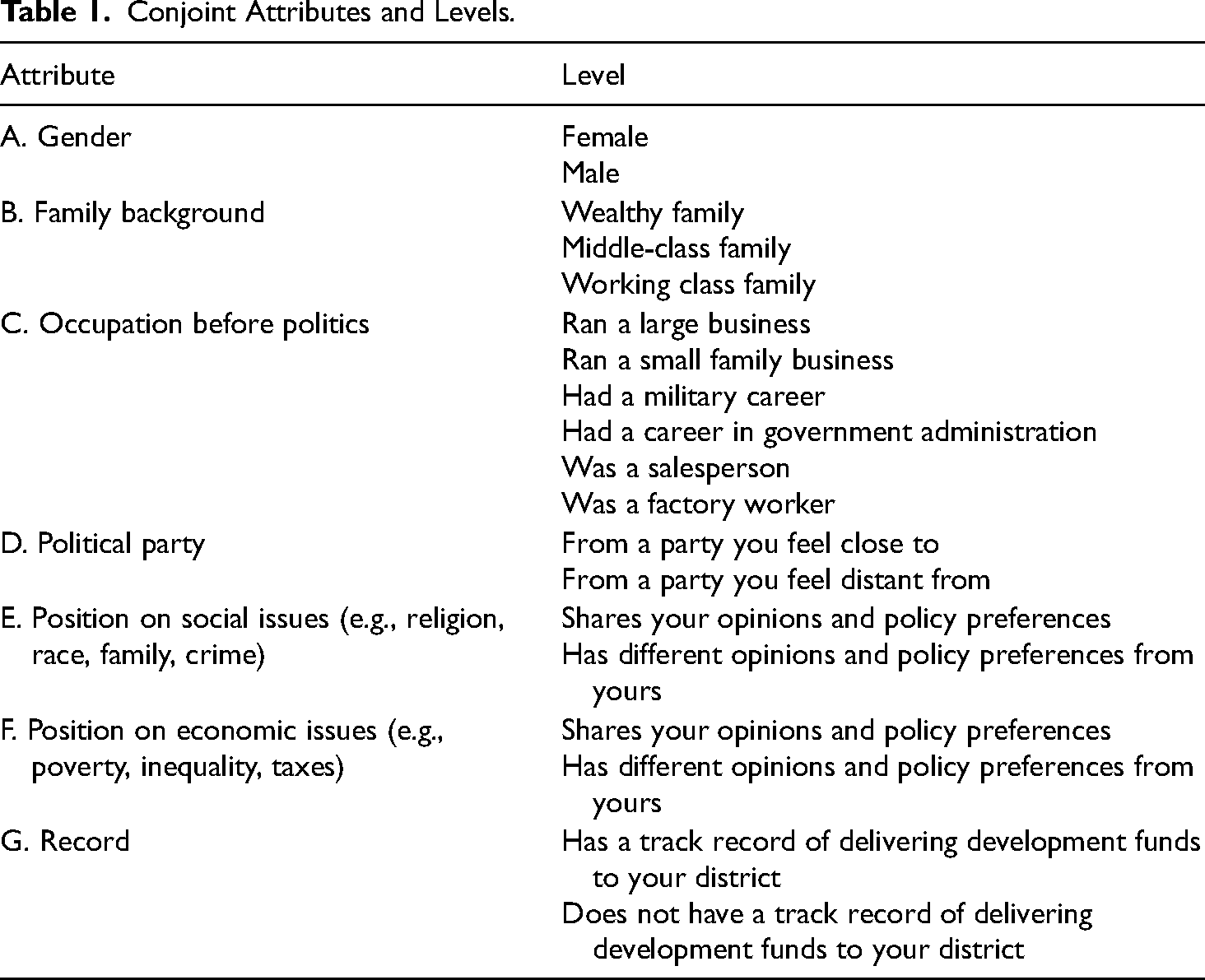
The remaining attributes in the conjoint design capture key aspects of a candidate's political and ideological profile. In Southeast Asia, however, political affiliations and ideological orientations are often mutable, party systems often feature several key players and complex coalitional politics, new actors may rapidly acquire political clout, and ideological labels such as “left” vs. “right” or “liberal” vs. “conservative” are not always understood by voters. To address these issues, we anchor each political and ideological attribute relative to the respondent's own preferences, setting their position as the baseline. This approach frames the candidate as either aligned or unaligned with the respondent's political preferences, creating attributes such as “from a party you feel close to” versus “from a party you feel distant from,” or holding “the same” versus “different” opinions on social and economic issues. By doing so, we ensure consistency in how the attributes are designed across countries, increase the clarity of the profiles for respondents, and facilitate more straightforward interpretation in data analysis.
It should be noted that voters in real elections often face significant informational constraints and may lack reliable knowledge about where candidates stand on key policy issues. Conjoint analysis allows us to isolate the relative importance of different candidate attributes under the assumption that voters can make an informed choice when presented with appropriate information. While this experimental setup may differ from real-world conditions, it provides valuable insight into the extent to which voters would prioritize shared policy preferences if such information were readily available. A related issue concerns the interpretation of partisanship across different political contexts. In some cases, political parties are well-differentiated and operate within polarized party systems, whereas in others, partisan distinctions are weaker or less meaningful to voters. As a result, an attribute level such as “from a party you feel distant from” may resonate differently according to political context. Given the comparative nature of our study, we have prioritized standardization across cases to maintain cross-country comparability. However, in the empirical section, we also contextualize these findings and discuss how political environments may shape the way respondents interpret and respond to the partisanship attribute.
The final attribute in the conjoint design captures a candidate's incumbency record, specifically their ability to deliver development funds to their district. The effect of this candidate feature should be interpreted broadly as an incumbency advantage, which typically refers to the electoral benefits that current officeholders gain due to their visibility, established networks, and access to resources (Dettman et al., 2017). To a certain degree, this attribute could also be used by respondents as a shortcut to infer about desirable candidate traits such as experience and competence. At the same time, given that clientelistic linkages are prevalent in the context of Southeast Asia, incumbents often use these resources to distribute targeted benefits, such as development funds or services, directly to local constituencies. In this sense, incumbency advantage is closely linked to a candidate's capacity to meet clientelistic expectations through material support. It would be a mistake, however, to interpret this attribute solely as an indicator of clientelism, as it may also encompass other aspects of the incumbency experience. 6
For the analysis of our conjoint experiment data, we estimate linear probability models with standard errors clustered by the respondent, an approach valuable for its simplicity in both estimation and interpretation. In these models, the estimated coefficients represent the average marginal component effect (AMCE), or the estimated change in the probability of a respondent choosing a candidate, given a discrete change in the attribute in question from a baseline value, all else being equal. Additionally, to maintain realism in the candidate profiles, we exclude implausible combinations of attributes from the analysis, as such combinations might reduce respondent engagement or lead to inconsistent responses. 7 To probe the robustness of the findings, we re-estimate the pooled data model by adding socio-demographic control variables (age, gender, education, and income), by estimating different functional forms (simple logit and conditional logit for paired data) and by including implausible combinations. Results are remarkably consistent across estimation, as reported in Table A2 in the Appendix.
The Drivers of Candidate Choice in Southeast Asia
Figure 1 shows a coefficient plot for the model estimated with the pooled data and allows visual inspection of how each candidate attribute uniquely shapes voter choices. For each attribute, the baseline value is represented by a circle along the dashed vertical line at zero, while the other circles and 95percent confidence intervals represent the effect of the other attribute values. Gender, the attribute at the top of the list, appears to play a significant role, with female candidates being 4.8 percent less likely to be selected than male candidates. This finding would suggest that the underrepresentation of women in the region is indeed rooted in social prejudice, at least to a certain degree. However, we show in the next section that region-wide generalizations should be avoided because of substantial variation across country.
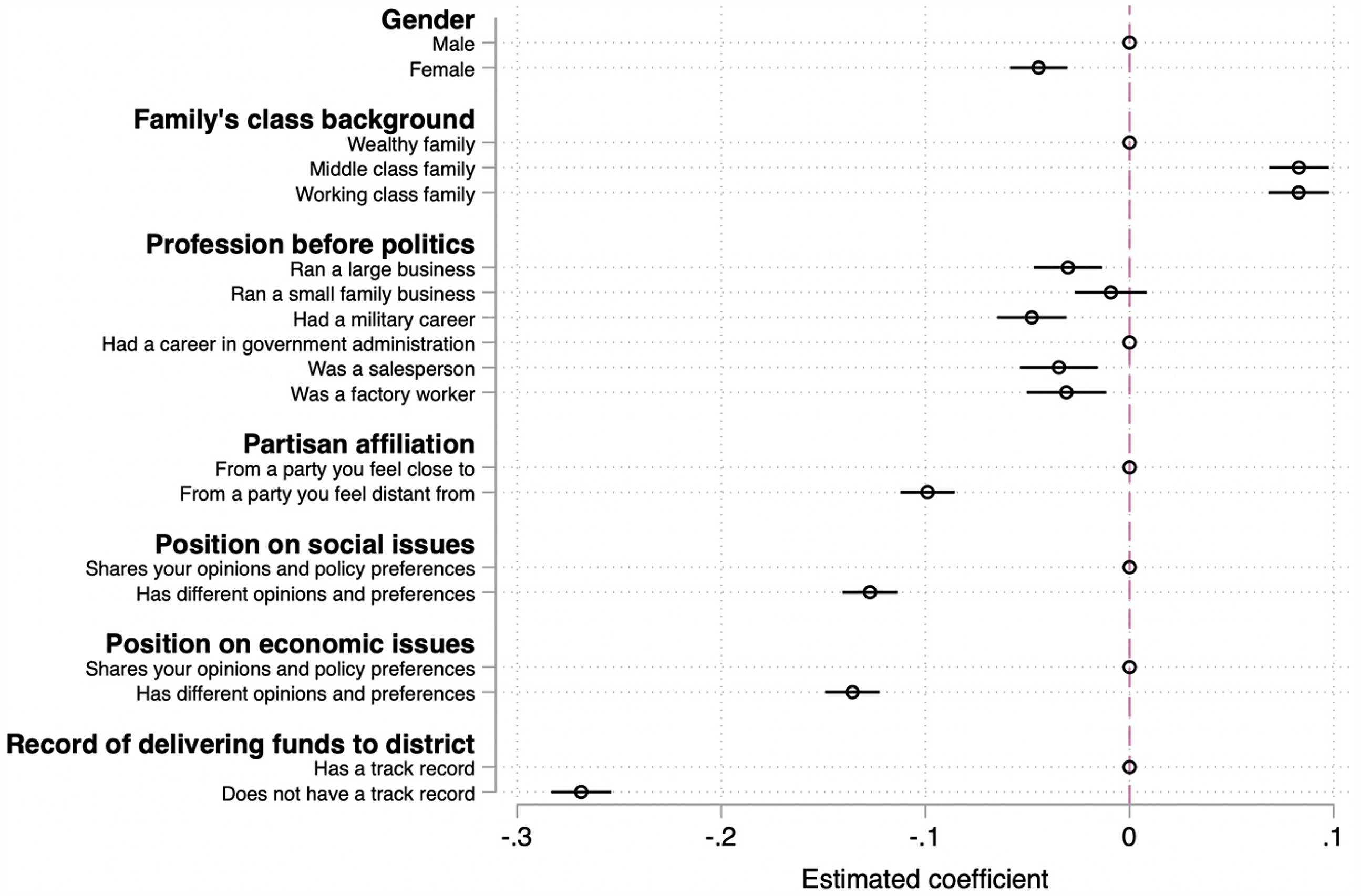
Determinants of Candidate Choice, Pooled Samples (with 95 percent Confidence Intervals).
Social class origins also emerge as a critical factor in candidate choice. However, the estimated coefficients suggest that lower-class candidates are not penalized, and, in fact, may count on an electoral advantage vis-à-vis those coming from more privileged backgrounds. Specifically, both candidates from middle- and working-class backgrounds have an increased probability of 8.8 percent of being chosen, when compared with candidates from wealthy families. This finding may be surprising given the stark economic inequalities in Southeast Asia, and deep-rooted elitist prejudice towards political participation from lower social classes. Yet, it resonates with the comparative literature on “humble beginnings” reviewed above and suggests that voters may see candidates from modest backgrounds as more relatable or empathetic to their own experiences and challenges.
Results are less straightforward, however, for the profession attribute. Here, the baseline level displayed in the chart is having a prior career in government administration, and all the estimated coefficients are negative. This means that Southeast Asian voters prize experience in public affairs when assessing a candidate's profession before entering politics, as all other professional profiles have a lower chance of being selected. Certain professional paths, such as military service or running a large business, are associated with a decrease of 3–5 percentage points in the probability of being chosen. These results help clarify the ones for social class, discussed in the previous paragraph. While voters view very favorably candidates of modest origins, such favorability does not extend to candidates who have remained in menial professions like factory worker or sales attendant. Ideas of social mobility and deservingness, therefore, presumably play an important role in the evaluation process, and the positive effect of lower-class origin cannot be solely attributed to perceptions of relatability and empathy.
Moving beyond socio-demographic characteristics, partisanship exerts a significant influence on candidate selection, as candidates from a party with which the voter feels distant are 9.8 percent less likely to be chosen. This finding underscores the strength of partisan alignments in a region that is often described as having weak political parties and volatile or underdeveloped party systems. Even in such a context, partisanship may be a key factor in voting behavior, and the magnitude of the coefficient suggests that it is a more important driver of candidate choice than many other candidate traits. However, as noted earlier, the significance and meaning of this attribute is likely to vary across the diverse set of countries in our study. In the next section, we explore these cross-country differences in greater detail.
Policy positions on social and economic issues also play a very important role in candidate evaluation. Candidates whose positions on social issues differ from those of the voter see about a 12 percent reduction in their likelihood of being chosen, while candidates with opposing views on economic issues face a decrease of 13.6 percent. The results for social issue positions are aligned with expectations outlined in the previous section, and they remind us that many Southeast Asian voters care about the social and political debates salient in their countries. The findings for the economic policy attribute are somewhat more surprising, given the lack of party differentiation on this policy dimension. However, the fact that Southeast Asian voters, as discussed above, deeply care about economic development, and sometimes prioritize it over other desirable outputs, may help explain this finding. Even in electoral contexts in which economic policy positions are similar across parties, the economy can be salient, and candidates may find ways to differentiate themselves on this issue.
Finally, incumbency record, specifically the ability to deliver development funds to the district, has the strongest effect on the probability of being chosen. Candidates without this track record see a substantial 26.8 percent decrease in their likelihood of selection, indicating that voters place a high value on tangible, locally targeted benefits. As mentioned in the previous section, some caution is needed in interpreting this result, as the attribute may capture different aspects of the incumbency advantage. Nevertheless, the fact that the attribute explicitly mentions the delivery of targeted development funds suggests that Southeast Asian voters appear to generously reward candidates for directly and materially benefiting their communities.
When comparing the effects of these attributes, incumbency record and policy alignment therefore emerge as the most influential factors in candidate selection. Partisanship and alignment on social and economic issues also have substantial effects, showing that ideological and identity alignment are significant drivers of voter support. In contrast, while attributes like gender and professional background may be statistically significant, their effects are smaller in magnitude. While voters may express preferences based on demographic characteristics, they prioritize policy alignment, tangible development outcomes, and partisan affinity when making their choices.
Exploring Variation Across Country
Figure 2 reports results for the country-specific estimations from the conjoint experiment, with distinct patterns emerging across different countries. 8 When interpreting cross-country variation in the results, two important caveats should be acknowledged. First, it is inherently difficult, based on data from survey experiments alone, to determine why a given coefficient is statistically significant in one survey but not in others. Any explanations for such differences are necessarily post hoc and speculative, as the experimental design was not explicitly structured to allow for such nuance, context-specific explanations. While contextual political factors may provide plausible explanations, these interpretations should be seen more as hypotheses for future research than definitive conclusions.
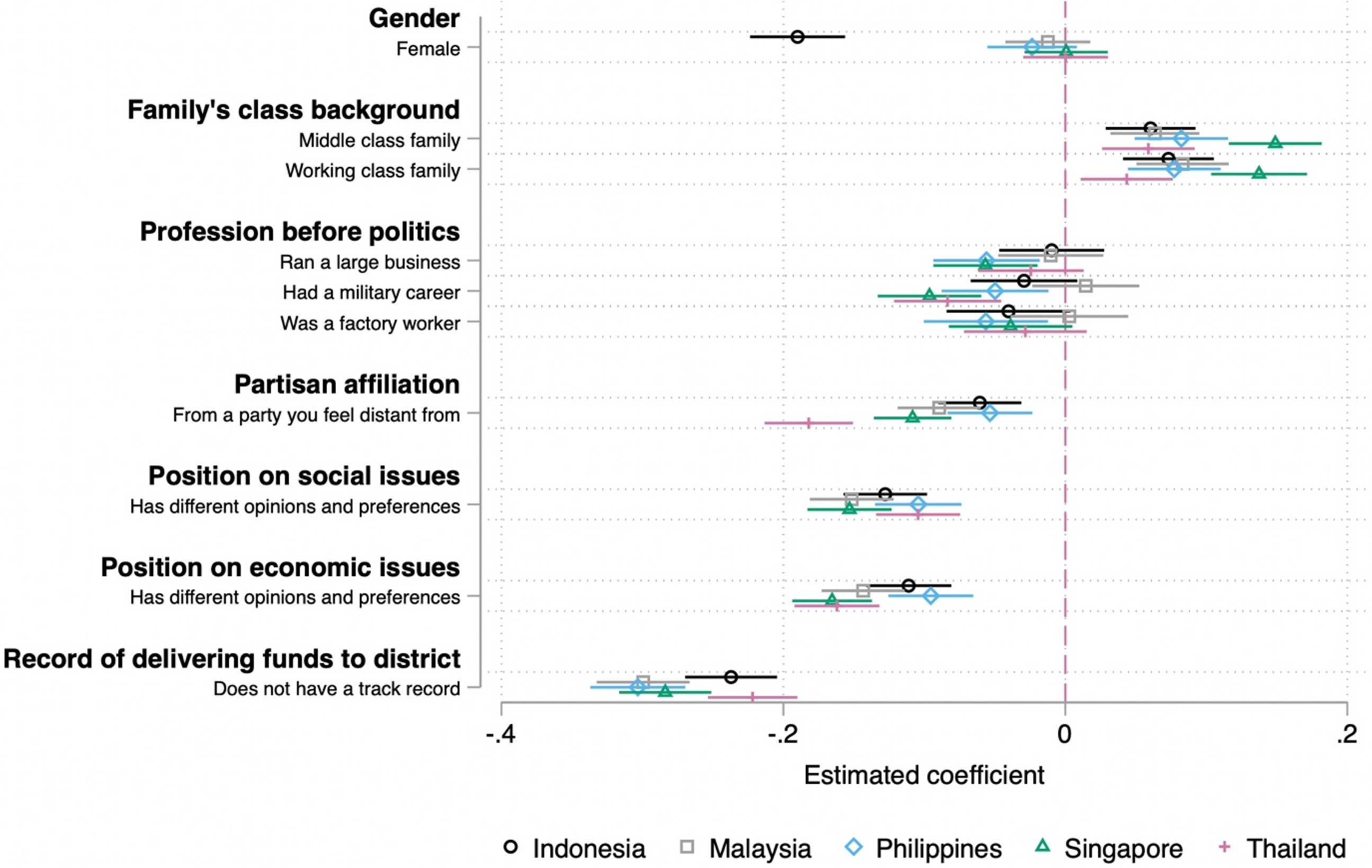
Determinants of Candidate Choice, by Country (with 95 percent Confidence Intervals).
Second, the country-specific estimates reported in Figure 2 are derived from separate models, each estimating AMCEs within a single country. This approach ensures that the results are appropriate for testing the null hypothesis of whether a given attribute has a statistically significant effect within each case. However, as Leeper et al. (2020) caution, direct comparisons of AMCEs across subgroups or country cases can be problematic, as AMCEs are influenced by potential differences in baseline preferences and attribute distributions. For example, a significant difference in the estimated AMCEs for a “military career” across two countries may not be solely due to differences in voter preferences for candidates with a military background, but also to differences in how candidates in the baseline category—experience in government administration—are perceived. To be sure, in our experiment, most attributes have only two levels and the differences across country in ACMEs are generally not very large, which substantially reduces the risk of misinterpretation. Nevertheless, to address this issue, we analyze marginal means, which represents the probability that a candidate with a specific attribute level is chosen, all other attributes being equal.
The first attribute is gender, and it shows stark variation across countries. While in four of the five countries we study women candidates are not any more or less likely to be chosen, females are at a very substantial disadvantage in Indonesia. A woman candidate in Indonesia has a marginal probability of being chosen of 40.9percent while the figure for other countries ranges between 48.4 percent (Philippines) and 50 percent (Singapore). This shows that the negative effect found above in the pooled data is entirely driven by the Indonesian sample. Accounting for this distinctiveness of the Indonesian case is not straightforward, since, as noted above, women candidates face a similar set of challenges across the region, and Indonesia does not stand out as a case with especially low levels of representation. While puzzling, these results, further analyzed in the next section, resonate with existing research showing that negative attitudes towards women are widespread in this country, and they may even have worsened over the years despite socioeconomic modernization (White et al., 2024).
Social class background affects candidate choice in all countries, with candidates from middle- and working-class origins generally preferred. An analysis of marginal means, however, suggests that the probability of choosing a non-elite candidate is rather similar across countries, with very few significant differences. Professional background also varies across countries, although here too the range of variation is quite limited, and differences across countries are not generally significant. Our results suggest that military-background candidates, in many cases, do not fare any better or worse when compared with others with different occupational backgrounds before entering politics. In the case of Thailand, however, a candidate with a military background has a significant disadvantage vis-à-vis candidates of several other backgrounds, having an estimated probability of being chosen of 42.9which is significantly lower than for most other countries (for example, 51.2 percent in Malaysia and 50.2 percent in the Philippines). These results may be attributed to the political context described above, as the military are closely associated with authoritarian features of the regime that are strongly disliked by many voters; indeed, Thailand is the country with by far the lowest public trust in the armed forces among the five we cover. 9
Partisanship is significant across all five countries, but especially so in Thailand, where candidates from distant parties have a probability of being chosen of 41.5 percent, significantly lower than for any other country we study, where this value ranges from 44.5 percent (Singapore) to 47.7 percent (Philippines). This reflects Thailand's highly polarized political landscape, where party affiliation often aligns with strong ideological divides that make partisanship a defining factor in voter decision-making. In contrast, Indonesia and the Philippines exhibit a considerably weaker negative effect. In these contexts, where politics is generally less programmatic and polarized, many voters lack strong partisan attachments, and the prompt “a party you feel distant from” may not carry the same weight.
Finally, incumbency record, as measured by a candidate's ability to deliver development funds has a universally strong effect, with the largest effects being observed in Malaysia, the Philippines, and Singapore. It is worth noting that, as described above, majoritarian electoral laws, and first-past-the post especially, are predominant in each of these countries’ electoral systems. This perhaps could help to explain this especially strong finding, as the idea of “district” and service to a narrowly defined constituency might resonate among voters especially where such institutions are in place. Thailand as well has a substantial majoritarian element to its electoral system, although the high degree of polarization there, also identified in the very strong effect of the partisanship treatment, may imply a somewhat lower salience of materialistic selective benefits. Indeed, the difference in marginal probabilities between a candidate with and without a record of delivering funds to their districts in Thailand is 21.2 percent, significantly lower than the 30.6 percent estimated for the Philippines.
Heterogeneity Across Groups of Voters: Two Illustrations
We have so far compared the effects of various candidate attributes on voter choice and explored some interesting patterns of variation across the country. In this section, we deepen the analysis by examining how the effects of selected attributes vary not only across countries but also within specific respondent groups. By analysing effects within subgroups as defined by factors such as gender, income, education, and political ideology, we can better capture the heterogeneity of voter preferences and the varying ways in which experimental treatments intersect with individual characteristics. We focus especially on two cases identified in the previous section as somewhat unique, specifically the effect of gender treatment in Indonesia and partisanship treatment in Thailand. For each, we offer a comparison with a contrasting case, namely Malaysia and the Philippines, respectively. While focusing on these two cases does not provide a full analysis of treatment effect heterogeneity across all attributes and samples, this targeted approach may help us uncover context-specific dynamics that might otherwise be obscured in broader, cross-case comparisons. 10
The first attribute we examine is gender, with a particular focus on Indonesia, where the negative effect for female candidates stands out as markedly stronger than elsewhere. To investigate if this effect is driven by a specific group of voters, we conduct subgroup analyses across three key socio-demographic categories, namely gender, educational attainment, and income level. 11 Male and female respondents may hold differing views on female leadership due to gendered socialization or expectations, while respondents with a college education might exhibit more progressive views on gender. Income level may also be relevant, as individuals from lower-income backgrounds could be more likely to prioritize economic concerns over gender equality, or it could compound the effect of education and reflect more conservative societal norms prevalent in less privileged socio-economic strata.
In addition to these socio-demographic factors, we also consider political ideology, since views of state-Islam relations, as mentioned above, represents a central ideological divide in Indonesian politics and are closely linked to attitudes about gender roles. To measure ideological orientation, we asked respondents whether they believe Islam should have a greater role in Indonesian politics and society. Respondents who agreed or strongly agreed with this statement, constituting 23 percent of the sample, are classified as “Islamist.” Given that Islamic values often emphasize traditional gender roles, Islamist respondents may show stronger biases against female candidates and evaluate them more negatively.
The subgroup analysis for Indonesia, as shown in the left panel of Figure 3, reveals that highly negative effects of candidate gender occur among male respondents, where female candidates are 29.4 percentage points less likely to be chosen, and among respondents with Islamist views, who exhibit a similarly strong bias of 25.2 percentage points. However, even among groups that might be expected to hold more progressive views, such as women, non-Islamist and higher-income individuals, female candidates are evaluated significantly more negatively than males. The probability of choosing a female candidate is below 50 percent in all groups, being estimated at 35.3 percent among men, 46.5 percent among women, 37.4 percent for Islamists, 42 percent for non-Islamists and 31.7 percent for Islamist men. Surprisingly, there is little difference across education levels, with college-educated respondents showing only a slightly lower bias compared to those without higher education. The general result of this analysis therefore points to the pervasiveness of gender stereotypes in Indonesia.
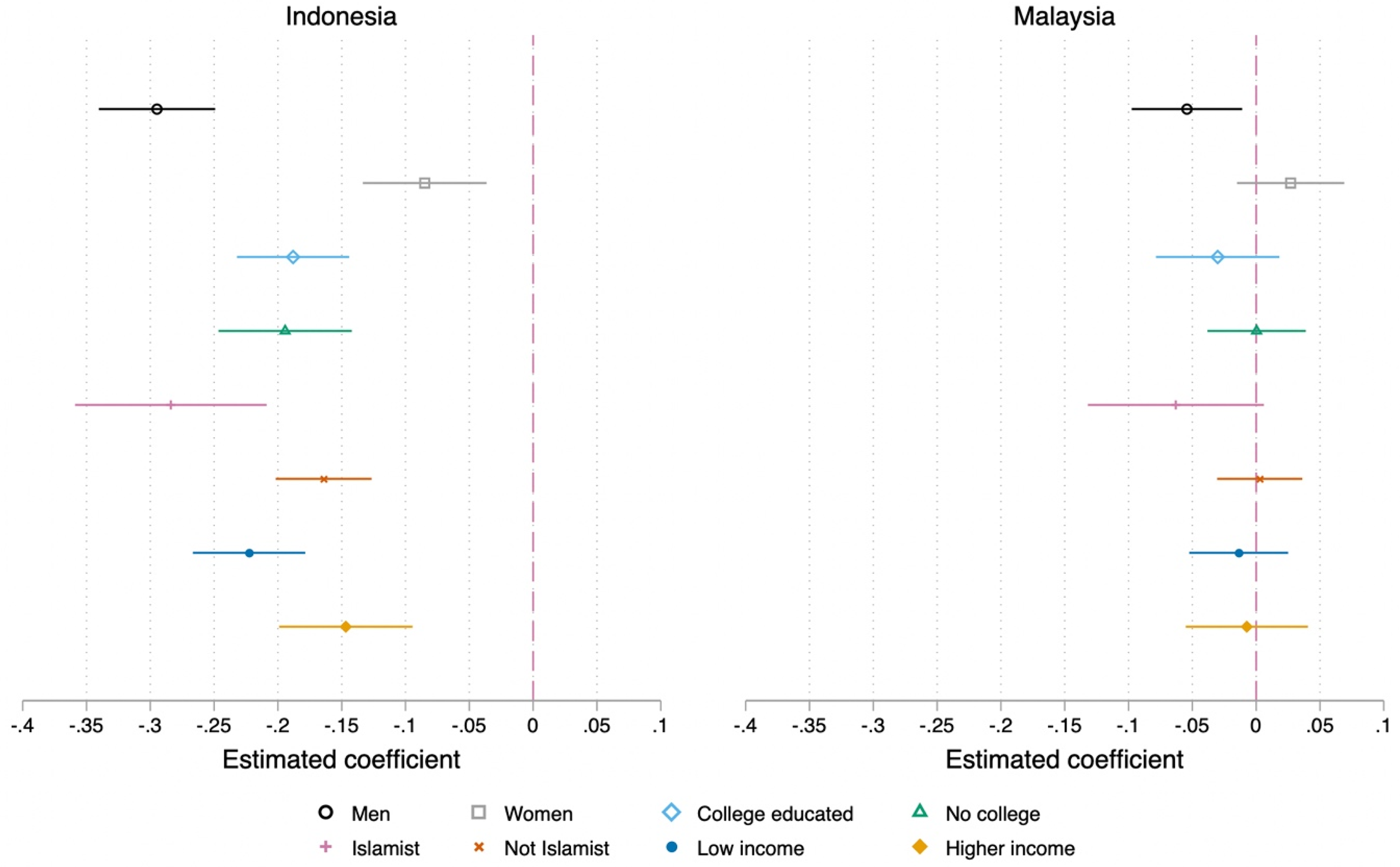
Effect of Candidate Gender on Choice for Different Groups of Voters, Indonesia and Malaysia (with 95 percent Confidence Intervals).
To contextualize these findings, the right panel in Figure 3 reports results for Malaysia, another Muslim-majority country. The socio-ideological profile of those most hostile to female candidates in Malaysia is the same, as male and Islamist respondents consistently exhibit the strongest negative effects. However, in this sample, the estimated coefficients for the gender attribute (female), while negative, are not statistically significant from zero in almost all groups. Even for men, the only group where the effect is significant, the marginal probability of choosing a female candidate is 47.4 percent, much higher than for men in the Indonesian sample. Explaining the unexpected difference between Indonesia and Malaysia is beyond the scope of this article. Nevertheless, the results demonstrate that it is possible for Muslim-majority societies to have large segments of the electorate that do not view female candidates unfavorably; while some patterns of discrimination may be shared across contexts, their intensity and prevalence are not uniform and could possibly be mitigated.
The second attribute we further explore is the role of candidate partisanship, for which we examine its effects within the context of Thailand and the Philippines. While Thailand is highly polarized due to its long-standing political conflict between the royalist-military establishment and pro-democracy or populist movements, the Philippines lacks strong partisan polarization because its political system is dominated by personalistic, patronage-driven networks. As we compare the two countries, we also examine differences in the effect of candidate partisanship across various groups of voters, as defined by their partisan orientations. First, we consider respondents’ support for the incumbent head of government (prime minister in Thailand and president in the Philippines) and categorize them as supporters, opponents, or neutrals as a proxy for general partisan orientation. 12 This measure allows us to investigate if the effect of partisanship on candidate choice is asymmetric across partisan groups, as some of them (especially more moderate, centrist voters) may be less polarized than others. 13 Second, we use an indicator of affective polarization by asking respondents how much they trust individuals with opposing political views. Here, the expectation is that voters who show little or no trust in those with opposing political views will respond more forcefully to the partisanship treatment, given their higher levels of affective polarization. 14
The subgroup analysis of candidate partisanship in the Philippines and Thailand highlights notable differences. In Thailand (left panel of Figure 4), the effect of having a candidate from a distant party is strong and significantly negative across all subgroups, reflecting the country's deeply polarized political landscape. At the same time, differences across partisan groups are significant. The estimated probability of choosing a candidate from a distant party is 44.9 percent among neutral respondents, significantly lower at 40 percent for pro-opposition individuals, and 41.3 percent for government supporters. Results for groups as defined by their level of affective polarization similarly conform with theoretical expectations, with polarized individuals being less likely to choose a candidate from a distant party than non-polarized ones (the estimated probabilities are 40.2 percent and 43.3 percent, respectively). These results indicate that in Thailand, partisanship is a defining feature of voting behavior: it is a highly influential factor in voter choice for most voters, and its effect varies predictably across voter segments.
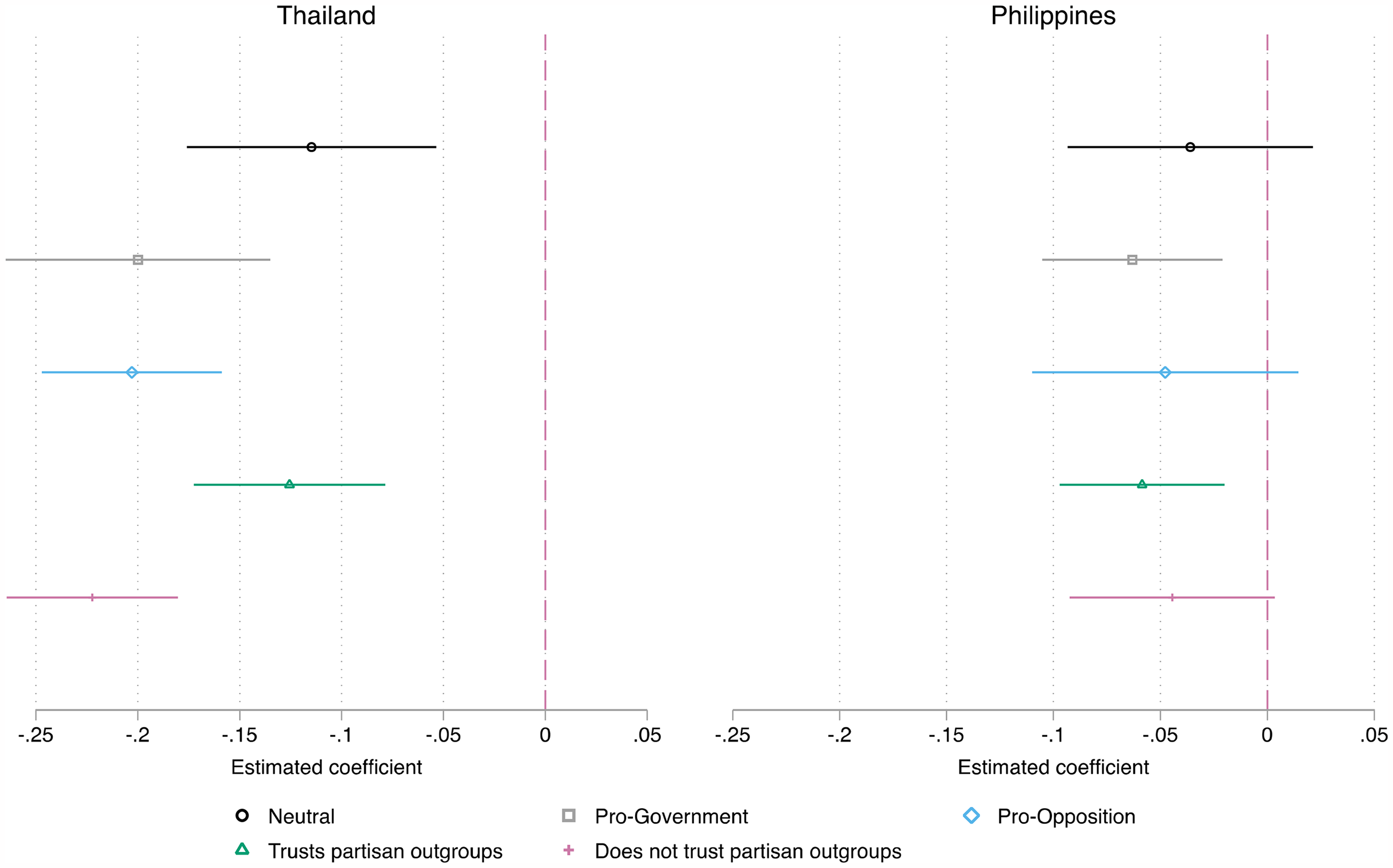
Effect of Candidate Partisanship on Choice for Different Groups of Voters, the Philippines and Thailand (with 95 percent confidence intervals).
In contrast, the Philippines (right panel of Figure 4) shows much weaker, less consistently negative and less predictable effects of candidate partisanship across groups of voters. These patterns suggest that many Filipino voters, even when holding partisan preferences or demonstrating some degree of affective polarization, may be relatively tolerant of candidates from distant parties. Yet, the inconsistent results also indicate that partisanship is not a central organizing principle in Filipino politics. As a result, Filipino voters may not interpret partisanship in the same way as voters in systems with more ideologically differentiated political parties, such as Thailand, and may rely less on partisanship as a heuristic for candidate evaluation.
Conclusions
This study has highlighted the dynamics of electoral decision-making in Southeast Asia, focussing specifically on candidate choice. Our experimental approach has allowed simultaneous analysis of various factors orienting voting behavior among Southeast Asian voters. Among these, the findings reveal that a candidate's ability to deliver tangible benefits to their constituency is the most influential. Beyond this, however, the analysis has also found strong effects of a candidate's partisanship. Particularly in contexts marked by strong political polarization, voters penalize candidates whose partisan and ideological affiliation they feel distant from. Policy positions, both on social and economic issues, also affect voter preferences significantly in all the five countries we study. While there is variation both across the country and across groups of voters, the effects of partisan and ideological factors typically trump those of candidate characteristics such as gender and social class.
The limitations of our methodological approach should be considered when interpreting the findings. First, the design does not explicitly account for ethnicity and religion, both of which can be highly salient factors in some Southeast Asian electoral contexts. Second, while the incumbency attribute may partially capture clientelistic linkages, the experiment lacks a dedicated measure of clientelism, such as explicit references to vote buying, patronage networks, or discretionary resource distribution. More broadly, like all survey experiments, this study presents a simplified decision-making environment, which does not fully capture the strategic and contextual complexities of real-world elections. Finally, while efforts were made to ensure a diverse and representative sample, survey respondents do not necessarily reflect the full demographic and political composition of the electorate. Because of these limitations, the results should be interpreted with caution. Nevertheless, this study represents the first systematic and controlled examination of voter preferences across five Southeast Asian countries, complementing observational studies of electoral behavior and providing a valuable foundation for future research.
With this caveat in mind, the findings from this study offer important insights into voting behavior in Southeast Asia. First, they paint a picture of voter preferences in the region that is more complex than often assumed. While the results suggest that clientelistic practices are plausibly a significant factor, they also challenge the notion that Southeast Asian politics is dominated by clientelism, as we demonstrate that ideological, partisan, and policy-based considerations all play meaningful roles in shaping electoral decisions. This complexity highlights the importance of moving beyond simplistic interpretations of the region's political dynamics and instead recognizing how multiple, intersecting, and sometimes contradictory factors combine to shape voter behavior. In Southeast Asia, as elsewhere (Contreras, 2024; Singer and Kitschelt, 2011), clientelistic and programmatic politics can co-exist.
Second, the results have broader implications for democratic accountability and representation in the region. A growing body of literature, as previously mentioned, explores the determinants of representation inequalities, particularly regarding gender, and to a lesser extent, ethnicity, and social class. These studies often focus on structural and institutional barriers, such as political finance, exclusive political parties or weak enforcement of gender quotas to explain underrepresentation. Our study shifts attention to the demand side, examining whether voters themselves discriminate against candidates from underrepresented backgrounds. In general, voters appear willing to support female candidates and are sympathetic toward lower-class candidates who demonstrate competence and ability. These results resonate with studies in other contexts who failed to identify biases in voter evaluation of underrepresented groups such women working class individuals (Carnes and Lupu, 2016; Schwarz and Coppock, 2022), although bias could work in more subtle ways than we were able to explore in this article (Madsen, 2019).
Building on the findings of this study, future research could deepen our understanding of voting behavior in Southeast Asia and contribute to comparative studies. First, the interaction between the various factors explored here warrants closer examination. For example, the coexistence of clientelistic practices and programmatic politics raises questions about how these two dimensions interact to influence voter preferences and electoral outcomes. Another important avenue involves exploring how gender intersects with other factors such as class, partisanship, or policy positions, and the intersection between descriptive and substantive representation (Boas and Smith, 2019; Jones, 2014). Second, the role of institutions merits further exploration. Electoral systems or the implementation of gender quotas, for example, may play a critical role in shaping candidate evaluation and choice (Neschen and Hügelschäfer, 2021). Research in this area could not only enhance theoretical understanding but also yield prescriptive insights for policy reforms aimed at promoting inclusive and equitable representation.
Supplemental Material
sj-docx-1-saa-10.1177_18681034251334253 - Supplemental material for What Drives Voting Behavior in Southeast Asia? Evidence from Candidate Choice Experiments in Five Countries
Supplemental material, sj-docx-1-saa-10.1177_18681034251334253 for What Drives Voting Behavior in Southeast Asia? Evidence from Candidate Choice Experiments in Five Countries by Diego Fossati in Journal of Current Southeast Asian Affairs
Footnotes
Acknowledgements
The author is grateful to Nicholas Kuipers and participants of the Eleventh Annual Conference of the Australian Society for Quantitative Political Science for comments on an early draft of this manuscript. Comments from the anonymous reviewers have greatly contributed to developing the manuscript.
Declaration of Conflicting Interests
The author declared no potential conflicts of interest with respect to the research, authorship, and/or publication of this article.
Funding
The author disclosed receipt of the following financial support for the research, authorship, and/or publication of this article: This work was supported by the University Grants Committee (grant number GRF # 11610021).

Supplemental Material
Supplemental material for this article is available online.
Notes
Author Biography
References
Supplementary Material
Please find the following supplemental material available below.
For Open Access articles published under a Creative Commons License, all supplemental material carries the same license as the article it is associated with.
For non-Open Access articles published, all supplemental material carries a non-exclusive license, and permission requests for re-use of supplemental material or any part of supplemental material shall be sent directly to the copyright owner as specified in the copyright notice associated with the article.
