



Abstract
This article reinterprets the Thai discourse of bamboo diplomacy. In a normative study of Thai foreign policy, bamboo diplomacy has been readily taken as a self-explanatory approach behind the resilience of Thailand's position through bending with the prevailing wind of international politics for its survival. However, the oversimplification of this view of bamboo diplomacy belittles the reality in which the making of Thai foreign policy demands careful calculations and even sacrifices from the political elites. Proposing a reinterpretation of Thai diplomacy, the article argues that Thai bamboo diplomacy has been shaped by the interplay between interests and values as a basis of the shift of Thai positions and alliances throughout the country's history. A main research question is: Under which condition is a values-based Thai foreign policy formulated and implemented? While the interests-driven approach has remained central to Thai foreign policy, Thailand has demonstrated some resilience in its shift towards a values-based foreign policy if dictated by domestic and international factors. Under this circumstance, values are vital as a legitimisation mechanism for the shift of foreign policy and alliances for the ultimate attainment of national interests.
Introduction
Thai diplomacy is often described as resilient. Analysts recount how the art and mastery of Thai diplomacy enabled Thailand alone, among Southeast Asian nations, to escape colonisation and to thwart a major communist insurgency during the Cold War. Through resilient diplomacy in the face of shifting international conditions, Thailand managed to elude total foreign domination. The constant need to preserve the country's independence and protect national security has long dominated Thailand's foreign policy decision-making process. Since the dawn of Thai interactions with the outside world, the conduct of “bamboo diplomacy” – deeply rooted yet bending with prevailing wind – has seemingly served as a major part of a foreign policy strategy (Kislenko, 2002: 537). It suggests that Thailand consistently bends towards any prevailing side for the ultimate attainment of national interests. But bending with the prevailing wind has never been a simple choice for Thailand given the intricacy of international politics. It has demanded, among many things, many calculations, justifications, and even sacrifices in making a foreign policy that guarantees national survival and that of the political regime. Such demands necessitate an in-depth analysis of the bamboo diplomacy beyond its usually indolent interpretation to make a logical sense of the (sudden) shift of Thai position and alliance over the long history of Thai foreign relations.
Attempts were made in the past to reinterpret the bamboo diplomacy. For example, Jittipat Poonkham argued that the bamboo diplomacy was in fact a recent construct as a narrative to manage Thai anxiety caused by the changing world order, particularly the prospect of American retrenchment from Southeast Asia in the wake of the 1975 Vietnam War. The bamboo diplomacy discourse was produced only in the late 1960s, when Thailand began to conduct a different set of diplomatic practices towards the USSR and China (Poonkham, 2022: 3). His interpretation however seemed to suggest that the bamboo diplomacy was essentially shaped by the realist outlook of international politics. Traditionally, Thai elites have upheld a realist stance in confronting international realities and interacting with other states under the constraints of the international system. A general theme according to the realist theory is that states are unitary actors striving to maximise their self-interest in an environment of other competing actors, resulting in a perpetual struggle for survival, power, and wealth. Even in the post-Cold War era, the realist reading of international politics has remained unaltered (Sebastian, 1999: 220). Thai elites have closely followed the realist tradition in the manoeuvring of the country's international relations. Thailand, formerly known as Siam, emerged from the colonial period as an independent modern state. The pride of never having been officially colonised contributed to the state's overemphasis on national security and survival. But this overemphasis has led to a constricted interpretation of Thai diplomacy.
This article explores the Thai bamboo diplomacy from another angle. It seeks to highlight the complexities of the bamboo diplomacy by demonstrating how values legitimise policy shifts throughout the different periods of Thai interactions with the outside world. For this purpose, the article focuses on the interplay between values and interests to understand the resilient nature of Thai diplomacy. It is true that the Thai foreign policy has traditionally been built on realism. Thus, it has been predominantly interests-driven. The study however examines the role of values in the conduct of diplomacy. The main point is that the construction of values affects and justifies the country's foreign policy interests. The view on values is at the core of the so-called Western enlightenment, where secularism, rational thought, and scientific achievement were conceived as basic values for human improvement. Today, this set of values is extended to include, among others, commitment to democracy and human rights, a respect for the environment, a desire to encourage fairness on the global stage (fair labour, business, legal, and governance arrangements), and recognition of the importance of tolerance and a desire to promote that to others (Lee, 2002: 1-9).
Values have indeed come to play a meaningful role in the conduct of Thai diplomacy. The country has relentlessly searched for a balance between its adherence to interests and values in foreign policy (note that values are also a kind of “ideational interests” that are different from “material interests” fundamental for the realists). Among a myriad of values, democracy was chosen to represent not only a Thai value in foreign policy but also the country's image and identity projected to the world. Democracy as an image and identity fits perfectly with the reinvention of Thailand as an emerging democratic state in the context of the Cold War in which the Free World was fighting against communism. It can be argued that interests and values are not necessarily alternative pathways for conducting Thai diplomacy. Yet, they can be essential connections. E H Carr's magnum opus, “The Twenty Years’ Crisis,” advanced a classic claim that “thought” and “material” factors are inseparable from each other. Thought is consistently employed to legitimise material interests. It is unlikely for policymakers to claim any material interests without relying on ideational elements (Carr, 2016: 84-88).
While the interests-driven realist approach has been the mainstay of the Thai foreign policy, Thailand has been resilient in adopting the values-driven approach to justify its shift of position as dictated by domestic and international factors. Under this circumstance, values serve as a crucial element in influencing the choice of partners that the country selects through foreign policy. This study argues that the resilience of the Thai bamboo diplomacy, often portrayed through its skill in bending with the prevailing wind, is determined by the complex interplay between interests and values. The research question for this study is: Under which condition is a values-based foreign policy formulated and implemented which leads to policy shifts? The switching back and forth between interests-driven and values-driven foreign policies – and sometimes combining the two together – to fulfil the national interests is this study's reinterpretation of the bamboo diplomacy.
Analytical Framework: Values as Legitimisation Mechanism
Literature on values in foreign policy is abundant. Scholars agree with the interwoven nature of the two notions. They function in a complementary and conflicting manner. Krishnan Srinivasan, James Mayall, and Sanjay Pulipaka examine the importance of value and its interconnectedness with power and interests in foreign policy (Srinivasan, Mayall & Pulipaka, 2019: 4). One of the themes in his book is the incongruity between the universalisation of Western values and the alternative value systems including Asian values. On the surface, the incongruity appears to engage with the discourse of the clash of civilisations. However, at the core of this incongruity is fundamentally the defence of political regime. States uphold certain values to legitimise certain principles or ideologies crucial for the stability of the regime. Concludingly, values matter in foreign policy. They interact with power, interests, and circumstances to shape outcomes (Sally, 2020).
Other studies perceive values as a key leverage in the conduct of diplomacy. Gareth Evans explores the foreign policy of Canada and Australia, arguing that adhering to values could be seen as a strategy in achieving national interests. He asks: Why should Canadians, Australians, or anyone else care about human rights atrocities, health epidemics, environmental catastrophes, weapon proliferation, and other problems afflicting far-away countries when they do not have any direct immediate impact on their own physical security or economic prosperity vis-à-vis their traditionally defined national interests? His thesis is that acting as good international citizens wins hard-headed reputational and reciprocal-action returns and as such bridges the gulf between idealism and realism by giving realists good reasons for behaving like idealists (Evans, 2016: 7-10). Values should not be just optional add-ons to state's foreign policy. They should be embedded in foreign policy. Similarly, Terence O’Brien argues that New Zealand has struggled to fashion long-term relations in Asia because its interests and values are focused predominantly on an Atlantic-centred English-speaking world. Awkwardly, while interests to be gained from building ties with its Asian neighbours have been a drive in New Zealand's foreign policy, its values continue to derive traditionally from elsewhere, forming as a barrier in the conduct of diplomacy with Asia (O’Brien, 2013: 16-21).
The United States, while championing its values-based diplomacy, has at time back-paddled in its international commitments and embraced a more assertive, transactional approach to foreign policy. President Donald Trump's “America First” exemplifies how values were compromised at the expense of a nationalist fervour. A side effect of this was the downgrading of support for democracy and human rights in US foreign policy (Vinjamuri, 2020). Values-driven foreign policy is implemented as a pathway to achieve national interests; it can be abandoned when running into a conflict with interests. This was reflected in the case of a selective embrace of democracy and human rights in US foreign policy. During the Cold War, the United Stated openly supported military regimes in Thailand to protect its interests in the region. The American support left a legacy of authoritarianism in the country. In a more recent time, Trump reasserted America's interests and was thus selective in his support for democracy and human rights, especially as he forged deals with autocrats, from Saudi Arabia, Turkey, and North Korea to Thailand. The White House rolled out the red carpet in welcoming the leader of the Thai coup, Prime Minister General Prayuth Chan-ocha, in October 2017. The US case exposed the dynamic relationship between interests and values in foreign policy. It also provides a model of a selective treatment of values in foreign policy in the face of an interests-first agenda.
Within the realm of the Thai study of foreign policy, several scholars attach importance, in various degrees, to the role of values and ideas in diplomacy. Neil Englehart studies Siam's strategy of enacting solidarism with European conceptions of “civilised” behaviour to gain entry into international society without having to develop its military capabilities (Englehart, 2010: 417). Snitwongse (2001) explored the twin goals of principle and profit in Thai foreign policy. She argued that while the Democrat government (1997–2001) promoted democracy and human rights in foreign policy, these principles often had to make way for pragmatism in the conduct of diplomacy (Snitwongse 2001, 208). The collection of essays in a recent study on international relations as a discipline in Thailand also widely discusses the ideational angle of the Thai foreign policy. However, the editors of the volume admit that because of the dominant realist approach, other theories, including the values-centric approach. were far less impactful (na Thalang, Jayanama & Poonkham, 2019). Kislenko's seminal work on the bamboo diplomacy discourse also recognises the vital role of the Thai traditional wisdom, culture, and religion in foreign policy. But Kislenko and other scholars have yet to discuss the complexities of the bamboo policy stemming from the interconnectedness between interests and values as the roots of resilience of the Thai foreign policy.
This article sets out to analyse the dialectic relationship between interests and values in the Thai bamboo diplomacy. The analytical framework for this study is to treat values as a legitimisation mechanism in the shift of the Thai international position. Thailand has at times been obliged to reposition itself to maintain national interests, particularly under the pressure of international realities, power politics, and the unforeseeable. In this process, Thailand's strategy is to adopt values to add legitimacy to foreign policy since values supposedly imbue moral and ethical principles, compliance with international norms and practices, and commitment to the international order. One may explain this foreign policy behaviour as Thailand prioritising its post-materialistic/pro-social necessities over its materialistic/proself needs (Maslow 1954; Rathbun 2014, 5). But while values may serve Thailand's pro-social necessities, they are also used to defend its proself agendas. For the latter, values serve as a legitimisation mechanism for Thailand's defence of its interests, hence highlighting the interwoven interplay between interests and values and the country's resilience in the face of a changing domestic and international environment. In this analytical framework, the study discusses the changing national interests in different periods of Thai politics. It explores the role, the purpose, and the function of values in connection with the interests of the country or the political regime and with the changing international order. It seeks to explicate the selection of those values based on their intellectual history, their cultural resonances, and their hints and hidden messages, double meanings, and aporias, in relation to national interests of the day. This is to prove that the oscillation between interests- and values-driven foreign policy underlines Thailand's tactic of switching stances and allies and its roots of resilience. This resilience has sometimes allowed Thailand to establish a formal alliance with one power while maintaining informal alliances with other (even competing) states. Hence, a shift in Thai diplomacy with great powers from one alliance to another could be kept unclear deliberately. The article investigates which Thai interests and values are articulated in a chronological manner, from the colonial era to the end of the Prayuth government in 2023.
The Interplay Between Interests and Values
The definition of Thai interests is straightforward. For most Thai governments, interests are synonymous with the country's strategic goal: national security (Dhiravegin, 1975: 78-79). Other interests include prosperity and the well-being of the country and its people. Thai values are nonetheless more complex to define. The term “value” is translated in Thai as khunkha or khaniyom. It is sometimes translated as lakkarn or principle, as well as lakpatibat or norm. These terms are interchangeable in some circumstances. Collectively, they mean standard, pattern, or customary belief. They typically describe a standard that is highly desired or considered critically important (for the country/regime/people). However, it must be stressed that there are different nuances between these words. Some of them are more principled, philosophical, or reflective of worldviews, while some reflect tangible guidelines for practicing. While khunkha means being worthy and valuable, khaniyom carries the meaning of norms accepted by the society. And while lakkarn simply means principle, lakpatibat involves an act of practice. Thai values may derive from different sources: from history, tradition, myth, and political/cultural/religious background to ethnic make-up. They may include certain principles and standpoints, some of which are recognised in the West, such as the respect for sovereignty and shared responsibility. But some are exclusively Thai, namely, the value of Thai royalism. The broad definition of Thai values, in some ways, allows Thai leaders to arbitrarily shift the foreign policy for the ultimate protection of national interests and those of their own. While interests are a dominant drive of the Thai foreign policy, values can be a short-term motivation depending on their usefulness for the country/regime. As a strategic goal, national security means preventing external interference in internal affairs and therefore warranting political stability. For Thailand, safeguarding national security is not only a principle of international law but also an obligation that must be pursued to defend a national essence. It has been articulated in Thai diplomacy as the defence and preservation of Thailand's principle of political legitimation – the holy trinity of national identity: nation, Buddhism, and monarchy (Winichakul, 1994: 3). Here is where the domains of interest and values intersect. While defending the monarchy is a strategic goal for the national interest, royalism is a Thai value that earns its place in foreign policy. As a symbol of Thai political legitimisation and national identity, the monarchy represents both an interest and a value to be protected. But Thai national identity is not defined as a principle for export – as a universal value – instead as a distinctive national value that sets Thailand apart from all other nations.
The Early Years
The establishment of the Foreign Ministry in 1840 in Siam coincided with the culmination of colonialism in Southeast Asia. King Mongkut (1851–1868) adopted a modern concept of national boundaries to affirm that Siam was as civilised as the West. Siam was transformed from an unbounded kingdom into a clearly defined territorial entity. On this basis, Mongkut opened his kingdom to extensive intercourse with the West. Within a few years of his reign, he negotiated treaties with most Western powers of the day. But the price of acceptance into the Western-dominated world was high. Siam succeeded in maintaining its independence but had to cede the right of extra-territoriality to Britain and France. All the territories surrounding it became colonial possessions of European powers through what Siam believed to be “unequal treaties.” Siam lost its control over Sisophon, Siem Reap, and Battambang in Cambodia to the French and Perlis, Kedah, Perak, and Kelantan in Malaya to the British. These losses compelled Siam to prioritise the restoration of full national sovereignty as its paramount foreign policy goal (Baker & Phongpaichit, 2014: 40). Although the losses were propagated to condemn foreign powers and to boost nationalism, Siam's treaties were concluded, maps drawn, and borders demarcated for Siam's own interests in the face of British and French imperialist designs. Since the monarch was Siam's sovereign, the preservation of the royal institution was made a foreign policy goal at a time when colonialism threatened the independence of kingdoms in the region. Under this circumstance, Siam's diplomats spoke in defence of these values for the sake of national security to justify and motivate this goal: the belief in equality of all sovereign states (Suthiwartnarueput, 2021: 69), mutual respect as a principle of interstate relations, and monarchism as the most legitimate form of Siamese government (Phillips, 2016: 6). This demonstrated how values were used to legitimise Thailand's strategic foreign policy goal.
The Cold War Era
With the strategic goal of national security as the backdrop, successive Thai governments deployed certain values to accompany, explain, and defend shifts in foreign policy as an added legitimisation mechanism. Shifting alliance because of changing values has a long history. During the Second World War when Thailand aligned with Japan, Thai diplomats expressed solidarity with the value of fascism. Not only did the value of fascism legitimise Thai military cooperation with Japan, but arguably, it also safeguarded Thai independence as the country was moving into the unknowns of power politics. The Thai adoption of fascist value was juxtaposed with the system of a military-led constitutional monarchy under Field Marshal Phibun Songkhram who inculcated national discipline and the organicism of the state (Charoenvattananukul, 2020: 5-6). The decision was driven by the fear of Japanese colonisation, the urge to protect sovereignty, and the regime's diplomatic ambition on the global stage. As a result of this newfound friendship, not only was the Thai territorial integrity respected, but Thailand also regained lost territories in Cambodia from the French after Japan defeated the European forces in the region. Cooperating with Japan, therefore, embedded the value of respect for sovereignty. When Japan lost the war, Thailand's fate became uncertain. The Seri Thai (Free Thai) movement, based in Europe and the United States and consisting mostly of political intellectuals, successfully argued that the pro-Japan stance of the government in Bangkok was not the official foreign policy of Thailand (Chaloemtiarana, 2007: 14-15). The twist in the country's fate unveiled a selective embrace of Thai values in foreign policy. The Seri Thai claimed that Thailand was essentially a democratic country and that the Thai regime that articulated a fascist value was not a legitimate representative of the country. The name Seri Thai, as its leaders also claimed, resonated well with the Thai value of democracy (Ngamkhachonkhunlakit, 2001: 21). Thailand again sidestepped around a detrimental situation – a potential war crimes charge as an accomplice of imperial Japan – thanks to a claim of its value as a legitimisation device.
But this favourable outcome came with a diplomatic obligation as the world moved into the Cold War. Thailand became a major ally in the US-led “Free World” – a position that prompted another reinvention of Thai diplomacy. This, together with the Seri Thai's pronounced value, turned Thailand from a fascist state into a democratic one, albeit nominally. Although Thailand aligned with the United States, it did not place any serious emphasis on democracy. Indeed, American policy aims during the Cold War were incompatible with Thai democracy (Fineman, 1997: 216; Chinwanno A, 2021: 452). Rather, successive Thai governments justified the country's alliance based on resistance to communist subversion internally from the Communist Party of Thailand and the student movements and externally from the communists in Indochina. Anti-communism was explained as central to the Thai goal of protecting national security (Tejapira, 2009: 270). In this way, the value of democracy, which was inherently anti-communist, served as a wide-ranging justification for suppression of opposition movements by the security forces and a pro-US foreign policy. Anti-communism, embedded within the Thai value of democracy, thus, means a belief, an ideology, or even a determination, to keep the Thai national identity free from an extrinsic element (Chaloemtiarana, 1978: 410).
Within the realm of national security exists another strategic goal of maintaining territorial integrity – that is, the appropriateness of empowering Thailand to defend against domestic and foreign threats to Thai territory and the Thai system (Mead, 2012: 225). This goal was prioritised during the period of military rule and a crucial response to the Cold War in which the Thai territorial integrity was under communist threat. As an example, Prime Minister Field Marshal Sarit Thanarat exploited the value of respect for sovereignty to legitimately fight for its territorial integrity through an assertive foreign policy against Cambodia. Engaging in the dispute over ownership of the Preah Vihear temple, the two countries took the case to the International Court of Justice (ICJ) in 1962 through which the court ruled in favour of Cambodia. Sarit announced, “With blood and tears, we shall recover Preah Vihear one day” (Tiemchan, Chaleimak & Wichatham, 2008: 90). The Thai goal of territorial integrity, coupled with a sense of nationalism, was meant to divert attention from the failure of Sarit in protecting the national sovereignty, which challenged the legitimacy of his regime.
Following the US’s relative loss of interest in the region after the end of the Vietnam War, Thailand needed to reduce its dependence on Washington and balance with other powers in the region. The normalisation of diplomatic relations with China in 1975 paved the way for the next phase of the Thai foreign policy, which continued to be based on the theme of national security. China, although still a communist state, was now perceived as friend, not foe (Viraphol, 1976: 4). However, Thai diplomats did not need to praise communism to legitimise the tilt to China. Rather, the principle of non-interference in internal affairs served to justify cooperation between countries with different political systems. While the Thai strategic goal remained unchanged, the shifting alliance from the United States to China, motivated by the changing situation in the region, was influenced by the selective embrace of value of respect for sovereignty. Yet again, values were evidently used to legitimise China's rapprochement.
Post-Cold War Period
From 1988 to 2006, a period when civilian regimes were relatively long-lived, the Thai foreign policy sought good economic relations with neighbours to achieve economic prosperity as a strategic goal (Busbarat, 2020: 962). This period demonstrated the shift of values prominent during the Cold War to those promoting an open-door foreign policy. In 1988, Chatichai Choonhavan was elected prime minister and proposed a seismic change of foreign policy, turning the battlefield of the Cold War in the neighbourhood into a marketplace for Thai businesses. The shift from Prem Tinsulanonda's semi-democratic to Chatichai's democratic system affected the way in which some values were enshrined – and some abandoned – in foreign policy. The democratically elected Chatichai downplayed the goal of national security while seeking legitimacy from economic growth through foreign policy. Promoting economic prosperity of itself and its neighbours was this time a principal interest. It was also accompanied by a value of mutual economic prosperity in the region, which reduced chances of conflict and increased chances of cooperation. Chatichai's marketplace policy led to an increase in Thai investment in Indochina. Border trade was allowed with Laos and Cambodia, resulting in a rapid growth of trade volume. For example, bilateral trade between Thailand and Cambodia jumped from 0.9 million baht in 1984 to 318.30 million baht in 1990 (Phasuk, 1997: 53). Thailand's foreign policy in this period was developed through the economic rationale of globalisation in the post-Cold War period (Busbarat, 2012: 129). As globalisation emerged as an international norm, Thailand took advantage of the global trend by prioritising its economic interest reinforced by values that underlined the country's aspiration for the region's economic prosperity.
Promoting regional economic prosperity as a foreign policy reflected both domestic and international intentions. Domestically, the Chatichai government, as the first elected government in over a decade, sought to consolidate civilian rule. By turning old battlefields into lucrative markets, the government hoped to reduce the influence of the military in domestic politics and foreign affairs. Internationally, the termination of the Cold War required Thailand to rethink its relations with communist neighbours such as Laos and Vietnam just at the time when these countries were opening their markets to international trade and investment to address the long-postponed agenda of economic development. By assigning itself the role of regional economic leader, Thailand placed its neighbourhood relations on a stable, cooperative, and profitable foundation. Although the Chatichai government did not serve for long, its emphasis on common prosperity as the calling card of Thai diplomacy lasted beyond his tenure as prime minister. Chatichai was removed by a military coup in 1991, but pro-democracy demonstrations led to the resignation of the military regime's prime minister, General Suchinda Kraprayoon, a year later (Maisrikrod, 1992: 60). The ensuing democratisation process produced the country's most democratic constitution in 1997 and eventually to the election of a civilian prime minster, Thaksin Shinawatra, who served from 2001 to 2006. The financial crisis in 1997 also compelled Thailand to search for a new identity in foreign policy. Economic independence was one identity accentuated during the Thaksin period (Prasirtsuk, 2007: 890). It also revisited Chatichai's economy-first foreign policy (Genasan, 2004: 38). Thaksin set up the Asia Cooperation Dialogue (ACD), the largest Asia-wide network – an ambitious foreign policy propelling Thailand to the forefront of regional politics (McCargo and Pathamanand, 2005: 53). He also founded ACMECS (Ayeyawady-Chao Phraya-Mekong Economic Cooperation Strategy), which transformed Thailand into the region's major donor. The negotiation of free trade agreements proliferated during the Thaksin administration, supporting a business-oriented foreign policy. But the value of regional economic prosperity also had other objectives. It was adopted to defend Thailand's realist power-driven policy of establishing itself as a political powerhouse of mainland Southeast Asia. The concept of Suvarnabhumi (golden land) and Thaksin's ambitious projects of ACD and ACMECS suggested that the Thai foreign policy elites exploited values for the achievement of both pro-social and proself agendas.
The goal of economic prosperity once again served both domestic and international purposes (Chachavalpongpun, 2010a: 6-17). Domestically, a desire to eliminate the influence of the military in politics was materialised through a trade promotion in the neighbourhood. This goal was a part of strengthening Thaksin's own position in the face of the politicised military. Internationally, Thaksin cashed in on the blossoming of global businesses in the post-Cold War period. He, more than any other leaders in the past, was enthusiastic to lead the world to fulfil national interests as well as those of his own. In 2006, he nominated his foreign minister, Surakiart Sathirathai, to compete for the position of the United Nations Secretary General (UNSG) (Nhuitragool and Ruland, 2015: 151). Although Surakiart lost out in the competition, this attempt demonstrated that Thailand adhered to the value of shared responsibility; and through Surakiart, it was a shared responsibility within the family of the United Nations. 1 Surakiart's campaign showcased a value that was based on a desiring role of Thailand as a responsible stakeholder and an avatar of peace and cooperation, just like what Gareth Evans wanted for Australia and Canada. The shift of foreign policy focus was made possible because of a new priority in national interests sustained by ideational values. In an interview, Surakiart said, “I think for the United Nations to be an effective voice of democracy and human freedom, the United Nations itself must be a paragon of good governance. It must be effective, accountable, and transparent. The bottom line was to make the United Nations relevant in the rapidly changing world” (International Press Report, 2005). Surakiart told the author that his standpoint reflected the norm of cooperative internationalism – a key to his democratic government. 2 The author also interviewed Tej Bunnag, a former foreign minister (and former permanent secretary of the Thai foreign ministry during Surakiart's tenure), who said that the nomination of Surakiart for the position of the UNSG, successful or otherwise, would enhance Thailand's international profile and establish the country as a global player (also see Chinvanno, 2020: 188). 3
After Thaksin's Downfall
The 2006 coup overthrowing the Thaksin government plunged Thai politics into a period characterised by alternating civilian and military rule. From 2006 to 2014, there were four governments, five prime ministers, violent clashes between red and yellow shirts, and an armed conflict with Cambodia over the Preah Vihear temple (Samakkeenit, 2014: 101). Thaksin's sister, Yingluck, served as the prime minister from 2011 to 2014 until she was toppled in a coup led by General Prayuth. Prayuth became the prime minister from 2014 to 2019. In the 2019 election, the ruling party, Palang Pracharath, nominated Prayuth as the returning prime minister. The return of military rule was connected to the looming royal succession, as Thailand approached the end of King Bhumibol Adulyadej's reign (Chachavalpongpun, 2015: 1213; Chong, 2019: 283). These coups were carried out ostensibly to protect the monarchy and thereby to protect the power and privileges of elites connected to the monarchy (Sopranzetti, 2016: 299). The emphasis in foreign policy shifted back from “marketplaces” to “battlefields,” situating national security back at the heart of foreign policy. Certain values were also endorsed as a legitimisation mechanism for the junta's regime, such as respect for sovereignty, to decry foreign interventions. This kind of foreign policy made possible an informal alliance of Thailand with other less democratic states in the region.
Accordingly, Thailand under the military sought to consolidate relations with its neighbours. On 4 July 2014, Myanmar Supreme Commander Senior General Min Aung Hlaing visited Thailand, making him one of the first ASEAN leaders to meet the Thai junta in the post-coup period. Min Aung Hlaing praised the Thai junta for “doing the right thing” in seizing power (The Nation, 2014). He also compared his country's experience during the political turmoil in Yangon in 1988, when the Tatmadaw, Myanmar's army, launched deadly crackdowns against pro-democracy protesters. When the Tatmadaw staged a coup in February 2021, Prayuth offered words of support and declined to intervene in Myanmar's domestic politics, echoing the Thai value of respect for sovereignty (Reuters, 2021). The action of the Prayuth government exploited the Thai/ASEAN principle of non-interference to legitimately ignore the world's call for the return to democracy in Myanmar.
Thailand's alignment with Myanmar also welcomed another neighbour, Cambodia. In July 2014, Cambodia's Deputy Prime Minister and Defence Minister General Tea Banh visited Bangkok and expressed his confidence in the military leadership in restoring peace and order in Thailand. His visit was politically meaningful in several ways. In the 2013 election, Cambodia's ruling party, the Cambodian People's Party, won only 68 out of 123 seats in the National Assembly. The opposition Cambodia National Rescue Party won all the remaining 55 seats. Besides, the government was accused of condoning widespread corruption (Kingsbury, 2017: 62). Therefore, a détente with Thailand could be used to repair the declining popularity of Hun Sen at home after years of conflicts over the Preah Vihear temple and the maritime dispute in the Gulf of Thailand (Sathirathai, 2011: 7) and the allegations of Hun Sen supporting former premier Thaksin and offering shelter to anti-military red shirts (Charoensin-o-larn, 2010: 321; Chachavalpongpun, 2010b: 107). Tea Banh's visit paved the way for an official trip to Thailand of Hun Sen in December 2015 and a series of continuing bilateral cooperation in various fields. The two men met again in 2019 at the border town of Aranyaprathet to mark the ceremonial reopening of a rail link that would restore train service between the two countries after more than four decades (Voice of America, 2019). The state-to-state relationship between Thailand and Cambodia has continued to blossom.
Although these neighbouring regimes, like Thailand's, were nominally democratic, they were in substance repressive security states. Thai diplomats placed no emphasis on the similarity of political structures and still less did they engage in any criticism of the human rights abuses by their neighbours. They emphasised instead the national security as a basis of cooperation (Mérieau, 2019: 337). By seeking cooperative relations with neighbours sharing long land borders with Thailand, the Thai foreign policy sought to underline security issues, including boundary disputes, human trafficking, and narcotics trafficking, and at the same time embracing the value of respect for sovereignty as a basis for their interactions. In this way, the political interests of Thailand, Myanmar, and Cambodia appear to have converged.
Amid the Sino-US Rivalry
Respect for Sovereignty as a Response to American Disapproval
These domestic and regional developments coincided with a seemingly renewed focus on human rights and democracy in the American foreign policy under President Barack Obama and a dramatic increase in China's influence in the region. Thailand's military rulers no longer found international approval where they had traditionally found it – the United States – but now from where they had historically been denied it, China. Following the 2014 coup, the United States voiced concern about the disappearance of democratic space in Thailand and imposed sanctions against the junta. The United States suspended US$4.7 million worth of financial assistance to Thailand and halted joint programmes for Thai police training (Dalpino, 2017: 220). Thailand was excluded from the 2014 Rim of the Pacific Exercise (RIMPAC) – the largest international military maritime exercise in the world – in response to spiralling human rights abuses in the wake of the coup. Although the United States still participated in Thailand's Cobra Gold military exercise in 2015, the number of US troops was reduced to 3600 in 2015 compared to 4300 in 2014. And the US participation remained limited in 2016 as part of the US's sanctions (Chanlett-Avery, Dolven & Mackey, 2015).
Thai rejection of the American interventionist approach was demonstrated through a foreign policy emphasis on the value of respect for sovereignty, the principle of non-interference, and an ideology of nationalism to defend national interests. Such emphasis served to add legitimacy to the Thai disapproval of the intruding American power into Thailand's increasing militarism. This was not an issue for Thailand during the Cold War when the United States intervened in Thai domestic politics. When the United States suspended benefits under the Generalised System of Preferences (GSP) for Thailand in 2019, Deputy Prime Minister and Minister of Health Anutin Charnvirakul announced, “Thailand is not a colony of the United States” (Manager Online, 2019). Some in Thailand even called on the government to embargo American products (Siam Rath, 2019). The American intervention continued. In 2020, a group of US senators requested the Thai government to release all young activists following their nationwide rally (BBC News, 2020). In 2021, Jake Sullivan, the National Security Advisor, expressed concern over the arrests of young activists who received lengthy lèse-majesté sentences (The White House, 2021). Lèse-majesté is defined by Article 112 of the Thai Criminal Code, which states that insulting comments about the king are punishable up to 15 years in prison. The Prayuth government maintained its disdain vis-à-vis the US concerns, reaffirming its adherence to the value of royalism to delegitimise the international norm of freedom of expression endorsed by the United States (Rojanaphruk, 2016).
Thaksin, in an interview, stated that while the current Thai position might have fulfilled some domestic agendas of the regime in Bangkok, it was a dangerous step that could negatively affect the long-standing relationship with the United States, once the guardian of Thai national security. He said, “My government came through the democratic channel, so I valued democracy in foreign policy. Based on this democratic value, my government was able to conduct foreign policy on issues that mattered to the country's prosperity while at the same time appreciating our long-term partner – the United States. Thai foreign policy was more than just a concern of national security.” 4
Respect for Sovereignty Facilitates a Tilt to China
By reaffirming the value of respect for sovereignty, Thailand placed itself in a more comfortable position with other like-minded ASEAN friends and China. Sino-US competition opened the door for Thailand to adhere to selective values to justify the shifting political alliance for Thai interests, reaffirming its strategy of bending with the prevailing wind. As China has in the past decades risen to exert its influence in Southeast Asia, Thailand has found it convenient to embrace the Chinese hegemony. Following their diplomatic normalisation in 1975, Thailand and China formed a loose military alignment against the expansion of Vietnamese influence in Indochina (Chinwanno C, 2005: 28). After the end of the Cold War, bilateral relations remained healthy, thanks to the absence of territorial disputes and the well-integrated Chinese community in Thailand (Pongsudhirak, 2012). The Thai–Chinese community has become influential in the political life and foreign policy of Thailand (Zawacki, 2017: 111). The bilateral ties were also underpinned by the firm connection between the Thai royal family and the Chinese leadership, which favourably responded to the Thai value of royalism. 5 The coup of 2014 pushed Thailand further into the Chinese orbit, witnessing Thailand bending backwards to appease the Chinese leadership, while American sanctions deepened Thai ties with China. As the West questioned the legitimacy of the military regime, Thailand's obvious option was to reach out to China for the latter's political recognition. China demonstrated that it cared little about the authoritarian nature of Thai politics.
Besides the value of respect for sovereignty, the budding Thai–Chinese relationship was built on a common principle that political alignment guaranteed economic security. In 2017, the Prayuth government signed a US$390 million deal to purchase a submarine from China. The payment would be made in instalments over seven years (Chachavalpongpun, 2017). It also ordered 28 VT4 tanks and 34 VN-1 armoured personnel carriers from China. Thailand participated in joint military exercises with China, although not yet at the scale of its traditional joint exercises with the United States. Thai–Chinese military exercises focus on border surveillance, terrorism, and piracy. In mid-2016, the two countries held their naval exercises in the Gulf of Thailand, following the first joint activities between their air forces the previous year (Rajagopalan, 2016). Today, China has taken over from Japan as Thailand's largest trading partner. Under the junta regime, up to 400,000 Chinese nationals took up residence in Thailand over the preceding decade (Jory, 2017). The number of Chinese tourists visiting Thailand in 2018 was almost 10 million (Bangkok Post, 2019). Prayuth was eager to further deepen Thailand's relations with China. Shortly after the coup, he was seen shaking hands with Chinese business owners. News reporting China's enthusiasm to invest in a US$15 billion high-speed train project made headlines in Bangkok and gave credence to warm Sino-Thai ties (Lertpusit, 2023). Most Thai cabinet ministers and powerful businesses in Thailand have significant investments in China. Thailand's Charoen Pokphand (CP), one of Southeast Asia's largest companies, has been doing business in China since 1949. Thailand also welcomed China's soft power. More Thai students have been keen to learn Mandarin, prompting China to dispatch a troop of language teachers to Thailand (Siriphon and Banu, 2021: 6). Clearly, Thailand's foreign policy towards China was implemented on a win–win formula underpinned by a value of respecting each other's sovereignty.
In April 2017, Surin Pitsuwan, former foreign minister and former ASEAN secretary-general, in an interview, recognised the role of values in Thailand's foreign policy. Surin however was concerned that Thailand's over-reliance on China might affect Thai ties with the United States and possibly the standing of the country on democracy. He said, “Some past governments exploited values for their political gains, such as in seeking ties with illegitimate regimes in the region to build up a kind of cross-border solidarity to strengthen their political position at home.” 6 The following statement of Prayuth would probably have deepened Surin's concern. Prayuth told the media, “The friendship between Thailand and China has existed over thousands of years, and with the United States for around 200 years. China is the No. 1 partner of Thailand” (Campbell, 2018). Thailand's resilient position proved effective. The warming-up of Sino-Thai relations prompted the Donald Trump administration to readjust the US position vis-à-vis Thailand (Holmes, 2017). As mentioned, Prayuth was invited to the White House in 2017. While Thailand focused on a Boeing investment to boost its development zone known as the Eastern Economic Corridor, the United States welcomed Thai investments in the gas and coal sectors and the opening of its domestic pork market as well as military purchases (Audjarint, 2017). The improving ties between the United States and Thailand contributed to the entrenched power of the Prayuth government.
For the United States, punishing the junta for espousing the military regime would only drive Thailand closer to China. Not doing so, the United States would be blamed for encouraging authoritarianism at the expense of democracy. This situation allowed the Prayuth government to manage its political crisis at home with minimal interference from the outside world. This same situation also allowed China to further consolidate its position in Thailand. It is however noteworthy that the Thai relations with China, although notably amicable, have lately become more complex. The over-reliance on China, mentioned by Surin, compromised with the Thai national interests. As a result, some of the Chinese policies towards Thailand could be seen as fraught, signalled by, for example, the non-invitation to the Belt and Road Initiative (BRI) Summit in May 2017 in Beijing, possibly because of Thailand's renewed ties with Trump (Busbarat, 2017). China also delayed its decision on high-speed rail projects in Thailand, reiterating that its investment was not without conditions. In fact, the Chinese projects came with both high cost and high interest. After initial lengthy talks on the possible Chinese investment, the two countries finally signed an agreement, in 2020, for a US$1.62 billion segment of a high-speed rail line, part of Beijing's Belt and Road cross-border infrastructure initiative (Chambers, 2022: 356). With authoritarian states like China wielding more power and with established democracies in the West and the developing world reluctant to stand up for their values or pursuing democracy promotion strategies that too often focus on rhetoric, elections, and process, the international environment has become more complicated and challenging for democracy (Kurlantzick, 2013). China successfully exerted its influence on other Southeast Asian states including Myanmar and Cambodia (Bower, 2012). The new alliance between Thailand, Myanmar, Cambodia, and China has had the potential to negatively affect the region's democracy. That however might serve the Thai interests, which enshrined the value of respect for sovereignty through the principle of non-interference.
Conclusion
This article argues that the shifting Thai position vis-à-vis international events has been influenced by the interplay between interests and values, unravelling the complexities of the bamboo diplomacy. The Thai foreign policy traditionally focuses on national security as the country's uncompromising goal. The study suggests that, alongside such dominant focus, political leaders employed certain values, such as respect for sovereignty, to validate the shift of foreign policy. Throughout the long history of Thai diplomacy, Thailand's political elites have been driven by the twin engines behind the Thai foreign policy – interests and values, as shown in Table 1.
National Interests and Elite Values.
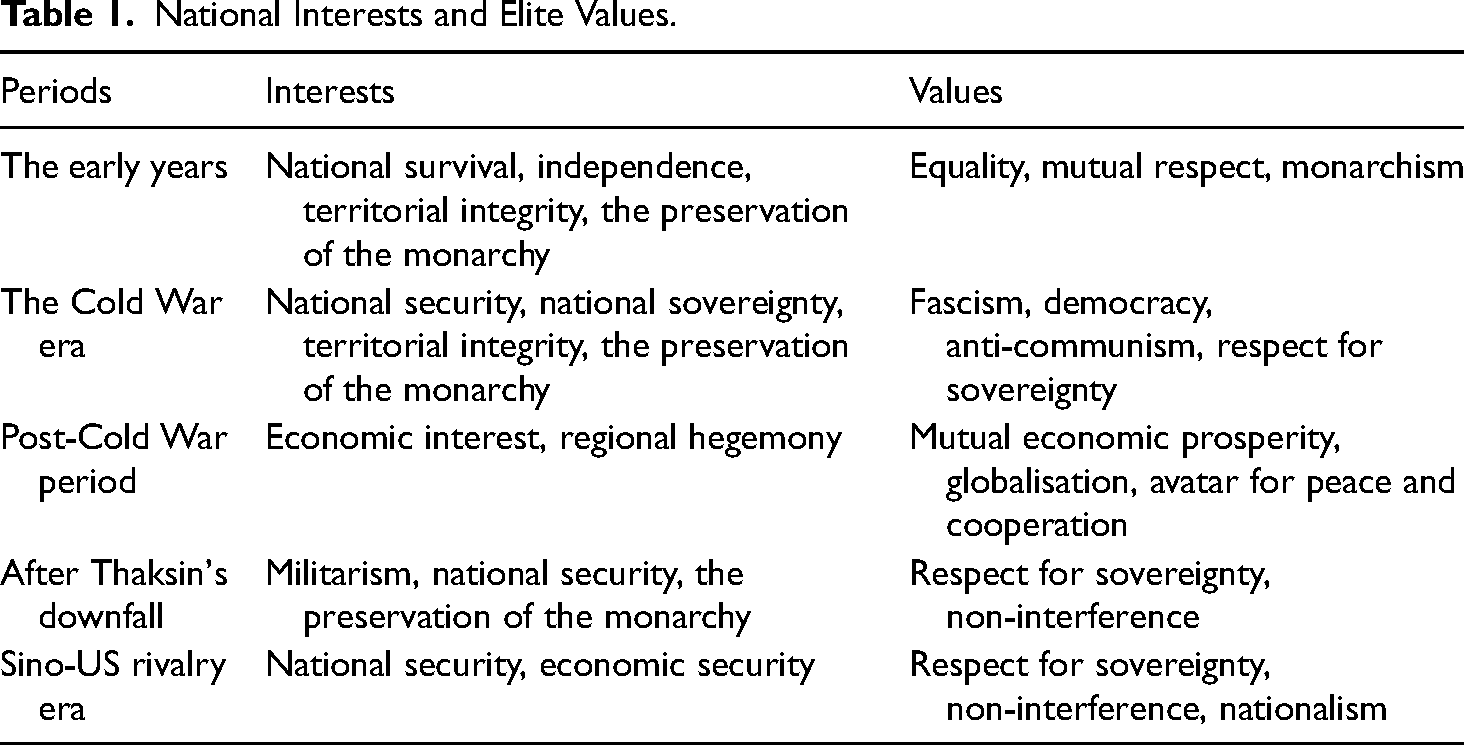
Proself foreign policy has been a key component of the elite values. Mongkut and Chulalongkorn made the preservation of absolute monarchy a foreign policy goal by weaving elite values and national interests in the face of European colonisation. That is, absolute monarchy could deliver a Western-style modernisation of political institutions as part of defending the value of respect for sovereignty. For self-preservation and with fear of Japanese colonisation, Phibun similarly embraced a foreign value of social nationalism/fascism. In the Cold War period, military leaders cultivated anti-communist nationalism to appease the United States for its aid, support, and legitimacy. During the Chatichai and Thaksin governments, foreign policy priority was placed on economic security through a value that promoted economic prosperity across the borders. Under the Prayuth regime (2014–2023), the US's interventionist approach compelled the Thai junta to defend its regime by adhering to the value of respect for sovereignty and in the meantime form informal alliances with autocratic states, including China, for regime legitimisation. Thus, values have become most meaningful as an added legitimisation mechanism in the repositioning of Thailand's standing in the wake of the changing international environment because of their roots in moral and ethical principles, their compliance with international norms and practices, and their commitment to the international order. The history of Thai diplomacy is evidently marked by Thailand's strategy in switching foreign policy approaches for its ultimate survival under the wind of change in international politics. This study highlights that central to the bamboo diplomacy is an interwoven relationship between interests and values. Together, they have effectively created a resilient Thai foreign policy.
Footnotes
Acknowledgment
The author would like to thank Andrew J. Nathan, Professor of Political Science at Columbia University, for his valuable advice in the process of writing this article.
Declaration of Conflicting Interests
The author declared no potential conflicts of interest with respect to the research, authorship, and/or publication of this article.
Funding
The author received no financial support for the research, authorship, and/or publication of this article.

Notes
Correction (May 2024):
The acknowledgment section is added for this article.