



Abstract
The article deals with bilateral relations between India and Myanmar. It argues that the current transformation processes offer a unique opportunity for a major readjustment of India's foreign policy towards Myanmar. In taking on India's perspective, it assesses the history, current state of and prospects for the relationship between New Delhi and Naypyidaw in six policy areas: democratization and stability; security in India's Northeast region and illegal migration; trade and infrastructure; energy security; development cooperation; and the role of China.
Introduction
Recent political developments in Myanmar 1 since 2011 have led to cautious hopes for a beginning of democratization and liberalization processes in the country (Bünte 2014). With a possible political and economic transformation, there might also be room to reconsider Myanmar's foreign policy, particularly regarding its giant neighbours, China and India (Gordon 2014: 193–194). Likewise, international actors may reassess their strategy towards a changing Myanmar (Singh 2012: 26). In such a period of transition, new and unexpected opportunities might open up to either readjust or even drastically alter foreign policy doctrines and traditions. In some cases, a complete fresh start of bilateral relations might occur, ideally to the benefit of both parties involved.
I am going to use the official name “Myanmar” throughout the study. The English term “Burma” will only be referred to in a historical context, for events before the renaming in 1988, or in direct quotations, following academically accepted patterns (e.g. Renshaw 2013: 30). For the purposes of this article, there is no political connotation in the use of either “Myanmar” or “Burma”.
This article 2 deals with the bilateral relationship between India and Myanmar as an example of a possible new beginning in international diplomacy. It argues that a reassessment by India and a shift in the relations between New Delhi and Naypyidaw is not only conceivable but, from an Indian perspective, absolutely necessary. For India, the current situation might present a unique opportunity to rectify some foreign policy failures of the past and overhaul an attitude of obliviousness and neglect towards Myanmar that has marred the relationship for decades. After a short historical overview, this paper assesses the current state of India–Myanmar relations in six different policy areas. It will look at India's role in Myanmar's process of democratization and at its interest in stability in Myanmar. Following that, security in India's Northeast and the issue of illegal migration from Myanmar will be considered. The next three topics the paper looks at are closely interconnected: Trade and infrastructure, access to energy resources and development cooperation are interdependent issues that can hardly be addressed in isolation from each other. Finally, the role of China and its influence on India–Myanmar relations is scrutinized. The concluding section summarizes the findings, describes India's view of Myanmar and offers a glimpse at the road ahead.
I would like to thank two anonymous reviewers for their very helpful comments and suggestions.
Apart from a review of scholarly studies, policy papers and journal and newspaper articles, this paper is based on a number of interviews with leading experts on India–Myanmar relations from Indian think tanks, research institutions and universities. Here, a glaring limitation of this study becomes obvious. The history, current state of and prospects for the bilateral relationship between New Delhi and Naypyidaw are analysed from an Indian point of view. This somewhat biased perspective of course invites criticism but is also an invitation to complementary research that could shed more light on the Myanmar side of the relationship. The main purpose of this study is to offer an assessment of India's foreign policy towards Myanmar.
Today's Myanmar was part of the British Empire in South and Southeast Asia. Since its political separation from British India in April 1937, it has been administrated as an independent unit, serving as a strategic buffer safeguarding the Indian heartland in World War II (Egreteau 2003: 19–26; Singh 2012: 27–28). After the war ended, Burma lost this role. Its importance to the British Empire was further diminished when India and Pakistan were given independence in August 1947. Burma itself became independent on 4 January 1948, but in contrast to India, Pakistan and Ceylon did not join the Commonwealth. Immediately after independence, bilateral relations between India and Burma were strong. The shared cultural and religious heritage was intensely emphasized by leaders of both nations. The deep bonds between the countries were reflected in Jawaharlal Nehru's famous words on the occasion of Burma's independence:
As in the past, so in the future, the people of India will stand shoulder to shoulder with the people of Burma, and whether we have to share good fortune or ill fortune, we shall share it together. This is a great and solemn day not only for Burma, but for India, and for the whole of Asia (quoted in Routray 2011: 301).
In 1951 India and Burma signed a Treaty of Friendship which, according to Nehru, was intended to last “for ever thereafter” (Lall 2006: 431). After 1954, New Delhi's relations with Burma, as well as India's rapprochement with China, were guided by the “Panch Sheel” (the five virtues) of peaceful coexistence: respect for the other nation's territorial integrity; respect for the other nation's sovereignty; mutual non-aggression; mutual non-interference in domestic affairs; and equality and actions towards mutual benefit (Mitra 2011: 187). Throughout the 1950s, bilateral affairs between India and Burma remained stable, partly because of common interests within the Non-Aligned Movement further bolstered by a strong personal relationship between Nehru and Burma's Prime Minister U Nu (Myint-U 2012: 268). In the form of development cooperation, India granted Burma a loan of 46 million USD in 1958. The military coup in Burma in 1962, however, changed the nature of the two nations’ political and economic relations. While there was not necessarily an open rift between them in the following decades, a lasting mutual indifference developed that was helped by Burma's self-imposed isolation (Egreteau 2003: 33–36). The stern repression of the Burmese democracy movement in 1988 led to a further deterioration of relations, resulting in a short diplomatic ice age between New Delhi and newly named Myanmar (Dörffel 2003: 379–380; Singh 2012: 31–32).
The 1990s brought about a substantial new orientation in India's foreign policy (Mitra 2011: 183–196). Following the severe economic crisis of 1991, which almost resulted in a total bankruptcy of India, the government of Prime Minister P. V. Narasimha Rao (1991–1996) recalibrated India's foreign relations in order to foster economic development. New Delhi's so-called “Look East Policy” focused on Asian markets and an extension of Indian trade relations towards Southeast Asia. Under this new framework, a fresh start in India–Myanmar relations was possible (Egreteau 2003: 102). For New Delhi, economic and strategic interests now trumped democratization and human rights considerations that had previously been widely viewed as crucial to any rapprochement (Haacke 2006: 34). The new policy of “constructive engagement” (Egreteau 2003: 132) led to the Common Border Trade Agreement of 1994 and a gradual improvement of the bilateral relationship. In 1995 India and Myanmar even conducted a joint military operation against ethnic guerrilla groups (Myint-U 2012: 71). When Indian Prime Minister I. K. Gujral (1997–1998) promulgated the “Good Neighbour Policy”, Myanmar's prospects were further enhanced. Now, India was abandoning the principle of strict reciprocity in its foreign relations within its immediate neighbourhood. Instead, New Delhi announced that it was willing to invest considerably more while at the same time assuring its respect for the “Panch Sheel”, particularly with regard to the sovereignty and territorial integrity of neighbouring countries. Regional economic cooperation became a cornerstone of India's foreign policy. For Myanmar, this development resulted in its integration into the organization BIMSTEC 3 (Bangladesh, India, Myanmar, Sri Lanka, Thailand – Economic Cooperation), which aimed to establish more effective collaboration in the Bay of Bengal region (Wagner 2005: 281).
After the integration of Bhutan and Nepal in 2004, officially renamed Bay of Bengal Initiative for Multi-Sectoral Technical and Economic Cooperation (BIMSTEC).
Prime Minister Atal Bihari Vajpayee (1998–2004) and the government of the Bharatiya Janata Party (BJP) brought a “real shift in India–Myanmar relations” and a much more pragmatic approach to, for instance, military-to-military contacts and economic ties (Lall 2006: 432). In 2000 both nations became founding members of the Mekong–Ganga Cooperation (MGC) group. Two years later, India and Myanmar reopened diplomatic representations and consular offices. Under the subsequent government of Prime Minister Manmohan Singh (2004–2014), bilateral economic relations between India and Myanmar were cautiously further improved without, however, resulting in a significant political rapprochement. A rare foreign visit of General Than Shwe to New Delhi in July 2010 led to the signing of many economic agreements, yet fell short of truly bringing the relations to a new level (Myint-U 2012: 221, 270–271). When Myanmar's new president, U Thein Sein, hosted Prime Minister Singh for a state visit in Naypyidaw in May 2012, it marked the first visit of an Indian prime minister to Myanmar in 25 years and was widely regarded as “a historic milestone” (Singh 2012: 26). While once again many memorandums and agreements were signed, it seems that the visit was just a hint of the greater shifts to come.
Given the change of government in India in 2014, there may be an opportunity for a much more fundamental transformation or even a completely fresh start in relations between New Delhi and Naypyidaw. Particularly the proclamation of India's new “Act East Policy” may signal a major shift from its former “Look East” approach towards a more proactive stance. According to critical voices in India, such a reorientation is much needed since India's rather passive and self-sufficient foreign policy towards Myanmar has been marred by ineffectiveness, especially in the economic realm. Former Indian ambassador to Myanmar Gopalapuram Parthasarathy writes, “We would be less than honest if we did not admit that in project and investment cooperation, our record has been tardy” (Parthasarathy 2014). Oftentimes, however, it is not the basic intention but the longsome and incomplete realization of arduously agreed-upon plans and projects that is widely criticized, as the following interview excerpt shows:
It wouldn't be wrong to say that India has the best of plans, policies and mechanisms in place to promote and protect its interests in Myanmar. […] The problem is in implementing these plans and projects. New Delhi need not reinvent new policies, if the existing policies and plans are implemented effectively half of the battle is won. [.] There is no doubt that the Burmese want close ties with India [.]. If we, however, ask if the Burmese are happy with India's role in Myanmar, there is a sense of frustration at the pace at which India has been moving [.]. [.] The lack of proper and effective implementation of policies and projects has been a major source of damaging India's image (Yhome, interviewed by author 4 October 2014).
Hence, there is not only much room for improvement but severe need for action if India does not want to squander the opportunities for better and mutually beneficial relations between India and Myanmar that might be opening up at the present.
When asked about the single most important issue for India with regard to Myanmar, the experts, researchers and policy advisors interviewed for this study 4 variously named several different topics as the top priority. Security in India's Northeast and bilateral trade relations were named most often. Related to trade and economic issues, the question of connectivity – meaning, the improvement of the exchange mechanism between the two nations and a better connection from India to Southeast Asia through Myanmar as a transit country – was also seen as crucial to India. Other subjects mentioned include energy, illegal migration and democracy. Interestingly, one topic which usually receives much attention in the Western world was not mentioned at all: The supposed great power competition between India and China in a “new Great Game” of influence in Asia, in which Myanmar is usually seen as crucial to both sides, was not named as a top priority for India. Apparently, there is a much different assessment of the “China factor” within the foreign policy community in India than some Western observers assume.
A complete list of the interviewees is provided at the end of this article.
However, probably the most remarkable point about the answers to the question What would you regard as the single most important issue for India? is the diversity of the issues named. There does not seem to be much consensus on the order of India's interests in its bilateral relations towards Myanmar among the relevant policy institutes and think tanks. Of course, this reflects the generally incoherent and in some cases erratic foreign policy India conducted towards its eastern neighbour in the past. After more than 65 years, there is still no tangible foreign policy statement, let alone a grand strategy regarding Myanmar from the Indian side. Considering the generally feeble nature of the Indian foreign policy service (Chatterjee Miller 2013), this is part of an overarching problem and hardly surprising. It may, nevertheless, cast serious doubts on one of the basic assumptions of international relations analyses – namely, that actors are aware of their own interests and are able to convert these interests into a list of ranked preferences. As long as a concerted official Indian foreign policy strategy is missing, it is an important task for researchers and advisors to organize the different policy areas and point out interdependencies between them.
The promotion of democracy abroad has never been one of the main pillars of India's foreign policy and plays a rather marginal role today. Instead, the principle of non-interference has dominated foreign policy debates and choices in India since the 1950s (Wagner 2009: 9–11). The advancement of democratic ideals is usually weighed against national interests and only occasionally supersedes economic or security-related concerns. With bilateral relations already at a low point and not much leverage to lose, India did openly side with the Burmese democracy movement in 1988, welcoming political refugees and exiles from the country (Egreteau 2003: 121–124; Haacke 2006: 34). Apart from granting asylum and supporting exile radio broadcasts, however, tangible activities on the part of India to foster democratic developments in Myanmar have remained scarce. In the early 1990s, India's assessment of the situation changed. With Myanmar's military rulers firmly established and issues such as the question of energy security or the violent rebellions in India's Northeast becoming more pressing, New Delhi began its policy of “constructive engagement” and has since largely refrained from explicit calls for a transition towards democracy (Wagner 2009: 17–19; Egreteau 2011: 468–470). This “triumph of pragmatism” (Routray 2011) in India's foreign policy brought a modest improvement in bilateral relations, but disappointed the Burmese democracy movement and many observers. An activist from the Burma Centre Delhi notes:
Although India allowed Burmese refugees to take shelter in India especially during [the] 1988 nationwide uprising (many students activists and political leaders fled Burma and took shelter in India), India didn't do much or influence much in the process of democratization in Burma/Myanmar. It's not a matter of being underestimated or overemphasized, but having worked for democracy and human rights in Burma along with Burmese democratic forces in India [over] the past many years, I don't really see India influencing that country for democracy (Alana, interviewed by author 7 October 2014).
This sentiment of disappointment was also reflected when, during her visit to India in 2012, opposition leader Daw Aung San Suu Kyi voiced sadness about the missing support for democratic change in Myanmar and openly criticized New Delhi for straying from the ideals of Mahatma Gandhi and Jawaharlal Nehru (Miglani 2012; The Hindu 2012). Despite its underwhelming efforts so far and going well beyond a mere return to Nehruvian idealism, India has practical incentives for engaging more on behalf of democratization in Myanmar. While in the past the question of stability has often been linked to supporting or at least tolerating military rule in Myanmar, this reasoning has partially been reversed. Now, only a thorough democratization is seen as a safeguard for lasting stability. Democracy would also offer an opportunity for Indian foreign policy to engage with several different actors in Myanmar and not continue to depend on the mood swings of one single decision maker:
Stability and strengthening reform process in Myanmar […] have a direct bearing [on] India's strategic interests in the region. Instability provides room for other major powers to play a role in its periphery, and as Myanmar's reforms progresses, it not only addresses the external role concern but also opens up more domestic actors in a democratic setup, thereby presenting multiple domestic actors [that] India can engage with, thus keeping a check on the possibility of a single-actor dominance whose domestic and foreign policy orientations could adversely affect India's interests there – the junta in the past is a case in point (Yhome, interviewed by author 4 October 2014).
Of course, whether democratization in Myanmar will have short-term positive effects on Indian foreign policy remains to be seen. There are reasons to be sceptical about the ability of a civil government – for instance, Daw Aung San Suu Kyi's National League for Democracy (NLD) – to remove some of the obstacles to better bilateral relations and brighter prospects for future cooperation, particularly regarding security concerns in the Northeast (Lee 2014: 311). In any case, having a reliable and predictable partner in Naypyidaw has to be considered as one of India's essential interests.
Security in India's Northeast and Illegal Migration
India and Myanmar share a land border 1,643 kilometres long, of which only 10 kilometres are in the process of being fenced (Lee 2014: 299–300). Unsurprisingly, this porous border has been exploited by guerrilla organizations on both sides. The Northeast region of India's “seven sisters” (the states of Assam, Meghalaya, Arunachal Pradesh, Nagaland, Manipur, Mizoram and Tripura) have represented “a policy headache for New Delhi” and been ravaged by violence for decades (Myint-U 2012: 235–236, 272–293). Outside of Assam, three states directly bordering Myanmar have been hit hardest by guerrilla warfare: Nagaland, Manipur and Mizoram. Particularly during the 1980s and the 1990s, armed groups from India such as the United Liberation Front of Assam (ULFA) and the National Socialist Council of Nagaland/Khaplang (NSCN-K) used the inaccessible and hardly controllable border region as a safe haven. With the open and covert support of the Burmese military junta, they set up bases and supply structures on Burmese territory (Hazarika 2014). Likewise, the Indian government has been accused of lending financial and technical assistance to rebel organizations from Myanmar such as the Kachin Independence Organization (KIO) and the Karen National Union (KNU) since 1988 (Ganesan 2010: 11). The gradual improvement of bilateral relations between India and Myanmar has led to progress on both sides of the border and has resulted in more coordinated efforts to contain insurgencies (Pardesi 2012: 122–123).
An additional problem is the increasing illegal migration from Myanmar. Recently, thousands of Muslim Rohingya have fled the spreading ethnic violence in Myanmar and come to India (Mishra 2014). According to Aparupa Bhattacherjee of the Institute of Peace and Conflict Studies in New Delhi, the Indian government underestimated the issue for a long time and did not tackle the problem seriously (Bhattacherjee, interviewed by author 30 October 2014). But even if pursued more rigorously from the Indian side, there will be no solution without close cooperation between the border-security forces of India and Myanmar. Here, New Delhi faces the problem that the government in Naypyidaw has conflicting priorities and engages rather reluctantly in the relevant border areas. As Rahul K. Bhonsle, who served as an army officer for a decade in India's Northeast region, points out:
For the Myanmar government, priority of borders is dictated by the security challenges that are faced by it on multiple fronts. Thus it is more concerned about the borders inhabited by Kachin, Karen and Wa and the Rakhine State with Bangladesh, while [the] Indian border is seen as more of a concern for Delhi (Bhonsle, interviewed by author 4 October 2014).
Still under the government of Manmohan Singh, India and Myanmar signed a Memorandum of Understanding on Border Cooperation on 8 May 2014. This agreement is set to provide a framework for an extended collaboration on security issues, for information and intelligence exchange, and for jointly coordinated border patrols. While tangible outcomes have not yet materialized, the goal of the memorandum is a further weakening of transnationally operating guerrilla groups and a more effective prevention of other illegal activities such as contraband trade or human trafficking (Hazarika 2014).
Trade and Infrastructure
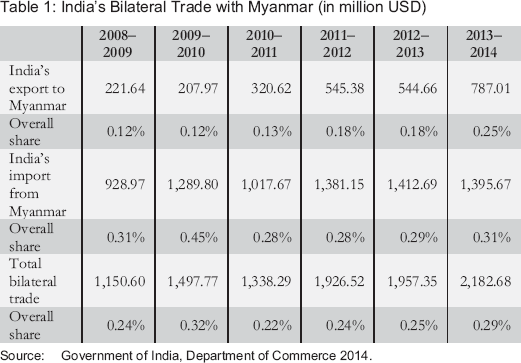
Bilateral trade between Indian and Myanmar reached almost 2.2 billion USD in the fiscal year (FY) 2013–2014, 5 a noteworthy increase compared to former years. In FY 2001–2002, the trade volume was just a little over 300 million USD, and in FY 2007–2008 the number was still below 1 billion USD (Ganesan 2010: 12). Despite the progress, however, trade with Myanmar still accounts for only 0.29 per cent of India's overall trade (see Table 1). The gains in absolute money volume have not led to a significant increase of the relative share of bilateral trade relations compared to other partner countries. Trade with Myanmar largely remains an afterthought for much of the Indian economy.
India's Bilateral Trade with Myanmar (in million USD)
India's Bilateral Trade with Myanmar (in million USD)
Source: Government of India, Department of Commerce 2014.
The Indian fiscal year runs from 1 April to 31 March.
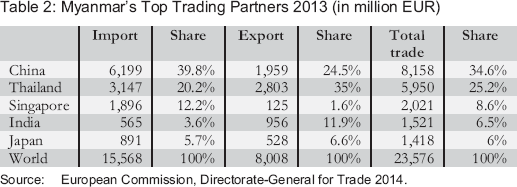
There is much room for a further extension in bilateral trade from both sides. India ranks only fourth on the list of Myanmar's most important trading partners, trailing Myanmar's other economically important neighbour countries, China and Thailand, by substantial margins (see Table 2). As stated by former government official C. S. Kuppuswamy of the South Asia Analysis Group, it is an important immediate target for New Delhi to raise the volume of bilateral trade to 3 billion USD by the end of FY 2015–2016 (Kuppuswamy, interviewed by author 6 October 2014).
Myanmar's Top Trading Partners 2013 (in million EUR)
Source: European Commission, Directorate-General for Trade 2014.
Not only does India want to increase bilateral trade with Myanmar, it also strives for an enhancement in the exchange of goods with other countries of the Association of Southeast Asian Nations (ASEAN). So far, Southeast Asia has played a rather marginal role in India's foreign trade even though the ASEAN–India Free Trade Area (AIFTA) came into effect in 2010. According to statistics from the Indian Department of Commerce, there were only three countries from the ASEAN region among India's 25 most important trading partners in 2013–2014: Indonesia ranked 8th, Singapore came in 10th and Malaysia was 21st. Thailand, Vietnam and Myanmar were well outside the group of India's top trading partners. In order to extend Indian trade with Southeast Asia, the interregional connectivity needs to be improved. The new government of Prime Minister Narendra Modi immediately declared the issue of connectivity a priority of its foreign policy (Jacob 2014). Of course, Myanmar as a hub and transit country plays a crucial role in this endeavour. The enhancement of transportation facilities in Myanmar has been a major focus of Indian bilateral development cooperation for years. Since 2008, the Indian government has spent 20 million USD on the construction of a trilateral highway linking the Indian state of Manipur with Thailand through Myanmar. The road, which is co-financed by Thailand and the Asian Development Bank (ADB), is supposed to be completed and opened in 2016 (Mullen et al. 2014: 17–18). Such projects can also be seen as small steps within the larger framework of establishing a new “Southern Silk Road”. An important part of these considerations is the initiative to create a Bangladesh–China–India–Myanmar (BCIM) corridor (Aneja 2014). All these processes form preconditions for the intended establishment of the world's largest free trade area, ASEAN+6. The negotiations about the creation of a Regional Comprehensive Economic Partnership (RCEP) consisting of the ASEAN member states plus six partner countries (India, China, South Korea, Japan, Australia and New Zealand) started in November 2012 and could hugely benefit from an enhancement of transportation facilities and trade routes between India and Southeast Asia (Hoepfner 2013).
Another ambitious infrastructural project in Myanmar combines economic aspects with security politics for India. The Kaladan Multi-Modal Transit Project is designed to create a direct trade connection from Kolkata to Mizoram over the Bay of Bengal into the port of Sittwe and through the states of Rakhine and Chin in Myanmar. Here, the water transportation routes on the Kaladan River will be enhanced while many roads will be modernized or newly constructed. The long-term goal for New Delhi is a significantly improved linkage of its Northeast region to the Indian heartland (Hackmann 2014: 14–15). Since 2007, India has invested 50 million USD into this project. Enhanced trade could bring not only a spark to the economy but also a noticeable improvement of the living conditions in Mizoram and the other states in the Northeast that have suffered from violence for decades. It is hoped that the intended socioeconomic development will weaken secessionist movements and reduce the activities of guerrilla groups, thereby easing the security problems. Also, the establishment of an alternative connection between the Indian centre and the Northeast would at least partially compensate for the strategic disadvantage of the narrow Siliguri Corridor (Mullen et al. 2014: 17–18). In the long run, building closer connections between India's Northeast and Myanmar could be beneficial to both sides, mutually reinforcing socioeconomic development:
Northeast India and Burma combined make up a market of over 100 million people – poor now, but not necessarily forever. It has not helped Northeast India to have an internationally isolated, economically mismanaged military dictatorship next door. But neither has it helped Burma to be adjacent to one of the most conflict-ridden and neglected parts of India. [.] In a way, Northeast India and Burma have long reinforced one another's problems. As borders begin to open, the question is whether they can now support each other's progress instead (Myint-U 2012: 307).
Myanmar's vast oil and gas resources are intriguing to many countries. Competition for exploration and exploitation rights began long ago. In fact, it was Myanmar's potential role as a supplier of natural gas that was crucial for improving bilateral relations with ever energy-hungry India in the 1990s and early 2000s through a new “pipeline diplomacy” (Lall 2006: 425–430, 2009: 34–35). New Delhi, however, has damaged its prospects for years because of longsome decision-making and uncoordinated policies. Government-owned companies from India were not well prepared to succeed in the competitive environment of international bidding in Myanmar (Narayan 2009: 25). Additionally, New Delhi manoeuvred itself into a difficult situation regarding a tripartite gas pipeline project from Myanmar to India through Bangladesh in 2005. When Indo-Bangladeshi relations worsened and the prospects for the pipeline became uncertain, India did not have a strategy for an alternative transportation route (Islam 2009: 140–142). Former Indian ambassador to Myanmar Gopalapuram Parthasarathy recounts the consequences of this disappointing endeavour and another telling example of Indian failure:
After having secured exploration rights for gas in the Bay of Bengal, we conducted our project-planning and diplomacy so clumsily that we did not have a strategy ready for taking the gas to India through a pipeline across Myanmar and our Northeast, or for transporting it as LNG. China deftly stepped in and took away all this gas by expeditiously building a pipeline to Yunnan Province. In the mid-1990s, Myanmar offered us hydroelectric projects with a potential of over 1,000 MW across rivers near our borders. We took years to scrutinize these projects [.]. After nearly two decades, we backed off (Parthasarathy 2014).
Today, India's more or less self-inflicted defeats have given China a much better position in the Myanmar gas market (Lall 2014: 213). What is more, virtually all current and future hydropower joint ventures in Myanmar are being conducted with the help of Chinese firms (Eleven 2014). India's reputation in the energy sector and beyond has been severely damaged (Jha 2013: 233). As Rahul K. Bhonsle said, there is a widespread feeling in Myanmar that the “Indian government promises much but delivers little” (Bhonsle, interviewed by author 4 October 2014). Many auspicious projects have never been implemented: “Things didn't materialize much except […] in papers” (Alana, interviewed by author 7 October 2014). There is an urgent need for a different approach from the Indian side. The new government in New Delhi seems to have realized the problem and has started to tackle it with fresh rhetoric. Minister of External Affairs Sushma Swaraj as well as Prime Minister Modi have announced the transformation of the more than twenty-year-old “Look East Policy” into an “Act East Policy”, thereby raising hope that India is going to speed up its decision-making and conduct future projects with much stronger commitment (Jacob 2014; PTI 2014).
Development Cooperation
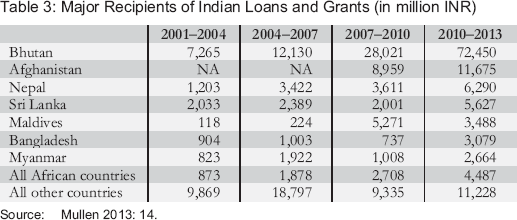
Despite the fact that an overall foreign policy strategy regarding the bilateral relationship between India and Myanmar is still missing, the latter country has been a major recipient of Indian foreign aid, mainly through the Indian Technical and Economic Cooperation (ITEC) and similar schemes. Additionally, Myanmar is one of just three countries for which New Delhi has laid out a comprehensively planned aid and development assistance programme (Bhonsle, interviewed by author 4 October 2014). The other two nations with such a special status are Bhutan and Afghanistan, which is well reflected in the volume of Indian loans and grants over previous years (see Table 3). From 2000 to 2014, Bhutan alone received almost half (48.85 per cent) of India's total loans and grants, while Afghanistan accounted for 8.38 per cent. With a share of 3.49 per cent, Myanmar came in sixth, behind Nepal (5.86 per cent), Sri Lanka (5.35 per cent) and Bangladesh (3.83 per cent) (Mullen et al. 2014: 3). There is still much room for an extension of financial development assistance from India to Myanmar, especially considering the fact that India's annual contributions fall well short of the amount that the United Kingdom, the European Union, and leading donor country Japan are giving per year. The United Kingdom doubled its bilateral aid to Myanmar to 95 million USD in 2014. Starting in 2015, the European Union is planning to quadruple its annual development assistance to Myanmar to 123 million USD. In 2013 Japan announced it would deliver an aid and investment package to Myanmar to the tune of 394 million USD (Patteran 2014). Compared to these numbers, India's financial commitments appear meagre and underwhelming. In the current “feeding frenzy” (Patteran 2014), which will probably gain even more momentum after Myanmar's general election in 2015, New Delhi runs the risk of being left behind and once again gambling away future opportunities.
Major Recipients of Indian Loans and Grants (in million INR)
Major Recipients of Indian Loans and Grants (in million INR)
Source: Mullen 2013: 14.
Most of India's loans and grants in bilateral development cooperation are being used for infrastructure projects. Another focus is the modernization of Myanmar's agricultural sector, which is being advanced by hundreds of millions of Indian rupees and further supported by knowledge transfer. Apart from that, India funds numerous education and training facilities in Myanmar. The establishment of the Myanmar Institute of Information Technology (MIIT) was financed by New Delhi with an amount of 326.8 million INR. Almost 50 million INR went into the founding and subsequent expansion of the India-Myanmar Centre for Enhancement of Information Technology Skills (IMCEITS) in Yangon, which so far has produced approximately 1,500 IT specialists. India and Myanmar also cooperate in the area of effective and efficient governance. Through the ITEC programme, India is training 525 government officials from Myanmar. Additionally, public servants are being educated in all forms of digital services and e-governance (Mullen et al. 2014: 17–18).
Naturally, China plays an important role in all of New Delhi's foreign policy considerations. Hence, the relations between India and Myanmar cannot escape the shadow of the giant neighbour to the North. With the Beijing-financed construction of a new harbour in Kyauk Phyu, Myanmar has become part of the so-called “String of Pearls” of Chinese deep-water ports around the Indian Ocean. This alleged encirclement with harbour facilities in Pakistan, Sri Lanka, Bangladesh and Myanmar is viewed with much scrutiny and suspicion in India. It is feared that these ports might someday be used not only economically but also for military purposes (Vasan 2012: 415–416). Also, the huge Chinese influence in everyday life in many parts of Northern and Northeast Myanmar is cause for concern among some Indian observers (Myint-U 2012: 30–31, 266–268). Particularly the growing interdependence of the economies of China and Myanmar in the border region and the close trade relations between Myanmar and Yunnan Province serve as a painful reminder of India's own shortcomings in this respect (Lall 2014: 211; Parthasarathy 2014).
In general, India and China compete for influence in Myanmar in every policy area. Among parts of the Indian foreign policy establishment, there is “a shared sense of the two countries as rivals”, particularly regarding the “crossroads” nation Myanmar (Myint-U 2012: 238). This also includes the vital question of energy security. For a time, “China and India both regarded competition in the energy sector as a purely zero-sum game” (Li 2009: 154). Some observers, however, question whether New Delhi really must follow the rules of such an “anachronistic” game. As, for instance, Obja Borah Hazarika points out:
In the twenty-first century, treating a country like a pawn in a country's strategic calculation is anachronistic. India can, at most, make itself seem like a more feasible partner in security, economic and cultural issues to Myanmar, and let the latter take its pick between China and India (Hazarika, interviewed by author 25 October 2014).
In addition, there is a chorus of very critical voices regarding the apparent obsession of Indian foreign policy with China in general, which has allegedly been visible for decades, particularly as it relates to Myanmar. A truly independent Indian foreign policy should not just be reacting to Chinese decisions and initiatives, especially considering the different strategic positions and resource capabilities of New Delhi and Beijing. According to proponents of this view, a coexistence of India and China in Myanmar is definitely possible as long as New Delhi is able to avoid direct competition and a power struggle with Beijing that it almost certainly cannot win (Wagner and Cafiero 2014: 2). India has to realize that China's lead is probably too large to be overcome in a short period of time. Right now, “India is not there to compete with China” (Kuppuswamy, interviewed by author 6 October 2014). However, the constellation might change faster than anticipated since China's influence in Myanmar seems to be declining. Increasingly, Naypyidaw appears to regard its dependency on China as a strategic problem and as a loss of sovereignty it is no longer willing to concede (Lee 2014: 294–295). Strengthening national sovereignty thus requires a diversification of Myanmar's foreign policy. The visit of General Than Shwe in New Delhi in 2010 has been interpreted as an early demonstration that Myanmar “would seek to balance China with India” (Myint-U 2012: 221). New Delhi could profit from this situation if it overcomes its own fixation on China. The Modi government has taken some initial steps in this direction:
India's policy towards Myanmar [so far] has basically been nothing but a response to what China was doing there. India has now realized that it has to look beyond China and is, therefore, fine-tuning a proactive policy towards Myanmar (Hussain, interviewed by author 21 October 2014).
Part of this new strategy is an emphasis on the cultural and religious heritage that India and Myanmar share. There is a “natural” familiarity China cannot offer, particularly regarding a common Buddhist tradition (Myint-U 2012: 31). Therefore, it is not surprising that Minister Swaraj, during her visit to Myanmar in August 2014, pointed to Buddhism as an important link between the countries that may foster people-to-people contacts and serve as a foundation for generally improved relations. Accordingly, Swaraj suggested the establishment of direct flights between Yangon and the Buddhist pilgrimage site Bodhgaya in India (Roy 2014).
Conclusion
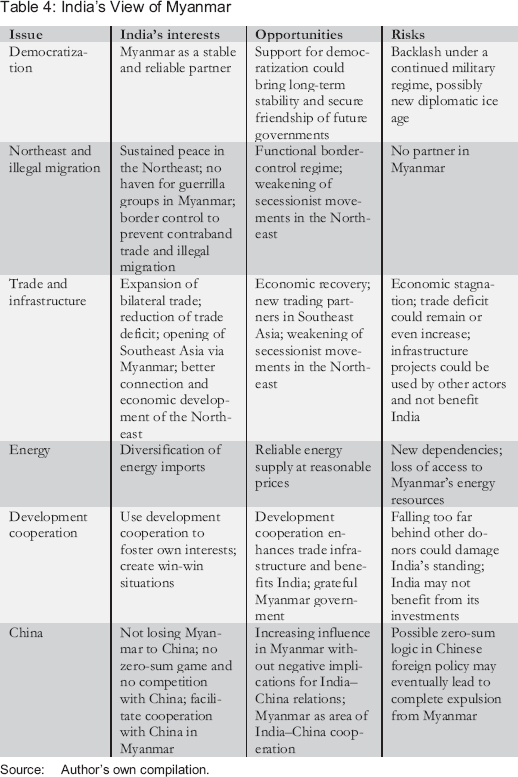
India–Myanmar bilateral relations seem to be at a crossroads. The political changes in Myanmar coupled with an apparent desire to diversify its foreign policy might open up new opportunities for New Delhi to pursue its interests and avoid the risks and pitfalls that have plagued its policy towards Myanmar for many years (see Table 4). The pragmatic and undogmatic foreign policy doctrine of India's new prime minister, Narendra Modi, is based on an “enlightened national interest” and places its focus squarely on India's immediate neighbourhood, including Myanmar (Haidar 2014).
India's View of Myanmar
Source: Author's own compilation.
India's political influence in Myanmar can be enhanced only if New Delhi shows a substantial increase in public appreciation for the importance of the bilateral relationship. In this respect, some observers were heavily critical of U Thein Sein not having been invited to the swearing-in ceremony of Narendra Modi on 26 May 2014, especially regarding the fact that the heads of state of all other neighbouring countries had been invited (Sailo 2014: 3). Myanmar, critics argue, is obviously still not seen as a real neighbour of India:
Although Myanmar shares a long, sensitive border with India, many in New Delhi don't seem to regard it as a neighbour, a fact reflected in the failure to invite President Thein Sein to Modi's swearing-in event. Distant Mauritius was invited to the event but not Myanmar (Chellaney 2014).
It should be particularly alarming to everyone aspiring to better relations between New Delhi and Naypyidaw that the non-invitation was not widely seen as a mistake or an affront but, in fact, generally interpreted as fitting, given the current nature of India–Myanmar relations:
In all likelihood, the lack of an invite for Myanmar's President Thein Sein was not a mistake or a deliberate omission, but simply something that was on nobody's mind. Politicians and the media in both countries did not seem to expect that Myanmar would even be invited, as evidenced by the fact that the media in neither country made an issue out of Myanmar's non-invite (Pillalamarri 2014).
Under these circumstances, Modi's visit to Myanmar in November 2014 was a welcome step in a new direction. Although Modi's primary reason for coming to Myanmar was to attend the ASEAN meeting and the East Asia Summit (EAS), there were also bilateral talks with President U Thein Sein. Arguably even more important were the signs of respect shown through one of Modi's preferred channels of communication, Twitter. On 6 November 2014, Modi tweeted: “I will have bilateral meetings with leaders of Myanmar, a valued friend. Having stronger relations with Myanmar is a priority area for us.” Particularly the description of Myanmar as “a valued friend” carries a significance not to be underestimated. India is signalling rhetorically that it is serious about defining anew its relations towards its smaller neighbours that have been neglected in the past. In addition to Myanmar, Bhutan and Nepal have also already enjoyed increased attention and appreciation followed by state visits. After the bilateral talks in Naypyidaw, Modi said via Twitter: “Had a very good meeting with President U Thein Sein. We had extensive discussions covering various aspects of our bilateral relations.” While no details of the meeting have been revealed, there seems to be a solid foundation for future collaboration.
Not only India, but also Myanmar could benefit from new developments in the bilateral relationship. This pertains particularly to Myanmar's interest in joining the South Asian Association for Regional Cooperation (SAARC). So far, Naypyidaw has observer status within the organization. A full SAARC membership of Myanmar would represent a historic precedent since Myanmar would be the only permanent member of both SAARC and ASEAN, thereby abrogating and bridging the border between the regions of South and Southeast Asia. Having rejected the idea before (Haacke 2006: 33–34), Myanmar officially applied for SAARC membership in March 2008 (Yhome 2008). The bid was supported by India, yet failed nevertheless (Saez 2011: 40). According to some analysts, India should encourage Myanmar to apply once again for membership and support such a bid even more emphatically, just as it had successfully done when Afghanistan became a full SAARC member in 2007 (Rahman 2009; Singh 2012: 33). While this seems to be a matter of course, there is good reason to point out even supposedly self-evident and natural foreign policy choices. All too often, India has damaged its own interests by erroneous decision-making, thus becoming a “would-be” instead of a real great power (Chatterjee Miller 2013; Wagner 2005). India has been regarded an “anti-Machiavelli” who commits virtually all mistakes an actor striving for power should avoid (Rösel and Gottschlich 2008: 139). Considering India's foreign policy towards Myanmar and following Israeli diplomat Abba Eban's famous assessment, one could conclude that New Delhi “never missed an opportunity to miss an opportunity”. For India, it is time to change this perception through a different policy approach.
Interviews
Alana: Burma Centre Delhi (BCD); interviewed by author 7 October 2014.
Bhattacherjee, Aparupa: Research Officer, Southeast Asia Research Programme (SEARP), Institute of Peace and Conflict Studies (IPCS), New Delhi; interviewed by author 30 October 2014.
Bhonsle, Rahul K.: Director of Security Risks Asia, South Asian Risk Consultancy; Director and founder of Security-risks.com; retired Brigadier in the Indian Army; served for a decade in India's Northeast region; interviewed by author 4 October 2014.
Hazarika, Obja Borah: Assistant Professor, Department of Political Science, Dibrugarh University, Assam; interviewed by author 25 October 2014.
Hussain, Wasbir: Executive Director of the Centre for Development and Peace Studies (CDPS), Guwahati; Visiting Fellow at the Institute of Peace and Conflict Studies (IPCS), New Delhi; two-time former Member of India's National Security Advisory Board; interviewed by author 21 October 2014.
Kuppuswamy, C. S.: South Asia Analysis Group (SAAG); former Director of the Cabinet Secretariat, Government of India; retired officer of the Indian Army; interviewed by author 6 October 2014.
Yhome, K.: Research Fellow at the Observer Research Foundation (ORF), Delhi; interviewed by author 4 October 2014.