



Abstract
Utilising Pitkin’s concept of representation, this article surveys the landscape of Chinese Indonesian political representation since the advent of regional elections in 1999. Analyses of the dataset of individual profiles of Chinese Indonesian executives, as they adopt inclusive-pairing tactics by taking on deputised roles or appeal using charisma, had demonstrated that there was a visible transition from “descriptive” towards more “substantive” forms of political representation in various constituencies – seen as the most important dimension of ideal representation despite the presence of soft ethnic politics. Recent appeals to indigenism (pribumi-ism), especially in the wake of Jakarta governor Ahok’s failed re-election bid in 2017, had the effect of confining representational politics towards the narrow margins of ethnicity above all else. This article looks at the precarity of thedivide between pribumis and Chinese Indonesians (Tionghoa) from the perspective of political representation at the regions and fills in the lacuna of political representativeness in post-reform Indonesia – overlooked so far by critiques of democracy.
Introduction: Political Representativeness in Democratic Indonesia
Contemporary democracy in Indonesia has been the subject of much research and critique in recent years and for good reason. Indonesia, despite its astonishing democratic transition following the fall of the Suharto regime, has not kept pace with reforms (Davidson, 2009) while aspects of New Order illiberalism has prevailed (Winters, 2013). When evaluating the quality of Indonesia’s democracy, arguments have centred upon institutions (Power, 2018) and systems (Robison and Hadiz, 2017), with representation taking a back seat. In this article, I argue that political representativeness should be seen as an equally critical aspect in the evaluation of democracy in Indonesia, given the recent rise in identity politics that has visibly hardened. In particular, rhetoric pandering to old ideas of indigenism (pribumi-ism) have resurfaced and have served to accentuate the already existing pribumi–tionghoa (or pribumi-Chinese Indonesian) divide.
Political representation is generally seen as a way of establishing the legitimacy of democratic institutions via the responsiveness governments have towards its citizens or constituencies. In studies of representation, what is taken to be its best forms have been defined by Pitkin (1967) as “substantive” and is seen as actions taken on behalf of, or in the interest of, the represented by the representative. This is in contrast to “descriptive representation” where the representative resembles those being represented. Indonesia’s decentralised political landscape – where direct elections had been conducted at the regional level since 2003 – provided ample opportunities to examine political representation as a factor underlying the quality of democracy in Indonesia. With increased tensions surrounding the pribumi–tionghoa divide in recent elections following the rise in the pribumi discourse, this article surveys the landscape of Chinese Indonesian political representation since 1999 to explore how Chinese Indonesian executives at various levels (regency/district, town, and province) fared in their respective constituencies, the strategies they used to overcome underling ethnic politics, and the strides made towards better forms of democratic representation. Finally, the article sets out the argument –based on a dataset of Chinese Indonesian representation at the regions – that, while there was a promising trend that had tended towards greater “substantive representation,” recent appeals to the rhetoric of pribumi-ism had the effect of stagnating the gains made by limiting representational politics to the narrow margins of ethnicity – or what is seen is “descriptive representation.”
This article is divided into four sections. The first section addresses the rise of the politics of indigenism in Indonesia in recent years and the new layers of meaning it had taken up in its latest iteration. The second section provides a nuanced examination of the problematics behind definitions of “Chinese-ness” in Indonesia from the perspective of assimilation and integration in various parts of the Indonesian archipelago, both historically and under the New Order regime. With the liberalisation of the Chinese Indonesians culturally, religiously, and politically after a long period of enforced assimilation following Suharto’s ouster in 1999, an overview of their burgeoning political participation and representation is presented in the text as well as in relevant tables.
The third section ties in the theoretical concept of political representation with two dominant typologies of Chinese Indonesian representation that is identified via inclusive pairings in the regions. The typologies are derived from a dataset of successful Chinese Indonesian executives elected to positions of bupati (regent), mayor, and governor since 2003. According to the particular context and habitus of the constituency, individual candidates are analysed for their own peculiar strategies and pathways to electoral success. The first of the two dominant typologies is the strategy of taking up of deputy roles in places where ethnic homogeneity and identity carry greater weight. The second is the appeal of charisma where ethnic identity is overlooked in place of the qualities of the individual and how he/she “acts for” their constituency. In an underlying atmosphere of soft ethnic politics, I argue that the latter reflects traits of “substantive representation,” while the former resembles more “descriptive” forms of representation. Finally, this article concludes with the argument that political representation, at the level of the regions, should be considered a critical aspect in the evaluation of the overall democratic quality of the country.
The Politics of Indigenism
The politics of indigenism (pribumi-ism or asli-ism) is on the rebound in contemporary Indonesia. Allegedly thought to be on the decline at the beginning of the Reformasi era, 1 the idea of the pribumi (literally known as “inlanders,” and currently used to denote ancestral nativity or indigeneity in the Indonesian archipelago) has found fertile ground in a resurgence of the politics of envy and grievance by pribumis on Chinese Indonesians (Aziz, 2018). A relic of the colonial era, the pribumi status has traditionally sought to exclude those not considered part of the Indonesian Nation (Bangsa Indonesia), which had comprised of asing (foreign) or pendatang (new arrivals) aliens including the Chinese, Arabs, and Indians. These groups of people are generally portrayed as descendants of people originating from a foreign country who entertain questionable political loyalties to Indonesia but dominate the country’s economy despite their status as minorities (Aditjondro, 1998; Coppel, 1983; Zhou, 2019: 97–115). In contemporary Indonesia, those not considered pribumi had been directed primarily to a narrower category of non-Muslim Chinese in which perceptions had perceptibly hardened. 2
These exclusionary sentiments of what constitutes a pribumi and his/her position and status in society had been most clearly demonstrated in the Jakarta Gubernatorial Election in 2017, whereby race and religion converged as defining issues in the electoral contest. During the campaign, incumbent Jakarta governor Basuki Tjahaja Purnama, more popularly referred to as “Ahok,” was singled out by groups that voiced suspicions over his identity as both an ethnic Chinese and a Christian (or what is known as a “double-minority”; Sumaktoyo, 2017; Wijaya, 2016). Hard-line groups had vehemently expressed their disapproval of a non-Muslim as governor of the nation’s capital. Ahok was later accused of having blasphemed the Islamic religion, then incarcerated under trumped-up charges after a lengthy judicial review, resulting in an electoral loss (Kami, 2016). 3 The Ahok incident was indicative of a general trajectory that had befallen what was seen previously as a positive direction towards the gradual political normalisation of the ethnic Chinese from their “economically strong but politically weak” status (Herlijanto, 2016).
Contemporary Pribumi-ism
Politically, non-pribumi discrimination had resurfaced in various forms. Retired army general Joko Santoso, who is linked to the Gerindra Party, established the Pribumi Party (Partai Priboemi), declaring that it wants to restrict non-indigenous Indonesian political and economic rights. Vigilante hard-line groups like the Islamic Defenders Front (Front Pembela Islam, FPI) have also employed rhetorical and intimidation tactics directed at Ahok’s ethnicity and religion. General Gatot Nurmantyo, Commander of the Indonesian Armed Forces, had jumped onto the pribumi bandwagon with ambitions of competing in the 2019 presidential elections. He reportedly gave a speech at the National Leadership Conference of the Golkar Party on 22 May 2017 alluding to the harm imposed upon the unity of Indonesia by “migration.” He then read a few stanzas of a poem by Denny JA, entitled “But They Are Not Ours” – a poem that reinforced perceptions of indigeneity (Suryadinata, 2017). 4 Newly elected governor of Jakarta Anies Baswedan had used the word pribumi in his inauguration speech after an especially polarising and divisive electioneering campaign dominated by what is known abbreviately as SARA (ethnic, religious, racial or societal groups) sentiments (Kapoor and Da Costa, 2017). 5
Notions of pribumi-ism have also since evolved and enlarged to incorporate the Arab community. This was not always the case as Arabs were at one point in time grouped together with the ethnic Chinese as non-pribumi (or Foreign Orientals under the Dutch). The Arabs had since, at a societal level, acquired pribumi recognition by virtue of a shared religion. Parallel to the Indonesian Youth Pledge (Sumpah Pemuda) of 1928, there was a section of the Arab Peranakan diaspora who decided to form a nationalist group called the Arab Indonesian Association (Persatuan Arab Indonesia, PAI)) to integrate, assimilate and pledge allegiance to Indonesia while still under the rule of the Netherlands East Indies. 6 This was not withstanding the fact that a separate association called the Indo-Arab Movement (Indo-Arabische Beweging) founded in 1930, tried to advocate for the separate status of Arab immigrants as Foreign Orientals.
Increasingly, the Islamic religion had come to be associated with indigeneity more so than other religions. Being of Arab descent in many ways now carries much prestige by way of a common, perhaps misplaced perception that their ancestors were the first missionaries that brought Islam to the archipelago (Shahab, 2017). Sayyids (Arab descendants of the Prophet) or Habibs (Islamic scholars of Yemeni Arab descent) continue to play a disproportionate role in the realm of Islam in Indonesia. 7 Another argument put forward (Coppel, 2002: 98–103) on the more favourable treatment of Arab minorities in Indonesia was that many of the Peranakan Arabs had acculturated themselves to the santri (orthodox Islamic stream) side in Indonesian society. 8 Developments however had not proven so favourable for the Chinese.
Hybridity and Binaries of “Chinese-ness” in Indonesia
Historically, there were precedents to this current state of affairs, especially over how the conception of pribumi and the discrimination of the Chinese evolved after Reformasi. Since independence, Chinese Indonesians had found themselves trapped between a rock and a hard place. Politically, those who pushed for an integrationist approach, personified in the formation of Baperki (Consultative Body of Indonesian Citizenship), lobbied for Chinese Indonesians to be accepted as an ethnic group or suku. 9 This was eventually trounced by the New Order on the basis of its dubious links to the Communist Party of Indonesia (Partai Komunis Indonesia, PKI). The assimilationists, on the other hand, were more wary of their existence as a separate ethnic group. They understood that pursuing politics would only sharpen existing differences and preferred joining general political parties. A small minority wanted assimilation in a broader socio-cultural sense, cautious not to stand out in order to guard against “exclusivism.” 10
Outside Java, the situation for the Chinese was more varied and complex. More totok than their Peranakan counterparts, Chinese communities there are seen in a different light, and on several occasions less Indonesian. 11 In North Sumatra and West Kalimantan where their population is the highest, many have retained their own cultural practices and language (Hokkien, Teochew, and Hakka) to a high degree. At the same time, Chinese communities from these regions also tend to suffer the heaviest under the repression and scrutiny of Suharto’s New Order regime as their national and political loyalties were generally more suspect.
In many ways, the Chinese Indonesian identity and their belonging tended to be tied to a sense of place rather than a focus on integration or assimilation especially in the Outer Islands (Sai and Hoon, 2013). This would prove crucial in a more open, democratic environment. In West Kalimantan, the Chinese miner communities already enjoyed a strong presence even before the Dutch arrived, in the form of various independent kongsi federations, with the predominantly Hakka Lanfang Republic being the largest and longest reigning (Heidhues, 2003; Yuan, 2000). In the Riau and Karimun Islands, Chinese Teochews dominated gambier plantations and, for a time when Riau was abandoned by the sultanate, developed their own institutions of political and economic control (Trocki, 1979: 32). Along North Sumatra’s plantation belt, the Chinese (mainly Hokkiens from Zhangzhou) were recruited to work as labourers in tobacco plantations since the 1880s when lands were leased out for plantations (Stoler, 1995). In Bangka and Mentok (Belitung), Hakka miners from Guangzhou and Kalimantan formed the first Chinese society since the mid-1800s, drawn by work in the tin mines (Heidhues, 1992).
A further delineation in “Chinese-ness” can be inferred vicariously from the religion that is embraced. It had been estimated that more than half of Chinese Indonesians are Buddhists (53.82 per cent), a third Christians (35.09 per cent), 5.41 per cent Muslims, and the rest Hindu or other religions. 12 While the Chinese usually embrace religions other than Islam, complications can arise when a section of the ethnic Chinese minority group embraces the majority religion of Islam in Indonesia. According to Hew Wai Weng, the hybridised identities of Chinese Muslims in Indonesia further complicate the binaries of “Chinese-ness,” whether this means being accepted as a pribumi or not (Hew, 2018: 254–255). While ordinary Muslims who have a Chinese background choose to identify themselves as “Indonesian” or menjadi Java (becoming Javanese) or campuran (mixed), it may not be consistent with how other Indonesians identify them.
Under Suharto’s New Order, these multi-farious hybridity and binaries of Chinese-ness were buried under assimilationist policies that sought to remove any markers or identifiers depicting Chinese-ness. The general assumption then was that one could only either be Indonesian or Chinese. The fall of Suharto and the embrace of multi-culturalism in place of assimilation triggered a rise in identity politics throughout Indonesian society on the one hand, yet freed the Chinese from years of enforced assimilation to recapture their heritage and identity on the other (Hoon, 2006).
Chinese Indonesians under Indonesia’s Glasnost
With the advent of Reformasi, the political landscape gradually opened up for the once politically enfeebled Chinese. On paper, discriminatory policies against the Chinese were officially lifted. President Habibie started by issuing an order (Presidential Instruction No. 26/1998) to end the use of the terms pribumi and non-pribumi in all official programmes and policies. 13 In 2006, Confucianism was officially recognised as a religion in a Ministry of Religion circular, which stated that there were six official religions in Indonesia, including Confucianism (Pausacker, 2007). Most importantly, the enactment of the New Citizenship Bill No. 12/2006 formalised the anti-discriminatory nature of the new Reformasi state (Jawa Pos, 2007). 14 In 2014, President Susilo Bambang Yudhoyono nullified the notorious Cabinet Presidium Circular (1967) obliging all Indonesian government agencies to use the terms Tiongkok or Tionghua to address ethnic Chinese individuals over the derogatory term Cina.
Under a new political climate, Chinese Indonesian politicians began to steadily appear on the regional political stage, beginning with the Outer Islands of Kalimantan, Sulawesi, and Sumatra. In the West Kalimantan province, Yasen Akun Effendy became the first elected bupati (regent) of Sanggau in 2003 – the first ever elected Chinese bupati in Indonesian history (La Ode, 2012: 179). In Bangka, Basuki Tjahaja Purnama (Ahok) was elected as bupati of East Belitung in 2005 – the first elected representative in the Bangka-Belitung province of Chinese origin. In Bitung city (North Sulawesi province), Chinese businessman Hanny Sondakh was elected as mayor in 2006. Finally, in 2014, Ahok broke another record by becoming the first Chinese Indonesian elected as deputy governor and then acting governor of Indonesia’s capital city of Jakarta – albeit a short-lived one. The euphoria of Ahok’s accession was palpable as he was thrust into the epicentre of national and ethnic politics (Chen and Dwicahyo, 2016), creating the hint of a suggestion that Chinese Indonesians may be elected to the highest office in Indonesia (Tanjung, 2014).
This rise in the number of Chinese Indonesians elected to executive positions regionally paralleled the increase in political participation. In 1999, there were fewer than fifty Chinese Indonesians running for direct elections nation-wide, but, by 2004, there were nearly 150 (Tjhin, 2009). By 2014, there were about 315 candidates (Saptaatmaja, 2014). Table 1 shows the various Chinese Indonesian politicians who were successfully elected to positions of (deputy) bupatis, (deputy) mayors, and (deputy) governors since direct regional elections (pilkada) began in 2003.
Profiles of Chinese Indonesians in Positions of (Deputy) Bupatis, (Deputy) Mayors, and (Deputy) Governors (2003–2020).
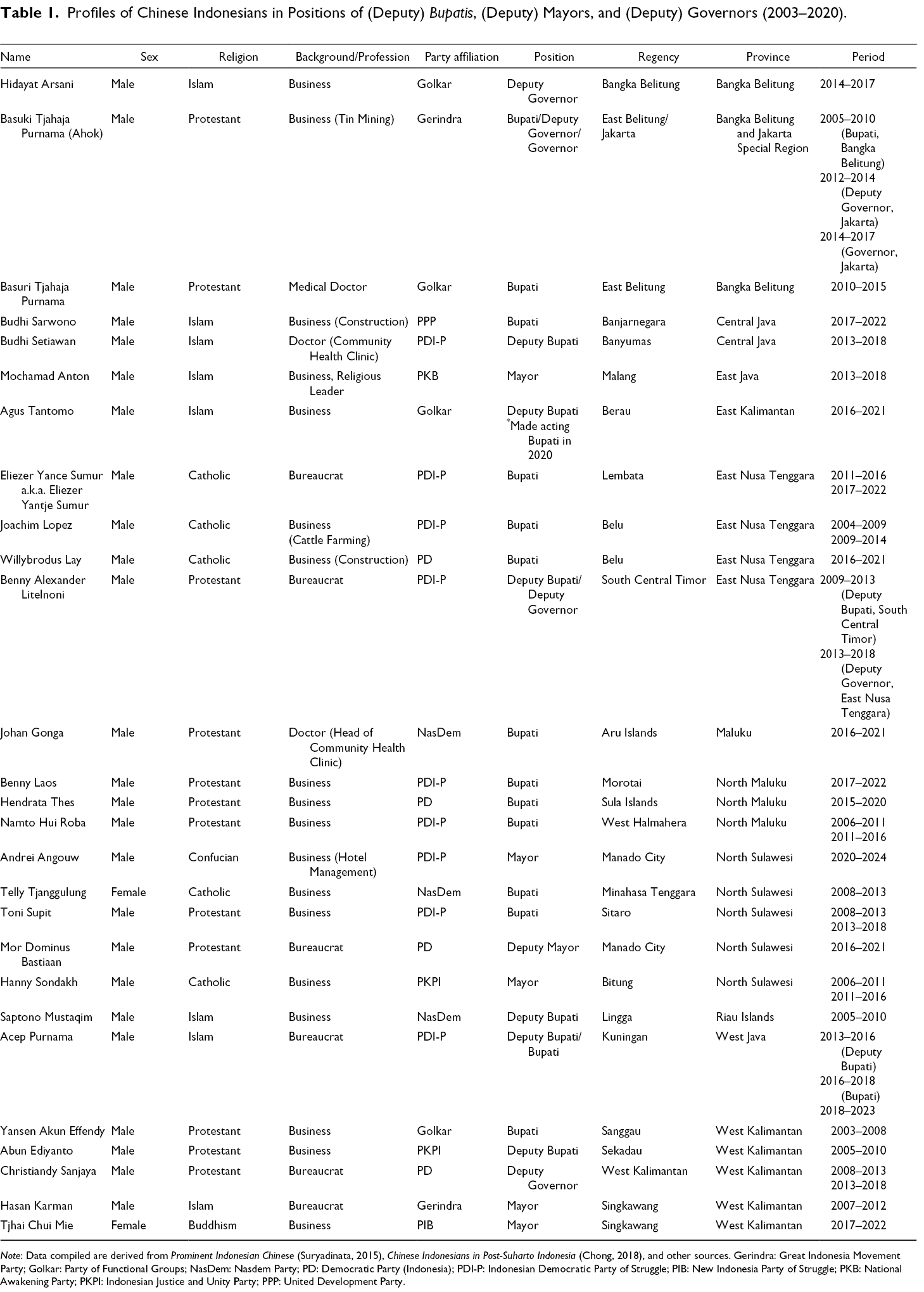
Note: Data compiled are derived from Prominent Indonesian Chinese (Suryadinata, 2015), Chinese Indonesians in Post-Suharto Indonesia (Chong, 2018), and other sources. Gerindra: Great Indonesia Movement Party; Golkar: Party of Functional Groups; NasDem: Nasdem Party; PD: Democratic Party (Indonesia); PDI-P: Indonesian Democratic Party of Struggle; PIB: New Indonesia Party of Struggle; PKB: National Awakening Party; PKPI: Indonesian Justice and Unity Party; PPP: United Development Party.
Mapping Pitkin’s Concept of Political Representativeness onto Typologies of Chinese Indonesian Representation in Regional Elections
While the early flush of political success was felt first in regions with a higher proportion and distribution of Chinese such as West Kalimantan and Bangka/Belitung (both considered ethnically heterogeneous provinces), 15 inroads had been made in regions where the pribumi population had been dominant and the Chinese population extremely small. The cities of Bitung (North Sulawesi) and Malang (East Java) as well as the islands of North Maluku stand out for having Chinese mayors and bupatis sometimes for consecutive terms despite its overwhelming pribumi population.
Employing Pitkin’s concept of representation theory, I argue that there had been a trend in post-reform Indonesia whereby political representation – at least amongst elected Chinese Indonesian executives – has steadily migrated from that of a “descriptive representation” towards a more “substantive representation,” despite the underlying pribumi–tionghua divide. Descriptive representation prescribes that candidates “stand for” constituents sharing similar characteristics (in terms of ethnicity, religion, geographical area, etc.), while substantive representation depicts candidates “acting in the interests of the represented in a manner responsive to them,” even if their own sociological profile does not match that of the majority of their constituents (Pitkin, 1967: 61). Substantive representation, or what is also known as “interest representation,” is considered to be the most important dimension of political representation. It is understood as “the starting point in a democratic view of representation” by most representation theorists (Plotke, 1997: 32–33). This was evident in the election of Ahok to deputy governorship in Jakarta in 2014, considering his “outsider” status in Jakarta. It is also seen in the less-well-known election of Mochamad Anton as mayor of Malang (East Java) in 2013, or the re-election of Eliezer Yance Sumur as bupati of Lembata (East Nusa Tenggara [NTT]) in 2017. Despite their minority status, these elected Chinese Indonesian executives represent a largely pribumi constituency – a phenomenon not seen since the Dutch East Indies.
In addition, being successfully elected to the posts of bupati (regency level), mayor (city), and governor (provincial level) presents varying sets of challenges that are widely linked to the context and habitus of the region that is contested (Table 2). 16 This was made possible due to peculiar strategies and pathways that Chinese Indonesian politicians had adopted (Choi, 2011). In general, regions such as West Kalimantan have a higher proportion and spread of Chinese, while Chinese communities in the provinces of East Indonesia typically integrate better with the local population (Aldo, 2018; Jacobsen, 2006: 79–80). 17 These regions generally demonstrate what can be observed as “descriptive representativeness”, where the combination of ethnicity and/or religion mirrors the constituencies. Singkawang had two Chinese Indonesian mayors – Hasan Karman (2007–2012) and Tjhai Chui Mie (2017-present) – due to the fact that it is a city with a high Hakka Chinese demographic. 18 On the other hand, being elected to gubernatorial positions that oversee a much larger pribumi constituency is a much rarer occurrence amongst Chinese Indonesians and entails a move towards forms of “substantive” political representativeness. Apart from Ahok and Christiandy, Benny Alexander Litelnoni was a Chinese Peranakan who became deputy governor of the NTT province.
Distribution of Chinese Indonesian (Deputy) Regents, (Deputy) Mayors, and (Deputy) Governors in Various Provinces (2003–2020).
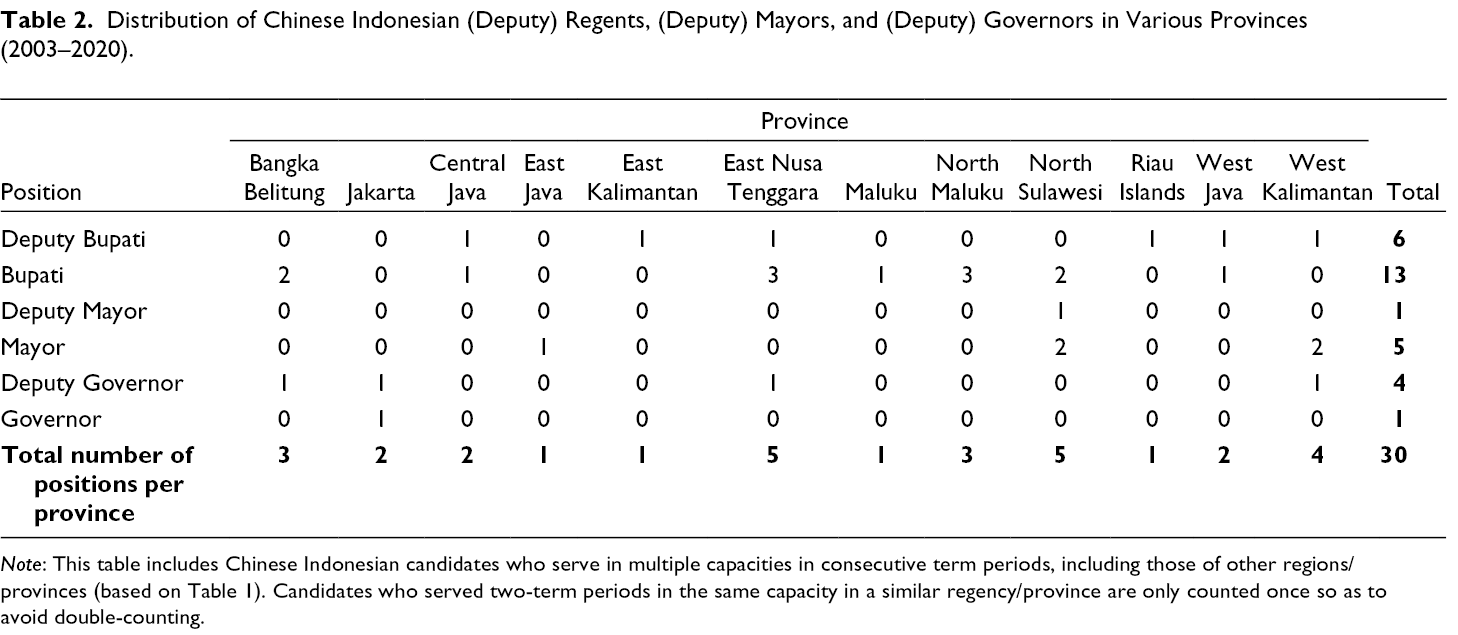
Note: This table includes Chinese Indonesian candidates who serve in multiple capacities in consecutive term periods, including those of other regions/provinces (based on Table 1). Candidates who served two-term periods in the same capacity in a similar regency/province are only counted once so as to avoid double-counting.
With the pribumi–tionghoa dichotomy an abiding factor during elections, Chinese Indonesian candidates had adopted mitigation strategies, depending on the specific context of the region contested, that distinctively downplay or divert attention away from their ethnicity so as not to be seen too “conspicuously Chinese.” This had largely been the case for provinces that are very homogeneous ethnically (Table 3) or where a candidate competes electorally in a constituency that is foreign. While all electoral strategies invariably involved tactical inclusive pairings (as opposed to exclusive pairings) with a pribumi candidate, within such a framework, two major strategic typologies adopted by Chinese Indonesian candidates can be discerned. One involved taking on a secondary role as deputy that typically “stands for” the constituency, while the other involved the cultivation of charismatic appeal towards a focus on the qualities of the individual that “acts for” the specific interests of the constituency. Again, the habitus of the specific constituency determines the strategies and forms of representation that a Chinese Indonesian candidate adopts.
Percentage (%) of Chinese Indonesians in Proportion to Total Population in Provinces with Chinese Indonesian Executives (Based on the 2010 Population Census).
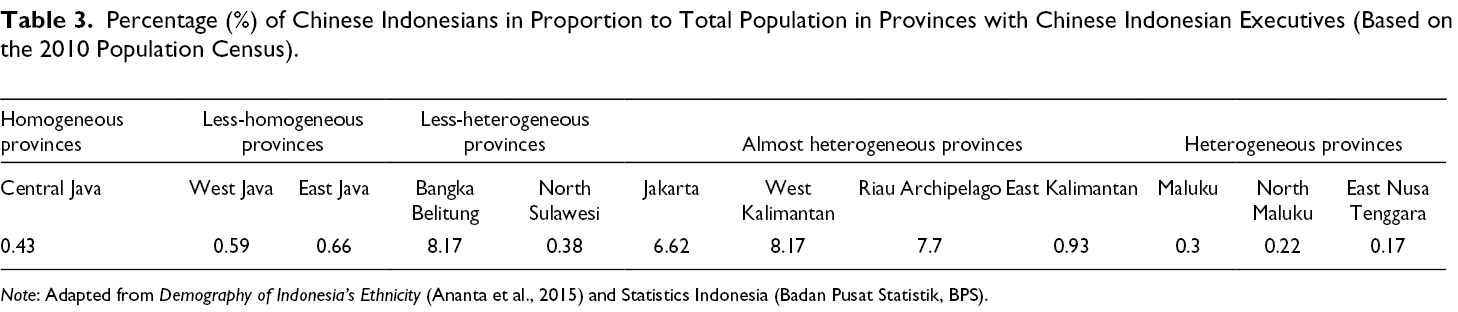
Note: Adapted from Demography of Indonesia’s Ethnicity (Ananta et al., 2015) and Statistics Indonesia (Badan Pusat Statistik, BPS).
In this article, a general rule of thumb determining substantive representation in the context of the existing pribumi–tionghoa divide is accessed based partly upon the concentration of Chinese Indonesians at the provincial or district level and whether or not the candidate takes on a more prominent role in politics. Also, recent studies of ethnicity and religion in Indonesia had demonstrated that ethnicity, in particular the pribumi–tionghoa divide (Meyer and Waskitho, 2021; Sumaktoyo, 2021), stands out undisputedly as a salient feature of underlying identity politics in contemporary Indonesia over other factors. This article thus considers ethnicity as the predominant criteria when determining forms of representation. The following sections attempt to illustrate, with relevant examples, the two strategic typologies that Chinese Indonesian politicians had adopted in their various political habitus and an evaluation of the forms of representation that it entails, with inference to the datasets that I had compiled.
Tactical Inclusive Pairing
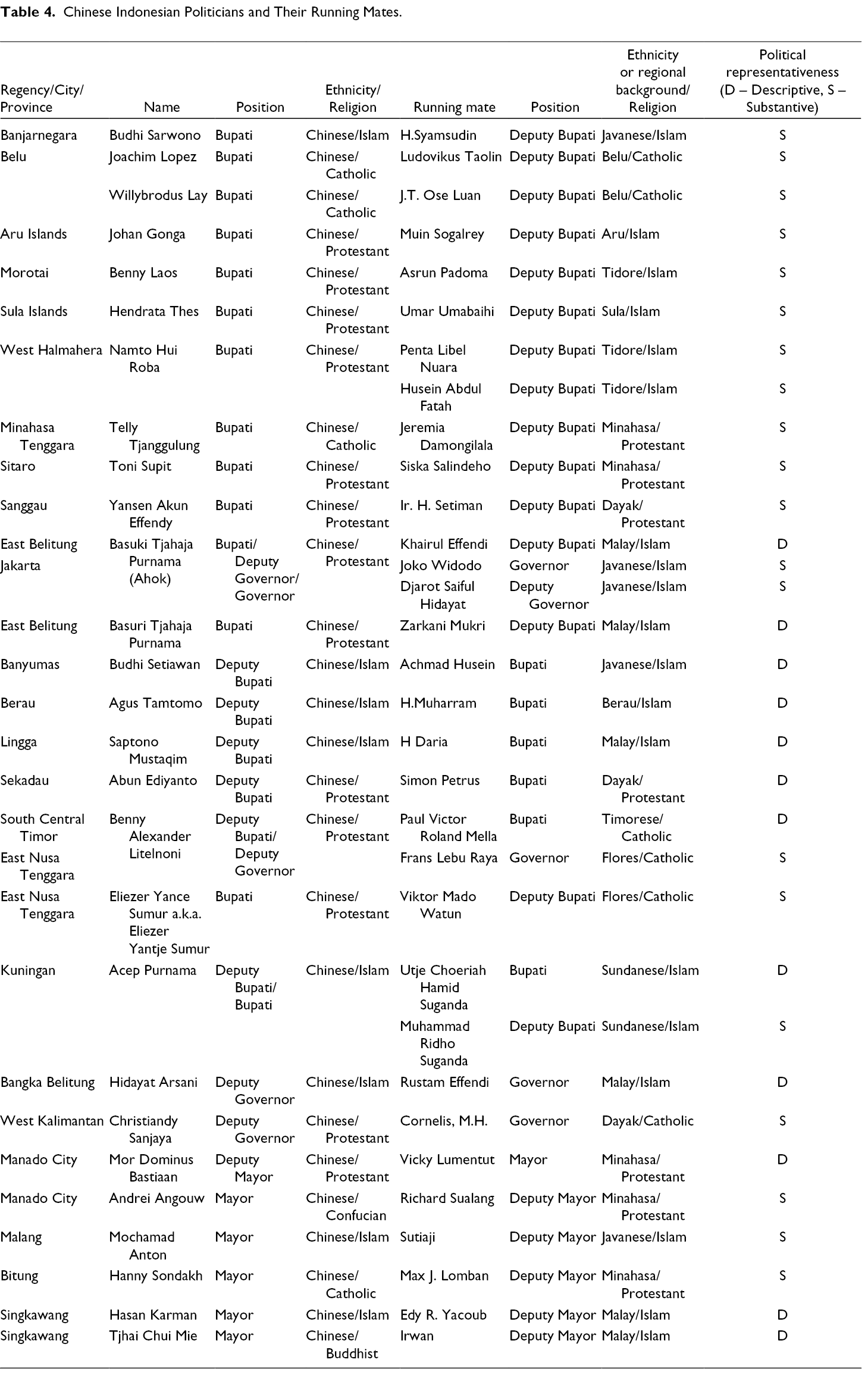
Inclusive pairing with a pribumi candidate remains the most discernible tactic amongst Chinese Indonesian politicians who are keen on securing themselves a place politically (Table 4). While such combinations are largely contingent upon the ethnic make-up of the region that is contested, major considerations are placed on the peculiar political constellations that presented itself, especially during the early years of Reformasi. The earliest participation of politics by Chinese Indonesian candidates in the West Kalimantan province is a clear example of such a trend. Historically, a “vulnerable” (rawan) province under the grip of governor and bupati appointees from Jakarta, the emergence of a pan-Dayak political consciousness (König, 2016) coupled with long-standing grievances over the political dominance wielded by the Malays had resulted in a number of successful Dayak–Chinese pairings in several Dayak-majority regencies (John Bamba, personal communication, 12 June 2018). 19 On the other hand, inclusive pairings involving Chinese–Malay candidates had worked in favour of Chinese Indonesian political representation in the coastal city of Singkawang. 20
Chinese Indonesian Politicians and Their Running Mates.
In the provinces of East Indonesia where identity politics, at least for the Chinese, was not a major impediment, the situation is more favourable. While much of North Maluku had descended into violence and conflict due to communal clashes between Christians and Muslims from 1999 to 2000 (Duncan, 2005), its turn towards inclusive multi-culturalism was just as swift. Furthermore, while the Chinese are a small minority, their dominance over commerce and business in the region, especially by powerful Chinese Peranakan families in NTT and West Timor for centuries (Lombard-Jourdan and Lombard-Salmon, 1998), presented a favourable political opening. 21 Belu, the regency that is closest to the boundary with Timor-Leste, saw two consecutive bupatis of Chinese Peranakan descent paired with locals – Joachim Lopez (2004–2014) for two terms and Willybrodus Lay (2016–2021). Both were not only prominent businessmen involved in crucial sectors of the local economy, but they were also political leaders functioning as heads of the Indonesian Democratic Party of Struggle (Partai Demokrasi Indonesia Perjuangan, PDI-P) and the Democrat Party (Partai Demokrat, PD) of Belu Regency, respectively (Jenahas, 2020; Tribun News, 2012). A similar pattern is observed in the dominance of Chinese Indonesian bupatis in Christian-majority North Sulawesi and Muslim-majority North Maluku where ethnic fault lines and religious sensitivities had less hold over the functions of business and patronage (Lubis, 2017).
Taking on Deputy Roles
In regions where ethnic homogeneity is strong and identity carries more weight politically such as the provinces of Java, it can be seen that Chinese Indonesian politicians contested for and won election in secondary roles as deputies within an inclusive pairing strategy (about a third of all executive positions involved a Chinese Indonesian deputy; see Table 2). Such a strategy has its advantages. In a lesser role, the risk of political overexposure and vulnerability is reduced, allowing for new and relatively junior politicians to enter the political arena. Being in a deputy position also means possessing the potential for future political advancement into larger executive roles where opportunity or merit permits. Acep Purnama of Kuningan (West Java province), who identifies as Chinese Muslim, served a term as deputy bupati before being re-elected as bupati for two terms. Ahok began his political career in Jakarta as deputy governor. Agus Tantomo, the deputy bupati of Chinese descent of Berau (East Kalimantan), was made acting (pelaksana tugas) bupati following the unexpected demise of bupati Muharram due to Covid-19 complications in September 2020 (Daton, 2020).
A strong pribumi candidate at the helm capable of commanding significant political capital can turn out to be the most important factor for winning in an election, especially when paired with a political neophyte or outsider. Budhi Setiawan – a professional doctor and an activist of Chinese descent without a strong political background (Chandra, 2014) – became deputy bupati due largely to his pairing with Achmad Husein, a prominent local leader and an incumbent politician who was bestowed the highest civilian honour (adipati) by the Surakarta Sunanate (Widiyatno, 2013).
In the Outer Islands, bureaucrats Benny Alexander Litelnoni’s and Christiandy Sanjaya’s pathway towards deputy governorship in NTT (2013–2018) and West Kalimantan (2008–2013) provinces, respectively, mirrored such a pattern as well. Benny Alexander Litelnoni’s opportunity arose when incumbent governor Frans Lebu Raya’s running mate, deputy-gubernatorial candidate Esthon Foenay decided to run for the top gubernatorial position himself (Molan, 2013). Frans Lebu Raya was a renowned PDI-P politician known for being the driving force for development in the NTT province. Christiandy Sanjaya, who would go on to serve as deputy governor of the West Kalimantan province for two terms, had paired with Cornelis – an extremely influential and controversial Dayak figurehead who was a pioneer and president of the pan-Dayak movement and the National Assembly for Dayak Customs (Majelis Adat Dayak Nasional, MADN), as well as the ex-bupati of Landak, a Dayak stronghold.
In general, Chinese Indonesian executives adopting a strategy of deputisation parallels what is described as “descriptive representation” – that is, a safer option that is in line with safeguarding and standing for the interests of the majority pribumi population without compromising chances at executive positions – albeit in a less prominent role and capacity.
Charismatic Appeal
Charismatic appeal, when utilised to the right effect, can be a boon for Chinese Indonesian politicians, especially when ethnicity is overshadowed in favour of more “substantive” forms of representation including being seen as acting for the interest of the constituency. By positioning himself as a straight-talking, no-nonsense personality, Ahok’s image as someone who is “clean, tough and anti-corrupt (bersih, tegas, antikorupsi)”, despite his outsider status, had galvanised both voluntary groups and a band of staunch supporters. This had partly accounted for his victory during the 2012 Jakarta gubernatorial campaign and his ability to connect with a majority of the Jakartan electorate (Suaedy, 2014). 22 Against the backdrop of anti-Chinese sentiments, Ahok sought to move beyond the narrow confines of his ethnic identity by reinterpreting the term asli (native) as being about moral conduct whereby cleanliness (from corruption) and a responsible government was the main focus, demonstrating his ability to “act for” his constituency and working to great effect during his early tenure as deputy and acting governor (Hatherell and Welsh, 2017: 185–186).
The same could be said of Mochamad Anton (also affectionately known as Abah Anton) 23 who was the Chinese Muslim mayor of Malang from 2013 to 2018 (Khumaini, 2016). Anton was not only a successful businessman in his own right but also chairman of the Malang Branch of the Chinese Muslim Association of Indonesia (Persaudaraan Islam Tionghoa Indonesia, PITI).. Holding the title of Haj, Anton’s Islamic credentials and his strong relations with the Nahdlatul Ulama (NU) in Malang – at one point he became treasurer of the NU branch of Malang – enabled him to be supported by the NU-affiliated National Awakening Party (Partai Kebangkitan Bangsa, PKB) for his mayoral bid. By adopting a distinctively cultural approach with appeals to Islamic piety and aiding the poor, Anton’s ethnicity was overridden in favour of his religious identity (Basuki, 2014). In fact, during his tenure as mayor, Anton affirmed his role as a defender of Islam acting for the interest of his electorate by issuing a circular (surat edaran) making it mandatory for all Muslims to observe the daily Islamic prayers (shalat berjamaah) in 2016 (Portal-Islam, 2016).
This was not too dissimilar from how Budhi Sarwono appealed to his constituency as bupati candidate of Banjarnegara (Central Java province), with a specific focus on the poor and downtrodden. This inclination had been largely due to his past experiences. A Chinese Muslim entrepreneur in the construction business and chairman of the PITI branch of Banjarnegara, Budhi was a self-professed ex-drug dealer and user who spent time behind bars and almost overdosed himself. He attributed his conversion to Islam as the event that saved his life (Tribun News, 2019). Budhi was known to be a sensationalist and was not afraid of courting controversy, including publicly revealing his meagre salary as bupati in protest of the far higher sums that members of the regional people’s representative council (Dewan Perwakilan Rakyat Daerah, DPRD) received (Agiesta, 2019). Ironically, his eccentricity had become a form of political capital and a means by which he is seen as acting for the interest of his constituency.
Conclusion: Quo Vadis Chinese Indonesians and Democratic Representation?
Since Reformasi, Chinese Indonesians in general have experienced greater civil liberties and political freedom. It began with the unravelling of years of discriminatory laws under the New Order, which not only gave the Chinese Indonesian recognition of their rightful place in Indonesian society but also attempted to breach the pribumi–non-pribumi divide. While these institutional efforts had appeared relatively successful in the early years, especially following the enactment of the New Citizenship Bill in 2006, discrimination still persist in various forms. Politically however, Chinese Indonesian politicians had adapted when running for office by way of eliding unnecessary attention paid to aspects of their ethnicity through the strategies mentioned. That Chinese Indonesians can still be politically successful in regions considered particularly difficult to contest attests to the fact that “Chinese-ness is in the eye of the beholder” (Suprajitno, 2013).
It can also be seen that Chinese Indonesians thrive politically in the ethnically heterogeneous provinces of East Indonesia (Table 3), taking up half of all executive positions for regional elections. Where multi-culturalism is embraced and “substantive representation” a growing phenomenon, there had been a higher number of Chinese Indonesians elected into executive positions. Where identity politics remains a strong imperative, Chinese Indonesians had also succeeded in their own right although in lesser numbers.
Thus, while “soft ethnic politics” that “generally lack ideological depth” (Aspinall, 2011) is always an unavoidable feature of Indonesian politics (Chong, 2018; Miichi, 2014; Thung, 2009), 24 increasing statuary gains by the Chinese and the growing confidence of their position within Indonesian society during the reform years had nonetheless unsettled certain pribumi groups. This is even more so as Chinese Indonesian political representation has increasingly evolved towards more “substantive” forms throughout the years, as argued. Chinese Indonesians, unlike their pribumi counterparts, pale considerably when it comes to territories beyond their principal constituency. Ahok’s rise had shown that prior to his failed re-election, there was a genuine hope that his candidacy was a demonstration that Chinese Indonesian political representation can go beyond one that is ethnically heterogeneous and territorially defined. The recent revival of the discourse of pribumi-ism affiliated with aspects of Islamic conservatism (Osman and Waikar, 2018) can thus be seen as a concerted attempt at subverting the multi-cultural praxis that had been at the heart of reforms in Indonesia by essentialising ethnicity and pandering to a conservative, largely intolerant version of Islam. 25 Their success at galvanising support beyond Jakarta since 2017 had indeed impacted politics at the regions. 26
Yet this did not entirely deter Chinese Indonesians’ chances at other forms of political office. For the period of 2014–2019, there were fifteen Chinese Indonesian members in the two national legislative assemblies of Indonesia (Cui, 2014). 27 It dropped to eleven for the 2019–2024 period (Suryadinata, 2019). The DPRDs in the various provinces showed even greater promise. A number had risen to leadership positions within their respective regional DRPD – an alternative pathway towards executive positions. 28 During the recent 2020 simultaneous regional elections, another unlikely record was broken for Chinese Indonesians. Andrei Angouw made headlines by becoming the first Chinese mayor of Manado who openly adheres to Confucianism – a first since Confucianism was recognised as Indonesia’s sixth official religion in 2006 (Detik News, 2020). In the wake of fresh concerns over anti-Chinese sentiments that drew sustenance from the Covid-19 pandemic in Indonesia (Parhani, 2020), Andrei’s win is a testament to the political gains Chinese Indonesians had achieved thus far, despite the challenging political climate. It is also a reminder that homogenous Western Indonesia and relatively heterogeneous Eastern Indonesia have vastly contrasting attitudes towards Chinese Indonesian representation in politics.
The rise of the pribumi rhetoric two decades after reforms and a decade after the New Citizenship Bill was passed can thus be seen as a culmination of anxieties by some pribumi elites in an increasingly competitive electoral field. By reviving the spectre of indigenism, old fears and concerns had been roused, and hopes for greater equity in terms of political representativeness had been dashed. This means that Chinese Indonesians as a whole are likely to be cautious and even more so when it comes to electing someone from their own ethnic group, with many pressured to remain apolitical (Lim, personal communication, 22 November 2018). It also means that stereotypes and discrimination are likely to find greater traction even amongst the Chinese themselves (Republika, 2016). In a survey tasked to gauge public sentiments towards the Chinese, negative prejudices resurfaced in which Chinese Indonesians are seen as exclusive, economically privileged, commanding an overt influence in politics while possessing divided national loyalties (Setijadi, 2017). 29 All this do not bode well for greater participatory politics and representation in a democratic setting.
The false rhetoric of non-pribumi domination of political office had evoked anachronistic fears of henchman appointees of Chinese origin by Dutch colonialists – except that this time Chinese Indonesian politicians are elected, not appointed. In the larger scale of things, the proportion of Chinese Indonesians elected into executive office since 2003 remains miniscule. Recent critics of democracy in Indonesia have often focused on aspects of democratic deconsolidation in Indonesia (Mietzner, 2018; Warburton and Aspinall, 2019), expressed in the form of state coercion against populist radicals. While these debates are important, other aspects of democracy in Indonesia such as the regression of democratic political representativeness in the context of historical discrimination that favours narrow ethnic or religious markers over a more “substantive representation” should render closer consideration. This article not only tried to provide a survey of Chinese Indonesian political representation at the regional level, but it also sought to demonstrate the precarity of political representativeness within Indonesian democracy and how it can easily be overturned by the old trope of pribumi-ism despite institutional reforms. As the opposite of representation is not participation but exclusion, the bitter reality of the tionghoa–pribumi divide had demonstrated that improving political representativeness should be considered as an aspect of democratic consolidation, and one that remains an important bellwether of how democratisation in Indonesia can be evaluated beyond the narrow lens of ethnicity or even territory.
Footnotes
Acknowledgements
I would like to thank Alexander Arifianto (Indonesia Programme, RSIS, NTU) for his insightful feedback, as well as the two anonymous reviewers and the journal editor for their thoughtful suggestions and excellent advice.
Declaration of Conflicting Interests
The author(s) declared no potential conflicts of interest with respect to the research, authorship, and/or publication of this article.
Funding
The author(s) received no financial support for the research, authorship, and/or publication of this article.
Notes
Author Biography
Email: