



Abstract
Under the authoritarian regime, earlier iterations of Vietnam’s public diplomacy (PD), especially during wartime, reassembled propaganda and psychological warfare. But thanks to Doi Moi (i.e. “renovation”) in 1986, new understandings of PD were made possible with a revamped foreign policy of multi-lateralisation and diversification. This article argues that information and communications technologies (ICTs), especially the internet and social media, have further transformed the practice of Vietnamese PD. Focusing on the period from 1997 when the internet was introduced in Vietnam, this article first provides a general analysis of the influence of ICTs on Vietnam’s politics. It then delves into how ICTs have transformed Vietnam’s PD. The key takeaway is that the internet and social media have significantly empowered public opinion in foreign policy, giving rise to cross-border cyber communities that can play the roles of both recipient and practitioner of PD.
Keywords
Background on Public Diplomacy and Digital Technologies
Public diplomacy (PD) may be a new concept, but it is a long-established practice. There has been a long-term academic debate on what PD entails, but a growing consensus can be found in the definition of the concept by Bruce Gregory (2011: 353), “an instrument used by states, associations of states, and some sub-state and non-state actors to understand cultures, attitudes and behaviour; to build and manage relationships; and to influence thoughts and mobilise actions to advance their interests and values.” In essence, this definition denotes that PD may include any public-facing communication attempts with a view to achieving policy objectives. And as per this understanding, PD has broad boundaries, which may be on a collision course with other concepts. As a matter of fact, to some, PD may include, for instance, strategic communications, propaganda, and public affairs, while others insist on a clear-cut distinction.
However, over the past twenty years, the central debate has not been about what PD can be, but how practitioners should conduct PD for optimal effect. It seems the general consensus among academics is that PD practitioners should graduate from one-way and manipulative messaging to mutual understanding and relationship building, as that is the genuine and sustainable way to win hearts and minds (Melissen, 2005). There are several forces behind this school of thought, a major one of which is breakthroughs in information and communications technologies (ICTs), especially the penetration of the internet and social media. ICT advances have allowed for the freer availability of information, thus empowering the general public to be more deeply involved with the policymaking process and forcing state actors to reckon with the exponential growth of the public sphere and, in many parts of the world, the dire need to appeal to the masses. “Public sphere” is a term coined by Habermas to denote “a sphere which mediates between society and state, in which the public organises itself as the bearer of public opinion” (Habermas et al., 1974: 49–55).
The thought of incorporating technology in the projection of national image and influence emerged decades ago, but technological limits at the time did not allow much scope to realise the idea. Perhaps the first steps towards direct engagement with global audiences started when the United States Information Agency’s (USIA) Voice of America launched an online text service in 1993, an official website in 1995, and real-time audio services in 1996 (Cull, 2013). Nonetheless, even such remarkable events sound outmoded today, when new communication technologies such as the print press, radio, television and internet have metamorphosed by leaps and bounds, “challenging existing institutional practices and presenting new opportunities for engaging and/or alienating foreign constituencies” (Arsenault, 2009: 135–153).
On the surface, the most noticeable change ICTs brought about is the publicising of diplomacy. While PD has always been designated as a supporting form to traditional diplomatic channels, today’s diplomacy per se is hardly conducted behind closed doors. Thanks to almost unlimited and unfiltered access to information and numerous communication media, most of the previously clandestine diplomatic efforts are put in the public arena, intentionally or otherwise. That means modern diplomacy has come under the spotlight. ICTs facilitate diplomatic work and, at the same time, make it vulnerable. Leaking, hacking, and other intrusive acts have posed severe threats to diplomatic work and diplomats. As such, a discussion on the role of ICTs in PD must also address the spill-over effect caused by events unrelated to diplomacy.
One of the significant implications is that ministries of foreign affairs and diplomats have started to adopt publicity as part of their work, turning their diplomatic efforts into cyberspace-specific diplomacy. Cyber diplomacy or digital diplomacy has proved to be essential to the conduct of foreign affairs across democratic states, with political leaders, career diplomats, and government agencies maintaining active profiles on popular platforms like Facebook, Twitter, and Instagram.
This article examines the impact of ICTs, especially the internet and social media, on Vietnam’s PD. Vietnam presents a special case study for PD, in part because it has witnessed one of the longest single-party regimes. Whether socialist, semi-authoritarian, or full-scaled totalitarian, the Communist Party of Vietnam (CPV) has maintained a strong grip on the society since 1945, essentially limiting public participation. Though commonly known for its propaganda system, Vietnam has for a long time employed various public-targeted strategies, thus representing a documented evolution of the practice and concept of PD. As demonstrated by my survey data, Vietnamese practitioners share the same belief that digital diplomacy is highly relevant to PD, and also consider PD to be closely related to the concepts of people’s diplomacy, cultural diplomacy, and external information (or external propaganda, tuyen truyen doi ngoai in Vietnamese) (Figure 1).
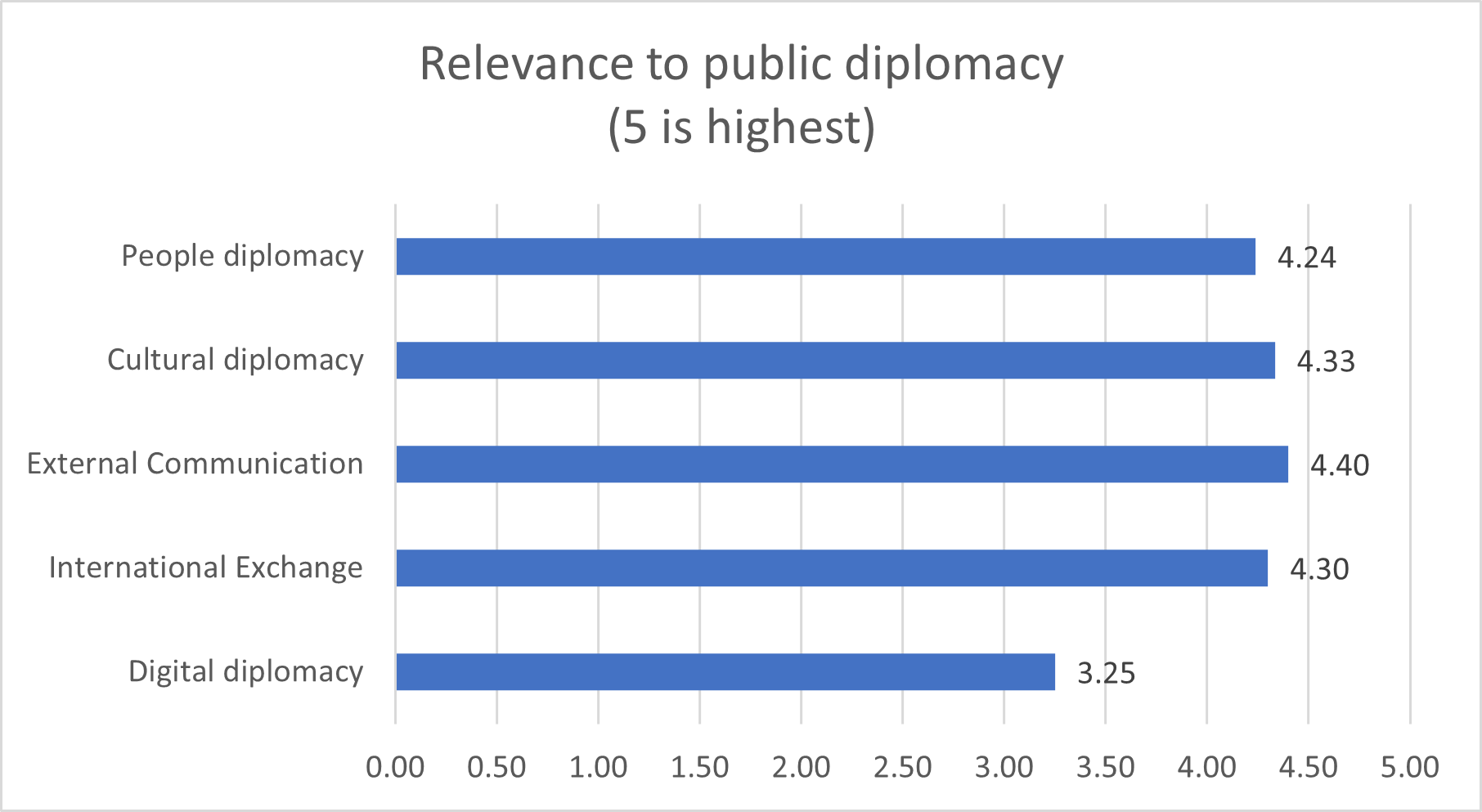
Public Diplomacy (PD) and Other Concepts.
As a brief summary, however, the practice of PD has never been foreign to the party-state of Vietnam. Before Doi Moi (i.e. “renovation”) in 1986 and especially during the First and Second Indochina Wars, Vietnam actively engaged in many activities that are nowadays considered either as part of, or older versions of, PD. Under the banner of external propaganda and people’s diplomacy, Vietnam was relatively successful on the diplomatic front during wartime. However, its Cold-War-styled PD was designed for immediate effect, with one-sided messages that aimed to sway public opinion in either camp, friends or foes.
The Cold War PD that the communist regime employed did not always enjoy positive results. After 1975, Vietnam engaged in two smaller intertwined wars against the Khmer Rouge in Cambodia and the Chinese, the former of which failed the court of public opinion (Abuza, 1995). Vietnam’s occupation of Cambodia caused much outrage among Southeast Asian countries, especially Thailand, which was concerned that Vietnam might send troops across its border to chase after the remnants of the Khmer Rouge. For fear of regional instability, other countries rallied behind Thailand and worked towards isolating Vietnam from the international community (Luu Van Loi, 1996). The US embargo after the war was another factor that wreaked havoc on Vietnam’s waning economy.
Doi Moi was officially adopted by the Sixth National Congress of the CPV in 1986. Among a wide range of socio-political reform measures, Doi Moi also kickstarted a foreign policy that gradually moved towards diversification and multi-lateralisation (Communist Party of Vietnam, 2007) in support of domestic goals. Vietnam’s PD, accordingly, has been transformed into a longer-term and relational strategy with diverse stakeholders. More details about Vietnamese PD before Doi Moi and the impact of Doi Moi can be found in, for example, Bradley and Nguyen (2015) and Lam (2015).
The central argument presented in this article is that the internet and social media have transformed Vietnam’s PD into an intermestic design. “Intermestic” implies that Vietnam’s PD has taken both domestic and international policy objectives into consideration, targeting and involving the publics at home and abroad. With the focus on ICTs, this article explores Vietnam’s PD after the introduction of the internet in Vietnam in 1997. I conducted elite interviews and perception surveys with diplomatic officials from Vietnam’s Ministry of Foreign Affairs (MOFA), from 2018 to 2019. There were nine interviewees and twenty-three survey respondents.
By design, an investigation into Vietnam’s PD cannot forgo the bigger context of Vietnam’s politics since PD, as part of the public outreach apparatus, cuts across Vietnam’s domestic and international policies. Centring on the general public, social media is a transcending determinant across the political spectrum, thus requiring a holistic analysis. Therefore, to understand the implications of ICTs for PD, this article unpacks the impact of ICTs on the Vietnamese public sphere. Public opinion, thanks to ICTs, matters more in the Vietnamese political process and transforms PD. This article, as such, addresses two main themes: the rise of online activism thanks to ICTs and the impact of ICTs on PD.
The Booming of the Internet and Social Media in Vietnam
In Vietnam, ICT penetration, though belated, is nothing short of phenomenal. According to Mai Liem Truc, before 1997, Vietnam’s government had been cautious about the downsides of the internet, such as toxic content and the potential leaking of state secrets (as cited in Duc Hoang et al., 2017). 1 As such, Vietnam’s official decision to join the World Wide Web in 1997 was undertaken with reservations. In fact, for more than twenty years, the growth of the internet in Vietnam has been accompanied by the state’s relentless efforts to curtail its perceived threats – as detailed below.
For almost five years after 1997, low-speed dial-up connections only managed to attract less than 4 per cent of the population. However, in 2003, ADSL (asymmetric digital subscriber line) broadband was introduced and the domestic userbase grew seven times over the next five years. But the biggest driver of the internet’s expansion occurred in 2009 with the arrival of fibre cable and mobile broadband technologies (Duc Thien, 2017; Thuy Van, 2017). A latecomer to the internet, Vietnam has continuously been among the top countries with the highest numbers of internet users. According to the Ministry of Information and Communications (MIC), as of 2017, there were 64 million users, accounting for 67 per cent of the population (Ministry of Information and Communications, 2017).
With high levels of internet penetration comes a rapid increase in online presence and association. Communication platforms have sprouted exponentially, ranging from blogs, chatrooms, and online forums to social networking sites. Various social platforms have come and gone. Before 2009, Yahoo dominated Vietnamese market share with household names like Yahoo Messenger and Yahoo 360. As of 2018, Facebook commands the top spot with 60 million active accounts (Mai Phuong, 2018a). Facebook, Google Search, and Google’s YouTube have been the three most visited sites in Vietnam since then (Duc Thien and Thien Dieu, 2018).
The Rise of Online Activism
In Vietnamese politics, it is not an exaggeration to say that following the adoption of Doi Moi, no other event has been more consequential for ordinary people than the World Wide Web. Before the internet, the party-state was relatively successful in maintaining a tight control on freedom of information, expression, and assembly, despite the fact that these are constitutional rights. From a state-centric perspective, there is little room for the growth of civil society in this authoritarian regime. As such, for a long time, Vietnam watchers shared a grim view that there was hardly any civil society in Vietnam, and ordinary citizens and their associations would have limited freedom to influence the state’s policymaking (London, 2009; Salemink, 2006). But if one adopts a looser definition of “civil society,” such as “organisations in the public sphere that operate at least semi-autonomously of the state,” by Kalathil and Boas (2010) in Open Networks, Closed Regimes, then it is quite clear that Vietnamese civil society has changed rapidly over the past two decades, mostly thanks to ICTs, and especially the internet.
With the internet, ordinary people have access to a powerful resource and space to practise their constitutional liberties. It is easy to see how the internet is a powerful resource on a global scale. Internet connections have become much more affordable and faster. According to a study by Picodi (2019), an international e-commerce company, Vietnam’s internet price per Mbps is on par with India, and lower than a majority of the sixty-two countries studied. The internet landscape of Vietnam is also intriguing. For a population of about 97 million, Vietnam has more than 143 million mobile numbers and subscriptions, so mobile connections are about 150 per cent of the population (Vnetwork, 2019). On average, Vietnamese users spend about six hours and forty-two minutes every day on the internet, with two hours and thirty minutes for social media. The average speed of internet access is more than 20 Mbps, which is sufficient for multi-media tasks like high-quality video streaming (Vnetwork, 2019).
Affordable mobile broadband plans have furthered the cyberspace as an informational arena that gradually challenges the traditional informational role of the state-controlled press. While the internet provides the Vietnamese people with access to cross-border information, the infiltration of social media has fundamentally changed the way they communicate and get their news. Mainstream media is under the control of the party-state, and news content has traditionally been primed and framed to serve the state’s purposes (Reporters Without Borders, 2019). According to a 2018 study by the Pew Research Centre, 48 per cent of Vietnam’s online population uses social media as a news source, and the younger they are, the more likely they rely on getting news from social platforms (Mitchell et al., 2018). These users are also among the country’s highly educated and urban-based members of the population (Kurfürst, 2015).
Social media have posed existential threats to the press. Mainstream news media accounted for 81 per cent of advertising revenue in 2010, but less than 30 per cent in 2018 (Dang KhoaKhoa, 2019). News travels faster and is considered more trustworthy on social media than in the print media – a point that was acknowledged several times by Do Quy Doan (2013), former deputy minister of MIC. The print media has tried to adapt itself by directly engaging with social media users. Many leading news outlets have both websites and social pages, such as Thanh Nien, Tuoi Tre, and VnExpress. There is also a growing symbiotic relationship between the press and social platforms: journalists get wind of newsworthy information on social media, and online activists lean on mainstream news outlets to extend their outreach to non-users of social media (Nguyen Thanh Lam, 2016). 2 This reciprocity has proven to be risky: many news outlets are sanctioned for jumping the gun – publishing adverse or unverified information (Ha Son Thuy, 2016).
Access to the internet provided entrance to the immense knowledge base of the world that Vietnamese people did not enjoy in a tightly controlled society. The freedom of connection becomes essential to the freedom of expression (Dutton et al., 2010). Technology has become more user friendly than before, and netizens can make use of prebuilt tools and features to create a website, a forum, or a blog without much need for technical expertise. For people with limited English skills, there is plenty of Vietnamese content on the web. According to Web Technology Surveys, Vietnamese was used by 1 per cent of the websites by the end of 2019 – which makes Vietnamese the 11th most-used language on the World Wide Web (Web Technology Surveys, 2020). That is not to mention the various machine translation technologies deployed by the likes of Google, Facebook, Microsoft, and Apple – all of which have gained relatively positive results in dealing with the language barrier. Therefore, with the internet, the Vietnamese people have access to both information and technology. Such access empowers them to establish or engage with online groups without space and time constraints. It should be noted that such access is bi-directional: people outside of Vietnam also have more access to Vietnam in cyberspace.
The internet is leading the charge to revolutionise the “public sphere,” which used to be confined by geographical boundaries. Traditionally, the public mainly represented themselves – had their voice heard – via the mass media and elections (Dahlgren, 2005: 147–162). Public participation in Vietnam, as such, was previously unresolvable since the party-state has not allowed for free press or free elections. Breakthroughs in communication technologies – such asWeb 2.0 that gave rise to YouTube, MySpace, and Facebook, and the growing blogosphere supported by the likes of WordPress and Joomla – have transformed the public sphere into a global and networked space (Castells, 2007; Shirky, 2011). As public opinion can be amplified in a networked public sphere, civil society can thrive. A global public sphere nurtures a global civil society and a transnational public (Castells, 2008: 78–93; de Jong et al., 2005).
For Vietnam, the newfound public sphere has become a political arena from at least 2001. Various activist groups and individuals have turned to the internet and social media to present their views, often in direct contrast with or in criticism of the state (see Table 1 for several landmarks). Political civil society is budding at a remarkable rate if one considers Thayer’s definition that views political civil society as “non-violent political, advocacy [by] labour and religious organisations and movements that seek to promote human rights, democratisation and religious freedom in authoritarian states” (Thayer, 2009: 1-27). Even for more radical ones among these activist groups – those calling for pluralism and multi-party systems – the internet has become an essential conduit for their activities (Thayer, 2009). As Chang et al. (2013: 150–164) noted, “…the Internet and social media have provided alternative sources of information, lowered the cost of political participation, and increased the mobilising capacity of opposition forces.”
The Politics of Blogging in Vietnam (2003–2018).
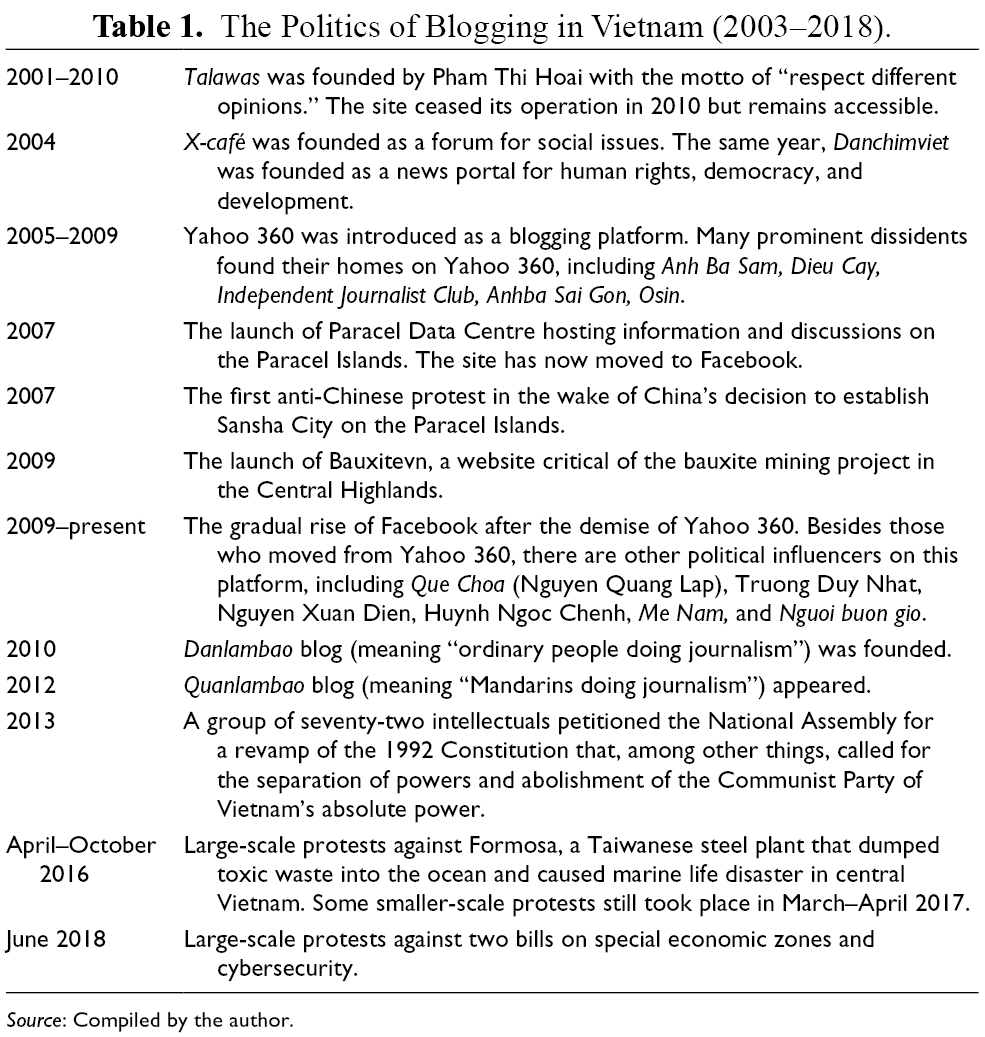
Source: Compiled by the author.
Indeed, the internet and social media have had a mobilising effect on policymaking and public opinion. Private actors have directly or indirectly challenged the idea of “sensitivity” regarding many issues that used to be off limits. They have shown to be willing to push the envelope as well as apply such tactics as priming (i.e. suggesting a series of related issues in a way that alters people’s considerations of the subject matter) and framing (telling a piece of news from a specific angle that affects how people interpret the news). As Bui Hai Thiem (2016: 77-93) observes, “transparency,” “accountability,” and “advocacy” have become daily vocabulary. Even terms like “interest group,” “vested interest,” and “civil society” are no longer taboo (Dang Ngoc Dinh, 2006).
Online Activism and the Nation Branding of Vietnam
In the same vein, the impact of ICTs on PD is undeniable. ICTs have transformed the public sphere. Since PD is a communication process involving the public, PD has also changed. Communications have transcended the boundaries between domestic and international affairs, thanks to the transnational and instantaneous flow of information and establishment of online communities. The first change to PD is that it is more and more difficult to distinguish between domestic and international politics in cyberspace. As seen in Table 1, online activism is not limited to Vietnamese constituents, nor is it constrained by the physical boundaries of Vietnam.
On the one hand, there is a more robust connection among the Vietnamese at home and abroad. Transnational elements appear in online activism, together with the growing relevance of the Vietnamese diaspora – a scattered community of over 4.5 million Vietnamese overseas as of 2018 (more on this later). Pham Thi Hoai, founder of the pioneering blog Talawas, for instance, is a Vietnamese German. Before Talawas was shut down due to Vietnam’s firewalls, its audience was mostly from Vietnam (SimilarWeb, 2020). Another example is with the case of the protest movement against China’s aggression in the South China Sea; Vietnamese expatriates have frequently taken to the street in tandem with domestic rallies (Tran Quang Vinh, 2014). That is not to mention this, Vietnamese authorities have always accused the US-based pro-democracy organisation Viet Tan of plotting to overthrow the communist regime by means of spreading false information and supporting illegal protests inside Vietnam (Lao Dong Online, 2018). On the other hand, technologically speaking, online activism is transnational, since the Vietnamese people rely on blogging and social platforms owned by international corporations, whose technical infrastructure and operational policies are largely independent of Vietnam’s jurisdiction.
In that vein, domestic events can certainly attract transnational interest and vice versa. As one function of PD is to build an international image, PD comes under the influence of such events. There is clear evidence of the blurred line between the domestic and the international in more open political systems (Fitzpatrick, 2010; La Porte, 2012). This section presents three small case studies to demonstrate that the spill-over effect caused by events that are not foreign related in a traditional sense is also present and growing in a semi-authoritarian regime like Vietnam – with implications for its PD work. Later on in this article, the three examples will be referred to as three incidents for the sake of brevity.
The first case study is related to a plan of felling 6,700 trees by Hanoi’s municipal authority in 2015. The public at the time was concerned about the environmental impact of that plan, and there were discussions on social media. Then the online dissent gained momentum when several public figures issued open letters to local authorities. Tran Dang Tuan, former vice president of Vietnam’s national television, and Ngo Bao Chau, a world-renowned mathematician, helped push the online debate forward. In response, one senior official of Hanoi said that there was no need to consult the people before felling trees (Hong Nhi, 2015). His answer further inflamed public sentiment.
Widespread resistance from the concerned public in cyberspace quickly turned into political activism on the street from March to April 2015 (Minh Thu, 2015). It then quickly drew international attention, with some observers, such as The Financial Times journalist Michael Peel, believing this was a step forward for Vietnamese civil society (Peel, 2015). Seemingly caught off guard by such strong public dissent, both Hanoi’s municipal leadership and the central government had to respond by launching an investigation and eventually withdrawing the plan and disciplining some officials involved (Tu Anh, 2015).
Another incident that was even more detrimental to Vietnam’s international reputation occurred in 2016 in relation to a water pollution crisis that affected four provinces in central Vietnam. Formosa, a Taiwanese steel plant located in the province of Ha Tinh, was found to have dumped toxic waste into the ocean, allegedly causing mass fish deaths, which were devastating for the environment, livelihoods of affected fishermen, and the tourism industry. Yet initially, central and local authorities denied any link between Formosa and the mass fish deaths (VnExpress, 2016b). Some senior officials even claimed that there was no toxic waste, but merely a natural phenomenon called “red tides” (Chau AnAn, 2016). Mass protests ensued (BBC, 2016; Thanh Phuong, 2016).
Yet, not until an international group of scientists joined hands for nearly three months to trace the cause of the disaster did the government conclude Formosa was the culprit, with a demand for USD 500 million in damages (VnExpress, 2016a). Several senior officials at central and provincial levels were disciplined for failing to adhere to environmental regulations (Hoang Thuy, 2017). Prime Minister Nguyen Xuan Phuc then tried to appeal to the public by stating that there should be no trade-off between the environment and economic development, and that such a trade-off would harm the people’s livelihoods and bring about social instability (Le Kien, 2016).
The third case study is more political than the previous two. In June 2018, thousands of people across the three regions of Vietnam took to the streets to protest against two controversial bills submitted to the National Assembly: the now-suspended Special Economic Zone (SEZ) bill and the recently ratified Law on Cyber Security (Reuters Editorial, 2018). The most contentious point in the first bill was that foreign investors would be granted the right to lease Vietnamese land for up to ninety-nine years. Without mentioning China, it nonetheless raised grave concern over the prospects of long-term land occupation by Chinese investors and of the erosion of sovereignty. Even when the SEZ bill was still on the National Assembly floor, there was disapproving feedback from top economists, at least for fear that the projected SEZs in the bill are unlikely to be viable (Le Nguyen, 2018). Some National Assembly deputies were concerned that the bill might inadvertently facilitate inflows of migration (Vo Hai and Hoai Thu, 2018).
The cybersecurity bill, on the other hand, faced public backlash for allegedly suppressing and violating the people’s freedom of speech on social media as well as invading their privacy. In the wake of unexpected public objections, the government eventually decided to delay the consideration of the bill to the next working session of the National Assembly, but not before some provocative statements from top-level politicians had been delivered. The Chair of the National Assembly publicly affirmed that “the Politburo has endorsed this initiative [economic zones], we [the Assembly] have to discuss to pass this law” (Nguyen Le, 2018). All the while, the Minister of Planning and Investment lamented that some forces were trying to sabotage Vietnam–China relations (Nam Phong, 2018). These statements, no matter how well-intentioned they may have been, were considered tone-deaf and added fuel to the fire.
There are two major commonalities among these three case studies. The first is that apparently public opinion has gained traction in Vietnam’s policymaking thanks to the internet and social media. More and more frequently, grassroots discussion starts online. If the matter at hand is of interest to a broader audience, it gains popularity by means of liking and sharing, especially by those who have a large following – such as celebrities and other public figures. Nguyen Hoang Anh (2019) conducted an analysis of 7,800 comments on Facebook related to the 2015 tree removal case and found that a majority of the comments advocated a change of policy, that is, stopping the removal plan. This meant that social media empowered the public to participate in policy discussions. Online discourse then kickstarted a chain reaction, from attracting the press, piquing international interest, turning into physical demonstrations, to prompting a government response. Besides “advocacy,” online activists also called for more accountability and transparency as well as public consultation in the policy process. However, it would be premature to infer that ICT-powered public participation can drive policymaking – more on this later. But its role as a facilitating or catalysing force is undeniable.
The second commonality among these cases is their impact on the international image of the regime. For the case of Hanoi’s tree removal plan, several international news outlets, such as VOA, The Diplomat, and Reuters, covered the news about the plan and public response (e.g. Ho Binh Minh, 2015). Even a city-level incident as such would likely have an impact on the international perception of Vietnam, especially on the lack of environmental awareness among public officials. The 2016 ocean disaster attracted much more international interest, and unfortunately seemed to confirm the negative impression of Vietnam’s ineffectual environmental regulations. Data from Google Trends (Figure 2) show that search queries for the Formosa disaster closely followed the developments of the real-life situation, with the USA and Vietnam as the two most inquiring locations (Google Trends, 2016). A quick analysis of news coverage on this incident, using the news search engine newslookup.com, shows that there were 314 unique news articles in English – meaning they were not aggregated or duplicated. Among the articles, 162 originated in the USA (Newslookup, 2016).
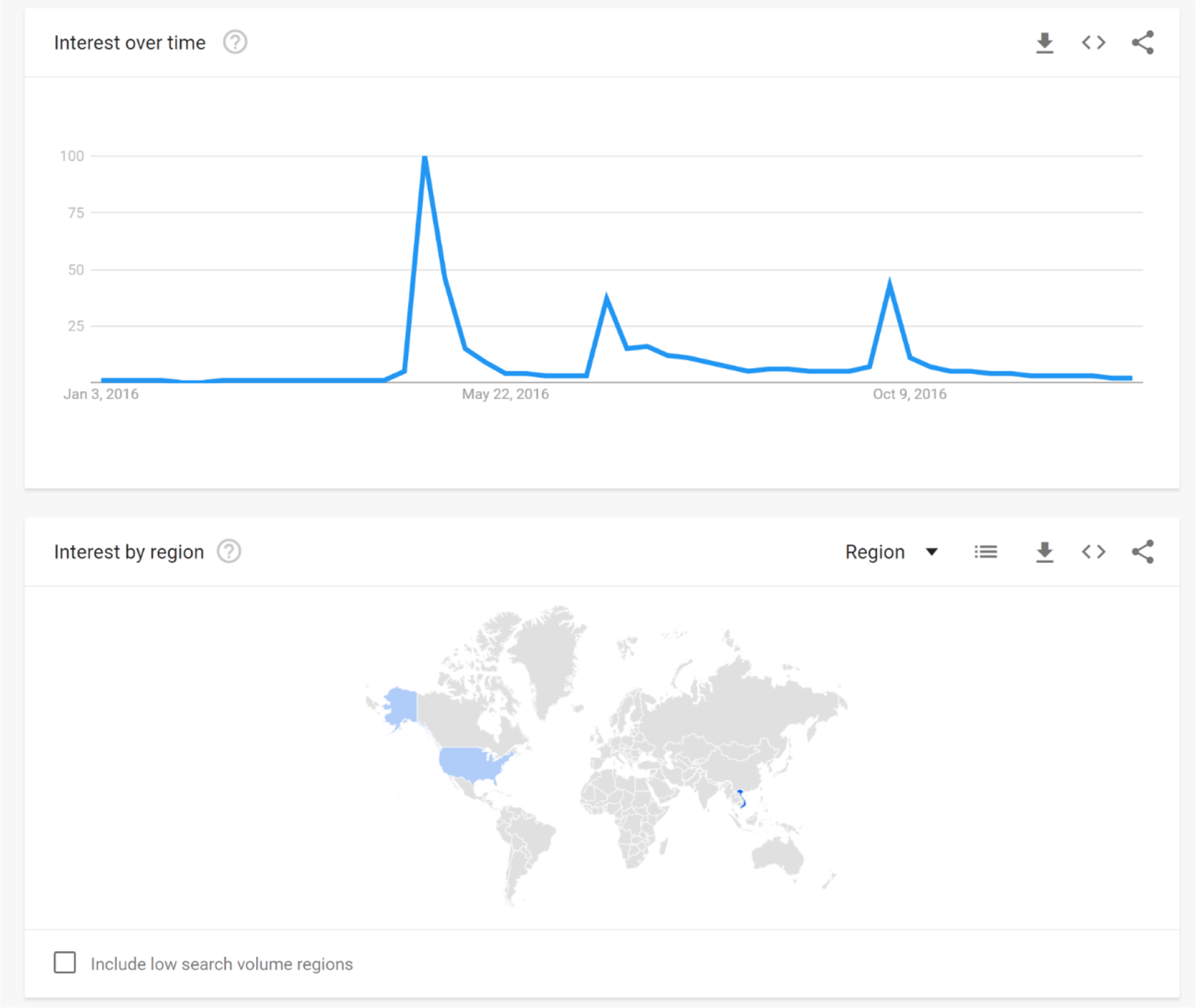
Global Interest in the Formosa Incident (2016).
The 2018 protests against two controversial bills attracted the most interest on a global scale, compared with the previous two cases. Again, Google Trends (2018) shows a strong correlation between search queries and real-life developments of the incident (Figure 3). Accordingly, global interest reached its peak in June, the same time the National Assembly was in session and large-scale protests were in progress. Besides Vietnam, the USA and Australia were the largest places of origin for related search queries – probably thanks to large Vietnamese diasporas in these countries. In terms of news coverage, there were 3,521 articles on the matter, with 3,052 from the USA (Newslookup.com, 2018). In comparison, it is obvious that the 2018 incident achieved a ten-fold increase in news coverage, showing that incidents with a sensitive nature – like human rights – seem to draw much more discussion.
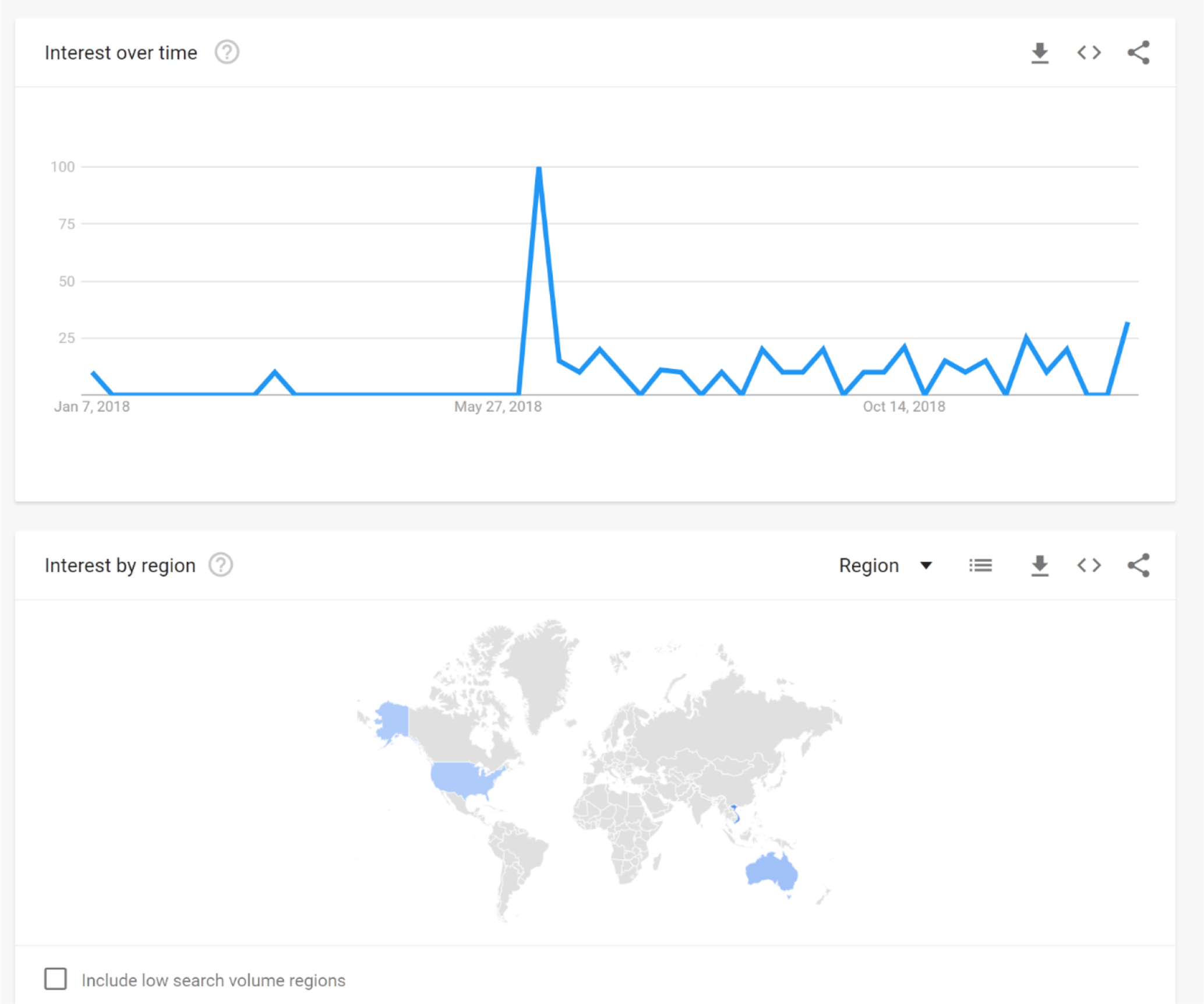
Global Interest in Cybersecurity Law.
One can tell from these cases that the online public sphere will only further public participation. Just as the spill-over effect caused by these public events caused negative publicity, public events of a positive nature can be beneficial to Vietnam’s image building. The question is to what extent the regime can accommodate public participation.
State Response against the Rise of the Internet and Social Media
While the purpose of this article is to focus on the impact of ICTs on PD, one cannot ignore the general antipathy from Vietnam’s authoritarian regime to information access. PD is eventually a form of communication, while the internet and social media are communication technologies. That is not to mention that an indispensable component of Vietnam’s PD – external information – is part of the informational (propaganda] apparatus of this regime.
As mentioned above, the party-state has always been concerned about maintaining its monopoly of information, mainly for fear of subversive attempts against its absolute power. While it needs to tap ICTs for economic purposes, the party-state does not encourage the expansion of the public sphere and public participation. Therefore, with the decision to connect to the World Wide Web, the regime has concurrently tightened its grip on the internet with a multitude of legal, institutional, and technical measures. If seen as a strategy, then the party-state was applying a “carrot and stick” approach. This section discusses the “stick” side.
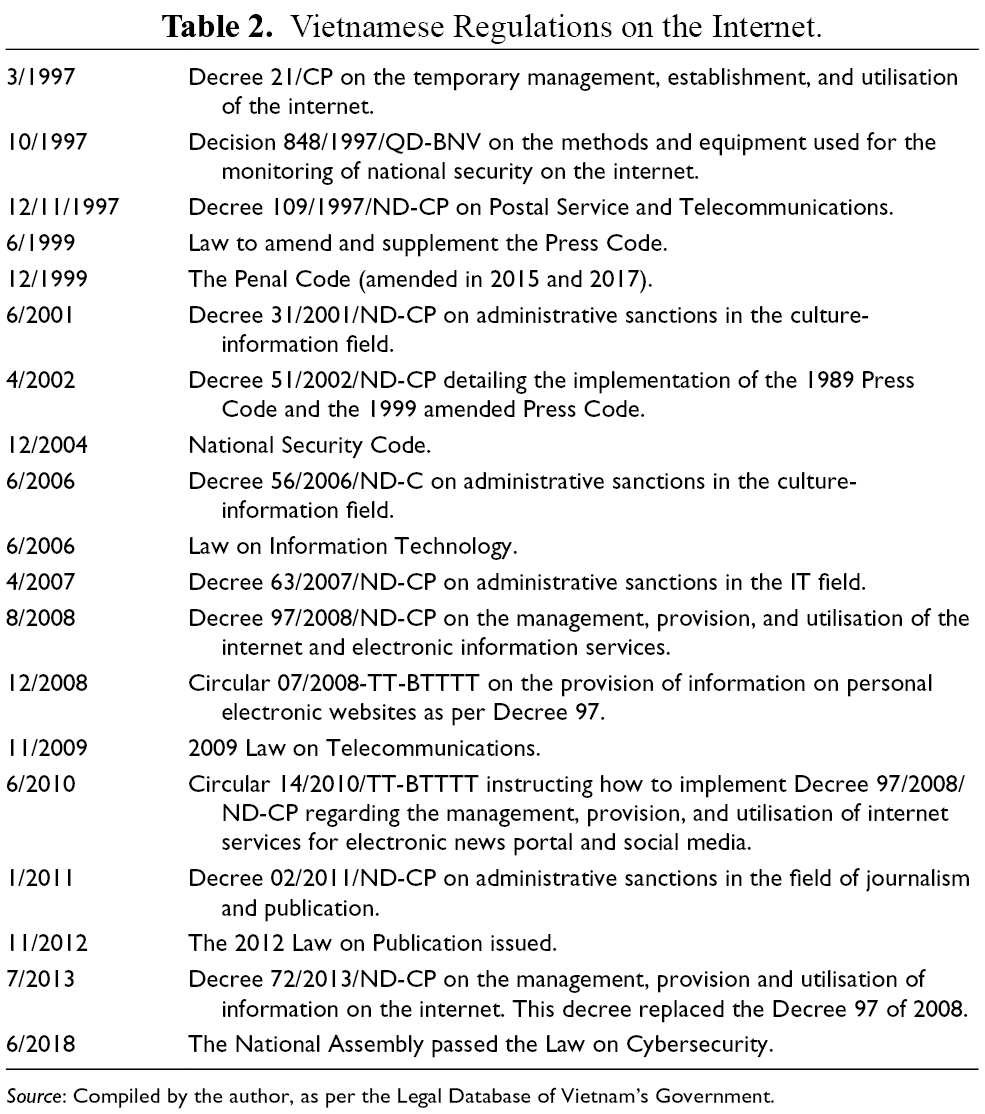
Legally, the Vietnamese regime since 1997 has continuously promulgated or amended laws and regulations to control the internet. A non-exhaustive list is provided in Table 2.
Vietnamese Regulations on the Internet.
Source: Compiled by the author, as per the Legal Database of Vietnam’s Government.
Even before the controversial introduction of the 2018 Law on Cybersecurity, the government had frequently cited preceding regulations listed above in order to sanction individuals and groups deemed as having subversive or harmful intentions to the regime. These regulations are worded vaguely or ambiguously and eventually serve as a blanket ban on free speech. For example, in the 1999 Penal Code, the three most cited clauses are 79 (now 109) that criminalises “activities that aim to overthrow the people’s government,” 88 (now 117) “anti-state propaganda,” and 258 (now 331) “abusing democratic freedoms” (BBC, 2017a). The government also uses Decree 97 and Decree 72 to monitor online activities. Article 25 of Decree 72, for example, demands that social media providers “reveal personally identifiable information of those users who are related to terrorist and criminal activities as well as other infringements as per the request from relevant authorities” (Vietnam’s Government, 2013).
Institutionally, to enforce the above legal framework, the party-state brings into play an inter-ministerial taskforce for cybersecurity. The taskforce takes its roots from a long-standing authoritarian apparatus of repression (see Thayer, 2014). According to Article 10 of the 2018 Cybersecurity Law (National Assembly of Vietnam, 2018), the three ministries in charge are the Ministry of Public Security (MPS), Ministry of National Defence (MND), and MIC. While these ministries have always been leading the charge in controlling the internet, the underlying change is subtler: each has expanded or otherwise promoted their specialist agencies. In the MND, the High Command of Cyberspace Warfare was established in 2018 on the foundation of the IT Agency, directly reporting to the Ministry instead of the General Staff as previously (Duc Tuan, 2018). The MPS established the Department of Cybersecurity and High Tech Crime on the foundation of several agencies at the departmental level and put the new Department directly under the Ministry (Thai Son, 2018). All the while, the MIC has expanded the mandate of its Authority of Information Security (Ministry of Information and Communications, 2019). These changes show that the party-state has upped the ante at an institutional level.
At an operational level, this taskforce has, throughout the years, applied a spectrum of activities to curb political dissent on the internet. Hard-line treatment includes several forms of suppression, from harassment and crackdown to prosecution. Many political dissidents have been arrested and tried over the years, including notable names like Truong Duy Nhat, Pham Viet Dao (in 2013), Nguyen Huu Vinh, and Nguyen Quang Lap (in 2014). Vietnamese authorities also regularly crack down on peaceful rallies and detain protesters. In the three incidents presented above, this hard-line treatment was applied, with a number of protesters being detained and imprisoned (Tu Anh, 2016; BBC, 2018).
The soft-line approach is more covert and flexible, yet still coercive and manipulative. One long-term measure of censorship is to block access to oppositional websites and platforms. As of 2019, the websites of BBC, VOA, RFI, and RFA were inaccessible. Leading blogging platforms, such as WordPress and Blogspot, which host a multitude of dissident sites, are often attacked and disrupted using various technical methods. Facebook and YouTube have sometimes been blocked, especially during sensitive times like the 2016 protests against Formosa, the Taiwanese steel plant that discarded toxic waste into the ocean (Freedom House, 2019).
Another measure is the government’s direct engagement in cyberspace with counter-information attempts. Social media becomes a political arena not just for non-state actors but for state actors as well. Just as Chang et al. (2013: 150–164) observe, “conflicts are taking place more and more online nowadays, and bloggers are often the front-line combatants.” At the same time, the party-state seeks to thwart adverse information online using foot soldiers in Force 47. According to official news, this unit was established in 2016 as per Directive 47 of MOD’s Political Department of Vietnam People’s Army (VPA) – hence the nomenclature (Mai Hoa, 2017). As of 2017, this force of more than 10,000 has engaged in cyber warfare to guard the regime against “toxic” information. In particular, this growing group of foot soldiers reportedly neutralises “negative” and fake news with substantial doses of “positive” news about the regime (BBC, 2017b). In the same vein, under MIC’s Authority of Information Security, a new national cybersecurity centre was established in 2018, boasting the ability to monitor and process 100 million online messages per day. According to MIC minister Nguyen Manh Hung on the National Assembly floor, this centre has reduced negative information online from 30 per cent to 10 per cent (Van Duan, 2019).
Furthermore, Vietnamese authorities have tried to pressure international internet services to make concessions as a precondition for smoother business in Vietnam. According to a government report, as of May 2019, at the request of Vietnamese authorities, Google. blocked over 7,000 videos and removed nineteen YouTube channels with “mischievous” content. Facebook had to scrap 200 websites containing anti-governmental content, 208 fake accounts, and 2,444 websites that promoted sale of “illegal products and services” (Sen, 2019). By Google’s own account, Vietnam’s government tripled its content removal requests from 2017 to 2019, with a majority of the requests targeting anti-government information (Google, 2019). Under Article 26 of the 2018 Cybersecurity Law, international providers of internet-based services have to store data of Vietnam-based users on a local server and have a representative office or branch in Vietnam (National Assembly of Vietnam, 2018). Thus far, this requirement has not been realised with a guiding decree and has been pushed back by Google and Facebook (Reed, 2018).
In the regime’s interaction with the public, the press is a crucial informational instrument. In 2015, CPV General Secretary Nguyen Phu Trong reaffirmed an established tradition that the press media would serve as a powerful propaganda tool for the CPV (Nguyen Phu Trong, 2015). Overseen by the Central Commission for Information and Education, a select group of these news agencies is tasked to disseminate targeted news to both domestic and international audiences (Prime Minister, 2016). With Vietnam News Agency as the leading broadcaster, the press has an obligation to introduce the CPV’s policy and state’s laws at home and abroad, and keep the Vietnamese informed of world news and the international audience of selected updates about Vietnam. 3 In that manner, the press is an essential instrument of the external information subset of Vietnam’s PD. As of 2015, Vietnam had 858 print news agencies, 105 online agencies, sixty-six radio and television stations and 207 news aggregators (Ministry of Information and Communications, 2015). In essence, the press does not have its own free voice other than to communicate the CPV’s viewpoints.
From all of these developments regarding the government’s responses, there are several important takeaways. First, underlying these developments are two main themes regarding the state’s behaviour: policy innovation and institutional adaptation. Having seen the internet and social media as a serious challenge to the state’s monopoly of information, the state, at a policy level, has regularly amended its regulations around informational access, which is fundamental to other activities in cyberspace. At an institutional level, key state actors have also adapted themselves to the age of social media by overhauling task forces and deploying counter-information tactics and other technical procedures.
Second, the negative attitude and repressive moves by the party-state against internet freedom is, paradoxically, a token of its own trepidation about public opinion. Acting on its unease, the state has gone the extra mile to pre-empt the prospect of an ICT-empowered public sphere. But it has often found itself in controversial and reactive situations, instead of proactiveness. Information access is an all-front battle. In the three incidents above, the authorities had to yield, meeting public opposition halfway. To save face, however, the authorities would, at the same time, take retaliatory actions. They picked out certain members of the public and the press for punishment under the above legal framework, as a warning shot to dissidents.
It is apparently a “carrot and stick” situation, one that is prone to getting out of hand, even causing friction within the party-state’s ranks; take an example: the draft Law on Demonstrations tabled in 2014 as a way to legalise and manage public protests. As of 2019, the bill has not been passed since the government has not submitted a complete version to the National Assembly, citing unforeseeable complexities (Ha Vu, 2019). This postponement prompted unusual blowback by the National Assembly’s leadership (Le Kien, 2019). Previously, then-Prime Minister Nguyen Tan Dung advised against withdrawing the bill (Thu Hang, 2014). The long-term contention about the demonstration bill also witnessed Tuoi Tre, one of the most popular newspapers in Vietnam, being suspended for three months for allegedly misrepresenting a statement by the then-State President Tran Dai Quang as endorsing the bill (Anh Vu, 2018).
The state’s efforts to control the internet, thus far, has only reaped mixed results. The cybersecurity law attracted domestic and international criticism from the moment it was first tabled in the National Assembly. Even though it was eventually adopted as the highest-level regulation on the internet, its effect so far has been underwhelming. Despite tight censorship, Vietnamese users have been resourceful in bypassing and circumventing state restrictions. In fact, Vietnam is one of the fastest growing markets for VPN (virtual personal network) tools – an effective way to bypass firewalls and mask personal information (Zagradanin, 2019). And, as previously mentioned, Vietnamese authorities have not succeeded in coercing top technology companies into full compliance with the new cybersecurity law.
The state’s counter-information reinforces the public’s distrust since it trades in fake news, like playing fire with fire. While the mainstream news media have always had to contend with these issues, social networks and social messaging facilitated the spread of “fake news.” Traceability and verifiability are easier said than done (Ireton and Posetti, 2018). For Vietnam, the non-uniformed Force 47 may just be one of the black propaganda tools that state actors have in their arsenal – commonly and pejoratively referred to as du luan vien (polemicist). Since this group is, by nature, black ops, there is a name-and-shame game when one side of a debate accuses the other of being a polemicist (Thai Son, 2018), which is telling of the public’s loss of confidence in state actors.
Worse still, several studies point out that social media has been useful in the competition among political factions in Vietnam (Abuza, 2015; Mai Duong, 2017; Bui Hai Thiem, 2016). Accordingly, there are anonymous and untraceable blogs and accounts, such as Quan lam bao (“Mandarins doing journalism”) and Chan dung quyen luc (“the face of power”), that aim at promoting or discrediting certain politicians with unverifiable, yet outrageous, details. These sites are often in full throttle before an important political event that involves personnel decisions. That fact was, for the first time, confirmed by Vo Van Thuong, head of Central Commission for Information and Education, on several occasions (Le Hiep, 2019). Emotions play a key role in the exponential spreading of (mis-)information, and pre-existing social tension significantly legitimises “fake news” (Stieglitz and Dang-Xuan, 2013; Tandoc Jr et al., 2018). The same applies to Vietnam.
Public Diplomacy and Social Media
The main line of argument of this paper is that ICTs, especially the internet and social media, are highly instrumental in the growth of transnational civil society – that is, public participation – that has fundamentally changed Vietnam’s politics. Public opinion has become a force to be reckoned with. By extension, as PD is crucially involved with the public, it is also subject to the impact of ICTs. Policy innovation and institutional adaptation apply to PD as they do to the general political environment.
As a one-party state, Vietnam is faced with a dilemma in dealing with online activism. Its knee-jerk reaction is suppression, but there are vital factors at stake that restrict the state from more heavy-handed reactions. As an elaboration on the point about the state’s dilemma, there are two main factors that hinder the regime from applying extreme measures to completely censor the internet and potentially slow online activism to a crawl: political legitimacy and international reputation. These two factors are interrelated and allow for innovative understandings of PD. After Doi Moi, the CPV enjoyed two new sources of legitimacy: economic performance (a top priority of national interests) and international recognition (essential to cultural nationalist identity) – which both strengthen public confidence in the state (e.g. Alagappa, 1995; Le Hong Hiep, 2012; Thayer, 2010). International reputation is beneficial to economic development as it helps attract foreign investors, while economic success helps improve international reputation.
Despite the perceived downside, the internet and social media have significantly contributed to these sources of legitimacy in such a way that the government cannot afford to completely censor the internet or keep international corporations at bay. First, Vietnam’s internet economy reached USD 20 billion in 2019 with an annual growth rate of 38 per cent since 2015 – second only to Indonesia in the Association of Southeast Asian Nations (ASEAN) (Davis et al., 2019). E-commerce technologies are provided by international corporations, with a majority located in the USA. Tighter censorship or attempts to sanction the likes of Facebook and Google will have an instant dampening effect on vibrant economic growth trends. As Le Hong Hiep (2019) argues, Vietnamese authorities find it unwarranted to block international social platforms since such an action would paint Vietnam as an uninviting business environment and may antagonise the USA with whom Vietnam would like to strengthen its ties.
Besides, various international organisations for human rights have frequently criticised the Vietnamese government for its poor record of human rights and urged key actors, including the USA and the European Union (EU), to make economic co-operation conditional upon Vietnam’s improved human rights (Human Rights Watch, 2019). Though those calls for sanctions do not always gain traction, it is not in the best interest of the party-state to tarnish its international reputation. The relationship between human rights and foreign direct investments is a non-linear and unpredictable one (Sikka, 2011; Smith et al., 1999; Spar, 1999), which is why few rational actors would be willing to push it to breaking point. Even for an authoritarian state, popular support is more and more vital to the party-state’s legitimacy, and an iron-fist policy on the internet and online activism does more harm than good (Dien Luong, 2017).
As discussed thus far, a lot of measures adopted by the state may be characterised as a hard-line approach. Even softer measures like blocking access or counter-information are still applied with a healthy dose of coercion and manipulation. But “carrot and stick” is a delicate balance, one that the party-state has experimented with and improved on. As of 2019, Vietnamese political elites seemed better aware of the upside and downside of social media, which warrants a more flexible attitude towards this form of technology. In 2019, Vo Van Thuong (2019), the head of the powerful Commission of Propaganda and Education of the CPV and a Politburo member, penned an op-ed that discussed the impact of social media on Vietnam’s social and political stability (Vo Van Thuong, 2019). His op-ed was significant and noteworthy in at least two ways. First, this was the first official take from one of the highest-ranking politicians in Vietnam who oversees Vietnam’s information management. Second, choosing to publish the piece across leading news outlets, from Nhan Dan, the official newspaper of the CPV, to Voice of Vietnam and VietnamNet, Thuong implied that his opinion reflected that of the CPV leadership and required compliance from all the ranks across the party-state. His op-ed incited debate from both dissidents and pro-government groups (BBC, 2019).
Besides several usual talking points that echoed the regime’s long-term anxiety about social media such as subversive activity and peaceful revolution, Vo Van Thuong presented several observations that are rarely heard of from a top-tier politician in the context of Vietnam. Acknowledging the power of social media in providing people with means and platforms to connect with each other, he conceded that:
With multi-dimensional effects, social media have become a form of power, surpassed official media and challenged technical and administrative measures of all countries, especially developing countries. […] Like other countries, Vietnam is taking advantage of the superior characteristics of social media, while also encountering the negative impacts of this new form of communication that are difficult to control. (Vo Van Thuong, 2019)
As to the problem of “fake news” on social media, he posited that besides external adversaries, disinformation and misinformation also came from the collusion among social media influencers and degrading, opportunistic and ambitious politicians and officials (Vo Van Thuong, 2019). Thuong repeated this viewpoint at the 2019 national symposium of the press six months later (Le Hiep, 2019). Therefore, while he encouraged politicians to use social media to engage with the public, to maintain a positive image or for political advocacy, he requested that such use must build on full disclosure and transparency (Vo Van Thuong, 2019).
The most significant impression from Thuong’s article is that it struck a relatively open note. While urging full compliance with Vietnam’s legal framework for information control, he also admitted that social media is an open, unique, and critically important environment besides mainstream news media, whose strengths need to be brought into full use, whose progressive need to be values promoted and whose weaknesses and evils need to be defeated (Vo Van Thuong, 2019). What does all of these mean for PD?
PD is, by nature, on the “carrot” side. It is always about appealing to the public. ICTs have transformed Vietnam’s PD in fundamental ways, in terms of stakeholders, objectives, and instruments. First, the quantum changes to the concept of “the public” have reinforced the structural change of the Vietnamese’s conceptualisation and conduct of PD. PD activities, from external information, people’s diplomacy, or cultural diplomacy, are to serve the CPV’s legitimacy by informing the public of the party-state’s international achievements. The internalisation of PD is partly attributable to the CPV’s long-standing view that foreign policy is to support domestic affairs. But ICTs have redefined “the public” and “the public sphere,” thus transmuting Vietnam’s PD into intermestic behaviour – that is, it is both inbound and outbound.
A PD message, therefore, is directed not only to the domestic public but also a transnational public, including Overseas Vietnamese. The Vietnamese diaspora has become critical to Vietnamese foreign policy. As of 2018, there are 4.5 million Vietnamese abroad, mainly residing in the USA, Australia, France, Poland, Cambodia, Laos, and Malaysia (Mai Phuong, 2018b). In 2018, Vietnam received record-level remittances worth USD 16 billion, which accounted for 6.4 per cent of Vietnam’s GDP. There were also about 3,000 businesses owned by overseas Vietnamese with a total investment of USD 4 billion (Quoc Huy and Pham Tam, 2018). Appealing to this population is one of the key missions of the diplomatic sector and apparently falls under the purview of Vietnam’s PD.
As the Vietnamese public both at home and abroad has rapidly converged thanks to ICT, it is more and more difficult to distinguish between PD and public affairs (i.e. attempts at domestic outreach). In the same vein, it is also much more challenging to distinguish between external and internal information management. The past couple of years, top officials in charge of information management have requested that external and internal information link up, and that the diplomatic sector be the bridge between these two realms, capitalising on ICTs (Manh Hung, 2019; Pham Van Linh , 2018; VH, 2016). For Vietnam, this policy innovation is born out of necessity as much as resistance, as presented above.
Separating the public affairs from PD is increasingly incompatible with the interconnectedness of global relationships. Here is an example: just like elsewhere, when a political leader of Vietnam addresses the public, he or she does not merely talk to the domestic public. As shown in the three incidents, the Vietnamese overseas and other international audiences can also tune in depending on the topic at hand, with the support of ICTs. Ha Anh Tuan acknowledges that social media is more and more influential to policy formation, including foreign policy as it allows open discussion, especially around topics of great interest to the public, such as healthcare, education, and national security. 4 In that vein, anyone using social media or other communication channels with a political agenda can be considered a PD practitioner; as in digital networks, information is transmitted in a multi-directional and multi-dimensional manner.
In this regard, Vietnamese political elites have increased their public engagement in social media. Nguyen Thi Kim Tien, former minister of health, and the Office of Vietnam’s Government were pioneering in the use of Facebook accounts to promote their activity to the public. A close look at these accounts shows that PD practitioners primarily use social media for informational purposes. Nguyen Quang Dong posits that Vietnamese politicians frequently use social media as a channel for social listening, in the sense that engaging with social media helps them stay apprised of public feedback and on their toes – hence an improved sense of accountability. 5 Ha Anh Tuan agrees that social media can have a monitoring effect, in the sense the state can draw on public feedback to investigate wrongdoings. 6
Perhaps the institutional adaptation is most noticeable among diplomatic practitioners. Despite the state’s overwhelmingly negative attitude against the internet and social media, none of the interviewees and respondents of this study consider social media to be a negative influence on PD (Figure 4). Half of the survey respondents think that social media has a positive impact on PD, while the other half caution that there are two sides to the coin. All of the survey respondents and interviewees hold that social media is merely a tool, albeit a powerful one. Such a tool can be of great help if used effectively.
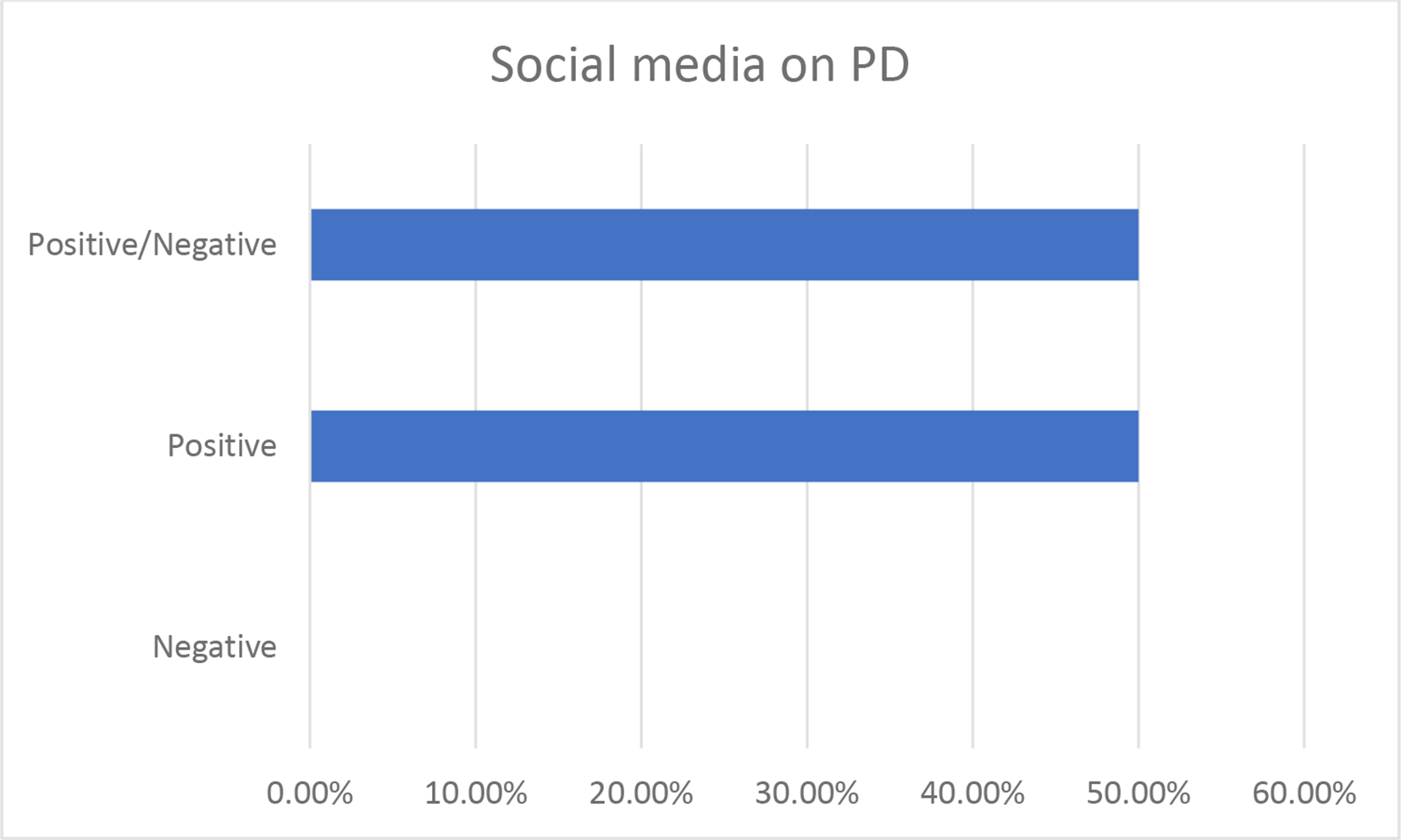
Perceived Impact of Social Media on Public Diplomacy (PD).
As such, diplomatic actors are eager to get acquainted with social platforms. Social media changes the way PD practitioners co-ordinate with each other, gather information, and exert influence on their audience. The MFA has an active Twitter handle, while many diplomats set up their personal accounts on Facebook. Luong Thanh Nghi sees social media mainly as an instrument to provide direct information to the public and, in doing so, correct misinformation and disinformation. Nguyen Hong Thach concurs by claiming that social media helped him, as Vietnam’s Ambassador to Iran, to provide prompt rebuttal against the many misconceptions of this nation. 7 Ha Anh Tuan believes social media has been an important channel to offer the public up-to-date knowledge about the South China Sea situation. Interestingly, Nghi thinks social media was an effective way to manage communication crises when he was Ambassador to Australia, less because of what he had to say and more because of how Australian sympathisers came to support him and deescalate the situation. 8 The most reliable defence may not be from the defendant, but from others. That is what Cull (2010: 11–17) mentioned in his seven lessons about PD: “sometimes the most credible voice is not one’s own.”
Currently, it seems that PD practitioners conduct public engagement mainly for agenda-setting and presence-expansion purposes. To illustrate this point, I investigated a public group on Facebook with the name “Foreign affairs from a practitioner’s perspective” (Hoat dong doi ngoai duoi goc nhin cua can bo ngoai giao). This Facebook group was created by several officials in the Ministry of Foreign Affairs (MOFA) in 2015, with the aim to collect and disseminate information about foreign-related activities to “insider” professionals vertically and horizontally. Started with about 100 members from MOFA, the group had about 14,000 members as of 2019, including high-ranking diplomats, public officials from other ministries, and local authorities. Among the administration team is Ngo Huong Nam, the incumbent Ambassador of Vietnam to Australia (Hoat dong doi ngoai, 2015). However, the largest proportion of members comprises of young professionals and college students who are interested in foreign affairs, and the press. 9
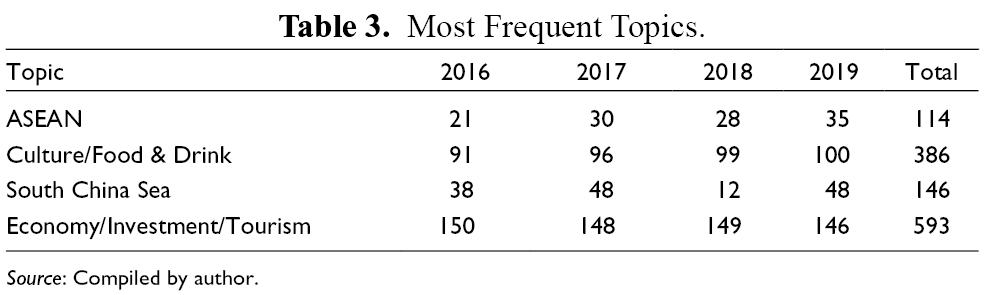
From 2016 to 2019, the most frequent topics in this group included ASEAN, culture (including culinary activities), South China Sea, and economics (including tourism and investment) (Table 3). All related posts are to report real-life activities at many embassies. So, these topics are both in the agenda of those embassies and the agenda of this Facebook group in its interactions with its members. The large numbers of “likes” and “shares” as well as the growing number of members show that this group has expanded its online presence. Unfortunately, Facebook no longer allows free access to in-depth analytics of public groups. Therefore, I was unable to tally the exact metrics of engagement such as likes, dislikes, or shares. The collected data below may not be total, but the general trends are consistent. And one thing is clear: there is little conversation between message senders and the audience. Instead, exchange often happens among audience members.
Most Frequent Topics.
Source: Compiled by author.
Informing the public is undoubtedly a vital objective of the domestic dimension of PD. However, calling for support from the public is also required. National image building, or nation branding, requires a concerted effort that can wield a form of social power. Businesses can benefit from that image building work, so their contribution, technical or financial, is as natural as it is important (Ngoc Khanh, 2009). Besides, the Vietnamese public is no longer a passive one. As shown in the three incidents, online activism has an impact on how the regime is perceived internationally. Public participation will not stop expanding, as ICT breakthroughs happen rapidly. This means the state and the public have to be on the same page when it comes to what is best for the nation in the global arena. Non-activist incidents, such as those caused by Vietnamese travellers, also have a spill-over effect on Vietnam’s nation branding, thus having been regularly blasted by the press media and social media under the headline of “ugly Vietnamese” (Thanh Tuyen, 2018; VOV, 2018). For Vietnam, the growing importance of the Vietnamese diaspora requires a new approach to the government’s communication efforts, since political ideology is counterproductive. The most definite linkage across all strata of the Vietnamese people is perhaps the sense of nationalism.
In the big picture, diplomatic professionals may be in the best position to build rapport with the general public. Vietnam’s foreign affairs are not often caught in the crossfire of online activism – sans the South China Sea dispute with China. As shown above, critics of the party-state focus on domestic issues like human rights, religious freedom, anti-corruption, and land rights. Generally, public opinion on Vietnam’s foreign policy is on the positive side. Since Doi Moi, Vietnam has achieved considerable milestones in international relations, and its global reputation as a thriving economy has been on the rise. The informational mechanism of Vietnam, including PD stakeholders, has made sure that such good news can be delivered to the people. An example is that the announcement that Vietnam was voted as a non-permanent member of the Security Council for the 2020–2021 term was met with positive reactions (Anh Ngoc, 2019).
Conclusion
There are several key takeaways from this article. First, it is proven that the contours of PD reflect broader developments in Vietnam’s politics. In other words, the impact of ICTs permeates Vietnam’s political arena, and PD, with its public-facing platforms, is a prime example of such impact and among the first to experience any change to the dynamics of public participation. It is not hyperbole to state that modern diplomacy is PD, as public involvement is indispensable, and publicity is as much a need as it is a must.
ICT penetration, especially the internet and social media, has been instrumental in providing a forum for public participation, and enabling social listening by political elites. Public participation on social media diminishes state censorship and nurtures the freedom of expression, at least in cyberspace. Ordinary citizens have a chance to voice their concerns and advocate policy formation, while political elites and their supporters have accessible outlets to monitor and, at times, manipulate public opinion. At the same time, the print media has adapted by actively engaging in or listening to online discussions to keep abreast of news-worthy information.
As shown in the article, ICT penetration is a global phenomenon and one that the Vietnamese regime tries to resist with mixed results. The expansion of the global public sphere and the rise of non-state actors at times clash with state policies, which shines light on the responsive–repressive relationship between the state and society (Kerkvliet, 2010). The authorities have applied both soft-line and hard-line approaches to manage public participation.
Thanks to ICT, public opinion has inevitably gained traction in Vietnam’s policymaking, including foreign policy. Social power is a newfound resource for the public. ICTs are the main driver behind Vietnam’s PD turning intermestic – where domestic and international issues cross paths and even encroach on each other. That is because netizens are transnational, and the instantaneity of information online has consistently pushed the envelope of news circulation. Cyber communities, even in the form of pocket neighbourhoods, have a more significant impact in the PD process.
With Doi Moi introducing a globalist and integrationist foreign policy, ICTs further transform Vietnamese PD in terms of actors, objectives, and instruments. Policy has been innovated, while PD professionals have adapted themselves by making use of social media to engage with their audiences, including the domestic Vietnamese, the Vietnamese overseas, and the international public. Such engagement, however, is still predominantly one-way messaging, and PD practitioners are more focused on social listening than interaction. 10
Future research into ICTs and Vietnam’s PD can either adopt a subject- or object-oriented approach. Potential case studies, such as cultural diplomacy and the South China Sea, can provide insights on how Vietnamese PD practitioners utilise cyberspace to promote policy objectives. One can also devise metrics to measure public reaction and response to such PD initiatives.
Supplemental Material
Supplementary Material 1 - Supplemental material for Information and Communications Technologies, Online Activism, and Implications for Vietnam’s Public Diplomacy
Supplemental material, Supplementary Material 1, for Information and Communications Technologies, Online Activism, and Implications for Vietnam’s Public Diplomacy by and Vu Lam in Journal of Current Southeast Asian Affairs
Footnotes
Acknowledgements
The author would like to thank Professor Carl Thayer at UNSW and anonymous reviewers for their constructive feedback on earlier versions of this article. The author is also grateful to survey and interview participants for their informative empirical data. Any content errors, however, remain the sole responsibility of the author.
Declaration of Conflicting Interests
The author(s) declared no potential conflicts of interest with respect to the research, authorship, and/or publication of this article.
Funding
The author(s) received no financial support for the research, authorship, and/or publication of this article.
Supplemental Material
Supplemental material for this article is available online.
Notes
Author Biography
Email:
References
Supplementary Material
Please find the following supplemental material available below.
For Open Access articles published under a Creative Commons License, all supplemental material carries the same license as the article it is associated with.
For non-Open Access articles published, all supplemental material carries a non-exclusive license, and permission requests for re-use of supplemental material or any part of supplemental material shall be sent directly to the copyright owner as specified in the copyright notice associated with the article.
