



Abstract
Indonesia’s rise, its democracy promotion, and engagement in the democratisation of regional institutions have often been analysed in scholarly literature in the recent years. Indonesia’s “democratic turn,” both internal and external, increased its relevance in international relations. The academic discussion focuses on the role and meaning of Indonesia’s contribution. The aim of this article is to broaden the debate by analysing the meaning of “democracy” in Indonesian narrative investigated from the perspective of the strategic narratives concept and to propose a new framework for the assessment of narrative based on its coherence. Therefore, the research question is – Are the strategic narratives of democracy articulated by Indonesia coherent? The analysis shows, and it is an argument, that with some exceptions strategic narratives are incoherent and this incoherence has two dimensions: intra- and inter-incoherence. The argument is substantiated by an analysis of Indonesian foreign policy strategies and political speeches.
Introduction
Indonesian policy, both internal and external, has raised doubts about the quality of democracy in the country since 2015. Indonesia is ranked a “flawed democracy” (The Economist Intelligence Unit, 2018). 1 The decline of democracy is partially associated with the presidential term of Joko Widodo (Jokowi), who assumed the office in October 2014 and has been perceived less democratically oriented than his predecessor, Susilo Bambang Yudhoyono (SBY) (Power, 2018). The criticism is also relevant to the assessment of international roles Indonesia has enacted since 2003. 2 Among several roles, the role of a democracy promoter is of particular importance as it is critical for the state’s international position (Karim, 2017: 385–386). Firstly, it facilitates the improvement of relations with the Western countries, especially important after the beginning of the democratic transition in 1998 when the West was providing financial support. 3 Secondly, it strengthens the process of gaining a more influential position in the regional (Asia-Pacific) and international systems by adopting the middle power status-seeking behaviour (Karim, 2018). Thirdly, as suggested by Rizal Sukma (2011), the promotion of democracy abroad helps to develop and strengthens democracy at home. 4
Indonesia’s “democratic turn,” both internal and external, increased its relevance in international relations, but the recent decline of democracy has questioned the state’s credibility. The rise of Indonesia and its contribution to democratisation and democracy promotion have often been investigated in the scholarly literature. This article’s aim is to shed some light on this issue and broaden the academic debate by an analysis of the meaning of democracy in Indonesian narratives investigated from the perspective of the strategic narratives theory 5 to propose a framework for the strategic narratives analysis – based on its coherence and to suggest that coherence is an additional aspect of evaluation of a state’s narratives. The research question is as follows: Are the strategic narratives of democracy articulated by Indonesia coherent? The article’s argument is that Indonesian strategic narratives are incoherent with some minor exceptions. I suggest that (in)coherence has two dimensions. They are intra- and inter-(in)coherence. The argument is substantiated by an analysis of Indonesian foreign policy strategies and political speeches made between 2005 and 2018. The article is divided into five parts. After the introduction, I provide a review of scholarly literature and explain the analytical framework of strategic narratives and propose to include the element of coherence in the analysis of narratives; the fourth section explains the use of the term democracy in Indonesian strategic narratives. The article closes with a conclusion.
Literature Review
Many recent publications focus on Indonesian democracy and democracy promotion, especially by testing their arguments on the examples of the Association of South East Asian Nations (ASEAN) and the Bali Democracy Forum (BDF) (Acharya, 2014; Karim, 2017; Rüland, 2017; also my work Grzywacz, 2019). Additionally, the literature provides general analyses of the meaning of democracy in Indonesia. These works use different empirical case studies to substantiate their claims; however, the method of the strategic narratives analysis is not applied to test their arguments.
Some scholars focus on the interplay between Indonesian democratisation and its foreign policy (Poole, 2015; Rüland, 2009; 2014; 2017); other academics more specifically on democracy promotion – suggesting that Indonesia’s democracy promotion is a result of its role conception and a reflection of a will of political elites to increase Indonesia’s significance in international relations (Karim, 2017) as well as that it is a part of the state’s middle power strategy (Karim, 2018). Another related conclusion suggests that the limited effectiveness is an outcome of a role conflict between the role conception and the role prescriptions (Grzywacz, 2019). Rizal Sukma (2011) concludes that in Indonesia’s case the term “democracy projection” rather than “democracy promotion” is more accurate. Much of the criticism is oriented towards the BDF initiated in 2008 to promote democracy and democratic transitions in an open and “no finger-pointing” manner. Its openness results in the presence of non-democratic regimes at the forum discussing the relevance of democracy. While many of the scholars would criticise the BDF (Berger, 2015; Liow, 2018; Weatherbee, 2013), others believe the Forum is more than just an irrelevant meeting (see Acharya, 2014: 110–112). The criticism of Indonesia’s democracy and democracy promotion is twofold. Firstly, scholars question the intentions and effectiveness of Indonesian initiatives; secondly, Indonesia is criticised for the recent democracy decline (Robison and Hadiz, 2017; also Diprose et al., 2019).
The above-mentioned studies provide the analyses and explanation as to what Indonesia’s political intentions are and how democratisation has changed the national and international politics and investigate different initiatives promoting democracy with special focus on the Asia-Pacific region. Scholars, as discussed above, focus on constraints and weaknesses of Indonesia’s democracy promotion; however, the literature does not cover the narrative part of foreign policy as an explanation of its limited impact on other actors. One of the paper’s aims is to suggest that an analysis of strategic narratives may help to better understand the weaknesses of the state’s democracy promotion.
Indonesian democracy promotion has been studied from the perspective of the role theory in several works. The role theory provides an explanation why and how does an actor enact and play different roles and how does the role enactment resonate with a state’s political goals and performance. One of the main foci in the studies conducted from the role theory perspective is a role conception, a stage when an actor decides what role to play. An integral part of the role enactment choice is identity as well as discursive process, by which I understand convincing other actors, both national and international, that the role played is a consequence of a state’s identity. These two aspects are interconnected and are a part of the strategic narratives framework. Strategic narratives have a potential to provide more detailed explanation of the role performance, and especially the role conception. The studies on role performance do not provide the detailed analyses of discursive politics, and by a detailed investigation, I understand not only an empirical analysis but also a conceptual framework of narrative analysis. While narratives are studied in many different manners, the strategic narratives approach suggests that political actors manage the discourse. Politicians are (or should be) aware of the narrative importance. Moreover, the concept of strategic narratives is complementary to the role theory and other theoretical approaches, and as such, it may enrich and refine the concepts acknowledging significance of narratives but not developing or neglecting frameworks of their analysis.
A Framework of Strategic Narrative and its Coherence
Lawrence Freedman (2006) was the first scholar to investigate the meaning of strategic narratives in the area of international security. He suggested that actors work on their storytelling capability to make their stories more convincing. He believed it is a “secret weapon” that helps to persuade other actors about the rightness of the military operations. The rationale behind this explanation is not to convince others that a war is right, but that it is necessary, and to influence public opinion and societal perception by portraying a conflict as being just. Since Freedman’s (2006) publication, the framework of strategic narratives has been strongly developed in the discipline of security and extended to other fields relevant to international relations. Scholars like Miskimmon et al. (2014, 2017) have contributed greatly to the development of the strategic narratives theory by publishing works investigating the usefulness of this concept in the area of international politics and communication. Researchers believe that there are three types of narratives: (1) system, (2) identity, and (3) issue; but also that there are “three elements postulated by the strategic narrative theory – formation, projection, and reception” (Roselle et al., 2014: 76–79). Miskimmon et al. (2014) explain that an actor refers to a common past, present, and future to facilitate and achieve a political goal.
The general definition of strategic narratives includes an assumption that they are “a means for political actors to construct a shared meaning of international politics to shape the behaviour of domestic and international actors” and “strategic narratives are a tool for political actors to change the discursive environment in which they operate, manage expectations, and extend their influence” (Roselle et al., 2014: 3). According to James Pamment (2013: 50), strategic narrative is applied to investigate how an actor (1) positions himself/herself on the international arena and (2) formulates his/her political aims. Actors can utilise different means of communication; refer to a national, regional, or international system or a specific issue; and construct narratives about themselves and others. At the national level, narratives can be shaped by one or many actors (political elite, organisations, press) if they have the ability to influence public opinion. Actors use strategic narratives to strengthen their credibility and position as well as to gain political power.
Creating a story helps to persuade others to the information presented in the story, that is, articulated meanings and values, and it also provides the substantiation and explanation of why the political actions are right and necessary. Narrative can be also defined as a simple description of events. However, even a simple description should contain elements setting the course of thinking and interpreting the way it follows the actor’s (author or authors of a narrative) intentions. The result of a constructed narrative should be a coherent structure to protect and promote authors’ interests. To summarise, the more coherent the structure and story itself is, the more effective it becomes.
As suggested by Ringsmose and Børgesen (2011: 513–515), a strong strategic narrative should contain the following four elements: (1) clarity of purpose, (2) prospect of success, (3) consistency, and (4) absence of strong competing narratives. A strong strategic narrative can also be measured by its effectiveness – and then, the triad of formulation, projection, and reception is particularly useful. Another approach to assessing effectiveness involves the relation between political myths and strategic narratives. Olivier Schmitt (2018: 488) suggests that a narrative is effective when it “resonates with local political myths,” and he provides the framework to better understand how political community interprets strategic narratives. The aim of this article is to suggest that coherence should be an integral part of the assessment of a state’s strategic narratives and, furthermore, of the effectiveness of this communication.
The study of strategic narratives has gained a lot of academic attention. Scholars like Chiara de Franco (2012), Emile Simpson (2012), or Jens Ringsmose and Børgesen (2011) analysed strategic narratives and have investigated narratives in conflicts; more recently, Paul Bacon and Joe Burton (2018) and Joe Burton (2018) continue to apply the framework in security studies. The most recent publications show the tendency to broaden the scope of political analyses by investigating other issues: state identity (Pate, 2018), power (van Noort, 2018; 2019); relations between narrative and political myths (Schmitt, 2018), through the “plot and character” in elucidating the concept of democracy (Wells, 2019), use of narrative in political campaigns (Welsh, 2018), narrative of constructing Otherness for political purposes (Schissler et al., 2017), and “readiness” by investigating narrative in media (Seixas et al., 2019). 6 Moreover, the publication of Carolina van Noort (2018) proposes an analysis of coherence by investigating elements of competing narratives developed by states and national groups against an actor who creates the strategic narratives. The analysis focuses on the multi-actor impact on the narratives strength.
The aim of a well-constructed story is to convince others to the story’s line of argumentation; therefore, it should be coherent, that is, a story should not be composed of contradictory elements and denotations articulated by the narrator should not be mixed up. However, coherence has not been widely studied in the literature. Research on coherence and image creation is important for examining foreign policy effectiveness, which traditionally and most often is investigated on the basis of the triad: declarations (objectives), political initiatives, and the degree of achievement of goals (as well as the means and methods of achieving them and external actors’ impact and reactions to political activities). This approach, although well-established in foreign policy analysis, underestimates the element of “soft influence” on the recipients of a story. Persuasion in foreign policy has been well analysed in the field of security studies and, therefore, proved its usefulness in political analyses. The ability to convince others is understood in this article as an essential part of the analysis of strategic narratives and directly linked with the coherence of a story.
Coherence in this article will be assessed on the basis of a modification of the findings of Miskimmon et al. (2014) as well as Ringsmose and Børgesen (2011). The information presented in foreign policy strategies and narratives of political elites is the basis of coherence evaluation in terms of its context (type of a forum, reference to national or international events); reference to a state’s experience, identity, and its role; reference to the past, present, and future; and understanding, terms, and processes associated with democracy. Additionally, the summary includes an assessment of the clarity of purpose, a vision of success understood as justification of taking actions and appeals to the “better future” as well as the lack of competing narratives. Competing narratives are assessed for the presence of contradictions articulated by political elites among themselves.
As already mentioned, there are three types of narratives. Narratives may touch upon (1) system of international relations and its actors; (2) identity providing information on a state’s values, historical experience, place and role in international relations; and (3) issue, a selected theme (or themes) resonating with a state’s interests and goals. This article applies a state-centric and an issue-centric perspective by analysing political speeches on the chosen issue – democracy, however, the enactment of democracy promotion would not be explainable without a reference to the international system or identity. Discussion on any issue includes references to system, other actors, or values. In this article, the discussion on democracy is placed within a context, with references to system and identity, especially since these three dimensions are complementary and overlapping elements of narratives (see also Ba, 2019: 251–254).
Based on the Indonesian example, my argument is that the image of Indonesia as a democracy promoter is incoherent and this incoherence has two dimensions: (1) intra-(in)coherence (between politicians) and (2) inter-(in)coherence (between formal foreign policy strategies and narratives of political elites) – see Figure 1; with some minor exceptions when narratives are coherent.
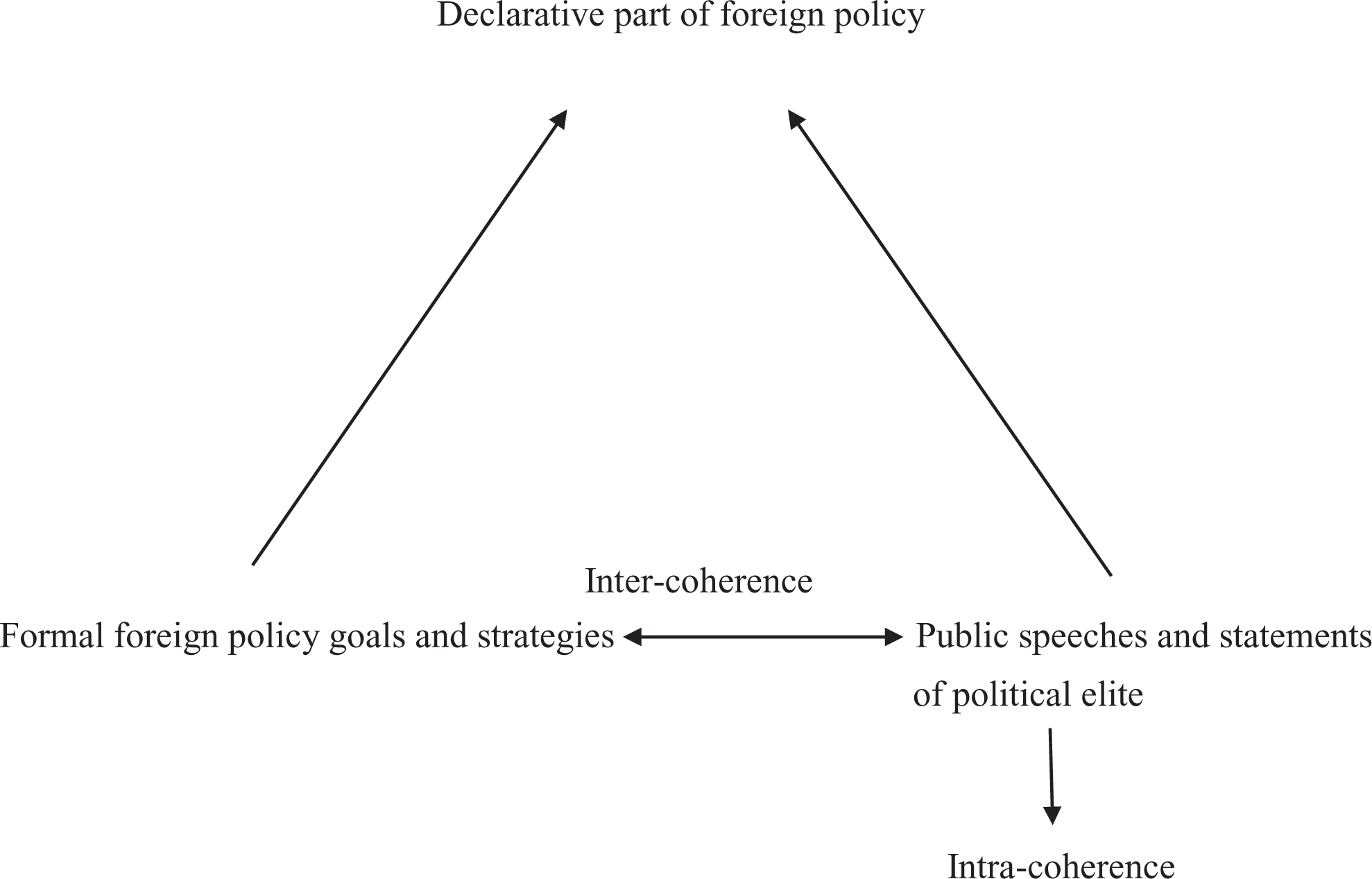
Intra- and Inter-Coherence in Strategic Narratives.
The strategic narratives framework provides a comprehensive approach to verifying the features of any political issue that is essential to better understand an actor’s foreign policy but also provides a more consistent method of analysis by explaining its theoretical and/or analytical assumptions. Additionally, the strategic narratives framework is a set of tools providing information about an actor’s political aims and means of their achievement, persuasive skills, and it facilitates the evaluation of strengths and weaknesses of the narratives.
This study does not investigate the reception of strategic narratives, which is the next step as suggested by Miskimmon et al. (2014). I analyse and compare documents and speeches to focus on the declarative part of the framework. The assessment of effectiveness must include political actions and initiatives; however, foreign policy actions and their outcomes depend not only on an actor’s will but also on the degree of acceptance by external actors. Foreign policy is formulated on the national arena; however, it is conducted in the international environment, where many actors’ interests may either converge or clash. Foreign policy operates in the external environment, the area of interest of many actors, therefore a state cannot fully control the outcome. What an actor can control is the communication process and its further utilisation for political purposes. This is why I make a division between the declarative and practical part of foreign policy, and in this article, I focus on the former. This is not to suggest that the latter is less important. However, I rely on the findings of Sukma (2011), Karim (2017), as well as other critics of Indonesia’s democracy promotion initiatives, who conclude that the Indonesian aim of promoting democracy is more to promote Indonesia than democracy (e.g. Liow, 2018). At least several papers investigate Indonesian political behaviour and suggest a variety of reasons undermining Indonesia’s effectiveness, as discussed in the “Literature Review” section. These conclusions, however, do not include the assessment of narratives (and their coherence).
The article applies both qualitative and quantitative methods with the dominance of the former. The proposed framework is applied to analyse the data, which was gathered by the selection of relevant documents: speeches of Indonesian presidents and ministers of foreign affairs given between 2005 and 2018. In 2004, Indonesia held the first direct democratic elections and has begun to give a new meaning to its activity in international relations (free and active policy is the main underpinning of Indonesian foreign policy). I traced democracy or democracy-related words (i.e. democratic values, democratisation) in all of the speeches. The strategic narratives analysis is narrowed down here to official statements of the most powerful politicians in Indonesian politics to provide information on their understanding of democracy but also to verify how much “the Indonesian story” may be persuasive for others in terms of its democracy promotion by analysing its coherence.
To conclude, the aim of my article is threefold: (1) to investigate and assess coherence of Indonesia’s strategic narratives of democracy; (2) to propose a framework of the strategic narratives analysis based on its coherence; and (3) to suggest that coherence is an integral part of the strategic narratives theory and facilitates a better understanding of foreign policy communication.
Democracy and its Meaning in Indonesian Strategic Narratives
Foreign Policy Objectives
The basic principle of Indonesia’s foreign policy is its independence and activity (politik luar negera bebas-aktif). Independence is most commonly defined as avoidance of military alliances; however, after the end of the Cold War, it was interpreted as an ability to minimise the influence of states on Indonesia’s internal affairs, while the activity refers to the protection of national interests (cf. Anwar, 2010: 127). Moreover, as argued by Rizal Sukma (2003), it also contains the feature of pragmatism. The principle has an unchangeable character but is subject to different interpretations.
According to the Direction of Indonesian Foreign Policy, a document published by the Indonesian Ministry of Foreign Affairs (MFA, 2009a), among the foreign policy goals, priority is given to the development of cooperation between the countries of the ASEAN. In addition to ASEAN, the following are also indicated: a more active role in the security and peace area; border diplomacy and improvement of the quality of protection of Indonesians abroad; as well as “to create a more positive image of Indonesia through advancement of democracy and human rights, and protection of culture heritage”; strengthening the relationship with countries of Asia-Pacific, America and Europe; economic diplomacy and development of South–South Cooperation. The document also indicates that as part of improving the Indonesian image, democratisation processes in Asia should be supported, including the organisation of the BDF to “promote a positive image”; it is explicitly stated that democracy and human rights are important for the image of Indonesia.
The long-term development plan (2005–2025) indicates eleven general and seventy-two specific objectives set to be achieved by the Indonesian government. The issue of democracy appears twice. It is mentioned for the first time in the goal of strengthening relations with the Americas and Europe; it reads: “to promote the compatibility between democracy and Islamic values in countries in America and Europe based on Indonesia’s experience.” It appears for the second time in the section on public diplomacy – “to strengthen Indonesia’s image overseas as a democratic country having Muslims as the majority in the population” (MFA, 2009b).
Joko Widodo, the president of Indonesia since 2014, at the beginning of his presidential term, outlined general directions of foreign policy outlook: (1) promotion of an archipelago identity; (2) middle power diplomacy; (3) strengthening the relationship with Indo-Pacific region (Scott, 2019); and (4) economic diplomacy (Connelly, 2015: 5–6). These goals do not contradict the general directions of the Indonesian foreign policy; however, there is no reference to democracy (and Muslim democracy) or the image of Indonesia; and identity is defined through a geographical aspect.
The above-discussed documents determine Indonesia’s international activity and focus on its “positive image,” communication, and public diplomacy. Strategic objectives of Indonesia’s foreign policy include strengthening the country’s international roles and its leadership in ASEAN, while the objectives related to the image have a general “positive image” description. On this basis, several conclusions can be drawn: (1) Indonesia treats democracy and democratisation pragmatically, both are mentioned in the context of image and international relations improvement; (2) the image of Indonesia as a democratic state should be promoted and strengthened, particularly by a reference to Indonesian experience and its moderate Islam; and (3) Indonesia’s aim is to be an increasingly active state in international relations, especially in the Asia-Pacific region (and above all in ASEAN where it seeks to be a leader, however, not in a way to be recognised as a hegemonic state).
Overview of Speeches
The analysed documents were selected by applying two criteria: (1) a clear reference to international relations, events, or Indonesian foreign policy and (2) their presentation during international meetings (of all kind) and/or their addressing an external audience. I selected 393 documents, 7 in 62 of which democracy was mentioned or discussed (almost 16 per cent of documents). Speeches were given by Indonesian presidents and ministers for foreign affairs serving between 2005 and 2018. I have chosen these two types of political positions for their prestige and international interest. The presence of the most influential politicians at any type of a forum raises much of the interest and attracts media coverage. Additionally, high-profile politicians discuss international relations more often than politicians concentrating primarily on national or local politics.
The average frequency of the use of democracy in the speeches is 4.4 per year; however, this is not constant. As shown in Figure 2, 2006 was an exceptional year as democracy was part of numerous speeches made by Indonesian leaders. The next period of increased interest in democracy discussion was between 2011 and 2013, and since the end of SBY’s second presidential term in 2014, there has been a decrease in using democracy and democracy-related terms in official statements; however, during both SBY’s presidential terms, the democracy-related issues were unevenly addressed (see Figure 2).
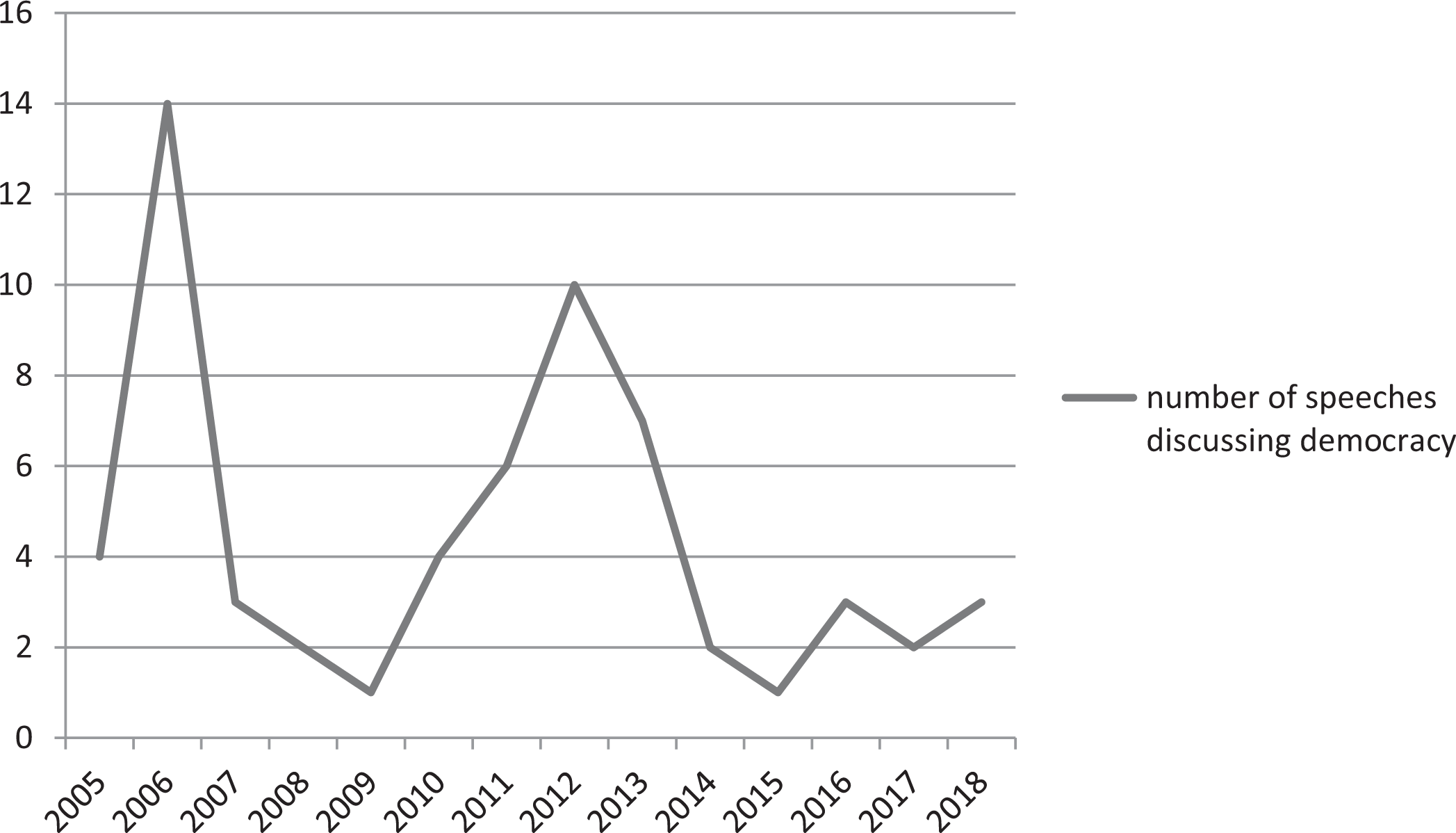
Number of Speeches Raising the Issue of Democracy Between 2005 and 2018.
As it was explained, speeches are analysed through the application of the following criteria: context (type of a forum, reference to national or international events); reference to a state’s experience, identity, and its role; reference to the past, present, and future; and understanding, terms, and processes associated with democracy.
SBY, president between 2004 and 2014, would use the term democracy often and in different situations. There is an increase in the use of the word democracy in speeches given during events promoting democracy (particularly at the BDF, but also to a lesser extent as a representative of the Global South, which can be observed in speeches given during the meetings of the Non-Aligned Movement (NAM)). Political declarations articulated on different forums include those discussing economy, international cooperation, Islamic community, and other, which debated democracy but very briefly. Yudhoyono also narrowed down the discussion on democracy and its promotion to Asia-Pacific rather than expanded it to all actors or regions. Most of the speeches were targeted at external audiences and aimed to strengthen the image of Indonesia as a Muslim, democratic, and developing country. However, SBY directed some of his speeches towards a national audience and tried to convince it that Indonesia can be a more powerful state and has the resources and capabilities to play an active global role. Another feature of SBY’s speeches involved his emphasis on Indonesia’s experience as evidence that democracy, Islam, and development are compatible and Indonesia can be a role model. In most of the speeches, SBY refers to Indonesian experience, its democratic transition, long tradition of tolerance, cultural diversity, but especially the Indonesian success and reformasi (the period of transition after 1998). He discussed the democratic history of Indonesia during the presidency of Sukarno and Suharto, two first presidents of Indonesia, but by stating it was a questionable time and with a reference to Indonesia’s current status clearly declaring that nations do not have to choose between democracy and development (it was a reference to Suharto’s policy of pembangunan – development). Yudhoyono’s references to the present and future are more frequent than to the past. Generally, SBY used the term “value of democracy”; however, he also stated that democracy is the twenty-first century’s requirement, which may be interpreted as instrumental treatment of this system. 8 Processes and terms associated with democracy used by Yudhoyono include governance, rule of law, transparency, institutions and institution-building, prosperity, and equality. Democracy in his speeches is understood as a process that is never smooth and easy and requires evaluation and improvement. While democracy is – as stated by SBY – universal, Indonesia’s role is to exercise its democracy promotion capability in the Asia-Pacific region remembering that democracy is a process of discussion, dialogue, and debate and cannot be pursued by coercive means.
Ministers of Foreign Affairs Hassan Wirajuda (2001–2009) and Marty Natalegawa (2009–2014) shaped narratives in a similar way to SBY. Wirajuda was a minister appointed by Megawati Sukarnoputri, president of Indonesia between 2001 and 2004, and continued his service during Yudhoyono’s first presidential term. Wirajuda discussed democracy during his speeches given before the United Nations (UN), BDF, ASEAN, and NAM. He referred to the need to become more democratic not only in terms of the national system but also in terms of international relations and the international system. He believed that “without democracy, world organizations like the United Nations, cannot be effective” (Wirajuda, 2008: 4). He criticised the way the UN Security Council operates and also the “underrepresentation” of all civilisations, especially Muslims, in international relations. Wirajuda referred to the political and economic changes in Asia-Pacific and more narrowly to changes in ASEAN. He believed this region responded to the need of democratisation. The politician also referred to globalisation describing it as a force that has changed global social relations. It would suggest that democracy is a result of international changes and challenges. Wirajuda praised the Indonesian experience in the democratic transition. Changes in Indonesia occur in most of his speeches while human rights are quite often assumed to be essentially linked with democratic transition. Wirajuda generally described Indonesia as the largest Muslim democracy or world’s third largest democracy. He also believed that Islam can contribute to the development of democracy in the region and also that it helps to build a positive image of Indonesia, a country where Islam and democracy can coexist. He treated democratisation as a process, and as such, it needed improvement and consolidation. 9 As in the other cases, democracy is defined in terms of political pragmatism. According to these statements, democracy can strengthen relations with other powers and international organisations as well as enhance economic relations of the country. Another aspect, characteristic for Wirajuda’s speeches, involves stating that democracy is not a Western concept, it is a universal system which belongs to everyone. The terms associated with democracy in his speeches are peace and development. He believed these values are compatible with each other. Also the term good governance was often associated with democracy.
Marty Natalegawa was more active in raising the issue of democracy than his predecessor. He discussed democracy during the meetings of BDF, in his annual statements, UN, NAM, ASEAN, and also on economy-related forums. He was a politician that included democracy in speeches that were not exactly connected with this issue, for example, during a conference on cyberspace. He also touched upon the situation in the Middle East to stress the importance of regional political changes in ASEAN and particularly in Myanmar. According to him, democracy should be consolidated at both the regional and international levels. Natalegawa spoke of Indonesia’s success in promoting democracy and human rights, especially its contribution to ASEAN’s development, but also emphasised that in order to be effective democracy promotion requires cooperation. For example, in 2013, he pointed out that Indonesia together with its partners had been developing regional architecture. Stabilisation and democratisation of the region help to maintain peace, which is also a result of Indonesian contribution. He portrayed Indonesia as a unique country, an actor who facilitates the improvement of democracy and human rights in ASEAN, but also described the BDF as a platform providing support in democracy promotion. He emphasised the forum is based on dialogue and “universal democratic values without ignoring each country’s special character and values” (Natalegawa, 2013). Natalegawa referred to national changes and Indonesian experience, but with a clear statement that democracy in a diverse environment is always a challenge and a process. He referred to the reformasi period and the then-current challenges. He would define democracy as a value by indicating the need of “promoting the values of democracy.” Interestingly, Natalegawa believed that democracy should be a response to the undemocratic political acts, especially those which are a threat to security. 10 Terms associated with democracy in his speeches include human rights, tolerance, good governance, and rule of law. He also made statements linking democracy with economic development. Much the same as SBY or Wirajuda, Natalegawa defined human rights and democracy as universal concepts. It meant the values do not belong to any civilisation or state but also that people can determine their systems regardless of the pressure exerted by any country, organisation, or social movement.
Joko Widodo does not focus on democracy promotion as frequently as his predecessor. In 2016, in BDF’s opening speech titled “Religion, Democracy, and Pluralism,” he made similar statements as SBY in the previous years about the compatibility of Islam and democracy but also asserted that BDF has been open to debate and dialogue and is an important initiative promoting democracy. Widodo gave the BDF opening speech only in 2016. In 2015, his Vice President Haji Jusuf Kalla opened the forum, and since 2017, the speech has been delivered by Retno Marsudi. Jokowi often describes Indonesian experience, objects to intolerance or defends Pancasila, and refers to the tolerance and global changes to emphasise the importance of the Indonesian BDF initiative. The number of speeches discussing democracy is not only a result of the current president’s political views but also his international presence. Yudhoyono participated actively in more regional and international meetings than Widodo has. However, it does not mean he is not interested in democracy promotion. Indonesia is involved in the process of solving the Rohingya crisis and democratic changes in Myanmar besides being an actor that along with Malaysia tried to engage the ASEAN Intergovernmental Commission on Human Rights in the process of negotiations with the Myanmar government. Widodo makes much fewer comments on democracy and aspects relevant to democratic transition. In a few of his speeches, he defends Indonesia and the condition of its democracy as a response to the increase of international criticism. He refers to the economic development, stability, and prosperity and also to good governance and transparency in politics with a rare reference to Indonesian experience of the reformasi era. In 2017, Jokowi supported the “Ten Year Programme of Action” of the Organisation of Islamic Cooperation, which includes the promotion of Islam, democracy, and human rights as compatible.
Retno Marsudi, Minister of Foreign Affairs from 2014, describes the image of Indonesia in a similar way to SBY. She narrows down the importance of democratisation to Asia-Pacific, while in 2018, she discussed the decline of democracy at the global level to emphasise that Asia-Pacific is an exception in this matter, which is at least partially an outcome of Indonesia’s efforts to promote democracy through BDF. She refers to Indonesian experience, the era of reformasi, but also dialogue and importance of open discussion on democracy. She talks of institutions, governance, transparency, and development, and in 2018, she often mentioned “inclusive democracy” which can be treated as a synonym of “equality” in SBY’s speeches. There are new aspects in Marsudi’s speeches, ignored before by highly influential politicians. In 2018, she ignited a discussion on the importance of youth and women with a reference to the future of democracy and its development in Indonesia. However, she makes fewer speeches than her predecessors (summary in Table 1).
Features of Indonesia’s Strategic Narratives of Democracy.
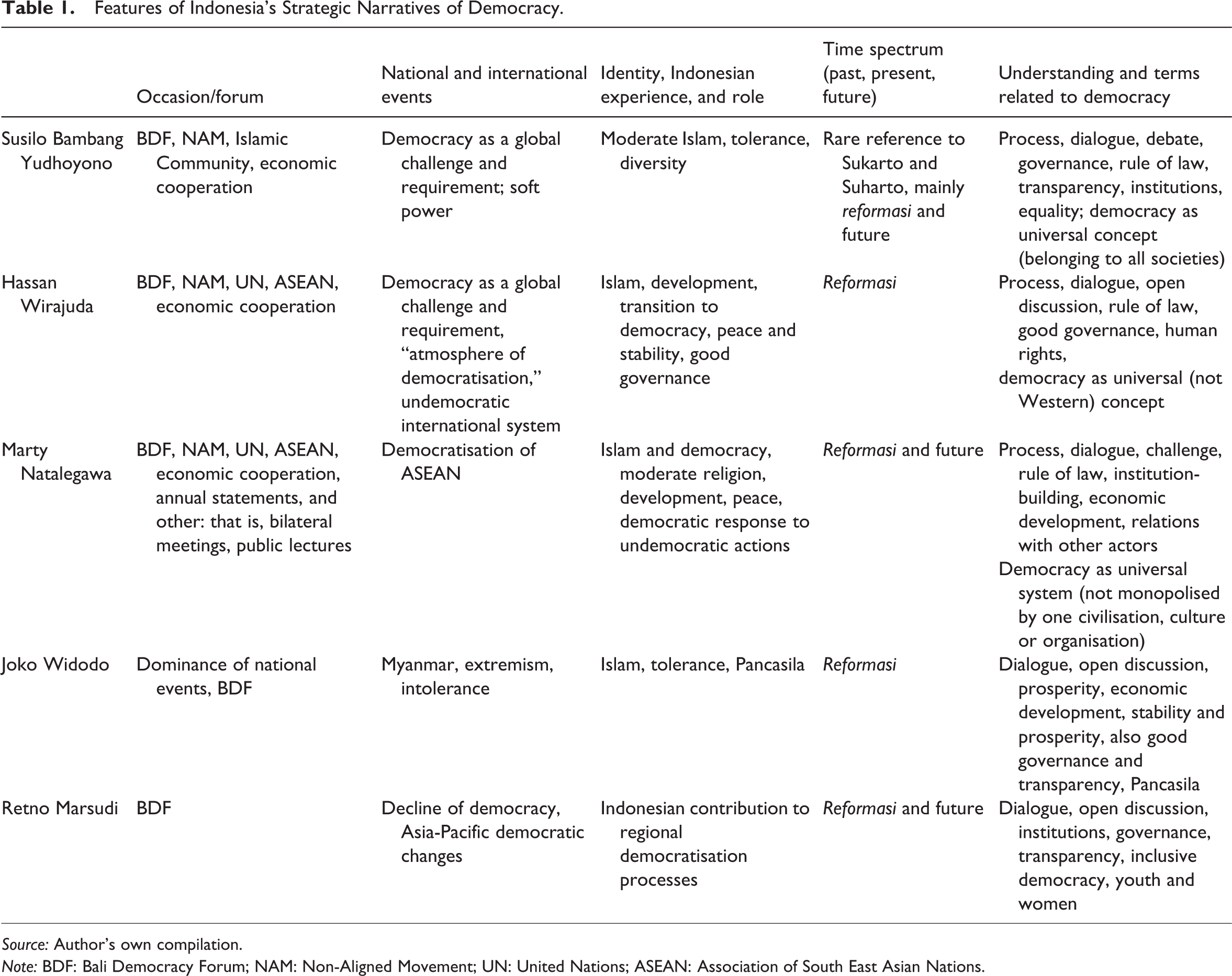
Source: Author’s own compilation.
Note: BDF: Bali Democracy Forum; NAM: Non-Aligned Movement; UN: United Nations; ASEAN: Association of South East Asian Nations.
(In)coherence in Indonesian Narratives
The comparison of the strategic narratives (including both foreign policy goals and strategies as well as political speeches) allows for a conclusion that Indonesian strategic narratives of democracy are incoherent in at least several aspects, however, with some exceptions. Inconsistencies can be classified into two groups: intra- and inter-(in)coherence.
Intra-coherence (between politicians) includes (in)coherence between the two analysed administrations and within them. An analysis of strategic narratives proves that SBY and foreign ministers of his presidential terms were more involved in promoting democracy than Joko Widodo and Retno Marsudi. Jokowi rarely raises the issue of democracy and when he does it is discussed in the context of the Muslim religion, especially in the regional dimension (at BDF). SBY’s coverage of democracy in the speeches was unevenly distributed throughout his presidency. Politicians present different understanding and role of democracy, from its instrumental treatment to belief in its “inner” value. It includes differences in speeches between politicians and in speeches of the same politician, especially SBY. There is a variety of the forums chosen to discuss democracy, ranging from a few (BDF, developing countries meetings) to the many and thematically diverse forums, particularly evident in the case of Natalegawa performance. Yudhoyono referred to the history of Indonesia before reformasi, while other politicians avoided to address Indonesian development before 1998 and most often referred to its democratisation process. Politicians present different understanding of democracy. Until 2014, democracy is clearly defined as a universal concept; however, societies should decide how they shape the system with respect to their culture and identity as well as politicians emphasise democracy is not a Western system. They also differently referred to the past, present, and future. In the Yudhoyono’s speeches, all time references may be traced; Wirajuda recalled reformasi; and Natalegawa focused both on the reformasi and in the future. The same conclusion can be drawn on the speeches of Jokowi, focusing on reformasi, and Marsudi, referring to both Indonesian reforms and future. Moreover, politicians refer to different international and regional circumstances shaping the need of promoting democracy, from international pressure to security issues.
Inter-(in)coherence, between documents and speeches, includes at least three aspects. In the foreign policy objectives, the element of representation of the Muslim community and the Global South (developing countries) is treated very briefly; however, Indonesian politicians have chosen this “audience” relatively often to discuss democracy. Promotion of democracy in the discussed documents should lead to improvement of the Indonesian image overseas; however, most of the speeches were given at BDF, NAM, and economic forums. Politicians use the term “promotion of democracy” and define democracy as a value as often as they treat democracy as an element of the Indonesia’s image. However, incoherence is clear especially considering foreign policy goals stating explicitly that democracy helps to improve the image of Indonesia, suggesting pragmatism in democracy promotion.
Indonesian strategic narratives also include coherent aspects of narratives. This is particularly evident in the assumption of Indonesian leadership in ASEAN and the Asia-Pacific region, where in fact Indonesia is the most active. The form of BDF dialogue has been defended by politicians, each of them stating that the discussion on democracy must be open and inclusive. Coherence can also be noted in the selection of “soft means” to promote democracy, especially at BDF as well as in highlighting the experience and identity of Indonesia.
Conclusion
Indonesia’s role as a democracy promoter has been questioned since its enactment in 2003. Initially, democracy consolidation and the national turmoil were a political challenge. Since 2008, the form of BDF meetings has been criticised – the open forum is its strength for Indonesian politicians, for others – its weakness. More recently, the decline of the quality of democracy is the most debated issue. Most of the scholarly analyses focus on the reasons and political ambitions of Indonesia, its need to gain political power and factors undermining the effectiveness of Indonesian foreign policy and democracy promotion. There is, however, another aspect to consider in the assessment of Indonesian efforts to promote democracy – construction and coherence of strategic narratives.
Coherence of strategic narratives is an important part of the story created by political elites in order to persuade other actors to the need and necessity of taking certain actions – in this article tested against Indonesian democracy promotion. Foreign policy strategies focus on the Indonesian image, while political speeches describe democracy both as a value and as an instrument to develop the state and its position in international relations; therefore, the purpose of Indonesian efforts is not clear. The vision of success and justification for promoting democracy also has two features: it is associated with the requirements of the twenty-first century, but it also results from the successes of Indonesia, which is developing dynamically based on its democratisation. In the strategic narratives (articulated by the elites), there are generally no competitive “stories,” although there are differences in emphasising aspects related to democracy. The analysis contained in this article shows that coherence has two dimensions, intra- and inter-coherence, both relevant to the creation of a strong narrative. The former refers to the coherence in the political speeches, the latter to the coherence between foreign policy strategies and the content of the speeches, both being a part of declarative and discursive part of foreign policy analysis. Weaknesses of Indonesian strategic narratives of democracy promotion are important factors undermining the credibility and image of Indonesia as a democracy promoter.
Footnotes
Acknowledgement
I would like to thank Professor Marcin F. Gawrycki and two anonymous reviewers for the comments and suggestions on earlier drafts of this article.
Declaration of Conflicting Interests
The author declares no potential conflicts of interest with respect to the research, authorship, and/or publication of this article.
Funding
The author(s) disclosed receipt of the following financial support for the research, authorship, and/or publication of this article: This work was financed from the funds of the Polish Ministry of Science and Higher Education granted to the Faculty of Business and International Relations of the Vistula University to maintain the research potential; decision no. 218919/E-656/S/2018, 26 June 2018; and no. 1/E-656/S/2018, 27 December 2018.
Notes
Author Biography