




Abstract
What is the role of political representation by ethnic parties in a multi-ethnic state that has undergone a transition from military rule, and is seeking to resolve protracted intrastate conflicts? The present article examines this question through a contextual case study of ethnic parties in Myanmar – a state that is characterised by unresolved ethnic grievances and conflicts; a political transition that has created new opportunities for ethnic representation; and multiple ethnic parties making representative claims on behalf of ethnic groups. Based on a mixed methods approach, the article documents that ethnic parties have been relatively ineffective in ensuring formal and descriptive representation and have had limited possibilities for substantive representation of ethnic interests. The article also identifies key explanations for the weak electoral performance of ethnic parties, emphasising party fragmentation and vote-splitting as well as weak party institutionalisation and limited capacity to make representative claims. Finally, the article analyses strategies for party-building, in preparation for the 2020 election. Based on the common emphasis on vote-splitting, most ethnic states have seen initiatives to merge parties, while a few parties have also sought to develop their political platform and sector policies. The article concludes that ethnic parties may gain improved formal representation after the next election but questions about the parties’ capacity for substantive representation remains. The 2020 election will thus be a new test for how ethnic voters see themselves best represented, in the light of competing representative claims and past experiences: by ethnic parties or non-ethnic democracy parties?
Introduction
What is the role of political representation by ethnic parties in a multi-ethnic state that has undergone a transition from military rule, and is seeking to resolve protracted conflicts against ethnic armed organisations? Can ethnic parties provide effective political representation and forge transformations towards substantive democracy and conflict transformation? The aim of this article is to address these questions through a contextual case study of electoral performance and party-building processes among ethnic parties in Myanmar. This choice of case is justified with reference to Myanmar’s multiple armed conflicts and recent democratic opening, which means that there are both deep-seated ethnic grievances and new opportunities for ethnic political representation.
The Myanmar case may add new insight and nuance to comparative and theoretical debates on ethnic parties and democratisation. There are, however, also limits to the theory-testing utility of this case, since the transition from military rule and armed conflicts is ongoing and open-ended and there is little prior research on ethnic parties in Myanmar. In this situation, the article pursues the more modest ambition of an analytical mapping of political representation by ethnic parties, as a basis for further comparative and theoretical analyses of the role of ethnic parties in conflict-ridden transition states.
The analytical focus of the article is based on three contextual conditions. First, political representation is a long-standing ethnic grievance that is at the centre of Myanmar’s intrastate conflicts. Myanmar is a multi-ethnic country that has been marked by protracted military rule and intrastate conflicts between the military and the ethnic armed organisations (Smith, 1991, 2018). The roots of the conflicts date back to the colonial period and especially the 1947 Panglong Agreement that established the principles of ethnic self-determination, political representation and economic equality as the basis for an independent Union of Burma in 1948 (Sakhong, 2014). Subsequent failures to implement these principles have been the root causes of multiple and persistent armed conflicts. Protracted military rule, large-scale human rights violations, military dynamics and war economies have become additional drivers of war, but the Panglong principles remain the essential benchmarks for conflict resolution (Smith, 1991, 2018). It can thus be observed that ethnic political representation is both an aim and a means for conflict resolution in Myanmar.
Second, Myanmar’s democratic opening has created new but constrained opportunities for ethnic political representation. Following five decades of direct military rule, the ruling State Peace and Development Council (SPDC) crafted a new constitution in 2008, held fraudulent elections in 2010, and transferred power to a nominally civilian government in 2011. This military-imposed transition produced a hybrid form of rule that includes competitive elections, parliamentary politics and civilian government but also constitutionally guaranteed positions of powers for the Myanmar Army (Bünte, 2017; Egreteau, 2016; Huang, 2016; Stokke and Soe Myint Aung, 2019). The 2008 Constitution introduced elected parliaments at the union and state/region levels, as a framework for general elections in 2010 and 2015, and by-elections in 2012, 2017, and 2018 (Tin Maung Maung Than, 2013). However, the constitution also contains provisions that means that the military continues to control key public affairs – especially those related to state security – and exerts strong influence in parliament, government, and public administration. Myanmar’s transition from military rule thus raises critical questions about the substance of political representation, amidst formal institutional arrangements for electoral democracy.
Third, the democratic opening has been followed by a proliferation of political parties making representative claims within these new political spaces. Contemporary Myanmar has a broad diversity of parties, including a large number of ethnic parties, but most of the parties are small and few have been successful at winning seats or have the capacity to provide substantive representation in parliamentary politics. The 2015 election demonstrated that the plurality of parties and their weak institutionalisation mean that they face a high risk of electoral defeat and under-representation of ethnic nationalities. The period since 2015 has also raised questions about the substance of ethnic representation, despite a democratically elected pro-democracy and pro-federalism National League of Democracy (NLD) government. It can thus be observed that although there are new political spaces and numerous ethnic parties, critical concerns remain about the capacities and strategies of ethnic parties to provide political representation.
Against this background, the present article examines the role of ethnic parties in political representation of ethnic nationalities in Myanmar. Given the limited research that has been done on ethnic parties earlier, the primary focus is on formal representation in union and state/region parliaments. More specifically, the article aims to address the following research questions: First, what characterises and explains the electoral performance of ethnic parties in Myanmar since 2010? Second, what are the strategies of ethnic parties to strengthen their electoral competitiveness before the 2020 election?
The empirical analysis is based on a mixed methods approach. The electoral performance of ethnic parties is analysed on the basis of descriptive statistics from the 2010 and 2015 general elections and the 2012, 2017, and 2018 by-elections. Such quantitative election data are combined with information from qualitative interview with leaders and activists in ethnic political parties since 2013; discussions in capacity building workshops with ethnic parties in 2013–2014; participatory observation in party development processes during 2017–2018 (especially in Kachin and Shan states); and continuous following of media and scholarly reports on ethnic politics since 2013. As the purpose of the article is to address general patterns of ethnic representation, and due to confidentiality concerns, direct quotes from interviews and ethnographic fieldwork are not included in this article.
The article starts out with two brief sections that contextualise the analysis with reference to scholarship on political representation and ethnic parties and to Myanmar’s ethnic diversity and democratic opening. Thereafter follows three analytical sections that examine the electoral performance of ethnic parties, the explanations behind the relatively poor performance of most ethnic parties, and their strategic responses to these experiences. First, election results data are used to identify persistent problems of weak descriptive representation by ethnic parties. Based on this empirical analysis, the second section provides an analytical discussion of the mechanisms behind the weak electoral performance. While party fragmentation and vote-splitting are often foregrounded as primary explanations, the discussion also points to weaknesses in party institutionalisation and the limited competitiveness of ethnic parties in the context of polarised rivalry between two dominant national parties.
Third, the final section provides a brief discussion of contemporary initiatives to develop stronger ethnic parties, in preparation for the 2020 election. Based on the common emphasis on vote-splitting, most ethnic states have seen attempts to merge ethnic parties, while some parties have also sought to develop their political platform and specific sector policies. While many ethnic political leaders seem confident that the combination of ethnic identity politics and merged ethnic parties will yield electoral gains in the 2020 election, persistent problems of weak party development mean that there is continued uncertainty about the capacity of ethnic parties to provide both formal and substantive representation.
Conceptualising Representation and Ethnic Parties
Myanmar’s military-imposed transition raises critical questions about the form and substance of political representation, in other words, how representatives are authorised, provide representation, and are held accountable by those being represented (Stokke and Soe Myint Aung, 2019; Törnquist et al., 2009). In her classical study of representation, Pitkin (1967) distinguishes between four principal meanings of the concept: formalistic representation (authorisation of representatives), descriptive representation (correspondence between representatives and the represented), symbolic representation (symbolisation of the represented) and substantive representation (practices of representing) (Dovi, 2015). This typology has provided a vocabulary for studying institutional procedures for selecting and authorising representatives; the descriptive resemblance between representatives and the represented; the citizens’ feelings of being symbolically represented; and the representatives’ acts of substantially promoting the interests of their constituencies. Pitkin also demonstrates that representation can be passive or active: while descriptive and symbolic representation mean that the representative is “standing for” a constituency, substantive representation means that representatives are “acting for” those being represented. This provides a conceptual basis for critical attention to the links and tensions between formal, descriptive, and symbolic representation, on the one hand, and substantive representation, on the other (Törnquist et al., 2009).
The starting point for Pitkin’s analysis of representation is the represented rather than the representatives, in other words, the identities, interests, and preferences of constituencies. This analytical logic, which is exemplified by cleavage models of party systems and electoral politics (Lipset and Rokkan, 1967; Ufen, 2012), stands in contrast to scholars that foreground the role of representatives in constructing constituencies and making representative claims. Saward (2010), for example, criticises Pitkin for portraying the represented as fixed and prior to the process of representation. He advocates instead an understanding of representation as a performative process, whereby the represented and their interests are constituted: “Would-be political representatives…make claims about themselves and their constituents and the links between the two; they argue or imply that they are the best representatives of the constituency so understood” (Saward, 2006: 302, italics in original).
Saward’s conception foregrounds the framing of social groups and representative claims on their behalf and thus downplays objectivist conceptions of representation (Bourdieu, 1991; Stokke and Selboe, 2009). It also shifts the understanding of agency from political cleavages and forces in society to political actors that compete for positions as legitimate representatives (Severs, 2010). The notion of representative claims thus builds on Pitkin’s typology of representation but retheorises both the meaning of representation and the relationship between representatives and the represented.
This constructivist turn has brought renewed attention and debates on democratic representation but has also been the target of criticism (Disch, 2015). Severs, for example, argues that the focus on claims-making has “drawn attention away from normative issues regarding good, or democratic, representation, which were previously central to scholarship” (2012: 170). This leads her to the conclusion that there is a need for critical attention to substantive claims – claims that not only speak for the represented but also substantially about their interests – and to responsiveness between representatives and those being represented (Severs, 2010, 2012).
These positions and debates are highly relevant for studies of ethnic parties. Chandra defines an ethnic party as “a party that is the champion of the particular interests of one ethnic category or set of categories” (2011: 155). By extension, multi-ethnic parties champion the interests of all significant ethnic categories, while non-ethnic parties do not advocate ethnic interests per se. This general definition can be operationalised through different indicators, such as ethnic party name, ethnic categories, and issues that are emphasised in party platforms and electoral campaigns, the ethnic composition of the vote base and party leadership, and so on. In agreement with Pitkin’s understanding of the relationship between representatives and the represented, studies of ethnic parties have typically seen ethnic groups as pre-given, internally homogenous, and relatively unchangeable. Ethnic identities are hence conceived as a fixed basis for ethnic parties and exogenous to political institutions and competition (Chandra, 2005). Such primordial views of ethnicity have been defended as a pragmatic way of depicting ethnic cleavages and conflicts in ethnically divided societies (Horowitz, 1985; Ishiyama, 2009).
Primordialism has, however, been widely discredited and largely replaced by constructivist approaches to ethnicity, which argue that “ethnic groups can be fluid, internally fragmented, multidimensional, and endogenous to institutional structures and political competition” (Chandra, 2005: 238). The latter perspective is in agreement with the constructivist turn in representation but has in turn been criticised for creating an image of ethnic groups as artificial constructions and seeing ethnic politics as instrumental manipulation of ethnic identities. While the primordialist approach is seen as supporting deterministic understanding of ethnic groups and politics, the constructivist approach is criticised for its inability to acknowledge that ethnic cleavages and injustices are experienced as real among ethnic constituencies and parties.
Responding to this dilemma, Chandra (2012) proposes a constructivist perspective on ethnicity and ethnic politics, which acknowledges the existence of descent-based ethnic attributes while insisting that ethnic categories based on such attributes are constructed, contextual, and changeable. This conception puts ethnic groups on par with other categories that may be the focal point for representative claims, for example, social class or gender. Likewise, Severs’ (2010, 2012) call for attention to substantive claims and responsiveness also applies to representation of ethnic groups. Successful political representation by ethnic parties is thus contingent both on their ability to construct ethnic categories, make representative claims, and substantially represent their interests.
Myanmar’s Ethnic Diversity and Formal Democracy
Myanmar is a multi-ethnic state that officially recognises 135 ethnic groups, as subdivisions of eight “major national ethnic races”: Bamar, Shan, Mon, Kayin (Karen), Kayah (Karenni), Kachin, Rakhine (Arakan), and Chin (Transnational Institute, 2014). The ethnic race categories are the basis for the territorial organisation of the union, with seven regions that are dominated by the Bamar majority in the centre of the country and seven states dominated by non-Bamar ethnic nationalities along Myanmar’s external borders (Figure 1). The list of 135 recognised ethnic groups (taingyintha) also forms the basis for Myanmar’s citizenship law (South and Lall, 2018). Self-reported ethnic identity was included in the 2014 census, but the ethnic population figures are politically contentious and have not been released (Ferguson, 2015; Transnational Institute, 2014). A common estimate is that the Bamar majority makes up approximately two-third and non-Bamar nationalities roughly one-third of the total population (Egreteau, 2017).
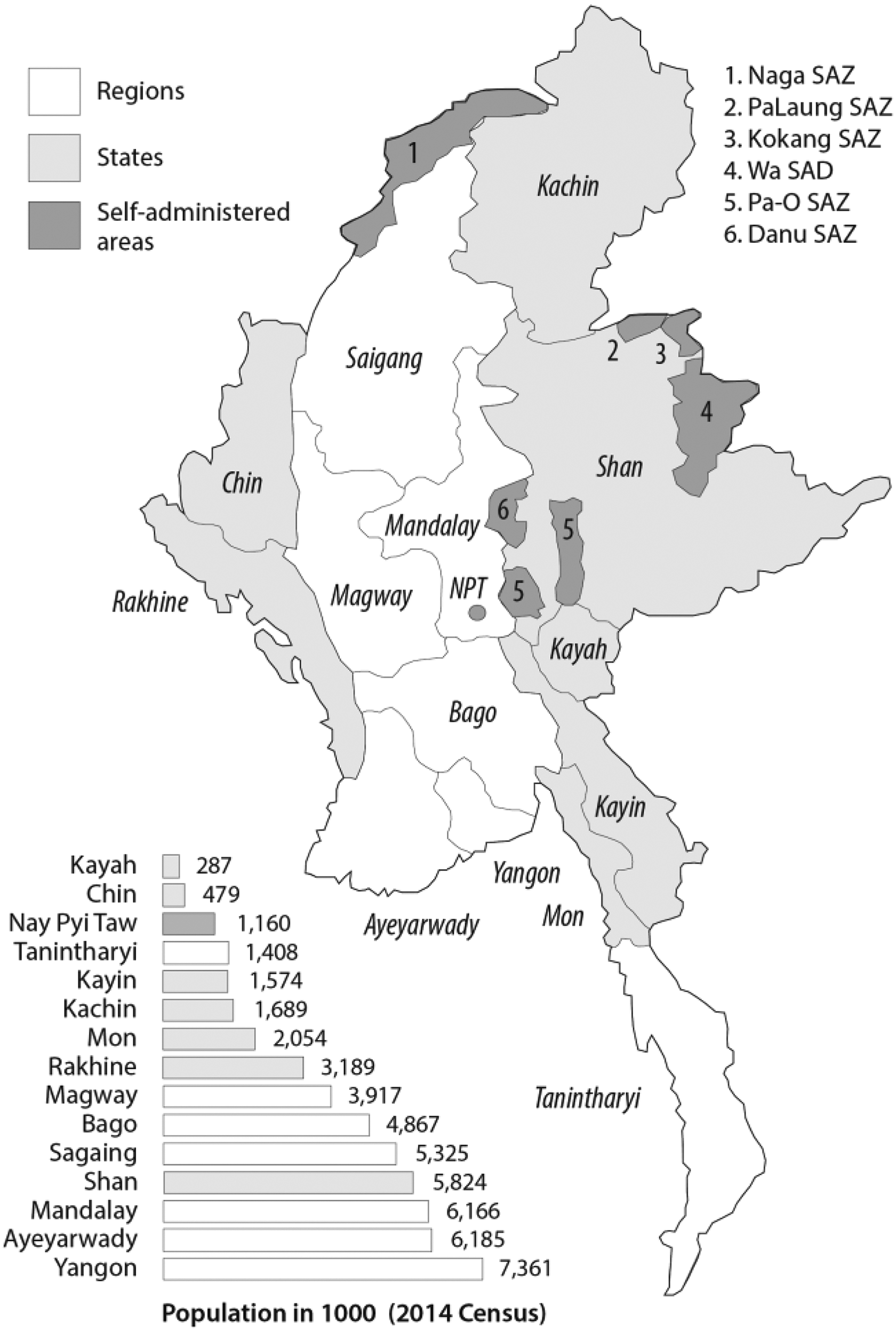
Administrative Divisions of Myanmar.
Myanmar’s ethnic classification scheme is controversial for a number of reasons, including its core primordialist assumptions. While anthropological and historical studies have demonstrated that these categories should be understood as social and political constructions rather than pre-defined and fixed groups (see e.g. Leach, 1954; Sadan, 2013), political discourse in Myanmar is imbued with essentialist and exclusionary notions of ethnic groups and boundaries. This reflects both how colonial and post-colonial governmentality have contributed to institutionalising ethnic categories and how they have been solidified and politicised during the post-colonial period (Smith, 1991, 2018; Transnational Institute, 2014). Consequently, majority–minority relations and centre–periphery relations have become the pivot of state-building and contestation of state authority (Smith, 1991; Taylor, 2009). Ethnic areas have been affected by multiple and protracted conflicts between ethnic armed organisations demanding ethnic equality, representation, and self-determination and the Myanmar Army claiming to defend the unity, stability, and sovereignty of the Union of Myanmar. Against this background of military rule and intrastate conflicts, the democratic opening since 2010 has brought new possibilities for political inclusion, while there are also clear limitations on ethnic representation.
Myanmar’s military-imposed transition has introduced an institutional framework for electoral democracy, parliamentary politics, and civilian government, but the democratic substance is constrained by constitutional regulations that grant the military (Tatmadaw) authority over national security and strong military influence in parliament, government, and public administration (Crouch, 2019; Egreteau, 2016; Stokke and Soe Myint Aung, 2019; Williams, 2014). The roots of the opening can be traced back to 1988, when a combination of governance failure, socio-economic crisis, and popular protests led to the collapse of the Burma Socialist Programme Party (BSPP), and the subsequent formation of a new military regime, the State Law and Order Restoration Council (SLORC), which was renamed as SPDC in 1997.
SLORC held multi-party elections in 1990 that yielded a landslide victory for newly formed democracy and ethnic movement parties, but the election results were rejected and the military rulers claimed that the election had only been for a National Convention to draft a replacement for the annulled 1974 Constitution. This was later used as a basis for unilateral constitution-making by the military, which brought formal political liberalisation in combination with secured positions of power for the military under the new 2008 constitution (Crouch, 2019; Huang, 2016; Williams, 2014). The state and politics in contemporary Myanmar are thus to a large degree shaped by the changing continuity of military domination (Selth, 2018).
The 2008 Constitution established the Pyidaungsu Hluttaw (Union Parliament) as a bicameral legislative body consisting of the Pyithu Hluttaw (House of Representatives) and the Amyotha Hluttaw (House of Nationalities) (Egreteau, 2017; Kean, 2014; Union of Myanmar, 2008). The Parliament is assigned formal roles in lawmaking, oversight of the government, and public representation, and is the basis for the election of the President. The 2008 Constitution also creates state/region parliaments and governments (Nixon et al., 2015), but these do not have the power to elect or oversee state/region governments.
The parliaments at union and state/region levels are the foremost arenas for ethnic political representation, authorised through ordinary elections in 2010 and 2015, and by-elections in 2012, 2017, and 2018. The 2010 elections were neither free nor fair but was used to transfer power to a nominally civilian government led by President Thein Sein and the military’s Union Solidarity and Development Party (USDP). The 2015 election was, in contrast, reported to be free but not fully fair, due to the disenfranchisement of the Rohingya population in Rakhine State, cancelled elections in parts of Shan State, and a first-past-the-post electoral system that creates discrepancies between the popular votes and the composition of the legislatures (Huang, 2016; Transnational Institute, 2015). The election returned a landslide victory for the National League for Democracy and was followed by a peaceful transfer of power to a government led by State Counsellor Aung San Suu Kyi, the first democratically elected government since 1960 (Ardeth, 2016; Huang, 2016; McCarthy, 2016). Myanmar’s next ordinary election is scheduled for late 2020.
Formal Representation by Ethnic Parties
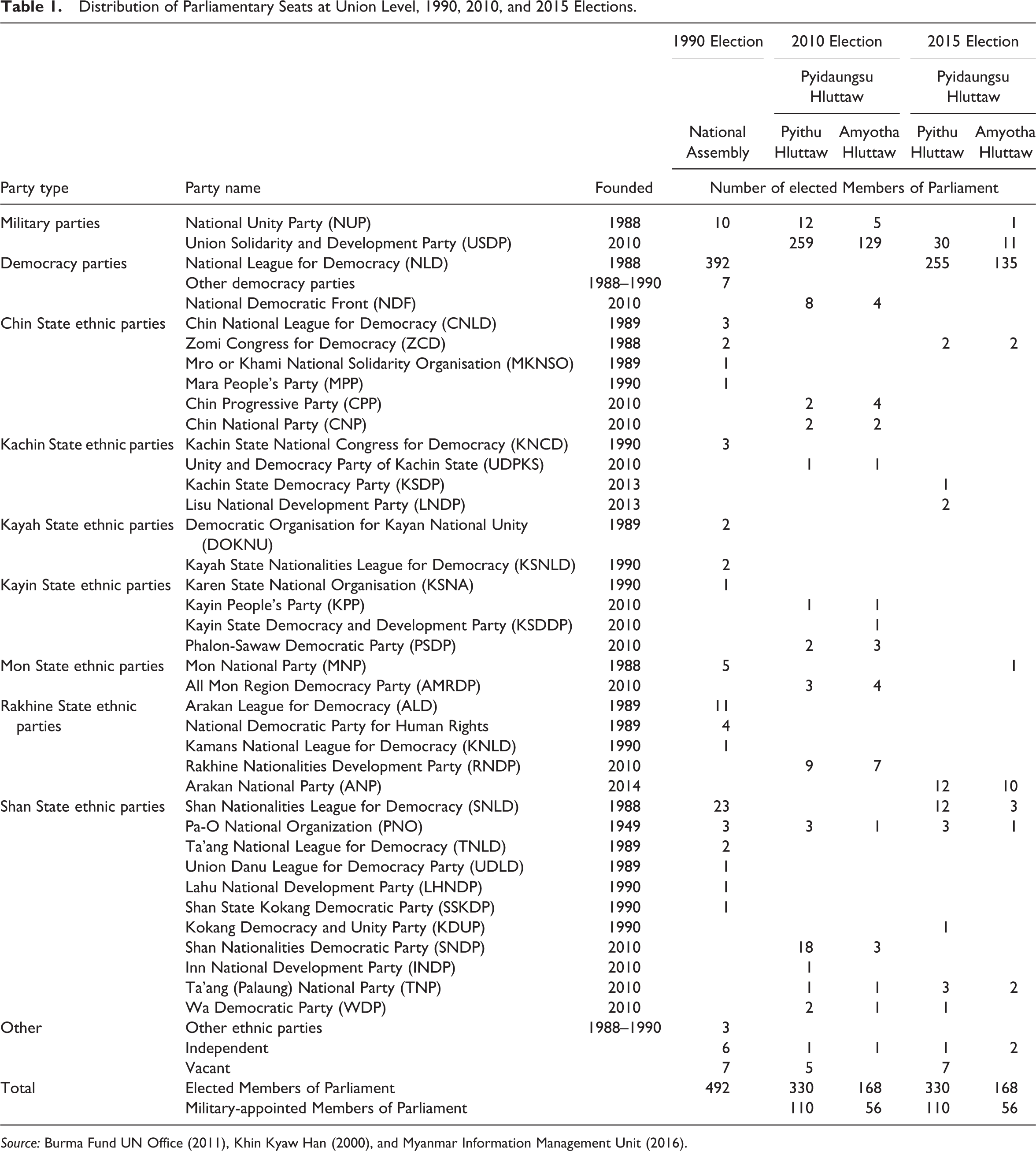
The three elections in 1990, 2010, and 2015 provide a basis for assessing the degree of formal and descriptive representation by ethnic parties. Myanmar has a large number of political parties, more than 90 were registered and contested the 2015 election. Approximately two-third of these can be classified as ethnic parties in the sense that they make explicit reference to an ethnic group in their party name, make ethnic representative claims, and get electoral support from ethnic constituencies. There are, however, only a few parties that have been successful in winning seats in union and state/region legislatures. A total of sixteen parties were represented in the union parliament after the 2010 election, while thirteen parties won seats in 2015 (Table 1). Only four parties won more than five seats in 2015: NLD, USDP, Arakan National Party (ANP), and Shan Nationalities League for Democracy (SNLD).
Distribution of Parliamentary Seats at Union Level, 1990, 2010, and 2015 Elections.
A prominent feature of Myanmar’s party system is that the plurality of political parties is not organised around class or religion, despite strong social and religious cleavages. The party system revolves instead around two cleavages centred on contentious state- and nation-building processes. On the one hand, there is a divide between territorial (union-wide) and ethnic definitions of demos, and hence between Burman and ethnic nationalisms. This cleavage dates back to the 1947 Panglong Conference and the early period of democratic politics in the 1940s and 1950s and has been reinforced during the long history of intrastate conflicts. On the other hand, there is also a political divide between the emphasis on sovereignty, unity, and stability that is closely associated with the military and demands for democracy and human rights that are linked to pro-democracy popular movements. The foremost critical junctures that have shaped this cleavage are the 1962 military coup and the 1988 democracy uprising.
Scholarly analyses and political discourse in Myanmar thus revolve around three party clusters: non-ethnic parties that originate from and maintain close links to the military; non-ethnic parties that stem from the pro-democracy movement; and ethnic parties representing non-Bamar nationalities (Kempel et al., 2015; Stokke et al., 2015). The group of ethnic parties is highly diverse but shares the common presumption that the interests of ethnic groups are best represented by ethnic parties. There are no major multi-ethnic parties at the union scale, but SNLD has announced its intention to become a multi-ethnic party aimed at representing all ethnic communities within Shan State.
The clusters of military and democracy parties are each dominated by a major party (USDP and NLD) that have union-wide organisational structures and electoral support. Minor military and democracy parties include the National Unity Party (NUP) – the successor to the BSPP – and the National Democratic Front (NDF), which was formed as a splinter group from NLD for the purpose of contesting the 2010 election. Among the ethnic parties, there is a divide between old movement parties founded in 1988–1990 and new electoralist parties that were formed before the 2010 election, when the old parties were prevented from re-registering or refused to participate in elections under the 2008 Constitution. This has been the basis for two alliances of ethnic parties – the United Nationalities Alliance (UNA) and the Nationalities Brotherhood Federation (NBF) – that have organised the old movement parties and the new electoralist parties, respectively (Burma Partnership, 2015; Keenan, 2013; Stokke et al., 2015). Whereas the 1990-era ethnic parties have had strong links to NLD, the 2010-era ethnic parties engaged pragmatically with the USDP-government from 2011 to 2015. Many of the NBF-affiliated parties that were represented in the union parliament from 2010 to 2015 performed poorly in 2015, when the UNA parties also contested the election (Table 1). Prominent examples of such 2010-era ethnic parties include All Mon Region Democracy Party (AMRDP), Chin Progressive Party (CPP), Chin National Party (CNP), Phalon-Sawaw Democratic Party (PSDP), and Shan Nationalities Democratic Party (SNDP).
Figure 2 presents a simplified visualisation of the election results since 1990, showing the share of seats won by military parties, democracy parties, and ethnic parties. While military parties (USDP and NUP) performed well in the military-controlled and fraudulent 2010 election, they were strongly defeated by NLD in the free 2015 election, mirroring both the 1990 election and the 2012 by-election when NLD won forty-three of forty-five available seats (Tin Maung Maung Than, 2013). Since 2015, representation of military interests has to a larger extent relied on the 25 per cent of parliamentary seats that is reserved for military appointees. Likewise, new democracy and ethnic parties such as NDF and SNDP, which were established for the purpose of electoral participation and won a number of seats in 2010, were defeated by older movement parties such as NLD and SNDP in the 2015 election. Rakhine State represents an anomaly in this regard, as the 1990-era ALD and the new Rakhine National Development Party (RNDP) successfully merged into ANP and became the third largest party at the 2015 election.
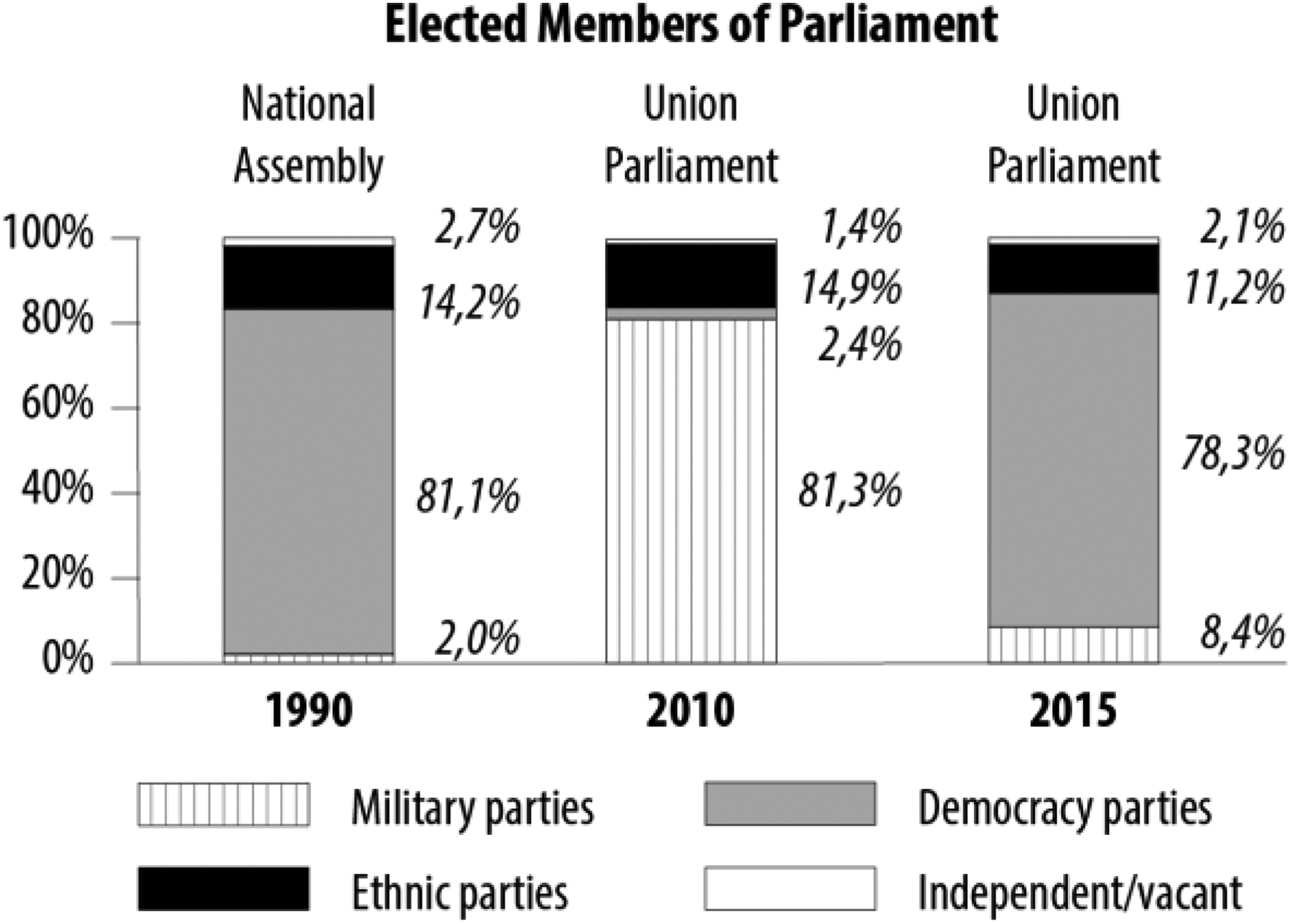
Distribution of parliamentary seats by party type at union level, 1990, 2010, and 2015 elections.
Apart from these major parties (and a few NUP representatives), all other members of the current union parliament come from minor ethnic parties. They typically represent small ethnic groups that are spatially concentrated in a few electoral districts within ethnic states, in other words, they are parties that pursue ethnic identity politics of “minorities within minorities,” some of which also have special administrative zones (Figure 1). Such parties include Zomi Congress for Democracy (ZCD) in Chin State; Kokang Democracy and Unity Party, Lahu National Development Party, Pa-O National Organization, Ta’arng (Palaung) National Party, and Wa Democratic Party in Shan State; and Lisu National Development Party (LNDP) in Kachin State (Transnational Institute, 2015).
At the union level, Figure 2 shows that ethnic parties have won 11–15 per cent of the seats in the 1990, 2010, and 2015 elections, which is well below the estimated one-third share of non-Bamar ethnic groups in the population. Ethnic parties have thus not managed to provide fair descriptive representation of ethnic constituencies. This disproportionality is, however, nuanced by the number of ethnic representatives from military and democracy parties. Egreteau (2017), for example, examines the self-reported ethnic belonging of all members of the union parliament and finds that 64 per cent of the elected representatives identified as ethnic Bamar or half-Bamar during the 2011–2015 period. After the 2015 election, this share was found to be 64.3 per cent. Although Egreteau observes that the typical legislator in the 2010s fits the conventional image of a Burmese postcolonial leader – “a man, in his fifties or sixties, ethnically Bamar, Buddhist, and with a professional career in public service, either in the civilian bureaucracy and education sector or the armed forces” (2017: 19) – the composition of the legislature has come closer to mirroring the proportional share of Bamar and non-Bamar groups in the population. Beyond this simple majority/minority dichotomy, there are important variations in how well different ethnic groups are represented in union and state parliaments. While some ethnic nationalities have a sizeable presence in the union and state parliaments, other ethnic groups are largely unrepresented by both ethnic and non-ethnic parties.
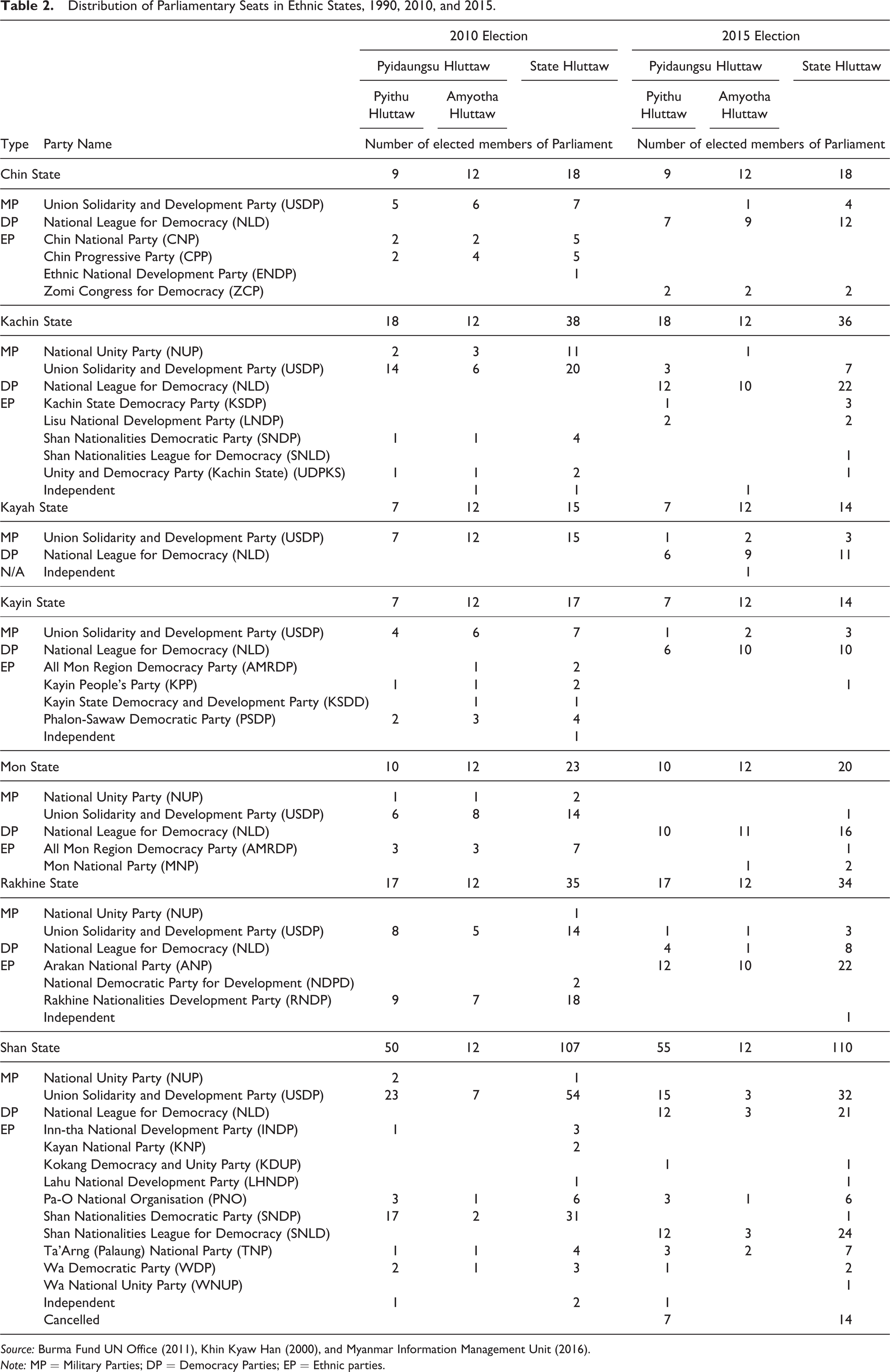
Further empirical insights on political representation by ethnic parties can be gained from election results at the state/region level. Table 2 and Figure 3 provide information about the party affiliation of elected legislators from ethnic states in union and state parliaments in 2010 and 2015, showing that ethnic parties won few seats in most ethnic states and fewer seats in 2015 than in 2010. The two exceptions to this pattern are found in Rakhine State where ANP became the largest party in 2015 and in Shan State where SNLD won the second largest number of seats at both the union and state levels. SNLD’s electoral results were still below expectations, especially in conflict-affected areas where local security factors and military presence seem to have benefitted USDP (Myanmar Information Management Unit, 2016; Transnational Institute, 2015).
Distribution of Parliamentary Seats in Ethnic States, 1990, 2010, and 2015.
Source: Burma Fund UN Office (2011), Khin Kyaw Han (2000), and Myanmar Information Management Unit (2016).
Note: MP = Military Parties; DP = Democracy Parties; EP = Ethnic parties.
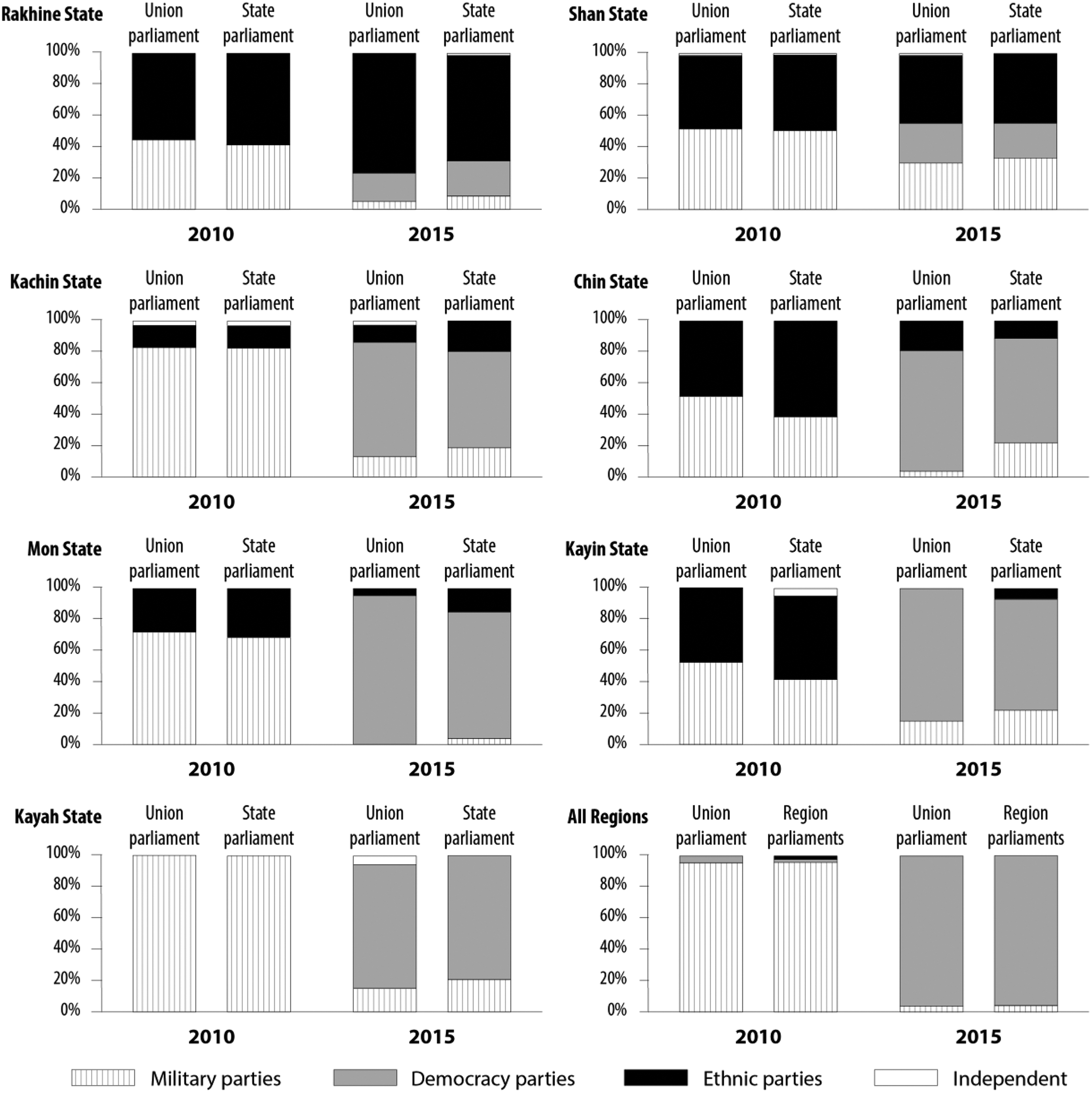
Distribution of parliamentary seats by party type in states and regions, 2010 and 2015 elections.
In marked contrast, ethnic parties did not win any seats at all in Kayah State and Kayin State, and only a few seats were won in Kachin, Chin, and Mon states. Apart from SNLD and ANP, the seats won by ethnic parties were primarily taken by parties representing small but geographically concentrated ethnic groups, such as Zomi, Lisu, Phalon-Sawaw, Kokang, Pa-O, Palaung, and Wa communities. Most strikingly, no ethnic parties making representative claims on behalf of the major ethnic groups of Chin, Kachin, Kayah, Kayin, and Mon won significant numbers of seats at either union or state level. Outside the ethnic states, none of the ethnic parties won any seats in Bamar-dominated regions. It is also notable that out of a total of twenty-nine Ethnic Affairs Ministers, which are reserved positions designed to ensure representations of specific minorities within a state or region, only five were won by ethnic parties (Ardeth Maung Thawnghmung and Yadana, 2018; Transnational Institute, 2015).
This means that although the proportion of Bamar/non-Bamar legislators at the union level may reflect the general composition of the population, the representation of ethnic constituencies by ethnic parties is generally weak. The main exceptions are ANP and SNLD in Rakhine and Shan states. Similarly, there is a handful of smaller ethnic groups that have gained some political representation. In sharp contrast, the major ethnic communities of Chin, Kachin, Kayin, Kayah, and Mon appear to be strongly underrepresented. In general terms, it can thus be observed that most ethnic parties have demonstrated limited ability to secure formal representation through elections and have thus been poorly positioned to provide substantive representation of ethnic interests in parliamentary politics.
Explaining the Electoral Performance of Ethnic Parties
The challenges of weak representation by ethnic parties raise further questions about the causal mechanisms behind the election results and about the ethnic parties’ responses and strategies for the upcoming election in 2020. While various explanations have been offered for the poor electoral performance in 2015, respondents and observers converge around two sets of challenges for ethnic parties: (1) fragmented ethnic parties and vote-splitting and (2) weak party institutionalisation and ineffective representative claims. These alternative interpretations are complementary rather than mutually exclusive but have supported different party-building strategies in preparation for the 2020 election, as will be discussed in the next section.
On the one hand, many respondents from ethnic parties and civil society organisations emphasise the fragmentation and divisive competition among ethnic parties (Ardeth, 2016). It is a common perception that vote-splitting played a decisive role in the context of a first-past-the-post electoral system and single-member electoral districts (Ardeth, 2016; Lemargie et al., 2014; Marston, 2013; Sai Wansai, 2015). The large number of ethnic parties, reflecting both the plurality of ethnic groups and the personal ambitions of political leaders, is thus seen as a source of electoral defeat in the 2015 election. With the exception of ANP in Rakhine State, pre-election efforts to merge parties or form no-contest agreements failed. There were, for example, five ethnic parties that competed against each other in the small Kayah State, creating a situation where “the result was not only a split ethnic vote, leaving space for the NLD to prosper, but also limited public enthusiasm over local parties that appeared small and weak” (Burke, 2015: 5). As shown in Table 2 and Figure 3, no ethnic parties won any of the Kayah seats in the union and state hluttaws.
The fragmentation among ethnic parties is also shaped by dynamics in the political field. Most importantly, the military-imposed transition has forged a divide between old movement parties that were founded in 1988–1990 but abstained from the 2010 election and new electoralist parties that were formed for the purpose of contesting the 2010 election (Stokke et al., 2015). Shan State, for example, saw a polarised competition in 2015 between SNLD and SNDP, resulting in a clear shift from SNDP to SNLD as the dominant Shan party. In Chin and Mon states, it is notable that both the 1990-era movement parties (Chin National League for Democracy and Mon National Party) and the 2010-era electoralist parties (CPP, CNP, and AMRDP) performed poorly at the 2015 election (Table 1). Similar patterns are also found in Kachin, Kayin, and Kayah states. In Rakhine State, in contrast, a merger of the old Arakan League for Democracy (ALD) and the new Rakhine Nationalities Development Party produced an electoral victory for the ANP in 2015. The ANP has subsequently split over political differences, but the stark contrast between Rakhine and other ethnic states is often taken as evidence that the failure to merge was a decisive factor behind the poor electoral performance of most ethnic parties in 2015 (Burke, 2015).
Vote splitting has thus become a popular explanation, especially among party representatives, for the failure of ethnic parties to provide formal and descriptive representation for ethnic groups. Transnational Institute (2015) adds important empirical nuance to this thesis by analysing electoral data to check whether the sum of votes for competing ethnic parties outnumbers the votes for the winning non-ethnic party (USDP or NLD). This calculation is based on the assumption that the voters for ethnic parties would also vote for a combined party, that is, that ethnic identity takes precedence over representative claims by non-ethnic parties. Based on this assumption, they find that vote-splitting was a factor in some electoral districts, but the actual number of seats that were affected by vote-splitting is relatively small. In fact, the calculation shows that only an additional 17 seats would have been won in union, state, and region parliaments if competing ethnic parties had merged prior to the election. Although vote-splitting undoubtedly played a role, it is not a sufficient explanation for the low number of seats won by ethnic parties in 2015.
On the other hand, party respondents and observers also emphasise that ethnic parties were outcompeted in the polarised contest between USDP and NLD. Many ethnic voters supported NLD rather than ethnic parties, either for strategic reasons or because NLD’s representative claims were deemed more attractive (Sai Wansai, 2015). The 2015 election was the first one with free competition between NLD and USDP. This made the election into a referendum between the legacy of military rule and USDP’s campaign focus on “unity and development,” on the one hand, and the legacy of the pro-democracy movement and NLD’s focus on “change”, on the other (Ardeth, 2016; Tin Maung Maung Than, 2016). In this polarised political contest between two dominant non-ethnic parties, ethnic parties and identity politics were relegated to a subordinate position.
Ethnic parties also had little capacity to formulate political alternatives and limited financial and organisational resources to run effective campaigns and mobilise ethnic constituencies (Burke, 2015; Transnational Institute, 2015). Respondents from ethnic parties and civil society organisations thus report that many ethnic voters supported the NLD to ensure a pro-democracy government (Sai Wansai, 2015; Tin Maung Maung Than, 2016). Respondents and observers also point to the iconic standing of Aung San Suu Kyi, symbolising the mass movement for democracy and federalism, as a key explanation for both political and strategic support for NLD among ethnic voters (Ardeth, 2016).
This alternative interpretation of the 2015 election thus argues that ethnic parties had little capacity to compete with NLD for support in ethnic constituencies. It is not vote-splitting among ethnic parties that explains their electoral defeat, but rather the political weaknesses of ethnic parties and uncertainty about their ability to provide substantive representation. As there are little empirical data available on ethnic voters’ motivations for supporting NLD, it is difficult to ascertain whether it represents a strategic voting that was limited to the 2015 election or indicates a shift from ethnic identity politics towards non-ethnic parties. Ardeth (2016: 137) finds that “Karen (or Kayin) voters in the Yangon region said that they voted for the NLD rather than Karen parties because of disunity among Karen political parties or the perception that they were too small to effect major change or form a government.” A post-election survey in Kachin State reports that voters were motivated both by strong resentment against USDP rule and a strong correspondence between the voters’ political orientation and the NLD’s core campaign message (Kachinland Research Centre, 2016). A large share of the respondents answer that they would have supported NLD even if there had been a merged Kachin ethnic party. This leads the authors to conclude that “Kachin parties lost the election badly not because they failed to forge a unified Kachin party; it was because they were not able to command the confidence of the Kachin voters” (Kachinland Research Centre, 2016: 21). These surveys confirm the observation made by some respondents that ethnic parties failed to make attractive representative claims in a context of party fragmentation and a dominant political contest between NLD and USDP.
The observed problems of political capacity raise critical questions about the character and determinants of ethnic party development. Field observations support the analytical generalisation that most ethnic parties are poorly institutionalised both in terms of party values and policies and in terms of party organisation, which are the core dimensions of party institutionalisation that are emphasised in the scholarly literature (Randall and Svåsand, 2002). Ethnic parties are typically characterised by the absence of comprehensive political programs or specific policies beyond basic identity markers (Stokke et al., 2015; Wells, 2018). Most political parties are also weak in terms of organisational structure and internal democracy. With some notable exceptions such as SNLD, they have limited capacity to organise party activities, mobilise voters, and function as political representatives. In this situation, they resort to ethnic identities and the symbolic capital of party leader as the basis for representative claims.
These problems of weak party institutionalisation can be further contextualised with reference to Myanmar’s political history of repressive party–state relations (Stokke, forthcoming). Most of Myanmar’s post-colonial period has been marked by military rule and state repression of parties, although there have been periods of partial military withdrawal from government (Egreteau, 2016; Huang, 2016). These conjunctures, within the overall context of a praetorian state, have offered some temporary and constrained political spaces for party development, but not sufficient political opportunities for gradual and continuous party development based on social and political cleavages in society. In this situation, Myanmar’s political parties, and especially the ethnic parties, tend to be leadership-centric networks for identity politics rather than programmatic political organisations.
Strategies for Party-Building among Ethnic Parties
The 2015 election has been followed by various initiatives for party-building in ethnic states. While most observers and political actors expected the NLD to win the election, as had already been indicated by the 2012 by-election, the magnitude of NLD’s victory took many by surprise (Ardeth Maung Thawnghmung, 2016; Marston, 2013; Tin Maung Maung Than, 2013). NLD’s clear majority in the Pyidaungsu Hluttaw had particularly strong repercussions for ethnic parties. Before the election, there was a common expectation that ethnic parties would gain the power to decide who should be the President and exert influence on the government or be included in a ruling alliance (Sai Wansai, 2015). Instead, NLD’s strong position in parliament allowed it to form a single-party majority government and appoint governors and ministers in ethnic states with little consideration for ethnic allies (Sai Wansai, 2015). Consequently, ethnic parties – including ANP and SNLD – were left in a marginal position with limited influence on policymaking and public administration, despite the change of government from USDP to NLD.
The foremost strategic response of ethnic parties following the 2015 election has been to merge parties within each ethnic state (Hein Ko Soe, 2018; Nan Lwin, 2018). This consolidation strategy is based on the realisation that most of the major ethnic groups – the Shan, Kachin, Kayah, Chin, Mon, and Karen – were represented by at least two competing parties in 2015. Mergers or electoral alliances are thus seen as a natural response to the problems of vote-splitting. The extent to which such mergers have happened has, nevertheless, taken many observers by surprise, in the light of the hesitance to merge parties in the past. A newspaper report in April 2018 concluded that although vote-splitting was recognised as a major impediment for ethnic representation, “mergers to maximise their chances at the ballot box in 2020 seem unlikely in all states but two” (Hein Ko Soe, 2018: 1). This prediction has since been proven wrong: At the time of writing (November 2019), Karen, Kayah, Kachin, Mon, and Chin ethnic parties have agreed to merge and some have registered new parties (Nan Lwin, 2018).
In Mon State, for example, merging the 1990-era Mon National Party (MNP) and the 2010-era AMRDP has been a contentious issue since before the 2015 election (Aung Aung, 2018; Burma Partnership, 2015). Although the need and common ethnic basis for a merged party is recognised, there have also been deep-seated political divisions between MNP and AMRDP that have blocked an actual merger. Reluctantly, the leaders of both parties came to accept an amalgamation after being pressurised by an alliance of civil society organisations and Buddhist monks supported by the New Mon State Party (NMSP), the foremost Mon ethnic armed organisation. In the aftermath of two large-scale Mon Political Conferences, and under the threat of a third Mon party being formed, the AMRDP and MNP finally agreed to merge in 2018 (Lawi Weng, 2018; Naw Betty Han, 2018b). The new party, named Mon Unity Party, has reportedly not yet developed a comprehensive political platform beyond the overall focus on Mon identity and demands for self-determination.
The Mon case points to the existence of both unifying and divisive factors in ethnic politics. While being united by Mon identity and shared frustration with a government that is perceived to be majoritarian, entrenched political differences between the parties have posed major obstacles for a merger. In this situation, third party engagement by civil society organisations and NMSP seems to have played a crucial role. These observations resonate with a parallel process in Kachin State, where merging small and unsuccessful parties has come to be seen as a precondition for Kachin political representation and influence after the 2020 election. Discussions about party consolidation has centred on seven Kachin parties, but the process has also involved civil society organisations, Baptist and Catholic leaders, as well as consultations with the Kachin Independence Organisation (KIO) (Hein Ko Soe, 2018; Zaw, 2018). The relations with KIO are especially complex and opaque. KIO has extended general support for the initiative but has not engaged actively, due to the experience in 2010 when Kachin State Democracy Party (KSDP) was blocked by the Union Election Commission due to the leader’s earlier links to KIO. Some respondents also suggest that KIO may have its own goals and strategies for political transformation in the future.
In contrast to Mon State, the process of ethnic party-building in Kachin State has also brought up questions about the ethnic boundaries that form the basis of ethnic identity politics. In simplified terms, key civil society organisations have advocated an inclusive notion of “Kachin people” (including the six groups Jinghpaw, Lisu, Zaiwa, Lhaovo, Rawang, and Lachid) and a broad-based and bottom-up party development process. In contrast, the actual party-building process has consolidated what is commonly seen as a group of Jinghpaw parties, thereby reinforcing rather than transforming internal ethnic boundaries within Kachin. At first, the process produced a merger of three parties: Kachin Democratic Party, KSDP, and Kachin National Congress (Network Media Group, 2018). These are parties that have been broadly related to the 1990-era ethnic and democracy movement. A fourth party, Union and Democracy Party of Kachin State, was formed before the 2010 election and collaborated closely with the USDP-government. Eventually, all four parties agreed to merge and to form a new Kachin State People’s Party (Kachin News Group, 2018, 2019). Other Kachin parties – LNDP, Lhaovo National Unity and Development Party, and United Nationalities Federal Democracy Party – have opted out of the new party formation and it is unclear whether there will be any electoral agreements before the 2020 election.
Similar processes have also taken place in Chin, Kayin, and Kayah states, where no parties representing the major ethnic groups won a significant number of seats in 2015. In Kayin State, four small parties – PSDP; Kayin Democratic Party; Kayin State Democracy and Development Party; and Kayin National Democratic Party (KNDP) – agreed to merge in 2018 and have registered at the Union Election Commission as KNDP (Ariffin, 2018; Chan Tar, 2018; Nan Lwin, 2018; Zaw, 2018). In addition to this comes two more Kayin parties – Kayin People’s Party and Kayin National Party – that are based outside Kayin State and will continue as separate parties representing Kayin constituencies outside Kayin State (Aung Aung, 2018; Hein Ko Soe, 2018).
In Kayah State, likewise, Kayah Unity Democracy Party and the All Nationals’ Democracy Party (Kayah State) agreed to merge in 2017 and has registered as Kayah State Democratic Party (Ariffin, 2018; Kantarawaddy Times, 2017; Nan Lwin, 2018). A third Kayah party – the Kayah National Party – is reportedly seeking a strategic alliance rather than a merger with KSDP.
In Chin State, the 2010-era Chin National Democratic Party and the CPP reached a merger agreement in 2017. In 2018, they were joined by the 1990-era Chin National League for Democracy to form CLD (Ariffin, 2018; Nan Lwin, 2018; Naw Betty Han, 2018a; Zaw, 2018). The ZCD Party, which represents a Chin subgroup and was relatively successful in the 2015 election, is not part of this merger but is reportedly planning consultations with other parties to avoid vote-splitting among ethnic Chins (Hein Ko Soe, 2018).
These party-building initiatives have mainly focused on merging parties to avoid vote-splitting. Such mergers may form a basis for subsequent party institutionalisation, but there seems to be relatively little attention to the political programs and policies of these parties so far, except general references to ethnic identities and interests.
Shan and Rakhine states stand out as different from the other ethnic states in terms of electoral success for ethnic parties in 2015 as well as the dynamics and trajectories of party development after the election. In Rakhine State, there was a successful merger in 2014 between the 1990-era ALD and the 2010-era RNDP, which formed a basis for electoral success of the ANP in 2015 (Burma Partnership, 2015; Nan Lwin, 2018). The merger of ALD and RNDP meant that ethnic vote-splitting was avoided, while Rakhine nationalism had a strong mobilising effect on voters. ANP’s success was especially strong in the northern part of the state, where a large number of Rohingyas had been disenfranchised (Transnational Institute, 2015).
ANP’s electoral success demonstrates the political potential of consolidated ethnic identity politics and thus provides a model for other parties, as mentioned above. It should, however, be noted that post-election factionalism within ANP also demonstrates the challenges of party-building that is narrowly focused on party mergers and representative claims based on ethnic identity (Min Min, 2016). In 2017, ANP split due to political and personal disagreements between the former members of the two founding parties. Key members from the ALD criticised the RNDP-domination within ANP and their strong emphasis on Rakhine Nationalism, arguing that this may impede local development (Min Min, 2016). In turn, the chair of ANP resigned with reference to disunity among the party leaders (Hein Ko Soe, 2018; Zaw, 2018). It thus seems that key political differences that were subsumed under Rakhine identity politics remained a source of factional contentions and subsequent break-up.
In Shan State, where SNLD was relatively successful in the 2015 election, post-election party-development has taken a different path. The 2015 election marked a shift from the 2010-era SNDP to the 1990-era SNLD. SNDP has on several occasions expressed an interest in merging the two parties, but SNLD has instead prioritised building its strength as a policy-based party (Hein Ko Soe, 2018; Myat Moe Thu, 2019; Nan Lwin, 2018; Nyein Nyein, 2017; Zaw, 2018). Their stated aim is to build a party that is based on policies rather than being defined by ethnic identity and to use this to strengthen communication and accountability vis-à-vis the voters (Mizzima, 2018; Myat Moe Thu, 2019). Towards this end, SNLD has held internal policy workshops, organised working committees, and drafted party policies for prioritised thematic areas. This strategic focus on party platform and accountability relations, rather than merging two parties with different political stances, seems to be both a source and a product of SNLD’s position as a one of the most institutionalised ethnic parties, showing few signs of internal factionalism.
This review indicates that the weak electoral performance in 2015 has been followed by various initiatives for ethnic party-building. While most of these have focused on merging ethnic parties, in agreement with the thesis on the vote-splitting, there are also initiatives that are aimed at political institutionalisation of parties. Irrespective of their choice of strategy, many respondents from ethnic parties express optimism regarding the prospects of at the 2020 election. This is justified with reference to their party-building initiatives, but also a common perception that ethnic voters are increasingly dissatisfied with the NLD-government. Their expectation is thus that ethnic parties may gain a more prominent position and increase its bargaining power in parliament and government.
Several respondents and media observers find support for this expectation in the outcomes of the 2017 and 2018 by-elections (Ei Ei Toe Lwin, 2018; Jagan, 2018; Sai Wansai, 2017). At these elections, NLD only gained nine out of nineteen seats in 2017 and seven out of thirteen seats in 2018, which was below expectation. Respondents from ethnic parties especially emphasise that NLD won few of the vacant seats in ethnic states (Figure 4). This is taken as an indication of reduced support for NLD among ethnic voters, while consolidated ethnic parties are expected to attract more ethnic votes in 2020. A note of caution may be that most ethnic parties remain poorly institutionalised both in organisational and political terms. Questions about their political capacity thus remain, despite the merging of parties and the reduced risk of vote-splitting.
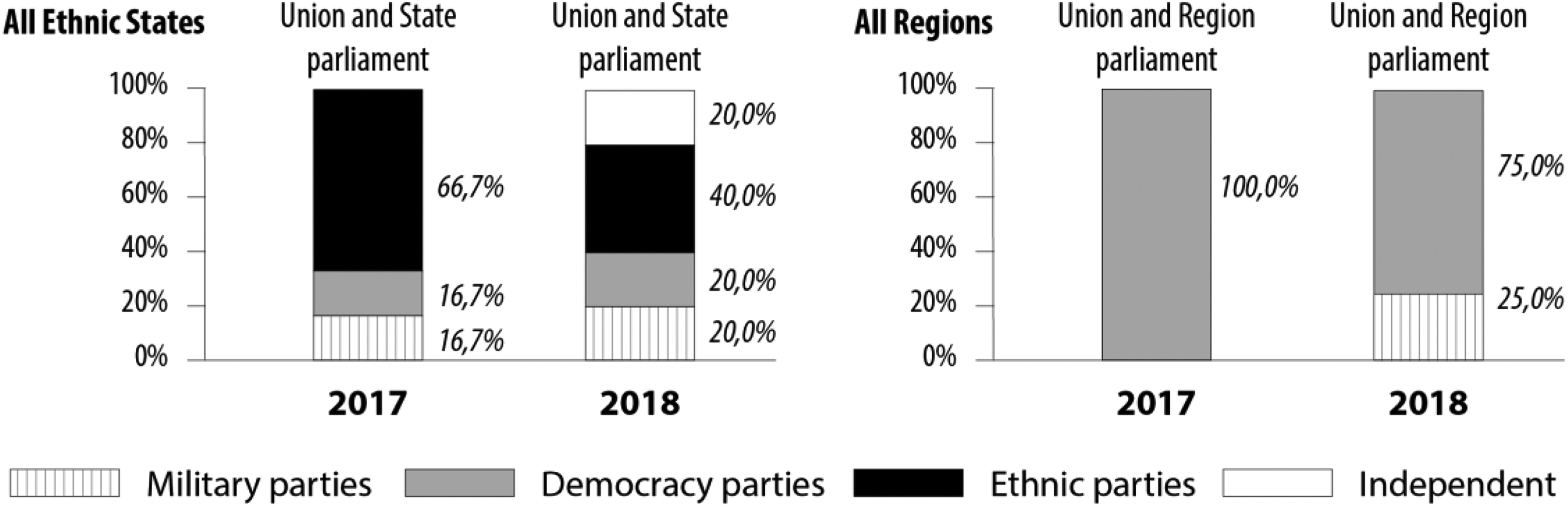
Distribution of parliamentary seats by party types in states and regions, 2017 and 2018 by-elections.
Conclusion
This article has examined the role of political representation by ethnic parties within Myanmar’s new system for formal electoral democracy and parliamentary politics. Based on recent electoral performance, a key finding is that ethnic parties have been relatively ineffective in ensuring formal and descriptive representation for ethnic groups and have thus had limited possibilities for substantive representation of ethnic interests. In this situation, political representation by ethnic parties may so far have played a legitimising role for the new democratic institutions more than providing substantive representation towards democratic deepening and conflict resolution. The article has also identified key explanations for this relatively weak electoral performance of ethnic parties, emphasising party fragmentation and vote-splitting as well as weak party institutionalisation and limited capacity to make representative claims. In preparation for the 2020 election, ethnic party-building initiatives have especially focused on merging parties, but there are also some notable initiatives for organisational and political party institutionalisation. Such party development combined with voter frustrations with the NLD-government may bring electoral gains for ethnic parties at the 2020 election. There are, however, also persistent concerns about the capacity of ethnic parties to make representative claims and provide substantive representation in union and state legislatures. The 2020 election in ethnic states is thus set to be a new open-ended test for how ethnic voters see themselves best represented, in the light of competing representative claims and past experiences with formal and substantive representation: by consolidated ethnic parties or non-ethnic democracy parties?
Footnotes
Declaration of conflicting interests
The author(s) declared no potential conflicts of interest with respect to the research, authorship, and/or publication of this article.
Funding
The author(s) disclosed receipt of the following financial support for the research, authorship, and/or publication of this article: This research has received funding from the European Union’s Horizon 2020 research and innovation programme under grant agreement N°770562 (CRISEA)
Author biography