



Abstract
Since 2011, while the principles of foreign policy “independent, active, and non-aligned” under the respective governments under the Union Solidarity and Development Party and the National League for Democracy have remained the same, the foreign policy approaches – including the concept of non-alignment – of the two leaders of these governments have been quite different. This article describes the survival and foreign policy of the small country of Myanmar beyond the great power lens, arguing that the impact of strategic culture on the two governments since 2011 has differed because of the different levels of legitimacy enjoyed by the two leaders. The cornerstones of Myanmar's strategic culture are (1) that it shall never tolerate foreign interference, (2) that it shall always pursue self-reliance in its diplomacy, and (3) that the very nature of Myanmar is to be independent.
Keywords
Introduction
After its independence from British rule in 1948, Myanmar adopted an independent-neutralist foreign policy both due to its own internal political instability and to avoid the ideological struggle between the capitalist and socialist blocs in the Cold War period. In 1961, Myanmar became a member of the Non-Aligned Movement (NAM), but after a military coup by General Ne Win in March 1962, the military government eliminated the established parliamentary democracy and by 1964 the government was using a one-party system that prohibited the formation of other political parties, and its embrace of an isolationist policy disconnected the country from the outside world. In 1974, General Ne Win won Myanmar's general election and became president (1974–1981). From the 1970s onwards, the government began to rekindle foreign contacts to foster the country's development, but the situation was complicated by the Cold War raging in the background. In 1979, Myanmar withdrew from NAM, and since 1981 the government has pursued an “independent and active” foreign policy. In September 1988, a military coup was staged by the State Law and Order Restoration Council/State Peace and Development Council (SLORC/SPDC) government, which adopted a similarly independent and active foreign policy. After the Cold War, the bipolar nature of the international system disappeared, the United States became a hegemon, and the unipolar international system emerged. The SLORC/SPDC government declared in 1988 that Myanmar would continue to practise an “independent and active foreign policy” (MOFA, 2005). In 1992, Myanmar reentered NAM and the taste for being non-aligned has not diminished. Indeed, the two governments that have led Myanmar since 2011 – first Thein Sein's Union Solidarity and Development Party (USDP) (2011–2016), then Aung San Suu Kyi's National League for Democracy (NLD) (2016–present) – have both practised and reaffirmed this “independent, active, and non-aligned” foreign policy. Myanmar's foreign policy has been characterised at varying points since 1948 by neutralism, isolationism, non-alignment, and an independent but active approach. Both internal and external factors influence Myanmar's foreign policy, and among these, “strategic culture” is the one domestic factor particularly worth noting.
In this article, strategic culture will be considered as an explanatory factor of Myanmar's foreign policy. Since 2011, while the principles of foreign policy under the USDP and NLD governments have remained the same, the foreign policy approaches of the respective leaders of these governments have been quite different. This difference does not necessarily represent a significant change in the country's foreign policy, as both governments have adjusted to, and maintained non-alignment in, the international community. Strategic culture can explain a country's foreign policy as a domestic factor that influences state leaders’ (decision-makers) perception of issues, while systemic stimuli influence others’ perceptions of these decision-makers. Thus, this article will explain Myanmar's foreign policy through the lens of strategic culture.
The present article comprises four parts. First, it provides an overview of the concept of strategic culture, a literature review, and a conceptual framework based on a neoclassical-realist model of foreign policy. Scholars’ definitions of strategic culture and its evolution differ and therefore need to be explored. Second, the article discusses both the sources of Myanmar's strategic culture and its pattern. Third, it explains the impact of strategic culture on the USDP and NLD governments. Finally, the conclusion summarises the findings of this article – namely, that Myanmar's strategic culture is an underlying factor influencing foreign policy decisions made by the leaders of both governments.
Literature Review
A number of scholars have written about various aspects of Myanmar's post-2011 foreign policy. Haacke (2016) states that the principle of non-alignment guided Myanmar's foreign policy under President Thein Sein's government and that “the government's focus on strategic autonomy has been accompanied by efforts to diversify and balance the country's external relationships” (Haacke, 2016). In a short article analysing Myanmar's foreign policy after 2015, Chaw Chaw Sein (2016a) writes that domestic matters have become more important than international matters in the post-election period of the NLD government. In a separate article, Chaw Chaw Sein (2016b) also opines that although Myanmar's foreign policy has changed, its basic principle under the President Thein Sein government has not. Myoe (2016) regards the USDP government's adjustment on foreign policy as leadership-driven and the president as the main actor, with the military (Tatmadaw) as the lead institution. Myoe (2017) writes that although the NLD government maintained the principles of foreign policy, it is different in some ways. Bünte and Dosch (2015) explain Myanmar's political liberation and rebalancing with external actors under President Thein Sein government this way: “The country's liberalisation is a deliberate strategy of the military, whose aim is to achieve economic renewal and a recalibration of foreign relations” (Bünte and Dosch, 2015). In explaining Myanmar's non-alignment choice through the lens of strategic culture, Passeri (2019) explains the traditional beliefs of Myanmar under the parliamentary period and goes on to describe the period from 1962 to 2010. From 2010 to 2019, Myanmar walked the path of non-alignment between the United States and China by hedging.
Scholars who are experts regarding Myanmar's foreign policy have, by and large, not studied its correlation with the country's strategic culture, an article by Passeri (2019) notwithstanding. Since 2011 the approaches of the USDP and NLD governments have differed in how they have pursued non-alignment. This article explores the approaches of the two governments through the lens of strategic culture that demands a position of non-alignment, further fleshing out the concept of strategic culture and showing that the impact of strategic culture is different vis-a-vis the USDP government and the NLD government. This article makes a valuable contribution to the gap in knowledge on Myanmar's foreign policy by seeking to understand both the sources of strategic culture and its correlation with Myanmar's foreign policy. Thus far, most scholars have discussed Myanmar's foreign policy through the lens of a threat or use of force on the part of great powers such as the United States and the (former) Soviet Union. This article intends to describe the survival and foreign policy of a small country such as Myanmar beyond the great power lens, arguing that the impact of strategic culture on the two governments since 2011 has been different in each case because the two leaders enjoy different levels of legitimacy. The approach of each government to the concept of non-alignment has also been different. The cornerstones of Myanmar's strategic culture are (1) that it shall never tolerate foreign interference, (2) that it shall always pursue self-reliance in its diplomacy, and (3) that the very nature of Myanmar is to be independent. Each of these three pillars can be illustrated through three respective, local proverbs: “Self-reliance is the best alliance,” “A patch of grass between two fighting buffaloes cannot survive,” and “[Myanmar is] a tender gourd among the cactus.” This article will address the following two questions: (1) What are the sources of Myanmar's strategic culture? (2) How does the impact of strategic culture play out vis-a-vis the two governments? The investigation will depend on the sources of strategic culture. In this regard, Lantis (2006) identifies myriad sources, such as material and ideational factors; this article will focus on those of a physical, political, and social nature to explain the strategic culture specific to Myanmar, thus bestowing a preferential status on Lantis (2006) as a resource. To understand and explain the correlation between strategic culture and foreign policy, neoclassical realism is the most suitable perspective to adopt. Therefore, the best way to understand this phenomenon is to use the neoclassical-realist model of foreign policy as a conceptual framework.
Strategic Culture in a Neoclassical-Realist Model of Foreign Policy
Considering the view of strategic culture under the neoclassical-realist model of foreign policy and explaining Myanmar's foreign policy through that lens is the most suitable way to understand the influence of elite beliefs. Neoclassical realism views states as the primary units in the international system and, like structural realism, posits the term “polarity” to indicate the number of great powers or major states in a system at a given time. This includes unipolarity (one state), bipolarity (two states), and multipolarity (three or more states). In the international system, polarity refers to the relative distribution of capabilities among the great powers, not the pattern of alliance: “Policy choices are no longer conceived of as a direct product of systemic stimuli; instead, they pass through the prism of the state, which perceives them and responds to them within the institutional constraints of its unique domestic circumstances” (Ripsman et al., 2016: 31). Neoclassical realism highlights the role of independent and intervening variables. Ripsman et al. (2016) explain that neoclassical theorists employ domestic factors as intervening variables, including strategic culture. Strategic culture can control the major actors – the interactions between decision-makers and within society as a whole – as well as the formulation of foreign policy. Based on the neoclassical-realist model of foreign policy, systemic stimuli (international system) are the independent variables that can affect the perception of state leaders. Domestic factors such as strategic culture as an intervening variable can affect the perception, decision-making, and policy implementation in the intervening process. Through the intervening process, the foreign policy response (dependent variable) of state leaders will emerge.
Definition and Evolution of the Strategic Culture
Scholars have defined strategic culture in a number of ways. According to Snyder (1977),
strategic culture can be defined as the sum total of ideas, conditioned emotional responses, and patterns of habitual behaviour that members of a national strategic community have acquired through instruction or imitation and share with each other with regard to nuclear strategy (Snyder, 1977: 8). Booth (1990) defines strategic culture as “a nation's traditions, values, attitudes, patterns of behaviour, habits, symbols, achievements and particular ways of adapting to the environment and solving problems with respect to the threat or use of force.” Moreover, strategic culture defines a country's behaviour on war and peace issues. Accordingly, Klein (1991) defines strategic culture as “the set of attitudes and beliefs held within a military establishment concerning the political objective of war and the most effective strategy and operational method of achieving it” (Klein, 1991).
Examining the evolution of the scholarly concept of strategic culture, Johnston (1995) conceptualises it in terms of three generations: the first generation of strategic-culture scholars, which emerged in the early 1980s, emphasised the different nuclear strategies of the United States and the Soviet Union during the Cold War. These scholars, such as Colin Gray and David Jones, argued that geography, political culture, and historical experiences led to divergent nuclear strategies. In the mid-1980s, the second generation of scholars appeared, describing strategic cultures as emerging from historical experience and not from political and military elites (Johnston, 1995). Emerging in the 1990s, the third generation of strategic-culture scholars “tends to be both more rigorous and eclectic in its conceptualisation of ideational independent variables, and more narrowly focused on particular strategic decisions as dependent variables” (Johnston, 1995). Neumann and Heikka (2005) state that the three generations have not specifically explained strategic culture, as it is “seen as a dynamic interplay between grand strategy, which is understood as a system for formation of statements and the practices of doctrines, civil–military relations and procurement” (Neumann and Heikka, 2005).
Lantis (2006) enumerates many sources of strategic culture, including material and ideational factors, explaining that the potential sources of strategic culture are physical (geography, climate, natural resources, generational change, technology), political (historical experience, political system, elite beliefs, military organisations), and social (myths, symbols, defining texts). Geography, climate, and (natural) resources have been fundamental factors in strategic thinking, and they remain sources of strategic culture. The geographical factor is important to understanding a country's adoption of one particular strategic policy over another: As some countries share borders with several other countries, differing strategic factors play roles vis-a-vis their neighbours – that is, they may face various security dilemmas. The other important sources of strategic culture are general change, technology, and transnational norms: “Both generational change and technology, particularly information and communications technology, can have important ramifications for issues of empowerment and strategic reach” (Lantis, 2002). The development of information and communications technology has allowed individuals and groups to communicate in new and innovative ways, disrupting the notion of distance as an impeding factor. The political institutions and defence organisations of a country are the other sources of strategic culture. The Western liberal democratic pattern has been adopted by some countries but not others. Some are considered mature democracies, while others are undergoing democratic transformation and are in various stages of consolidation. Civil–military relations, military doctrines, and procurement practices may also affect strategic culture. Myth, though often thought of as something unfounded or false, can, alongside symbols, act as a stabilising or destabilising factor in the evolution of strategic-culture identities. The concept of myth can thus be seen as a notion that has been accepted by people throughout history or as the basis of a traditional understanding. Symbols are crucial: “Work on symbols has also suggested that these act as socially recognised objects of more or less common understanding and which provide a cultural community with stable points of reference for strategic thought and action” (Lantis, 2006). Key texts are regarded as an important element that can inform the appropriate strategic thought and action of relevant actors, as “traditional analyses of peace and conflict have long pointed to the influence of such texts throughout history and in different cultural settings” (Lantis, 2006).
Sources of Myanmar's Strategic Culture
Isolationism has been a defining aspect of Myanmar's interstate relations for centuries. Geographically, Myanmar has been protected from foreign invasion by its long coastline and by its high mountain ranges in the east, west, and north. Before 1852, the rulers of the country exerted strong power in domestic affairs and in its limited relations with the outside environment to ensure its security. The mountains serve as natural borders between Myanmar and its neighbours Bangladesh, India, China, Laos, and Thailand. Myanmar is also rich in natural resources: In the latter period of the Konbaung Dynasty, “King Mindon Min (1852–1878), faced with the reality of the British threat, adopted more active diplomacy, sending out missions to various countries and permitting a certain degree of foreign political, economic, cultural, and religious activity” (Myoe, 1993). The king encouraged and adopted a balanced relationship with foreign countries.
When Myanmar gained its independence from British rule in 1948, the parliamentary democracy system was being used. At the end of 1949, U Nu delivered a speech regarding the geopolitical location of the country, and this situation pushed the country towards independence and isolationism: Our tiny nation cannot have the effrontery to quarrel with any power. Take a glance at our geographical position: Thailand in the East, China in the North, India in the West, and stretching southward, Malaya, Singapore and so on. We are hemmed in like a tender gourd among the cactus. We cannot move an inch. (Steinberg and Fan, n.d.)
The U Nu government adopted a neutralist foreign policy, which was outward-looking and allowed the country to participate in international affairs. Myanmar is located between giant countries, such as India and China, and allies of the United States. Due to the competition between the United States and the Soviet Union in the international arena, Myanmar managed its policy-neutral position amidst the rivalry of great powers. In 1950, Kuomintang's (KMT) presence along the Chinese border presented a security problem for Myanmar. However, due to the ideological rivalry between the East and the West, Myanmar adopted a policy of neutralism in a bid to avoid further complicating regional and international conflicts and to prevent external interference in Myanmar's domestic affairs. Geographical factors have contributed to Myanmar adopting a non-aligned approach in its foreign policy.
Myanmar's most predominant religion, Buddhism, and Prime Minister U Nu's socialist model are also contributing factors to the country's path of self-determination on the international stage. The concept of Buddhism had been accepted by the kings since the monarchical period (before the colonial period). The religious dimension was also a source of Myanmar's strategic culture during the parliamentary period (1948–1962). It could be argued that neutralism derives from the Buddhist idea that “the middle path is the best and the only way to the truth” (Samyuktagama, Chapter 12). Moreover, those in power believe that socialism is the most suitable way for Myanmar to be a “welfare state” and that it comprises the middle of the road between the (communist) East and the (capitalist) West
Passeri (2019) mentions that the idea of socialism appeared in the parliamentary period, with the country's need to navigate between Eastern and Western ideologies.
Historical experience is also a source of Myanmar's strategic culture. In the past, U Nu and his partners had the experience of “walking the tightrope between foreign powers in the attempt [to safeguard] the country's survival” (Passeri, 2019: 13). In the early 1930s, U Nu and his associates were involved in anti-imperialist student strikes; later, they were part of the struggle for the country's liberation during the Second World War, where they felt the loss of the country's sovereign status. After the colonial period, Myanmar faced internal political instability; colonial rule and the struggle for independence led to the U Nu government attempting to block external interference into the country's domestic affairs, refusing conditional foreign aid.
Myanmar adopted a parliamentary democracy in 1948. Agreeing to try to solve the problem through diplomatic negotiations, the government of Myanmar brought the KMT border issue to the United Nations (UN), a move proposed by the United States. Myanmar tried to prevent direct interference of the great powers into the country's domestic affairs and sacrificed American aid by maintaining neutrality. On 4 August 1952, U Nu delivered a speech at the Pyitawthar (Union Welfare) Conference that reaffirmed a policy of neutralism. The important elements for the fulfilment of a neutral policy are, in his words, as follows: (1) We must use our own consideration to either support or object to any matter on its own merits. (2) We must establish the friendliest relations with all nations whenever possible. (2) We must accept from any country any assistance for the creation of a welfare state provided such assistance is given freely and does not violate our sovereignty. (4) We must render our utmost assistance to any country which needs it (Myoe, 2020)
At the Asian Socialist Conference in January 1953, the idea of neutrality arises that will later evolve into the NAM, which strongly condemned imperialism and communism. Due to the insurgency problem and the KMT issue, Myanmar's realist view made the need to protect its security paramount. The realist paradigm has shaped Myanmar's worldview such that states are viewed as needing to be self-reliant to survive, while the primary instruments of the state's foreign policy are diplomacy and deterrence.
During the 1950s Myanmar was a member of NAM and adhered to a policy of positive neutralism. In 1961, U Thant, a diplomat from Myanmar, was elected UN secretary-general.“The adoption of a middle path also entailed some difficult decisions, which further uncovered the emergence of a set of strategic preferences capable of affecting Burma's external behaviour” (Passeri, 2019). The U Nu government managed its position between the United States and the Soviet blocs, rejecting the Southeast Asian Treaty Organization led by the United States and the British Commonwealth.
“The politics of statue building in Myanmar has been, however, driven by its particular socio-political context” (Myoe, 2015: 112). During the struggle for the country's independence from the British, nine “martyrs” of Myanmar, including Boyoke (General) Aung San, were assassinated on 19 July 1947. General Aung San was a nationalist, revolutionary, and the founder of the Tatmadaw, who is recognised by the people of Myanmar as the father of the independence movement. For their efforts to found and unify the Burmese empire, the historical monarchs Anawrathta (1044–1077), Bayin Naung (1550–1581), and Alaungpaya (1752–1760) are considered Myanmar's greatest kings, respectively having founded the first, second, and third Burmese empires. While statues of the three kings had been erected by the SLORC/SPDC government, a statue of Aung San was not erected until the parliamentary period. All of the statutes symbolise Myanmar's being a country not dependent on others.
Particular defining texts from Myanmar's history inform the ways in which pertinent actors adopt strategic thought and action. In Myanmar, there are many such treatises, such as Mhan Nam Yarzawin (Glass Chronicle), Loka Niti (Guide for the People); Reja Niti (Guide for the King), Senaga Byuha (which details the art of dispatching and manoeuvring the components of the army), Rajawathathi (which specifies the guidelines and duties for those who serve the king), and Ayedawbon Kyan (Revolution). These texts inform and influence actors (decision-makers) in how they adopt appropriate strategic thought and action. The Loka Niti scripture is part of the Buddhist literature, with chapter 6 detailing the role of kings in terms of how they “enact diplomacy.” The Ayedawbon Kyan, treatises on revolution, explain military strategy and tactics, including how to succeed in war, how to control a rebellion and maintain power, and how Myanmar kings should carry out diplomacy and foreign relations. In the monarchial period, Myanmar kings fought “invaders” from neighbouring countries and never allowed foreign intervention in the empire/country. However, in 1885, Myanmar fell under colonial rule. After gaining independence in 1948, Myanmar feared once again losing its sovereignty. By understanding Myanmar's ancient and more recent history, we can clearly see how the country has come to the strategic culture that it currently follows.
Period of Isolation, Self-Reliance, and Dependence (1962–2010)
After the coup d’état by General Ne Win in 1962, the military government adopted a policy of isolationism. The military discarded the positive neutralism of the parliamentary period and held to strict neutralism. Indeed, the first decade after the military coup by General Ne Win, Myanmar attempted to isolate itself from the outside world. The government thought that this policy would lead to the successful implementation of its social programmes. With the beginning of the Burmese Way to Socialism, “the country increasingly resorted to an autarchic, nationalistic, and inward-looking posture, designated to insulate its unpopular and arbitrary regime from the outside world” (Passeri, 2019: 17). Myanmar became highly suspicious of great powers and especially distrustful of the People's Republic of China (PRC). Myanmar condemned China's support for the Burma Communist Party. Generally, Myanmar felt anxiety around the Cold War, especially in regard to the escalation of the Indochina conflict. Myanmar tried to refrain from becoming involved in the balance-of-power politics. Although the military government took a realist worldview, the government decided that isolationism was the most suitable path for Myanmar. With the authoritarian period coinciding with the country's gradual reduction in participating in the international environment, Ne Win decided to withdraw from NAM in 1979.
However, due to the cultural background, historical experiences, and internal political situation, the concept of non-alignment did not disappear from the political scene in Myanmar. The power of the country was transferred from the Revolutionary Council to the Burma Socialist Programme Party (BSPP) with the announcement of the 1974 constitution as well as the new name Union of Myanmar, as it officially became a socialist country. Although the BSPP government announced in 1971 that it would follow an “independent foreign policy,” the aspect of non-alignment was not announced officially. After 1974, the government increased relations with foreign countries and shifted from isolation to self-reliance.
The military junta under the State Law and Restoration Council (SLORC/SPDC) took place in September 1988, when the SLORC/SPDC declared that it would follow “an independent, active foreign policy.” When the government refused to recognise the NLD's victory in the 1990 election, the international community consequently exerted pressure on the Myanmar government. As a consequence, the legitimacy of the military government was eroded in the domestic arena, but the country's status in the international arena was able to compensate for its domestic failings. In 1992, Myanmar decided to rejoin NAM and has since followed a non-aligned policy, maintaining friendly relations with neighbouring countries. In 1997, Myanmar joined ASEAN, with an eye to regionalism. However, due to the changing international situation and fluctuating regional security after the Cold War period, Myanmar has since accepted constructivism, although a realist perception persists. Soon, the Cold War ended and the United States emerged as a hegemon, as did a rising China. “Myanmar's embrace of regionalism is aimed at fostering and enhancing state security, which is always conflated with regime security and national security in [its] overall perspective” (Myoe, 2006). The SLORC/SPDC government also prevented external intervention in internal affairs, although the government has opened up to the regional and international community. The international community condemned the activities of the military government, and the United States and its allies placed sanctions on Myanmar. Those actions deeply affected the relationship between Myanmar and China, pushing the two countries closer together. China supported the authoritarian regime politically and diplomatically in regional and international forums.
By analysing all of its sources, Myanmar's strategic culture can be seen in the following ways: (1) Myanmar's strategic culture tolerates no foreign interference, (2) Myanmar always pursues the path of self-reliance, and (3) the nature of Myanmar is to be independent. Based on the sources of Myanmar's strategic culture, we now turn to how these sources were applied under the USDP and NLD governments.
Strategic Culture and Foreign Policy of Myanmar After 2011
Former army bureaucrat and prime minister Thein Sein became president in 2011. President Thein Sein's government practised an “independent, active, and non-aligned foreign policy” and made some progress towards becoming a genuine, disciplined, multi-party democratic system in line with the mandates of the 2008 constitution, including making several reforms in internal affairs and reintegrating into the international community. In November 2015, the NLD won in a landslide victory; this time, their victory was upheld. The new civilian NLD government, headed by Aung San Suu Kyi, took power in March 2016. This new government also adopted an “independent, active, and non-aligned foreign policy.” Although the principles of the foreign policy followed by Thein Sein and Aung San Suu Kyi may be the same, the two leaders’ approaches to foreign policy are different in important ways.
Geography
Geography is an important factor in Myanmar's foreign policy. In the twenty-first century, the international system is multipolar, unlike the bipolar system prevalent during the Cold War, and China is rising. After 2011, U Nu's neutralism became active once again as non-alignment. On 27 September 2012, President Thein Sein attended the sixty-seventh session of the UN General Assembly, delivering the following remarks: “Myanmar practises an independent, active, and non-aligned foreign policy and Myanmar's foreign policy actively contributes to international peace and security” (The New Light of Myanmar, 28 September 2012).
Less than one week prior to that, on 21 September 2012, President Thein Sein had attended the ninth ASEAN–China Expo in Nanning, China. On 28 June 2014, President Thein Sein visited China to attend a conference marking the sixtieth anniversary of the five principles of peaceful coexistence, where his remarks were summarised this way: Myanmar's independent, active, non-aligned foreign policy is based on the Five Principles of Peaceful Coexistence, the President noted. Regarding the friendly relations with neighbouring countries, President U Thein Sein stressed Myanmar, China and India share a common border, which is miles long, and that they have been good neighbours for hundreds of years, citing the principles of peaceful coexistence.
1
It was reported in a national newspaper that Aung San Suu Kyi communicated the following sentiment at an official meeting with diplomats from home and abroad in Naypyitaw in April 2016: Clarifying the country's foreign policy, [Aung San Suu Kyi] recalled that since the country regained independence in 1948 it has adopted an independent, non-aligned and active foreign policy direction, dealing closely and warmly with not only neighbouring countries but also the nations of the world. She also pledged that Myanmar would actively participate in [the] regional and international arena while working for its development.
2
Aung San Suu Kyi, who is the foreign minister as well as state counsellor, remarked that Myanmar has taken this foreign policy direction since 1948 and that the country has cultivated cordial relationships with neighbouring countries and participated in both regional and international organisations and fora. With these two leaders mentioning in their speeches how important the geographical factor is to Myanmar's foreign policy, the country collaboratively seeks to maintain friendly relations with neighbouring countries and with those in the international arena. In particular, Myanmar has always considered itself to have paukphaw (“brotherhood”) relations with China.
Wang Yi, the Chinese foreign minister, was the first foreign state official to visit Myanmar under the newly elected NLD government, having come at the invitation of Aung San Suu Kyi. After that, Geng Huichang, Chinese Minister of State Security, visited in July 2016, followed by Song Tao, the head of the Chinese Community Party's International Liaison Department, in August.
State Counsellor Aung San Suu Kyi visited China in August 2016, a pragmatic choice of destination, given China's crucial importance to the stability and security of Myanmar. Myanmar has also rebalanced its foreign relations efforts due to domestic pressure and to seek opportunities in the international arena. In April 2017, President Htin Kyaw visited China at the invitation of President Xi Jinping – the first visit to China of a Myanmar president under the NLD government. In May 2017, State Counsellor Aung San Suu Kyi visited China to attend the Belt and Road Forum for International Cooperation. Recently, in January 2020, President Xi Jinping visited Myanmar as head of state, representing a historic moment for China–Myanmar relations.
Historical Experience
Belief in the prevention of external intervention in internal affairs has been maintained under the USDP government. Myanmar had previously been under the influence of the British for many years. This historical event gave birth to the fear of great-power intervention in domestic affairs. The following is an excerpt from a speech delivered by President Thein Sein at the first regular session of the Pyidangsu Hluttaw on 30 March 2011: The successive governments never came under the influence of any powers. They remained neutral in international relations. They never permitted any foreign troops to deploy within the borders of the Union. They never launched aggression against or interfered in the internal affairs of any other country. And they never posed threats to international and regional peace and security. These points are the pride of Myanmar's foreign affairs policy.
3
President Thein Sein's government followed the aforementioned “non-aligned, independent, and active” foreign policy principles of previous governments. His government has also prevented any great power from interfering in domestic affairs, as did previous governments.
The Rakhine Issue
“The previous Myanmar governments refused to recognise the Rohingya Muslims, making the case that the members of any officially recognised ethnic group must prove that their ancestors had lived in Myanmar before the British colonised the Arakan (Rakhine) area in 1823” (Haque, 2016). On 12 July 2012, President Thein Sein said that “although the Myanmar government has the responsibility for the country's ‘own’ ethnic nationalities, it is impossible to recognise the illegal immigrant Rohingya because they are not citizens” (Win, 2018: 253). In June 2012, three Muslim men murdered a Buddhist Rakhine woman in Ramree Township, Rakhine State; subsequently, ten Muslim men were murdered on a bus by Buddhist people” (Win, 2018: 260). In August 2012, President Thein Sein's government formed a commission to investigate this and other problems in Rakhine State; the commission comprises 27 members whose goal is to investigate “the Rakhine issue” and to advise the government on the strategy most in line with Myanmar's national interests. Myanmar has faced pressure from the international community to grant citizenship or to provide legal protection to the Rohingya. Haque (2016) mentions that “President Obama called on Myanmar to draft new plans to confer citizenship to the Rohingyas, while a number of Western policymakers and analysts have suggested ‘blanket citizenship’ for the Rohingyas in Myanmar” (Haque, 2016). At that time, both President Thein Sein and Aung San Suu Kyi rejected this proposal. Moreover, Myanmar rejected a UN resolution in 2013 intended to push Myanmar to accept the Rohingyas as citizens. Although the USDP government has established friendly relations with all countries, the government has tried to prevent foreign interference into the matter.
Domestic challenges have remained critical issues for the incumbent government, and the Rakhine issue, in particular, has become an important domestic political issue. The NLD government has faced pressure from the international community, including the UN, regarding allegations that the military and security forces violated human rights with counter-insurgency operations in northern Rakhine State following Arakan Rohingya Salvation Army insurgents attacking Myanmar border posts along the border of Bangladesh in October 2016. The Rohingya issue has also impacted the NLD's foreign policy agenda. In 2007, the United States issued sanctions on Myanmar under the military regime because of the military government's lack of democracy and its human rights violations. The United States has also condemned the NLD democratic government for human rights violations. The NLD government sought to internationalise the conflict and, to that end, formed an advisory commission to solve the Rohingya issue, led by Kofi Annan (former UN secretary-general) in August 2016. This commission aims to propose specific actions to promote the well-being of all people in Rakhine State and to give recommendations to Myanmar's government on how best to achieve peace and welfare in Rakhine. After the commission delivered its final report on 25 August 2017, the situation rapidly deteriorated in Rakhine State. Although relations between the United States and Aung San Suu Kyi were cordial before 2016, the human rights violations in Rakhine have led to tension in that relationship.
Elite Beliefs
During the period of the SLORC government, China supported the military government politically, especially regionally and internationally. The Chinese government has maintained its commitment to the Five Principles of Peaceful Coexistence with Myanmar and has stressed the principle of non-interference. Beijing took a chance in deviating from the condemnation of Myanmar on the part of Western countries, becoming the most salient security supporter for Myanmar. Beijing protected Myanmar diplomatically in the international arena, when attempts were made to punish the political inflexibility of the military government. China's diplomatic efforts have led to Myanmar becoming heavily dependent on China. In an attempt to balance China's influence on Myanmar, however, President Thein Sein's government also pursued liberalisation in relations with all countries and international organisations. In September 2011, the government of Myanmar announced that the construction of the Myitsone Dam – a joint project between Myanmar and China, agreed to in 2009 – would be suspended until 2015. The project faced opposition from protesters, civil society activists, and members of political parties in Myanmar. However, the SLORC/SPDC government had simply ignored public opinion. President Thein Sein's decision regarding the suspension of the Myitsone project demonstrates Thein Sein's change in perception of China. Although the USDP government reduced its heavy reliance on China, it maintained good relations with the country. At the same time, the USDP government has reintegrated into the international community. By taking these actions, the USDP government adjusted its foreign policy. On 28 May 2011, President Thein Sein conferred with Chinese President Hu Jintao on matters of mutual interest at the Great Hall of the People in Beijing. Sein is quoted as saying the following about Myanmar's foreign policy: As a UN member, Myanmar will continue to actively cooperate with regional and international organisations including [the] UN. The foreign policy of Myanmar to have friendly relations with its neighbouring nations is fundamental and important. So, Myanmar will continue to have friendly relations with its neighbours. The historical paukphaw relationship has evolved, and it has reached a strategic level. And efforts will be made to further consolidate the friendship between the two countries.
4
After 2011, due to Aung San Suu Kyi's being awarded the Nobel Peace Prize and Myanmar's closer relations with Western countries, Beijing worried that anti-China sentiment might burgeon in Myanmar given China's support for the military regime in the face of Myanmar's transition to democracy. However, Aung San Suu Kyi has pursued friendly relations with China. She chaired the investigation committee for the Letpadaung copper mine project under the USDP government. Although the local people and society of Myanmar opposed it, the committee approved the continuation of the project. In June 2015, before the election, Aung San Suu Kyi visited China as the leader of the NLD party. In August 2016, Aung San Suu Kyi visited China again, this time as a state counsellor. Myanmar has rebalanced its foreign relations to reduce domestic pressures and to seek international opportunities; indeed, it is thought that “since the NLD came to power, [Aung San Suu Kyi has] completely dropped her critical tone of China and presented a reasonably pragmatic outlook in her dealing with the giant neighbour” (Myoe, 2017).
Regarding the Myitsone Dam, Aung San Suu Kyi announced the creation of a new commission to review the dam during her visit to Beijing. She visited the United States in September 2016. She also visited China again on 30 November 2017 as a Special Guest of the PRC, and to attend the Communist Party of China in Dialogue with World Political Parties High-Level Meeting. On 1 December 2017, State Counsellor Aung San Suu Kyi and President Xi held talks in Beijing, and they committed to creating a closer relationship between Myanmar and China.
Political System
Under the USDP government since 2011, the political system of Myanmar has changed from a dictatorship to a democracy, attempting to shape its political culture towards democratic norms. Although President Thein Sein was an army officer under the dictatorship, the government undertook the transition to democracy. Myanmar's foreign policy approach has included integrating itself into the international community. The relations between Myanmar and the United States have notably intensified. US president Obama visited Myanmar in 2012 and 2014 as head of state, which was a historic event under President Thein Sein's government. In 2014, Myanmar assumed the ASEAN chair, another positive result for his government. As expressed previously, during the period of the SLORC government, China supported the military government politically, especially in the regional and international arenas; President Thein Sein's government also embarked on a policy of liberalised relations with all countries and international organisations.
The NLD government is a democratic government with a democratic leader, Aung San Suu Kyi. The NLD government promised to promote and protect the role of the news media in the 2015 Election Manifesto, granting the right of news agencies to gather and publish news on activities of every branch of government (Mangshang, 2018). However, the Myanmar government has faced criticism from internal and external media regarding freedom of the press: “Amongst many controversial laws relating to the freedom of expression, Article 66(d) of the Telecommunications Law has been widely recognised as a retaliatory tool that people in powerful positions have used to harass or threaten those who try to hold them accountable” (Mangshang, 2018). Indeed, the Telecommunications Law has been used by powerful people to suppress or threaten critics. According to a report by the Non-Governmental Organisation Free Expression Myanmar, there were 106 criminal complaints under section 66(d) of the Telecommunications Law from November 2015 to November 2017, eleven during the USDP government and ninety-five under the NLD government. “In addition to the NLD's lack of interest in making substantial amendments to controversial press freedom laws such as 66(d), civil society organisations and the media community have complained about the NLD's inadequate public consultation and cooperation on many issues, including freedom of expression” (Mangshang, 2018).
Conclusion
As a result of this analysis, the trend reflected in Myanmar's strategic culture can be delineated in the following ways: (1) Myanmar's strategic culture tolerates no foreign interference, (2) Myanmar always pursues a path of self-reliance in its diplomacy, and (3) the nature of Myanmar is to be independent. Moreover, the analysis reveals that the pattern of the sources of Myanmar's strategic culture significantly affects how foreign policy has been shaped over the years – indeed, over the centuries. Likewise, the geographic factor, as a source of strategic culture, has greatly influenced Myanmar's foreign policy. The influence of the source of strategic culture, such as historical experience, on the NLD government's decision-making regarding the Rohingya, has, to some extent, diminished. For instance, the USDP government tried to preclude any foreign country from interfering in domestic affairs, as did the previous (SLORC/SPDC) government in regard to the Rakhine issue. However, the NLD government has actually invited foreigners to join the commission working on the issue of the Rohingya. Although both governments have tried to implement Myanmar's democratic system, the NLD government has faced some criticism regarding its democratic norms. Moreover, Aung San Suu Kyi is recognised as a democratic leader by both local and international authorities.
Both leaders have changed their views, especially with regard to China. Since the 2011 transition to democracy, the two governments have been trying to adjust the country's foreign policy to align with the democratisation process, particularly as it concerns China and the United States. Both President Thein Sein and State Counsellor Aung San Suu Kyi changed their tunes on China after they took power. Each leader of Myanmar under the respective USDP and NLD governments visited China before visiting the United States. Although Thein Sein served as an army officer and prime minister under the military regime before 2011, he tried to reduce Myanmar's heavy reliance on China, in contrast to the military government's approach. By contrast, democratic leader Aung San Suu Kyi represented the opposition to the authoritarian regime. Aung San Suu Kyi is seen to favour Western countries and to harbour anti-China sentiments. In practice, relations between Myanmar and the United States and its allies were better under the USDP government, particularly as the Rohingya issue led to a cooling of relations under the NLD government. Although Aung San Suu Kyi is perceived as harbouring anti-China sentiments, relations between Myanmar and China are, in practice, closer under the NLD government than they were under the USDP.
Myanmar's strategic culture is an underlying factor that has influenced foreign policy decisions for both governments. According to the speech of U Nu quoted above, Myanmar in the parliamentary democracy period is akin to the proverbial “tender gourd among the cactus.” Based on the sources of Myanmar's strategic culture, that culture can best be described by the belief that “self-reliance is the best alliance” and by the proverb stating that “a patch of grass between two fighting buffaloes cannot survive.” In conclusion, historical experience (fear of external interference) and the political system (transition to democracy) have both shaped the strategic culture (in terms of, respectively, belief in the prevention of external interference, and belief in democratic norms and rules), developments that have undermined the NLD government. The impact of strategic culture is different under the two governments because of the different levels and sources of legitimacy of the two leaders. Aung San Suu Kyi had already achieved legitimacy in the domestic and international environment before her party took power. Thanks to her legitimacy, she can control the impact of strategic culture. On the contrary, President Thein Sein had to work towards gaining legitimacy as the leader of Myanmar in domestic and foreign eyes because legitimacy had been eroded under the military government (SLORC/SPDC) from which he derived. As a result, President Thein Sein could not ignore the strategic culture factor. In sum, due to the differences in legitimacy between the two leaders, the impact of strategic culture on the two governments has been correspondingly different.
Potential sources of strategic culture.
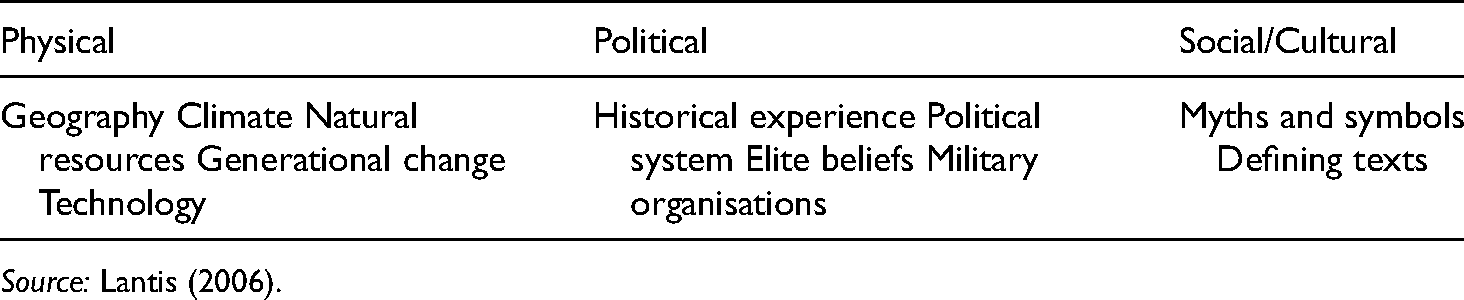
Source: Lantis (2006).
Footnotes
Declaration of Conflicting Interests
The author declared no potential conflicts of interest with respect to the research, authorship, and/or publication of this article.
Funding
The author received no financial support for the research, authorship, and/or publication of this article.