



Abstract
This article is the first account of an overlooked aspect of the Xayaburi Dam, currently under construction in Laos in the mainstream of the Lower Mekong River; namely, the negotiations between Laos and Vietnam. Despite broad consensus among scholars and observers that Vietnam and Laos had diverging interests and preferences regarding the Xayaburi Dam, how Laos went ahead with the project despite Vietnam's explicit opposition to it has so far remained completely uncharted. This article aims to fill this knowledge gap by focusing on the state-to-state level of the Xayaburi Dam and addressing the factors that enabled Laos to pursue its interests prevailing over Vietnam despite the clear power asymmetry that shapes the bilateral relationship. The article concludes that geopolitical factors have limited Vietnam's leverage and its capacity to implement effective countermeasures to prevent Laos going ahead with the construction of the dam and have led to a positive outcome in relational power terms for Laos.
Introduction
On 7 November 2012, Laos organised a ground-breaking ceremony for the 3.7 billion USD Xayaburi Dam on the Mekong mainstream. This specific multibillion-USD hydropower project holds extraordinary diplomatic relevance, as evidenced not only by the large number of newspaper and magazine articles – the search term “Xayaburi Dam” returns more than 60,000 results on Google – but also by the academic research carried out by political scientists, who have focused on the political dimension of the problem – see, in particular, works by Cronin and Hamlin (2012), Thabchumpon and Middleton (2012), Geheb, West and Matthews (2015), Hensengerth (2015), Mirumachi (2015), and Suhardiman, Giordano, and Molle (2015).
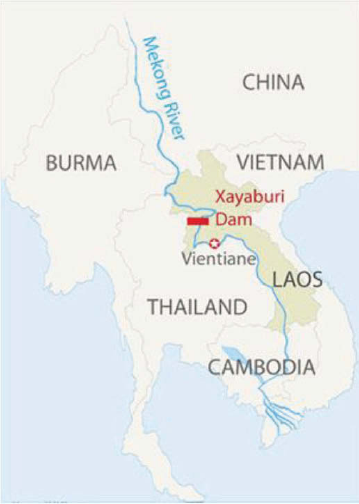
Xayaburi: The First Mainstream Dam in the Lower Mekong
A paper published by the Center for Strategic and International Studies (CSIS) in Washington underlines the fact that “some diplomats and officials in the region have quietly begun to describe the Mekong River as the next ‘South China Sea’” (Phuong 2014: 3). These studies all stress the conflict between the interests of Laos and Vietnam's regarding the dam, but a crucial question remains unexplored: how was Laos able to pursue its interest and in so doing prevailing over Vietnam, one of its closest allies but one far more powerful than itself? The bilateral relationship between Laos and Vietnam is clearly asymmetric. In 2014, according to the Economist Intelligence Unit (EIU), Vietnam's GDP was nearly 16 times that of Laos and its population 13 times larger. Since the end of the Vietnam War in 1975, the two countries have shared a “special relationship” that has built on the 1977 Treaty on Friendship and Cooperation, in which Vietnam is without doubt the stronger party (Pholsena and Banomyong 2006).
The present article assumes that states are unitary and rational entities and, by focusing on the relationship between states, looks at the international diplomatic side of the Xayaburi Dam issue rather than at the environmental, social, economic and legal dimensions. Those are equally important matters but have already been addressed by, among others, Jakkrit (2015), Le (2013), Baran et al. (2011), Rieu-Clarke (2015) and King (2015). Therefore, by focusing on the international dimension of the Xayaburi Dam issue, and thanks to the data collected through a set of 13 intensive semi-structured elite interviews 1 with diplomats, government officers, academics and other stakeholders involved in the Xayaburi project, this article provides first-hand original information, shedding new light on the aspect of the Xayaburi negotiations that have received the least coverage.
The list is available as an appendix at the end of the article.
The remainder of the paper is divided into four main sections. The first section sets the context in which the dam has been planned and in which construction has begun by illustrating Laos's policies related to hydropower development. The second section provides a full reconstruction of the negotiations between Laos and Vietnam, tracing the process at both the bilateral and the multilateral levels and highlighting stakes, priorities and implications. The third section takes stock of the data provided by the previous one in order to interpret and explain the different phases and steps of the negotiations. The fourth and final section systematically analyses the findings to observe the impact in relational power terms.
The Policy Context: The Mekong River as a Key Development Resource for Laos’ “Battery of Southeast Asia” Policy
Laos accounts for the largest share (25 per cent) of the Mekong's drainage basin of 790,000 sq. km (greater than Thailand's 23 per cent and China's 21 per cent) and for 35 per cent of the water discharged into the sea, followed by Thailand and Cambodia (18 per cent), China (16 per cent) and Vietnam (11 per cent). Equally important is Laos's mountainous morphology: thanks to the beneficial elevation of its territory, Laos has high hydropower potential. It is no surprise, therefore, that the country has sought to tap the river's potential in order to increase its exports and improve its poor account balance exploiting the “peace dividends” provided by the end of the conflict in the region that allowed to transform the Mekong from a “Cold War front line into a corridor of commerce” (Bakker 1999: 209).
The interest in hydropower and the related policy of focusing on it to increase the country's exports potential and attract foreign exchange was then conceptualised in the formula of becoming the “battery of Southeast Asia” in the coming decades as a key national strategy (Weatherbee 1997). Therefore, for the Government of Laos (GoL), implementing hydropower facilities became a necessary path towards economic development and poverty reduction 2 and the sector was identified as a priority in order to achieve the Millennium Development Goals, with the aim of graduating from the status of least developed country (LDC) by 2020 (Vongsay 2013). In addition, given Laos's lack of financial resources and technologies, hydropower development concurrently appeared to be a viable method of attracting foreign direct investment (FDI) (Geheb, West, and Matthews 2015). The hydropower sector was a key component in leading Laos's economic growth, as underlined by Hansakul and Wollensak (2012). It is estimated that, together with the mining sector it accounts for some 25 per cent of Laos's economic growth and 15 per cent of its total export revenues (Moungcharoen of the Lao People's Democratic Republic 2013). These fulfilments were made possible by the rapid economic growth of the region, which stimulated a steady increase in demand for electricity among Laos's neighbours. As can be seen in Figure 2 below, the tremendous increase in electricity generation that took place in Laos in 2010 – provoked by the 1075 MW Nam Theun II Dam coming into operation – was almost completely absorbed by exports.
For reference, see the National Policy “Environmental and Social Sustainability of the Hydropower Sector in Lao PDR”, signed on 7 June 2005 by the current Lao Prime Minister, Thongloun Sisoulith (Government of Lao People's Democratic Republic 2005).
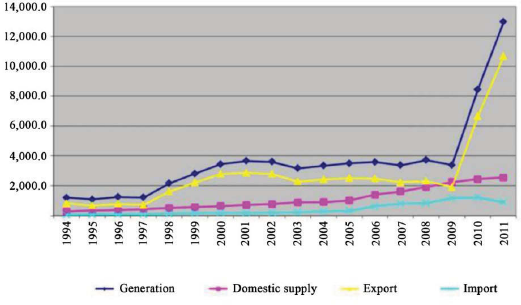
Laos's Electricity Market (MW, 1994–2011)
In this context, it is unsurprising that the Mekong River is at the core of Laos's hydropower policy. The GoL has plans to use the river's unexploited potential to build a cascade of nine mainstream dams that, once operational, will have a total capacity of nearly 10,000 MW, which represents approximately 38 per cent of Laos's total estimated theoretical hydropower potential 26,000 MW (Vongsay 2013).
Thus, these nine mainstream projects combined have enormous economic relevance for the GoL as they are expected to attract some 25 billion USD in FDI and generate 2.6 billion USD of yearly revenues from electricity exports; that is, more than two-thirds of the country's total (Stone 2011, cited in Matthews 2012: 394). However, such projects have been delayed for years as a consequence of their economic and technical complexity and of the uncertainty regarding their environmental impact, which has especially worried the downstream countries of Cambodia and Vietnam. The Xayaburi Dam changed this story, becoming the first mainstream hydropower facility under construction in the lower branch of the Mekong. The next section provides an analysis of the process that led to the official ground-breaking ceremony for the project in November 2012.
Reconstruction of the Laos–Vietnam Negotiations on the Xayaburi Dam
Once completed, the Xayaburi Dam, a 3.8-billion-USD and 1,285 MW power plant currently under construction in the Xayaburi province of Laos, will be the first mainstream dam in the Lower Mekong Basin (LMB). As with general plans for hydropower development in the Lower Mekong, highlighted in the previous section, the origin of the Xayaburi project can be found in the Indicative Basin Plan drafted by the Mekong Committee, the predecessor of the Mekong River Commission (MRC) in 1970. In that plan, the location was “identified as a potential mainstream dam site” (Geheb, West, and Matthews 2015: 112). The GoL dusted off the project in the first few years of the 21st century and appeared to be ready for concrete steps in 2007 when the negotiations and the bidding process took place, leading to a memorandum of understanding (MoU) being signed on 4 May 2007 between the GoL and the Thai construction company Ch. Karnchang, whose proposal won over those of another Thai company and the American AES Corporation (United States Embassy in Vientiane 2007a). In order to build the dam on 22 June 2010, the Xayaburi Power Company Limited (XPCL) was registered in Laos, where the headquarters were established. Three months later, on 29 October 2010 the company signed a build-own-operate-transfer (BOOT) agreement with the GoL, according to which, XPLC, after having built the Xayaburi Dam, would operate it for 29 years from the beginning of commercial operation (that is, until 2048), before transferring the dam to the GoL. 3
All the information regarding the Xayaburi Power Company Limited can be accessed at the company's official website: www.xayaburi.com.
This section presents an analysis of the complex negotiation that took place from that time – until the official ground-breaking ceremony held on 7 November 2012 at the dam site, focusing on the preferences and actions of Laos and Vietnam.
The First Phase: Multilateral Negotiations within the Mekong River Commission
Being a mainstream dam, the Xayaburi project needed to go through the Procedures for Notification, Prior Consultation and Agreement (PNPCA) required by the 1995 Mekong Agreement (Mekong River Commission 1995). Thus, the Xayaburi case became the first in which the MRC applied this six-month long process, which formally began on 22 October 2010 following the submission from Laos one month earlier (Mekong River Commission 2011). As Hensengerth emphasised, “during the following six months, the standard duration of the PNPCA, the four governments were unable to reach a compromise” (Hensengerth 2015: 918). On 15 April 2011, just a week before the end of the six-month period, Vietnam submitted the “Form for Reply to Prior Consultation” to the MRC through the Viet Nam National Mekong Committee (The Socialist Republic of Viet Nam 2011). That document clearly identifies Vietnam's concerns related to upstream dam developments in terms of food and water security for its vital Delta region, stressing that “the Mekong Delta is vital to food and water security and for the livelihood of nearly 20 million people of Viet Nam” and how “upstream hydropower development, especially the mainstream cascade, will present serious threats to the Mekong Delta, in particular saline intrusion, reduced fisheries and agricultural productivities, and degradation of bio-diversity” (Socialist Republic of Vietnam 2011: 2).
The document concludes by appealing to the close friendship between Hanoi and Vientiane and for cooperation among Mekong riparians, which should prevent unilateral benefits and damage to other states. It asserts that:
Viet Nam expects that its requests will be taken thoroughly and seriously into account by Lao PDR in the “Mekong Spirit” 4 and fully in line with all principles set forth in the 1995 Mekong Agreement and the recent Hua Hin Declaration. Viet Nam wishes to reiterate its strongest commitment and full cooperation with other Member Countries, especially Lao PDR, the close friend of Viet Nam, in their respective endeavours toward its own prosperity, but not at the expense of the environmental health of the Basin as well as of other riparian countries. (The Socialist Republic of Viet Nam 2011: 3, emphasis added)
As Mirumachi (2015) underlined, the discourse about the management of the shared water resources of the Mekong “is often associated with the ‘Mekong Spirit’, or the goodwill of the states to work together despite being political adversaries” (Mirumachi 2015: 106).
Four days later, the MRC members attended a special session of the MRC's Joint Committee in Vientiane, in which they recognised the impossibility of reaching an agreement and the need for the issue to be discussed at the ministerial level (International Rivers 2014). As one MRC technical advisor explained in an interview, the various riparian countries had different opinions, which led downstream ones to demand a 10-year moratorium to allow a comprehensive assessment of the environmental risks (Vogel 2011). Vietnam's request for a 10-year moratorium was based on the Strategic Environmental Assessment (SEA) of Hydropower on the Mekong Mainstream, prepared by the International Center for Environmental Management (ICEM) for the Mekong River Commission and published in 2010 (ICEM 2010).
Once the six-month period was over, Laos claimed that the PNPCA was automatically finished (International Rivers 2014). According to a senior researcher, Laos did not see the Xayaburi Dam as a transboundary project and it considered that the PNPCA had forced Laos to do something that it did not want to and that had never happened before. Consequently, the GoL felt that it was already granting considerable concessions (Interviewee 6). Suhardiman, Giordano, and Molle (2015) stressed that “fearing opposition from its downstream neighbors, and from Vietnam in particular as its closest ally (Inter Press Service 2011; Voice of America 2011a), Laos agreed to conduct more studies to assess the dam's environmental impacts” (Suhardiman, Giordano, and Molle 2015: 212).
The Second Phase: Negotiating at the Government Level
So, despite the Laos prime minister's reassurances to his Vietnamese counterpart, Nguyen Tan Dung, during the 18th ASEAN Summit, which was held in Jakarta in early May 2011 (Thanh Nien News 2011), the GoL did not actually stop the project. This became evident shortly after the meeting in Indonesia, since Laos went ahead with its arrangements with the Thai developer, communicating to Ch. Karnchang in June of the same year that the PNPCA process was over and that the project could move forward (International Rivers 2014). This happened even though the compliance report commissioned from Pöyry Energy AG, the Swiss subsidiary of the Finnish consulting company, by the GoL in May 2011 had yet to be released. The GoL had to commission such a report given the divergences – and pressures from downstream countries – that emerged during the PNPCA process and the lack of an MRC mechanism to assess compliance with its standards (King 2015). The report aimed to alleviate downstream concerns and did confirm that the GoL complied with the MRC Design Guidelines and had taken into consideration the comments submitted by the other parties within the Prior Consultation process. However, it also pointed to the need for “adaptations and improvements” related to “sediment transport through the reservoir” and to “fish passing facilities” to be carried out during the construction (Pöyry Energy AG 2011: 9).
In an interview with the author, Hans Guttman, chief executive officer of the MRC from 14 November 2011 for three years, recalled that:
in April 2011, Cambodia asked for more studies and Vietnam for a moratorium of 10 years with respect to the proposed Xayaburi Dam. Thailand's position was unclear, probably it was uncertain. Laos took note of this and discussion followed until the MRC Council meeting of 8th December 2011, where it was agreed to conduct more studies, but in which Vietnam and Cambodia did not change their opinion since they deemed the degree of uncertainty unacceptable. From the perspective of Vietnam and Cambodia the PNPCA process has never been completed, but has been suspended. However, Laos (who considered the PNPCA completed after 6 months) informed Thailand that the process was complete. (Interviewee 4)
On 17 April 2012 Ch. Karnchang publicly informed the Stock Exchange of Thailand that its Lao subsidiary had signed a contract with the Xayaburi Power Company: the “Engineering, Procurement and Construction Contract for the Xayaburi Hydroelectric Power Project” (The Nation 2012). By declaring that the construction had commenced on 15 March 2012, the GoL appeared determined to go ahead with the project. In July 2012, the diplomatic repartee showed a new surge, with Vietnam and Cambodia asking to halt the construction. The Lao Minister of Foreign Affairs said it had stopped but was contradicted by the Ministry of Energy and Mines (MEM) of Laos on the same day. These declarations were followed by a visit to the dam site, organised by the MEM in response to an MRC request, which was attended by some 70 foreign delegates (International Rivers 2014). The last phase of the negotiations, before Laos officially gave the green light to the project, took place in early September 2012. On 7 September, just one day after the Vientiane Times reported that the Xayaburi Dam would have gone ahead (Vientiane Times 2012), the then-president of Vietnam, Truong Tan Sang, intervening at the APEC 2012 CEO Summit in Vladivostok (Russia), defined water as the oil of the 21st century and mentioned Vietnam's recent proposal for getting the Mekong countries to cooperate with Japan in conducting “research on sustainable utilization and development of the Mekong River, including research on the impact of hydro-power dams on the mainstream” (Truong 2012). The Vietnamese president did not mention Laos or the Xayaburi Dam directly but the timing of the speech and his references to upstream Mekong mainstream dams, as well as to the threat to the “largest granary of Vietnam” (the Delta), left very few doubts about the target of his discourse.
Laos Begins the Project
The ground-breaking ceremony for the Xayaburi Dam in Laos, held on 7 November 2012, demonstrated that the GoL's decision to go ahead was anything but easy. In fact, the news came out in the media suddenly on 5 November, while dozens of heads of state were engaged at the ASEM 9 meeting in Vientiane. The next day, Prime Minister Thongsing Thammavong of Laos denied that a ground-breaking ceremony was scheduled, telling the Wall Street Journal that the event was just a visit for the press and for experts and that it did not signal the start of the project (Otto 2012; Vandenbrink 2012). However, this was not the case at all, as the banner prepared for the day made clear. Diplomatic representatives of the neighbouring countries attended the event, including the ambassador of Vietnam, Dr Ta Minh Chau (Latsaphao 2012). Somsavat Lengsavad, deputy prime minister of Laos, who superintended the ceremony, declared that “We had the opportunity to listen to the views and opinions of different countries along the river. We have come to an agreement and chose today to be the first day to begin the project” (Chenaphun 2012).
The report of the event by the state-owned Vientiane Times ran along the same lines, stating that “There has been much conjecture about the project, but the Lao government is now confident it has satisfied all parties with a redesign of the dam, and has undertaken hydrological and fish migration studies” (Latsaphao 2012: 1) and claiming Laos's right to exploit its own resources by building a run-of-river dam similar to many projects developed in the United States and in Europe. The redesign mentioned in the quotation above, as well as in the one below, refers to the changes introduced to the project following the above-mentioned compliance report prepared by Pöyry and can be understood as proof of Laos's willingness to be (and appear) cooperative despite remaining firm in its intention to start construction. According to a subsequent report by Pöyry, the redesign resulted in additional costs of 100 million USD and in changes to the seismic design, a navigation lock to allow fish migration, and the introduction of low-level outlets and turbines to permit sediments and fish to pass through (Schmidiger and Sierotzki 2015).
The Vientiane Times’ article, which can be considered very much equivalent to an official declaration released through the newspaper's pages, concluded that:
the government is now of the firm opinion that the project has been properly and thoroughly researched. Every effort has been made to consider the various processes required to improve the design in order to build a “transparent” dam that will have no impact on the geology of the Mekong. The redesign has been tested and found to be viable through the use of a specially constructed hydraulic model. Friendly countries no longer oppose the dam's construction, and the Lao government is now fully confident about making the decision to go ahead with the project. (Latsaphao 2012: 3)
Laos Pursues its Interests despite Vietnam's Divergent Preferences
The outcome of the negotiations, after Vietnam's public opposition to the dam, seems to have clearly gone in favour of Laos. After all, through the Xayaburi Dam Laos secured its economic-strategic interest by developing one of its few available resources (hydropower), which is considered crucial both for domestic consumption and for export opportunities, in direct contrast to downstream Vietnam's interest in environmental safeguards, which were explicitly linked by Vietnamese officials to food and human security.
In addition to this development constituting an advancement in its national policy of becoming the “battery of Southeast Asia”, Laos, as stressed by the former CEO of the MRC, Hans Guttman,
Expects 150 million USD per year from the concession period of 27 years. Even though official records in 2013 estimated that the revenue would be around 130 million USD, this is a huge amount of money for Laos, higher than the 80 million USD in yearly revenue generated by the Nam Theun 2 Dam. (Interviewee 4)
Here, Guttman is referring a report released by the Ministry of Energy and Mines in 2013, according to which the GoL “expects to earn US$3.9 billion from the Xayaboury dam throughout the 29-year concession period” (Vientiane Times 2013: 21); that is, 134.4 million USD per year.
Therefore, considering all the direct and indirect public statements reported above in relation to Vietnam's standpoint on the Xayaburi Dam, the generally accepted interpretation of the issue is one of Vietnam disagreeing with the dam but somehow inexplicably being forced to accept the fait accompli and Laos's unilateral course of action – see, for instance, Otto (2012) or Herbertson (2013). For some analysts, Laos's decision to move forward had the potential to destabilise the diplomatic ties of the two countries sufficiently to jeopardise the peaceful and prosperous equilibrium that the entire region had finally achieved after decades of war (Cronin and Hamlin 2012).
However, the length and complexity of the negotiation process, along with the economic – and political – interests at stake for the two countries, suggest it is important to critically examine what appears to be a clear-cut diplomatic victory for Laos (supported by the investor country, Thailand, as highlighted by Matthews (2012) and Hensengerth (2015), among others) over the downstream riparian Vietnam (and Cambodia). Hanoi reacted to the ground-breaking by sending the Vietnamese ambassador to Laos to attend the ceremony, and it must also be highlighted that a statement released by Vietnam's Foreign Ministry spokesperson, Luong Thanh Nghi, the next day avoided openly criticising the GoL's decision to go ahead, simply saying in general terms that “he hoped Laos will work with Viet Nam, Cambodia and Thailand in conducting careful and comprehensive research on the cumulative impacts on the environment, economics and society of all hydro-power plants expected to be built on the Mekong River”, apparently accepting the fait accompli (Viet Nam News 2012). However, during the MRC Council meeting of January 2013 in Luang Prabang, Nguyen Thai Lai, Vietnam's Deputy Minister of Natural Resources and Environment, asked for the works on the dam to be halted, eliciting a sharp response from Viraphonh Viravong, who said that Laos would not continue the consultation and that his country had already gone beyond the Mekong Agreement. Viraphonh Viravong put a definitive end to the discussion, stating assertively that “after six months, all you can do is record the difference of opinions and that is the end of the process” (Chen 2013).
Therefore, in order to understand how Laos managed to achieve such a result, an in-depth analysis has been conducted to explore the negotiation process that led to the ground-breaking ceremony summarised above, drawing extensively from the primary data provided by the interviewees, which enabled the author to look behind the scenes and beyond what has already been publicly said by the two sides and reported by public sources. The first purpose of the analysis is to understand how Laos prevailed over Vietnam despite the asymmetry of power. Since the outcome has been known – construction of the Xayaburi project began in 2012 and has never stopped, and the dam is expected to start operations by 2019 – the main unanswered question is how Laos managed to start the project unilaterally, at the same time avoiding strong retaliation from Vietnam or any other strong diplomatic reaction.
Inevitably, the Xayaburi issue falls within the wider bilateral – and asymmetric – special relationship and involves all four members of the MRC and has a regional scope. A senior Lao official illustrates the bigger picture in this regard, which includes four countries: two that have already developed their water resources (Vietnam and Thailand) and two later developers (Laos and Cambodia). Since all the planned mainstream hydropower plants are in Laos and Cambodia, there is no natural harmony of interests (Interviewee 2).
Hans Guttman also confirmed that Vietnam's reaction surprised Laos, which, given its very strong relationship, had anticipated that Hanoi would support its economic development (Interviewee 4). Another Lao official recalled that in private meetings Vietnam always said ‘no’ to the Xayaburi Dam and that even though during official visits Lao and Vietnamese leaders hug and kiss each other, when they move on to Mekong affairs, the atmosphere becomes frosty. “The core of the relationship is still okay, but there is an elephant in the room now that is changing the pattern”, the official said (Interviewee 2).
These interviews accurately define the geopolitical concerns that could lie behind the Xayaburi Dam, as well as its relevance for the Laos–Vietnam special relationship. The quotes above contain crucial implications that will be highlighted below, but the interviewees raise two main points. First, the Xayaburi Dam has much to do with international relations between Laos and Vietnam, to the extent that it can be seen as a test of the bilateral special relationship itself. Second, the issue does not relate exclusively to Laos and Vietnam but is framed and negotiated in a complex geopolitical spectrum where the role of actors such as Thailand and China must be considered. In light of these considerations, the next section will examine the negotiations between Vientiane and Hanoi, showing how the former prevailed, and will also thoroughly assess the implications and role of the broader geopolitical complex.
Analysis of the Negotiations
What Prevented a Stronger Reaction from Vietnam?
After construction began on 7 November 2012, it was possible to observe signals that behind closed doors the issue was being dealt with at the highest level between Hanoi and Vientiane given that – as already stressed – the Vietnamese ambassador in Laos attended the groundbreaking ceremony and that the spokesperson of the Vietnamese Ministry of Foreign Affairs (MOFA), speaking the next day, avoided openly blaming the GoL. Lao leaders at the ground-breaking ceremony declared that all countries were happy with the project, so it is not surprising that it is also shared by a member of the Lao National Mekong Committee (LNMC), who explained how, after the PNPCA and after the project had been redesigned, all countries were happy with the new version, which, for example, added five facilities for the passage of fish. The interviewee added that the project had to be monitored, but there was no problem since members of the MRC were still working together and there were visits to the dam site every three months (Interviewee 3). This was echoed by an official of the Department of Water Resources (DWR) of the Lao Ministry of Natural Resources and Environment (MONRE), who emphasised that transparency and focus on details were crucial elements in reaching a compromise 5 and concluded that “We never thought to leave the 1995 agreement, although American and Vietnamese NGOs published statements that we were close to doing so” (Interviewee 11).
The reference to a compromise contained in this interview, and any following references to a compromise or to an agreement between Laos and Vietnam on the issue, relate to the fact that the two countries avoided a more direct and stronger confrontation on the Xayaburi issue described in this section, and do not indicate any official or specific agreement or deal signed by the two governments.
However, while Lao officials involved in the “Mekong affairs” put the stress on details and transparency, an official of the Ministry of Foreign Affairs (MOFA) of Laos, as well as a consultant close to the Lao Ministry of Planning and Investment (MPI), claimed that the agreement was reached at the highest level. The MOFA representative stressed that a compromise was possible because the Vietnamese government understood Laos's position on the issue to some extent (Interviewee 5). The interviewee here referred to the absolute priority that the GoL had given to the Xayaburi project. In addition to these inputs from Lao officials, similar statements were made by an ambassador of another ASEAN country in Vientiane, who was convinced that after going through the MRC procedure, and after adopting revisions to the dam relating to fisheries and sediments, Vietnam agreed (Interviewee 9). A Vietnamese scientist who worked for the MRC noted that Laos went ahead after representatives of the two countries sat down together and reached agreement, contending that Vietnam said, “You can go ahead but you have to make sure the best mitigation of the impact is put in place and when we have problems you have to cooperate” (Interviewee 13). Significantly, however, in an interview with the author that took place three years after the inauguration event, a senior Vietnamese diplomat explained that
After Laos conducted environmental studies on the impact for fish and the environment more generally, we agreed. It is also relevant that although there are concerns about environmental aspects, all Laos's neighbours are interested in investing. If Vietnam does not invest there are other countries ready to replace us. It is also a fact that people and offices in the North of Vietnam are less concerned than local authorities and people in the South of Vietnam. (Interviewee 12)
The words of the Vietnamese diplomat, who cannot be named, combined with the positions of the Lao sources reported above, corroborate the argument that, despite the divergence of interests between the two countries, at some point before 7 November 2012 they reached a compromise that avoided worsening the dispute and causing further confrontation or conflict to erupt. It is clear from the last passage that the issue was not dominated only by environmental and economic calculations, with various factors, ranging from geopolitical considerations to domestic elements, also informing the negotiations, making it a multidimensional process.
The fact that Vietnam continued to express its concerns after the ground-breaking ceremony – during the MRC Council meeting held in Luang Prabang in January 2013, for instance – could appear to contradict the findings that a compromise was reached. However, the fact confirms the substantial divergence between the preferences of the two states and can be explained by two factors. First, as indicated by former MRC's CEO Hans Guttman, with respect to the evolving understanding of the likely impacts of the Xayaburi Dam, Vietnam may have preferred to save face and keep up appearances: “Vietnam is facing different opinions on the Xayaburi Dam issue”, he said, “but it is difficult to change their position. Although from 2013 the pressure decreased (there were high-level meetings), they cannot explicitly change their position” (Interviewee 4). The second reason can be found in the different views and priorities of different ministries and agencies; the fact that the Xayaburi Dam was the first mainstream dam in the Lower Mekong, and thus the first test of the incompatible interests of the riparian countries, may have created problems for the Vietnamese government. Explaining that Laos was surprised by Vietnam's reaction, Guttman argued that “it is likely that different factions in the Vietnamese government had different opinions but finally the threat to the Mekong Delta was considered paramount”, adding that “it should be noted that although Hanoi had strong words over Xayaburi there was no noticeable reduction in other assistance and cooperation between Laos and Vietnam” (Interviewee 4). For the central government in Hanoi, it was also difficult to push too much against the Xayaburi project because such a position could hardly be viewed as sustainable if one considers that Vietnam's “position to defer mainstream dam development contradicts its ambition to proceed with national hydropower plan (ie, Lower Sesan 2) regardless of its downstream impacts (to Cambodia)” (Suhardiman, Giordano, and Molle 2015: 211) and that Central Highland dams in the country create similar environmental problems (Le 2013; Geheb, West, and Matthews 2015). These two factors explain why, in the MRC, the Viet Nam National Mekong Committee continued to publicly express its concerns without undermining the state-to-state compromise reached by its government with Vientiane.
The next section examines in greater depth the role of the wider geopolitical and strategic context, first by providing an overall assessment and then by focusing on the most important actors.
The Role of the Geopolitical Context
The above analysis points to the fact that the most important factor that prevented Vietnam from taking an even stronger stance on Laos's hydropower project and from reacting in a stronger way can be found in the common history that shapes the Laos–Vietnam bilateral relations that inform Vietnam's long-term foreign policy strategy. It can be noted that Lao officials highlighted in the interviews the virtues of the dam itself, as well as their country's open and transparent behaviour, while the Vietnamese ones underlined factors such as the strength of the bilateral relationship and the capacity to cooperate, the need to face economic competition, and indirect benefits. In this respect, the reference by the Vietnamese diplomat to the need to consider the fact that other countries might “replace” Vietnam as an investor in Laos must not be overlooked. Thanks to the context in which this statement was placed, and especially considering that the same interviewee also explicitly said that the two countries eventually reached a compromise, as well as appealing to their close friendship, it seems that the Vietnamese diplomat's allusion to the problem of competition can be seen not only as the expression of the contingent need to cooperate in spite of Laos's adverse behaviour, but also as a strategic imperative dictated by the common past of the two states (and leaderships), as well as by Hanoi's long-term foreign policy strategy. As is evident from the Vietnamese diplomat's words, with Laos having a great strategic importance for Vietnam, another interviewee suggested that Hanoi could have feared that making too much trouble in the Xayaburi case could have resulted in a less favourable attitude by Laos towards Vietnamese interests and investments (Interviewee 1). Another informant underlined how:
the Xayaburi dam is a perfect case to illustrate both the connection between the two countries and the willingness of Laos to test this partnership. In fact, Laos, with the financial and diplomatic support of Thailand, is going ahead with an infrastructure which might be costly for Vietnam. Nonetheless, Vietnam cannot be too openly critical because of the historical special relationship with Laos and because of the increasing role played by China in the country, especially through massive investment. It means that the Vietnamese government needs to manage its relationship with Laos carefully, also due to the emergence of leaders in the Lao political spectrum who are increasingly closer to Beijing than to Hanoi. 6 (Interviewee 2)
Kingsbury (2017) underlined this potential shift within the Lao leadership.
This point of view is also shared by the Laos historian Martin Stuart-Fox, who, in an interview with Bloomberg News, declared that “from the Vietnamese side, they would have to be very reluctant to put too much pressure on Laos out of concern it would just push them into the arms of the Chinese” (Bloomberg News 2014). In addition, the powerfulness of the bilateral ties must be put in perspective: the combined effect of fears of competition for influence over Laos and the fact that, despite the serious threat posed to the Delta region by the dam, the issue was probably not considered a matter of life or death in Hanoi. As mentioned above, the Xayaburi Dam negotiation process can be seen as difficult but not worth compromising good relations for (Interviewee 10). The relative importance within the broader bilateral ties between Hanoi and Vientiane persuaded the former of the need to appear cooperative, regardless of how reluctantly this was done. Indeed, according to another interviewee, at the end of the consultation phase of the PNPCA process, Vietnam did not agree but preferred to keep a low profile in order to show its goodwill towards a harmonious coexistence (Interviewee 7).
Thailand's Direct Support for Laos
Besides the relative importance of the issue within the GoV's priorities, it is also necessary to consider that while the Xayaburi Dam was not perceived as a vital matter in Hanoi, it had much higher importance for other actors. As pointed out by Associate Professor Ruth Banomyong, head of the Department of International Business, Logistics and Transport at Thammasat University in Bangkok and co-author of one of the rare accounts on Laos's geopolitics, 7 “Vietnam never agreed on the Xayaburi Dam, but could not do much. Other actors had more influence, especially Thailand since it will buy most of the energy produced by the dam” (Interviewee 8). The predominance of Thai interests has also been stressed by Laos's Vice Minister of Energy and Mines, Viraphonh Viravong, who argued: “It would be too expensive for anyone to damage the project. It's like starting a war. The stakes are too high for Thailand” (Janssen 2015). This reasoning refers to the fact, already mentioned above, that the Thai company Ch. Karnchang owns the majority of the shares, Thai EGAT will buy 95 per cent of the produced electricity, and funding is provided mainly by Thai financiers. Thailand has a lot to gain from projects like the Xayaburi Dam. In fact, Thailand's stance on the project was informed by two key national priorities that perfectly match Laos's “battery of Southeast Asia” policy: the internationalisation of hydropower production and the diversification of its energy mix, which is currently dominated by hydrocarbons, with fossil fuels accounting for 98 per cent of the country's primary energy consumption in 2014 (Oxford Business Group 2016). First, the purpose of internationalising the production of electricity from hydropower derives from the strong anti-hydropower social movement inside Thailand and from the fact that the internal potential has already been exploited. Second, Thailand has a particular interest in diversifying its energy mix because it relies on natural gas imported from Myanmar for its electricity production (Matthews 2012; Jakkrit 2015; Cronin and Hamlin 2012).
The already cited work by Pholsena and Banomyong (2006).
In this respect, as the figure below shows, Laos represents a crucial partner for Thailand, considering that all electricity provided to EGAT by countries in the Greater Mekong Subregion (GMS) comes from facilities located in Laos, but also, and more importantly, given the share the Xayaburi Dam will account for.
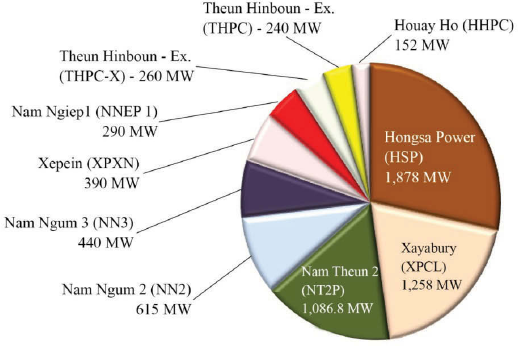
GMS Power Project Sales to EGAT
China's Economic-Strategic Goals
Although China had no stake in the Xayaburi project itself, it is nonetheless a major hydropower developer in the region, had completed four mainstream dams in its branch of the Mekong at the time, and had signed agreements with the GoL for four out of nine proposed Mekong mainstream dams. Besides its role as a potential investor, China can be considered as the “enabling actor” since, as Trandem stressed, “China's own upstream dam construction on the Mekong has helped pave the way for the Lower Mekong mainstream dams to re-emerge on the region's agenda” (Trandem 2011). Therefore, being the first in the mainstream hydropower cascade envisioned by Laos (and Cambodia) in the Lower Mekong, the Xayaburi case was of crucial importance in opening the door for the other 10 planned dams. Beyond China's interest in setting a precedent in the Lower Mekong Basin, the Xayaburi Dam was also highly relevant for Beijing from a strategic point of view. As a Stratfor brief published back in April 2011 stressed:
As Vientiane opened up its economy and accelerated integration with regional markets, especially with Thailand and China […] a rebalancing of Vietnam's strategic influence appears to be under way […] China has welcomed Laos’ expanding cooperation with Thailand, which it sees as helpful in setting a precedent on hydropower and further loosening Laos’ bond with Vietnam. (Stratfor Worldview 2011)
The Overlooked Role of the United States
Vietnam was not alone in its attempt to prevent the building of the Xayaburi Dam. Besides the Cambodian opposition mentioned above, throughout 2012 the United States joined the two downstream Southeast Asian countries (Chang 2013). The US's active opposition to the project emerged clearly when the US Congress passed the Mekong River Protection Act of 2011, instructing the
United States Executive Directors of the World Bank and the Asian Development Bank to oppose the provision of any loan or financial or technical assistance for the construction of hydroelectric dams or electricity transmission systems in the Mekong River Basin unless the Secretary submits a related report providing certain assurances. (US Federal Legislative Information 2011)
This became evident when the GoL went public and declared its intentions to hold a ground-breaking ceremony on 5 November 2012. On that day, the US Department of State released a statement that sharply criticised Laos's decision to go ahead (US Department of State 2012). Washington's opposition can be seen as driven by the intention to support Vietnam (an important partner for the US), and to counter Chinese economic activities in the region. In fact, there is a substantial convergence of interests between the US's “Pivot to Asia” policy and the ever-improving Hanoi-Washington partnership; during a visit to the United States in 2013, Vietnam's president, Truong Tan Sang, stressed that the two countries would cooperate to preserve the Mekong's sustainability (Hutt 2015).
However, the United States is linked to the Xayaburi project by a specific and direct interest that has surprisingly been completely ignored by both media and academic debate on the issue. In 2007, as mentioned above, AES Corporation, an American company headquartered in Arlington (Virginia), competed with another Thai company alongside Ch. Karnchang to try to win the contract for the Xayaburi Dam. These companies enjoyed full support from the US government, according to three diplomatic cables sent by the US embassy in Vientiane between April and May 2007 and later released by WikiLeaks in August 2011 (United States Embassy in Vientiane 2007a; United States Embassy in Vientiane 2007b; United States Embassy in Vientiane 2007c). Of particular relevance is the first cable's mention of the competition between the American proposal, possibly backed by multilateral development banks such as the Asian Development Bank, and the Chinese developer SinoHydro, which was believed to be interested in building all four Mekong mainstream dams planned by the GoL at that time (United States Embassy in Vientiane 2007a). Therefore, it can be argued that the outcome of the AES bid triggered Washington's opposition to mainstream hydropower development in the Mekong because the US might have realised that all the other large mainstream dams were going to be awarded to Chinese or other regional competing developers.
Nonetheless, the analysis of the negotiations and its outcome points out that the US had a limited impact on Laos's decision, arguably because the economic and political ties with Washington are much less intense than those with Hanoi, Beijing and Bangkok.
A Relational Power Analysis of the Xayaburi Case
As seen above, in the case study of the Xayaburi Dam, the outcome appears to be in favour of Laos, despite the clear asymmetry of the bilateral relationship with Vietnam. This section applies an analytical framework to test such conclusion and to observe whether changes of relational power have occurred. The framework builds on the relational conceptualisation of power proper to the Weberian tradition and systematised by Dahl (1957) and draws upon a recent framework of influence developed by Goh (2016) and applied in a collective volume addressing China's actual influence in developing Asia. The framework is articulated in four analytical components designed to carry out a relational power analysis of the Laos-Vietnam negotiation about the Xayaburi Dam and to measure its impact in terms of relational power.
Assessment of Preferences
The previous sections have examined the divergence of interests between the two states, as well as Laos's success,; thus, this paper confirms the thesis, expressed by the vast majority of scholars and analysts, that Vietnam would have preferred a dam-free Lower Mekong River.
Therefore, the main conclusion from the findings presented herein is that the Xayaburi Dam enabled Laos (A) to get Vietnam (B) to do something (accept the construction of the dam) that it would not (in an ideal scenario; that is, following its own preferences informed by national interests) otherwise do. This outcome, according to Dahl's definition 8 of relational power, means that the Xayaburi Dam – the independent variable – had a positive impact on the relational power of Laos in its bilateral relations with Vietnam. The clear opposition of Lao and Vietnamese preferences on the issue leads to the possibility of power to prevail and at the same time as the “potential for establishing causality” (Goh 2016: 12) is strengthened. However, to control the consistency of this conclusion and to appreciate the ways in which this relational power was expressed and materialised, the analytical framework will now be fully applied. First, it will be highlighted that the two conditions of relational power can be identified in the Xayaburi case. Second, the forms of this power will be assessed. Third, absolute gains and costs for the prevailing state will be uncovered.
“A has power over B to the extent that he can get B to do something that B would not otherwise do” (Dahl 1957: 202–203).
Conditions of Power
The above analysis shows how the criterion of a causal relationship between the Xayaburi Dam and the impact in terms of power in the Laos–Vietnam relation – that is, between the actor that is supposed to increase its power and the target – is satisfied. Undoubtedly, the Government of Laos's green light for the project was ultimately the crucial factor causing a change in relational power terms. In other words, the realisation of the dam resulted in an outcome that went against Vietnam's preferences and interests and, thus, in a situation in which Laos prevailed, because of its decision to build it in the first place and then because of all the necessary preliminary tasks (arrangements with Thai stakeholders, MRC procedures) to be carried out in order to reach the goal of building it. With respect to goal attainment, the findings presented in the assessment of preferences above clearly point to the fact that the outcome was consistent with Laos's preferences and against Vietnamese ones. Moreover, Laos, having decided to go ahead with the project, was stuck with its decision from 2007 to 2012 and consistently promoted its goals, pressuring Vietnam to adapt. The analysis of the negotiation process demonstrated that Laos acted cautiously, conscious of its status, but from 2007 never stopped or changed its plans. A clear example of this can be found in the GoL's behaviour in mid-2011 after the PNPCA procedure: it first showed an accommodating attitude when Laos's prime minister assured his Vietnamese counterpart that the Xayaburi project had stopped, but at the same time was undertaking all necessary steps in order to move on with the infrastructure.
Forms of Power
With respect to forms of power, the findings are in line with Goh's (2016) key assumption that, in a power relation shaped by opposing interests, power would take the form of hard power, and coercion would be the most important tool exploited by the prevailing actor, despite the potential coexistence of softer forms of power. Rather than being induced or persuaded to accept the Xayaburi Dam, Vietnam was forced to accept the fait accompli and Laos's unilateral decision to go ahead with the construction despite Vietnam's strong disagreement with the project. Vietnam's opposition is indisputable (as clearly confirmed by the official statements against the dam made within the MRC framework by the Vietnamese president, Truong Tan Sang, just before Laos organised the ground-breaking ceremony, and by the interview with the Vietnamese diplomat reported above). However, despite its attempts to change Laos's plans, Vietnam was forced to comply, mainly by geopolitical constraints, which meant that a stronger reaction towards Laos's plans was not strategically viable. In fact, in refusing Hanoi's requests for a 10-year moratorium, suspending the project until more studies were conducted on its impact downstream, Laos coerced Vietnam into accepting the construction of the dam, displaying hard power. This was also manifested in assertive declarations by Laos leaders, such as responding to Vietnam's further requests to stop the project by rejecting them and saying: “After six months, all you can do is record the difference of opinions and that is the end of the process” (Chen 2013). Therefore, Vietnam was forced to comply in order to avoid the costly consequences signalled by Laos's behaviour. As comprehensively pointed out in the analysis of the negotiations, Vientiane managed to end up in such a coercive position thanks to a skilful (and conscious) mobilisation of the geopolitical resources that could support its hydropower goal.
First, Laos leveraged Thailand's interests (and then its stakes), facing Thai interests and stakes could have been compared to “starting a war”, as Viraphonh Viravong, the Lao Vice Minister of Energy and Mines, put it. Second, as acknowledged by Stuart-Fox and by the interviewed Vietnamese diplomat, leveraging the importance of the special relationship between Laos and Vietnam could, in the light of China's potential competition for influence in Laos, have provoked costly consequences for Hanoi. Lao officials appeared well aware of these constraints, as was made clear in the interview in which a Lao official in the MRC stated: “without China we would have had a very different story” (Interviewee 2).
Moreover, the findings are also coherent with Goh's assumption that, in practice, a combination of coercion, inducement and persuasion is likely to occur, although in the Xayaburi case hard forms of power are preponderant. Laos managed to some extent (the findings prove that it at least tried) to persuade Vietnam by presenting itself as a small and poor country that might only develop its economy by becoming the ‘battery of Southeast Asia’. The presence of this softer form of power clearly emerged in the quote from an official of the Lao National Mekong Committee, who stressed the broader bilateral ties in conjunction with a minimisation of the Xayaburi project's negative impact for Vietnam, suggesting that “a very small fish that might not be able to pass through the Xayaburi Dam” should not compromise the excellent historical ties between the two countries (Interviewee 3).
Outcome
In terms of absolute gains and costs, the balance appears to be clearly in Laos's favour since it secured its main interest of building the Xayaburi Dam and succeeded diplomatically by testing the special relationship, while facing only minor costs, such as the delay of the project caused by Vietnam's opposition (both within the MRC and bilaterally) and the need to revise the original design in order to meet Hanoi's demands, which led to additional costs of 100 million USD. The resulting costs were lower than the gains from pursuing one of the most important national economic policies – that is, becoming a leading hydropower exporter in the region – as well as from the concrete and direct economic benefits that will be generated by the Xayaburi Dam, which will generate around 4 billion USD throughout the 29-year concession period that ends in 2048. In addition, the infrastructure provides potential control over the flow of the river and could therefore become a “weapon” at Laos's disposal.
Conclusion
To conclude, for Laos the Xayaburi Dam negotiation represented a clear success over Vietnam once the distance between the project's economic benefits for Laos and the risks and costs caused to Vietnam are taken into account. The article highlights that geopolitical constraints played a key role in limiting Vietnam's leverage and its capacity to implement effective countermeasures able to prevent Laos going ahead with the construction of the dam. In fact, the analysis of how the broader geopolitical context was intertwined with the bilateral asymmetric negotiations between Laos and Vietnam over the Xayaburi Dam demonstrates that other states had direct or indirect interests in influencing the outcome. However, given that such pressures were not unidirectional – Thailand and China supported Laos, but the United States aligned with Vietnam (and Cambodia) in opposition – Laos has been able to mobilise and leverage such interests in order to achieve its goals despite opposition from Hanoi. The involvement of a plurality of actors in the negotiation provided a source of diplomatic diversification for Vientiane, while for Hanoi this translated into competition for influence in Laos. Finally, the relational power analysis demonstrates that the Xayaburi Dam allowed Laos to increase its relational power over Vietnam, securing its interests despite the divergences and power asymmetry with Hanoi.