



Abstract
It has been nearly 30 years since Vietnam shifted to a multidirectional foreign policy that places greater emphasis on cultivating friends and engaging with the international community. Vietnam has moved from being an isolated country, largely dependent on Soviet aid, to a country that bolsters its standing in bilateral and multilateral forums whilst reaping the economic benefits of greater integration into the global economy. Since the start of the 21st century, China's more assertive posture, along with an increasingly complex, interdependent and multipolar world, has provided Vietnam with a host of problems. This article formulates a definition for a multidirectional foreign policy using Vietnam as a case study and argues that multidirectionalism allows Vietnam to reap economic benefits whilst safeguarding against uncertainty. Furthermore, the article tracks the three principal mechanisms through which Vietnam implements its multidirectional foreign policy: strategic and comprehensive partnerships, trade agreements, and multilateralism.
Introduction
Vietnam's multidirectional foreign policy has its origins in Doi Moi, the economic reforms brought about at the 1986 Sixth Party Congress. After 10 years of economic mismanagement, along with international isolation due to the conflict with Cambodia, the Vietnamese Communist Party (VCP) faced the prospect of “reform or die” (Turley 1993). 1 It, of course, chose the former and initiated Doi Moi. At this pivotal juncture, the VCP shifted its priorities from military strength to economic development and diplomacy. Politburo Resolution 32 in July 1986 called for Vietnam to create favourable conditions for economic development, which included “peaceful coexistence” with China, the United States, and ASEAN (Elliot 2012). This required a peaceful solution to the Cambodian crisis and steps to end Vietnam's isolation. Subsequently, the politburo issued Resolution 13 in 1988, which called for the adoption of a multidirectional foreign policy focused on economic development and creating “more friends and less enemies” (Thayer 2016c). The Seventh Party Congress in 1991 fully adopted this multidirectional foreign policy, which called for the diversification and multilateralisation of Vietnam's relations with countries and international organisations alike (The Communist Party of Vietnam 1991).
This phrase was first uttered by Secretary General Nguyen Van Linh and has often been used since to emphasise the continued need for reform.
As a result, Vietnam significantly bolstered its diplomatic relations, moving from having diplomatic relations with just 23 countries in 1985 to 163 by 1995. It momentously joined the Association of Southeast Asian Nations (ASEAN) in 1995, the Asia-Pacific Economic Cooperation (APEC) in 1998, and applied for World Trade Organization (WTO) membership in 2001. Because of its increased integration into the international community, Vietnam has undergone an economic transformation that has seen consecutive years of high economic growth (approximately 6 per cent), an impressive reduction in poverty, and much-improved living standards. At the time of the Ninth Party Congress in 2001, the VCP elevated Vietnam's multidirectional foreign policy and placed greater emphasis on “proactive integration into international and regional economies in order to maximise the country's strength, autonomy, raise international cooperation and safeguard national interest” (The Communist Party of Vietnam 2001).
The added importance of its foreign policy also coincided with Vietnam's recognition of the profound changes on-going in the international system. In July 2003, the Eighth Central Committee issued Resolution 8, which diverged from Vietnam's traditional friends vs enemies approach. The concept of partner (doi tac) and opponent (doi tuong) emphasised that, within a relationship, areas of cooperation and areas of conflict can operate simultaneously. The resolution also called for a flexible approach to relations (Pham 2011). Since then, Vietnam has started to recognise the integrated international system with other emergent power sources, such as Russia, China and India (Tran 2008). During the 2006 Tenth Party Congress, Vietnam called for “proactive integration into the international economy whilst at the same time expanding international cooperation into other domains” (The Communist Party of Vietnam 2006). The pinnacle of Vietnam's economic integration came in January 2007 when Vietnam became a member of the WTO.
By this time, multidirectionalism had become a key tool for Vietnam to enhance its economic situation whilst maintaining its sovereignty, territorial integrity, autonomy, and independence. The expansion into other domains recognised the need for a broader focus that incorporated aspects other than just economic ones. Between 2006 and 2011, Vietnam took numerous steps to positively engage with the international community. It became a non-permanent member of the UN Security Council in 2008, contributed to the building of the ASEAN Community and ASEAN Charter, and successfully fulfilled its chairmanship of ASEAN and the ASEAN Inter Parliamentary Assembly (AIPA).
In recognition of Vietnam's proactive measures, the Eleventh Party Congress elevated integration to “proactive and positive international integration,” with a key focus on diversity (Nguyen XT 2017). In 2013, the politburo issued Resolution 22, which significantly broadened the scope of “proactive and positive” integration, focusing not only on the economy, but also areas of politics, defence and security, as well as cultural and social fields. Subsequently, Prime Minister Nguyen Tan Dung issued Directive No. 15/CT-TTg, which led to the establishment of a National Steering Committee on International Integration. This included two inter-agency steering committees; one dealt with integration in politics, security and national defence, while the other dealt with culture and society, science and technology, and education and training (Thayer 2016b). Ultimately, Vietnam's multidirectional foreign policy serves its national interest of maintaining a peaceful and stable environment, protecting national independence and sovereignty and boosting Vietnam's position to bolster national construction and defence.
But how do we define a multidirectional foreign policy and what mechanisms has Vietnam implemented to pursue such a policy since it began promoting a proactive and diverse approach to foreign relations? There is little scholarly research that pinpoints a precise meaning of what a multidirectional foreign policy entails. In the present article, I will attempt to contribute to the discourse on multidirectionalism as a foreign policy by synthesising previous research into the matter and formulating a definition using Vietnam as a case study. This could help explain the benefits of such a policy and how it fits into Vietnam's core strategic interests outlined above. Similarly, it can be useful for understanding potential foreign policy strategies for other states seeking to preserve their autonomy, maximise gains, and minimise loses, particularly vis-à-vis asymmetrical relations.
Ultimately, multidirectionalism is a foreign policy that seeks to diversify relationships in order to reap as many political, economic and security benefits as possible, all while hedging against potential threats in an increasingly integrated, multipolar international order. For Vietnam, as a relatively small state with an historically asymmetrical relationship with China, a multidirectional foreign policy is favourable as it prevents the country from either balancing or bandwagoning with one particular state but increases its autonomy and preserves its sovereignty through a broad-based hedging strategy. I will then focus on the three mechanisms through which Vietnam carries out its multidirectional foreign policy – strategic/comprehensive partnerships, trade agreements and multilateralism – and how these three mechanisms allow Vietnam to bolster its national construction and hedge against potential threats.
Multidirectionalism
Multidirectionalism bears several lexical titles: omni-directionalism, multi-vectorism, and diversified foreign policies are notable interchangeable terms. As is the case with Vietnam, small and medium states are the prime adopters of multidirectional foreign policies. Small states frequently use multidirectional foreign policies when dealing with asymmetrical relations. Brantly Womack stated that an asymmetrical relationship is one in which a disparity of capabilities exists between two states, leaving the weaker side more exposed to the stronger (Womack 2016). At the same time, the stronger side is unable to dictate its terms to the smaller state since the smaller side dedicates more resources to resisting the larger state than the larger state is realistically able to dedicate itself. Small and medium-sized states implement multidirectional foreign policies to alleviate some of the threats and potential challenges an asymmetrical relationship may pose. While traditional forms of balancing and bandwagoning are options, they reduce the states’ autonomy, leading them to instead emphasise diversity and integration within their relationships to maximise gains and reduce threats. Thus, states with historical asymmetrical relationships are more prone to have multidirectional foreign policies since this enables them to preserve their autonomy vis-à-vis their larger neighbour.
Another key aspect of multidirectionalism is the evolving nature of a multipolar system that differs sharply from the bipolar system of the Cold War and unipolar system that followed shortly thereafter. The use of force or unilateral action has become increasingly “self-limiting” (Womack 2014). Furthermore, economic growth, energy security, and environmental sustainability has led to an “interest-based, problem-driven, and process oriented” interconnected system that creates a greater need for cooperation (Grevi 2009). For larger states, this means that they find their behaviour increasingly constrained, even though global demands are placed on them for greater leadership when dealing with global, integrated problems. Meanwhile, for smaller states that had traditionally been constrained to the sidelines of great-power politics, a multipolar world has allowed them greater freedoms and platforms to pursue foreign policies that bring them the largest amount of political, security and economic benefits possible.
On the other hand, a multipolar world also means that prevailing uncertainty is prominent (Kuik 2016). The rise of territorial disputes in the South China Sea, as well as across Asia, creates a potential future source of conflict. Financial crises such as the 1997 Asian Financial Crisis, the 2008 Global Financial Crisis, as well as the 2015 Chinese stock market turbulence, highlight the grave economic uncertainties that pose a threat to the economic well-being of smaller states. These states are less capable of riding out the storm created by such financial restrictions. There is also a domestic component to this uncertainty with the rise of value/norm-based foreign policies. In particular, the United States and the European Union have a strong ability to define norms in the international context. Given their economic might, they have considerable leverage in exerting these norms, which can pose a threat to the sovereignty of smaller states that are less resistant to such pressures.
Multidirectionalism can also be a useful policy in pursuing a hedging strategy, which is all the more useful in the multipolar world. Hedging is a form of alignment behaviour but differs from traditional forms of alignment such as balancing or bandwagoning because it allows a state to exhibit both forms of “power acceptance” and “power rejection” (Kuik 2016). In other words, it is a strategy that strikes the middle ground without committing to a larger power. It maximises rewards but mitigates risks and uncertainties.
Given the high stakes and high uncertainty in a multipolar world, states involved in asymmetrical relations must attempt to acquire as many benefits as possible, while also securing alternatives for worst-case scenarios. These policies are often contradictory yet necessary in order to present a stance of neutrality to preserve gains and minimise losses. As will be demonstrated below, Vietnam has skilfully implemented a series of mechanisms that enable it to hedge against potential military, economic, and political threats. However, it has been skilful at ensuring these preventative measures do not inhibit it from gaining from the interconnected, multipolar world. While these mechanisms sometimes appear contradictory and wide-ranging, that is precisely what a hedging strategy is designed to do: maximise benefits and reduce potential risks. Ultimately, a multidirectional foreign policy allows for the successful implementation of a hedging strategy.
Post-Soviet states such as Ukraine, Uzbekistan, Kazakhstan and Azerbaijan have all been proponents of “multi-vector” foreign policies. These are policies that seek to neither “balance nor bandwagon” (Gnedina 2015). Rather, they are tactical manoeuvres that seek to maximise wealth whilst maintaining a degree of autonomy and thus enhance their own bargaining power. Given post-Soviet states’ preferences to avoid becoming over-reliant on Russia, while at the same time maintaining cordial relations, they often seek out further partners in order to give themselves both greater flexibility in dealings vis-à-vis Russia and to attract the economic benefits of major players such as the US, the EU, China and Japan. These multi-vector foreign policies are geared towards ensuring autonomy and a stable environment that encourages economic development. Kazakhstani President Nursultan Nazarbayev has demonstrated the use of such a policy by claiming that a multi-vector foreign policy develops “predictable and friendly relationships with all countries,” creating economic benefits in the process at the same time as minimising security threats (Diyarbakirlioglu and Yigit 2014). Similarly, multi-vector foreign policies are designed to avoid being engaged in a tug of war between two powers.
Thailand is another country that has historically been associated with an omni-directional foreign policy. In 1985, then-Foreign Minister Siddhi Savetsil outlined Thailand's new omnidirectional approach to foreign relations after a decade of preoccupation with the Indochina conflict. Cheow described this foreign policy as a desire to play a more active role on the global stage in order to strengthen Thailand's national and economic security. Thailand sought to strengthen its relations with larger powers, prioritise ASEAN, and link foreign policy to economic diplomacy (Cheow 1986). This foreign policy offered flexibility that accommodated large powers but also maintained a high degree of autonomy in the process, and was geared towards economic growth. As such, Thailand enjoyed good relations with its neighbours and super-powers alike, and reaped considerable economic benefits, at least until the 1997 Asian Financial Crisis (Snitwongse 2001).
Although Japan's present-day foreign policy is more prominent and proportionate to its economic size, the country has historically engaged in what it labelled an “omni-directional foreign policy.” Scholars have described Japan's omni-directional foreign policy during the Fukuda Doctrine as a “simplistic policy, which allows economics to be separated from politics, when it is to Japan's advantage, by maintaining friendly relations with all” (Khamchoo 1991). Meanwhile, Vietnam's current multidirectional foreign policy has been described as the process of forming as many equidistant partners to ensure freedom and protect itself from overdependence on one particular power (Do 2014). Matthias Maass described Vietnam's “multi-dimensional foreign policy” as seeking to link up with all the great powers and major international organisations (Maass 2012).
Weaving together the above descriptions, we can characterise multidirectionalism as a foreign policy in which a state, usually a small or medium power, attempts to play a more active role, which encourages diversity and pragmatism in its relationships to reap as many economic, political and security benefits as possible, at the same time as enhancing its bargaining position, notably vis-à-vis asymmetrical relations. This is a strategy that maximises gains but also guards against the potential pitfalls of uncertainty and future conflict in an increasingly complex, interdependent and multipolar world order. Based on this definition, there are considerable benefits in pursuing a multidirectional foreign policy for Vietnam. Economic development is paramount for the state as it seeks to meet the 2020 development targets it outlined shortly after the 12th Party Congress, which include economic growth rates of 6.5–7 per cent, a GDP per capita of USD 3,200–3,500, and having 80 per cent of citizens covered by health insurance (Quan Doi Nhan Dan 2016). Economic ties are now a focal point of international relations.
In pursuing a multidirectional foreign policy, Vietnam can draw on additional sources of economic growth and avoid becoming overly reliant on a single power for growth. Paramount to promoting sustainable economic development, however, is securing peace and stability and ensuring the protection of Vietnam's national sovereignty and territorial integrity. Given recent events, particularly China's more assertive posturing in the South China Sea, Vietnam's sovereignty and territorial integrity have come under threat. By pursuing a diversified foreign policy Vietnam can draw on the support of various actors, both large and medium-sized powers, in its dispute with China to gain greater leeway. Due to the massive disparity in size, in addition to the desire to rectify the problem peacefully, a diversified approach offers Vietnam greater alternatives in quelling the conflict without jeopardising Vietnamese economic and political relations with its neighbour to the north. Additionally, Vietnam avoids a situation where it becomes sucked into taking sides between an increased US–China rivalry. It can pursue a “multipolar balancing strategy” as opposed to a narrower balancing strategy (Thayer 2015b).
From a security standpoint, increased diversification to foreign relations fits into Vietnam's “three nos” approach to defence; that is: “no military alignment or alliance with any power, no military bases on Vietnamese soil, and no reliance upon another country to counter a third party” (The Socialist Republic of Vietnam 2004). 2 Pursuing a diversified foreign policy via multilateral institutions, as well as strong bilateral partnerships, avoids a situation in which Vietnam is forced to forge a close relationship with any one particular power that might bring this policy into question. Thus, a multidirectional foreign policy fits into Vietnam's strategic objectives of creating a peaceful, stable environment to bolster its standing, both bilaterally and multilaterally, in addition to protecting its sovereignty and territorial integrity. I will now turn my attention to the three mechanisms by which Vietnam pursues a multidirectional foreign policy: strategic partnerships, trade deals, and multilateralism.
The three nos were first mentioned in Vietnam's 1998 White Paper and more formally codified in the subsequent 2004 White Paper.
Strategic Partnerships
Strategic partnerships have proliferated since the turn of the millennium and, like multidirectionalism, a multipolar world has been conducive to their formation. Strategic partnerships are goal-driven rather than threat-driven (Wilkins 2011). They are comprehensive agreements that signify a long-lasting commitment by two actors to establish a close working relationship across a significant number of policy areas and do not invoke the need for an identified threat (Nadkarni 2010). Similarly, they are a bilateral means of deepening cooperation to tackle global problems stemming from non-traditional security threats and to neutralise potential conflict areas. Vietnam has targeted strategic/comprehensive partnerships as a means to elevate Vietnam's relations and its standing in the international system, while taking advantage of cooperation to bolster national defence and construction, maintain peace, stability, and development in the world (Pham BM 2014). These efforts are also not antagonistic and represent Vietnam's commitment to peaceful solutions and cooperation, while also reflecting the country's hedging strategy.
The Vietnamese foreign policy lexicon includes several terms to denote the level and the amount of mechanisms to implement their partnerships. They are, in rising order of depth: comprehensive partnerships, strategic partnerships, extensive strategic partnerships, strategic-comprehensive partnerships and comprehensive-strategic cooperative partnerships (Thayer 2013). The difference in meaning between partnerships is rather blurred and Vietnamese foreign policymakers themselves have yet to come up with a clear definition of each (Le 2013). The content of each partnership varies, with comprehensive partnerships generally being less dense in nature. Since 2001, in coordination with its diverse, integrated, and more proactive foreign policy, Vietnam has established strategic/comprehensive partnerships with 16 different countries and upgraded three existing strategic partnerships to extensive strategic partnerships or strategic-comprehensive partnerships. These agreements are broad, comprehensive agreements that facilitate cooperation across a wide array of areas such as economics, politics, diplomacy, defence and security, science, and culture.
Vietnam's Strategic Partners
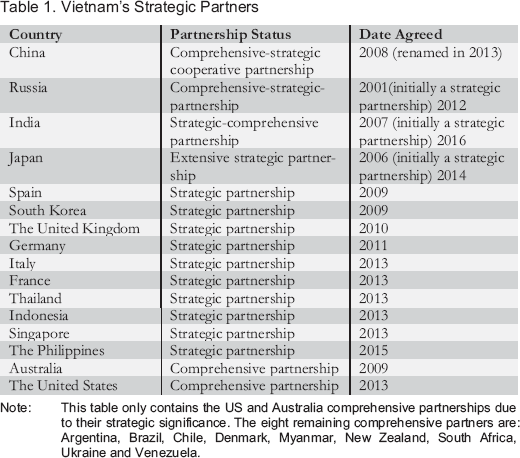
Note: This table only contains the US and Australia comprehensive partnerships due to their strategic significance. The eight remaining comprehensive partners are: Argentina, Brazil, Chile, Denmark, Myanmar, New Zealand, South Africa, Ukraine and Venezuela.
Vietnam currently maintains comprehensive partnerships with 11 countries, most notably the United States and Australia. Australia initially committed to a comprehensive strategic partnership, rejecting the term strategic, in 2009. In 2010, a plan of action was agreed upon to provide a framework within which cooperation could be identified (Australian Government: Department of Foreign Affairs and Trade 2014). Vietnam–Australia relations failed to take-off after this period until March 2015 when Nguyen Tan Dung, on a visit to Australia, witnessed the signing of a Declaration on Enhancing Australia-Vietnam Comprehensive Partnership. The two countries also expressed their view to establishing a strategic partnership some time in the future.
The landmark US–Vietnam comprehensive partnership was agreed in 2013. The partnership outlines five areas of cooperation: maritime capacity building, economic engagement, climate change and environmental issues, education cooperation, and promoting respect for human rights. This partnership confirms Vietnam as a geostrategic player in the region. Although the partnership also contains a clause on human rights, a traditional sticking point of Vietnam–US relations, there was no mention of human rights abuses during Prime Minister Nguyen Xuan Phuc's meeting with US President Donald Trump in May 2017 (Landler 2017).
Vietnam has entered into strategic partnerships with five different European countries. In 2009, after then-President Nguyen Minh Triet's visit, Spain and Vietnam reached an agreement to cooperate with regard to politics, economics, culture and education. Although bilateral trade between Vietnam and Spain reached USD 2.5 billion in 2014, Spanish State Secretary for Foreign Affairs Ignacio Ybanez Rubio admitted that their partnership is yet to reach its full potential (Mussons and Vidaurri 2016). In 2011, Vietnam established a strategic partnership with Germany that was designed to strengthen political, economic and cultural relations and development cooperation. Since 2013 there has been a narrower focus on education and training, energy and the environment (Vietnam Breaking News 2015). Vietnam also signed a strategic partnership with Italy in 2013 in which the two countries strengthened cooperation in areas of politics, global and regional issues, economic relations, development assistance, cultural, education, and scientific and technological cooperation, and defence and security (Tuoi Tre 2013).
Arguably the two most dense and important European strategic partnerships are with the United Kingdom and France. Vietnam and the UK agreed a strategic partnership in 2010 to cooperate in seven key areas: political, global and regional issues, trade and investment, sustainable socio-economic development, education and training, science and technology, security and defence, and people-to-people links (Foreign & Commonwealth Office 2010). Two thousand and fifteen also saw the first visit of a British Prime Minister to Vietnam and, in April 2016, British Foreign Minister Phillip Hammond met with his Vietnamese counterpart to discuss greater cooperation in education, including the establishment of a Vietnam-UK Institute in Da Nang. In June 2016, Minister of Defence Earl Howe met with Deputy Defence Minister Nguyen Chi Vinh to discuss future defence cooperation (Vietnam Plus 2016c). Furthermore, on a visit to Paris in 2013, Nguyen Tan Dung signed a joint statement on a Vietnam–France strategic partnership that aimed to cooperate in the fields of politics, national defence-security, economics and trade, investment, development, culture, education, scientific research, and law (Vietnam Ministry of Foreign Affairs 2013). A state visit by French President Francois Hollande in September 2016 reaffirmed the two countries’ commitment to strengthen relations and cooperation.
Vietnam has signed strategic partnerships with four ASEAN partners: Thailand, Indonesia, Singapore and the Philippines. The first was Thailand in 2013, after Secretary General Nguyen Phu Trong established a strategic partnership with five main pillars: political relations, defence and security cooperation, economic cooperation, social-cultural cooperation, and regional and international cooperation (Vietnam Plus 2013). Almost simultaneously, President Truong Tan Sang visited Indonesia to establish a strategic partnership. As well as improving cooperation in the fields of water, food, and energy security, the partnership aimed to create regular opportunities for dialogue exchanges regarding regional security issues, namely territorial disputes in the South China Sea (Hoang 2013). The fact that Indonesia is not a claimant state, although it has been embroiled in disputes with China regarding excursions into its exclusive economic zone, bolstered Vietnam's support for a peaceful resolution to the issue. In 2013, Singapore and Vietnam signed a strategic partnership to celebrate the 40th anniversary of diplomatic ties. This strategic partnership strengthened cooperation in five key areas: political, economic cooperation, security and defence cooperation, bilateral cooperation, and cooperation in bilateral forums (Singapore Ministry of Foreign Affairs 2013). Vietnam's latest strategic partnership was signed in November 2015 with the Philippines, in which the two countries agreed to enhance political, economic, defence and security, maritime and ocean affairs, scientific and technical, socio-cultural, and multilateral cooperation (Vietnam News 2015b).
In 2009, Vietnam began a strategic partnership with South Korea after then-President Truong Tan Sang's visit to Seoul. The two countries expanded cooperation in politics, science and technology, judicial, economics, trade, and security (Korea Times 2016). These relations were further strengthened economically when Vietnam and South Korea signed a free trade agreement (FTA) that was put into place in December 2015. The two countries also established a ministerial-level joint committee and subcommittees on goods trades, customs, trade defence, sanitary and phytosanitary measures, and technical barriers to trade (Vietnam News 2015a). Japan became the first country to enhance its strategic partnership to an extensive strategic partnership. The declaration contains 69 points and seven areas of cooperation that reflect the two countries’ political trust and deep development of bilateral relations. Building on a memorandum of understanding (MOU) signed between the Vietnamese and Japanese defence ministers in 2011, this strategic partnership created enhanced areas of exchanges for military and defence personnel (Ministry of Foreign Affairs of Japan 2014).
Russia was Vietnam's first strategic partner back in 2001 and in 2012 the two countries upgraded their relations to that of a comprehensive strategic partnership, focusing on seven areas: oil and gas cooperation, energy cooperation for hydro and nuclear power, military equipment and technology, trade and investment, science and technology, education and training, and culture and tourism. Russia's status as Vietnam's biggest provider of military equipment and technology has helped Vietnam modernise and upgrade its navy and military. Vietnam's first planned Nuclear Power Plant, Ninh Thuan-1, was largely financed by Russia and over 300 students studied in Russia in preparation for this project. However, the National Assembly ultimately cancelled this plan in November 2016, citing economic reasons (Vietnam News 2016). Nevertheless, the close cooperation between Vietnam and Russia signalled the depth and degree of cooperative measures in place between the two countries. On a brief visit to Hanoi, Indian Prime Minister Narendra Modi met with his Vietnamese counterpart Nguyen Xuan Phuc and announced the upgrading of the India–Vietnam strategic partnership to that of a comprehensive strategic partnership, an arrangement that Vietnam had previously only held with Russia (Mitra 2014). The visit of Modi also involved a USD 500 million line of credit for defence cooperation, providing a boost to Vietnam's physical military capabilities (Ho 2016).
Given the historical and geopolitical significance of China, a strong friendship is very important. Therefore, the partnership between the two countries was labelled as a comprehensive-strategic cooperative partnership. This partnership was established in 2008 (originally as a strategic partnership that was subsequently upgraded a year later to a strategic cooperative partnership and then renamed to its current title in 2013) and is a “dense network of party, state, defence, and multilateral measures” to support this highly valuable, albeit sometimes strained, relationship (Thayer 2015a). The Joint Steering Committee that was set up by the partnership has met nine times since its inception. This committee contributes to healthy relations by acting as a platform for consensus on a range of subjects. Similarly, Vietnam and China have conducted an annual Border Defense Friendly Exchange since 2014. Vietnam's Deputy Defence Minister Nguyen Chi Vinh hailed the programme on its third border exchange in March 2016, noting its ability to “strengthen mutual political trust” (The Voice of Vietnam 2016).
However, the fourth exchange was abruptly cancelled after territorial issues pertaining to the South China Sea were allegedly raised. According to Carl Thayer, vice chairman of the Central Military Commission, General Fan Changlong asked Vietnamese officials to cease drilling in several areas of the South China Sea, leading a Vietnamese official to strongly defend Vietnam's sovereignty (Thayer 2017). As a result, Fan left Hanoi and cancelled the meeting. The event led to a highly charged diplomatic spat in which China allegedly threatened the Vietnamese ambassador with military force if Vietnam did not stop drilling. Vietnam, wary of its economic dependence on China as well as uncertainty regarding Trump's commitment to the region, appeared to back down (Hayton 2017). This event not only undermined political trust between the two countries but again exposed the contradictions that exist in Vietnam's relations with China.
Ideological loyalty means a close relationship with China is inevitable and falls firmly in line with ensuring the regime's protected values are secured (Vu 2014). Economic dependence also means disputes are best resolved peacefully. However, as shown above, China is the principal threat to Vietnam's sovereignty. Vietnam's strategic objectives are to foster cooperation, economic development and a peaceful environment at the same time as maintaining its territorial integrity. Recent events have brought home the importance of a multidirectional foreign policy and there is no doubt that Vietnam wishes to cooperate with China as much as possible, at the same time as emphasising its friendly relations with all sides so that its objectives are maintained.
Ultimately, strategic partnerships are multi-faceted agreements that deepen bilateral relations. Similarly, they offer a wide range of benefits for Vietnam and its partners, all the way from economic development to greater investment opportunities to enhanced security. It is important to note that strategic partnerships incorporate defence aspects, defence agreements, and areas of security cooperation. These offer Vietnam opportunities to boost its capabilities in a non-threatening way, which allows Vietnam to pursue its objective of ensuring the protection of its sovereignty and territorial integrity without jeopardising its relations with China. In fact, since the 12th Party Congress in January 2016, Vietnam has identified acceleration of its defensive and security cooperation as part of its strategy for integration by 2020 (Vietnam Plus 2016b).
The diverse array of strategic partnerships means that Vietnam is not overly reliant on one particular partner. Carl Thayer stated:
The purpose of strategic partnerships is to promote comprehensive cooperation across a number of areas and to give each major power equity in Vietnam's stability and development in order to ensure Vietnam's non-alignment and strategic autonomy. (Thayer 2016c)
The diversity in its relations also dampens, or at the very least cushions, potential uncertainties and potential areas of conflict. Although Donald Trump's election in 2016 cast uncertainty regarding America's commitment to the region, Vietnamese Prime Minister Nguyen Xuan Phuc will have been reassured by his May, 2017 visit to the White House. The two countries issued a joint statement for enhancing the comprehensive partnership in which they pledged to:
Continue high-level contacts and exchanges of delegations, including through regular dialogue between the U.S. Secretary of State and Vietnam's Minister for Foreign Affairs to discuss measures to enhance the bilateral Comprehensive Partnership. (The White House 2017)
The statement also re-affirmed the importance of FON in addition to both countries commitment to resolving territorial disputes peacefully and in accordance with international law. Given the ability of strategic partnerships to elevate and diversify Vietnam's bilateral relations, providing more autonomy in the process, strategic partnerships represent a mechanism of a multidirectional foreign policy.
Trade Agreements
Since Doi Moi Vietnam has no longer defined security solely as defending national sovereignty and territorial integrity, expanding this concept to that of comprehensive security to incorporate economic, political and social factors as well (Elliot 2012), this has also created social and political stability. Since the 2000s Vietnam has experienced impressive growth rates, with its GDP usually hovering around 6 per cent (Trading Economics 2017). This has also led to a significant drop in poverty, with Vietnam being frequently touted as a success story for poverty alleviation (The World Bank 2013). In 2009, Vietnam became a middle-income country with a per capita GDP over USD 1200 (Nguyen 2015). Economic development is a core strategic interest for Vietnam and a multidirectional foreign policy helps Vietnam to achieve this through trade agreements. Vietnam is also keen to avoid becoming economically dependent on one country, as it had done during the Cold War, when more than 90 per cent of its trade was conducted with the Soviet Union and Eastern European countries (Maass 2012). The Ministry of Industry and Trade has outlined trade agreements as a “platform to further open to the outside, speed up domestic reforms, and serve as an effective approach to integrate into the global economy and strengthen economic cooperation” (The Socialist Republic of Vietnam Ministry of Industry and Trade 2016). Trade deals are a key component of fostering integration, cooperation, and promoting economic growth. They have had and will continue to have a significant impact on Vietnam's development, which will, in turn, contribute towards Vietnamese strategic goals (Abbott, Bentzen, and Finn 2009).
In recent years, Vietnam has put into place numerous bilateral and multilateral trade agreements. This demonstrates that Vietnam has actively and consistently pursued trade agreements that reap significant economic benefits and act as a mechanism for pursuing a multidirectional foreign policy. Vietnam's largest trading partner is currently China, with trade in 2015 valued at approximately USD 95 billion (Vietnam Net 2016). China is also Vietnam's most important trading partner, given its geostrategic location and pure economic size. Since the ASEAN-China FTA was signed in 2000, imports from China have risen from 7.3 per cent to 30 per cent of total imports, and exports have risen from 7.4 per cent to 11 per cent of total exports (Vietnam Country Profile 2017). Vietnam relies heavily on China for the import of the cheap raw materials that contribute to Vietnam's vibrant textile industries. Worryingly, as the vast gap in growth between exports and imports to China shows, Vietnam's trade deficit with China has grown remarkably in recent years. For example, it reached USD 32.3 billion in 2015 (Tuoi Tre 2016).
The lop-sided nature of Vietnam–China trade relations exposes Vietnam to potential unfair trading practices and gives China considerable economic influence over Vietnam (Pham QM 2014). Vietnam does not want to repeat the mistake it made during the Cold War of becoming economically overly dependent on one power. In line with its multidirectional foreign policy, Vietnam is developing trade agreements with other countries to reduce its dependence on China, most notably the US, Japan, South Korea, the EU, Russia, and Central Asian states.
Vietnam's Current Bilateral Trade Agreements
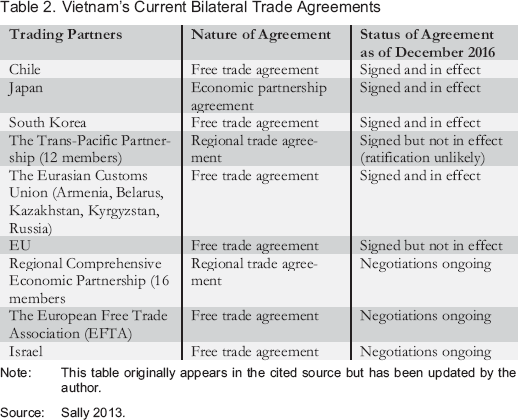
Note: This table originally appears in the cited source but has been updated by the author.
Source: Sally 2013.
During the 2000s, Vietnam's most significant trade agreement was the US-Vietnam Bilateral Trade Agreement, which came into force in 2001 (Office of the United States Trade Representative 2000). After five years, the amount of trade between the two countries increased significantly, diversified Vietnam's exports, and helped pave the way for complete integration when it joined the WTO in 2007. Unfortunately for Vietnam, the recently concluded Trans-Pacific Partnership (TPP) is essentially a dead deal given the US's withdrawal shortly after Donald Trump's inauguration. Vietnam was potentially one of the biggest winners from the TPP. This 12-bloc trade deal would have offered a host of benefits for Vietnam, such as significantly boosting exports, particularly for the clothing industry, and would have helped enforce much-needed structural changes to state-owned enterprises while boosting Vietnam–US trade relations (Bourdreau 2015). In September 2016, Vietnamese Minister for Planning and Investment Nguyen Chi Dung urged outgoing President Obama to ratify the agreement, showing how important a deal it was to Vietnam (Potkin 2016).
Vietnam currently has a trade surplus with the US in excess of USD 32 billion (Lawder 2017). Even after Trump's election, however, Vietnam took the diplomatic initiative to negate any potential backlash from Trump's bellicose statements regarding countries holding a large trade surplus with the US. Vietnam utilised a Washington lobbying firm to seek numerous pathways to Trump, setting up a phone call between Nguyen Xuan Phuc and Trump a month before the new president took office and sending the Foreign Minister Pham Binh Ming on a trip to Washington in April 2017 where he met with Secretary of State Rex Tillerson (Nguyen Mai 2017). Similarly, trade featured heavily on Nguyen Xuan Phuc's May visit to Washington, with the two countries affirming their commitment to promoting bilateral trade.
Nguyen Xuan Phuc has indicated that TPP or not, Vietnam will continue on its path towards increased economic integration and that other trade agreements remain strategically in place (Nguyen 2016). In the months since Trump's withdrawal, there has been vocal support for the TPP to go ahead without the US (Tomiyama 2017). However, Hanoi's response has been mixed; they are reluctant to move ahead without participation from the US, but Vietnam is continuing to proactively engage with the members of the TPP process. In September 2017, ministers from the 11 remaining countries agreed to put in place the preparatory work by November 2017 so they could meet on the sidelines of the APEC summit being hosted in Vietnam (Rowley 2017). Regardless, Vietnam has various trade agreements in place that will supplement any failure of TPP. In fact, Vietnam is a member of the 16-country Regional Comprehensive Economic Partnership (RCEP). RCEP member states account for roughly 3.4 billion people and have a combined GDP of USD 21.4 trillion (Ribka and Yulisman 2016). Negotiations are ongoing and likely to continue for the foreseeable future, leading to greater regional integration.
The EU and Vietnam have pushed ahead with their efforts to put together an FTA, which was achieved in December 2015. Ratification is due in 2017 and implementation scheduled for 2018. The EU is Vietnam's second-largest export market, with exports increasing from 5.59 per cent in 2005 to 29.9 per cent of total exports in 2015 (Delegation of the European Union to Vietnam 2016). The trade agreement will eliminate 99 per cent of all tariffs, along with containing strict rules of origins to allay fears of China using Vietnam as a conduit. In tandem with this, Vietnam and the European Free Trade Association (EFTA) have been holding negotiations to establish an FTA, with the 13th round of negotiations taking place in October 2015. The EFTA has indicated its willingness to recognise Vietnam's market economy status. Currently, WTO members are not required to recognise Vietnam as a market economy, and therefore reserve the right to subject Vietnam to temporary trade barriers (Vietnam-EFTA Joint Study Group 2011). The conferring of market economy status onto Vietnam would bring about significant trade benefits as well as prestige.
The Vietnam EU-FTA does include a clause on human rights. However, with Vietnamese leaders being hostile to accusations of human rights abuses from the EU and generally dismissive of the EU normative power to influence this, there is little perceived threat to domestic interference (Hoang 2016). It is also worth mentioning that this is not the first time the EU has included a human rights clause in a trade deal with Vietnam. Despite much reluctance from Hanoi, the 1995 EU-Vietnam Comprehensive Framework Agreement contained Vietnam's first bilateral treaty to include human rights. The inclusion came about largely due to its political clout, much of which has been on the wane in recent years given the Euro Crises, Brexit and the rise of Eurosceptic parties across Europe (Maass 2012). This is not to say that human rights could not be a sticking point. In fact, Vietnam's heavy-handed response to political dissidents since the 12th Party Congress in 2016 has raised the eyebrows of the EU parliament, and human rights groups, which have lobbied to reject the deal (Hutt 2017).
Similarly, diplomatic relations with Germany – arguably the most influential member of the EU – took a turn for the worse in August 2017. Germany accused the Vietnamese Secret Service of abducting Trinh Xuan Thanh, a former Petro Vietnam Official who fled to Germany after being charged in connection with causing USD 150 million in losses at the state-owned enterprise. Thanh later appeared on Vietnamese TV proclaiming he had come back by his own will but Germany still demanded his return (BBC 2017). If true, this brazen violation of German and international law might not have the power to completely derail the Vietnam–EU FTA but it could certainly strengthen the anti-human rights discourse within EU member states.
Still, multidirectionalism is designed to increase autonomy through diversity; therefore, much like the TPP, the EU–Vietnam agreement is not the be-all-and-end-all trade deal. Japan and Vietnam agreed on an Economic Partnership Agreement in December 2008 and it came into force in October 2009 (Vietnam Customs 2013). This Economic Partnership boosted cooperation in goods, services, investment, business climate improvement, and technical transfer. This agreement also agreed to exempt taxes on 92 per cent of the goods exchanged between the two countries after coming into force. Since the partnership was signed, the amount of Japanese investment into Vietnam has steadily increased with transportation equipment and electric machinery for the manufacturing centre being two of the largest areas of investment. Vietnamese garment industries have also benefited immensely from access to the Japanese market, contributing to Vietnam's rising trade surplus with Japan. The 2013 trade surplus stood at USD 1.8 billion (Vietnam News 2014). Although certain technical barriers to trade do exist, and some Vietnamese products do not satisfy Japanese safety requirements, Vietnam–Japan trade relations have benefited immensely from their Economic Partnership Agreement. With further tariffs scheduled to be cut during the period 2015–2019, more benefits will ensue that greatly contribute to Vietnam's economic development and its economic vitality.
South Korea and Vietnam signed an FTA in May 2015; the treaty was ratified by both countries’ domestic legislatures and came into force in December of the same year. This trade agreement will boost trade and cooperation between the two countries. Trade between them stood at USD 28 billion in 2014 (Vietnam News 2015a). The FTA will increase the competitiveness of Vietnamese exports to South Korea significantly. The trade deal will also work towards cooperation in the following areas: tariff elimination and reduction, investment, intellectual property, customs facilitation, trade safeguards, technical barriers to trade, e-commerce, competition, and institutional and economic cooperation (Tuoi Tre 2015). Given that South Korea is constantly one of the top three investors in Vietnam, the liberalising of trade between the two countries will assist Vietnam's economic development considerably.
After eight years of negotiation, the Vietnam-Eurasia Economic Union Free Trade Agreement (VN-EAEU FTA) was signed on 29 May 2015 (WTO 2016). This trade agreement set a USD 10 billion trade target and will significantly bolster Vietnam's nascent automobile industry, increase cooperation in the oil sector, and stimulate Russian investment into the country. Much has changed since Vietnam relied almost entirely on Soviet assistance during the Cold War. By 1996, Russian investment into Vietnam had fallen to one-tenth of what it used to be. Trade gradually picked up during the 2000s and hit the USD 1 billion mark in 2005 (Mazyrin 2012). Still, trade between the two countries in 2015 represented only USD 4 billion, a meagre amount compared to Vietnam's larger trading partners outlined above (Asia Times 2016). This trade agreement will seek to rectify the lack of Russian investment in Vietnam and ASEAN in general. Russian Foreign Minister Sergey Lavrov has even touted the Vietnam EEU as a “pilot project for Russian trade liberalisation between Russia and ASEAN and adds that Vietnam can act as a bridge to ASEAN” (Tsvetov 2016). Vietnam–Russian trade relations, in addition to relations in general, look set to grow and given Russia's “pivot to the East,” Vietnam can be a leading facilitator in boosting further integration.
Global and regional powers are not the only countries that Vietnam has sought trade agreements with. The Vietnam–Chile FTA came into force in January 2014. Vietnam's first FTA with a Latin American country entails provisions on facilitating market access, rules of origin, sanitary and phytosanitary measures, technical barriers, etc. Vietnam's textile industry, which represented export revenue of USD 18 billion in 2015, received an immediate boost from this agreement after textile exports to Chile received an instant tariff removal (Vietnam Trade Promotion Agency 2017). Other areas that received a tariff cut include seafood, coffee, tea, computers, and computer components. Chile could potentially be the first point of access for Vietnam into a much wider Latin-American market (World Trade Organization Center Vietnam 2011). Vietnam is also currently in negotiations to sign an FTA with Israel (Embassy of Israel in Vietnam 2016), with first round of negotiations held in March 2016. Trade between the two countries stood at USD 1.7 billion in 2015.
Since Vietnam monumentally became a WTO member in January 2007, trade deals have become a prominent part of Vietnam's proactive integration effort. Trade deals bring a host of economic benefits for Vietnam and help it achieve its development goals, provide boosts to its nascent industries, and increase investment into the country. Similarly, trade deals help offset the large trade deficit that Vietnam has accumulated with China during the past century. Importantly, however, they complement Vietnam's strong economic relationship with China rather than supplement it. Trade deals significantly diversify Vietnam's economic outlook, helping it develop further and also preventing it from being overly reliant on any one particular economy for its development. Furthermore, a diverse approach to trade agreements can alleviate the potential problems of normative pressure stemming from trade deals associated with the US and EU. Given the enhanced diversity, vast economic benefits, and ability to prevent Vietnam from being subject to unfair trading practices, trade deals play a prominent role in Vietnam's multidirectional foreign policy.
Multilateralism
Foreign and Deputy Prime Minister of Vietnam Pham Binh Minh has stated that multilateralism deserves to “have a higher place” among Vietnamese foreign policy, adding that “growing globalisation and the emergence of challenges on a global scale has fostered a greater need for countries, both large and small, to put into place multilateral framework” (Thanh Nien News 2016). Multilateralism bolsters Vietnam's voice in international affairs, wins it vital political support, and contributes to the peaceful management of disputes, as well as bringing various economic benefits that contribute to the development of the country. Vietnam's multilateral approach extends into participation in various multilateral organisations. In this section I will focus on Vietnam's role in ASEAN, its enhanced contributions to the UN, its role as APEC Chair, and its participation in the Shangri-La Dialogue. Therefore, multilateralism is a key mechanism of a multidirectional foreign policy.
It is clear that enhanced participation within ASEAN has enabled Vietnam to gain strength in numbers and enhance its capabilities to hedge against China, while also strengthening its proactive and diverse approach to multilateralisation. Evidence of Vietnam's enhanced and proactive role within ASEAN came in its 2010 Chairmanship of ASEAN. During this time, Vietnam also successfully hosted the association's major meetings, including the inaugural ASEAN Defense Ministers’ – Plus Eight Meeting, as discussed below. In addition, it received numerous high-level visits from its Asian partners – Japan, South Korea, and China – as well as the United States. In particular, the visit of Secretary of State Hilary Clinton in 2010 marked the beginning of the US pivot back to Asia with Vietnam and its ASEAN partners playing a fundamental role. Also, during its 2010 chairmanship, Vietnam hosted the sixteenth ASEAN summit meeting entitled “Towards the ASEAN community: From Vision to Action,” which signalled ASEAN's intent to forge a close-knit political-security, economic, and socio-cultural community. This plan of action came to fruition in 2015 with the launch of the ASEAN Community in December 2015. This has strengthened solidarity amongst members, deepened Vietnam's continued successful integration into the organisation, and given both ASEAN and Vietnam a stronger voice, particularly in their dealings with China (Tran 2015). For example, Vietnam has been an active member of the annual ASEAN Chiefs of Navy Meetings, which focuses on fostering cooperation amongst interoperability among ASEAN Navies.
At the heart of the ASEAN community is an ASEAN Free Trade Area. The economic importance of ASEAN is vital for Vietnam as it attempts to reduce its dependence on China and seek diversification in its economic partnerships. ASEAN represents approximately 15 per cent of both imports and exports for the Vietnamese economy (The ASEAN Secretariat 2014). Additionally, with predictions that ASEAN GDP will surpass that of Japan in 2030, there are many economic benefits in addition to the political and security ones (Kikuchi and Lee 2016). On 22 November 2015, ASEAN formally established the ASEAN Economic Community (AEC) as part of its ASEAN Community initiative, focused around four pillars:
A single market and production base,
A highly competitive economic region,
A region of equitable economic development,
A region fully integrated into the global economy. (Dosch 2016)
An ADB report assessing the progress prior to the formations of the AEC stipulated that ASEAN has enjoyed successes in lowering tariffs, liberalising investment and capital flows through signing the Comprehensive Investment Agreement in 2012, strengthening intellectual property rights via the ASEAN Intellectual Property Rights Action Plan 2011–2015, and signing a number of FTAs that signalled ASEAN's further integration into the global economy. However, the report noted that considerable room for improvement exists, particularly in reducing non-tariff barriers, promoting migrant workers’ rights and reducing their labour movement restrictions, fostering greater cooperation amongst members, and reducing the development gap that has constantly plagued ASEAN throughout its history (Balboa and Wignaraja 2014). In general, an ASEAN economic community has the potential to create a deeply integrated and highly cohesive ASEAN economy that could support sustained high economic growth and resilience, even in the face of global economic shocks and volatility. It would bring considerable economic benefits to Vietnam and help alleviate the lop-sided nature of Vietnam–China trade.
Vietnam remains committed to the peaceful management of disputes in the South China Sea, in compliance with UNCLOS, utilising bilateral channels for disputes between two parties, and multilateral channels when disputes involve a third party. ASEAN has provided Vietnam with greater collective diplomatic power in managing the issue, both with China and with claimant states within ASEAN (Shoji 2011). Vietnam became a member of the inaugural ASEAN Regional Forum in 1994 before joining ASEAN in 1995. Despite its latecomer status, Vietnam quickly integrated into the ASEAN community and has become a dynamic member. Its membership is considered a “turning point” in Vietnam's perception of the region and how it viewed the world (Pham 2011).
In November 2002, ASEAN and China agreed the Declaration on the Conduct of Parties in the South China Sea, which strategically committed both ASEAN and China towards a peaceful solution that incorporates the principles of the 1982 UN Convention on the Law of the Sea (ASEAN-People's Republic of China 2002). However, China has largely ignored calls to establish a more binding commitment that restrains and binds China from taking unilateral action in the South China Sea. The need for a binding code of conduct has intensified since 2009 as Chinese assertiveness has increased.
Nevertheless, throughout the 2000s ASEAN successfully implemented a series of “dominance denial acts” that prevented a rising China from asserting its dominance over the organisation, with the added aim of hedging against Chinese behaviour (Kuik 2016). These acts included the inclusion of India, Australia and New Zealand into the East Asian Summit that began in 2005 with the blessings of Japan. The summit was enlarged to include Russia and the US from the sixth summit in 2011, with the US and Russia first participating as guests when Vietnam hosted the fifth Summit in October 2010.
Additionally, China had long been pushing for a China-ASEAN defence minister meeting (ADMM) but ASEAN resisted such overtures and instead created the ADMM Plus Eight, which included Australia, China, India, Japan, New Zealand, South Korea, Russia and the United States. Vietnam hosted the inaugural ADMM-Plus Eight meeting in October 2010 with the objectives of enhancing regional peace and stability, promoting mutual trust, and contributing to the realisation of an ASEAN security community. Still, the China-ADMM has been held informally on the sidelines of the ADMM Plus Eight since 2011 (Singapore Minister of Defense 2016). Additionally, the US has hosted two Defence Forums with ASEAN Defence Ministers. The inaugural US-ASEAN Defense Forum was held in April 2014 in Honolulu after then-US Secretary of Defense Chuck Hagel extended an invitation at the 2013 Shangri-La Dialogue. China certainly made note of this; in October 2015 it hosted a China-ASEAN Informal Defense Ministers’ Meeting for the first time in China. At this meeting, China put forth a five-point proposal to boost security and defence cooperation between the two sides (Parameswaran 2015). October 2016 also saw a US-ASEAN Defense Ministers’ Informal Meeting held in Honolulu (Parameswaran 2016). The simultaneity of these events is worth noting as ASEAN attempts to deepen security cooperation with major powers.
The hedging strategy of ASEAN has led to minor breakthroughs in the organisation's attempts to peacefully manage the South China Sea dispute and establish a code of conduct there. The ASEAN Regional Senior Officials Meeting (SOM) – China meeting in Tianjin in July 2015 saw the establishment of a hotline between their respective foreign ministers in order to quickly and smoothly handle disputes. More recently, progress has been made in setting up a code of conduct (COC) in the South China Sea, with China indicating its willingness to negotiate one since mid-2016 (Thayer 2016a). Following this, China set a deadline for mid-2017 for drafting a framework COC, something that was completed ahead of schedule. In August, China and ASEAN agreed to adopt the framework at the ASEAN Plus 1 meeting in Manila (ASEAN 2017). Although question marks remain regarding whether the COC will be legally binding, the framework will serve as the basis for formal discussions, expected in November 2017 after the ASEAN Plus China Summit meeting.
As part of its efforts to be a more proactive member of the UN, Vietnam set up a Peacekeeping Centre in February 2014 to coordinate, train, and evaluate peacekeeping missions. Shortly after the centre was founded, and for the first time in the country's history, Vietnam sent officials to participate in a UN internal peacekeeping mission in South Sudan (Tuoi Tre 2014). In March 2015, Deputy Minister of National Defence General Nguyen Chi Vinh led a Vietnamese delegation to the first ever United Nations Chiefs of Defence Conference at the United Nation's headquarters in New York. Hervé Ladsous, UN Secretary General for Peacekeeping Operations, noted Vietnam's determination to join peacekeeping operations (Vietnamese Embassy in Australia 2015). At the same event, Vietnam's Permanent Representative to the UN, Ambassador Nguyen Phuong Nga, registered Vietnam for UNSAS, a two-way information sharing system that educates member states and the UN about resources, information, and financial situations in order to smoothly facilitate peacekeeping operations.
By 2017 the number of officers sent on peacekeeping missions had grown to 12, with Vietnam eager to increase the number to 19 by 2018. In fact, the UN has allocated two new positions for Vietnam, allowing one intelligence analyst officer and one military observer to join operations in the Central African Republic as part of Vietnam's attempts to deepen its involvement in peacekeeping operations (Phuong Hoang 2017). Vietnam hopes to set up a field hospital in South Sudan by early 2018. Vietnam has also worked closely with bilateral partners to organise workshops and training for its officers to bolster their skills and preparation for future engagement in peacekeeping operations. In November 2015, Vietnam and France organised a two-day conference to share their experiences in the UN Peacekeeping Operations. In addition, the British Council has been providing English training to Vietnamese peacekeeping officers as part of the Defence Cooperation Memorandum of Understanding between Vietnam and the UK (British Embassy Hanoi 2014). Meanwhile, Vietnam and China signed an MoU on Peacekeeping Cooperation in April 2015 aimed at stimulating further collaboration between the two armies, with numerous meetings on peacekeeping cooperation being held since (Thayer 2016c).
Vietnam has ultimately shown its willingness to proactively engage in UN peacekeeping missions. Its intentions have been backed up by concrete measures, with further deepened cooperation likely. Additionally, Vietnam was elected as a member of the UN Human Rights Council, the UN Economic and Social Council for the second time in its history, the board of governors of the International Atomic Energy Agency, serves as a member of the UNESCO Executive Board (2015–2019), and is seeking to become a member of the UN Security Council in 2020–2021 (Vietnamese Government Portal 2014).
The APEC region represents a vast amount of Vietnam's foreign trade; 80 per cent of FDI comes from APEC countries and Vietnam's trade with APEC countries totalled around USD 146 billion in 2016 (Phuong Ha 2017). After joining APEC in 1998, Vietnam has achieved substantial economic growth and, since 2006, began to be a more active member of the organisation. In 2006 Vietnam was the APEC chair for the first time and it successfully hosted the APEC Ministers’ Meeting. Since then it has hosted various committee chairmanship positions, such as the chairman of the budget and management committee in 2007, vice chairman of the health working group between 2009 and 2010 and chairman of the working group on emergency preparedness in 2012–2013.
Vietnam will host the APEC leaders meeting in November 2017. As chair of the 2017 APEC Summit, Pham Binh Minh attended the 2017 G20 Foreign Ministers’ Meeting in Bonn, Germany. He used the opportunity to call for the adherence to international law and the promotion of multilateralism. He emphasised the need for cooperation in a complex world. He stated that, despite Vietnam's modest resources, it has tried to positively contribute towards international organisations, notably the UN peacekeeping missions and ASEAN, all of which are keys to peacefully resolving disputes (Voice of Vietnam 2017). Minh believes that economic growth has put Vietnam in a better position to contribute more to APEC and its contributions thus far certainly demonstrate the country's commitment to multilateralism. Being the host of the APEC Summit allows Vietnam to demonstrate its commitment to multilateralism and gives it a platform for pursuing its political goals (APEC 2016).
Proactive engagement in regard to security has taken place via the Shangri-La Dialogue. This is an inter-governmental security think tank forum held annually and attended by defence ministers from over 28 states. Vietnam obtained full ministerial status in 2009 and has been proactively engaged in the organisation ever since. Prime Minister Nguyen Tan Dung gave a keynote address at the opening session of the conference on 31 May 2013 in which he called for the need for “strategic trust for the sake of peace, cooperation, and prosperity in the Asian region.” He added that countries, whether big or small, must “build their relations on the basis of equality and mutual respect and, at a higher level” (Nguyen 2013). Ultimately, strategic trust can be fostered through multilateral forums and adherence to international laws and ASEAN's core principle of consensus.
Exactly one year on from Dung's Speech, and in the midst of the HS-981 incident, Defence Minister General Phung Quang Thanh addressed the conference, stating that China must “immediately withdraw its drilling rig” and “join talks with Vietnam to maintain peace, stability and friendship between the two countries” (Vietnamese Government Portal 2014). On the sidelines of the meeting, Thanh also held bilateral meetings with counterparts from the UK, France, and the US. The involved parties called for restraint and respect for international law to ease the on-going tensions. At the 2017 forum, Deputy Defence Minister Nguyen Chi Vinh called on nations to “increase cooperation to settle differences and prevent conflicts” (Vietnam News 2016c). Tran Viet Thai of the Vietnam Diplomatic Academy claimed that this sends a message that Vietnam conforms to the norms of international law (Vietnam News 2016a). Meanwhile, on the sidelines of the 2017 forum, US Defense Secretary Jim Mattis held a meeting with representatives of ASEAN in which they called for greater commitment to the block, particularly through the ADMM Plus framework (Vietnam Plus 2017).
Vietnam's multidirectional foreign policy seeks greater engagement with the international community, whilst at the same time safeguarding its sovereignty and territorial integrity in order to foster national construction. In line with this, Vietnam has sought broader and deeper cooperation at the multilateral level and has taken proactive steps to do this. ASEAN provides Vietnam with a greater political voice vis-à-vis China. Meanwhile, it has also taken steps to enhance its engagement with the UN, APEC, and the Shangri-La Dialogue to help it achieve its national interests. Doing so brings Vietnam political support, economic benefits, and eases security concerns.
Conclusion
Although a lot has changed over the almost 30 years since Vietnam initially instigated its multidirectional Foreign Policy, the country's core strategic interests have not. They remain: maintaining a peaceful and stable environment, protecting national independence, sovereignty, and boosting Vietnam's position to bolster national construction and defence. Political, economic and security measures lie at the heart of these interests. As the world has become increasingly multipolar and integrated, new problems and threats have emerged. Also, the stakes for conflict have never been higher. For Vietnam, the aim of the game is to reduce uncertainty whilst benefiting from globalisation. A multidirectional foreign policy allows the country to mitigate the circumstances of asymmetry by neither balancing nor bandwagoning. Rather, diverse partnerships, enhanced integration, and flexibility allow for states to increase gains and minimise the risk of losses without falling into the orbit of a larger power.
Vietnam implements its multidirectional foreign policy through three key mechanisms: strategic/comprehensive partnerships, trade deals, and multilateralism. The strategic/comprehensive partnerships enhance cooperation bilaterally across a wide array of areas with pivotal partners, providing economic, political, and security benefits. While not always being defence-orientated, a large number of the strategic partnerships include defence arrangements that can counter an assertive China. Again, the benefits of cooperation are reaped and the risks are managed. Trade deals contribute to Vietnam's economic development, by bolstering national construction, support development goals, increase exports abroad, and attract investment into Vietnam. Maintaining a diverse portfolio of trade agreements also reduces dependence and reduces the economic leverage that China maintains over Vietnam. Meanwhile, multilateralism enhances Vietnam's bargaining power, particularly in relation to China, creates greater cohesion amongst ASEAN members, and brings immense economic benefits. Being proactive in ASEAN also enables Vietnam to safeguard the policy of non-intervention: which provides comfort to the regime.
Vietnam remains committed to ensuring a peaceful international environment that allows for cooperation in dealing with today's highly complex, integrated problems, further economic development, and the peaceful management of disputes. China's recent assertiveness has injected greater importance into Vietnam's multidirectional foreign policy, given the asymmetries that exist in Vietnam–China relations. A multidirectional foreign policy offsets problems associated with such a relationship. Given Vietnam's strong determination not to be overly reliant on any one power or be drawn into a bipolar conflict, it is easy to see why Vietnam continues to pursue a multidirectional foreign policy. However, challenges still lie ahead. Question marks arise as to whether America is fully committed to the region as it was under Barack Obama, particularly given the unpredictability of American foreign policy under Donald Trump. At the same time, the Philippines has firmly re-orientated itself into China's orbit, along with Malaysia. The on-going problems in the Euro-zone have reduced its cohesion and pose significant questions to the limits of regionalisation. This makes Hanoi nervous, as it could potentially play into China's hands. Yet, given that a multidirectional foreign policy has served Vietnam so well since it emerged from Doi Moi, we should expect little change in the country's foreign policy any time soon.