



Abstract
This article assesses the knowledge of, attitudes towards, and aspirations for ASEAN among Thai university students, who are set to enter the ASEAN Community labour market and are among those most in touch with ASEAN issues. It uses data obtained from a countrywide survey and focus group discussions to identify variables that affect knowledge, attitudes, and aspirations and to explore the relationships between knowledge, attitudes, and aspirations. The quantitative analysis conducted here uses students’ fields of study, academic performance, and exposure to both ASEAN-related courses and also information and discussions about ASEAN in the mass media and public forums as predictors of their level of knowledge about ASEAN. The paper's results confirm that positive attitudes towards ASEAN lead to positive aspirations for ASEAN. They also reveal that significant knowledge about ASEAN cannot, in isolation, adequately explain students’ attitudes towards ASEAN and does not always lead to positive attitudes. These findings and those obtained from the focus group discussions suggest that a high level of knowledge and understanding of fellow ASEAN member countries and their people – whether attained through formal or informal education or social interaction – is needed for students to develop positive attitudes and become aspiring members of the ASEAN Community.
Introduction
This article 1 assesses Thai university students’ knowledge of, attitudes towards, and aspirations for ASEAN. University students are in a process of forming their political and social identities, and universities facilitate this process through the provision of formal education and information. Using data obtained from a countrywide survey and focus group discussions, we identify variables that affect knowledge, attitudes, and aspirations and explore the relationships between knowledge, attitudes, and aspirations.
We would like to thank the reviewers and the editors for their time and valuable comments, and Dr. Nuntana Siraprapasiri for her wonderful suggestions on the statistical data analysis. The authors would also like to thank Thailand Research Fund (TRF) for their generous financial support.
As the launch of the ASEAN Community (AC) on 31 December 2015 drew near, there was much hype surrounding the question of what benefits or changes it would bring. Originally established to respond to the challenges within the Cold War context, ASEAN soon realised that it was no longer equipped to face the dynamics and increasing competition of today's globalised world. Challenges like the 1997 Financial Crisis, which hit the Asian Tigers, and the rise of China and India prompted ASEAN to rethink its mission of maintaining peace and stability within Southeast Asia. Consequently, at the Ninth ASEAN Summit in Bali in October 2003, members agreed that ASEAN should deepen its integration through the creation of the AC, which would be based on three pillars: the ASEAN Economic Community (AEC), the ASEAN Political-Security Community (APSC), and the ASEAN Socio-Cultural Community (ASCC). Member states also agreed that a regional identity was necessary to forge a closer cooperation not only among member states but also among ASEAN's 600 million people. ASEAN's community-building and identity-building activities are in line with the vision of “a community of caring societies, conscious of its ties of history, aware of its cultural heritage, and bound by a common regional identity” indicated in the Roadmap for an ASEAN Community (ASEAN 2013), which was declared at the 14th ASEAN Summit in Cha-am, Thailand, in 2009. This vision is also expressed in other ASEAN documents, such as the ASEAN Plus Three Cooperation Work Plan 2007–2017 2 and ASEAN's Vision 2020.
See online: www.mofa.go.jp/region/asia-paci/asean/conference/asean3/plan0711.pdf (12 November 2013).
One of the most common questions is how the AC will differ from ASEAN as a regional cooperation. Has ASEAN finally moved towards becoming a semi-supranational organisation similar to the European Union? According to Karl Deutsch et al. (1957: 36), community building is a process by which a group of people develop shared values and understandings to the point where a “we feeling” is shared by its members. By community “members,” we are referring to all people within a society. Knowing is to understand and embrace differences as well as to respect cultures outside one's own political community. It is through this process of interaction that a common identity is constructed. Identity is simply a matter of asking “Who am I?” Collective identity refers to the idea that a group of people feel a sense of solidarity based on commonalities, such as norms and cultural aspects. For any regional or international cooperation to become a community, it must successfully integrate not only its member states but also the people of the region. There should be a certain level of collective identity that makes people feel not only that they are true stakeholders in the cooperation but also that the well-being of others in the cooperation is as important as their own. Therefore, it is crucial to increase our understanding of public sentiment – that is, how people perceive the idea of creating a community and how they believe they will be affected by the process.
Contemporary debates concerning integration and identity tend to focus on norms and practices amongst ASEAN's elite. Acharya (esp. 2005, and 2001, 2009) argues that regional identity building is in fact underway and that regional elites have engaged in a process of socialisation in which they have imagined themselves to be part of the region. Likewise, Busse (1999) asserts that a regional identity emerged as a result of social practice and interaction that evolved during the Indochina crisis. However, sceptics such as Nischalke (2002) suggest that ASEAN is a rule-based rather than an identity-based community; in other words, ASEAN countries are bound together by agreements rather than by processes of exchange with and learning from one another to the extent that borders are blurred. For Nischalke (2002: 89) there is no evidence of a regional collective identity based on “shared meaning structures, mutual identifications, and norm compliance with the ASEAN way.” One obstacle to creating a “we feeling” is the reliance on extraregional powers rather than on one another. Leifer (1996) also questions the existence of a regional ASEAN identity. Critics of ASEAN believe that any attempt to pursue a regional identity-building project would fail due to distrust, diversity, and different national interests. All of these studies have based their arguments on relations between ASEAN's member states. Paradoxically, although the AC aims to become more people-centred, studies focusing on people's perceptions, attitudes, and aspirations – such as those by Thompson and Thienthai (2008) and Guido and Abdullah (2011) – are rare.
In order to become more inclusive of its 600 million citizens, the Initiative for ASEAN Integration (IAI) suggests promoting the AC through education, such as the distribution of academic textbooks at all levels. This is to be complemented with activities that promote cultural awareness as well as publicly displayed ASEAN images and symbols. Successful identity creation through education has been well documented in practice and in academic debates. Education is a form of socialisation whereby students learn about norms, ideas, ideologies, and attitudes. The educational environment is also one in which identity formation takes place. As Lave and Wenger (1991) argue, learning processes not only encourage the development of skills and knowledge but also change our behaviour. Learners adapt to the norms of their respective communities to the point where horizontal solidarity is established and the people will feel a part of the community. However, it is equally essential that certain groups within the community do not feel that their interests or identities are threatened in any way; otherwise, they are unlikely to find a collective identity appealing and may thus possibly seek alternatives. Therefore, a community must provide its members with their needs, as rational actors enter “into a community for their mutual good” (Locke 1690). People voluntarily become part of and identify with a community not because of formal structures and regulations, but rather when they are willing to share norms. Thus, a community differs from other types of integration or regional groupings where initiatives are decided by elites and where interactions are based on a cost–benefit analysis. It is this shared feeling amongst a group of people that in turn determines behaviour. It “builds on people's awareness of a nation (national self-consciousness) to give a set of attitudes and a programme of action” (Kellas 1998: 4).
Therefore, for the AC to truly be a people-centred community with a shared identity, it is essential that the public is aware of the objectives of and the developments within ASEAN (i.e. what the integration process will lead to) and learns about and understand the political, economic, and socio-cultural differences between the member countries and their peoples. This conclusion is based on the assumption that learning is a part of a socialisation process that can transmit thoughts, beliefs, knowledge, and identity. As knowledge helps maintain strong attitudes that are “resistant to change and persistent over time” and are “often thought to be built on an extensive, well-organised knowledge structure,” (Wood, Rhodes, and Biek 1995: 284) knowledge of ASEAN, its member countries, and its peoples influences attitudes towards ASEAN. Those with positive attitudes will aspire to be a part of the community; through their participation, horizontal solidarity and regional identity will emerge.
Because the AC has just begun to take shape and the potential of deeper ASEAN integration has yet to be realised, it is difficult at this point to predict students’ behaviour and actions vis-à-vis the AC. It can be expected, however, that students’ expectations of ASEAN – regarding the personal and regional benefits of a stronger integration – will to some extent influence how they act and participate as ASEAN citizens. This study, therefore, explores students’ aspirations for ASEAN – more specifically, it examines what they hope to achieve for themselves and for the AC as a whole.
Scope of the Study
Responding to the IAI plan to create a community and a regional identity through education, we seek to measure Thai university students’ knowledge of, attitudes towards, and aspirations for ASEAN as an institution and the upcoming AC. We also seek to test the association between these three variables and to identify which education-related factors might have significant effects on these key variables. The study focuses on university students not only because the IAI encourages ASEAN member states to promote ASEAN through education but also because students are the next generation of the AC and are more likely than most other segments of the population to be “in touch” with ASEAN issues given their access to classes on ASEAN and Southeast Asian affairs, student exchange programmes, seminars, conferences, and other forums which have increased in number, scope, and depth in the run up to the AC. The abundance of opportunities for students to become familiar with ASEAN issues and directly interact citizens of other ASEAN member countries makes studying ASEAN awareness at the tertiary level an interesting starting point. To achieve a “we feeling” amongst peoples of diverse backgrounds would probably take years and one cannot at this point expect to find substantial progress in ASEAN identity formation. Nonetheless, it is hoped that this study's findings on students’ awareness and aspirations can contribute to the ASEAN literature, which has otherwise focused on integration at the elite and state level.
Research Method
The primary data used in the study were gathered through a questionnaire that was conducted in 2013 and administered in Thai to a sample of Thai undergraduates at various public universities throughout Thailand. The survey involved multistage sampling. In the first stage 17 universities were purposely selected to ensure the representation of universities of different sizes and with different proximities to the border in each of the five regions as well as a range of disciplines. Fields of study were categorised into five different groups: (1) sciences – development and technology, (2) medical sciences, (3) humanities, social studies, and education, (4) economics, finance, and management, and (5) political science and law. In the second stage a number of departments, roughly proportionate to the total number of departments in each group, were randomly chosen from each of the selected universities. In the final stage random sampling was employed to select 20 to 30 students from each department. The entire sample for this study includes 2,003 students from 17 universities (20 campuses) in Thailand's central, eastern, northern, northeastern, and southern regions.
The questionnaire consists of closed-ended questions intended to measure the level of students’ knowledge of ASEAN, their attitudes towards ASEAN, and their aspirations for ASEAN. A number of personal characteristics and education-related variables believed to influence students’ knowledge, attitudes, and aspirations are also included in the questionnaire. The data collected from the survey are supplemented by more detailed information and opinions compiled through a series of focus group sessions, each consisting of approximately 10 students, and interviews with university lecturers designed to identify the strengths and weaknesses of the current curriculum in supporting the development of the AC.
Variables
The dependent variables of this study are knowledge, attitudes, and aspirations. It is reasonable to expect that the more students are exposed to information on ASEAN, the more knowledgeable they become. So the number of ASEAN-related courses that they have taken and the non-university sources from which students gather information on ASEAN (e.g. television, radio, print media, the Internet, seminars, conferences, and other forums) are used as predictors in the knowledge model. Students’ college experiences (measured by class level), academic performance (measured by GPA), and field of study (different fields presumably put different levels of emphasis on ASEAN studies) are also included.
Based on the basic conceptual framework (Figure 1), knowledge is an important determinant of attitude. We postulate that the more information sources the students use, the more enthusiastic and open-minded they will be, and this should favourably affect their attitudes. Social interaction through either participating in a student exchange programme or travelling to other ASEAN countries is believed to have significant effects on students’ attitudes towards ASEAN. But because only a very small proportion of university students have had such social interactions, there would be an insufficient number of observations for our quantitative analyses. Therefore, actual social-interaction variables are not included in the statistical analysis; however, their effects are explored at length during the focus group discussions. In the analysis they are replaced by the variable that measures proximity to the border checkpoint (approximately 200 kilometres or no more than a 2.5-hour drive), which assumes that those studying in such close proximity to the border will have the opportunity to engage in social interaction with people from the neighbouring country. It is also expected that the location of the university – for instance, whether it is in a region bordering a country with more or less friendly relations with Thailand – may influence students’ attitudes. Moreover, as the development of the AC has received a great deal of attention in recent years, we thought it would be interesting to explore whether students of different cohorts and with different career prospects view ASEAN differently.
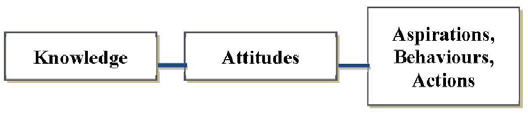
Basic Conceptual Framework of the Study
The basic conceptual framework also hypothesises that attitudes influence behaviour or, in this case, students’ aspirations. The opportunity to personally benefit from ASEAN integration is expected to positively affect their aspirations. Therefore, the variables measuring proximity to neighbouring countries and whether students’ future professions are among those that will benefit from the ASEAN Agreement on the Movement of Natural Persons (MNP agreement) were used as predictors in the aspiration model.
We state the following hypotheses:
Students who have a stronger academic performance and have received more information on ASEAN either through formal education or from extracurricular sources are likely to have greater knowledge of ASEAN.
Students with greater knowledge of ASEAN and greater opportunities to interact with people from other ASEAN countries are likely to have more positive attitudes towards ASEAN. Their attitudes are also expected to be affected by the relations between Thailand and the neighbouring country located closest to them.
Students with more positive attitudes towards ASEAN and greater opportunities to personally benefit from ASEAN integration are likely to have stronger aspirations for ASEAN.
The hypothesised relationships were statistically tested using a multiple regression analysis (MRA) technique. To ensure that the MRA technique is appropriate, residual analyses were performed. In all three models the assumptions of linearity, normality, and equality of variance are met. 3 The calculated tolerance and variation inflation factor (VIF) values of each of the independent variables indicate that no multicollinearity exists in any of the three models. 4 The results of the analyses can, therefore, be used with reasonable confidence.
In all three models the residual distributions, although slightly leptokurtic and slightly skewed, are basically normal. The cumulative probability plots also show that the observed residual distributions are very much the same as that of a normal distribution. In the scatterplots of studentised residuals against standardised, predicted dependent variable values, the residuals are randomly distributed in a band around the residual value of 0 with no discernible pattern, and the spreads of the residuals do not increase or decrease with predicted y-values, indicating that the assumptions of linearity and equality of variances are not violated.
All independent variables in each of the three models have tolerance values much greater than 0.1 – most are greater than 0.8, and the smallest is 0.461 – and very small variance inflation factor (VIF) values, the largest being 2.171.
Data
The students’ responses provide data on their academic interests and performances as well as on the opportunities they have had to learn about ASEAN, from both their university curriculums and non-university sources. Knowledge, attitudes, and aspirations are concepts that must be assessed through a number of observable indicators and indices constructed to reflect the level of these three variables of interest.
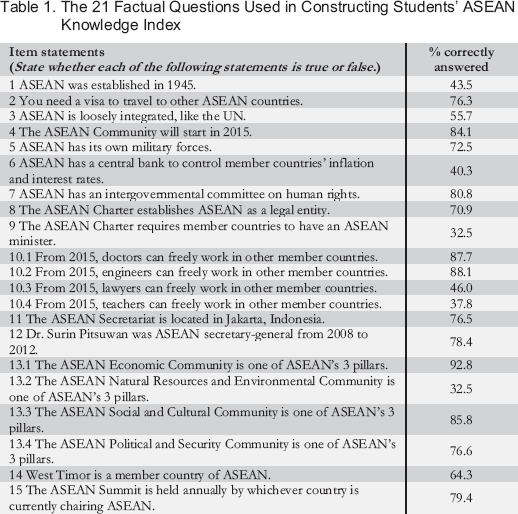
The students’ knowledge of ASEAN is measured by 21 factual questions concerning the history, present structure, and mechanisms of ASEAN and the AC (Table 1). These questions cover the main subject matters of most current ASEAN-related courses and of the majority of reports and discussions in the mass media and in public forums. A student's knowledge score is the sum of his or her correct answers – each of which is weighted to reflect the level of the question's difficulty based on the percentage of students that give the correct answer.
The 21 Factual Questions Used in Constructing Students’ ASEAN Knowledge Index
Twenty-two statements are used to gauge students’ attitudes towards ASEAN (Table A1 in the Appendix). They are measured on a four-point scale, ranging from strongly agree (four points) to strongly disagree (one point). A factor analysis of 22 item scores reveals that the statements concern four aspects of attitudes towards ASEAN, which can be labelled (1) interest in ASEAN member countries, (2) ASEAN identity (“we feeling”), (3) ASEAN's effectiveness, and (4) Thailand's education on ASEAN.
Only one component is extracted when another factor analysis is performed with the computed factor scores, indicating that it is appropriate to construct an overall attitude index using the four factor scores. When computing factor scores, factor score coefficients are adjusted in order to give the computed scores values between 1 and 4 (as in the original-item scales) so that the scores can be interpreted based on the original meaning of the values.
To gauge students’ aspirations for ASEAN, eight statements concerning students’ expectations of the benefits ASEAN will provide to them personally and to the region are used (Table A2 in the Appendix). Students’ opinions are measured on a four-point scale, ranging from “strongly agree” (four points) to “strongly disagree” (one point). A factor analysis of the eight item scores yields two components that reflect the two kinds of expectations. Only one component is extracted when the computed scores of the two factors are analysed, indicating that it is appropriate to construct the overall aspiration index using the two factor scores. The factor score coefficients are adjusted in order to give the computed scores values between 1 and 4, as in the original-item scales.
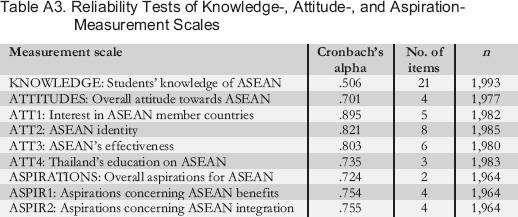
Reliability tests for each of the scales are performed using the students’ observations. The calculated Cronbach's alpha is satisfactorily high for five attitude scales and three aspiration scales, ranging from .701 to .895 (Table A3 in the Appendix). However, because the questions on ASEAN knowledge cover rather diverse subjects, the ASEAN knowledge scale has a rather low, though acceptable, level of internal consistency (Cronbach's alpha = .506).
The Results
Students’ Knowledge of ASEAN
Based on the number of questions respondents answered correctly, Thai university students appear to have a fairly high level of knowledge of ASEAN as an organisation: approximately 61 per cent correctly answered at least more than 70 per cent of the questions about ASEAN – 17 per cent of which answered more than 80 per cent of questions correctly (Table 2). However, the computed knowledge scores in which each correct answer is weighted by the level of difficulty show that the mean score of correct answers is only 12.5 out of a total of 21 (Table 3), implying that on average, students can answer questions on the general and well-known aspects of ASEAN but not the more difficult questions.
Distribution of Students by Number of Correct Answers (n = 1,992)
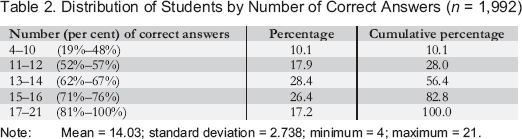
Note: Mean = 14.03; standard deviation = 2.738; minimum = 4; maximum = 21.
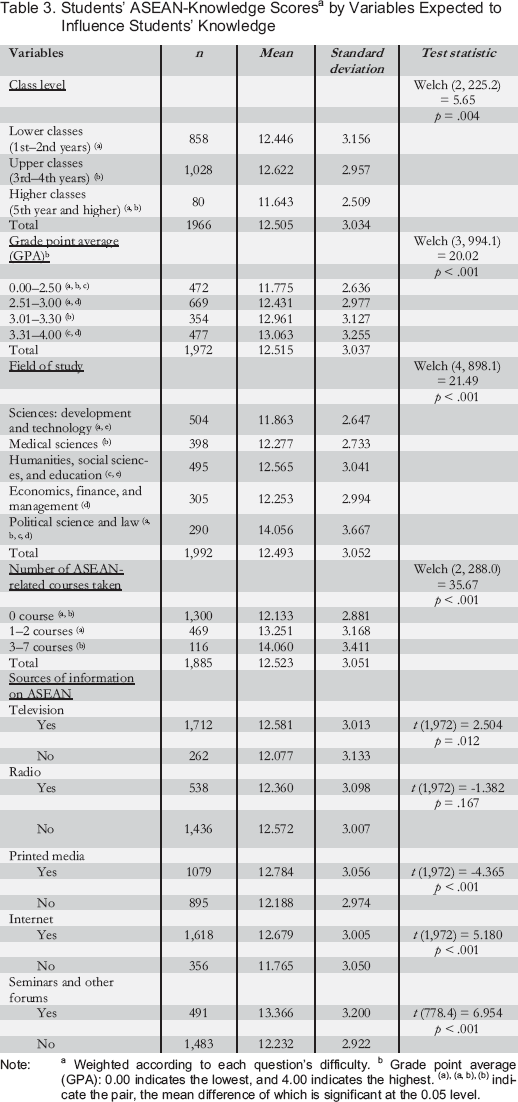
Students’ ASEAN-Knowledge Scores a by Variables Expected to Influence Students’ Knowledge
Note:
Weighted according to each question's difficulty.
Grade point average (GPA): 0.00 indicates the lowest, and 4.00 indicates the highest. (a), (a, b), (b) indicate the pair, the mean difference of which is significant at the 0.05 level.
Table 3 compares levels of knowledge of ASEAN of students who differ in terms of field of study, college experience, exposure to ASEAN-related courses and other sources of information on ASEAN, and academic performance.
The comparisons of the subgroup means show that while there are small differences in the level of knowledge about ASEAN among students in different class levels, the number of courses and seminars, conferences, and other forums that students have attended apparently have a significant bearing on the level of knowledge acquired. It also shows that law and political science students tend to have higher knowledge scores than those from other fields of study. This has much to do with the courses offered by university departments. In the universities included in this study, only liberal arts, history, and political science departments offer ASEAN-related courses.
While universities actively promote ASEAN awareness among their students, only a few have actually included ASEAN in their general education curriculum. Thus, ASEAN-related subjects are limited to only a small number of departments.
Understanding Students’ Attitudes towards ASEAN
To assess students’ attitudes towards ASEAN, the survey asks their opinions on ASEAN's achievements and benefits, Thai people's awareness of ASEAN, Thai education on ASEAN, and students’ willingness to be a part of the AC. Table 4 summarises what students think of ASEAN and other ASEAN member states.
Student s’ Opinions on Different Aspects of ASEAN (n = 1,981–1,987)

The majority of students are supportive of ASEAN's integration process. However, students are more likely to believe that economic cooperation has been more successful than political-security and socio-cultural cooperation. Similarly, the majority of students think Thailand stands to benefit from ASEAN integration in all three aspects, but much more so economically. Such opinions are also reflected in the focus group discussions. When asked whether they could give examples of cooperation within the APSC, the majority of the participants stated that there was no such thing and instead mentioned conflicts between ASEAN member countries. Many believe this ignorance is caused by the lack of media attention to other forms of cooperation compared to that given to the AEC. Furthermore, students were also able to cite concrete examples of economic cooperation and see how this might benefit their everyday lives.
More than 60 per cent of the students in the survey think that although the Thai educational system has highlighted ASEAN, Thai people in general do not have adequate knowledge of ASEAN. Most agree that courses on ASEAN should be made compulsory in university education. The subjects believed to be crucial for ASEAN's integration process were economics, trade, and comparative law within Southeast Asia, as well as ASEAN's various roles and its organisational structure. Subjects such as languages, history, art, comparative politics, and member countries’ foreign policy are considered less important. Similar opinions were voiced in the focus group discussions. Most participants agreed that students’ knowledge of ASEAN would strengthen regional integration and enable students to benefit from various opportunities provided by the AC. Unfortunately, most tertiary institutions do not cover all these subjects, and only a few university departments (such as political science departments) have made classes concerning ASEAN compulsory. Thus, many students seek alternative means to learn more about ASEAN, such as seminars and other activities that involve short- or long-term student exchanges.
Statements 8 through 14 directly measure the “we feeling” Thai students have towards other ASEAN member countries and their populations. When asked how much they agree with the statement that they wish to work with people from other ASEAN countries, 90 per cent of students agree with the statement, 36 per cent of which were even more emphatic (“strongly agree”). However, the results are different when students are asked how much they agree with the statement that they wish to work in other ASEAN member countries, with a lower percentage showing such strong willingness. Findings from the focus group discussions reveal that students would prefer to work in Thailand because it is their home and because they feel their work would otherwise be obstructed by a language barrier. If they must choose a country, they would opt for Singapore, where they could communicate in English, which is not too far from Thailand, and where they believe salaries are higher than in Thailand.
Trust is a key element of the “we feeling.” Although more than 80 per cent of the students in the survey say that they trust people from other ASEAN member countries, only 14.5 per cent “greatly” trust their fellow ASEAN citizens. During the focus group sessions, students cited formal education that emphasises the histories of war more than cooperation, and news media that tend to report conflicts rather than agreements as factors shaping their attitudes towards their neighbouring countries. Courses on ASEAN are also mundane and often stress differences and competitiveness rather than how countries are compatible and complement each other. While the students may not have a high level of trust towards other ASEAN citizens, they would be willing to help them out in times of difficulty and fully support the upcoming AC. On the whole, a significant number of the students indicate that they do have a positive attitude towards ASEAN – with 52.6 per cent fairly supportive and 33.8 per cent highly supportive of the establishment of the AC. Again, the results from both the survey and the focus group discussions show that the majority of students believe that joining the AC offers more advantages than disadvantages.
When asked about the existence of an ASEAN identity, 26 per cent strongly feel that there is one. Although this is a significant number, the focus group discussions indicate that the students do not fully understand what having an ASEAN identity means. Once we defined identity as an indicator of “who you are,” many felt there was no ASEAN identity yet.
Even though ASEAN identity is still a rather vague concept to many university students – who are more familiar with ASEAN issues than are most other sectors of the population – a great majority of them seem ready to embrace the idea of the AC and consider themselves ASEAN citizens. The responses to the final statement show that approximately one-fifth of the students strongly feel that they are ASEAN citizens.
The findings from our focus group discussions reveal that universities’ geographical locations have a bearing on the results. Students at universities closer to a border, who are likely to benefit from cross-cultural interactions with travellers or exchange students from neighbouring countries, are more likely to feel a greater affiliation with ASEAN. One interesting finding is that cultural assimilation affects students’ attitudes differently across regions. Students studying near the Thailand–Laos border mentioned during their interviews that they feel that Thailand and Laos PDR and their populations are very similar and that there is no need to cross the border to learn about one another given the number of Laotians living and studying in Thai communities. Interviewees studying near the Thailand–Malaysia border revealed that the multicultural setting prepared them for the (at that time) upcoming AC. Students are well exposed to cultural differences, and while they do not believe that a “we feeling” exists, they have more opportunities to interact with and learn about their Malay neighbours.
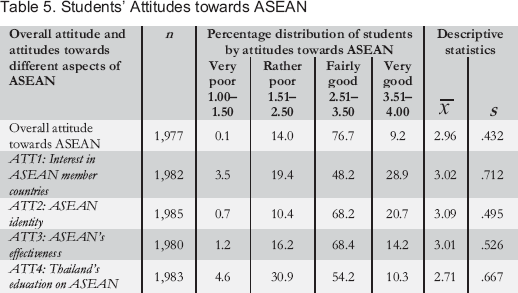
Students’ attitude scores are computed using students’ opinions of the 22 statements described in the data section. The relative-frequency distribution and the mean of overall attitude scores indicate that approximately 86 per cent of students have a positive attitude, and, on average, students have a “fairly good” attitude towards ASEAN (Table 5). Comparing the attitude scores of each of the four underlying components, we find that, on average, students’ attitudes are most positive in the area of ASEAN identity. Students’ interest in other ASEAN member countries and attitudes towards ASEAN's effectiveness are marginally lower than attitudes towards ASEAN overall, while attitudes towards Thailand's education on ASEAN are markedly much lower. Nonetheless, the majority of students have a positive attitude towards all aspects of ASEAN.
Students’ Attitudes towards ASEAN
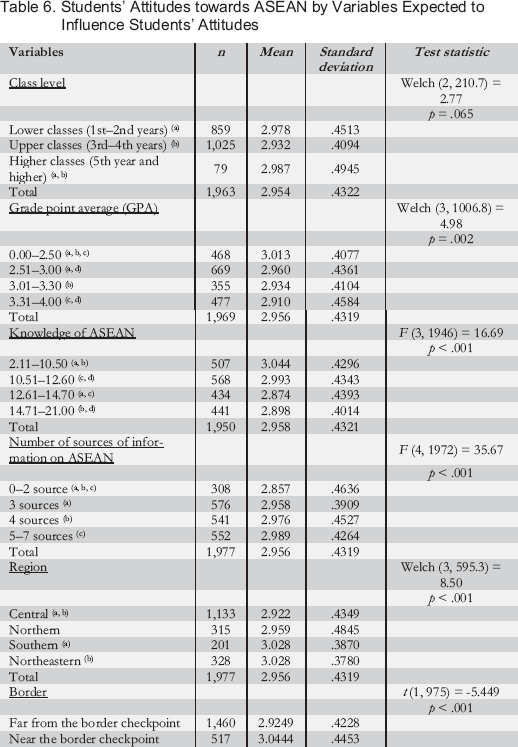
The results of the preliminary data analysis show that, contrary to what was expected, the more knowledgeable students become about ASEAN, the less favourable their attitudes towards it (Table 6). While students in different class levels do not differ in their attitudes, students who differ in terms of job opportunities promised by their current GPA, their degree of open-mindedness and enthusiasm (judged by the number of information sources they have made use of), and in where they are physically located tend to vary in their attitudes towards ASEAN. However, the differences, although statistically different, appear to be rather small.
Students’ Attitudes towards ASEAN by Variables Expected to Influence Students’ Attitudes
Understanding Students’ Aspirations for ASEAN
To measure students’ aspirations for ASEAN and the AC, the survey presents particular statements and asks students to indicate how much they agree or disagree with them. The statements and results are presented in Table 7.
Students’ Expectations of ASEAN and the ASEAN Community
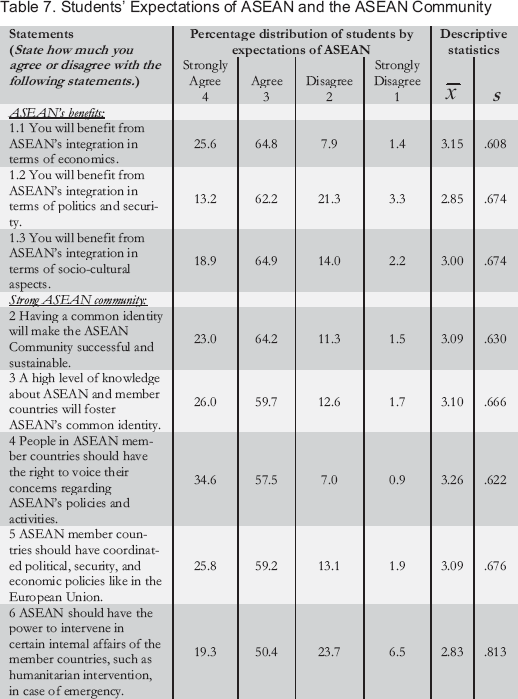
Based on the percentage distributions, students have greater hope that they will personally benefit from the AEC than from the APSC and the ASCC. Interestingly, a factor analysis of the responses to the nine statements groups the sixth statement with the first three, suggesting that students regard ASEAN's proactive role in the region, particularly in humanitarian actions, as in their personal interest. Focus group participants cite various ASEAN norms (including the ASEAN Way) that stress the non-interference principle, long consultation processes, informality, and an avoidance of sensitive issues as the main obstacles to security and political integration. Regarding aspirations for the AC, students would like to see a community with opportunities for popular participation, especially in terms of policymaking.
The results also show that students have high hopes that they will benefit from increased participation. When the European Union entered the equation in the fifth statement, roughly 80 per cent of the respondents agree that ASEAN member countries should have coordinated policies similar to those in the European Union. However, they are more sceptical as to how much of a role ASEAN should play when it comes to handling domestic affairs.
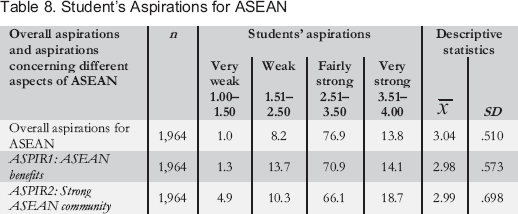
Based on their responses to nine statements, 90 per cent of students have strong aspirations for ASEAN and the AC (Table 8). They think that they as individuals could benefit from increased regional integration and hope to see a strong AC.
Student's Aspirations for ASEAN
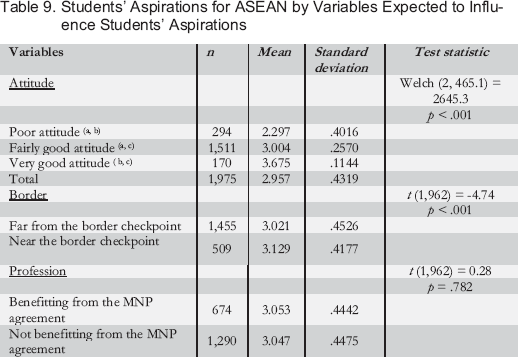
The comparison of aspiration mean scores shows that students with more positive attitudes have significantly greater aspirations for ASEAN (Table 9). Students closer to the border also tend to be more aspirational than those far away. Moreover, there is no difference in aspirations for ASEAN between students planning on entering professions that will directly benefit from the MNP agreement and students entering professions that will not.
Students’ Aspirations for ASEAN by Variables Expected to Influence Students’ Aspirations
Determinants of Students’ Knowledge of ASEAN
The multiple regression model

was constructed to test the research hypothesis that students who have a stronger academic performance and have received more information on ASEAN through both formal education and other sources are likely to have greater knowledge of ASEAN. Class level was entered to control for the effect of the recent hype surrounding the AC.
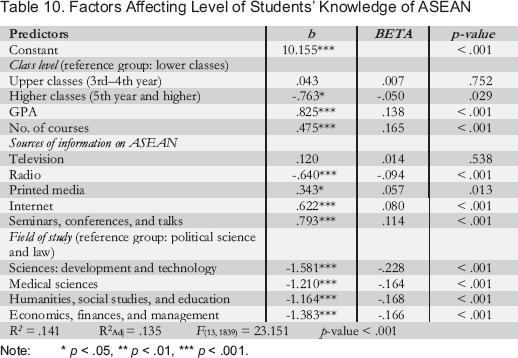
The overall model statistically significantly fits the data (F=23.151, p < .001); however, it explains only a small proportion of the variance of students’ knowledge of ASEAN (R2Adj = .135) (Table 10). Students’ academic performance, as reflected by their GPA, and the number of ASEAN-related courses they have taken in the university are two important factors positively related to students’ knowledge of ASEAN (BETA = .138 and .165, respectively). Printed media, the Internet, seminars, conferences, and other public forums that students have attended are sources of information that help students gain more knowledge of ASEAN, while television does not make any difference. Students who cite radio as their source of information tend to have less knowledge than those who do not.
Factors Affecting Level of Students’ Knowledge of ASEAN
Note:
p< .05,
**p < .01,
p < .001.
Bivariate analyses illustrate that, on average, students in their third and fourth years tend to have more knowledge of ASEAN than others (Table 3), suggesting that the hype around the AEC in recent years has had a greater effect on students in their third and fourth years than on students in their fifth year and higher), while students who have spent more years in university (where they can engage in many ASEAN-related extracurricular activities) are more aware of ASEAN than those in the lower class levels. The result of the multiple regression analysis confirms this observation, although only the difference between students in the upper and higher class levels is found to be statistically significant. Field of study also has a significant and, in fact, the most important bearing on students’ knowledge, with students in the fields of political science and law on average scoring higher than students in other fields. Because the number of ASEAN-related courses and other variables in the model have been controlled for, this finding pinpoints the fact that different disciplines place significantly different levels of importance on raising students’ awareness of ASEAN. Since ASEAN and the AC will directly or indirectly affect all professions, it is pertinent that students in all disciplines learn about and understand the community of which they are now a part.
Does More Knowledge Lead to a More Positive Attitude towards ASEAN?
We use the following model to test our second hypothesis, which proposes that students with greater knowledge of ASEAN and greater opportunities to interact with people from other ASEAN member countries are more likely to have more positive attitudes towards ASEAN and that their attitudes are expected to be affected by relations between Thailand and the neighbouring country nearest to them:

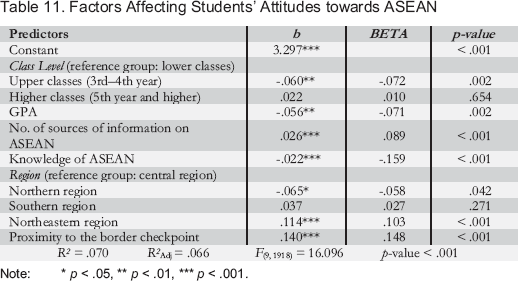
Although statistically significant, the model can only marginally explain the variance of students’ attitudes towards ASEAN (R2Adj = .066) (Table 11). This is because, in this study, knowledge – the factor expected to have the greatest influence on attitudes – only concerns the main subject matter of most current ASEAN-related courses and of the majority of reports and discussions in the mass media and public forums, while the statements used to gauge students’ attitudes cover four major aspects of ASEAN. Moreover, only one aspect – ASEAN's effectiveness – can be expected to be determined by how much students know about ASEAN's history, structure, and mechanisms. Contrary to many previous studies – particularly in the fields of medical science and public health, which found that the more knowledgeable a person is about something the more positive his or her attitude will be towards it – this study finds that students with more knowledge of ASEAN have less favourable attitudes towards it (BETA = −0.159). This implies that the more knowledgeable students are about ASEAN, the more disillusioned they become about ASEAN's benefits and effectiveness.
Factors Affecting Students’ Attitudes towards ASEAN
Note:
p < .05,
p < .01,
p < .001.
Another reason for the low explanatory power is that actual social interaction variables which could have better explained two other aspects of attitude – interest in ASEAN member countries and ASEAN identity – are not included in the model because, as previously mentioned, the number of students with actual social interaction with other ASEAN citizens is very small compared to the whole university student population. Therefore, the data from the random-sampling survey is not sufficient for the quantitative analysis to yield any valid conclusion on the effects of social interaction on students’ attitudes towards other ASEAN member countries and people. Nonetheless, the analysis finds the variable of “proximity to the border checkpoint,” which represents the opportunity to engage in social interactions and to have a close affinity with the people of the neighbouring country, to be a significant predictor of attitude (BETA = .149), suggesting that social interaction generally leads to a more positive attitude.
Discussions during the focus group sessions also present strong support for our argument that social interactions have a great impact on students’ attitudes. From around 50 students interviewed, we find that students who have been to other ASEAN countries not only had more knowledge of ASEAN and a more positive attitude towards other ASEAN countries and their people, they are also more eager to learn more about ASEAN and more enthusiastic and positive about the upcoming AC. Social interaction, however, does not always equate to good attitudes. Students from the engineering departments who worked in factories during third-year internships cite negative experiences while working with unskilled workers from neighbouring countries as their reason for being more sceptical of other ASEAN member states on the whole. On the other hand, students from departments of economics and commerce cite a positive experience interacting with students from other ASEAN countries while conducting their third-year internships in, for example, investment banks and foreign companies and express positive attitudes towards ASEAN integration. Obviously, for social interactions to lead to a common identity, they need to be of a positive kind and occur in an environment conducive to that.
Where students study is found to be a significant predictor of attitude, suggesting that the relations between Thailand and the neighbouring country at the state level and between the peoples of the two countries to some extent shape students’ attitudes towards ASEAN as a whole. Students in the central region, where Bangkok is located, have more positive attitudes than students in northern Thailand, similar attitudes to those in the south, but significantly less positive attitudes than students in the northeast. The result of another analysis in which the northeastern region is the reference group (not shown) shows that students in the northeastern region who find they have a lot in common with their neighbours across the Mekong River and who appreciate the fruits of good relations between Laos and Thailand have significantly more positive attitudes towards ASEAN than do those in the other regions.
Again, the AC development that has received the most attention in recent years appears to affect students of different cohorts differently. Students in the upper class levels who entered college when the hype surrounding ASEAN was gaining momentum are probably more knowledgeable about various issues of ASEAN – outside of those concerning ASEAN's structure and mechanism that are already accounted for in the knowledge variable – and, at the same time, they are more disillusioned than those in the lower and higher class levels.
The results support the notion that students who seek information from more sources are more enthusiastic, more broad-minded, and more receptive to new ideas. These students have a more positive attitude towards ASEAN than those who have made use of fewer sources of information.
It is postulated that higher academic performance often means greater career prospects, and perhaps this causes students with higher GPAs to be less interested in the benefits promised by ASEAN integration and to thus have less positive attitudes towards ASEAN than those with lower GPAs, as indicated by the results. But because students with higher GPAs have more knowledge about ASEAN, this finding could also be attributed to the particular information about ASEAN that they have received. For instance, when publicising the AEC, experts and commentators often stress the need for Thailand to be more competitive against other ASEAN member countries in order to gain economically from the integration. Similar to the effect of social interactions, it is not only the quantity but also the quality and the kind of knowledge and information being disseminated that are important in developing a positive attitude towards ASEAN among the general public.
The analysis verifies the hypothesised effects of all the factors in the attitude model. Most factors affect attitudes in the expected direction except for those concerning knowledge of ASEAN. Such findings point out that education on ASEAN should be more comprehensive and promote a good understanding and a positive attitude among the peoples of ASEAN member countries so that a common identity can emerge. They also point out that, unintentionally or not, the educational system, the mass media, and public forums and discussions that have sent out different messages with regard to ASEAN and have had a significant influence on people's attitudes towards ASEAN.
A Positive Attitude Creates an Aspiring ASEAN Citizen
A multiple regression analysis was performed with the model

to test the third hypothesis that students with more positive attitudes and greater opportunities to personally benefit from ASEAN integration are likely to have stronger aspirations for ASEAN.
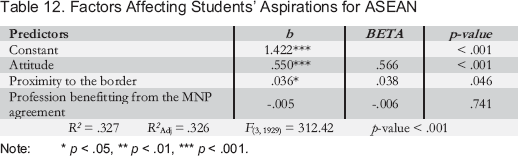
The model is significant and explains more than 30 per cent of the variance of aspiration scores (Table 12). The results strongly support the basic conceptual framework of the study as they show that students’ aspirations very much depend on their attitudes towards ASEAN (BETA = .556).
Factors Affecting Students’ Aspirations for ASEAN
Note:
p < .05,
**p < .01,
p < .001.
Besides being a proxy for social interaction that affects attitude, proximity to the border also represents a greater opportunity to personally benefit from ASEAN integration, particularly in terms of economic and socio-cultural aspects. The results reveal a significant but rather weak association between proximity and aspirations, suggesting that physical distance is not a big obstacle for students to enjoy the benefits provided by the AC.
It is expected that students whose future professions are among those that benefit from the MNP agreement (which promotes the free flow of skilled labour within the region) hold greater aspirations. However, the results do not bear this out. This could be because (i) the agreement, despite having been much publicised, it still not widely known, (ii) students may think that opportunities are rather limited, or (iii) students may think that the job opportunities created by ASEAN integration will benefit practically all professions and in all ASEAN member countries, albeit more directly for certain professions and for certain countries. As evident from the focus group discussions, students across all fields of study can be equally enthusiastic about the prospect of working in other ASEAN member countries. For example, engineering students now want to work in an emerging economy for a short time because they believe such economies can offer more job opportunities and more new projects to undertake. Education students who have gone on field trips to other ASEAN countries have seen how educational systems in other countries can be improved and how Thailand can learn from other countries’ models; thus they would not mind working in other countries.
The results of the quantitative analyses confirm most of the hypothesised relationships while revealing some findings that deviate from expectations, which require further and more detailed investigation. The specific experiences, observations, and opinions of students that were exchanged during the focus group sessions help to clarify and explain many results. They also offer useful insights that can be used to improve the education and public discussions on ASEAN and the AC so that students and the broader public have a high level of knowledge of ASEAN's role and mechanisms and a good understanding of fellow ASEAN member countries and their people – an important requisite to building a common identity.
Conclusion
ASEAN leaders aspire to develop a well-integrated AC that will bring about not only prosperity for ASEAN citizens but also a common identity. Social interaction and education on the cultures and interests of other ASEAN peoples are the means of creating regional horizontal solidarity. We find that the education required to achieve this goal should focused on helping people understand and respect the cultures and differences of their fellow ASEAN citizens and that social interactions need to be generally positive experiences. It is essential that various groups within the community do not feel that their interests or identities are in any way under threat. If they do, a collective identity is unlikely to develop and, as a result, the AC is not going to appeal to them.
By drawing on Deutsch et al.'s thesis, Neil Fligstein (2008) convincingly explains why European identity has been accepted by some but not by others. According to Deutsch et al., in order to create an identity, is it essential not only to have a common culture based around language, religion, race, ethnicity, or a shared formative experience, but also to develop a form of horizontal solidarity or awareness that has the ability to reach out to all social groups within a society. People have increasing opportunities to gain a sense of ownership of their daily lives by participating in the decision-making processes on issues that affect them. However, bringing ASEAN issues closer to the people or increasing participation will not necessarily lead to increased awareness of a collective identity. Increased awareness is dependent on whether the various groups within ASEAN perceive these issues as beneficial to them. It requires not only empowering citizens but also encouraging them to participate and become active citizens of the wider community.
Unfortunately, in many Southeast Asian countries political participation is still very limited. The elitist nature of Southeast Asian politics also makes it extremely difficult to increase popular-participation opportunities.
The politicisation of issues that matter to the people is probably one of the most significant differences between the European Union and ASEAN. In Europe politics have been brought closer to the ordinary citizen, and Europeans are accustomed to civic participation and have developed a sense of common identity. ASEAN has yet to witness such politicisation, as many still feel that ASEAN does not affect their everyday lives in a manner similar to how the European Union affects the everyday lives of Europeans.
Regarding ASEAN identity, since there are no other comparable surveys or statistics that measure awareness, attitudes, and aspirations for ASEAN that would allow us to establish whether there is an ASEAN identity or whether there has been progress towards such a common identity, we cannot determine how fast the process of building a common identity is going or how far along it is. Based on the survey results, as well as the resources and information available to the general public regarding the AC, ASEAN is likely to develop a common economic identity before other types of identities. This is because people can more easily identify the processes of economic integration and the benefits they are likely to receive. Once an economic identity is realised, it is hoped that other common identities will emerge. In the case of the European Union the perception of economic benefits likewise leads to greater support for European integration and a European identity (Verhaegen, Hooghe, and Quintelier 2014: 295–314). Through more frequent economic exchanges and more learning about other countries’ economic systems, laws, regulations, strengths, weaknesses, and business norms, ASEAN citizens can develop a common socio-cultural identity that can help facilitate integration. It is hoped that trust – the foundation of any common identity – will emerge with more positive social interactions. Once people can trust that the integration process underway is not a threat to their interests or identities, the AC will benefit from an ASEAN identity. A common identity is necessary because only when citizens feel part of the community will they welcome decisions that are made for and by the community as a whole.
Footnotes
Appendix
Reliability Tests of Knowledge-, Attitude-, and Aspiration-Measurement Scales
| Measurement scale | Cronbach's alpha | No. of items | n |
|---|---|---|---|
| KNOWLEDGE: Students’ knowledge of ASEAN | .506 | 21 | 1,993 |
| ATTITUDES: Overall attitude towards ASEAN | .701 | 4 | 1,977 |
| ATT1: Interest in ASEAN member countries | .895 | 5 | 1,982 |
| ATT2: ASEAN identity | .821 | 8 | 1,985 |
| ATT3: ASEAN's effectiveness | .803 | 6 | 1,980 |
| ATT4: Thailand's education on ASEAN | .735 | 3 | 1,983 |
| ASPIRATIONS: Overall aspirations for ASEAN | .724 | 2 | 1,964 |
| ASPIR1: Aspirations concerning ASEAN benefits | .754 | 4 | 1,964 |
| ASPIR2: Aspirations concerning ASEAN integration | .755 | 4 | 1,964 |