



Abstract
Timor-Leste rose to independence following a path that included three electoral processes organized under the auspices of the UN and has thus got elections imprinted on its own genetic code. After independence, the responsibility for electoral processes – a key aspect of the sovereignty of the Timorese people – was passed to the nation's authorities, who organized two full rounds of presidential and legislative elections in 2007 and 2012 with the assistance of the international community. This effort constitutes a major element in the process of granting the new regime internal and external legitimacy and at the same time is a response both to citizens’ perception of the political game in order to secure their empowerment and to the call for transparent, internationally acknowledged procedures. Initially, this essay analyses the legal and administrative framework for Timorese elections, bearing these competing requirements in mind. It then focuses on the 2012 elections: first, on the two rounds of presidential elections, including the intricate relationship between presidential candidacies and political parties, and then on the results of the legislative poll, which had a major impact on the political landscape. The final section deals with the challenges that lie ahead for the coming political cycle (2012–2017).
Keywords
Elections, Independence, Democracy
In the first half of 2012, Timor-Leste organized the second series of national elections since its independence ten years earlier. 1 Elections have been a vital part of this nation's recent history since the UN-sponsored referendum of 30 August 1999 – the first election in the land to be held in accordance to internationally accepted standards 2 – in which the overwhelming majority of its people (officially 78.5 per cent, with a turnout of 98.6 per cent of all registered electors) voted in favour of ending its 24-year-long incorporation into Indonesia, thus paving the way for independence (Martin 2001; Pereira Gomes 2001; Cardoso Gomes 2010a). 3 Two years later, on 30 August 2001, a new vote was organized to install a Constituent Assembly (Sousa 2001; Fox 2003; King 2003; Smith 2004). Fretilin, a historical party associated with the Resistance, comfortably won 55 of the 88 seats and dominated the Assembly, which voted to extend its mandate to become the first Parliament for the ensuing five years, thus granting that party a sound basis for stable government.
In addition to presidential and legislative elections, Timor-Leste also held elections for local ‘suku’ and village leaders in 2004–2005 and 2009, which will not be considered in this essay. However, it should be noticed that the UN administration opted to start the electoral process with national polls despite some proposals that sustained the idea of holding local elections first (Hohe 2001; Hohe and Ospina 2002).
In the last year of Portuguese administration (1975), genuinely democratic elections were prepared, but these were only actually organized in a few districts (Real forthcoming). Under Indonesian rule, several elections were organized, the last one a few months before the 1999 referendum, but none can be regarded as having the basic features of free and fair elections (Saldanha 2008: 70; Shoesmith 2011: 7).
Acknowledgements: This essay is part of an ongoing research project called ‘The Birth of a Democratic Nation: Timor-Leste after 1999’ sponsored by FCT (the Portuguese agency for science and technology) through grant SFRH/BPD/71238/ 2010, which I am conducting at CES/Coimbra together with Boaventura de Sousa Santos, whom I thank for his intellectual generosity. Several visits of mine to Dili (2009, 2011, 2012) benefitted from the hospitality of Fundação Oriente and the kind support of its local manager Alvaro Antunes, both of whom I gratefully thank on this occasion. I have benefitted from long interviews with Xanana Gusmão, José Ramos-Horta and Mari Alkatiri, as well as frequent conversations with Dionisio Babo (CNRT), João Gonçalves (PSD), João Saldanha (PR), Jose Teixeira (Fretilin), Lurdes Bessa (PD), Virgilio Smith (CNRT) and Roque Rodrigues (Presidential advisor). Carla Duarte (STAE), Filipa Carvalho (Office of the President), José Carlos Aragão (Office of the Prime Minister), José H. Meirelles (Office of the President), Maria Amado, Michael Leach, Michael Maley, Nuno Vasco Oliveira (Office of the Secretary of State for Culture), Paulo Vieira (ministerial advisor), Peter Carey, Rui Correia (STAE) and Sónia Neto (former aide to Ramos-Horta) also helped in different ways to sharpen my understanding of the Timorese and their political behaviour. Faustino Cardoso Gomes provided valuable insights into the workings of the National Electoral Commission (CNE). David Goldey taught me all I know about elections. I bear full responsibility for any errors that may exist in this paper.
On 14 April 2002, following the dispositions of the new Constitution yet to be implemented and still under UN administration (UNTAET Regulation 2002/1), Xanana Gusmão, the Resistance leader running as an ‘independent’ candidate supported by a large number of smaller parties, albeit not the ruling one, Fretilin, won a landslide victory (83 per cent vs 17 per cent) over Xavier do Amaral, who had briefly been President of Timor in 1975 (Cardoso Gomes 2010a). Both of these elections were completely organized by the UN Mission in Timor-Leste. Thus, when the flag of the first new nation of the 21st century was raised at midnight on 20 May 2002 and the independence of the Democratic Republic of Timor-Leste was proclaimed, the country had an elected President of the Republic, a National Parliament that resulted from the transformation of the elected Constituent Assembly into a legislative body and was the source of legitimacy for the country's government, and also the memory of a decisive vote that had opened up the route to make that possible. Free and fair elections with an enlarged franchise and overwhelming popular participation are thus inscribed in the genetic code of this country, and its independence was achieved through democratic electoral procedures.
In 2007, the country organized a round of elections for the presidency followed by legislative ones under the auspices of national electoral institutions supported by international aid. In the wake of the severe crisis that rocked the country in 2006, and in a difficult security situation illustrated by the existence of 150,000 internally displaced people, those elections were mostly peaceful and generally considered as free and fair (Feijó 2009, 2010; Jolliffe 2007; Leach 2009). The presidential elections required a second ballot for the Timorese to choose between the ‘independent’ candidate Jose Ramos-Horta and Fretilin's Lu Olo, in which the former obtained a comfortable majority of 69 per cent of the vote (Cabasset Semedo and Durand 2007). His ability to bridge different sides of the political spectrum and maintain an inclusive attitude during the crisis gained him the respect of the electors. The legislative elections of late June returned a new Parliament in which no single party commanded a majority, so a coalition was necessary to form a government. The President took the controversial but realistic step of inviting the leader of a post-electoral coalition to form the fourth constitutional government instead of the leader of the largest party, and Xanana Gusmão was sworn in as Prime Minister. This move generated a serious wave of discontent fuelled by Fretilin, but eventually this party stopped the escalation and returned to parliamentary tactics of opposition. The first change of government was thus achieved successfully, albeit in a climate of tension.
National elections held in 2007 and more recently in 2012 respected the constitutional schedule. These elections, however, required the elaboration of new legislation in line with constitutional provisions and the creation of national institutions to oversee and organize the electoral process as part of the sovereign function of the independent state. The extent to which the Timorese authorities managed to assume responsibility for organizing the expression of popular sovereignty in ways that were both transparent to their citizens and in accordance with internationally established standards of freedom and fairness is a critical element in the process of legitimation of the new regime, both internally and externally. As Robert Pastor has pointed out,
[t]he question is whether a country's institutions – both governmental and non-governmental – are sturdy and impartial enough to give people confidence that the instances of fraud are the exception rather than the rule, and that they can be corrected.
He added: ‘The character, competence, and composition of Electoral Management Bodies can determine whether an election is a source of peaceful change or cause for serious instability’ given that ‘[t]he fair and effective administration of the rules is often as important as the rules themselves’ (Pastor 1999: 5–6).
Elections are a sine qua non condition for a polity to claim democratic status and should not be regarded as an ethnocentric diversion from genuine democracy, no matter what amount of ‘political translation’ is involved in the process. However, they are not a sufficient condition on their own, as has been argued consistently in political literature: ‘Elections are meaningful exercises of democratic governance only if voters are able to endow elected officials with real power’ (Schedler 2002: 45). Otherwise, they may indeed be part of what has been termed ‘electoral authoritarianism’ (Levitsky and Way 2002) or ‘hybrid regimes’ that fall short of being democratic. Among other features, they must be free and fair according to well-established parameters. Electoral freedom requires the legal barriers to entry into the political arena to be low, substantial freedom to exist for candidates and supporters of different political forces so they are able to campaign and solicit votes, and that voters experience little or no coercion in exercising their choices. Elections are fair when they are administered by a neutral authority which is sufficiently competent and resourceful to take precautions against fraud in voting and vote counting, when the police, armed forces and courts treat competing candidates with impartiality, when the opposition is not systematically disadvantaged by electoral rules and procedures, when access to the media is granted to all competitors on fair grounds, when independent monitoring of electoral operations is allowed at all locations, when virtually all adults can vote, when procedures for organizing and counting the vote are transparent, and when clear and impartial procedures for resolving complaints and disputes are in place (Diamond 2002: 28–29).
According to Przeworski and his colleagues, democratic elections also entail contestation, that is, the cumulation of three factors: (a) ex ante uncertainty, or the actual possibility of competing actors securing a victory that is not previously determined; (b) ex post irreversibility, that is to say, abidance by the results of the polls in terms of the actual political outcome, or, if we revert to Schumpeter's classic definition, that the principal positions of power should actually be filled in accordance with the results of a competitive struggle for the people's vote; and (c) repeatability, a feature that only longitudinal analysis over time can ascertain (Przeworski et al. 2000: 16). Or one might take Schedler's seven-step ‘chain of democratic choice’ that requires a polity to uphold the following features simultaneously in their electoral processes: empowerment, free supply, free demand, inclusion, insulation, integrity and irreversibility (Schedler 2002: 39–41). These considerations constitute the background against which the performance of Timor-Leste will be matched.
The aim of the present essay is to address the general question of the relationship between the organization of free, fair and regular elections and the process of democratic consolidation, using the case of Timor-Leste as an example. Has Timor-Leste upheld the positive expectations derived from its recent history? Have elections helped to increase the system's responsiveness to changes in public opinion? Have those changes meant more instability? How do elections contribute to a balance of power between the President and the Government that responds before Parliament? How do political parties react to different electoral challenges within a few months? What is the present situation after the second full round of national elections?
The essay is primarily based on first-hand, long-term observations of Timorese society made between 2004 and 2012. 4 Recent working visits to the country allowed me to conduct extensive interviews with political actors in Dili and in several districts, members of the electoral administration (both the CNE and STAE), senior advisors and local and international journalists (see the acknowledgements below) and also to attend official briefings for electoral observers. I was then able to combine the extensive knowledge I gained from my professional involvement at an earlier date with insights obtained from significant periods spent as an observateur engagé. This piece reviews the main features of the 2012 round of elections, starting with an analysis of the legal and institutional framework in which they took place and then moving on to address the results of the presidential and legislative elections. In the final section, some implications of these elections on the next cycle of Timorese political life (2012–2017) will be discussed.
My first visit took place in 2004 and has been followed by several other trips since then. In 2005–06, I was a UN advisor to the Presidency of the Republic, and in that capacity I was involved in the preparation of an important presidential initiative to debate electoral issues with all the political parties and civil-society organizations (February–March 2006). Later on, I was an accredited international electoral observer (2007, 2012), which allowed me to follow events from a medium-term perspective and observe the electoral process both in Dili and in some districts, with open access to various sources of information.
Benjamin Reilly has noted that
[w]hile constitutional and electoral reforms have attracted a voluminous academic literature, issues of electoral administration remain under-studied by scholars and under-rated in general in terms of their effect (Reilly 2008: 175).
This section examines the Timorese options both in terms of electoral supervision institutions and in matters pertaining to the main legal framework.
During the first political cycle after independence (2002–2007), the constitutional provisions regarding electoral matters had to be converted into ordinary law and institutions created to carry out the functions that elections require. This task was performed rather late (ICG 2007: 2–3): the relevant legislation was only published at the very end of 2006 (28 December). Comments were often heard in Dili that the ruling party, which commanded a comfortable majority in Parliament, but had a difficult relationship with the head of state, believed that without the proper legislation being passed, the President's capacity to call early elections was in fact curtailed, and thus deliberately delayed passing the bills to secure its own stability.
The Electoral Administration
Among the critical decisions to be made regarding the electoral process, the definition of the composition of the body (or bodies) managing the election and the status it has rates very highly since it plays a considerable role in creating sound legitimacy bases for the whole process.
As defined in specific legislation (the Bill on the Organs of Electoral Administration – Law 5/2006), the Timorese electoral administration is composed of two main permanent institutions, the CNE (Comissão Nacional de Eleições – National Electoral Commission) and the STAE (Secretariado Tecnico dos Assuntos Eleitorais – Technical Secretariat for Electoral Affairs), as well as the logistic apparatus created for each electoral act (polling stations and vote-counting ‘assemblies’) in addition to the judicial system (which is called on to perform confirmation duties, settle disputes regarding contested elections and proclaim results). 5 This has existed ever since the early days. Timor-Leste chose a mixed system, unlike most countries that either opt for an independent body – which Reilly considers to be ‘demonstrably preferable to party-based models for established and emerging democracies alike’ (2008: 32) and which, by and large, has been the dominant model since World War II (Pastor 1999) – or that choose to place electoral matters under the government of the day.
This dual model may be considered a legacy of the Portuguese co-operation on electoral matters after independence (Feijó 2011). A similar system was adopted in Portugal after the 1974 Revolution and was only abandoned recently. In the 2006 bill, the vote-counting ‘assemblies’ and the polling stations were considered to be organs of electoral administration, although they were actually no more than instruments of the voting process at the time.
The STAE is a government agency under the auspices of the Ministry for Home Affairs and has existed ever since the early days of independence. It is defined as a ‘technical secretariat’, but also as an ‘executive organ in electoral administration’ (section 12-1). In practice, it was the sole legal entity to intervene in the preparation of national elections up to the end of December 2006 and thus played a role in the drafting process of the electoral legislation published at that time. It also took the updating of the national electoral register upon itself.
The key problem with this organ in a young democracy struggling to develop accountability procedures in Parliament, as Shoesmith has pointed out (Shoesmith 2008a, 2008b), resides in the possibility that it will not perform its duties according to neutrality criteria, but favour the governmental side instead. Criticism along these lines was heard in the period leading up to the 2007 elections, but the chairman of the STAE, Tomas Cabral, has managed to build up a reputation for showing integrity and survived the political changes of 2007 to remain in his post with the new administration.
The CNE is the body which is supposed to ‘exercise jurisdiction over all the electoral processes for elected organs of sovereignty, local power and the referendum, as well as over the mandatory, official, universal and unique voters registration to be used in those elections’ (from the preface to Law 5/2006). Efforts were made to ensure this would be an independent body: [The] ‘CNE is independent from any organs of political power, central or local, and possesses financial, administrative and organizational independence’ (section 4-2): appointees receive a six-year mandate, extendable only once, and are not subject to dismissal (section 6-1); the institution has its own budget and permanent personnel (section 11); its members are nominated by a variety of institutions: the President of the Republic (3), the National Parliament (3), the Government (3), judicial institutions (3), religious organizations (2) and women's organizations (1) (section 5); and members cannot be party leaders, stand for election or have any role in the organization of candidatures for election (section 5-4).
The law also stipulates that there is a general ‘duty of co-operation’ with the CNE extended to ‘all organs and agents of the public administration’, expressly including the STAE (section 10), whose chairman has the right to sit in on CNE meetings, but not to vote in them (section 9-5). This seems to give the CNE a prominent role and extended capacity in electoral matters.
In the course of the years, the CNE seems to have managed to establish itself as a reliable, independent body commanding ample support under its chairman, Faustino Cardoso Gomes, a highly respected figure. A large, new ceremonial building is currently under construction in Dili which is destined to become its new permanent headquarters and mirrors the importance accorded to this institution.
This law was revised in 2011. In Parliament, one member of the Opposition (Fernanda Borges, PUN) proposed that the STAE should be integrated into the CNE rather than being dependent on the Government, arguing that such a solution would clarify the leading role of the independent institution and offer guarantees of non-governamentalisation of sensitive issues regarding the electoral process. Her views reflected the basic stance of an International Electoral Certification Team (IECT) which made several proposals after the 2007 elections. However, this view was rejected and only adjustments were made that keep the dual-institution model (Law 6/2011). The most relevant novelty was the inclusion of a new responsibility for the CNE (‘to verify the single database of the electoral register’ – section 8-k), whereas the STAE was entrusted with keeping that database (section 12-4 and 5). In a way, this clarification reinforces the dual model.
On the whole, the dual system is operating to general satisfaction, although some friction often occurs due in part to the strong personalities of the leaders of the electoral administration bodies and mostly to inaccurate or blurred legal specifications (as observed by Michael Maley of the IECT). Competition between the bodies does create tension, but on the whole, it also affects the accuracy of their performance positively since both feel under pressure to perform correctly. Both organs are duly staffed (the STAE has 100 people at its headquarters and a further 200 around the country) and they benefit from the assistance of a sizeable (200-strong) United Nations Electoral Support Team. They are entitled to use helicopters to facilitate the transportation of people and material to remote areas of the country. This has enabled the electoral administration to build up a dense grass-roots network: they have gradually set up 850 polling stations in 442 villages (i.e. one station for every 735 electors), with a combined force of 9,130 paid and uniformed electoral officers. Multi-level training has been administered, including a novel post-graduate course on electoral administration and management at the National University for middle- and top-ranking officials from the STAE and CNE.
The task that faced Timorese law-makers confronted with the need to create electoral bills in line with broad constitutional provisions was considerably greater in the case of legislative elections than for presidential ones.
The Timorese Constitution spells out the main features of presidential elections: a two-ballot election fought by candidates aged over 35, proposed by a group of no less than 5,000 registered electors, with a secondary provision that all 13 districts must be represented by at least 100 electors. The Presidential Elections Bill (Law 7/2006) did not cause much debate in Parliament or the rest of the country. However, an amendment put forward in early 2007 at a time when the electoral process was underway regarding a detail about the ballot that the electors were to use to cast their vote was criticized by many people and was not signed by the President before he had consulted with the Court of Appeals in its capacity as the country's constitutional court (Law 5/2007; Court of Appeals, Constitutional Section, File 1/2007).
The Timorese authorities sought to improve their legislation, starting soon after the 2007 elections, but only in the period of preparation for the 2012 elections was the main bill revised – no less than three times, in fact. First, Law 8/2011 mainly addressed technicalities regarding counting procedures and assurances given to observers. It also fine-tuned the electoral calendar and stipulated that presidential elections must be held no later than two months before the end of presidential mandates (section 12-3). Two significant alterations were introduced: the enlargement of the franchise to include Timorese citizens living outside their country (section 39-A), and the requirement that electors should only be able to cast their vote (with a few specific exceptions) in the places where they had originally registered and no longer in a polling station of their choice upon presentation of their voter's card (section 40). Again, the President expressed his reservations about these matters, arguing that the diplomatic network would have difficulty securing equal rights for all those who fell in the same category in the first case and emphasizing the likely increase in the level of abstention, given the augmented difficulties for voters obliged to travel to their respective polling stations – mainly urban dwellers who still count in their village of origin. The political implications of the President's public reservations about the first issue led to a later amendment postponing the effective granting of voting rights to the Timorese diaspora until a later, unspecified date (Law 1/2012). The President commented positively on this decision in his public address on the day of the elections (PR, press release, 13 Jan. 2012). Once the electoral campaign had started, a new amendment was introduced through Law 7/2012, which abolished the need for the whole process to start over again and a new date to be found within sixty days in case any of the candidates died or were permanently impaired (section 26 of Law 7/2006, revised).
Hence, the 2012 presidential elections took place under a legal framework mostly unchanged from the one that governed the two previous elections. As far as the legislative elections are concerned, the Constitution was less specific and granted Parliament a wider margin for its choices (Feijó 2010). Five issues were central in this debate:
The number of MPs, which the Constitution framed as between 55 and 65 (CDRTL, section 93.2). Parliament chose the upper limit of 65 MPs (Electoral Bill, section 10).
The definition of constituencies, which could either be a single national unit or one constituency for each of the thirteen districts (CDRTL section 93.3). Parliament chose a single national constituency (EB, section 9), as had been the case when 75 members of the Constituent Assembly had needed to be elected, 13 others having been elected on a ‘first past the post’ basis in each district (UNTAET Regulations 2001/2, 2001/3 and 2001/11).
The choice of a method of proportional representation (CRDTL, section 65.4). Disregarding the Sainte-Lague method used in the ‘founding elections’ held in 2001 (King, 2003), Parliament chose to adopt the D'Hondt method (EB, section 13-1).
The decision to impose a threshold of three per cent in order to secure access to Parliament, which was also absent in the 2001 elections (EB, section 13-2).
The application of quotas. Parliament chose to impose a 25 per cent quota for women (EB, section 12-3).
As one might expect, the Parliamentary Elections Bill (Law 6/2006) caused a heated debate, but was ultimately approved by a Fretilin majority in Parliament without the help of opposition parties, who raised objections about several aspects of its provisions. It also marked a shift away from the rules governing the previous election. However, in the preparation for the 2012 elections, the new majority (formed by many of those who had criticized the bill severely back in 2006) saw no reason to alter the provisions of this bill substantially, just in those cases already mentioned in relation to the presidential elections (technicalities regarding vote counting and enlargement of the franchise to include the diaspora, and the obligation to vote in the area where electors had first registered). It did, however, increase the gender quota to one woman in every three candidates. A strong line of continuity thus marks the legal framework under which the 2007 and the 2012 legislative elections were both fought (which contrasts with the shifts that marked the transition from 2001 to 2007).
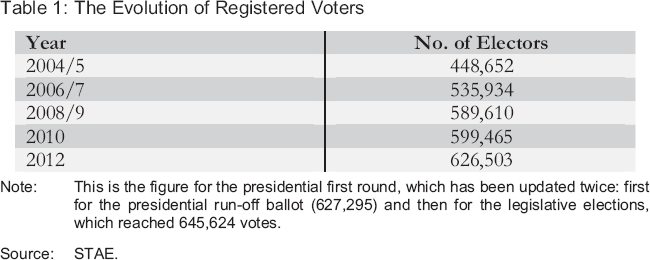
Before elections were called, the electoral administration updated the electoral register, which revealed an increase in the number of citizens entitled to vote. Table 1 summarizes this growth in the number of registered voters.
The Evolution of Registered Voters
The Evolution of Registered Voters
Note: This is the figure for the presidential first round, which has been updated twice: first for the presidential run-off ballot (627,295) and then for the legislative elections, which reached 645,624 votes.
Source: STAE.
The new register shows an increase of about 90,000 electors (17 per cent) compared to the last round of national elections in 2007. This is primarily due to the fact that the demography of the country is characterized by a very high proportion of young people, and thus as many as 100,000 people have reached the legal age to be entitled to vote (17 years). About 15 per cent of the registered electors had the chance to cast a vote for the first time in their lives, a circumstance that reveals the political weight of young people in the electorate of Timor-Leste. However, the death toll, which is likely to have diminished the number of registered electors, but is obviously harder to verify does not seem to be reflected fully in the final count. Since the new register results from the previous ones being updated and does not correspond to a fresh registration of the entire electorate, it suffers from specific shortcomings regarding the removal of deceased or migrant electors. Some of the figures from the STAE suggest that only 4,308 deceased electors were removed in the course of the updating process, which is only a fraction of the actual death toll in the population at large. 6 As such, a bias has been introduced that it has not been possible to quantify and the results for official abstention are higher than in reality.
If a mortality rate of five per thousand is considered (lower than the national average of 5.9, but adjusted for the fact that infant mortality is substantially higher than the average mortality rate of the adult population) and this is applied to the 600,000 electors registered in 2010, then at least 3,000 people should have been removed each year, adding up to 15,000. If those who migrated are taken into account as well, then the real figure may be estimated at more than 20,000. Extrapolating from the population census of 2010 reveals similar figures. By the end of that year, the number of people aged 17 and over (including non-Timorese residents) was about 577,000, whereas the electoral register contemplates almost 600,000 voters, perhaps 25,000 more than the true number of eligible citizens. These exercises suggest that there is an in-built bias towards over-representing actual abstention in official statistics due to poor registration updating. Such a bias probably accounts for more than five percentage points.
The current state of affairs in which presidential and parliamentary elections are held separately constitutes a structural aspect of the semi-presidential system of government in Timor-Leste and calls for individual analyses of both contests.
The Presidential Elections
On 13 January, President Ramos-Horta called for presidential elections to be held on 17 March. In the days that followed, no fewer than 14 candidates declared their intention to run. The Court of Appeals exercised its function by analysing all the proposals and ruled that just one of them failed to meet the legal criteria of 5,000 proponents (at least 100 for each district); the other 13 candidates were accepted. This represents a highly significant increase in the number of candidates from 2007, when eight were present, and also a manifestation of keen interest on the part of citizens: the combined number of subscribers for the competing candidates was over 120,000, or about 20 per cent of those registered to vote (Centru Jornalista Investigativu Timor Leste). For comparative purposes, the six candidates in the Portuguese presidential elections of 2011, where a similar procedure exists, managed to register their candidacies with the mobilization of less than one per cent of the electors. Effective candidates are entitled to USD 10,000 from state funds (which is repeated for those who get through to the second ballot), but no provision exists in the law regarding private donations (Government Resolution 7/2012).
In the past, Timor-Leste had elected presidents who stood as ‘independent’ candidates twice, the winners having defeated candidates presented as official representatives of their respective party both times. As such, the relationship between candidates and political parties, and the attitudes of different parties to the candidates, is a crucial factor in understanding the dynamics of presidential elections. In 2012, the relationship between presidential candidates and political parties was relatively complex.
The incumbent president, Ramos-Horta, and Major-General Taur Matan Ruak (formerly a guerrilla leader and commander-in-chief of the armed forces until September 2011) presented ‘independent’ candidatures, the former supported by a ‘petition’ signed by almost 120,000 Timorese citizens who appealed for his continuation as head of state. Some important political parties like Fretilin (the leader of the opposition and the party that won the plurality of votes in 2007) and PD, the second-largest party in the governmental coalition, filed official candidates – Francisco Guterres Lu Olo and Fernando Lasama Araujo respectively. But both men saw influential militants stand against the official nominee of their party as ‘independent’ candidates (Rogério Lobato, who managed to receive the support of the radical CPD-RDTL (Conselho Popular de Defesa da República Democrática de Timor-Leste – Popular Council of Defence of the Democratic Republic of Timor-Leste), and Lucas da Costa). The ASDT, another junior party in the governmental coalition, which was consumed by internal strife, saw its founder and main reference Francisco Xavier do Amaral – the ephemerous first president in 1975 – seek election with the support of ‘Bloku Proclamador’ – a coalition of small parties without any parliamentary representation – and a breakaway formation present its leader, Francisco Gomes. Francisco Xavier do Amaral, however, passed away during the campaign, only a few days after the last amendment to the electoral law was approved in Parliament, signed by the President of the Republic and published in the official bulletin (all in three days!). His supporters subsequently called for a vote for Rogerio Lobato.
A number of smaller parties also proposed their own candidates, either with parliamentary representation like PNT, which supported its leader, Abilio de Araujo, or the monarchist KOTA, which also supported its leader, Manuel Tilman, albeit in the face of internal dissention, or without parliamentary representation like Frenti-Mudança, a newly created party that supported its leader and Deputy Prime Minister José Luis Guterres. In the light of this, it seems clear that the presidential elections, apart from being genuine attempts at securing their election on the part of certain candidates, offered ground for politicians to prepare for the next parliamentary elections and settle internal party disputes or test their popularity. Curiously, the ruling alliance of parties (Aliança por uma Maioria Parlamentar – Alliance for a Parliamentary Majority, AMP) failed to present a single candidate who would represent an option in line with the incumbent government in the first round.
Two of the 13 accepted candidates were women: Angelita Pires (a former companion of the rebel petitioner's leader, the late Major Alfredo Reinado) and Maria do Céu Lopes (the leader of the well-known NGO Timor Aid), both claiming to be independent candidates (the candidate who was excluded was also a woman, Maria Angela Freitas, backed by PT). The claim to be independent extended to some of those mentioned above and emanated from party structures, which nevertheless saw it as a positive thing if they could secure such a status in the eyes of the electorate.
The leading party in the governmental coalition (Xanana's CNRT) and its popular leader, as well as its junior partner PSD – which had proposed a candidate in 2007 – first opted to announce they would not support either of their own militants or any of the candidates running directly and would grant their followers the freedom to vote as they saw fit. They suggested that ‘independent’ candidates would be better suited for the job than party-based ones, just like CNRT had done in 2007 when they announced their support for ‘independent’ José Ramos-Horta. However, as the campaign started, CNRT and Xanana retracted on their initial position and issued an endorsement of the ‘independent’ candidate Taur Matan Ruak (aka TMR), ostensibly on the grounds that the grass-roots members of the party were finding it difficult to choose between two candidates and the split was threatening the cohesion of the party and its perspectives for election in the future.
This complex picture suggests that, apart from those with a real chance of winning or at least running in a second ballot, the presidential elections were a battleground for diverse strategies of political affirmation on the part of individuals and political parties, bearing in mind their preparation for the legislative elections later in the year, thus creating a second level of significance for these elections. It also suggests that political parties felt their grass roots were being affected, notably by ‘independent’ candidates.
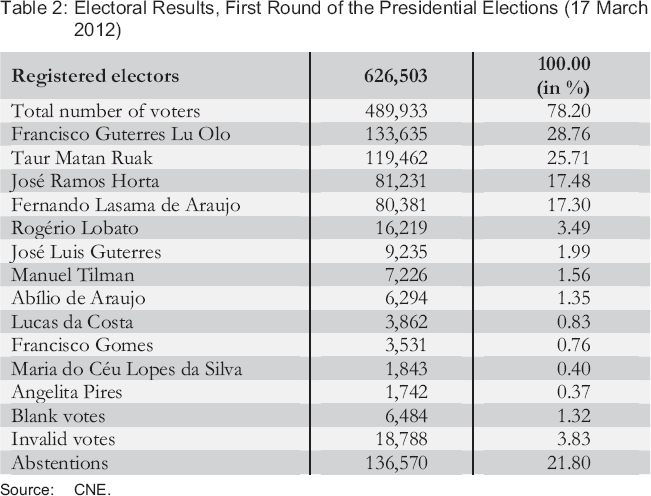
The results of the first ballot showed this to be a very competitive election with a high voter turnout. International electoral observers converged on the view that these had been free and fair elections on the whole. Table 2 summarizes the main results.
Electoral Results, First Round of the Presidential Elections (17 March 2012)
Electoral Results, First Round of the Presidential Elections (17 March 2012)
Source: CNE.
The actual electoral participation was higher than the official figures for abstention indicate, for the reasons stated above. Nevertheless, the official figures reveal a high voter turnout, which is even more impressive if one bears in mind this year's extended rainy season and the modification of the legislation that forced electors to cast their vote in their place of origin rather than in their current place of residence, which in some cases meant voters had to travel great distances at their own cost.
The degree of competitiveness exhibited in these elections can be seen from the fact that the four leading candidates polled about 90 per cent of the vote, and those who managed to secure a place in the second ballot only polled a little over 54 per cent together. No doubt remains, however, about the fact that Lu Olo and TMR were chosen to fight in the second ballot, given the gap between them and the candidates who almost tied for third place.
In spite of the incumbent President having failed to secure the run-off, these results bear a striking resemblance to those of 2007: Lu Olo won the first ballot just short of the 30 per cent mark, sustaining the attacks on his political base mounted by Rogério Lobato (3.6 per cent) and Jose Luis Guterres (2 per cent), and the ‘independent’ candidate supported by CNRT secured second place. Fernando Lasama and his PD fell short of the second round, but they fended off Lucas da Costa (0.9 per cent) in his attempt to dispute their electoral base and appeared as the third organized force with more room for negotiation. Ramos-Horta showed he had popular support of his own, cutting across party lines (including CNRT and Fretilin); the absence of two medium-sized, moderate parliamentary parties in the ballot (ASDT and PSD) helps explain the magnitude of his vote.
Another feature of the political landscape revealed by these elections relates to the regional distribution of votes. The four leading candidates show some marked regional differences in their level of performance. Taur Matan Ruak (much like CNRT had done in 2007) is the one whose electoral behaviour is less inclined to suffer from regional fluctuation, despite the fact that the standard deviation of his scores seems to be high: 9.10 for an average 25.71 per cent of the national vote (Lu Olo championed this measure at 14.06 for a 28.76 per cent vote, whereas Ramos Horta won 17.48 per cent of the vote with a standard deviation of 10.88 and Fernando Lasama won 17.30 per cent of it with a standard deviation of 9.95).
The Central and Western districts of the country had very competitive races. Six out of 13 districts voted for candidates who were eliminated from the ballotage. The eastern block consisting of Lautem, Viqueque and Baucau dictated the outcome of these ballots, as Ramos-Horta and Lasama did very poorly there, whereas TMR and mainly Lu Olo – who both originate from this eastern area of the country – captured the bulk of those voters. Again, this mirrors the historical results, albeit with a progression of Taur Matan Ruak on his side of the political spectrum. Even if the ‘ethnic divide’ that separated lorosaes and loromonus in the severe crisis of 2006 has now all but disappeared from the political stage, these electoral results nonetheless reveal the persistence of deeply rooted regional differences.
In brief, although the presidential elections are not fought directly by political parties, given the prominent role of ‘independent’ candidates, it is possible to say that the leaderships of the main parties were vindicated in their sometimes risky decisions as far as the presidential elections are concerned (for instance, CNRT's decision to back TMR instead of JRH or to give its followers the freedom to vote as they saw fit).
Having ascertained the relative electoral might of the major actors, negotiations started right away for the presidential run-off: would Fretilin manage to break the isolation cord around itself derived from its stint in government in the first few years after independence? Would TMR manage to reproduce the winning alliance that secured the victory of Jose Ramos-Horta and was later embodied in the governmental coalition? How would Ramos-Horta handle the 80,000-odd votes that he received?
There was much political negotiation in the days following the publication of the results, and rumours spread about the inclination of the eliminated candidates. Both Ramos-Horta (as President of the Republic) and Lasama (as Speaker of the House) held institutional positions, and they pledged to maintain a neutral stance. Lasama's party, PD, decided officially to grant ‘freedom of conscience’ to its followers, as did PSD, a junior partner of the ruling coalition. Arguably, they decided to keep all the doors open for future negotiations in the parliamentary contest, but it is also known that they could have faced a difficult task unifying their political support behind one candidate as the rank and file seem to have been divided between the two. Lu Olo secured the support of several minor candidates (Rogério Lobato, Manuel Tilman, Lucas da Costa, Abílio Araujo, Maria do Ceu Lopes da Silva and Angelita Pires), the official endorsement of certain political parties and organizations (Bloku Proklamador and factions of ASDT, PDN and PT) as well as some individual support from leaders of ‘non-committed’ parties (such as one vice-president of PD). In the other camp, the support of smaller political contributors (José Luis Guterres, UNDERTIM, CPD-RDTL, PST and part of ASDT) was offset by the towering presence of Maun Boot Xanana Gusmão, whose participation was felt increasingly on the campaign trail.
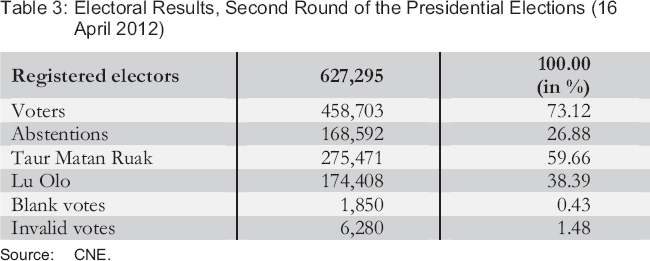
Before polling day, it was difficult to ascertain which of the two contenders would receive the decisive votes that were cast in the first ballot on eliminated candidates, and so tension ran high. The President of the Republic endeavoured to get both candidates to appear on a common platform and had them sign an declaration to conduct a peaceful and respectful campaign just before it started officially. On election day, however, Taur Matan Ruak succeeded in winning a sound 60/40 victory over Lu Olo, who nevertheless managed to improve on his 2007 score.
Table 3 shows that the electoral participation decreased slightly from 78.2 per cent to 73.1 per cent, some thirty thousand electors preferring to abstain this time. Lu Olo managed to capture the votes cast for smaller candidates in the first ballot, but could only receive about 20,000 of the 160,000 votes cast for Ramos-Horta and Lasama in the first ballot. The vast majority of these (in excess of 100,000) were transferred to Taur Matan Ruak, an outcome revealed by his results in the districts where those candidates had won easily. This was the critical factor in the campaign. Fretilin's strategy of taking ‘small steps’ supported by contact with minor candidates, but failing to engage the electors of the two major losers of the first round was soundly defeated.
Electoral Results, Second Round of the Presidential Elections (16 April 2012)
Source: CNE.
This form of behaviour reduced the appearance of regional cleavages. Taur Matan Ruak won in eleven out of thirteen districts, even in two districts where Lu Olo had obtained a plurality in the first ballot (Lautem and Manufahi). But this was due in part to the nature of a run-off election, which entails ad hoc coalitions of sorts. Nevertheless, Lu Olo managed to perform particularly well in the eastern districts, winning in two of them (Baucau and Viqueque) and scoring above his average in the other two, suggesting that regional patterns do persist. His performance in the west is an improvement in relation to 2007, but still remains under 30 per cent in various districts.
The outcome of the 2012 presidential election falls in line with what had happened on previous occasions. For a third consecutive time, an ‘independent’ candidate defeated an opponent with sound party roots, thus suggesting that the model role for the president favours this style of candidacy. Political parties other than the two major contenders had difficulty supporting either candidate openly, their bases supposedly being divided in their allegiances. Even CNRT changed course while the process was moving for reasons that pertain to the divergence of opinions in its support base. Presidential elections seem thus to have a consistently disturbing effect on party politics.
Both candidates share a common 24-year-long past of armed struggle in the mountains and belong to a generation that came of age in 1975, thus distancing themselves from the katuas (elders) of the regime (Xanana, Ramos-Horta and Alkatiri, all born in the 1940s), who played active roles in the dramatic events of that year that sometimes still resonate in the present with disturbing effects. Together with the emergence of new political actors without any previous political experience at party level, mainly in TMR's campaign, this fact heralds one of the changes that the new president promised so amply: the beginning of a generational renewal.
Other campaign promises like ‘a rich and strong Timor-Leste’ may prove more difficult to implement as TMR took positions that seem to go beyond the functions of the President of the Republic under the current Timorese constitution. One example can be seen in the latter's position on the introduction of military conscription for all young adults, a move that can only be decided by Parliament and which has tremendous budgetary implications. This military commander, who did not have any previous political experience before taking office, has claimed that a constitutional revision is not one of his priorities, but he would still like to see a strengthening of presidential powers. He faces an important test in the future.
President Ramos-Horta called legislative elections for 7 July 2012. As many as 21 entrants fought in these elections, and the ballot was almost a metre long in order to accommodate all their names and symbols. 7 The fact that each party receives a public subsidy worth USD 30,000 (USD 45,000 for coalitions) – which is considered a substantial sum – coupled with lenient legislation on party registration and the existence of a proportional system that facilitates access to well-paid positions in Parliament (which also distributes USD 3 million annually to the parties that have seats) contributes to this extreme fragmentation of the political competition (Shoesmith 2011: 9). Each political organization had to submit a list with 65 candidates plus 25 extra names, and therefore the total number of individuals directly involved in the electoral process rose to 1,890, or roughly one candidate per 330 registered voters. As McWilliam and Bexley noticed in earlier elections, this increases the likelihood that personal knowledge of candidates and their extended kinship ties may play a role in determining how significant numbers of electors vote (McWilliams and Bexley 2008: 67). It is also magnificent proof of the enthusiasm that elections generate here.
There were actually 18 individual parties plus three pre-electoral alliances, adding up to a total of 24 organizations fighting for seats. For a survey of Timorese political parties and groupings, see Shoesmith (2011). An earlier attempt at classifying parties and situating them on a left–right scale (which is often hard to follow) can be found in Saldanha (2008).
In the absence of opinion polls, extrapolations from the presidential results were the best way of envisaging the course of the legislative elections. On the strength of their recent performance, CNRT and Fretilin entered what was seemingly a ‘two-horse race’, replicating the 2007 election. Ramos-Horta's unusual decision to back both PD and ASDT (even though those parties and the former president had signed a memorandum of understanding prior to the polls) raised the prospect that a third force could emerge with king-making powers and that a new majority could be possible with any two of these three blocks, thus excluding smaller parties from the government arena. As such, a major evolution in the party system from the dominant party model that emerged in 2001 and the polarized plurality stemming from 2007 was a real possibility in the parliamentary elections.
The campaign ran smoothly without any undue pressure or breach of civility. Political platforms were presented, namely in a debate organized by the CNE, engaging all contenders, and broadcast live on national television for four hours. Apart from a few dissenting ideological proclamations (such as PST's defence of collectivization in spite of its leader being a junior minister in an AMP cabinet) and controversies on issues like the national languages, policies to prevent corruption and forms of support for the development of the private sector, broad consensus seems to have marked the debates. Unsurprisingly, all political parties defended extensive public spending, taking advantage of the positive conditions provided by the growth of the Timorese oil fund, in order to address the crying needs of the country's population. The tone of the campaign was set by the slogan ‘Hamutuk ita bele’ (‘Together we can do it’), repeated in this or a similar form by several parties. More open confrontation was based on personality histories, many opting to revert to images of individual leaders in military fatigues reminiscent of Resistance times, stressing the role of ‘suffering’ and ‘active combat’ against the invaders as their main form of political legitimization (Silva 2009). This was translated in the ballot by juxtaposing the party symbol and a photo of the leader – most noticeably, Xanana figured prominently in the CNRT ballot spot.
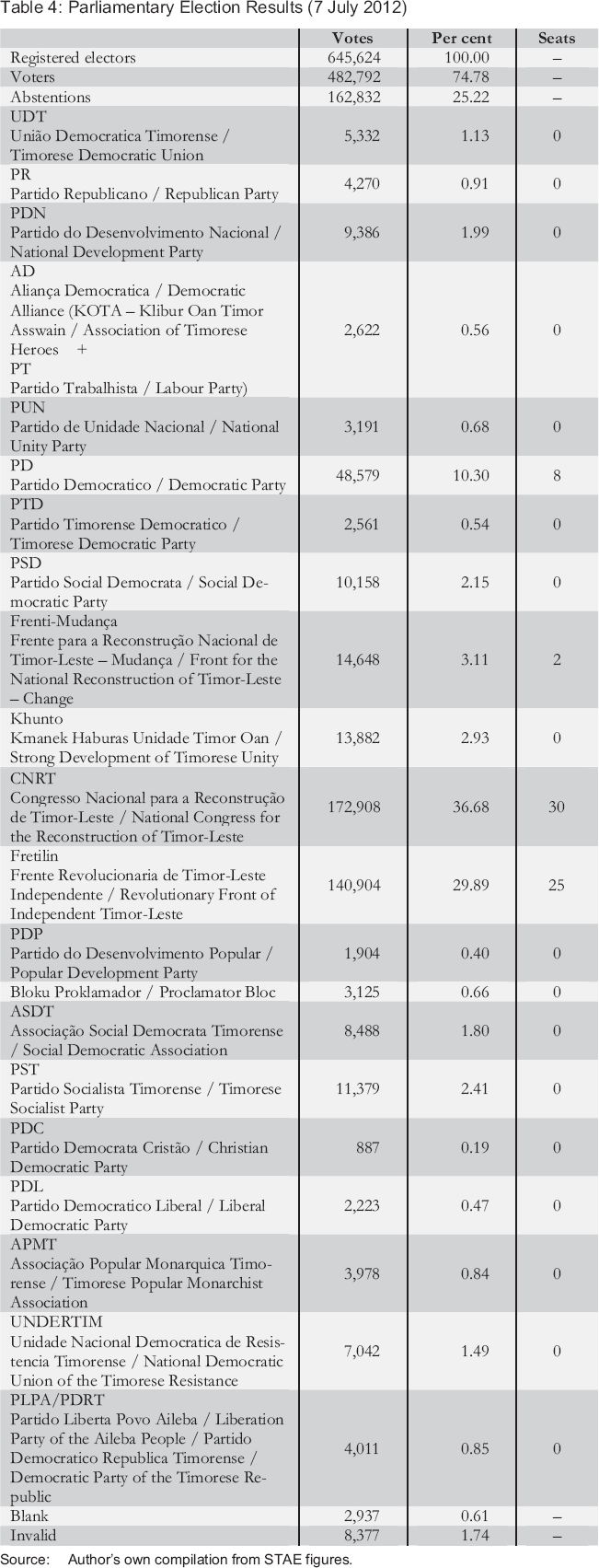
The election saw a high amount of voter participation (the official turnout was 74.78 per cent, but it is very likely it was actually in the low 80s) and it returned a Parliament in which only four of the 21 competitors actually obtained seats (Table 4). 8 CNRT increased its share from 24 per cent to over 36 per cent to become the largest party (with 30 seats). Fretilin also increased its share of the votes slightly compared with its 2007 level, polling just under 30 per cent and moving up from 21 to 25 seats. PD underperformed in relation to expectations and the result of its leader in the presidential elections (losing almost half those votes), scoring only a little more than ten per cent and securing eight seats, as before. The fourth party, Frenti-Mudança, is a newcomer, formally registered in 2011, that represents a split from Fretilin. Although it had no previous parliamentary representation, its leader was Deputy Prime Minister in the AMP Cabinet. It won just 3.1 per cent of the vote and captured two seats.
Parliamentary Election Results (7 July 2012)
Source: Author's own compilation from STAE figures.
For a review of Timorese political parties, see Saldanha (2008) and Shoesmith (2011).
The extreme fragmentation of the candidates’ organizations coupled with the three per cent threshold to enter Parliament implied that the percentage of disenfranchised electors doubled and now represents more than 20 per cent. This is not a common feature of proportional representation systems when they are associated with a single national constituency, but mainly results from the imposition of an electoral threshold. The conclusion emerges that the bipolar feature of the party system was increased (from 52 per cent to 66 per cent of the vote and the control of 55 out of 65 seats), a third new party managed to establish firm roots by winning around ten per cent of the vote, and smaller parties lost their past importance in coalition-building as a way of forming majority governments. Some of the ruling coalition parties disappeared, either due to internal strife (like ASDT after the death of its historical leader) or unfortunate political options (PSD proposed the former Minister of Justice as a candidate, although she had been convicted of corruption). The same happened to small opposition parties like PUN and KOTA. The fate of newcomers was generally negative, although Khunto (said to represent a close alliance with an influential local martial-arts group) was very close to the three per cent threshold.
Without a single party majority, and with a long-established rivalry between the two largest parties, which did not anticipate forming a grand coalition, the king-maker role was ascribed to PD, who could actually decide which side to align with, relegating the fourth party to a marginal status. The paradox of these elections is that the two larger parties increased their vote, but they also became more dependent upon a third party, which was barely able to maintain its earlier performance. This fact was nevertheless underplayed by the fact that Xanana is widely believed to exert influence on important sectors of PD, reducing the likelihood of any alternative arrangement.
Regional forms of support were evident for the major parties. As usual, Fretilin won in the three eastern districts plus Manufahi in the centre of the country and performed poorly in central-western areas (getting under 20 per cent in five districts). CNRT took the other nine districts. An estimation of the standard deviation for the results of the three leading parties reveals that CNRT was the most consistent throughout the country (with a standard deviation of 11.03 for a score of 36.66 per cent) and both Fretilin (14.51 for 29.87 per cent) and PD (5.20 for 10.30 per cent) suffered from significant fluctuations in their support. However, a CNRT/PD coalition was able to count on the majority of votes in eight districts plus three others where they polled more than 40 per cent, thus reducing the risk of being perceived as a formation out of touch with much of the country. Adding Frenti-Mudança to the alliance slightly improves those figures.
One week after the election, CNRT convened its leadership and announced an invitation to PD and Frenti-Mudança to form a new majority alliance. This news was received with intense dissatisfaction by Fretilin, which resented the fact that they were being denied access to executive power for yet another five years. This reaction was directly associated with the fact that the CNRT convention – in which members expressed their views freely as if behind closed doors – was broadcast live, and Fretilin supporters felt aggravated by the expressions used at that meeting. Unrest broke out in Dili and some of the traditional Fretilin strongholds (Baucau and Viqueque). No firm institutional response was made before one life had been lost and several dozen vehicles and a number of houses had been destroyed. This could have been avoided by taking adequate action promptly.
The coalition was formalized as Bloku Governu Koligasaun (BGK). The new National Parliament convened on 30 July with all its MPs taking up their seats. The Fifth Constitutional Government was sworn in in early August with Xanana at the helm, supported by ministers from the three coalition partners. The third political cycle of Timorese democracy is now in motion.
The closure of the 2012 electoral cycle allows us to return to the questions mentioned in the introductory section and conclude that, by and large, the country has lived up to the positive expectations placed on elections as a means of consulting the people and solving political disputes. Little doubt exists that Timor-Leste successfully organized a round of elections which were free and fair by international standards and through which its citizens expressed the choices they wanted to make in clear ways. Elections did have a real impact on those who held power, defeating an incumbent president and forcing significant changes to be made in the governmental coalition. Thus, these elections reveal that the system is responsive to changes in public opinion and to renewed expressions of citizenship. Both in the context of South-east Asia and Melanesia and in spite of the events that took place in the aftermath of the legislative elections, this is an achievement that reveals the success of Timorese democracy and must be largely credited to Timorese efforts to root their democracy in their cultural habits, and to the establishment of a credible electoral administration. 9
The UN's complacency with less than acceptable electoral practices in Cambodia shows that international assistance per se cannot be equated with successfully running democratic elections.
The same cannot be said as unequivocally regarding the sustainability of the electoral apparatus that delivered such a good result, for a number of reasons. First, in spite of a huge effort to enhance the Timorese capacity to run the show themselves, support provided by the international community was still very generous. This led, in turn, to a policy that valued the attainment of perfect results above all other considerations, including the cost-effectiveness of many critical decisions. Unless the current situation can be replicated well in five years’ time, one can expect that international aid to the electoral process will be scaled down and the Timorese authorities will then have to carry the burden of running future elections themselves. It will be hard to justify sophisticated solutions and generous use of funds, ranging from the use of helicopters to ferry personnel and material across the country to recruiting polling officers who have only three days’ work but are paid for a period of several months. Most likely, the budget for the next round of elections will be reduced (at least the international aid funds will), and a test of the present system's capacity to deliver under less favourable conditions will ensue. Acute stress was clearly noticeable in the final stages of the electoral campaigns, namely at the STAE, and important procedures will require careful evaluation before they are put to the test again.
The presidential elections showed beyond a doubt that changes can take place in the top echelons of the state without undue instability or turbulence. They have also reinforced the tendency to elect ‘independent’ presidents that appears as a limit to the realm of action of political parties, mostly confined to fighting for the position of Prime Minister and seats in Parliament. It is also noticeable that this tendency maintains a delicate balance between the head of state and the Government, the President retaining an individual, almost plebiscitary legitimacy not mediated by political parties. A strong narrative has asserted itself, stressing halerik (the ‘singing of suffering’). The metaphor of han maek (lit. ‘to eat the rough fruit’) constitutes a proclaimed basis for the legitimacy of the President. Both point to the importance of internal resources and deep-rooted cultural perceptions of political power that have been promoted to the forefront at a time when the international community prepares to leave its most ostentatious presence in the country later in the year. Targeting large numbers of UN vehicles in the July disturbances reflects this diffuse sentiment. President Taur Matan Ruak's declaration that he would avoid travelling abroad in the first year of his term in office is an example of the new mood in a country that used to be an international cause célèbre and may be expressing some form of rejection of such a status.
The parliamentary elections have also produced a negative outcome, however, namely a significant increase in the number of ‘disenfranchised’ voters. One in five electors voted for a party that did not manage to overcome the three per cent hurdle for parliamentary representation. On the other hand, they have reinforced the bipolar nature of the party system and placed a great strain on the largest party. The challenge is for CNRT to develop beyond a vehicle for articulating Xanana's enormous popularity, and from a party dependent on the control of central government (and the nepotism tendencies often associated with this sort of situation) to an organization with a stable political platform rooted in Timorese society. In a strong position as they are, CNRT leaders may open the party to other political formations that did not perform well, but may still be able to make some important personal contributions. Personal rivalries have been more significant than policy issues in determining the fragmentation of the political spectrum, and the consolidation of strong parties would certainly be a positive move.
Fretilin faces the challenge of moving forward and allowing a new generation to join the leadership now that Mari Alkatiri has been defeated for the second time. They also need to break off the ‘sanitary cordon’ that was created around the party in the course of its rather sectarian period in government (2002–2006), which is still limiting their growth prospects. Like former President Ramos-Horta, who seems to have lost almost all his political bets and has emerged from this electoral cycle in fragile circumstances, Alkatiri's time seems to be running out.
PD is confronted with the fact that its leader (now Deputy Prime Minister) has an appeal that extends far beyond the party horizon, as his vote in the presidential elections clearly shows, and he will certainly look for opportunities to establish himself as a main contender for the next round of elections in five years’ time. His key position in the political arena offers a unique baseline from which to obtain a permanent position at the negotiation table. For this to be possible, internal discipline – which is said to be a cause for concern in the parliamentary party – requires attention. The party's position as ‘king-maker’ may prove to be as much of a blessing as a threat.
The generous political party legislation and campaign funding may be revised in the future, and the likelihood of small parties surviving as independent organizations rather than seeking to move closer to the main established ones is questionable. Outside parliamentary representation, a fifth of the electorate is waiting for the established parties to evolve further in order to re-evaluate their allegiances. Regional tensions may persist, but possible developments in the creation of a decentralized level of governance and the President's desire to implement compulsory military service for all youths may also help to foster inclusive mechanisms of national solidarity.
Democracy in Timor-Leste seems to have been reinforced by the fact that competitive and participative elections returned results that were by and large accepted by the whole political community. Dissent over the new coalition created considerable tension, but a prompt institutional response kept the damage at a low level. The Timorese now have five years to consolidate or modify their political organizations and to test their evolution in new democratic elections.